Horton Ho I

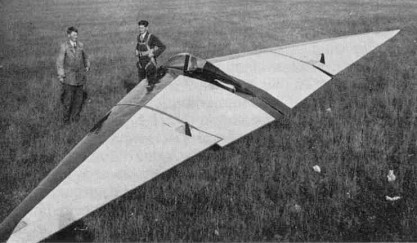
Reimar and Walter Horten started out with models, then progressing to gliders and eventually to powered aircraft. Their first tailless design, the Ho I sailplane. This was built at Bonn during the year 1931-1932 and had a flying life of about 7 hours.
It had a span of 40 ft. and a wing loading of 2 lb/sq.ft. The control system comprised a control flap giving elevator control and normal ailerons at the wing tip. Directional control was by leading edge drag rudder at the wing tip.
All the control flaps were hinged at the upper surface with a circular arc lower leading edge forming a seal with the wing. There was no aerodynamic balance.
The wing section was symmetrical throughout and thick enough (25% C) at the center section to house most of the pilots body. His head projected from the upper surface and was faired by a perspex cockpit cover. A rubber mounted skid formed the undercarriage.
The control system was unsatisfactory and was changed on subsequent aircraft. It seems to have been impossible to stop a slow speed turn by use of ailerons alone and the drag rudder, which at first was on the lower surface only, was ineffective and caused a nose down pitching moment. When an upper surface flap was added to cure this the braking action became too fierce and springs had to be incorporated to make the control heavier. Reference was made to a yawing tendency at low speed which could result in an uncontrollable turn through 360°.
The Ho I sailplane, won a prize at the 1934 Rhon soaring competitions, but the brothers were not satisfied with its performance and burned it.
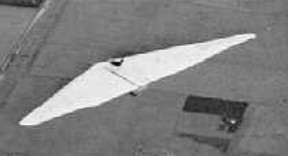
Ho.1b

Ho.1
Wing Span: 12.4m
Wing Area: 21sq.m
Aspect ratio: 7.3
Empty Weight: 120kg
Payload: 90kg
Gross Weight: 210kg
Wing Load: 10kg/sq.m
L/DMax: 21 @ 72 kph
MinSink: 0.80 m/s 60 kph
Seats: 1

Horten H I b
Wing span: 12.4m
Wing area: 21sq.m
Empty Weight: 120kg
Payload: 90kg
Gross Weight: 210kg
Wing Load: 10kg/sq.m
Aspect ratio: 7.3
L/DMax: 21 72 kph
MinSink: 0.8 m/s 60 kph
Seats: 1
Horton Aircraft HW-X-26-52 Wingless

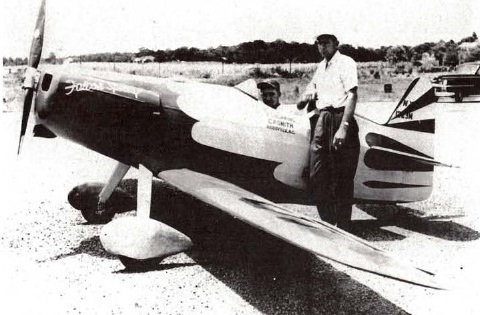
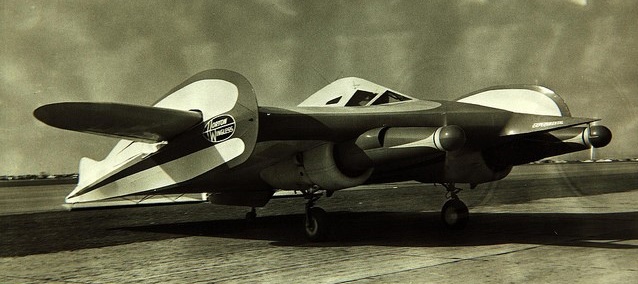
The Horton Wingless aircraft was invented by William Horton of Huntington Beach, California in 1952. He called the strange-looking plane “wingless” because he claimed the entire craft was a simple air foil with vertical fins and utilized all surfaces for lift. Unfortunately, Horton did not have the money to develop it, but was able to get into a partnership with billionaire Howard Hughes and Harlow Curtis.

The aircraft was a welded steel frame covered with a fabric skin and powered by two Pratt and Whitney R985 radial engines. Instead of a long high aspect ratio wing the fuselage was to create the lift and tip plates which he called ‘sealers’ were to tip losses that otherwise plague such airfoils. Essentially it was a highly-modified Cessna UC-78 with a more airfoil-shaped fuselage than wing.

Registered N39C, the aircraft logged around 160 hrs of flight time before Bill Horton had a falling out with Hughes. Horton was railroaded to prison.

Although this innovative prototype flew successfully, no backers were attracted. The venture failed not because the airplane didn’t fly, but because Hughes wanted to take full credit for the patents and production rights, which Horton refused to allow. Hughes sued Horton which effectively stopped any further development of the aircraft. Hughes managed to have the prototype and partially-constructed production version moved to the bone yard at the south end of the Orange Co airport and deliberately burned.

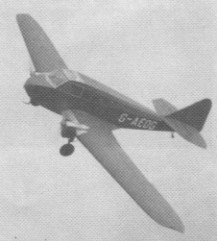
Horn TH-1

February 1997

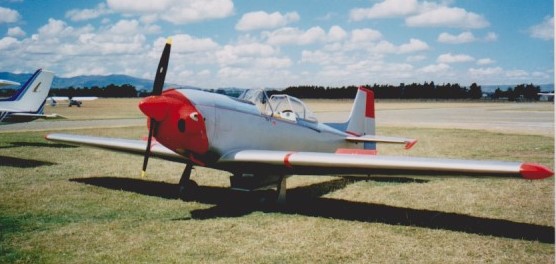
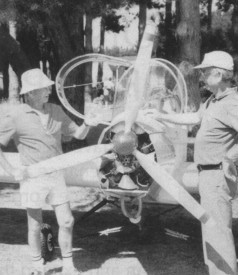
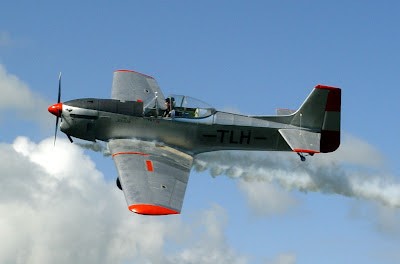
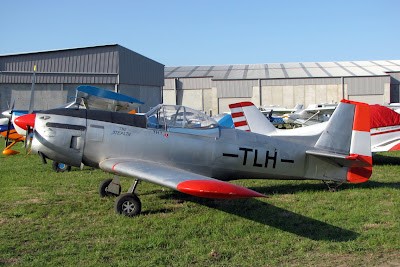
Horn TH 1 ZK-TLH was the result of over forty years of experience in aviation by a Levin pilot, being a low wing monoplane similar in microlight configuration to the Bobcat. Powered by a two cylinder Koenig radial, the TH 1 was undergoing ground trials in 1989.

The single-seat aircraft was built by Tom Horn without plans, and features spoilerons rather than ailerons.

It is surprisingly large for a microlight and was re-powered with a 1.8 litre Subaru engine.

ZK-TLH (c/n MAANZ/423) was first registered to Tom Horn of Levin on 17/4/89.

Tom sold it to his cousin Graham Horn of Taupo on 2 September 2002 although Graham may have been operating it for some time before the change of ownership.

Finally, it was sold to Brian Taylor of Whangarei on 2 August 2004. Brian constructed a new cowling and added a turbo charger to the Subaru engine and has flown it quite a bit around the North of the North Island.

Engine: Konig D-1000.
Seats: 1

Horizontec Halcón 1

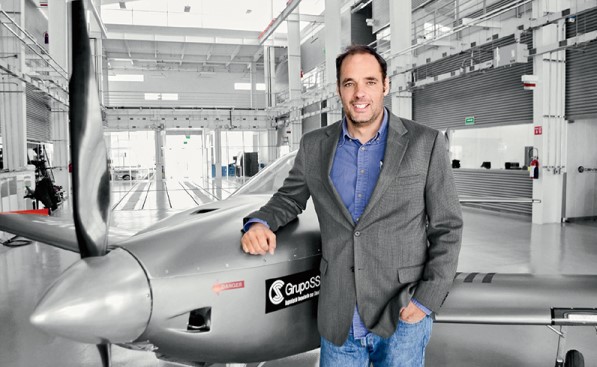
On 12 March, 2020, it was announced the Halcón 1 MSN 001 aircraft received the Certificate of Airworthiness from the Federal Civil Aviation Agency (AFAC), thus concluding a certification process under the experimental aircraft category.

The two-seater aircraft was built by Horizontec, a Mexican company dedicated to the design and development of aircraft supported by the National Center for Aeronautical Technologies (Centa).
More
On September 30th, 2017, the H1 made its first flight at the Queretaro Intercontinental Airport (AIQ), lasting approximately 30 minutes. Subsequently, in February 2018, the aircraft successfully completed 50 flight cycles necessary for Tipo approval, said Giovanni Angelucci, founding partner of Horizontec.

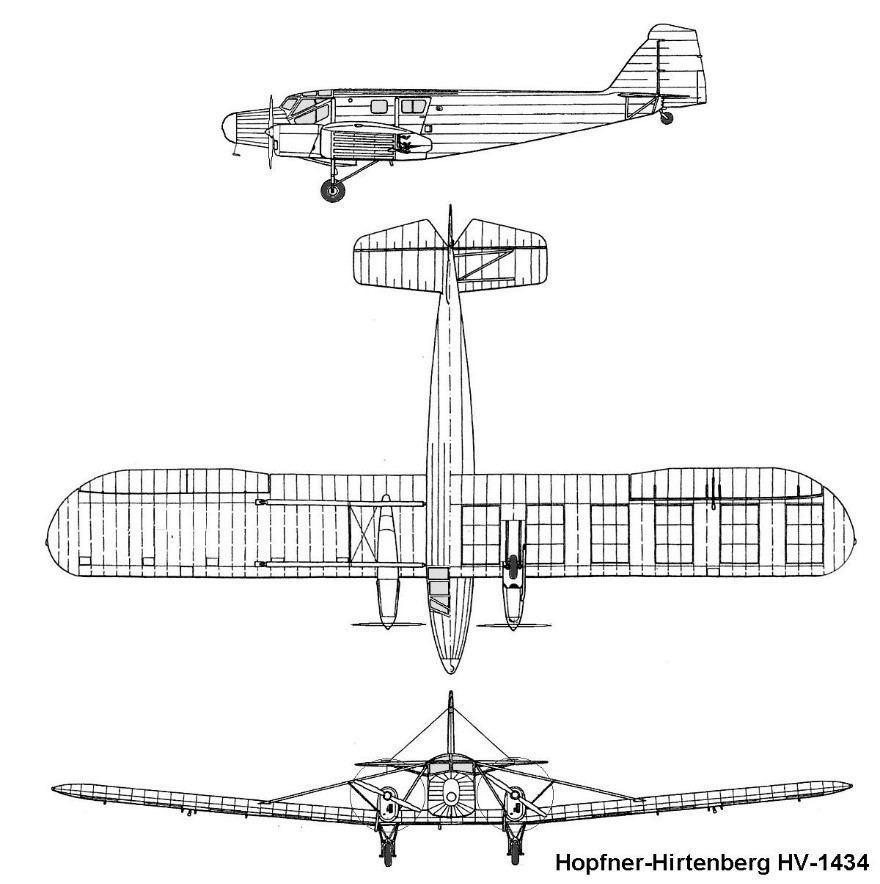
Hopfner HR.1434 / HR.14/34

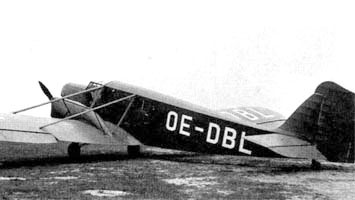
After the development of the transport high-level plan HV.12 / 34, designer Lampich started the design of the low-wing transport aircraft, designated Hopfner HR.14/34 (HR.1434) Werk.Nr 33. Despite not some similarity, it was a completely unique project. The only example of the aircraft was built by Flugzeugbau Hopfner GmbH at the Aspern Vienna airfield.

The retractable undercarriage was later modified as fixed.

The first flight of the aircraft prototype (registration number OE-DBL, D-OBDL later) took place on March 24, 1936. The aircraft was used (mainly for advertising purposes) until the spring of 1937.

Engine: 2 x de Havilland Gipsy Major, 120 hp
Wing span: 20.10 m
Wing area: 48.00 sq.m
Length: 11.77 m
Height: 2.84 m
Empty weight: 1754 kg
Normal take-off weight: 2300 kg
Maximum speed: 139 km / h
Cruise speed: 108 km / h
Service ceiling: 3166 m
Crew: 1-2
Passenger capacity: 5

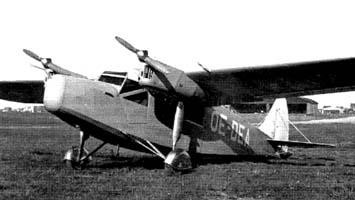
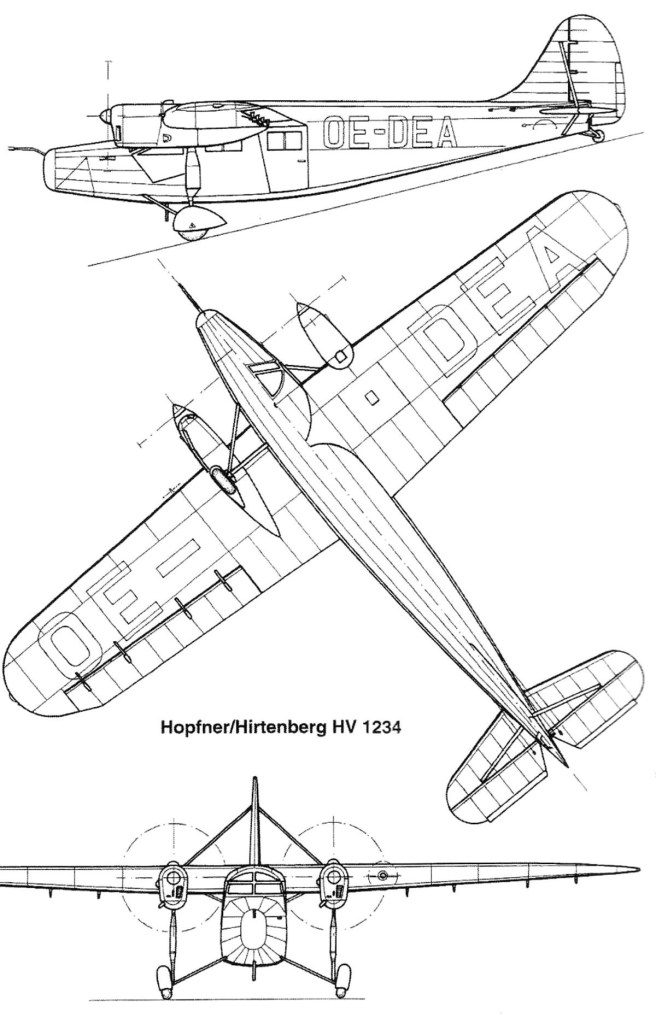
Hopfner HV.1234 / HV.12/34

The Hopfner HV.12 / 34 (HV.1234) light transport aircraft was designed by Lampich by special order of Anton von Habsburg, Prince Lorraine. The aircraft became the first twin-engine transport aircraft of Flugzeugbau Hopfner GmbH.

The HV.1234 featured six-seat., with enclosed cockpits and fixed undercarriage. The spacious fuselage was a steel tube construction, which was covered with fabric in the front and back center area with plywood at the stern. The passenger cabin space offered seats for five passengers and was luxuriously equipped. The two spar wings and tail were wooden structures, which were covered with plywood and fabric. The rudder were fabric covered. The flanding gear was fixed to the wing spars, and went through the engine cowling and had two oil dampers. Against the bottom of the fuselage, it was connected, each with a V-strut.

The first flight of the prototype aircraft, registered A-150 werk.Nr 28, took place in August 1935 at Aspern. The flight characteristics were assessed as good and the HV.12/34 flew irregularly as a private aircraft, but also as a light transport aircraft.

The following year, the aircraft received the registration number OE-DEA. After the annexation of Austria in 1938, the registration number was changed to D-OEEA. Later it came to the Airborne Division of Hirtenberger Cartridge Factory AG. When war broke out, it should be used as a liaison aircraft for the Luftwaffe, but there were problems with the supply of spare parts for the engines and the HV.12/34 was taken out of service. The fate is unknown.

Only the one was built.

Engine: 2 x de Havilland Gipsy Major, 130 hp
Prop dia: 2.00 m
Prop disc: 3.14 sq.m
Wing span: 14.10 m
Wing area: 30.00 sq.m
Aspect ratio: 6.63
Dihedral: 1 deg
Length: 10. 40 m
Height: 2.70 m
Empty weight: 1100 kg
Normal take-off weight: 2000 kg
Max take off weight: 2160 kg
Fuel capacity: 210 lt
Maximum speed: 205 km / h
Maximum speed at SL: 186 km/h
Cruising speed: 175 km / h
Range: 950 km
Servce ceiling: 4800 m
Climb to 1000 m: 6.25 min
Climb to 3000 m: 25 min
Rate of climb: 2.8 m/sec.
Endurance: 6 hr
Crew: 1
Passengers: 5

Hopfner HS.528

HS.528a

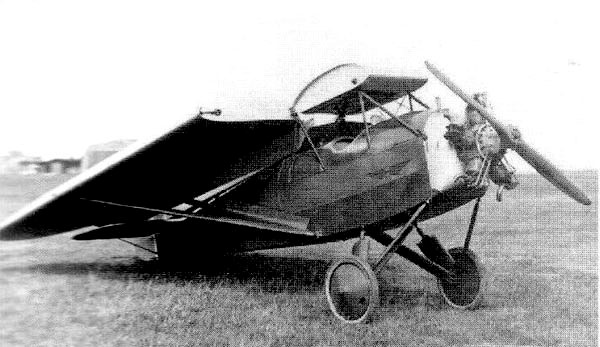
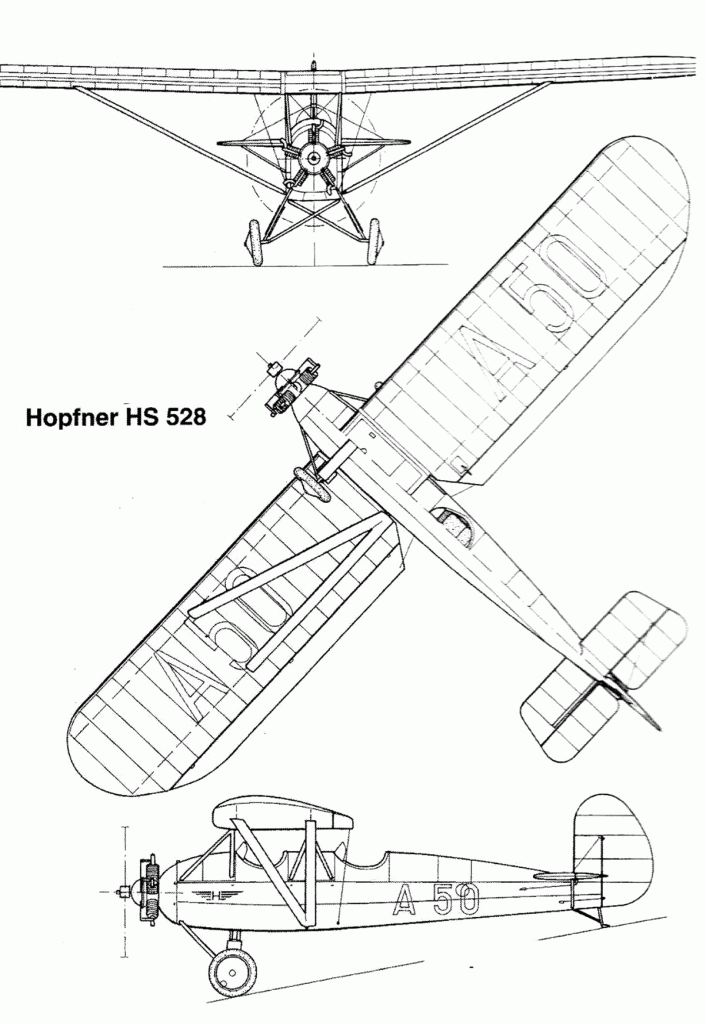
The Hopfner HS-5/28 was a conventional, parasol-wing monoplane utility aircraft built in Austria. It had seating for two occupants in tandem, open cockpits. The landing gear was of fixed, tailskid type with divided main units.

First flying in July 1928, two examples were built with Walter NZ60 engines as HS.528 (HS.5/28) A-50 and A-60 (later received the registration number OE-DLD). The aircraft flew until 1936 in Motorfliegergruppe Wien Nr. 51.

HS.528

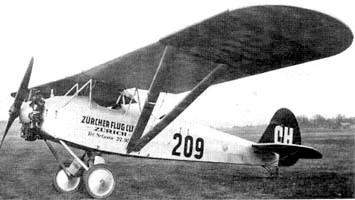
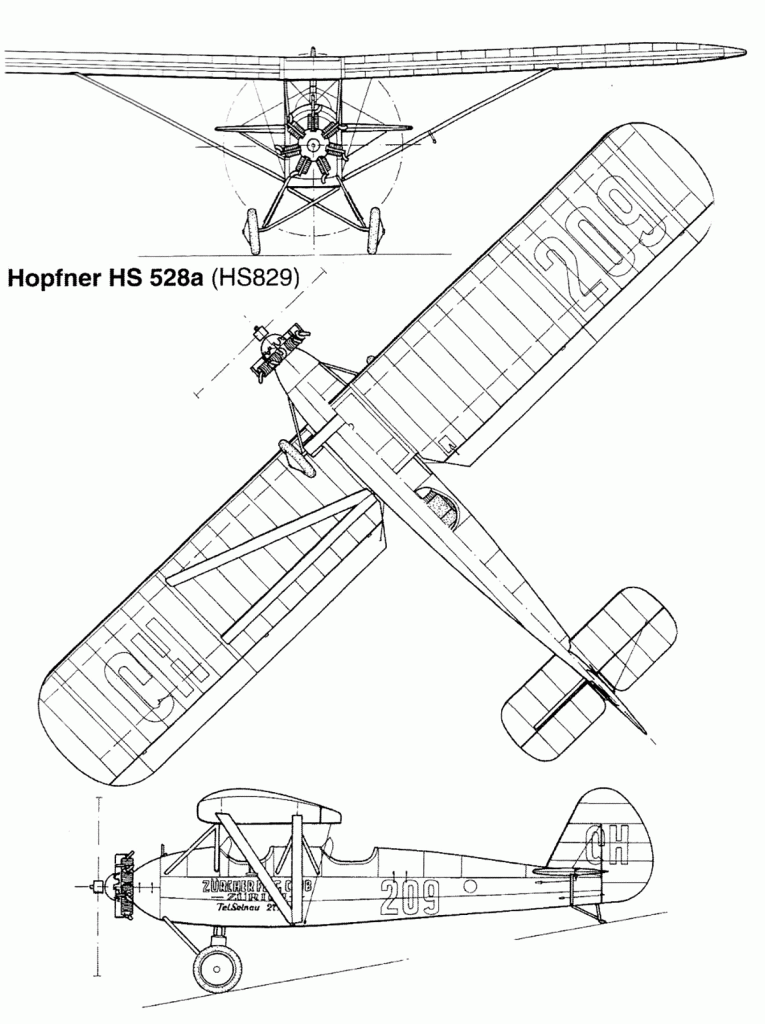
Following were two more with the more powerful NZ85, HS.528a (HS.5/28a), one rebuilt HS.528, for the Swiss aeroclub use. The first of the aircraft (the reconstructed A-50, the on-board number CH-231) was delivered to the customer in November 1928, and the second (CH-209) – in March next year. The latter was used until 1934 in the Zurich Aviation Club.

One HS.528a (HS.5/28a) was later 1 rebuilt as an improved version, the HS.829.

HS-5/28a
Engine: 1 × Walter NZ85, 63 kW (85 hp)
Wingspan: 11.26 m (36 ft 11 in)
Wing area: 18.5 m2 (199 ft2)
Length: 7.40 m (24 ft 3 in)
Height: 2.55 m (8 ft 4 in)
Empty weight: 400 kg (880 lb)
Gross weight: 650 kg (1,430 lb)
Maximum speed: 150 km/h (96 mph)
Range: 1,200 km (750 miles)
Crew: One pilot
Capacity: 1 passenger

Hopfner HS.8/29 / HS.829

HS.8/29

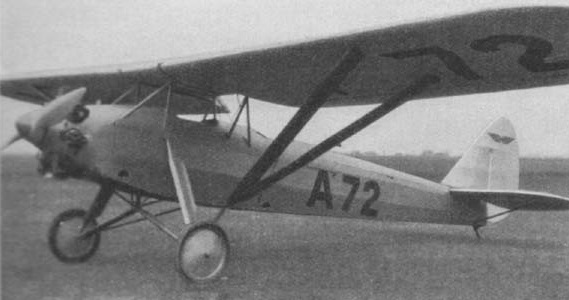
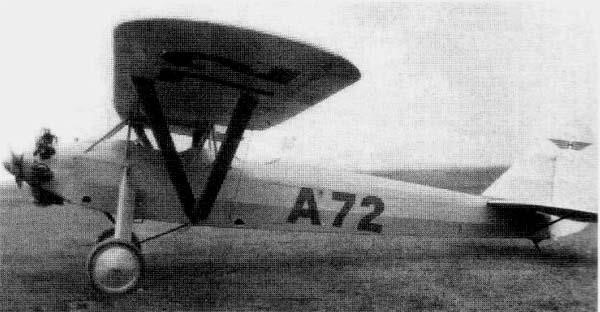
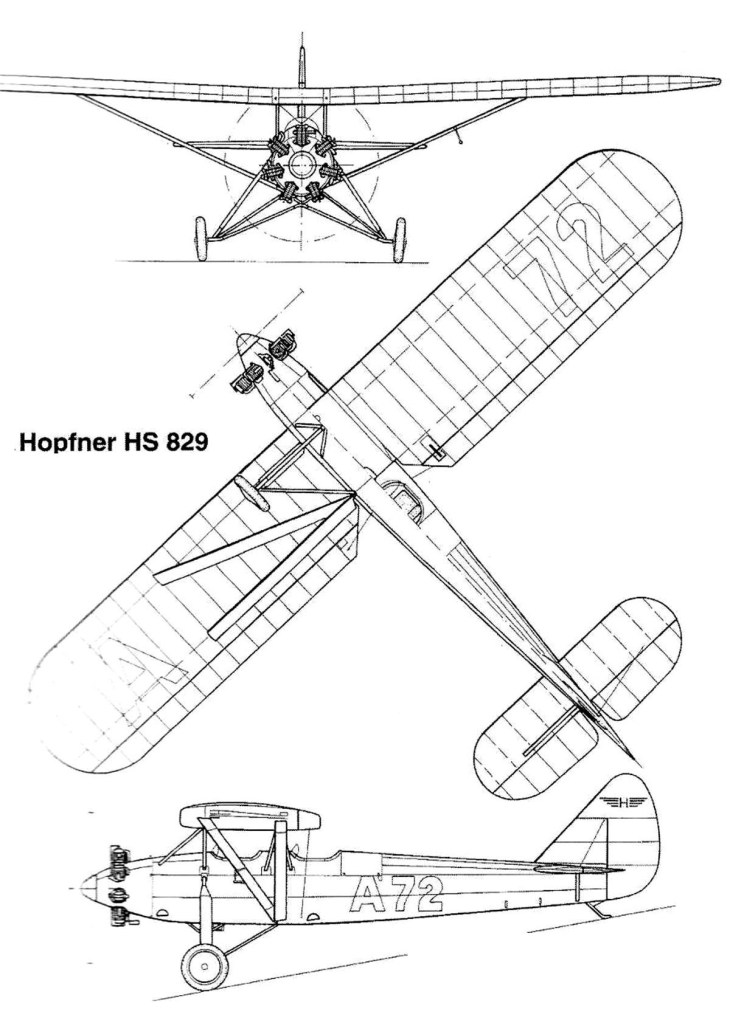
An improved version of the two-seater training / sports Hopfner HS.528 received the designation HS.829 and was equipped with a Walter motor of 85 or 110 liters capacity.

The HS-8/29 was a utility aircraft built in Austria in the late 1920s. It used a modernised version of its predecessor’s airframe, being a conventional, parasol-wing monoplane with seating for two occupants in tandem, open cockpits. The landing gear was of fixed, tailskid type with divided main units.

HS.8

The prototype aircraft (A-72), equipped with a Walter NZ85 engine 85 hp, took off in 1929. After successful tests, a small batch of 5 aircraft equipped with a Siemens Sh 14A engine with 110 hp was produced. In 1930, another batch of 9 aircraft was ordered.

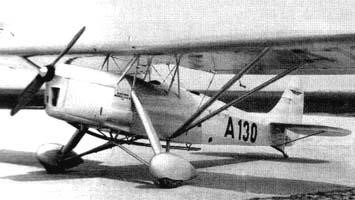
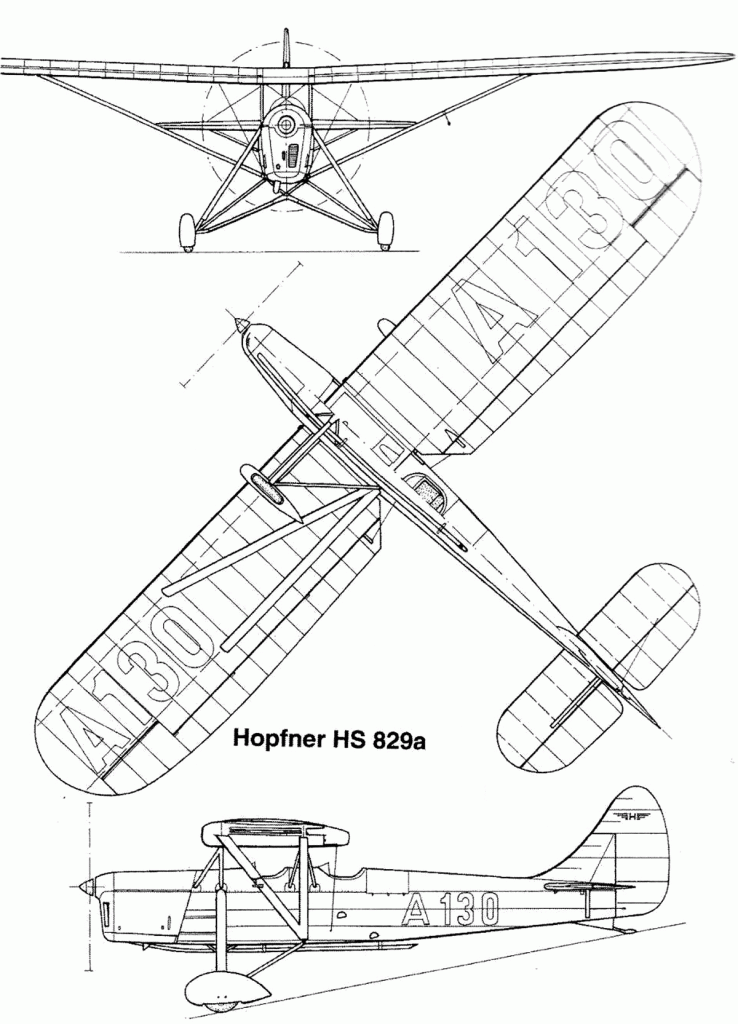
In 1932 a version of the airplane (A-130) was released with a de Havilland Gipsy III engine with 120 hp. The only example of the aircraft, designated HS.829a (HS.832), was transferred to the Austrian flying club, where it was used until February 1935.

Once again, the upgraded unit received the designation HS.932.

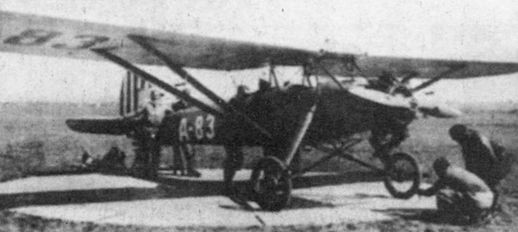
Hopfner HS.829 A-83 was operated in 1930 at the Tilag Fliegerschule Flight Training School in Graz.

Werk.Nr 21 Registration A-49, OE-DRH, D-ODDH was delivered to Max Olbrich. After “Anschluss” it was delivered to the Depot (Zeugamt) in Erding/Bayern and used for spare parts.

HS.829
Engine: Siemens Sh 14a, 110 hp
Span: 11.26 m
Wing area: 18.0 sq.m
Length: 7.70 m
Height: 2.40 m
Empty weight: 470 kg
Loaded weight: 763 kg
Max speed: 175 km/h
Cruising speed: 155 km/h
Range: 550 km
Crew: 2

HS 829