By 1954, Howard had decided that the next step for corporate aircraft (which were mostly Twin Beeches and DC 3s at the time) was faster, farther ranging machines like his modification of the Lockheed PV 1 Ventura.
Howard introduced the Super Ventura, which led to development of the Howard 250, the 350, and culminated in the Howard 500.
Monoplane
Howard Super Ventura
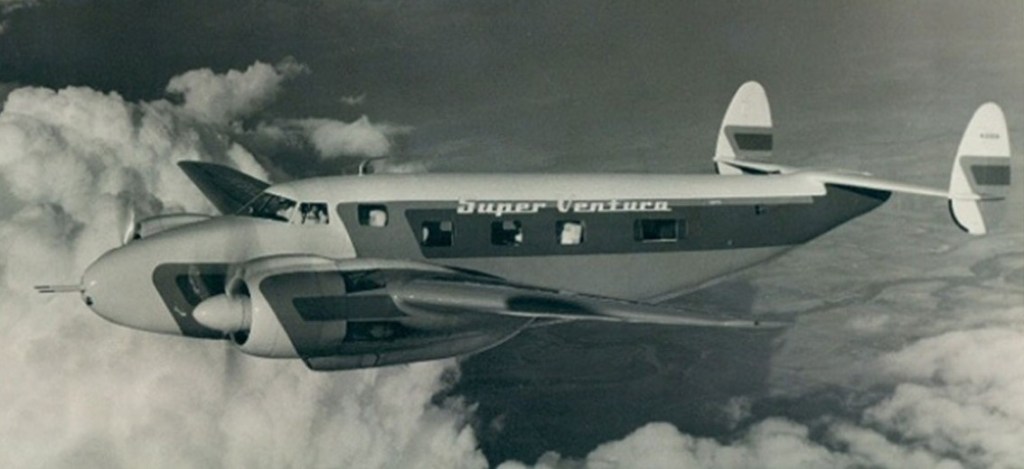
By 1954, Howard had decided that the next step for corporate aircraft (which were mostly Twin Beeches and DC 3s at the time) was faster, farther ranging machines like his modification of the Lockheed PV 1 Ventura.
Howard introduced the Super Ventura, which led to development of the Howard 250, the 350, and culminated in the Howard 500.
In 1964 Business AirCraft Corp (successor to Howard Areo) announced sale of the first BA 400 pressurised Super Ventura. It cruised at 350 mph at 21,000 ft with a useful load of 10,100 lb. It was the only pressurised plane in production available for $550,000.
Howard NH-1
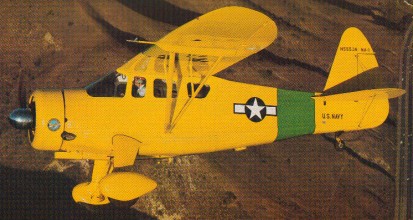
US Navy instrument trainer.
Howard DGA-15
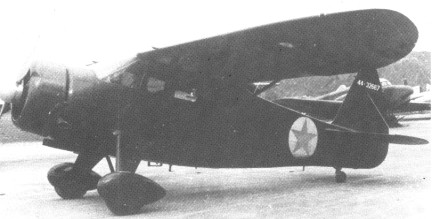
The DGA-6 Mister Mulligan design was developed through several models into the Howard DGA-15 five-seat cabin monoplane which served with the U.S. Navy in transport, instrument trainer and ambulance roles during the Second World War.
The last DGA-15 came off the Howard assembly line in 1943.
Howard DGA-8
Howard was planning the DGA 8 five place cabin airplane, one of the first truly classy personal transportation airplanes. By now, Israel was not only designing and building them but flight testing them as well. He says that to this day, there has never been an AD issued for his DGA 8.
Howard DGA-6 Mister Mulligan
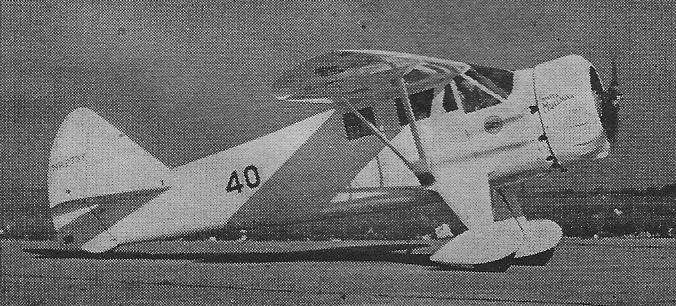
In 1933, Benjamin Odell Howard, a pilot for United Air Lines, decided that he wanted to get into the corporate airplane business. To do it, he chose to design and build a fast four place machine to win the Bendix Trophy cross country race. This would both bring the plane instant notoriety and give him prize money to help defray the cost of development. He enlisted the help of a promising young engineer named Gordon Israel in designing Mister Mulligan, a high wing, strut braced cabin monoplane. Benny Howard had discovered the magic of supercharging and high altitude flight. In 1935, he and Israel flew Mister Mulligan at 20,000 feet and above from Los Angeles to Cleveland and won the Bendix race at an average speed of 238.7 mph.
With DGA-6 Mister Mulligan Howard won all three major American racing titles in 1935, and this design was developed through several models into the Howard DGA-15.
Howard DGA-5 Mike
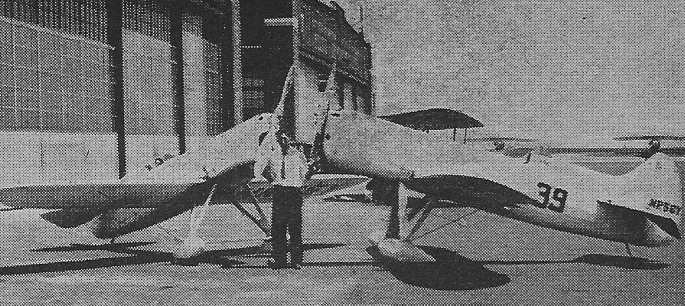
1938
Howard DGA-4 Ike

1938
Howard DGA-3 Pete
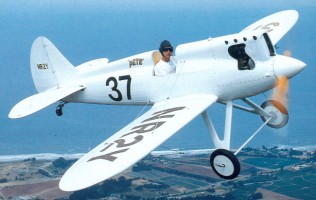
An original 1930 race aircraft, built for the U.S. National Air Races.
Pete, a closed course racer with a compar¬atively small 318 cubic inch 90 horsepower Wright Gypsy. Gordon Israel handled the structural design of the airframe and assembled it as well. Its success can be measured by its win¬ning five firsts and two thirds at its first out¬ing, in 1930. And the two third place finishes came in the 1,000 inch and unlimited dis¬placement classes.
The DGA-3 Pete racer, was succeeded by DGA-4 Ike and DGA-5 Mike.
Engine: Curtiss Wright Gipsy, 90 hp.
Max speed: 168 mph.
Hovey Beta Bird
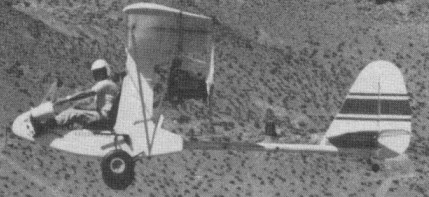
The Beta Bird, designed in 1977 but not flown until April 1979 at Mojave, California, is a high wing monoplane version of the Whing Ding II, with which it shares a common fuselage. Like the biplane, the conventional tailplane is carried on a tubular boom and there is a tailwheel undercarriage. Wing profile Hovey BB 14. Brakes on main wheels. Engine mounted below wing. The Beta Bird was initially known as the Bushwacker.
Flight handling characteristics are very good, with an extremely docile stall. Rugged reliability was proven in off-airport operations in high desert country. Single-place, single-engine, strut-braced monoplane followup to Whing Ding II biplane, using drooperons. Stick-and-rudder 3-axis controls. Nose cowl and instrument panel included. Landing gear: Two mains with large 600×6 wheels & tires (from Cessna 150) for rough-field operation, using individually operated hydraulic toe brakes. Tail-wheel non-swiveling, steered with rudder cable linkage. Powerplant: Converted VW engine, pusher mounted, direct drive to 54×24 prop. It is powered by a 1,385-cc converted VW engine and offers the homebuilder simplified methods of construction. The wings fold for transport or storage. The fuselage pod is plywood and spruce construction with a stiffened aluminum tail boom to support the tail. The wings are spruce in a two-spar configuration, and the ribs are single-piece aluminum tubes. The tail group is fabricated from aluminum tubing, pop-riveted together with gussets and covered with Dacron. Only 250 feet are needed for takeoff and landing, and the 7 1/2-gallon fuel tank is good for 180 miles.
Engine: Volkswagen 1385cc, 45 hp.
Power per unit area 0.52 hp/sq.ft, 5.6 hp/sq.m.
Length overall 16.5 ft, 5.02 m.
Height overall 6.0ft, 1.83m.
Wing span 25.5ft, 7.77m.
Sweepback 0 deg.
Total wing area 87 sq.ft, 8.1 sq.m.
Wing aspect ratio. 7.3/1.
Empty weight 405 lb, 184kg.
Max take off weight 650 lb, 295kg.
Payload 245 lb, 111kg.
Max wing loading 7.47 lb/sq.ft, 36.4kg/sq.m.
Max power loading 14.4 lb/hp, 6.6kg/hp.
Max level speed 85 mph, 137 kph.
Never exceed speed 95 mph, 153kph.
Cruising speed 70mph, 113kph.
Stalling speed 40 mph, 64 kph.
Max climb rate at sea level 400ft/min, 2.0m/s.
Take off distance 250 ft, 75 m.
Range at average cruis¬ing speed 130 mile, 209 km.
Engine: VW 1800cc
hp Range: 50-85
Length: 16.5 ft
Wingspan: 26 ft
Wing area; 110 sq.ft
Empty weight; 405 lb
Gross weight: 650 lb
Fuel cap: 7.5 USG
Cruise: 80 mph
Stall: 45 mph
Rate of climb: 750 fpm
Takeoff dist: 250 ft
Landing dist: 150 ft
Seats: 1
Landing gear: tailwheel
LSA: yes
 All Aero