After World War II, the Yugoslav aviation industry was reorganized with a central institution in charge of research and prototypes, with attached a few plants of lesser importance. This centrally located industry continues the lkarus name which was that of the first Yugoslav aviation company.
The factory of Novi Sad, as other aircraft factories in the country, were completely destroyed during the German occupation. The plant in Zemun was the most quickly rebuilt and it produced the Yugoslav military aircraft.
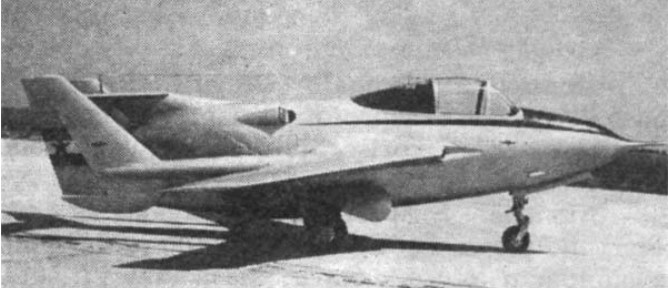
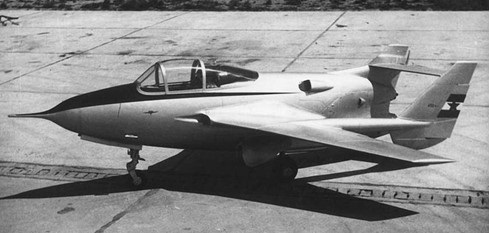
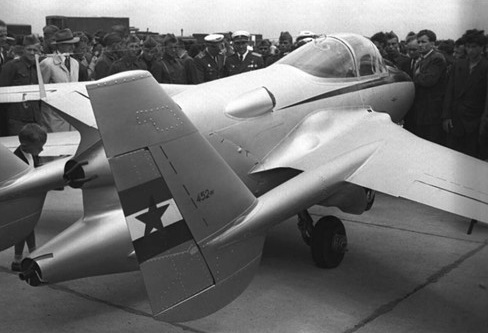
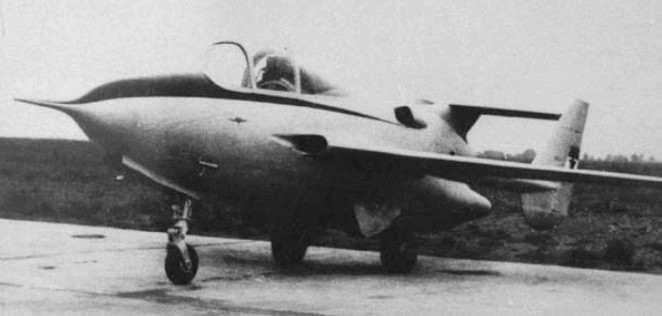
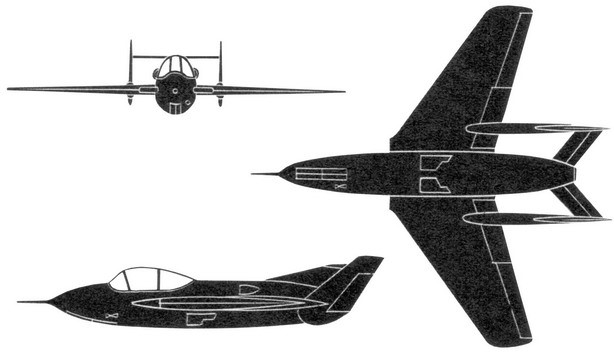
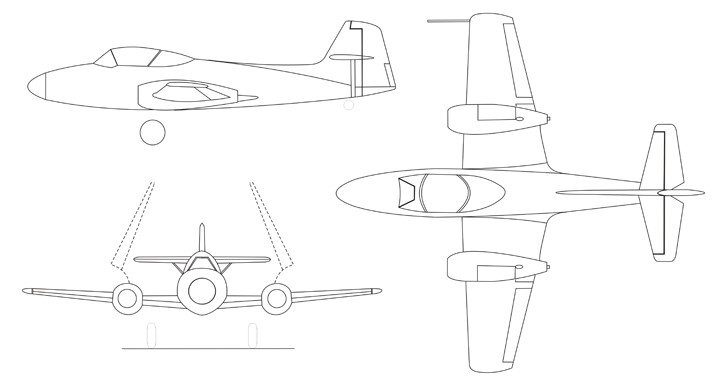
Among these, the 452M was designed by engineer Dragoljub Beslin, considered the prototype of a ground attack fast jet. The letter M (Mlazni) means jet powered. The 452M was a stubby pod-and-boom configuration with twin tails and a horizontal stabilizer at the end of the booms. The power source consists of two Turboméca Palas 056A turbojet engines arranged one above the other at the rear of the fuselage.
The top engine is fed with two side air inlets on each side of the fuselage, and the lower engine is supplied by entries in the leading edge of the wing root.
The wing is swept and supports two beams with two fins. The stabilizer joins the upper parts of both fins. The retractable tricycle undercarriage comprises two main wheels based on the fuselage and retracting into it. All undercarriage lower forward. Only intended for experimental purposes, the 452M was lightly armed with just 2 x 12.7-mm Browning machine guns.
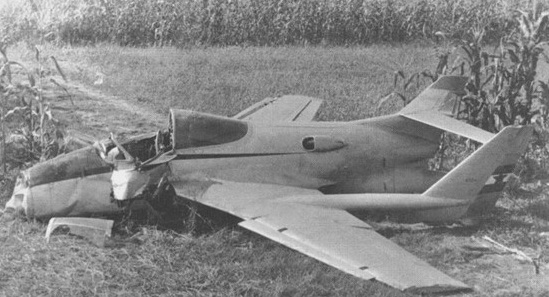
The aircraft made its first flight on 24 July 1953 which resulted in an engine failure due to a fault in the fuel line and heavy damage to the aircraft upon an emergency landing in a cornfield. The pilot survived but received a fractured skull in the incident.
Future development of the 452M to create an interceptor with a larger fuselage to accommodate a third engine to increase power and upgraded armament of 2 x 20mm cannons never got beyond the drawing board. The experimental jet was an advanced design for the time but was not selected for further development by the Yugoslav Air Force as other jet aircraft options were preferred and the project was cancelled.
452M Engines: 2 x Turbomeca Palace 056A, 4.0 kN Wingspan: 5.25 m (17 ft 12 in.) Length: 5.97 m (19 ft. 7 in.) Height: 1.77 m (5 ft. 9 in.) Wing area: 11.20 sq.m Empty weight: 1220 kg Maximum take-off weight: 1680 kg Max speed (est): 750 km.h. (466 m.p.h) Min speed (est): 190 km.h. (118 m.p.h) Cruising speed: 624 km / h Range: 540 km Ceiling: 9800 m Endurance: 75 min. Crew: 1
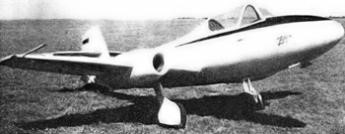
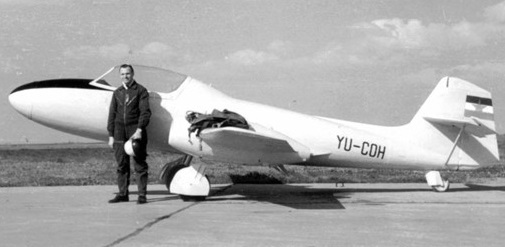
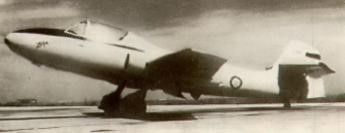
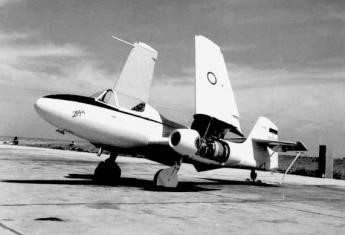
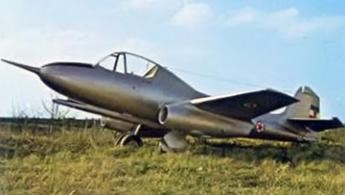
The Ikarus S-451M Zolja (“Wasp”) was an unarmed further development of the S-451M. This all metal aircraft was designed as a light attack aircraft. The letter M (Mlazni) means that the aircraft is powered by jet engines. It was a more streamlined design with a stretched fuselage, folding wings and two Palas turbojet engines installed within the wing rather than under them.
A single Zolja prototype was manufactured and made its first flight in 1954.
By 1960 the S-451M was now in civilian hands (registered as YU-COH) and on May 19th, 1960 broke the world air speed record in the I-C aircraft category, flown by pilot Ivan Črnjarić at 501 km/h (the record would remain unbeaten for 5 years).
The aircraft was retired in 1968 following damage from a ground incident.
Engines: 2 × Turbomeca Palas 056A Length: 6.8 m (22 ft) Wingspan: 6.70 m (21 ft 7 in) Height: 2.3 m (7 ft 7 in) Wing area: 8.00 m² (86 ft ²) Loaded weight: 1202 kg (2644 lb) Maximum speed: 439 km / h (284.5 mph) Minimum speed: 153 km / h (94.8 mph) Range: 392 km (233 miles) Ceiling: 8550 m (28,045 ft) Takeoff distance: 600 m Landing distance: 582 m
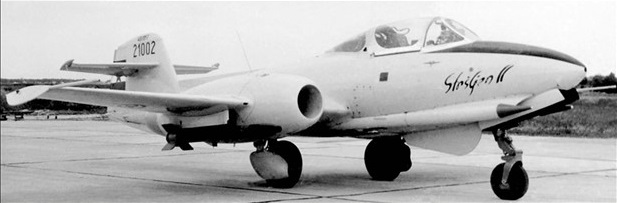
The J-451MM lead to development of the Ikarus T-451MM Stršljen II (“Hornet II”) single seat jet aerobatic training aircraft of which only one prototype (21002) was manufactured and this can now be seen at the Belgrade Aeronautical Museum.
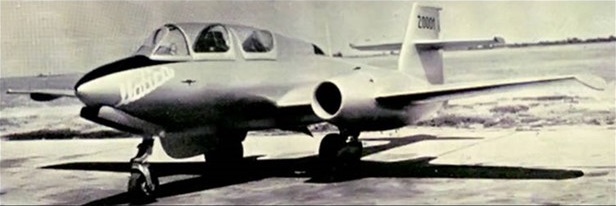
Another variant was the Ikarus S-451MM Matica (“Queen Bee”) two-seat jet training aircraft which set a world air speed record for its class of 750.34 km/h in 1957.
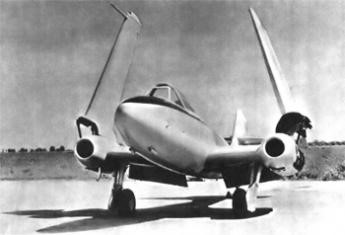
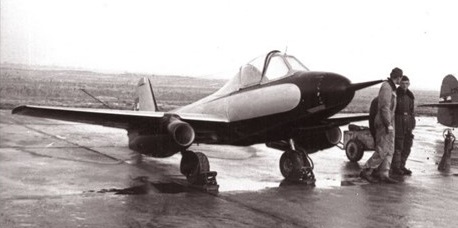
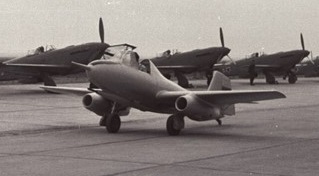
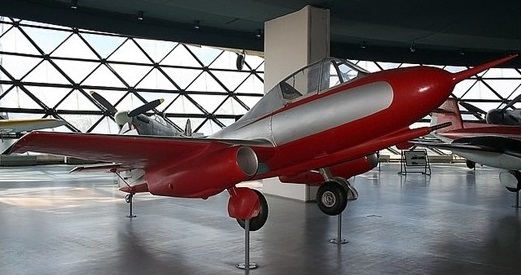
Utilising the basic airframe of the S-451, Ikarus came up with a new design to develop the first jet aircraft designed and built in Yugoslavia, the Ikarus S-451M (Mlazni or “Jet”). The Ikarus 451M was designed by Major Dragoljub Beslin. Basically they installed a conventional cockpit and added two small Turbomeca Palas 056 turbojet engines which produced a maximum speed of 453 km/h.
Ikarus S-451M at the Yugoslav Aeronautical Testing Centre in the early 1950’s
Captain Tugomir Prebeg made the first flight of this aircraft, in the morning of 25 October 1952, powered by two Turbomeca Palas jets. A single copy was built 1959.
With plans to develop a military version, a 20mm Hispano-Suiza 404A cannon and six underwing rockets was fitted to the S-451M for weapons testing.
Ikarus S-451M passes a lineup of Yugoslav Air Force Yak fighters at Batajnica Air Base – May 1953
Flight tests of the prototype were conducted at the Yugoslav Aeronautical Testing Centre until 1959 when the aircraft was handed over to the Belgrade Aeronautical Museum for permanent display.
Engines: 2 × Turbomeca Palas 056A Length: 7.45 m (24 ft 5 in). Wingspan: 6.78 m (22 ft 3 in). Height: 2.32 m (7 ft 7 in). Wing area: 8.00 m² (86 ft ²) Empty weight: 897 kg (1977 lb) Gross weight: 1350 kg (2980 lbs) Range: 300 km (190 miles) Ceiling: 8500 m (27,900 ft)
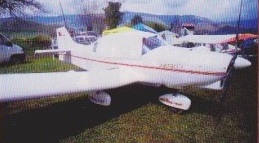
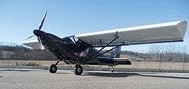
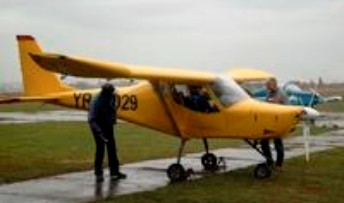
Savannah is a modified copy of the Zenith Zodiac CH-701 STOL aircraft. I.C.P. srl was once a distributor of the Zenith STOL CH-701. I.C.P. was established in 1980 to produce accessories for the automotive sector. At the beginning of the 1990s, I.C.P. began production of UL aircraft, in collaboration with Agrocopteros of Colombia, including models such as the MXP-740, the MXP-740 Savannah, the MXP-640 Amigo and the MXP-650 Amigo. The Savannah has evolved into the Savannah Turbo, Hydro, ADV, VG (Vortex Generator) and the new Savannah XL which features a wider and more comfortable cabin. A light-weight Savannah is the Bingo, offered with different power units. On 12 September 2009, I.C.P. opened its new factory at Castelnuovo Don Bosco (Province of Asti) in Italy.
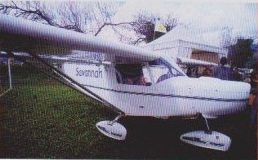
The Savannah is an evolved version of the Zenith/Zenair STOL CH701 built by the Italian ICP Company (a one time distributor of the CH701). Some differences include a raised cabin the CH701 has the tapered wing roots, the ICP does not and there are also changes to the tailplane. The NZ MCTOW is 544 kg, as against 520 kg in Australia and the US. It is fitted with two 40 litre wing fuel tanks and burns around 15 litres an hour. Power on stall (without flaps) occurs at about 13 kts and the Savannah will cruise at 85 kts. Newer models have progressive modifications including long-¬range tanks and manual slats, additional avionics, electrics and a Rotax 912ULS with a DUC three blade propeller.
The Savannah is an ultralight STOL aircraft (short takeoff and landing) with two side-by-side seats, single high wing, tricycle landing gear and full metal (alluminium) construction. It shares the same structure of the Bingo, differing just in some minor details, the engines mounted and the equipment.
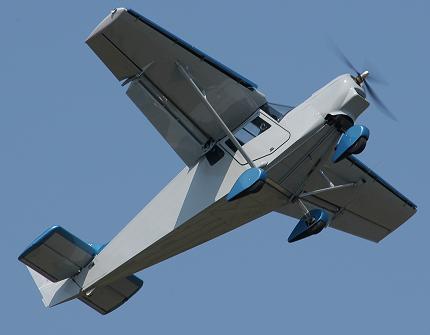
The Savannah ADV tapered wing with reduced surface has a NACA 2315 profile. In substance, a fast wing that seems to clash with the squared and simple fuselage of the Savannah, and its STOL performance. The stall speed at a MTOW of 560 Kg, in clean configuration, is up to 49 kts and has achieved 44 kts during test. In front, the slats run on linear guides and perfectly re-enter in the leading edge profile, keeping it clean. At the trailing edge are two big flaps with high full deflection angle and another slotted winglet extending for the whole leading edge of the flap itself.
Activation of the flap is by a single electrical control, therefore, for every degree of flaps deflection there is a defined extension of the front slats. The pilot has just one switch to operate and the whole mechanism is automatic. This made it possible to establish the optimal settings during the testing phase, thus avoiding potentially dangerous “personal interpretations” by the pilots and making the airplane safe and simple to manage. So, a single switch activates the four moving surfaces and their position is indicated by a pin moving along an arch drawn out at the root of the right wing, where the electric motor and the mechanical activation system is embedded, but still in sight. The regulation is continuous and in case of emergency a little winch is provided to be connected to the electric motor shaft with a cotter pin. The production aircraft were to be fitted with a permanent winch connected to the motor shaft, in order to allow for immediate activation in case of electrical failure.
Savannah Bingo 4S
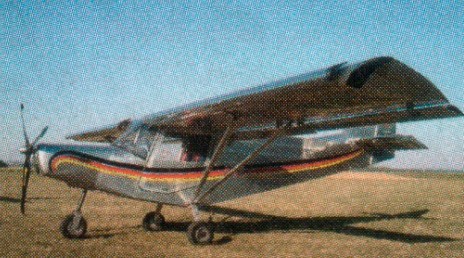
The Bingo is an ultralight STOL (short take off and landing) aircraft with side-by-side seats, single high wing, tricycle landing gear, metal construction. It has the same structure as the Savannah, differing just in some minor detials, the engine mounts, cowlings, and equipment.
All models are LSA.
Formerly known in the U.S. as the Skykits Savannah line, Italian maker I.C.P. became represented in the US by ICP Aviation in 2012 and included a tail-dragger version (model “T”) of the all-metal Savannah S-LSA. Twenty-nine of the tricycle-gear S model are registered in the U.S. in 2012. The STOL-capable S-LSA has a high-lift airfoil, Junkers-style flaperons, all-window doors and a true STOL stall speed of 26 knots. S model price 2012: $71,950; T model price 2012: $74,950.
Savannah
Variation: Agrocopteros MXP-740
Specifications:
Savannah Stall: 24 kt / 28 mph / 45 kmh Cruise: 76 kt / 87 mph / 140 kmh VNE: 86 kt / 99 mph / 160 kmh Empty Weight: 272 kg / 600 lbs MTOW Weight: 450 kg / 992 lbs Climb Ratio: 1000 ft/min / 5 m/s Glide Ratio: 12:1 Take-off distance (50ft obstacle): 330 ft / 100 m Landing distance (50ft obstacle): 440 ft / 135 m
Savannah (jabiru) Stall: 23 kt / 26 mph / 43 kmh Cruise: 70 kt / 81 mph / 130 kmh VNE: 109 kt / 125 mph / 202 kmh Empty Weight: 278 kg / 613 lbs MTOW Weight: 450 kg / 992 lbs Climb Ratio: 750 ft/min / 4 m/s Take-off distance (50ft obstacle): 260 ft / 80 m Landing distance (50ft obstacle): 260 ft / 80 m 2009 Price: 25000 EURO
Savannah Engine: Rotax 912S, 100 hp HP range: 80-120 Length: 21.3 ft / 6.1 m Height: 2.10 m Wing span: 29.3 ft / 9m Wing area: 142 sq.ft / 12,96 sq.m Wing chord: 144 cm Aspect ratio: 6,3 Empty weight: 635 lb / 272 Kg Gross weight: 1234 lb / 560 Kg Fuel capacity: 21 USG / 80 lt Wing load: 35 kg/sq.m Max. speed: 87 – 95 kt Vne: 108 kt Cruising speed: 78 – 84 kt Stall: 28 mph / 23 kt Approach speed: 31 kt Manoeuvre speed: 74 kt Range: 460 sm / 800 km Rate of climb: 1300 fpm Takeoff dist: 90 ft Landing dist: 160 ft Cockpit width: 41 in Undercarriage: nose wheel Wheels: 4×8″ Loading factor: +6/-4g Fuel consumption 75%: 12 – 14 lt/h Seating: 2, side by side Flaperons 0-20-40°
Savannah ADV Engine: Rotax 912S, 100 hp HP range: 80-120 Length: 21.3 ft Wing span: 26.3 ft / 8 m Wing area: 102 sq.ft / 9.4 sq/m Wing cord at root: 1.5m Wing cord at tip: 0.75m Empty weight: 654 lb Gross weight: 1234 lb Fuel capacity: 21 USG Maximum speed: 112 kts Cruise: 115 mph / 100 kts Stall speed clean: 43 kts Stall speed flaps: 30 kts Range: 510 sm Climb rate: 1200 fpm at 52 kts Takeoff dist: 110 ft / 35 m Landing dist: 160 ft Cockpit width: 41 in Seats: 2 Cockpit width: 41 in Load factor: +6 -3 g
Savannah Bingo 4S Engine: HKS 700E, 60 hp Length: 21.3 ft / 6.1 m Height: 2.45m Wing span: 29.5 ft Wing area: 140 sq.ft Empty weight: 610 lb / 255 kg Gross weight: 1234 lb Fuel capacity: 21 USG Cruise: 75 mph / 65 kt Stall: 28 mph / 25 kt Max speed: 73 kt Range: 460 sm Range with reserve: 880 km Rate of climb: 680 fpm Takeoff dist: 160 ft / 50 m Landing dist: 230 ft / 70 m Cockpit width: 41 in Landing gear: Nose fixed Wheel track: 1.7m Seats: 2 Fuel consumption: 10 lt/hr
Savannah Bingo 4S Engine: Rotax 503 Wing span: 9m Wheel track: 1.7m Empty weight: 245 kg Stall speed: 25 kt Cruise speed: 60 kt Max speed: 70 kt Take off run: 50 m Landing roll: 70 m Climb rate: 480 fpm Fuel consumption: 15 lt/hr Range with res: 520 km MTOW: 450kg Wing span: 9m Wheel track: 1.7m Length: 6.1m Height: 2.45m
Savannah Bingo 4S Engine: Rotax 582 Wing span: 9m Wheel track: 1.7m Empty weight: 250 kg Stall speed: 25 kt Cruise speed: 65 kt Max speed: 73 kt Take off run: 50 m Landing roll: 70 m Climb rate: 840 fpm Fuel consumption: 20 lt/hr Range with res: 410 km MTOW: 450kg Wing span: 9m Wheel track: 1.7m Length: 6.1m Height: 2.45m
Savannah Bingo 4S Engine: Victor 2 Empty weight: 250 kg Stall speed: 25 kt Cruise speed: 70 kt Max speed: 70 kt Take off run: 50 m Landing roll: 70 m Climb rate: 840 fpm Fuel consumption: 18 lt/hr Range with res: 500 km MTOW: 450kg Wing span: 9m Wheel track: 1.7m Length: 6.1m Height: 2.45m
Savannah Bingo 4S Engine: HKS Turbo Wing span: 9m Wheel track: 1.7m Length: 6.1m Height: 2.45m Empty weight: 265 kg Stall speed: 25 kt Cruise speed: 73 kt Max speed: 84 kt Take off run: 35 m Landing roll: 70 m Climb rate: 960 fpm Fuel consumption: 12 lt/hr Range with res: 810 km MTOW: 450kg
Savannah VG Cruise: 100 mph Stall: 30 mph Range: 460 sm Rate of climb: 1300 fpm Takeoff dist: 90 ft Landing dist: 160 ft Engine: Rotax 912S, 100 hp HP range: 80-120 Fuel capacity: 21 USG Empty weight: 645 lb Gross weight: 1234 lb Length: 21.3 ft Wing span: 29.3 ft Wing area: 132 sq.ft Cockpit width: 41 in Landing gear: fixed nose wheel
The Rambo is of aluminum construction, steel tube cabin, 118 cm wide. It is fitted with an electric elevator trim, carburator deicing, and cabin vent as standard 2009 Price: 33000 EURO The F99 LSA is a high wing LSA legal craft.
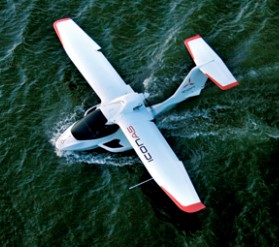
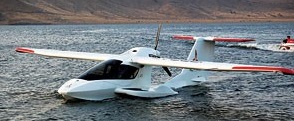
The Icon A5 amphibious LSA was unveiled at a very rock ’n’ roll premiere in Los Angeles in June 2008.
The ICON A5 has two seats and is made mostly of composite materials, with a high wing, T-tail, pusher prop, and tricycle landing gear. It is powered by a Rotax 912 flat-four engine, with hybrid air-water cooling and providing 75 kW (100 HP). All landing gear assemblies have single wheels, the nose gear hinging forward, the main gear retracting into sponsons that also provide flotation stability. Seating is side-by-side, the canopy hinging forward for access. The wings fold back along the rear of the aircraft for ease in handling.
Designed for recreation rather than transport and first flown in July 2008, the A5 is a sport plane available in 2008 for US$139,000.
The A5 received a lot of publicity but no production machine had flown yet.
The long-delayed amphibian could at last be nearing production after wrestling with overweight issues for years. In 2012 the manufacturer awaited FAA’s final decision on whether that agency would allow an additional 250 pounds beyond the LSA amphibious spec of 1,430 pounds or 1,680 pounds MTOW.
Icon’s stated grounds for exception: The extra weight is needed for its spin-resistant wing design. The ruling would only benefit the A5, not any other amphib or float plane.
Engine: Rotax 912, 75 kW Wing span: 10.4m / 34 ft Length: 6.7 m / 22 ft Empty weight: 450 kg / 1,000 lb Max speed: 192 kph Stall: 80 kph


 All Aero