JAI JAI-60 60 years of the JAI

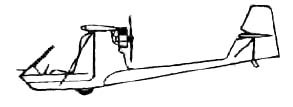
The JAI-60 (Russian: ХАИ-60) all-metal trainer was designed at the SKB JAI and built at the Kharkov Aviation Factory in 1990, in commemoration of the 60 years of the JAI.

One of the last works of the SKB JAI was the JAI-60 light aircraft (also known as “60 years of the JAI”) design began in 1985, when the magazine “Krilya Rodini” (Wings of the Fatherland), together with the DOSAAF and the NII MAP, launched a competition for the development and construction of a light aircraft for primary training.

The design group was led by the head of NIL OSKB JAI Gennadi G. Jmyz. The developers, from the very beginning, decided that the new model should be useful not only for training, but also for transporting passengers and cargo. In compliance with the conditions of the contest, great attention was paid to the take-off and landing characteristics, and the ability to operate from airfields with asphalt runway, and the ability to tow gliders.

The JAI-60 was designed as a high-wing, braced monoplane with a conventional type tail unit. In its construction, the wing has negative sagging (-7º).

The landing gear features fixed main titanium legs. The enclosed cabin easily accommodates the pilot and two passengers, also featuring a luggage compartment.

This model originally featured an MZ three-cylinder engine capable of 110 hp, but due to strong vibrations it was soon replaced by a 140 hp Czechoslovak M-332 engine.

The fuel system featured tanks located on the wing leading edge for a range of 700 km and capacity for a suspended auxiliary tank.

The JAI-60 prototype flew in 1990. Only the one was built.

Engine: MZ, 115 hp
Wingspan: 10.0 m
Wing area: 12.0 m²
Length: 6.2 m
Empty weight: 406 kg
Maximum takeoff weight: 680 kg
Maximum speed at sea level: 240 km / h
Landing speed: 70 km / h
Range: 670 km
Take-off run: 100 m
Landing run: 80 m
Accommodation: 1
JAI JAI-48

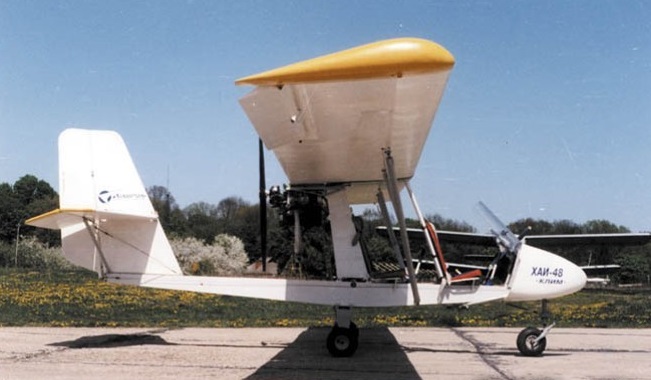
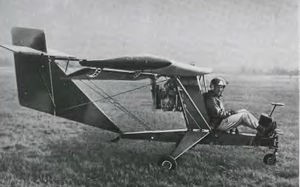
The JAI-48 (Russian: ХАИ-48) was developed by the SKB JAI student group as a two-seater light aircraft. This model, of a tricycle undercarriage, shows a clear descent from the previous models of the group.

Structurally it was similar in its construction to the JAI-35, with a minimalist fuselage made up of a structure of tubes and metal sheets to which a vertical bar was fixed on which the wing plane was supported, braced by uprights. As control structures the wings had ailerons.

The tail unit was of the conventional type with a mid-set empennage, braced by uprights.

The landing gear is fixed tricycle type, with the main wheels on titanium legs and the front wheel, steerable, with oil-pneumatic suspension.

The crew members were located in an open cockpit with a simple instrument panel and a transparent windshield.

The engine was located under the wing, driving a two-bladed propeller in pusher configuration.

Only one was built.

JAI JAI-47

The JAI-47 (Russian: ХАИ-47) two-seater sport deltaplane was developed by a group of JAI students in 1989.

Only the one was built.

JAI-47
Engine: RMZ-640, 35 hp
Wingspan: 9.0 m
Length: 2.2 m
Wing area: 12.0 m²
Empty weight: 125 kg
Maximum takeoff weight: 295 kg
Maximum speed at sea level: 50 km / h
Range: 200 km
Take-off run: 25 m
Landing run: 25 m
Accommodation: 2

JAI JAI-46

The JAI-46 (Russian: ХАИ-46) sport deltaplane was developed by a group of JAI students in 1988.

The JAI-41 participated in the First Soviet Glider Championship, which took place in September 1988 in Crimea, receiving the gold medal of the competition for its category.

Only the one was built.

JAI-46
Engine: RMZ-640, 35 hp
Wingspan: 9.0 m
Length: 2.2 m
Wing area: 12.0 m²
Empty weight: 120 kg
Maximum takeoff weight: 215 kg
Maximum speed at sea level: 45 km / h
Range: 250 km
Take-off run: 25 m
Landing run: 15 m
Accommodation: 1

JAI JAI-41

The two-seater JAI-41 (Russian: ХАИ-41) was designed as a pilot training and teaching motor-deltaplane and for the development of topographic surveys, aerial photography and cartography tasks.

Developed at the JAI in 1987, the JAI-41 participated in the First Soviet Glider Championship, which took place in September 1988 in Crimea.

Only the one was built.

Engine: 42-hp Vulcan V-40
Wingspan: 10.0 m
Length: 3.6 m
Wing area: 16,6 m²
Empty weight: 120 kg
Maximum takeoff weight: 220 kg
Maximum speed at sea level: 70 km / h
Landing speed: 40 km / h
Range: 160 km
Take-off run: 30 m
Accommodation: 1

JAI JAI-40

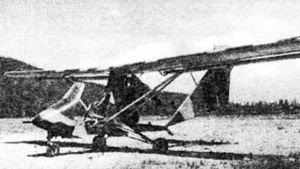
In 1986 at SKB JAI a light aircraft named JAI-40 (Russian: ХАИ-40) and nicknamed “VOK” was developed. Originally this device was obtained as a student work directed by G. Jmyz from the previous JAI-21. The aircraft was safe, light in handling and excellent speed and economy characteristics.

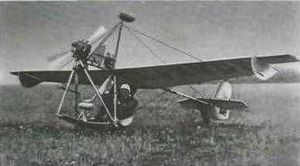
The JAI-40 was designed as a mixed construction single-seater high-wing monoplane. The wing, braced by inverted V posts, was constructed of wood with some use of composite materials and featured control surfaces along the entire length of the trailing edge.

The bar-type fuselage was constructed of metal tubes and sheets.

The glue unit was conceived on the basis of a fabric-coated duralumin tube structure. The horizontal planes were located high above the empennage and were braced to the structure by cables. The rudder featured a large area.

The landing gear was designed in a tricycle configuration. The front wheel was of the steerable type and was located directly at the bow of the device. The pilot sat in a seat on the basic structure of the fuselage. To avoid impacts during landing at large approach angles, a skid was installed under the rear of the fuselage.

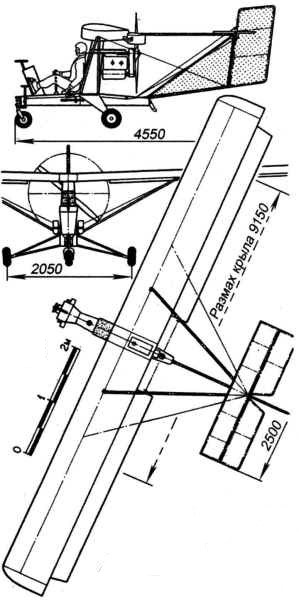
The drive configuration difficulties were offset by installing a 35 hp RMZ-640 geared motor. This engine was installed directly on the vertical pylon for fixing the wings, moving a propeller with two wooden blades 1.38 meters in diameter. The selection of the engine and the use of a wing with 8.2 aspect ratio allowed the model to fly easily and have an excellent take-off step. Later and in order to improve performance, a 42 hp Vulcan engine designed by VP Manuilenko would be installed, moving a propeller of 1.51 meters in diameter.

Its further development was reinforced and in 1988 it reached first place in its class in the light aircraft competition held in Túshino. With a takeoff weight of 305 kg and a 42 hp engine this little machine was capable of reaching 105 km / h.

JAI-40 in its final version

The JAI-40 successfully participated in the SLA-87 light aircraft competition.

JAI-40
Engine: 1 x Vulcan 42 hp
Wingspan: 8.50 m
Length: 4.75 m
Wing area: 9.60 m²
Tailplane wingspan: 5 m
Vertical fin area: 1.64 m²
Rudder area: 0.90 m²
Queue area: 1.40 m²
Elevators area: 0.86 m²
Wing aspect ratio: 8.7
Wing Profile: GA (W) -1
Wheel spacing: 2.05m
Empty weight: 172 kg
Gross weight: 262 kg
Maximum takeoff weight: 305 kg
Wing loading: 2.44 lb / sq.ft
Power load: 7.48 kg / hp
Fuel capacity: 10 liters
Maximum speed: 105 km / h
Cruising speed: 95 km / h
Stall speed: 55 km / h
Ascent speed: 128 m / min
Practical range: 90 km
Accommodation: 1

JAI JAI-39

The JAI-39 (Russian: ХАИ-39) was designed at SKB JAI in 1978 as a single-seat experimental light aircraft of twin-engine configuration.

Only one example was built.

JAI-39
Engines: two 4 hp Druzhba
Wingspan: 10.65 m
Wing area: 17.63 m²
Length: 3.62 m
Empty weight: 42.65 kg
Maximum takeoff weight: 140 kg
Maximum speed at sea level: 45 km / h
Landing speed: 22 km / h
Take-off run: 10 m
Accommodation: 1

JAI JAI-38

In 1983, in the SKB JAI piloted model development group, designed and built, JAI-38 (Russian: ХАИ-38) multifunctional delta. In charge of the design was fourth-year student SI Kanivolotski.

The delta was powered by a 40 hp Vulcan V-40 engine, designed and built at the institute itself. With a takeoff weight of 210 kg, the device managed to develop a speed of 75 km / h.

The JAI-38 participated in the second edition of the competition for amateur ultralight aircraft developed in Kiev. The 28 of July of 1984 during the aviation festival dedicated to the 100th anniversary of the renowned SV Grizodubova pilot, SI Kanibolovski demonstrated in the JHA-38 a take off and landing from the racecourse school.

JAI-38
Engine: Vulcan V-40, a 40-hp
Wingspan: 10.0 m
Wing area: 16,6 m²
Length: 3.6 m
Empty weight: 120 kg
Maximum takeoff weight: 220 kg
Maximum speed at sea level: 70 km / h
Landing speed: 40 km / h
Range: 160 km
Take-off run: 30 m
Accommodation: 1

JAI JAI-37 Mikhail Yefimov

JAI-37 “Mikhail Yefimov” (Russian: ХАИ-37 “Михаил Ефимов”) was an ultralight aircraft developed at the AKA of the JAI.

Structurally, the JAI-37 was conceived as a high-wing braced monoplane of mixed construction. The ailerons were located at the wing tips. These ailerons appeared as increases to the wingspan.

A modified “Vijr-30” naval engine with air cooling was used as the power plant for this implementation and with a takeoff power of about 28 hp.

The JAI-37, named Mikhail Yefimov, was built in 1982 by a group of JAI students from a project developed by V. Dombrov, who also directed the construction. In this process, V. Kozhushnov, S. Kurinni, R. Sielix, M. Boiko and I. Tkach stood out.

First flying in 1980, as a glider, and August 1981 powered, tests were not good due to the lack of effectiveness of the wingtip ailerons.

Based on JAI-37, the improved JAI-37M model was developed with modified wings and tail and more standard placement of the ailerons. Later another model would be built, known as JAI-37M2.

The JAI-37M participated in the First SLA-85 Light Aviation Competition, but in this competition it did not fly.

JAI JAI-35 Entusiast

In 1972 at the request of a group of students of the KAK JAI institute and under the direction of the head of the aeronautical construction laboratory A. Barannikov, within the structure of the OSKB JAI the Aviation Construction Club (KAK) designed the JAI-35 “Entusiast” (Russian: ХАИ-35М «Энтузиаст») motor glider.

The JAI-35 “Entusiast” training motor glider was created on the diploma work of student N. Labrov, an active member of KAK since its foundation. In the construction of JAI-35 and under the direction of A. Barannikov, V. Silyukov, S. Alexandrov, A. Jomich, A. Mosalienko and S. Kovaliov stood out.

The JAI-35 was conceived as a wooden construction motor glider with some use of composite materials. As a power plant, a “Vijr-30” outboard boat motor was selected, modified to work with air cooling. This engine developed about 28 hp at takeoff.

The first flight in a non-powered configuration was performed by N. Lavrov in 1980. With the power plant the first flight would take place in August 1981. At the controls was the head of the KAK A. Barannikov.

Under the direction of Natalia Labrova, students from the “A. Barannikov” of the JAI worked on a modified and improved version of the JAI-35 that was named JAI-35M. This version was powered by a 36 hp engine, showing better overall performance.

This JAI-35M participated in the SLA-87 Light Aviation Competition.

Between 1991 and 1992 studies were conducted to investigate the use of ultralight aerial photography tasks. JAI-29S and JAI-35M2 participated in these experiments. The results demonstrated the feasibility of using AFA cameras in this type of apparatus.

At least three JAI-35 were built.

JAI-35M
Engine: 36 hp
Empty weight: 170 kg
MTOW: 260 kg
Velocity at sea level: 2 m / s
Minimum descent speed: 1.5 m / s
Ascent speed: 2.4 m / s
Accommodation: 1