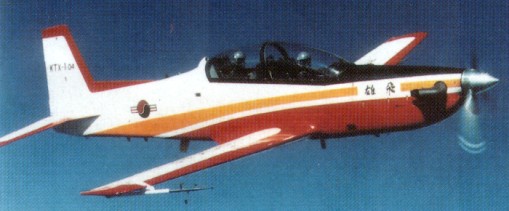
Development was initiated under the KTX program as a single-engined turboprop, basic training aircraft for the Republic of Korea Air Force in 1988 using the CATIA computer program to completely develop the aircraft, the first of its class. It was jointly developed by KAI and the Agency for Defence Development (ADD).
Nine prototypes were built on June 1991 with the first flight of the KT-1 occurring on November 1991 for static and fatigue testing. In 1995, the project was officially named ‘Woongbi’. In 1998 the final test flight was performed. The KT-1 is the first completely indigenous Korean aircraft ever developed. In 1999, a contract was signed for eighty-five aircraft with provisions for an additional twenty between Korea Aerospace Industries and the Republic of Korea. The first KT-1 Woongbi was handed over to the Republic of Korea Air Force in 2000 with the delivery of the eighty-five aircraft being completed in 2002. The Republic of Korea Air Force received 85 KT-1s and 20 KA-1s.
KT-1 can be equipped with either an analog or ‘glass’ cockpit configuration. Both types are employed by the Republic of Korea Air Force.
KAI exported seven KT-1Bs plus spare parts to Indonesia in April 2003 under a 60 million USD contract, and five more in May 2005. A KT-1B was lost during training 24-Jun-2010 .
In a press release held in Sacheon, South Korea on March 8, 2006, KAI stated that it will export more than 150 improved versions of the KT-1 to various countries in Central America and Southeast Asia. The improved export version of the KT-1 will be called KT-1C.
As of June, 2007, South Korea and Turkey have successfully negotiated for a contract of exporting 40(+15) KT-1, as well as modular armor technology of K2 Black Panther for Turkey’s future indigenous MBT, to Turkey for KRW₩500,000,000,000 (approximately US$540,000,000).
A statement published by Chungwadae, the South Korean Presidential website, on 26 January 2010, said that India and South Korea had agreed, as part of upgrading their partnership to a ‘strategic relationship’, form a joint committee in the first half of 2010. The statement added that this committee will facilitate an offer from Seoul to supply up to 60 KT-1 trainers to meet Indian Air Force requirements. However, India signed the contract with Pilatus to supply 75 PC-7.
On November 6th 2012, KAI and the Peruvian Air Force has successfully negotiated a $200 million contract for 20 KT-1Ps (10 KT-1 trainers and 10 KA-1 armed counterinsurgency variants) including some offset and technologies transfers for an approximate amount of US$208 millions. KAI will provide the first 4 airplanes by 2014 and the rest will be assembled at SEMAN (Maintenance air wing of the Peruvian Air Force).
Peru reported on 19 November 2013 having set up its KT-1 family assembly plant at Las Palmas Air Base in Lima, and plans to begin final assembly work on 16 planes beginning in March 2014. The first flight of a KT-1P for Peru took place on 19 Febuary 2014. Korean Aerospace Industries (KAI) announced on 21 May 2014 it started the production of the KT-1 Woongbi for the Peruvian Air Force.
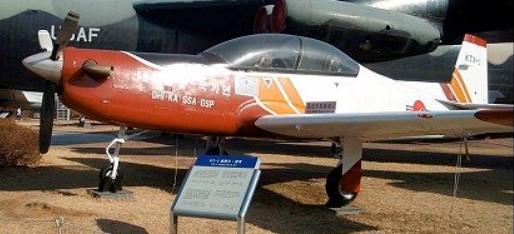
Variants:
KTX-1 Yeo-myung
Prototype primary trainer each with a different engine fitted, six built.
KA-1
An armed advanced trainer with light attack and forward air control capabilities. Several new features unique to the KA-1 are head-up-display and up-front control panel, MFD panels, and five hardpoints, two under each wing and one under the fuselage. The hardpoints may be equipped with rocket launcher, gun pods or AIM-9 Sidewinder missiles.
KT-1B
Export version for Indonesia.
KT-1C
Improved, armed export version equipped with a centreline forward looking infrared pod. The KT-1C may also be equipped with a 12.7 mm gun pod, chaffes, flares, training missiles, rockets or unguided bombs.
KT-1T
Export version for Turkey.
KT-1P
Export version for Peru.
Specifications:
KT-1
Engine: 1 × Pratt & Whitney Canada PT6A-62, 950 hp (708 kW)
Wingspan: 10.59 m (34 ft 9 in)
Wing area: 16.01 sq.m (172.3 sq ft)
Length: 10.26 m (33 ft 8 in)
Height: 3.68 m (12 ft 1 in)
Empty weight: 1,910 kg (4,210 lb)
Max. takeoff weight: 2,540 kg (5,600 lb)
Maximum speed: 574 km/h (310 knots, 357 mph) (IAS)
Range: 1,333 km (720 nmi, 828 mi) at 7,620 m (25,000 ft), max internal fuel
Service ceiling: 11,580 m (38,000 ft)
Rate of climb: 16.2 m/s (3,180 ft/min)
Endurance: 3 h
Crew: 2 in tandem



 All Aero