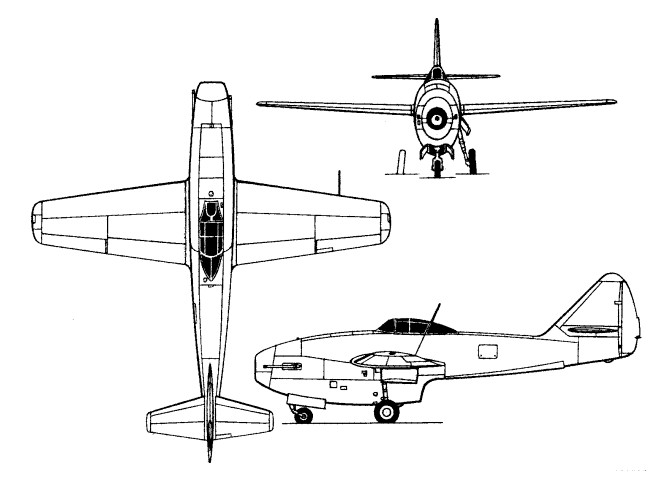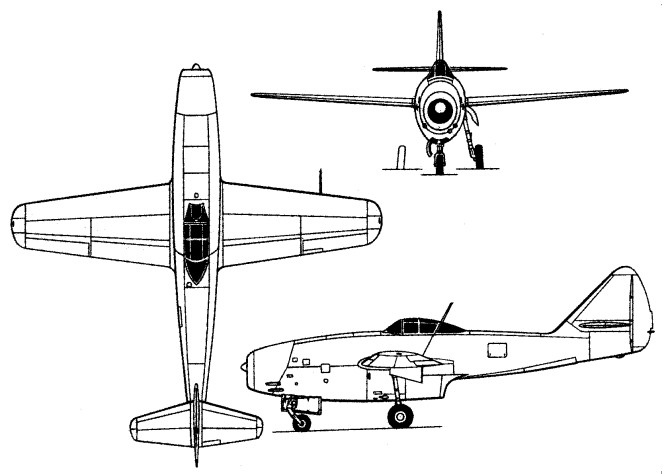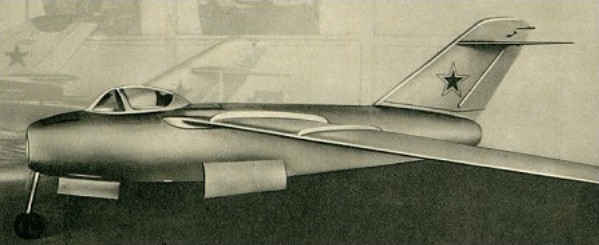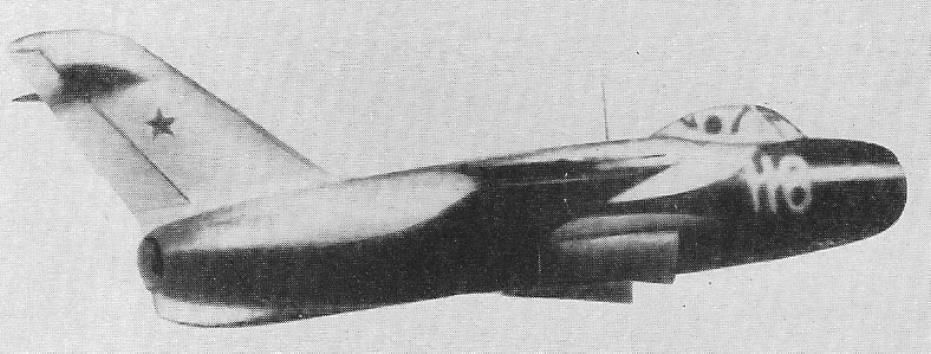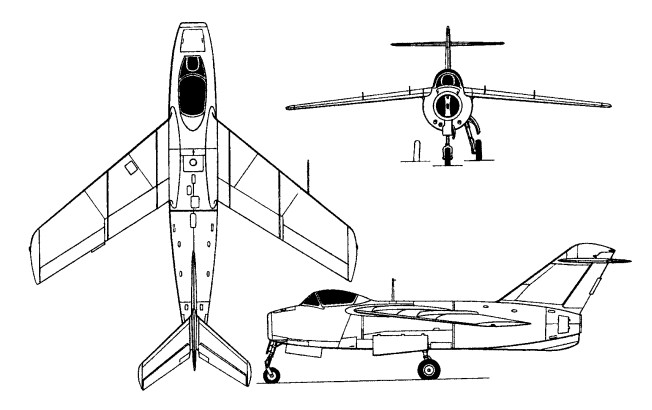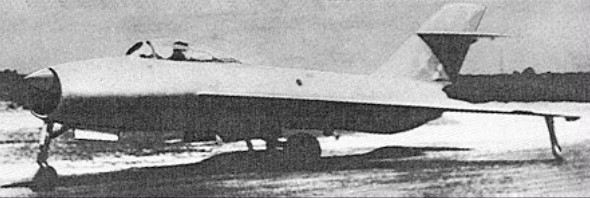
Lavochkin La-190

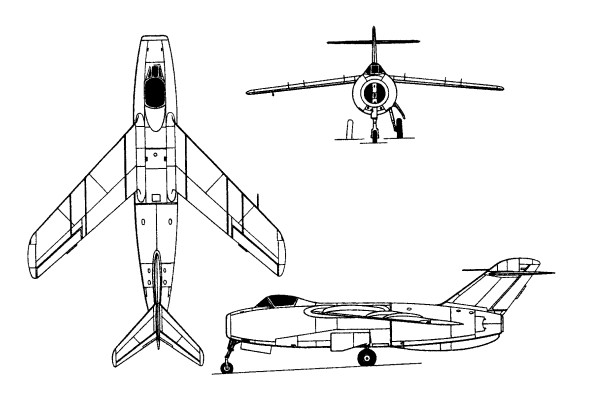
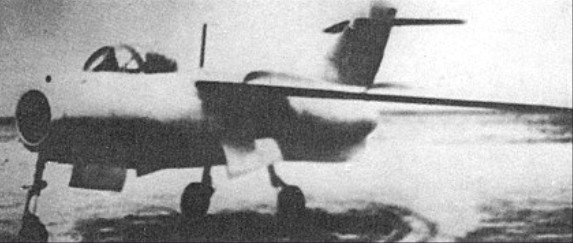
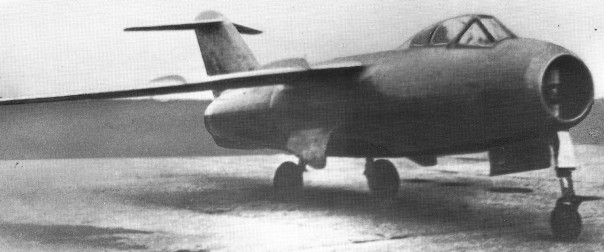
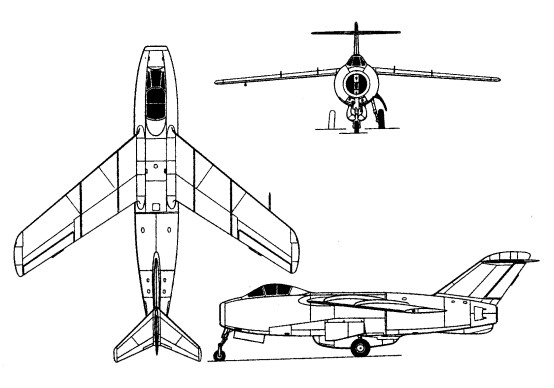
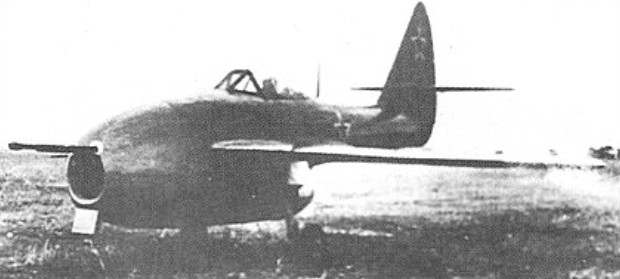
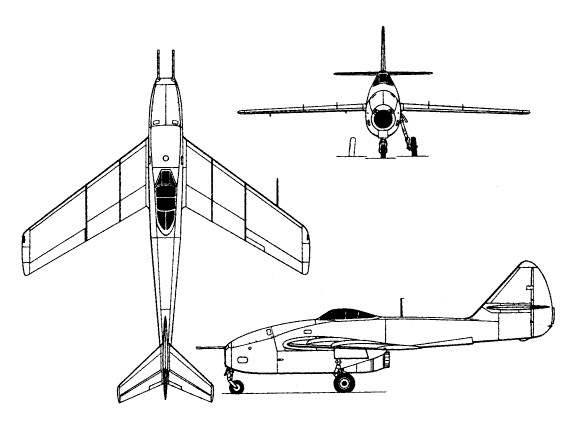
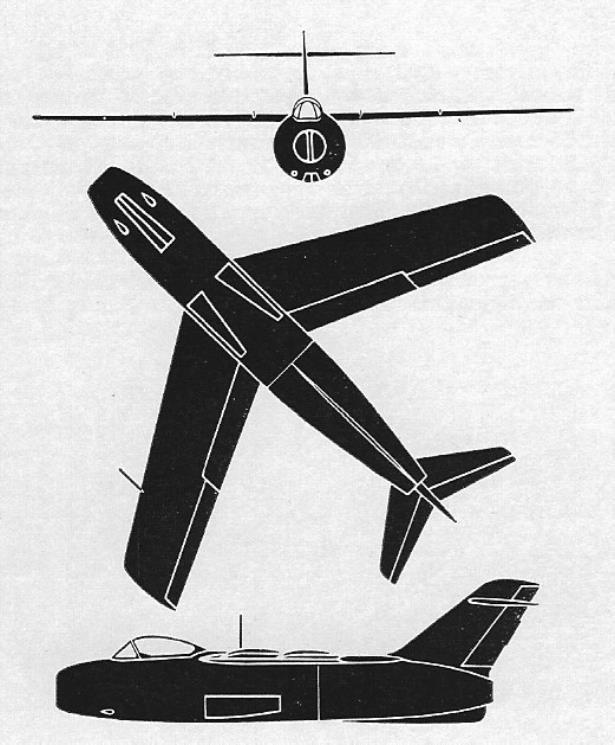
The La-190 was conceived to meet the October 1948 demand of Yosif Stalin for the “fastest fighter in the world”. Other contenders were the I-350, progenitor of the MiG-19, and the Yak-1000, which, in the event, was to be abandoned before flight testing. The requirement called for use of the new Lyulka AL-5 turbojet which had an initial rating of 4600kg.

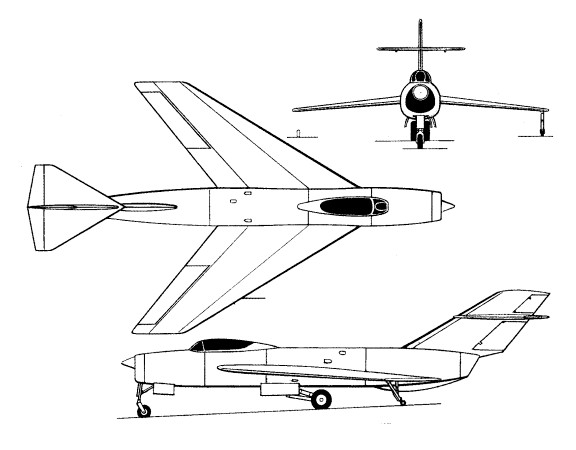
The La-190 featured wings swept at 55 degrees and a delta tailplane located about three-fifths of the way up the broad-chord vertical tail. Equipped with a bicycle-type main undercarriage members with wingtip outrigger stabilising wheels, and an armament of two 37mm N-37 cannon. Integral fuel tankage occupying virtually the entire interspar box of the 6.1% thickness wing which featured machined upper and lower skins. All control surfaces were powered by irreversible actuators.

Although planned originally as a day fighter, the prototype was completed in limited all-weather form with a radar radome in the upper portion of the nose inlet.

The sole prototype La-190 was completed in February 1951. The AL-5 engine offered less thrust than predicted and its unreliability led to cancellation of the development programme after only eight flights.

A speed of 1190km/h at 5000m, or Mach1.03, was attained in level flight during one test in March 1951.

Engine: Lyulka AL-5 turbojet, 4600kg
Max take-off weight: 9257 kg / 20408 lb
Empty weight: 7315 kg / 16127 lb
Wingspan: 9.90 m / 32 ft 6 in
Length: 16.35 m / 53 ft 8 in
Wing area: 38.93 sq.m / 419.04 sq ft
Max. speed: 1190 km/h / 739 mph
Range: 1150 km / 715 miles
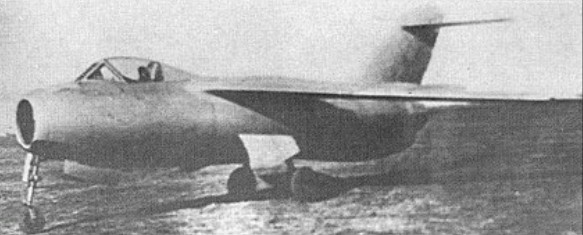
Lavochkin La-176

Combining a fuselage essentially similar to that of the Lavochkin La-168 with wings sweptback 45° at quarter-chord and several other aerodynamic refinements, the La-176 was flown in September 1948 with a 5004-lb / 2270kg RD-45F turbojet, and armament comprising one 37mm N-37 and two 23mm NS-23 cannon.

Re-engined with a Klimov VK-1 turbojet of 2700kg, the La-176 was claimed to have exceeded Mach=1.0 in a dive from 9050m to 6000m on 26 December 1948, test pilot of No.301 Factory, Captain Sokolovsky OV. It was initially believed that an ASI error had been involved, but the process was repeated six times during January 1949, 1105km/h being recorded at 7500m, this being equivalent to Mach=1.02. The La-176 thus became the first Soviet aircraft to achieve supersonic flight. Further development was abandoned shortly afterwards when the canopy locks failed at high speed, resulting in test pilot Î V Sokolovsky losing his life.

Max take-off weight: 4631 kg / 10210 lb
Empty weight: 3111 kg / 6859 lb
Wingspan: 8.59 m / 28 ft 2 in
Length: 10.97 m / 35 ft 12 in
Wing area: 18.25 sq.m / 196.44 sq ft
Max. speed: 1043 km/h / 648 mph
Range: 1000 km / 621 miles

Lavochkin La-172

To meet a requirement for a lighter “frontal fighter” powered by the Rolls-Royce Derwent turbojet, the Lavochkin bureau evolved two designs, the La-172 and the La-174TK.
The La-172 was powered by an NII-1 turbojet (as the pre-series Soviet version of the Derwent was designated) rated at 1600kg, and entered flight test early in 1948, with armament comprising three 23-mm NS-23 cannon. Early in the test programme, while being flown by I Ye Fedorov, the La-172 suffered uncontrollable flutter at 8000m and entered a flat spin. Recovery was effected at 3000m, but the prototype was heavily damaged in a subsequent crash landing. Nevertheless, development was continued via the La-174D to result in the La-15.

Max take-off weight: 3708 kg / 8175 lb
Empty weight: 2433 kg / 5364 lb
Wingspan: 8.83 m / 28 ft 12 in
Length: 9.56 m / 31 ft 4 in
Wing area: 16.16 sq.m / 173.94 sq ft
Max. speed: 1040 km/h / 646 mph
Range: 1300 km / 808 miles

Lavochkin La-168

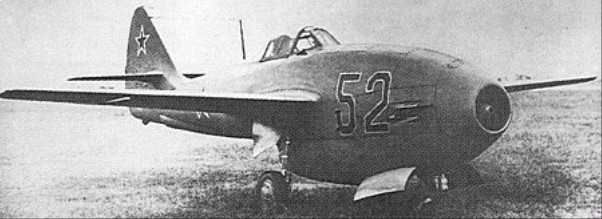
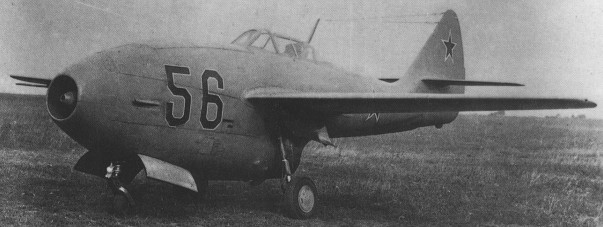
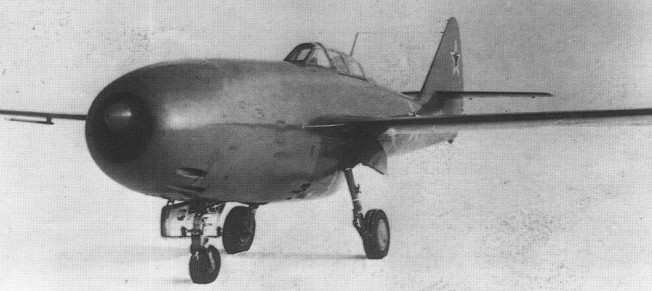
In March 1946, Yosif Stalin assigned the task of developing advanced single-seat fighters around the newly-acquired Rolls-Royce Nene turbojet to the design bureaux of Semyon A Lavochkin, Artem Mikoyan and Mikhail Gurevich, and Aleksandr Yakovlev on a competitive basis. The Lavochkin contender, the La-168, featured a shoulder-mounted wing sweptback 37° 20′ at the leading edge and fitted with Fowler flaps. An armament of two 23mm NS-23KM cannon and one 37mm N-37 cannon was fitted and power was provided by a 5000-lb / 2268kg Nene R.N.2 turbojet.
The engine was located toward the tail, where it exhausted through a short jetpipe, and was aspirated from a circular nose inlet via bifurcated ducting round the pressurized cockpit. A T-tail was used to allow the location of the tailplane farther to the rear than would otherwise have been possible, improving longitudinal control.
The La-168 was first flown on 22 April 1948, subsequently attaining 1084km/h at 2750m, representing Mach=0.914. During the test programme, the cockpit canopy collapsed when all three guns were fired simultaneously at 15000m, but the pilot succeeded in landing the aircraft.
The La-168 test programme continued until 19 February 1949, but the Mikoyan-Gurevich bureau’s competitive I-310 (Type S) had meanwhile been selected for large-scale production as the MiG-15.

Max take-off weight: 4412 kg / 9727 lb
Empty weight: 2973 kg / 6554 lb
Wingspan: 9.50 m / 31 ft 2 in
Length: 10.56 m / 34 ft 8 in
Wing area: 18.08 sq.m / 194.61 sq ft
Max. speed: 1084 km/h / 674 mph
Range: 1275 km / 792 miles

Lavochkin La-160 Strelka (Dart)

The Soviets’ first swept-wing aeroplane was the La-160, which was basically the La-154/156 with a lengthened fuselage and swept flying surfaces. Consequently known unofficially as the Strelka (Dart), the La-160 featured 35 degrees of leading-edge sweep on a wing of 9.5% thickness.

When initially flown on 24 June 1947, the La-160 was fitted with an RD-10 turbojet rated at 900kg, with which it could not get airborne fully laden.

After initial handling trials, the La-160 was fitted with an RD-10F which provided an afterburning thrust of 1170kg and with which, after diving and then levelling off, a speed of 1060km/h was allegedly attained at 5700m, this being equivalent to Mach=0.92.

The La-160 carried an armament of two 37mm NS-37 cannon, but was utilised primarily as a research vehicle in the development of more advanced fighters and no production was contemplated.

La-160
Max take-off weight: 4060 kg / 8951 lb
Empty weight: 2738 kg / 6036 lb
Wingspan: 8.95 m / 29 ft 4 in
Length: 10.07 m / 33 ft 0 in
Wing area: 15.90 sq.m / 171.15 sq ft
Max. speed: 900 km/h / 559 mph

Lavochkin La-152 / La-154 / La-156

La-152

The La-152 wing, although similar in planform to that of the earlier La-150, employed a new profile of only 9.1% – the thinnest section adopted up to that time in the Soviet Union – and was lowered to mid position. The RD-10 turbojet was retained, but to avoid the duct losses suffered by the La-150, the power plant was installed in the extreme nose, exhausting beneath a sturdier rear fuselage. The CG position was restored by moving the cockpit aft, and armament was three 23mm NS-23 cannon.

Work on the La-152 was initiated by the Lavochkin bureau within two months of a start being made on the La-150, and factory flight testing began in October 1946, only a few weeks after the La-150 had entered flight test. Three prototypes were built in parallel, all similarly armed and differing primarily in power plant, the second and third aircraft being designated La-154 and La-156 respectively.

The La-154 was to have been fitted with a Lyulka TR-1 turbojet of 1350kg, but was never flown owing to difficulties with this engine.

After initial trials with a standard RD-10, the La-156, which had increased tankage and had initially flown in February 1947, was fitted with an RD-10F engine equipped with an afterburner extension boosting thrust by 30% (to 2425 lb / 1100 kg).

La-156

The RD-10F-equipped La-156 was flown for the first time in September 1947 – the first Soviet aircraft to fly with an afterburning engine – and attained a max speed of 905km/h at 2000m. The flight test programme continued until the end of January 1948.

La-152
Max take-off weight: 3239 kg / 7141 lb
Empty weight: 2310 kg / 5093 lb
Wingspan: 8.20 m / 26 ft 11 in
Length: 9.12 m / 29 ft 11 in
Wing area: 12.15 sq.m / 130.78 sq ft
Max. speed: 778 km/h / 483 mph
Range: 492 km / 306 miles

Lavochkin La-152

Lavochkin La-150

The Lavochkin bureau’s response to Yosif Stalin’s order of February 1945 to design and build a single-seat jet fighter around a Junkers Jumo 004B turbojet, was the La-150 of pod-and-boom layout with a shoulder-mounted wing.
Like the competitive designs from the Mikoyan-Gurevich and Yakovlev bureaux, the La-150 was awarded a prototype/pre-series aircraft order, the first of the prototypes flying in September 1946 powered by the Soviet derivative of the Junkers Jumo 004B axial-flow turbojet engine, the RD-10 rated at 900kg.

The February 1945 Soviet requirement for a jet-powered fighter specified a single 1984-lb (900-kg) thrust RD-10, and the limited power of this engine dictated that the designers had to exercise considerable ingenuity in keeping down weight and optimizing the engine installation. The Lavochkin team’s response was a small machine and a pod-and-boom fuselage allowing the use of an efficient straight-through design from the circular nose inlet to the nozzle under the boom. Five prototypes were built for trials from late 1946, but the type was beset by problems including a high structure weight and sluggish performance. Excessive dihedral effect resulting from the wing positioning was rectified on the second prototype by drooping the wingtips, but excessive oscillation of the tail surfaces at high speeds resulting from inadequate stiffness of the tailboom could not be overcome.

The Yak 17 Feather was slightly faster and lighter than its competitor, the La 150, and was substantially superior in range; rough field performance of the Yak 17 was very much better than that of the Lavochkin design, which had a heavy narrow track undercarriage. The La 150 was abandoned in April 1947 and the Yak 17 was ordered into production.

Max take-off weight: 2961 kg / 6528 lb
Empty weight: 2059 kg / 4539 lb
Wingspan: 8.20 m / 26 ft 11 in
Length: 9.42 m / 30 ft 11 in
Wing area: 12.15 sq.m / 130.78 sq ft
Max. speed: 805 km/h / 500 mph
Range: 500 km / 311 miles
Armament: 2 x 23mm NS-23 cannon.

Lavochkin La-174TK

La-174TK

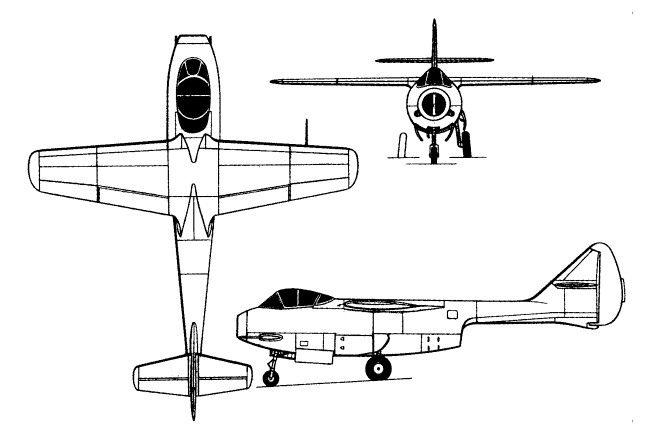
The final development of this straight-winged series was the La-174TK, which first flew January 1948 as a research type for the investigation of very thin, straight wings as an alternative to swept wings in overcoming compressibility problems.
The wing possessed a thickness ratio of only 6% (the “TK” suffix indicating Tonkoye Krylo, or Thin Wing) which the Lavochkin bureau believed might offer most of the advantages of a thicker sweptback wing while avoiding some of its disadvantages. The 6 per cent thickness/chord ratio was the smallest in the world at that time, and yielded performance benefits over the La-56. The basic configuration of the La-174TK reverted to that of the earlier La-152 series fighters, although the relationship was confined to a common design origin, with the single 1590kg NII-1 (RD-500) turbojet exhausting under the rear fuselage. Armament comprised three 23mm NS-23 cannon and flight testing commenced early 1948. Although lighter than the La-172, the La-174TK demonstrated inferior handling and performance characteristics, further development being discontinued.
The La-174TK was intended only for research and no production was ever planned.

La-174TK
Engine: 1590kg NII-1 (RD-500) turbojet
Wingspan: 8.64 m / 28 ft 4 in
Length: 9.41 m / 30 ft 10 in
Wing area: 13.52 sq.m / 145.53 sq ft
Max take-off weight: 3315 kg / 7308 lb
Empty weight: 2310 kg / 5093 lb
Max. speed: 970 km/h / 603 mph
Range: 960 km / 597 miles

Lavochkin La-15 / La-174D / La-180

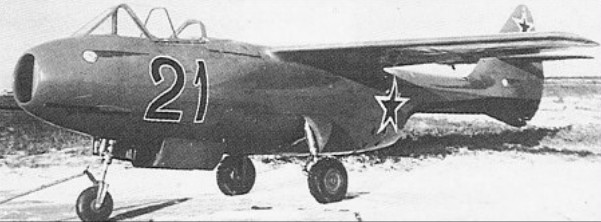
A replacement prototype for the La-172 was designated La-174D (the suffix signifying dubler, literally “replacement”), and entered flight test in August 1948. Lavochkin scaled down the basic La-174TK design to produce the La-174D tailored round the smaller Rolls-Royce Derwent turbojet. This differed in only minor respects from the preceding prototype, and series production was ordered during the same month as the La-15, armament being reduced from three to two 23mm NS-23 cannon, and 6 degrees of wing anhedral being added.

Type 21

The La-15 was powered by the RD-500 turbojet, the Soviet series version of the Derwent, deliveries to the VVS commencing in the late autumn of 1949.

Production plans for the La-15 were, in the event, scaled down because of difficulties experienced in manufacturing in sufficient quantity the numerous milled parts employed in the structure, but about 400 were produced, these remaining in VVS service until 1954.

A tandem two-seat conversion trainer version was evolved as the La-180, but only two examples of this variant were built.

La-15
Engine: RD-500 turbojet, 3527-lb (1600-kg) thrust
Max take-off weight: 3850 kg / 8488 lb
Empty weight: 2575 kg / 5677 lb
Wingspan: 8.8 m / 28 ft 10 in
Length: 9.0 m / 29 ft 6 in
Wing area: 16.2 sq.m / 174.38 sq ft
Max. speed: 1025 km/h / 637 mph
Ceiling: 13000 m / 42650 ft
Range: 1170 km / 727 miles

Type 21

Lavochkin La-11 / La-134

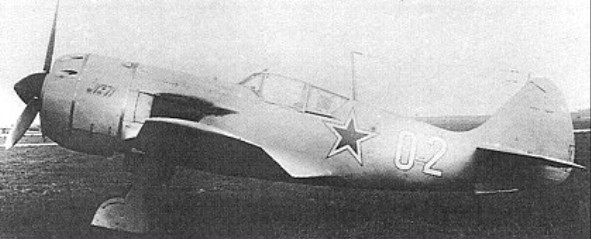
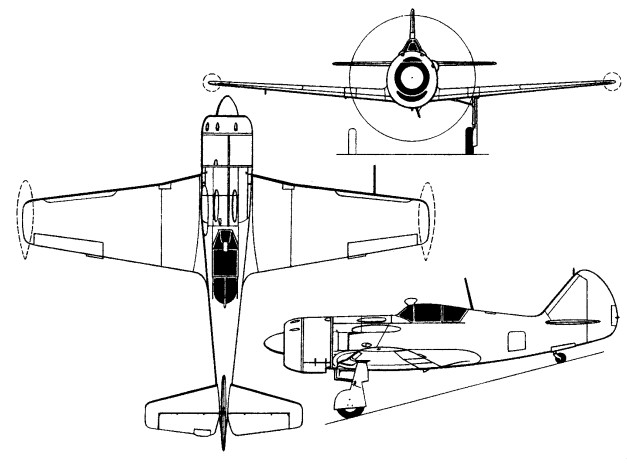
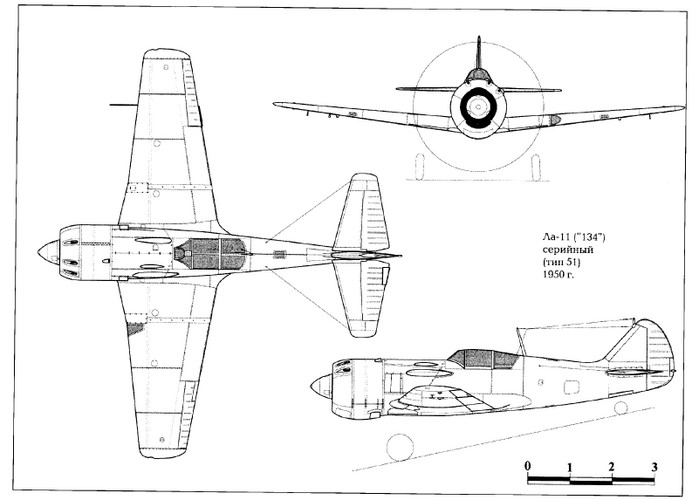
Evolved from the La-9 to meet a requirement for a fighter with sufficient range to fulfil the escort role, the La-11 was destined to be the last piston-engine fighter from the Lavochkin bureau. It had a wing fundamentally similar to that of the La-9 and retained the ASh-82FN engine, but provision was made to attach auxiliary fuel tanks at the wingtips, the ventral oil cooler was incorporated in the engine cowling and armament was reduced to three 23mm NS-23 cannon. The first prototype was flown in June 1947 under the design bureau designation La-134, and production (1947-51) at Gor’kiy was to total 1,182 aircraft.
The La-11 was supplied in some numbers to both the Chinese and the North Korean air forces, and saw operational use during the Korean conflict. It was finally phased out of first line VVS service in the early 1950s.

Engine: Shvetsov Ash-82FNV, 1850 hp
Max take-off weight: 3990 kg / 8796 lb
Empty weight: 2770 kg / 6107 lb
Wingspan: 9.8 m / 32 ft 2 in
Length: 8.7 m / 28 ft 7 in
Max. speed: 674 km/h / 419 mph
Ceiling: 10250 m / 33650 ft
Range w/max.fuel: 2550 km / 1585 miles