A postwar piston fighter project with M-211 (Jumo 211) engine; not unlike the Mustang.
Monoplane
Letov LF-109 Pionyr
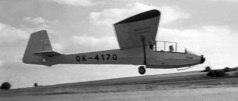
The 1950 LF-109 Pionyr two seat glider later was licenced to the Soviet Union.
Length: 25.492 ft / 7.77 m
Wingspan: 44.193 ft / 13.47 m
Aspect ratio: 9.0
Wing area: 217.433 sq.ft. / 20.2 sq.m
Max take off weight: 970.2 lb / 440.0 kg
Weight empty: 551.3 lb / 250.0 kg
Max. payload: 419.0 lb / 190.0 kg
Max. speed: 76 kt / 140 km/h
Landing speed: 30 kt / 55 km/h
Cruising speed: 33 kt / 62 km/h
Wing load: 4.51 lb/sq.ft / 22.00 kg/sq.m
Glide ratio: 18.0
Crew: 2
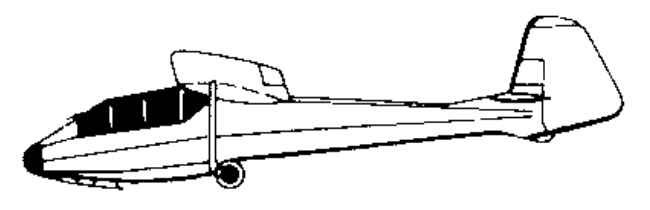
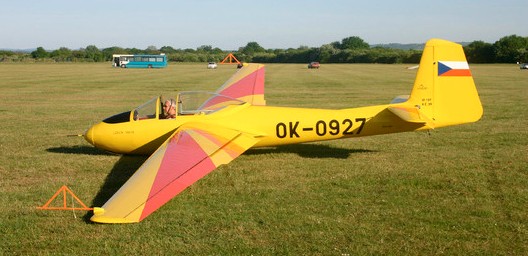
Letov LF-107 Lunak / VT-7 / XLF-207 Laminar
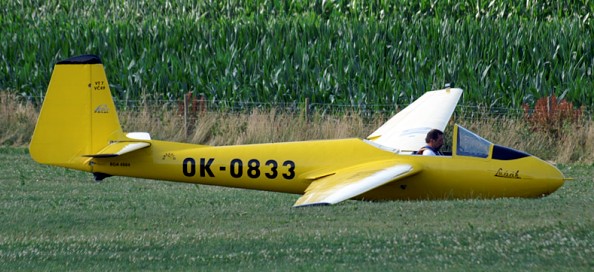
The Czech aerobatic glider LF-107 Lunak was designed by Rudy Letov and further developed by a group of sailplane pilots and aeronautical engineers. The first flight of the prototype took place on June 25, 1948 and a second prototype flew in July. The prototype participated later in the same year in an aerobatic competition in Grenchen, Switzerland, and in Ziar, Poland in 1949, where its good aerobatic and gliding characteristics drew considerable attention.
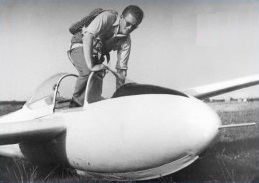
Unfortunately the serial production was disrupted by geopolitical developments, as the factory was charged with production of MiG-15, MiG-19 and MiG-21F aircraft and the access to Western civil export markets was progressively hampered by the emergence of the Iron Curtain. Therefore, only 75 examples of the Luňák were produced in all. Production models were used in local clubs for sailing and aerobatics as well as for training jet pilots.
In 1950, a variant with simpler construction and a revised cockpit, among other changes, was developed. This LF-107 Luňák of wooden construction, designated Letov VT-7 under the military training system, was instrumental in the development of gliding and aerobatics in the Czech Republic. The LF-107 was also used for aerobatic training in the Soviet Union, Bulgaria, Romania and Poland.
The Letov XLF-207 Laminar, a derivative of the Luňák, holds the distinction of being the first glider in the world to have a laminar flow wing. Its maiden flight took place in Praha Letnany in August 1951. Research into laminar flow wings was carried out by the XLF-207 Laminar, a LF-107 fitted with laminar flow wings.
In 1990 there were only nine airworthy Luňák, of which two are in the United Kingdom. A Luňák is displayed in the American Museum of Flight.
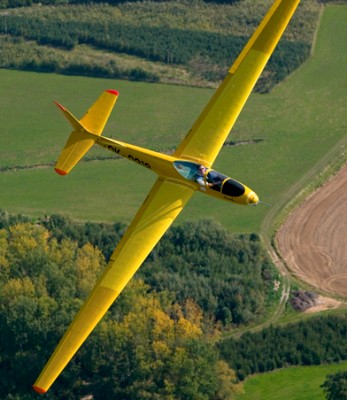
LF-107 Luňák
Length: 6.78 m
Height: 1.47m / 5ft
Wingspan: 14.27 m
Wing area: 13.38 sq.m
Aspect ratio: 15.22
Empty weight: 205 kg
Gross weight: 310 kg
Maximum speed: 300 km/h
Maximum glide ratio: 24 @ 80km/hr (43kts)
Rate of sink: @ 65km/hr 0.85 m/s (@ 35kts 167 ft/min)
Crew: 1
VT-7
XLF-207 Laminar
Letov L-290 Orel
A 44-48 passenger transport, based on the Junkers Ju 290. Power was by 4 x BMW 801.
Letov L-42
A 1960 6-8 passengers business jet and trainer aircraft. Two rear-mounted M-701 turbojets (10,8 kN each). Cruise speed 870 km/h. Designed in two versions: low-wing (appears like typical bizjet) and more unconventional – high-wing.
Letov Š.50
A three-seat monoplane bomber prototype of 1938, powered by 2 x 430 hp 7-cyl Avia Rk-17 radials (optional 2 x Gnome-Rhône 14M).
Letov Š.39 / Š.139 / Š.239
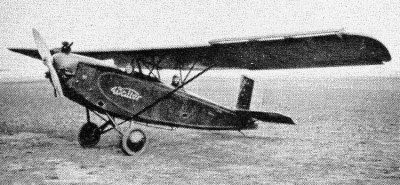
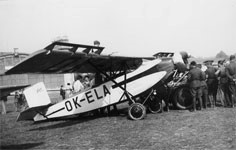
A two-seat, parasol monoplane sports plane (with HP slats) of 1931. After a prototype with a 36.8kW Orion LL-50 engine, 23 aircraft were built in 1934, powered by a 55 hp 3-cyl Walter Polaris radial engine.
An Š.139 development prototype (OK-ELA) of 1933 was powered by an 80 hp 7-cyl Pobjoy R radial.
Sixteen Š.239 developments were built, powered by an 85 hp 4-cyl Walter Minor 4. Ten went to flying clubs.
Engine: Walter Polaris, 40.5 kW / 55 hp
Propeller: two-blade wooden
Wingspan: 10,00 m
Length: 6,14 m
Wing Area: 14,00 m2
Empty Weight: 270 kg
Maximum Take-off Weight: 515 kg
Wing Loading: 36,8 kg/m2
Maximum Speed: 150 km/h
Cruise Speed: 130 km/h
Service Ceiling: 3300 m
Range: 480 km
Crew: 2-3
Undercarriage: fixed
Letov Š.33
A 2- to 3-seat high-wing bomber, powered by a 790 hp W-12 Praga Asso 9-W. After a brief test hop, the aircraft was grounded for excessive vibration and replaced by Š.516.
Letov Š.32
A five-passenger high-wing monoplane tri-motor airliner of 1931. Power was by a 3 x 140 hp 14-cyl Walter Mars. Four were built.
The Š.328/528 series were reconnaissance/light bomber biplane developments of the Š.32.
Letov S.239
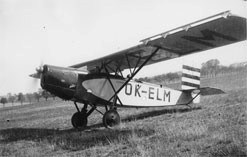
Wood-framed wings and tail-plane and fin covered by plywood, elevator and rudder by fabric. Fuselage steel-tube-framed, fabric-covered.
Letov S-239.16 (the 16th production S-239) was built in 1933. Ten were used by Flying Clubs and Masarykś Flying League units until March 15,1939.
An S-239 was powered by a British radial Pobjoy R engine. But the Pobjoy licence was not purchased and that reason for a Pobjoy-powered production of S-239s was not undertaken.
Engine: Walter Minor 4, 85 hp
Span : 10 m
Length: 6.14 m
Empty weight: 375 kg
Top speed: 174 kph
Climb to 1000 m: 5 min 16 sec
Range: 420 km
Crew: 2
 All Aero