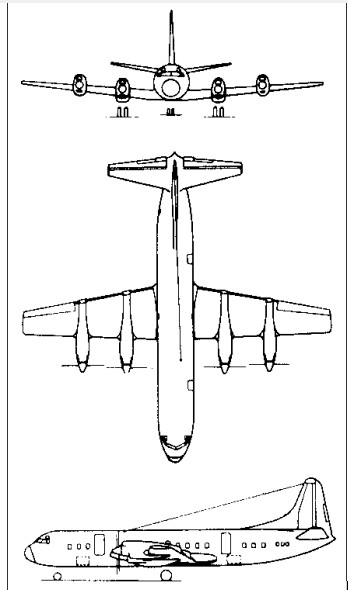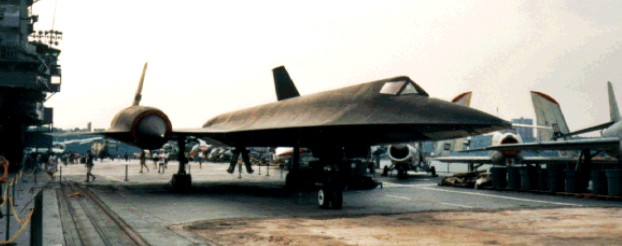
Lockheed A-11 / A-12 / YF-12 / SR-71 Blackbird

A-12

Lockheed Blackbird Article

A-11 / A-12
In response to a programme for the construction of a high-speed, high-altitude, long-range reconnaissance conventional aircraft, funded by and earmarked for service with the Central Intelligence Agency (CIA), a number of US companies submitted proposals for consideration, Lockheed’s ‘Ox-cart’ from the design team led by C. L. ‘Kelly’ Johnson eventually being adjudged most suitable, and this duly received the go-ahead in the autumn of 1959.

Construction of the prototype (60-5932) single-seat A-12, as the machine was officially known, forged ahead at the ‘Skunk Works’, the virtually complete prototype being taken by road to the remote Groom Lake flight test facility during January 1962 for final assembly and flight testing. The A-12 got airborne for its first official flight on 26 April 1962, this event being preceded by a totally unexpected ‘hop’ during the course of high-speed taxi trials two days earlier.

Construction was largely of titanium to maintain structural integrity, as localised skin temperatures of up to about 427°C could be reached through air friction.

Lockheed A-12

In the early days of the flight test the first A-12 relied upon two Pratt & Whitney J75 turbojet engines for power, the same company’s J58 turbo-ramjet engine not being installed until much later in the year. Almost inevitably, with such a sophisticated machine, the project suffered from many problems during the early stages of flight testing, these being experienced in virtually every area, but despite this the CIA apparently began to take formal delivery of its initial fleet of 10 aircraft (serial numbers 60-6924/6933) shortly before the end of 1962 and these were later joined by a second batch of five A-12s (60-6937/6941). Of these 15 machines, one (60-6927) was completed as a two-seater for training duties, this differing from its counterparts by virtue of having a second, raised, cockpit and featuring conventional J75 engines which bestowed a maximum speed of about Mach 1.2, well below that of the standard A-12 which was apparently capable of approximately 3860 km/h 2,400 mph) or Mach 3.6 at altitudes in the order of 28040 m (92,000 ft), figures which significant exceeded those records established by the YF-12A at the beginning of May 1965.
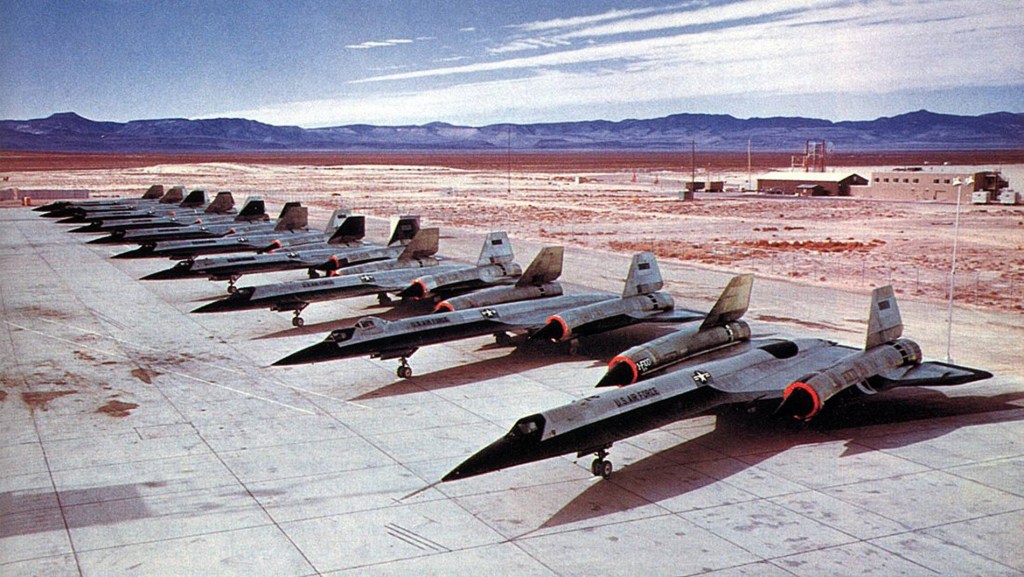
A-12

In addition, the last two production examples of the A-12 were configured to carry the GTD-21B drone and these also featured a second crew station aft of the pilot’s cockpit, his housing the Launch Control Officer. As far is is known the GTD-2 1 B/A- 12 pairing was not employed operationally but the drone may have undertaken reconnaissance missions after launch from a specially configured Boeing B-52H Stratofortress.
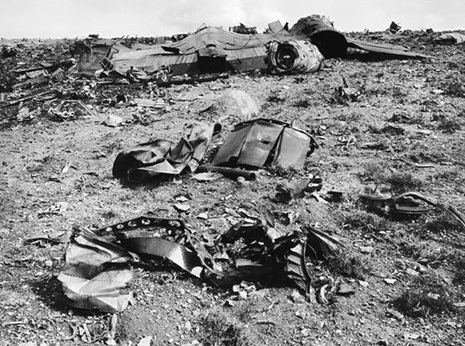
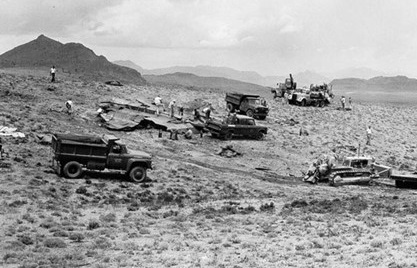
This A-12 crashed near Wendover, Utah in 1963 after entering an unrecoverable flat spin. Pilot Ken Collins managed to eject safely. He then successfully deterred several locals, who had come to his aid with the canopy of the shadowy A-12 on the back of their pickup, from the crash site by telling them the wreck was that of an F-105 Thunderchief with a nuclear weapon onboard. That same day, the CIA administered sodium pentothal to ensure Collins had divulged every last detail of the incident. When the men in black later carried him home, still heavily under the drug’s influence, Collins’ wife angrily assumed he’d been out drinking all day with his friends. Several decades later, the retired A-12 pilot was finally able to reveal the truth. X-Plane hunters continue to find components of the top secret aircraft wreck at the remote site.
As far as operational employment is concerned, the CIA continues to maintain a tight-lipped silence about the A-12 but the type’s great speed coupled with its capacity for inflight-refuelling made range considerations virtually irrelevant, the major factor in mission scheduling almost certainly being one of crew fatigue. In view of this and the nonstop 24140km. (15,000-mile) missions accomplished by the later SR-71A it would seem reasonable to assume that intelligence-gathering was accomplished from Groom Lake until at least the summer of 1968, which most sources state as marking the cessation of A-12 activity. In addition, Kadena Air Base on the Pacific island of Okinawa has also been linked with A-12 operations as well as those of the SR-71A, and could well have served for some considerable time as a forward operating location for CIA intelligence gathering activities directed against the People’s Republic of China and North Korea. Reliable reports attest that such activity ceased abruptly on 5 June 1968 following the loss of A-12 60-6932, apparently after take-off from Kadena. By then the SR-71A had attained full operational status and the latter type is believed to have assumed responsibility for A-12 missions at about this time. Eight of the 15 A-12s eventually appeared in open storage at Palmdale during October 1977 though where they had spent the intervening nine years remains a mystery.
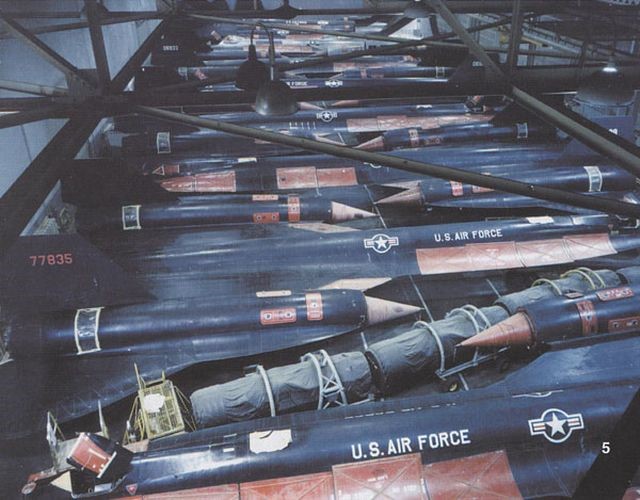
Lockheed A-12s while in secret storage at Palmdale, CA

In a Presidential announcement of February 1964, Lyndon Johnson formally revealed the existence of the ‘A-11 aircraft’.

YF-12
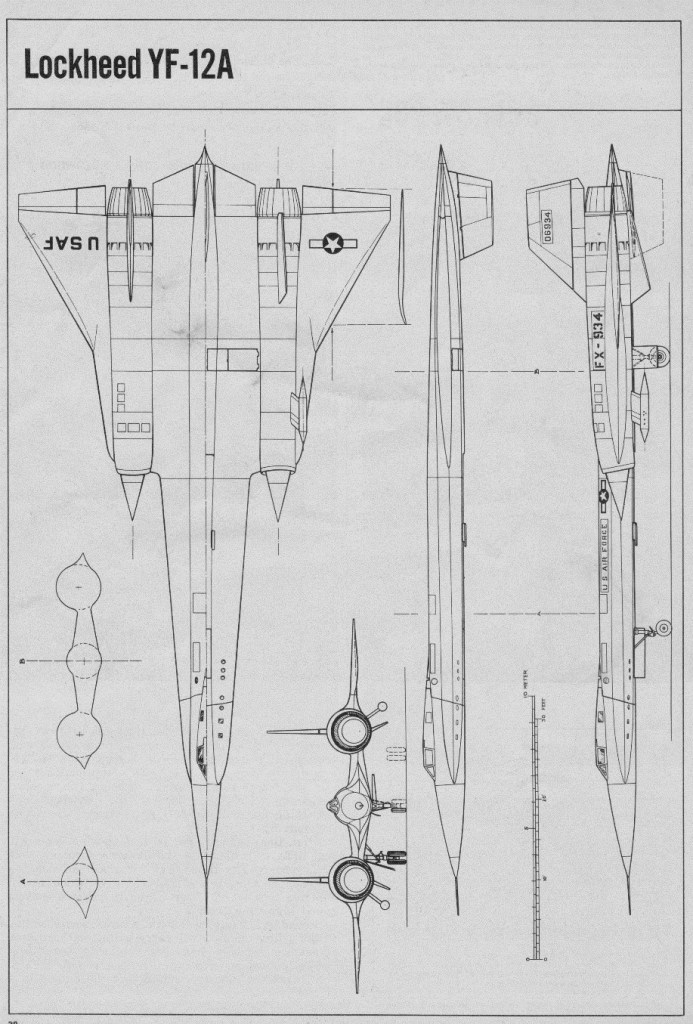
YF-12A

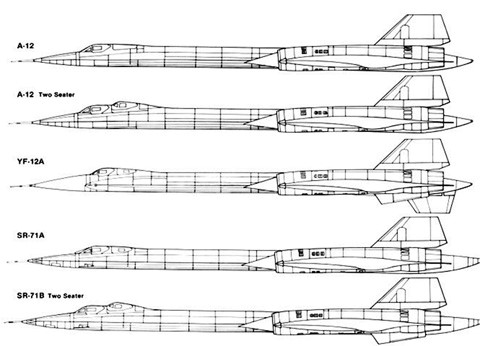
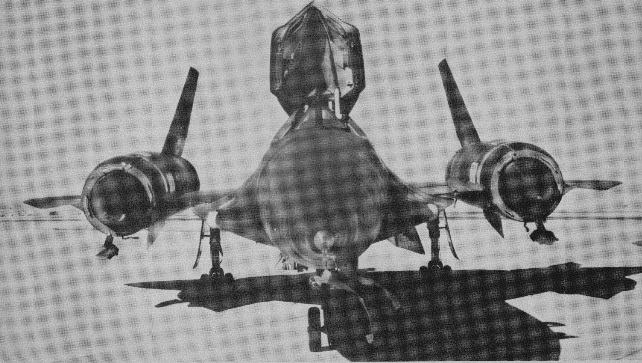
The second major ‘Blackbird’ variant to appear was the YF-12A, and it was this model which formed the basis of the Presidential announcement of February 1964 when Lyndon Johnson formally revealed the existence of the ‘A-11 aircraft’, adding that it was then under test as a long-range interceptor’. Three aircraft (606934/6936) of this type were built, the first example making its maiden flight from Groom Lake on 7 August 1963. Eventually to become the most publicly visible of all the ‘Blackbirds’, the three aircraft all featured significantly different nose contours, the forward fuselage chine having had to be redesigned to permit the installation of the Hughes AN/ASG- 18 long range radar required in the interceptor role. Armament was intended to be the Hughes AIM-47A air-to-air missile, four of which would have been housed internally, occupying space which was presumably given over to reconnaissance sensors and systems on the A-12. The type is based on advanced aerodynamics using a blended fuselage/wing design built largely of titanium alloys and covered in a special heat-radiating paint that led to the type’s nickname. The powerplant comprised a pair of 32,500-lb (14740-kg) afterburning thrust Pratt &Whitney J58 (JT11D-20B) bypass turbojets (or turbo-ramjets) which at high speeds produced their power not only as direct thrust from the exhaust nozzle but also as suction at the inlet.
The fighter derivative of the basic model was the experimental YF-l2A, of which at least four were produced with the A-11’s original short fuselage, a Hughes pulse-Doppler fire-control system and, in the fuselage chine bays originally used for the carriage of reconnaissance equipment, four AJM-47A air-to-air missiles. The YF-12A never served operationally, but was important in several evaluation programmes.

The YF-12A programme, seen as important in its own right, distracted attention from the more sinister A-12, the model which mounted an assault on several world records at the beginning of May 1965, capturing the headlines and setting new marks for sustained altitudes and speed with what appeared to be consummate ease. That the A- 12 was able to exceed these figures handsomely was not brought to anyone’s attention.

Subsequently, the YF-12As and a single YF-12C (itself simply the demilitarized second production SR-71A with the bogus serial number (06937) spent most of their flying careers at Edwards AFB, California, eventually being used until 1999 by NASA in a major research effort into high-speed flight. This came to an end during 1979, the sole surviving YF-12A (60-6935) being turned over to the USAF Museum at Wright-Patterson AFB, Ohio, in November while the YF-12C was apparently placed in storage at Palmdale. Of the other two YF-12As, 60-6934 fell victim to a landing accident at Edwards at a fairly early stage, most of the rear fuselage later being used as a basis for the sole SR-71C, while 60-6936 was destroyed Arhen it crashed on approach to Edwards during June 1971.

Crewed by a pilot and flight test engineer, these aircraft flew under NASA for 10 years.

On 1 May 1965, a YF-12A established records including 2062 mph and 80,000 ft sustained horizontal flight.
The YF-12As were capable of speeds in excess of Mach 3 and of sustained supersonic flight at heights of up to 24,385m.

The YF-12A paved the way for the SR-71A ‘Blackbird’ strategic reconnaissance platform that was retired from first-line USAF service in 1989, but even so the whole programme is still shrouded in secrecy and uncertainties.

SR-71
SR-71A

On Dec. 28, 1962, Lockheed got the contract to build the first group of SR-71s, which were to become the largest and best known branch of the Blackbird family. Bob Gilliland made the first flight on Dec. 23, 1964.
One year after the YF-12, the first SR-71 arrived at Beale Air Force Base, California, operational home of the Black¬bird. First flown on 22 December 1964, the SR-71 is an unarmed strategic reconnaissance aircraft. The SR-71B and SR-71C are training variants.

Lockheed SR-71 Blackbird Article

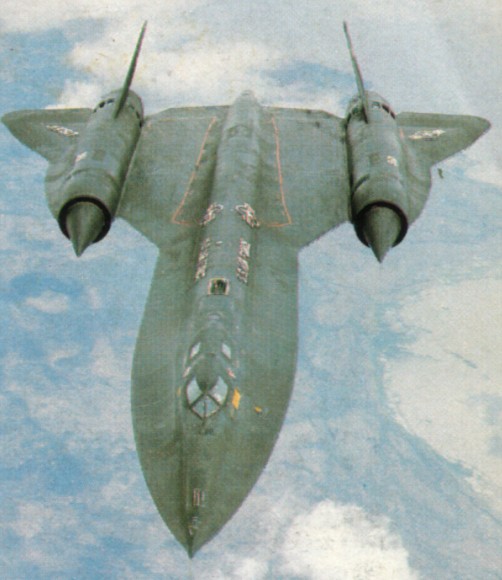
Developed from the A-12 and flown for the first time during December 1964, the Lockheed SR-71A was the world’s fastest operational aircraft, approximately 12 examples being active with the 9th Strategic Reconnaissance Wing at any given time. Possessing the ability to survey 260000 sq.km (100,000 sq miles) of the Earth’s surface in just one hour, the SR-71A routinely cruises at Mach 3 at altitudes in excess of 24385 m (80, 000 ft) during the course of its duties, and is able to gather a variety of data by virtue of highly classified but interchangeable photographic and electronic sensors which are installed to meet specific mission objectives.
Deliveries to Strategic Air Command began in January 1966, and it is believed that a total of 32 aircraft was built, this figure including two examples of the two-seat SR-71B plus a single SR-71C, the latter model also being a two-seater for pilot training, built of components taken from crashed aircraft and a structural test specimen.

SR-71 Crew

Unlike the A-12, the SR-71 is a two-seat aircraft with additional accommodation for a Reconnaissance Systems Officer (RSO). Externally, this model also differed from its predecessors in that it has a fully extended chine which is much broader around the nose while the rear fuselage boat-tail was extended by some 1.83 m (6 ft) aft of the trailing edge to improve overall fineness ratio and provide additional fuel capacity. JP-7, the fuel used by the SR-71, is so special due to its properties for operations at the high temperatures caused by Mach 3 cruise that the aircraft has its own fleet of tankers, designated KC-135Q.

The configuration of this aircraft results from extensive wind-tunnel testing to evolve a minimum-drag fuselage providing maximum speed while keeping kinetic heating to the minimum; and to maintain the best possible handling characteristics at supersonic, take-off (about 370km/h) and landing (about 278km/h) speeds.
Power plant comprises two 144.6kN Pratt & Whitney turbojets. The 36,287kg of special fuel for these engines – which is contained within upper-fuselage and inner-wing tanks – acts as a heat sink for the entire aircraft, fuel temperature being raised to 320°C before being injected into the engines. Highly complex air intakes with computer-controlled fail-safe systems are essential to ensure that smooth airflow to the engines is maintained over the enormous forward speed range of 0-3,200km/h, at the upper limit of which the engines are virtually operating as turbo-ramjets.

An initial batch of six aircraft formed the subject of the first contract which was placed in December 1962, and the first example took to the air for its maiden flight from Palmdale on 22 December 1964.

Deliveries to the designated operating agency (Strategic Air Command) began on 7 January 1966, the first example assigned actually being the second SR-71B to be produced. SR-71As began to follow during June of the same year to the 9th Strategic Reconnaissance Wing.

Attaining operational status in mid-1967, over 16 years later virtually everything about the SR-71’s usage and mission-related sensor equipment was still the subject of a stringent security blanket, although the USAF has revealed that it can survey 100,000 square miles of the Earth’s surface in one hour’. It seems certain that the intelligence-gathering effort entails unauthorized overflights of potentially hostile territory every now and then. However, since much valuable data can be obtained without recourse to actual overflight, it seems probable that many missions are of a peripheral nature, the SR-71A operating in international air space at extreme altitude whilst going about its duties.

Operations were routinely conducted from two forward operating locations by aircraft detached from the wing’s headquarters at Beale AFB, California. Kadena in Okinawa, normally had three aircraft attached at any time, while Mildenhall in the United Kingdom was the location of the second SR-71 detachment which usually controled the activities of two aircraft. In addition, 9th SRW’s headquarters at Beale served as the centre for crew training. The two-crew members, comprising a pilot and a reconnaissance systems operator, both wear full pressure suits similar to those of astronauts.
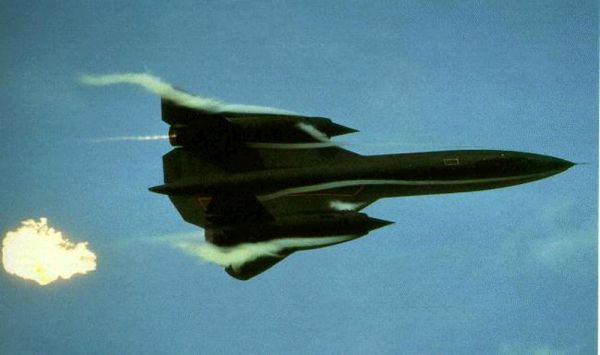
Regardless of the equipment fitted, it is apparent that the ‘Blackbird’ was highly regarded as an intelligence-gathering tool, clear evidence of this being provided by the massive expense incurred in supporting just a handful of aircraft. There is the large fleet of Boeing KC- 135Q Stratotankers (specially modified to carry the SR-71A’s unique JP-7 fuel. In addition, the unique aspects of high-altitude flight require the services of a large physiological support division, further 9th SRW infrastructure including a reconnaissance technical squadron with the task of processing data, and an extensive training element which uses several Northrop T-38A Talons as well as a surviving SR-71B.

A total of 31 new-build SR-71 Blackbird aircraft were constructed in addition to the SR-71C. Of the total production, 29 examples (64-17950/17955 and 64-7958/17980) are SR-71As, the two remaining (64-17956/17957) being completed SR-71Bs with a second, raised, cockpit for pilot training duties. 64-17956, was originally built as an SR-71A, but was later converted to an SR-71B trainer by the addition of a second cockpit. Two aircraft were converted.

Lockheed SR-71 in Britain

They have the capability to survey an area of 155,400sq.km within an hour and in 1976 established a closed-circuit speed record of 3,367.221km/h; a world absolute speed record of 3,529.56km/h; and a sustained-altitude record of 25,929.031m.

Including all three members of the ‘Blackbird’ family, production of new airframes totalled just 49, a fiftieth hybrid machine being completed with parts from a wrecked YF-12A and an engineering mockup.

The SR-71 left US Air Force service in January 1990. On a flight from the West Coast to the East Coast, where the aircraft was to retire to permanent static display at the Smithsonian, the Blackbird set a new transcontinental speed record, flying from Los Angeles to Washington D.C. in 1 hour, 4 minutes, and 20 seconds, averaging a speed of 2,124 mph.

SR-71
SR-71

Records
Absolute speed: 2193.17 mph / 3529.56 kph – 28 July 1976
1000km / 621.1mi closed circuit speed: 2092.294 mph / 3367.221 kph – 27 July 1976
Sustained flight in horizontal flight: 85,059 ft / 25,939 m – 28 July 1976

Gallery

Lockheed SR-71A Blackbird
Engines: 2 x P&W JT11D, 32,500 lb / 14,742 kg thrust
Wingspan: 55 ft 11 in / 16.94 m
Length: 107 ft 5 in / 32.74 m
Height: 18 ft 6 in / 5.64 m
Wing area: app 1000 sq.ft / 92.9 sq.m
Empty weight: 60,000 lb / 27,216 kg
MTOW: 170,000 lb / 77,111 kg
Speed: 2250 mph / 3620 kph
Ceiling: 100,000 ft/ 34,800 m
Range: 2980 mi / 4850 km
Seats: 2

SR-71A
Engines: two Pratt & Whitney J58 turbo-ramjet engines, 14742-kg (32,500-1b) afterburning thrust.
Wing span 16.94 m (55 ft 7 in)
Wing area: 167.2 sq.m / 1799.72 sq ft
Length 32.74 m (107 ft 5 in)
Height 5.64 m (18 ft 6 in)
Wing area 166.76sq.m (1,795 sq ft).
Empty weights: 27216 kg (60,000 lb)
Maximum take-off 78019 kg (172,000 lb)
Fuel capacity 13,000+ USG
Maximum speed at 24385 m (80,000 ft) 3661 km/h (2,275 mph) or Mach 3.35
Operational ceiling 26060 m (85,500 ft)
Maximum unrefuelled range at Mach 3: 5230 km (3,250 miles).
Crew: 2

Lockheed SR-71 Blackbird

Lockheed S-3 Viking

S-3A Viking

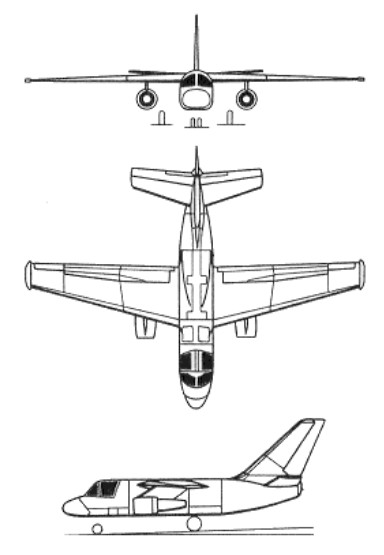
The S-3 is a carrier-based, subsonic, all-weather, long-range, multi-mission aircraft. It operates primarily with carrier battle groups in anti-submarine warfare roles. It carries automated weapon systems and is capable of extended missions with in-flight refueling.

The Viking’s primary flight controls are fully powered and are integrated with the automatic flight control system to relieve the pilot of routine anti submarine warfare manoeuvring. Primary flight controls are servo operated by dual hydraulic systems the loss of either hydraulic system results in the loss of half the available hinge moment. Reversion to manual control is automatic if both hydraulics are lost. In normal powered operation series inputs to the elevator and rudder servos compensate for pitching moments and provide turn co ordination and yaw damping. During autopilot operation parallel inputs to the power servos permit the pilot to, anticipate automatic manoeuvres.
The roll axis is controlled by short-span ailerons aug¬mented by differential spoilers mounted on the upper and lower surfaces of each wing. The servo actuators have artificial feel built in to minimise variations in manoeuvring forces throughout the flight envelope. Ailerons and spoilers act together for rolling, with the spoilers acting alone as airbrakes when required. During emergency manual opera¬tion when there is no hydraulic power the spoilers are inhibited and the control column operates only the ailerons.
The pitch axis is controlled by a hydraulically powered elevator servo; trim is via an electrically powered actuator. The elevator servo can be operated in normal powered, series or parallel modes. In the emergency manual mode, and in the normal powered mode, the servo is controlled by the pilot. In the series mode during manual approach with the approach power compensator on the servo is under the joint control of the pilot and the automatic flight control system.
Rudder control allows an engine failure to be coped with at low speed or following asymmetric stores release. The rudder servo, like that for the elevator, can operate: in normal power, series, parallel or emergency manual modes. During the fin folding sequence rudder pedal input to the rudder servo is disconnected to enable the pilot to continue steering the aircraft on the ground using the rudder pedals.

Lockheed S-3 Viking Article

The first S 3A Viking was rolled out at Lockheed’s Burbank, California factory on November 8 1971 and was first flown on 21 January 1972. The S-3A Viking replaced the piston-engined Grumman S-2 Tracker and entered fleet service in 1974. The last production S-3A was delivered in August 1978.

Used exclusively by the US Navy (firstly VS-41 in February 1974), a total of 187 were built before production ended in 1978, these being powered by two 9,275 lb thrust General Electric TF34 GE 2 turbofan engines.

Lockheed received an initial contract in April 1986 to supply 22 production conversion kits to modify S-3As to upgraded S-3B standard. Two S-3As were modified by Lockheed in 1984/85 to serve as S-3B prototypes, the first flying on 13 September 1984. The S-3B incorporates increased acoustic processing, expanded ESM coverage, improved radar processing, a new sonobuoy reference system, and Harpoon ASM capability. The S-3B version can be fitted with buddy stores, external fuel tanks that refuel other aircraft, to act as an airborne tanker.

Sixteen S-3As were converted to ES-3A Shadows for carrier-based electronic reconnaissance (ELINT) duties.

The Lockheed US 3A Viking car¬rier on board delivery development aircraft, a version of the S 3A Viking, was flown for the first time on 2 July1976. Four US-3As are used for COD. A few units were also converted for utility and limited cargo duty, known as the US-3B, all of which were retired by 1998.

Since the submarine threat has been perceived as reduced Vikings have had their antisubmarine warfare equipment removed and are now used primarily for sea and ground attack, sea surface search, over the horizon targeting, and aircraft refueling. As a result, crews are now usually limited to two people, but three people crews are not unusual with certain missions. Navy plans called for the retirement of all Vikings by 2009.

S-3B Viking

On May 1, 2003, US President George W. Bush rode in the co-pilot seat of a Viking that landed on the aircraft carrier USS Abraham Lincoln, where he delivered his “Mission Accomplished” speech announcing the end of major combat in the 2003 invasion of Iraq. That Navy flight is the only one to use the callsign “Navy One”.

Gallery

S-3A
Engines: 2 x General Electric TF34-GE-2 turbofan, 9275 lb (4207 kgp) thrust.
Wing span: 68 ft 8 in (20.93 m).
Length: 53 ft 4 in (16.26 m).
Height: 22 ft 9 in (6.93 m).
Wing area: 55.6 sq.m / 598.47 sq ft
Max take-off weight: 19280 kg / 42505 lb
Empty weight: 12070 kg / 26610 lb
Max. speed: 815 km/h / 506 mph
Cruise speed: 650 km/h / 404 mph
Ceiling: 11000 m / 36100 ft
Range w/max.fuel: 5700 km / 3542 miles
Crew: 4

S-3 Viking
Engines: 2 x General Electric TF-34-GE-400B turbofan engines rated at 9,275 lb thrust each
Length: 53 feet, 4 in
Wingspan: 68 ft, 8 in
Height: 22 feet, 9 in
Weights
Empty weight: 26,650 lb
Maximum takeoff weight: 52,539 lb
Speed: 518 mph
Ceiling: 40,000 ft
Range: 2,645 mi
Armament: Up to 3,958 lb
Crew: Four
Unit Cost: US$27 million

S-3B Viking

ES-3A Shadow

US-3A

US-3B

Lockheed S-3 Viking

Lockheed L.186 / P-3 Orion / Canadair CP-140 Aurora

P-3K

When in August 1957 the US Navy needed an advanced ASW/maritime patrol aircraft, it was suggested that a variant of a type then in production would be most suitable for this requirement. Lockheed proposed a developed version of the L-188 Electra, gaining an initial research and development contract on 8 May 1958.

Lockheed’s Model 186, which retained the wings, tall unit, power plant and other components of the commercial Electra, as well as much of the fuselage structure which was, however, shortened and provided with a 6.9m3 weapons bay, and there are 10 under-wing pylons for a variety of stores. The first Lockheed P 3 Orion, NP 3A BuNo 148276, was converted from the third L.188 Electra airliner by removing 7ft (2.1m) from the fuselage, flying from Burbank in August 1958. The air¬craft saw extensive use as an aero-dynamics test bed. It was eventually transferred to NASA.

Pressurised for the higher altitudes, the aircraft can operate from sea level, (usually 200ft minimum) up to 30,000 ft with a speed range from 140 to 405 knots. The engines are four x 4600 hp Allison turbo props with Hamilton Standard propellers. Maximum all up weight at take off is 14,500 lbs (6577 kg) higher than the original airliner at 127,500 lbs (57,800 kg) including a maximum of 60,000 lbs (34,000 lites) of fuel.

This was followed by the Lockheed YP3V-1 operational prototype, later named Orion, which first flew on 25 November 1959. The first production P3V-1 was flown on 15 April 1961, with initial deliveries being made to US Navy Patrol Squadrons VP-8 and VP-44 on 13 August 1962, by which time the type had been redesignated the P-3.

Lockheed P-3 Orion Article

P3V-1 Orion

In August 1963 a US Navy crew flew a P-3A nonstop from California to Japan, 5280 miles, in 14 hr 30 min. After several demonstration flights it returned nonstop in 14 hr 5 min.

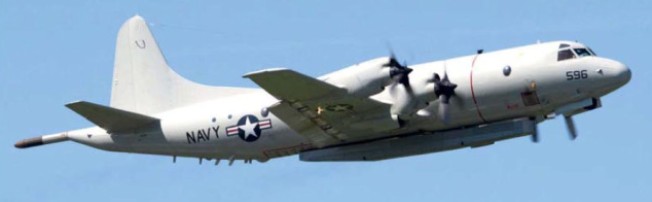
One hundred and fifty seven P-3As and 144 P-3Bs followed and production switched to the origi¬nal P-3C in 1968. P-3C is powered by 4,910 ehp (3 661 kW) Allison T56-A-14 turboprops. Progressive development of the P-3C’s systems through Update I and II has led to the production P-3C Update III model. The first P-3C Update III, with IBM Proteus acoustic processors, was delivered in May 1984. Update IV will improve the P-3’s ASW capability by the use of new acoustic processing systems and Litton AN/ALR-77 tactical ESM equipment. The P-3G would also feature Allison 501 turboprops in place of the T56-A-14s of the preceding model.

By 1994, production in Georgia was with wings built by Daewoo Aerospace in Korea and tail surfaces by Jetstream Aviation at Prestwick in Scotland, and remaining in production in the U.S.A. until 1995.

The first Kawasaki-assembled P-3C Orion was accepted by the Maritime Self-Defence Force at Gifu, Japan, on 27 May 1982. Flown for the first time on 17 March 1982, this aircraft was built from knocked-down components, and Kawwasaki was scheduled to deliver four more by March 1983. All were to be assigned to the 4th Air Group at Atsugi AB, near Tokyo.

Following the assembly in Japan of four P-3C aircraft from Lockheed-built components, Kawasaki produced the Lockheed Martin P-3C Orion for the JMSDF; 101st and final aircraft delivered in 1997, when four EP-3/UP-3D electronic intelligence/training variants remained to be delivered up to the year 2000.

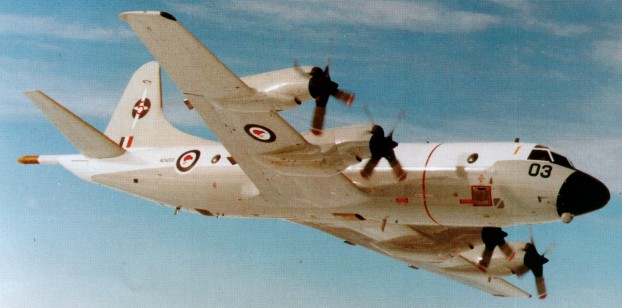
Other export P-3s feature various equipment changes: Australian P-3Cs used Marconi Avionics AQS-901 acoustic processing; the 21 Canadian CP-140 / CP-140A Auroras have S-3 Viking avionics; and New Zealand’s P-3Bs are fitted with Boeing’s UDACS display and control consoles.
The US Customs Service became the first customer for Lockheed’s P-3 (AEW&C) airborne early warning aircraft in May 1987. These aircraft will have a reduced mission system suitable for their task, while the full AEW&C aircraft would have a General Electric AN/APS-138 radar and APA-171 rotodome above the fuselage, together with a M1L1553A communications and data handling system. During 1984 Lockheed converted an ex-RAAF P-3B to serve as the AEW&C prototype, featuring the dorsal “rotodome”.
Designated EP-3Es and converted from P-3As, twelve versions serve with the US Navy to provide electronic surveillance. The EP-3s are equipped with APS-120 radar plus extensive jamming, detection and analysis equipment.

The significantly upgraded Australian Orions, designated AP-3C, were introduced into service in 2002 and are fitted with a variety of sensors, including digital multi-mode radar, electronic support measures, electro-optics detectors (infra-red and visual), magnetic anomaly detectors, identification friend or foe systems, and acoustic detectors.

The major changes since the Orion entered service have been in avionics equipment and capability, and more than 640 have been built to 1989, with the type then continuing in production (at Marietta, Georgia) until 1995/56 for South Korea, who ordered eight P-3C Update Ills in December 1990. Other Orions were in service in Iran, the Netherlands, New Zealand, Norway, Pakistan, Portugal, Spain and NASA and NOAA.

P-3 LSRS

The last of 18 upgraded AP-3C Orions was formally handed over to the RAAF in 2005. The first upgrade was performed by L-3 Communications in the USA and the remainder by L-3 and then Tenix in Australia. The programme was completed four years behind schedule.

L-3 Communications re-delivered the first of six P-3Ks to the RNZAF with sensor, communications and navigation systems upgrades in July 2005.

Gallery

P3V-1 Orion
Engines: 4 x Allison T56-A-10W, 4500 hp
Wing span: 99 ft 8 in
Length: 116 ft 8 in
Height: 33 ft 8 in
Wing area: 1300 sq.ft
MTOW: 125,500 lb
Max speed: 460 mph at 20,000 ft
Service ceiling: 27,000 ft
Endurnce -2 engines: 8 hr at 220 mph at 1000 ft

P-3B Orion
Engines: 4 x Allison, 4910 shp.
Wing span: 99 ft 8 in (30.37 m).
Length: 116 ft 10 in (35.61 m).
Height: 33 ft 8.5 in (10.29 m).
Max TO wt: 134,000 lb (60,780 kg).
Max level speed: 476 mph ( 765 kph).

P-3C Orion
Engine: 2 x Allison T56-A-14 turboprop, 4910 shp / 3661kW.
Installed thrust: 14,640 kW.
Wingspan: 30.38 m / 99 ft 8 in
Length: 35.61 m / 116 ft 10 in
Height: 10.27 m / 33 ft 8 in
Wing area: 120.77 sq.m / 1299.96 sq ft
Empty wt: 27,890 kg / 61492 lb
MTOW: 127,500 lb (57834 kg)
Heavywt model MTOW: 135,000 lb (61,236 kg).
Warload: 9070 kg.
Max speed: 476 mph @ 15,000 ft.
Cruise: 340 kt.
Initial ROC: 880 m / min.
Ceiling: 8600 m.
T/O run: 1290 m.
Ldg run: 845 m.
Fuel internal: 34,830 lt.
Max range: 4500nm.
Endurance: 3 hr on station.
Crew: 10
Air refuel: No.
Armament: 9000kg

P 3K
Engines: 4x Allison T56.
Length: 36m.
Wingspan: 30m.
Height: 10m.
Weight: 57,800kgs.
Max range: 7100kms (3850 NM).
Cruise speed: 260 750 km/hr.
Endurance: 15hrs with 2 engines shut down to conserve fuel.
Cruise speed: 195 205 km/hr.
Equipment: Rescue winch 270kg max load, nightsun search light, nightvision goggles.
Armament: 2 x M60D 7.62 machine guns.
Crew: 2 pilots, 2 flight engineers, 2 navigators, 1 air electronics officer, 3 air electronics ops, 1 air ordnanceman
Seating: up to 20.

NP 3A

EP-3E Orion
Engine: 2 x Allison T56-A-14 turboprop, 4910 ehp (3661 kW).

Lockheed Martin AP-3C Orion
Engine: Four Allison T56-A-14 (4600 shaft horsepower)
Length: 35.6m
Height: 10.44m
Wingspan: 30.8m
Maximum weight: 61,200Kg
Maximum speed: 750 km/h (405 knots),
Cruise speed: 650 km/h (350 kts) at 26,000 feet
Loiter speed:370 km/h (200 kts)
Endurance: 15 hours
Crew: 13, two pilots (captain and co-pilot), two flight engineers, tactical co-ordinator, navigator/communication officer, sensor employment manager, six airborne electronic analysts.

Lockheed P 3 Sentinel
Engine: 4 x T 56 A14, 3314 shp
Length: 116.798 ft / 35.6 m
Height: 33.793 ft / 10.3 m
Wingspan: 99.738 ft / 30.4 m
Wing area: 1300.291 sq.ft / 120.8 sq.m
Max take off weight: 142024.1 lb / 64410.0 kg
Weight empty: 61497.5 lb / 27890.0 kg
Max. payload weight: 80526.6 lb / 36520.0 kg
Max. speed: 410 kt / 760 km/h
Landing speed: 112 kt / 208 km/h
Cruising speed: 328 kt / 608 km/h
Initial climb rate: 1968.5 ft/min / 10.0 m/s
Service ceiling: 28297 ft / 8625 m
Wing loading: 109.27 lb/sq.ft / 533.0 kg/sq.m
Range: 2071 nm / 3835 km
Crew: 10

Lockheed P-3 Orion

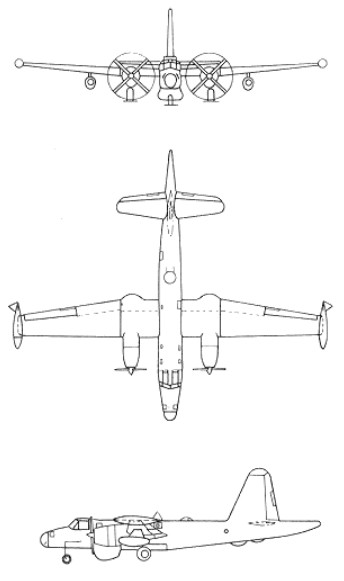
Lockheed P-2 Neptune

P2V-7 Neptune

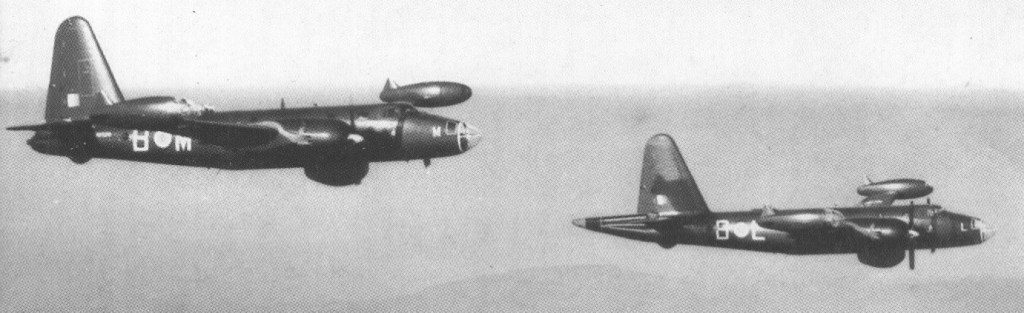
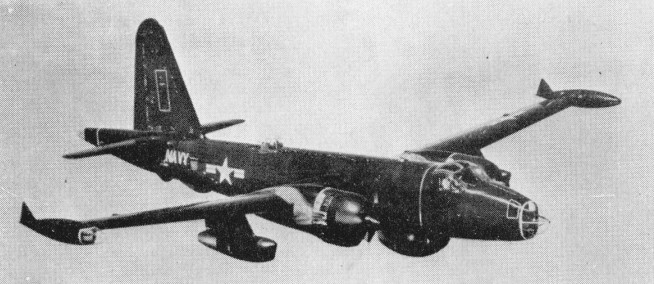
The first US Navy contract for two XP2V-1 Neptune maritime-reconnaissance bombers was placed in April 1944.

The P2V / P-2 has mid-set unswept wing, unswept tail surfaces, and conventional control surfaces. The ailerons drop 10 degrees when the Lockheed-Fowler flaps are fully extended. The tricycle undercarriage has a single wheel on each unit with the nosewheel retracting rearward and mains forward into the engine nacelles.

The first prototype flew on 17 May 1945. From then Lockheed received contracts for the P2V-1 to P2V-7 versions which were subsequently redesignated in the P-2 category.

Lockheed P-2 Neptune Article

Last versions in operational service were the P-2E (formerly P2V-5) which introduced the glazed nose, MAD tailboom, Julie/Jezebel ASW systems, etc, and later fitted with auxiliary underwing turbojets; SP-2E, as for the P-2E but with modernised equipment; P-2H, the first version to introduce auxiliary underwing turbojets and incorporating equipment and detail changes; and the SP-2H, as for the P-2H but with modernised equipment. These served with the Argentinian Navy (P-2H), Australian Air Force (SP-2H), Brazilian Air Force (P-2E), French Navy (P-2H), JMSDF (P-2H, and Kawasaki P-2J), Netherlands Navy (SP-2H), Portuguese Air Force (SP-2E) and the US Navy (SP-2H).

The USA supplied Britain with P-2 Neptune under the Mutual Defence Aid Pact. British Neptunes served in four squadrons from 1952 to 1957.

Truculent Turtle

In 1946 US Navy Neptune ‘Truculent Turtle’ flew non-stop 11,229 miles from Perth, Australia, to Columbus, Ohio.

The P 2H Neptune was a variant used by the Maritime Patrol Command of the Canadian Armed Forces.

On 6 November 1951 a Lockheed P2V Neptune from VP-6 Squadron of the US Navy was shot down over the Sea of Japan near the Soviet naval base at Vladivostok. The Neptune, with a crew of 10 on board, was to have reconnoitred the weather near the Siberian coast.
On 18 January 1953 an American P2V-5 Neptune maritime reconnaissance aircraft was shot down by Chinese MiG fighters near (over?) the coastal town of Swatou, opposite Taiwan. All thirteen crew were killed. The number of occupants appears to be a little on the high side for a normal patrol flight. In those days it was not unusual for American aircraft to drop secret agents over the People’s Republic of China. Such ‘cover-flights’ were usually flown from Nationalist Chinese Taiwan.
On 4 September 1954 the third Neptune went down. A P2V-5 of the American Naval Squadron VF-19 was shot down by two Soviet MiG-15 over the Sea of Japan, about 40 miles from the Siberian coast. The Neptune, originating from Atsugi airbase in Japan, forced-landed in the sea after the attack. Nine of the ten crew escaped and were rescued later.
On 22 June 1955 Soviet jets attached an American P2V-5 Neptune from Patrol Squadron VP-9 over the Bering Strait. With the starboard engine on fire the Neptune had difficulty in fore-landing near Gambell on St. Lawrence Island, barely 60 miles / 100 km from the Soviet coast but United Stated territory. Three crew members were injured during the Soviet attack. Washington demanded compensation of $724,947 but later accepted a Soviet offer of half that.

A small number of P2V 2 and P2V 7 Neptunes were in service with ski landing gear for operations in the Antarctic.

P2V-7 Neptune

Kawasaki developed from the Lockheed P 2H Neptune a new ASW and maritime patrol bomber which has the designation P 2J. First flown in July 1966, the P-2J ¬differed from the P-2H in having a lengthened fuselage, and 2,850 ehp General Electric T64-1HI-10 turboprops replacing original piston engines, plus underwing 3,085 lb st (1400 kgp) J3-1H1-7C turbojets.

Entering service with the JMSDF in 1969, the last of`82 production aircraft was delivered in 1979. Sixteen P2V-7 were supplied from the USA before Japanese production began. Armament of the P 2J comprises up to 8,000 lb (3,628 kg) of bombs, depth charges, or tor¬pedoes carried internally, and 16 5 inch rockets underwing.

An approach in Vietnam was the monitoring of electronic sensors on the ground, the signals being received by the AP 2E Neptune.

Between 1945 and 1962, 1195 were manufactured.

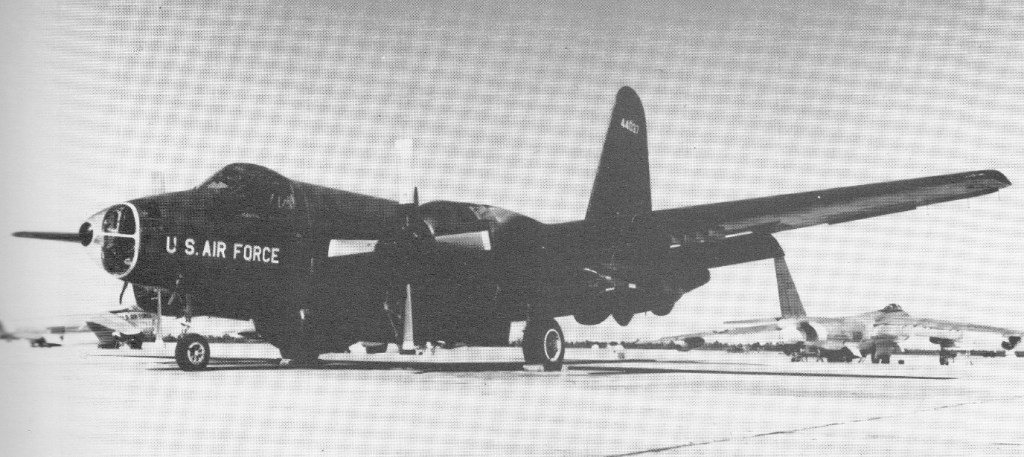
The CIA purchased seven Lockheed P2V-7U Neptunes for the USAF for clandestine missions along the Iron Curtain and beyond. The US Navy had not wished to be involved but the Navy bought the aircraft and the USAF operated them, with USAF markings. The USAF stated at the time they were purchased as RB-69 radio trainers.

RB-69

The RB-69 were converted by Lockheed into multi-purpose spying aircraft. They were able to perform low-level photographic reconnaissance, and with advanced ELINT equipment, electronic surveillance flights. Agents could be dropped through a panel in the belly, and tens of thousands of pamphlets could be dropped. Flights were planned from Eglin Air Base in Florida.
The USAF Neptunes were observed from 1957 in Taiwan, in Japan, and on Wiesbaden airbase in West Germany. From Wiesbaden the blue-black RB-69 flew with a number of additional bulges and with two pencil-shaped antennas alongside the fuselage. The aircraft carried the first sideways-looking radar system and operated until modified to ordinary SP-2H Neptunes for anti-submarine warfare.

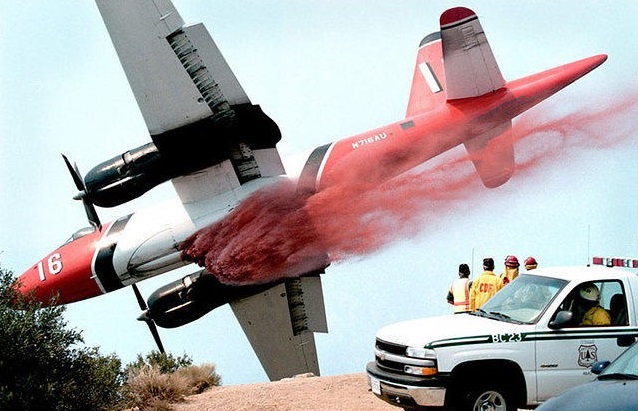
Hawkins & Powers enveloped civil conversions of C-130 and P2V-7 under TC A19NM, A30NM, and A34NM in the Restricted category as borate bombers for forest fire control.

Gallery

P-2 Neptune
Engines: 2 x Wright R-3350-32W, 2575kW
Max take-off weight: 36191 kg / 79788 lb
Empty weight: 22592 kg / 49807 lb
Wingspan: 31.7 m / 104 ft 0 in
Length: 27.9 m / 91 ft 6 in
Height: 8.9 m / 29 ft 2 in
Wing area: 92.9 sq.m / 999.97 sq ft
Max. speed: 648 km/h / 403 mph
Ceiling: 6800 m / 22300 ft
Range w/max.fuel: 5930 km / 3685 miles
Armament: 2 x 12.7mm machine-guns, bombs, missiles, torpedos
Crew: 7

P2V-5 Neptune
Engines: 2 x Wright, 3250 hp.
Wing span: 102 ft 0 in (31.08 m).
Length: 81 ft 7 in (24.87m).
Height: 28 ft 1 in (8.56 m).
Max TO wt: 76,152 lb (34,542 kg).
Max level speed: 341 mph ( 549 kph).

P2V Neptune
Length: 91.667 ft / 27.94 m
Height: 29.331 ft / 8.94 m
Wingspan: 103.904 ft / 31.67 m
Max take off weight: 80085.6 lb / 36320.0 kg
Max. speed: 309 kts / 573 km/h
Service ceiling: 22014 ft / 6710 m
Range: 3202 nm / 5930 km
Engine: 2 x Wright R-3350-32W, 3452 hp
Crew: 7
Armament: 3630kg

P2V-7 Neptune
Engines: 2 x Wright R3350-30W Turbo-Cyclone 3,250 hp, 2 x Westinghouse J34 turbojets, 3600 lb
Wingspan: 103 ft. 10 in
Length: 91 ft. 8 in.
Height: 29 ft 4 in
Wing area: 1000 sq.ft
Empty weight: 49,808 lb
Loaded weight: 72,000 lb
Fuel capacity: 1832 gal
Opt bomb bay fuel: 583 gal
Crew: 7
Max speed: 421 m.p.h.
Ceiling: 31,000ft
Service ceiling: 22,000 ft
Range: 3,700 miles at 175 mph at 1000 ft
Armament: 2x.50 in. machine-guns later 4 x 20mm canon
Bombload: 2×294 mm. rockets or 8,000 lb; plus 16 x 5-in. rockets under wings.

AP 2E

Kawasaki P 2J
Wing span is 97 ft 8.5 in (29.78 m).
Max cruise: 250 mph (402 km/h).

Lockheed P-2 Neptune

Lockheed L-1011 Tristar

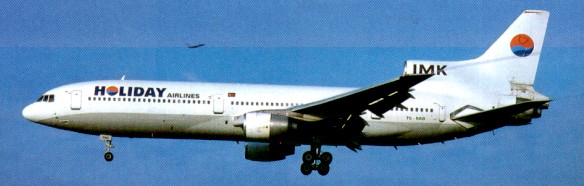
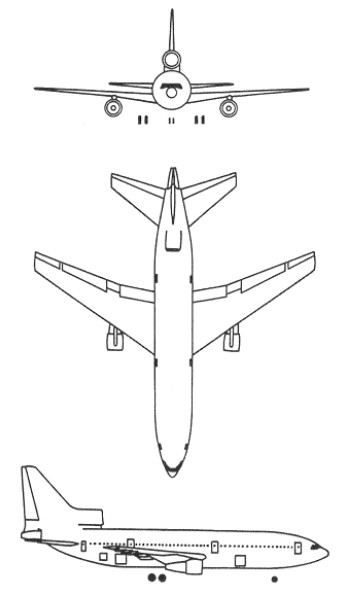
Lockheed L-1011 Tristar

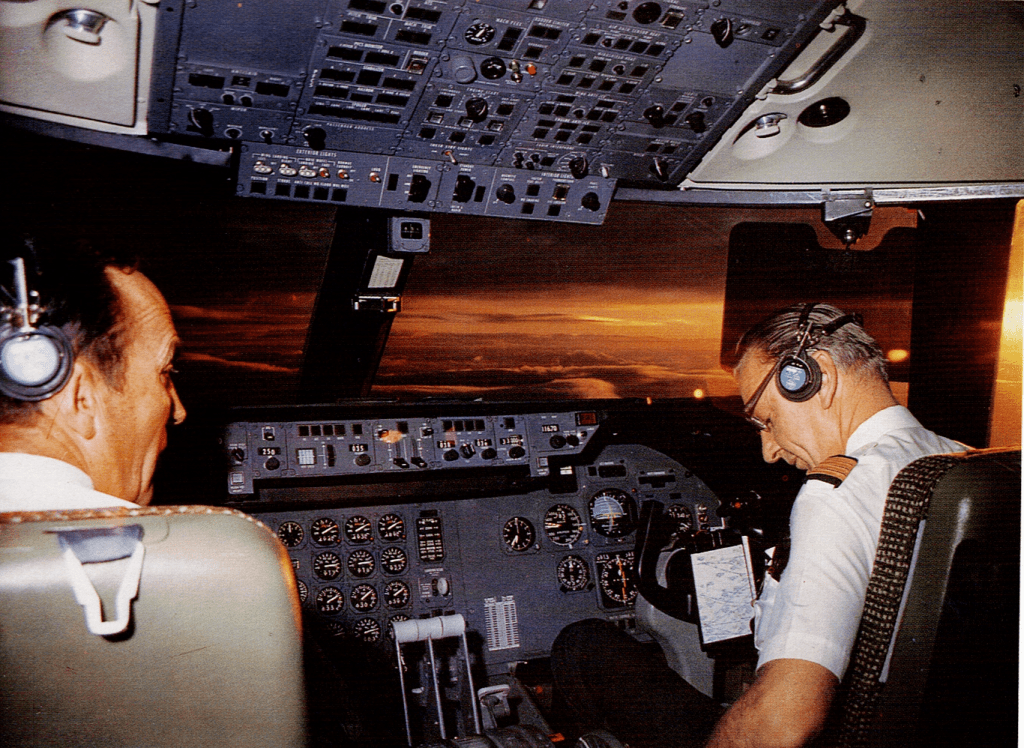
In the 1960s, American Airlines approached Lockheed and competitor Douglas with a need for an aircraft smaller than the existing 747, but still capable of flying to distant locales such as London, the Caribbean, and Latin America from company hubs in Dallas/Ft Worth and New York. The Model L-1011 was designed to enter this category with optimum payload-range performance and short-field characteristics. The Model L-1011 is powered by three 42,000-lb. s.t. turbofan engines, two of which are mounted in pods underneath each wing, and the third is located in the rear of the fuselage at the base of the tail unit. The TriStar’s engine is integrated into the tail through an S-duct for improved quietness and stability. Fuel is carried in two integral wing tanks and an inboard tank. With a full load, the TriStar can travel a maximum of 4,467 miles. Accommodations provide for 256 passengers in a mixed coach and first-class arrangement or a maximum of 400 passengers in a high density all-economy configuration.

Lockheed L-1011 Tristar Article

First flown on November 16, 1970, the twin-aisle TriStar’s design schedule closely followed that of its competitor, the DC-10, Douglas beat Lockheed to market by a year due to delays in powerplant development. Rolls-Royce, the maker of the TriStar’s RB211 turbofan engines, had filed for bankruptcy, halting L-1011 final assembly. The first flight was powered by Rolls Royce RB.211 high by pass ratio turbofan engines, from Palmdale, California.

The British government did not approve the large state subsidy used to restart Rolls-Royce operations until after the U.S. government had guaranteed the Lockheed loans previously provided to Rolls for the extensive engine contract. (The UK Goverment also took the contentious step (for a Conservative administration) of taking the aero-engine side of RR into public ownership, to maintain national defence capability). Its first revenue flight, for Eastern Air Lines, was made on 26 April 1972.

A longer-range variant of the standard-length L-1011 was developed in the late 1970s. Designated the L-1011-500, the fuselage length was shortened by 14 feet (4.3 m) to accommodate higher fuel loads.

Ironically, American Airlines never flew the “Ten Eleven,” purchasing many DC-10s instead.

Lockheed manufactured a total of 250 TriStars, ceasing production in 1984. Lockheed needed to sell 500 planes to break even. Failing to achieve profitability in the civilian airliner sector, the TriStar was to be Lockheed’s last commercial aircraft.

Flying all of its life on test and development work, the prototype was acquired by Aviation Sales of Ardmore in August 1986.

Gallery

L-1011 Tristar
Engines: 3 x Rolls Royce RB.211 22B turbofan, 42,000 lb / 180.5kN
Wing span: 155 ft 4 in (47.34 m).
Length: 178 ft 8 in (54.35 m).
Height: 55 ft 4 in (16.87 m).
Wing area: 312.1 sq.m / 3359.41 sq ft
Empty wt. 102000 kg / 222,941 lb
Max TO wt: 430,000 lb (195,045 kg).
Fuel capacity 23,814 USG
Max level speed: M0.9.
Cruise 474 mph.
Stall 144 mph.
Initial climb rate 2,800 fpm
Ceiling: 42,000 ft.
Range w/max.payload: 5000 km / 3107 miles
Pax cap: 345.
Takeoff run 7,590 ft
Landing roll 5,660 ft
Crew: 2-3

Lockheed L-1011 Tri Star

Lockheed L-1649 Super Constellation / Constellation Starliner

L.1649A Super Constellation

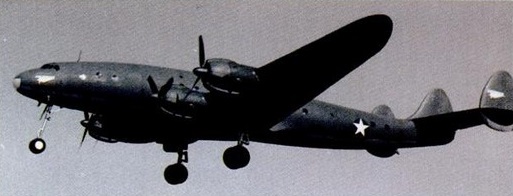
Lockheed built 286 Super “Connies,” then followed with production of the L.1619 Starliner. This development of the Model 649 standard Constellation actually started in when Lockheed were attempting to meet the requirements of TWA. Modified into a military transport during the Second World War, the design was reconverted into an airliner which came at the right time to equip airlines starved of new aircraft by the war.

The Super Constellation was first introduced on transatlantic services by KLM in 1953.

With a range of 7,200 miles, the Starliner became popular on long international routes for TWA and Air France. Only 43 Starliner Constellations were built, and most of those were short lived, bowing out gracefully for the introduction of the jet age. A historical note about the Connie’s heritage: the tri-tailed airliner was the first Air Force One.

US Navy designation – Lockheed R7V-1 Super Constellation.

In 1963 Flying Tiger VP Fred Benninger required a Super H Connie for less than the going price of $500,000. Finding two Navy surplus Elations, Connies with Electra engines, the fuselages were right but not the wings. Two cheap South American 1049G’s and four months of fitting parts produced two cargo planes for less than the price of one.

1988

Gallery

Lockheed Super Constellation
Engines: 4 x Wright, 3250 hp.
Wing span: 123 ft 0 in (37.49 m).
Length: 113 ft 7 in (34.65 m).
Height: 24 ft 9 in (7.56 m).
Max TO wt: 133,000 lb (60,380 kg).
Max level speed: 352 mph (563 kph).

EC 121K Warning Star
Engines 4 x 3,400 h.p. Wright R 3350 turbo compound piston engines.
Length 113.6 ft. (34.62 m.)
Wing span 123 ft. (37.47 m.)
Weight, max 137,500 lb. (62,370 kg.)
Crew 6.
Pax cap: 65 89
Max cruise 310 m.p.h. (500 km.p.h.)
Range 4,800 miles (7,700 km.) with 18,000 lb payload

Lockheed L.1049 Constellation

A stretched version of the L.749, the L.1049 Super Constellation, was introduced in 1950. Gross weight was increased substantially when the fuselage was expanded by 18.4 feet and 3,250-hp Wright engines were fitted. The stretched “Connie” held up to 91 passengers; with tip tanks, range was increased to 5,840 miles.

The first prototype Super Constellation (a conversion of the original C-69 prototype) flew for the first time on 13 October 1950. First in commercial service (on 15 December 1951) was one owned by Eastern Air Lines. This version could accommodate 71 first-class or 95 coach-class passengers (14 delivered to Eastern and ten to TWA during 1951-52).

Lockheed L.1049 Constellation Article

The L.1049C model had structural modifications to allow a gross weight of 150,000 pounds, provided that more powerful engines were available. Lockheed built 286 Super Connies.

L-1049 Super Constellation were in use by both the USAF and US Navy under a variety of C-121C and R7V-1 designations respectively.

Gallery

Lockheed C 121G Super Constellation
Engine: 4 x Wright R 3350-91, 3501 hp
Length: 116.175 ft / 35.41 m
Wingspan: 122.999 ft / 37.49 m
Max take off weight: 144917.0 lb / 65722.0 kg
Max. speed: 320 kt / 592 km/h
Range: 1825 nm / 3380 km
Crew: 5
Payload: 72 Pax

L-1049G
Engines: 4 x 3400hp Wright R-3350-972T-C18DA-3
Max take-off weight: 130,000 lb
Empty weight: 33119 kg / 73015 lb
Wingspan: 37.62 m / 123 ft 5 in
Length: 35.41 m / 116 ft 2 in
Height: 7.55 m / 24 ft 9 in
Wing area: 154.40 sq.m / 1661.95 sq ft
Cruise speed: 589 km/h / 366 mph
Ceiling: 6950 m / 22800 ft
Range: 6700 km / 4163 miles
Crew: 4
Passengers: 62-109

RC-121
Max Take Off Weight: 142,000 lb

Lockheed L-1049 Super Constellation / EC-121

Lockheed L.749 Constellation / C-121 / WV-2 / R7V

749A Constellation

The Lockheed Constellation L.749 variation was a long-range version of the earlier L.049. The first Constellation placed in airline service was the L.749 series. This aircraft differed from earlier versions in its increased fuel capacity and takeoff weight. The L.749 provided for 44 to 64 passengers and was powered by four 2,500-hp Wright Cyclone 18-cylinder air-cooled engines.

The 749 Constellation was operated by the military as the C-121A and C-121B.

EC-121

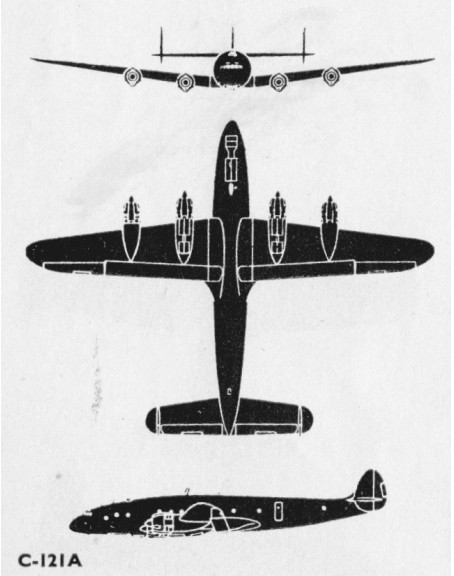
In service with both the U.S. Navy (WV-2) and U.S.A.F. (RC-121C) in 1955 as high-altitude early-warning radar picket. The WV-2 has very large dorsal and ventral radomes, which are not found on R7V transport versions. Basically-similar transport versions are the R7VA (U.S.N.) and C-121C. Experimental turboprop powered R7V-2 also flying. Earlier C-121A and VC-121B with shorter (95 ft. 1 in) fuselages were also in service in 1955.

Lockheed L.749 Constellation / C-121 Article

WV-2

Gallery

WV-2
Reconnaissance and early-warning aircraft
Engines: 4 x Wright R3350-34W Turbo-Cyclone, 2,250 h.p.
Wingspan: 123 ft
Length: 113 ft. 7 in
Loaded weight: 130,000 lb
Max. speed: 350 mph
Max. range: over 4,000 miles at 330 mph
Crew: Up to 31

Lockheed L.049 Constellation / C-29

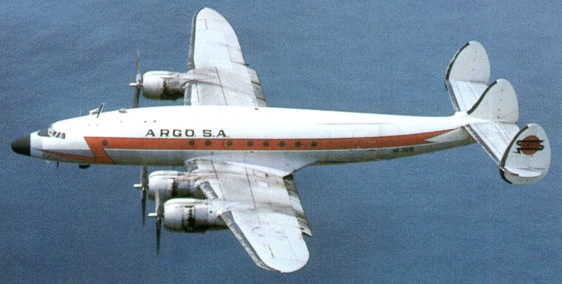
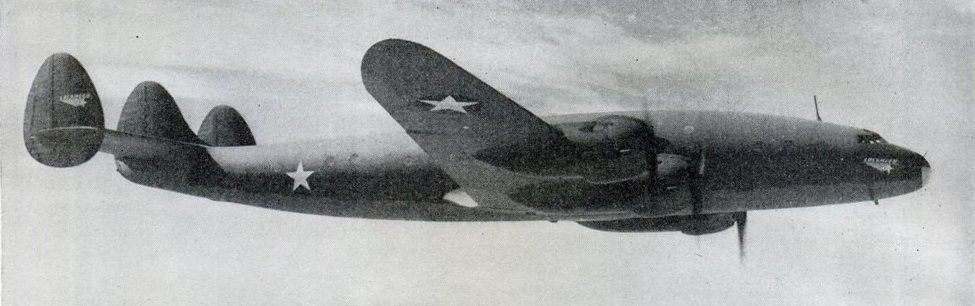
In 1939 TWA formulated a requirement for a long-range transport and C. L. Johnson designed the 558km/h Constellation. The earliest Constellation was initially flown in January 1943. Designed for commercial transport, the first Constellations were produced for the U.S. Air Force as C-29s.

Engines: 4 x Wright R-3350-35 Cyclone 18, 2170 hp
Length: 95.177 ft / 29.01 m
Height: 23.655 ft / 7.21 m
Wingspan: 122.999 ft / 37.49 m
Wing area: 1650.014 sqft / 153.29 sq.m
Max take off weight: 72013.1 lb / 32659.0 kg
Weight empty: 50507.7 lb / 22906.0 kg
Max. speed: 287 kts / 531 km/h
Cruising speed: 261 kts / 483 km/h
Service ceiling: 25000 ft / 7620 m
Wing loading: 43.67 lb/sq.ft / 213.00 kg/sq.m
Range: 2085 nm / 3862 km

Lockheed L.188 Electra

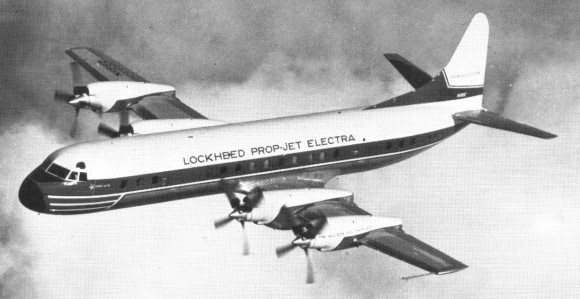
The design of the Lockheed L-188 Electra began in 1954, and in the following year the company received a launching order from American Airlines.

By the first flight, 144 were already on order. The prototype, first flown on 6 December 1957, was a low-wing monoplane of conventional configuration with retractable tricycle landing gear and powered by four Allison 501D-13, 501D-13A or 501D-15 turboprop engines. Standard accommodation was for 66 to 80 passengers, but a high-density arrangement was available optionally to seat 98.

Several crashes occurred in 1959 that caused Lockheed Corp. to make a few improvements including a stronger wing structure and engine nacelles plus thicker wing skins.

Built initially as the L-188A, the Electra became available also as the longer-range L-188C with increased fuel capacity and operating at a higher gross weight. A total of 170 had been built when production ended unexpectedly early as a result of passenger loss of confidence in the type after two had disintegrated in flight, and by the time remedial modifications had been, incorporated customer airlines were interested in turbojet- rather than turboprop-powered aircraft. About half of the total built remained in service in 1992, many of them converted by Lockheed Aircraft Service for convertible passenger/cargo or all-cargo use.

Gallery

L-188A Electra
Engines: 4 x Allison 501D-13, 2796kW / 4600 hp
Propellers: Hamilton Standard
Max take-off weight: 51256 kg / 113001 lb
Empty weight: 26036 kg / 57400 lb
Wingspan: 30.18 m / 99 ft 0 in
Length: 31.85 m / 104 ft 6 in
Height: 10.01 m / 32 ft 10 in
Wing area: 120.77 sq.m / 1299.96 sq ft
Cruise speed: 652 km/h / 405 mph
Ceiling: 8655 m / 28400 ft
Range: 3541 km / 2200 miles
Crew: 5
Passengers: 44-98

Engines: 4 x 4,050 h.p. Allison 501 D15 turboprop.
Length 104.5 ft. (31.81 m.)
Wing span 99 ft. (30.18 m.)
Weight empty 57,300 lb. (25,990 kg.)
MTOW: 113,000 lbs (51,227 kg).
Pax cap: 99.
Max cruise 405 m.p.h. (650 km.p.h.)
Ceiling 28,400 ft. (8,655 m.)
Range 2,770 miles (4,458 km.) with 18,000 lb. (8,165 kg.) payload
Cabin width: 10 ft 8 in.
Takeoff run 4,720 ft
Landing roll 4,300 ft

Lockheed L-188 Electra