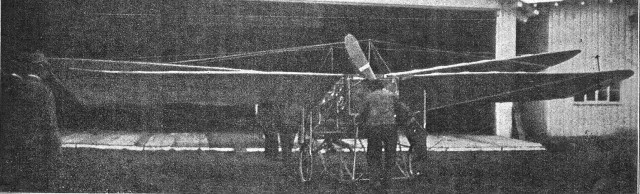
This long-lived machine went through an unusual series of modifications. It was built by the Kieler Maschinenfabik Mordhorst, Germany, in 1908 as a “Dreiflächner”, with three wings in tandem, for Otto Fritzsche, but Fritsche was killed in a car accident before a meeting in Kiel where he wanted to compete. Carl Loew took over the machine in 1909 and the Rumpler workshops removed one of the wings pairs and installed an Aeolus engine, but he still couldn’t get the craft in the air. After yet another another rebuild it looked more like a normal Taube monoplane and was equipped with a Daimler engine. In this configuration it flew in 1911, piloted by Loew. After a successful flight over the Baltic from Sonderburg in Nordschleswig (now Sønderborg, Denmark) to Kiel he donated the machine to the Kaiserliche Marine, who equipped it with floats and named it E.1. The E.1 survived until the beginning of 1914, when it was destroyed in a crash in Tsingtao, China.
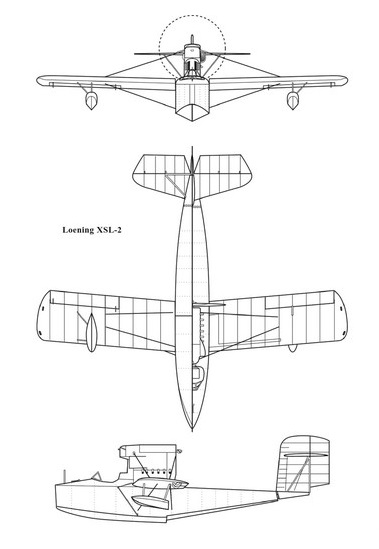
The Loening SL was the last type of airraft used in a series of Navy experiments, conducted intermittently from 1923 to 1933, to develop a small seaplane that could be deployed from a submarine. The aircraft had to be designed so that it could be easily dismantled and stowed in a watertight, eight foot diameter tube carried on the deck of the submarine. In 1930 BuAer decided to reinstate the idea with a small monoplane flying boat, and in June 1930, awarded Loening a contract to construct a single prototype as the XSL-1. The design emerged with a semi-cantilever monoplane wing which attached to the top of a single-step metal boat hull. The Warner engine, mounted on struts in a pusher configuration, featured a ring cowl and a small bullet-shaped nacelle. Stowage in the sub tube was accomplished by simply removing the wings and stabilising floats.
The prototype was delivered to NAS Anacostia for trials in February 1931. When testing revealed the XSL-1 to be underpowered with the Warner engine, it was returned to the factory for installation of a 160 hp Menasco B-6 and a more streamlined engine mount. The revised aircraft, re-designated XSL-2, resumed testing at Anacostia in early 1933 but these trials indicated only a nominal improvement in performance. Soon afterwards the Navy abandoned the entire program when the XSL-2 suffered serious damage during exercises with a submarine.
XSL-1 Engine: Warner Scarab, 110 hp Prop: 2 blade fixed pitch metal Wing span: 31 ft 0 in Length: 27 ft 2 in Wing area: 148 sq.ft Empty weight: 1114 lb Gross weight: 1512 lb Max speed: 101 mh Cruise: 88 mph Ceiling: 13,000 ft
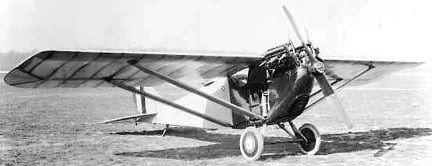
The Wright-Martin M-8 was a contract-built Loening M-8. Production was cancelled by WW1 Armistice, but the one for USN (A5631) was likely modified as a Pulitzer racer.
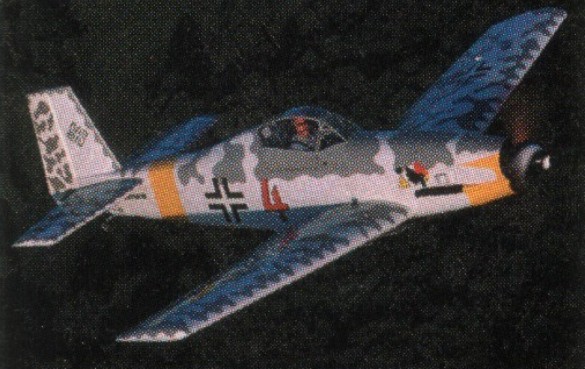
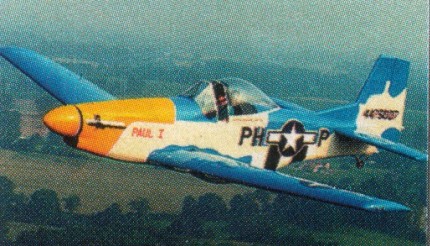
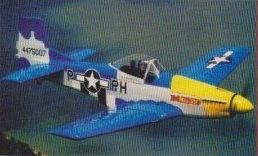
A 75% scale ultralight P-51 Mustang that qualifies as an LSA. The entire 5151 kit is designed for the inexperienced builder and is estimated to be completed in 400-500 hours. Almost all parts are pre-cut to exact dimensions, grooved, shaped and even tapered to ensure a perfect fit. The gussets and stringer attach pieces used in large quantity in the airframe are die cut like in a good model aircraft kit. The canopy and metal parts are also pre cut and those “difficult to make” parts are even preformed, predrilled and ready to assemble. All hardware comes separately packed and labelled for each section of the aircraft to avoid loss or confusion where parts go. The airframe kit includes everything to build the aircraft less engine, instruments and paint. Covering material and fabric glue, prop, tyres etc., and the enormous 18 inch custom spinner is also included in the airframe kit. Although the ROTAX 582LC is the recommend engine, there are several engine options including a 4 cyl., in-line 4-stroke engine available.
The construction of the 5151 Mustang consists more of an assembly than actually building, since all parts are highly prefabricated. Much of the assembly is of geodetic construction which, while it looks “fussy” it is actually a simple technique producing an exceptionally strong airframe for the structure’s weight. The fuselage consists of a conventional simple box-type construction which is transformed by formers and stringers into the shape of a P-51. The heart of the 5151 is the massive 10 x 12 inch centre section box spar which takes the optional wing tanks and the retractable or fixed landing gear, which ever the builder desires. The outer box spar i.e. wing panels attach to the centre section and are removable for storage or trailer, which leaves a foot wide structure on the landing gear for easy handling. Once the spar is assembled, the wing ribs simply attach to the spar and no jigs are needed since the aircraft is designed to be built on a flat bench. Also a remarkable feature is the technique used by the designer to virtually eliminate building errors in those critical components such as washout, taper etc., since the wing is tapered and all 12 wing ribs are different.
All tail surfaces are also built conventionally and consist simply of a leading edge spar, pre-cut trailing edge, ribs and geodetic bracing. The ribs are built over full-size drawings and are also built on the workbench, just as the entire rudder, elevators and vertical stabilizer. The retractable landing gear and also the fixed version is made of 4130N 2 inch chromolly tubing and comes tack welded.
The 5151RG has retractable undercarriage.
5151-RG
By 2014, the covering no longer came as part of the kit (available separately though), and only the Rotax 582 engine was offered. Ribs are solid wood – already cut to proper airfoil shape; simply require cap strips upper and lower.
5151 Engine: Rotax 503, 50 hp. Speed max: 95 mph. Cruise: 75 mph. Range: 325 sm. Stall: 28 mph. ROC: 700 fpm. Take-off dist: 150 ft. Landing dist: 250 ft. Service ceiling: 12,500 ft. Fuel cap: 5-13 USG. Weight empty: 513 lbs. Gross: 885 lbs. Height: 6 ft. Length: 22.9 ft. Wing span: 27.4 ft. Wing area: 130 sq.ft. Seats: 1. Landing gear: tail wheel.
5151 RG Engine: Rotax 582, 65 hp. Vne: 100 mph/ 89 kt. Cruise: 85 mph/ 79 kt. Range: 325 nm. Stall: 30 mph/27 kt. ROC: 1200 fpm. Take-off dist: 150 ft. Landing dist: 250 ft. Service ceiling: 12,500 ft. Fuel cap: 13 USG. Weight empty: 600 lbs. Gross: 885 lbs. Height: 6 ft. Length: 22.9 ft. Wing span: 27.4 ft. Wing area: 130 sq.ft. Seats: 1. Landing gear: tail wheel, retractable.
5151-RG Engine: Rotax 582, 64 hp Wing span: 8.4 m Wing area: 12.7 sq.m MAUW: 300 kg Empty weight: 203 kg Fuel capacity: 25 lt Max speed: 150 kph Cruise speed: 150 kph Minimum speed: 55 kph Climb rate: 4.2 m/s Certification: Vz Seats: 1 Fuel consumption: 13 lt/hr Kit price (1998): $7995
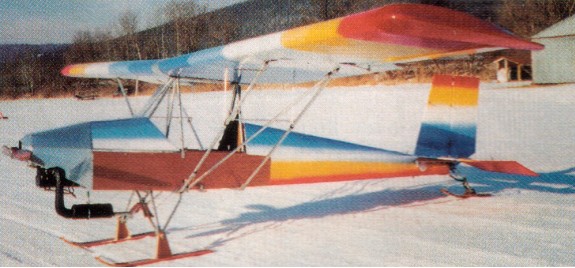
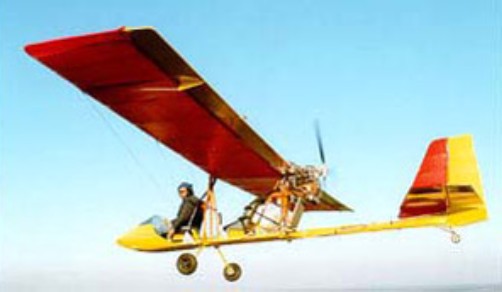
Produced by the Maxair Aircraft Corporation at the height of the ultralight boom, the original single-seat Drifter featured a 28-hp Rotax 277 engine. Its cable-braced wing and aluminum fuselage tube resulted in a rigid design that was soon expanded to include a two-seat trainer version and a short-wing, overpowered single-seat hot rod that was well outside ultralight limits. Some Drifters were equipped with monohull or dual floats.
Maxair declared bankruptcy in 1991, and the Drifter project was picked up by Phil Lockwood, who had worked for Maxair.
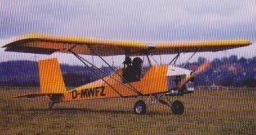
His company, Lockwood Aircraft, now kits the Super Drifter, an LSA, two-seat version powered by an 81-hp, four-stroke Rotax 912UL engine. With its standard 10-gallon tank, the Super Drifter claims a range of about 200 nautical miles at a cruise speed of about 60 knots—perfect for low-altitude, warm-weather exploring or short trips.
The two-seat Drifter and the similarly configured Air Cam has conventional controls and handling, and power is more than adequate. It’s worth noting that the rather short main landing gear legs and a long fuselage result in a nearly level three-point attitude on the ground. First-time front-seat pilots would benefit from climbing aboard, sitting awhile, and noting the angle between the Drifter’s small nose cone and the horizon. That’s the ideal landing attitude, and there is little ahead for a pitch reference.
Engine: Rotax 912, 80 hp HP range: 50-80 Length: 22 ft Wing span: 30 ft Wing area: 160 sq.ft Empty weight: 495 lb Gross weight: 1100 lb Fuel capacity: 10 USG Cruise: 70 mph Stall: 34 mph Range: 230 sm Rate of climb: 1000 fpm Takeoff dist: 200 ft Landing dist: 300 ft Landing gear: tailwheel
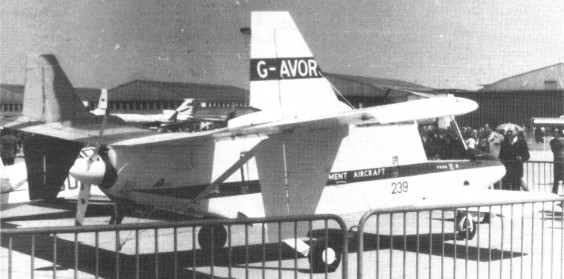
David Lockspeiser attempted to develop LDA (land development aircraft) general utility aircraft over two decades up to mid-1980s, with rear-mounted main wings and large canards, and rear-mounted engine with pusher propeller. A 70 percent-scale prototype flew 1971 as G-AVOR c/n LDA-01 and given PFA number 1346.
Construction was started at Shalford, UK, and the final assembly was done at Wisley. The two rear wing sections are interchangeable with each other and with the forward wing, which is mounted underneath the fuselage. The angular fuselage was capable of taking an underslung cargo pannier. A four unit undercarriage was fitted.
It was flown for the first time at Wisley on 24 August 1971 powered by a Continental C85-12. Initially it flew with a twin fin/rudder assembly but later a non-moving central fin was added.
In 1974, after a period of testing, the prototype was re-engined with a Lycoming O-320-D1A and given a conventional three unit undercarriage. The provision for the pannier was also removed. It appeared at the 1975 Paris Salon at Le Bourget France.
The intended full-size LDA-500 Boxer and larger LDA-1000 Boxer were designed.
Span: 29.00 ft Fore plane span: 13.00 ft Length: 22.06 ft

 All Aero