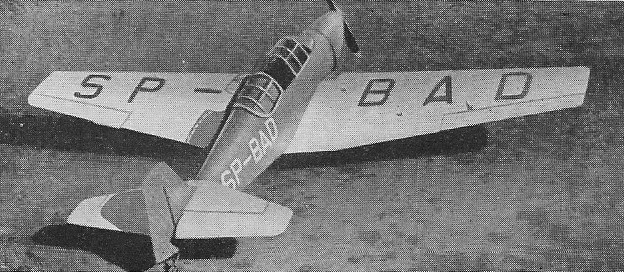
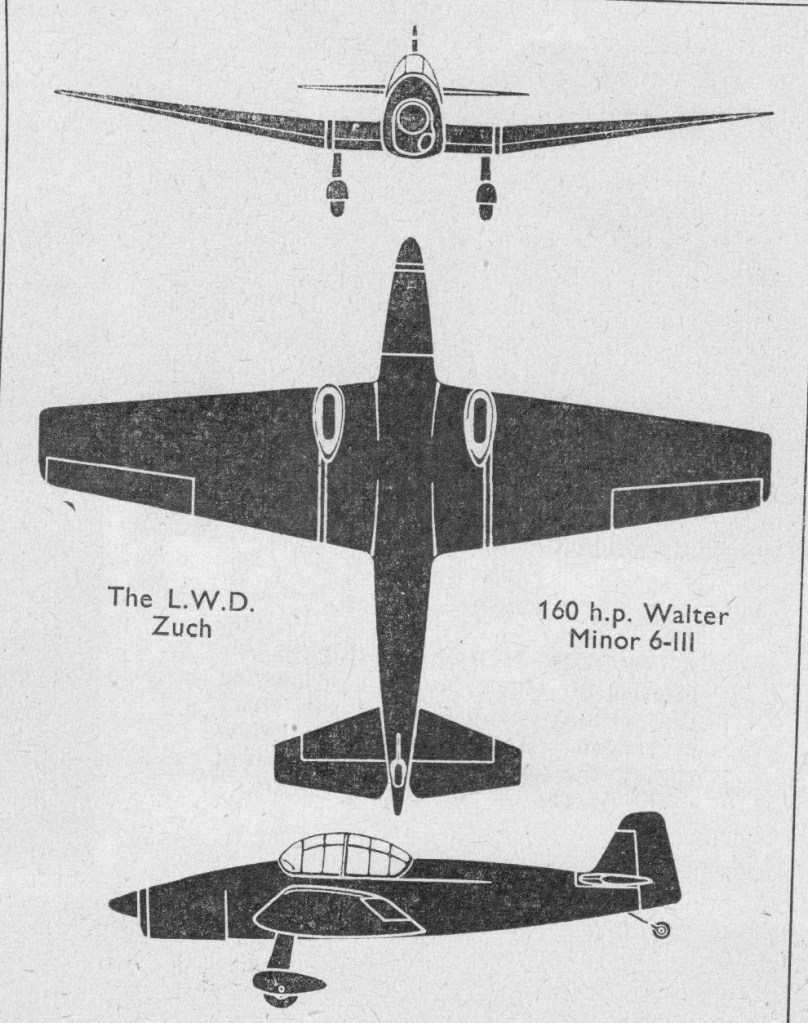
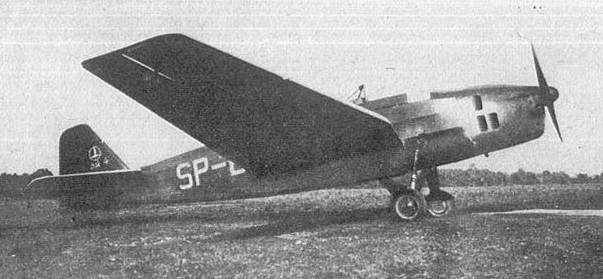
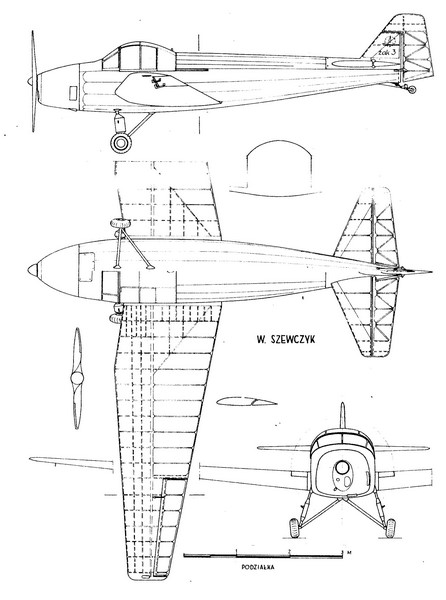
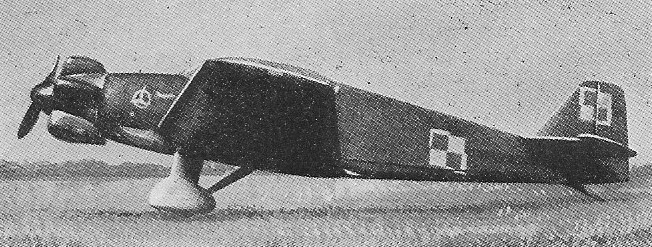
The Zuch-1 (Dare-Devil) was produced in 1948 by LWD / Lotnicze Warsztaty Doswiadczaine as a development of the Junak. Employing the same basic wing and fuselage, the Zuch-1 was powered by a 180 hp Walter Minor 6-III engine.
Designed as a two-seat primay training monoplane, the Zuch-1 has a welded steel-tube fuselage and centre wing section, and wooded outer wing panels, the whole covered by plywood and fabric.
Engine: 180 hp Walter Minor 6-III Max speed: 155 mph Cruise: 130 mph Range: 930 mi Empty weight: 1250 lb Loaded weight: 2200 lb Wingspan: 32 ft 9.5 lb Length: 29 ft 6 in Height: 6 ft 9.5 in Wing area: 188.4 sq.ft
After World War II flying clubs rebirth lacked of easy-to-use training aircraft. This problem was recognized by the Department of Civil Aviation. The director, Eng. Konrad Jagoszewski, head of the technical department of the Civil Aviation Department, Eng. Richard Bartel and Eng. Mieczyslaw Pęczalski (former deputy director of the PZL) developed a preliminary WTT for such aircraft.
It was agreed that the plane has to be a two-seater with side by side. The project was to be powered by a Czech Walter Mikron III 65 hp.
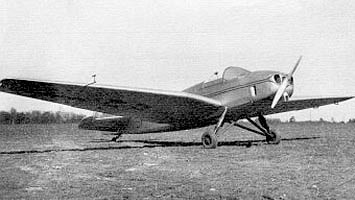
ZAK-1 prototype
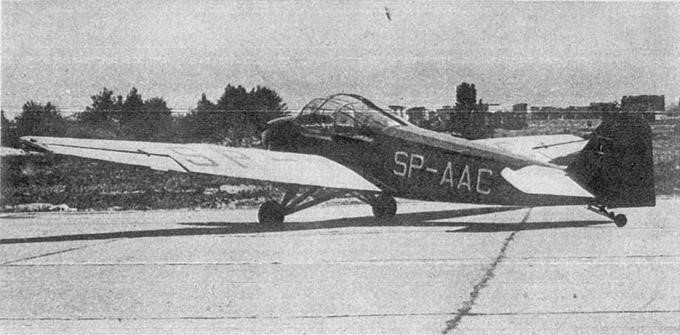
In 1946 the order went to the Experimental Aviation Workshops (LWD) in Lodz, where a group of designers headed Eng. Tadeusz Sołtyk could immediately proceed with the task. It was a light low-wing cantilever monoplane of a mixed construction, with a crew of two, sitting side by side, and fixed conventional landing gear. The plane was named Zak (old-fashioned “student”), and later added digital designation Zak-1. The prototype first flight performed on 23.03.1947 and received the registration SP-AAC, becoming the fourth post-war Polish plane (Starling-2, PZL S-1, Starling-3).
Zak-1 had a few glitches, among other things, they were improperly routed links the elevator, causing the looping out. They also changed the balance of the aircraft. Also, the engine had a tendency to overheat. The oil tank was changed to one that had a greater surface area, which solved the problem partially. Also, there were problems with feeding fuel to the engine. At certain points the motor is not getting fuel and choking. The problem was caused by the collection box intermediate (outgoing). They reported comments to the windshield and canopy.
The Zak-1 was good in flight. In flight at low speed there was warning vibration in the control stick. It was difficult to enter a spin, and recovery was easy. During 1947-1948. plane made dozens of propaganda flights.
Approval for the Zak-1 was received in February 1949. The aircraft rated positively, but acrobatics wer not allowed. The reason was the weak power unit. During the performance figures pilot pilot lost directional steering. The result was that at the exit of the loop faced sideways with loss of height. They tried to remedy this by increasing the height of the vertical tail.
Even before the first flight the Walter Mikron III was tested on a dynamometer. Instead of 65 hp, it only had 56 hp, forcing manufacturers to seek alternative propulsion.
With testing of the Zak-1 not yet completed, the Zak-2 construction was started. It was designed for installation of the Polish WN-1 motor (named constructor W. Narkiewicz), sometimes labeled PZL A-65. Since the WN-1 was in a trial phase, a Continental A-65 was used. The engine was removed from a Piper L-4. The Zak-2 plane did not differ much from the first prototype. Initially, it had mechanical brakes, which were later replaced by more effective hydraulic. It also had an oen cabin, equipped only with a windshield. Zak-2 was flown on November 27, 1947 and received registration SP-AAE. The aircraft underwent a trial approval in the autumn of 1951.
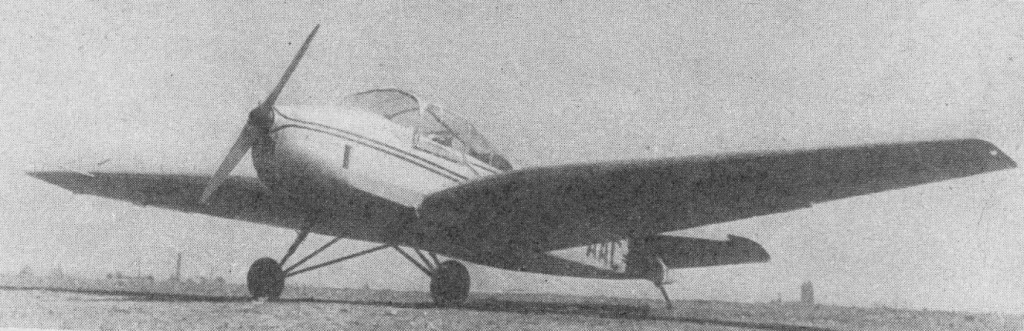
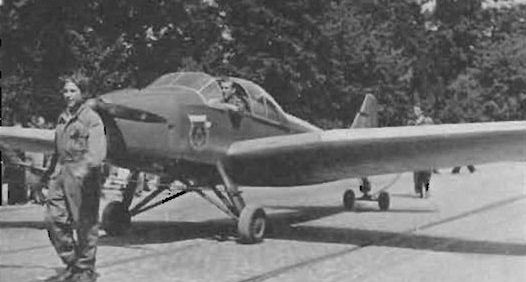
Positive Rating for the Zak-1 prompted the ministry to purchase 10 machines for flying clubs. The design appeared successful and the Ministry of Communication ordered a series of 10 aircraft. They were to be powered by licence-built A-65 engines, but since plans of engine production were abandoned, it was decided to fit them with Walter Mikron engines. They were also fitted with a closed canopy, sliding rearwards, and named Żak-3.
The design of the airplane Zak was threatened after work was suspended on the Polish WN-1 motor. Walter has not signed a contract for the production of the Walter Mikron III engines in Poland and it was decided to purchase a number of engines directly from Czechoslovakia.
The construction of the aircraft was carried out in the hall on the first floor of the main production building in Lodz. Completed aircraft, engines and painted, were drawn through a window on a makeshift wooden ramp (ramp) and slides to the ground. Wings also followed this path. The company which supplied the engines to Lodz, allegedly had the wrong address. In fact, they could not find the the street, because at that time the Communists gave many streets new names.
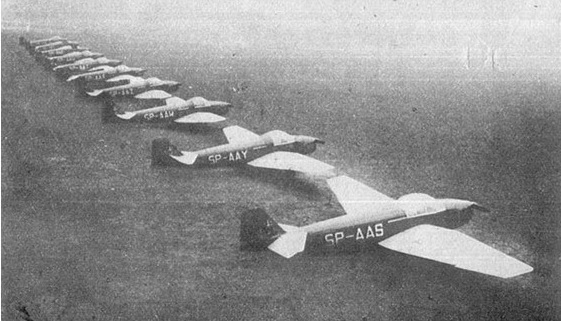
Ten planes were built by the LWD in the end of 1948, the first of them, SP-AAS, was flown on November 8, 1948. They had markings: SP-AAS to SP-AAZ, and SP-BAA to SP-BAC. At least one (SP-AAX) had engine replaced later with 85 hp (63 kW) Cirrus F.III.
The 10 aircraft machines were built two weeks before the deadline, although in fact only three of them had their first flight. In addition, the team realized that the machines may have shortcomings resulting from the rush and very nervous atmosphere. Fortunately, these defects have been timely detected and removed, even before the first flights, after the unification congress of communists.
Eng. Tadeusz Soltyka realized that the engines were weak and had a tendency to overheat. The Zak-3 SP-AAX underwent an examination at the Central Institute of Aviation in Warsaw and received the same assessment as Zak-1. The designers are still working to eliminate engine overheating. The focus is on different types of bottom oil tank; Additional ribs, ribs pressed, an additional barrier inhibiting mixing of oil was most effective.
Zak-3 SP-AAS, SP-AAT, SP-BAB, for a time were used in LWD to the various tests. For example, you try to use different profiles of wings, but without great effect. They also tested new hydraulic brakes.
ZAK 3
Zak-3 SP-AAX on air exhibition in Wroclaw was equipped with a Cirrus III RWD-21 engine. However, in this arrangement, the plane never flown. The aircraft was painted the color of the sea (top) and blue-silver (bottom).
10 LWD Zak-3 during the celebration of their transfer on 1.12.1948. These aircraft are painted in red (hulls and vertical tail) and silver (wings). Registration marks on the hull of silver, and red on the wings.
They were operated in aero clubs Kujawski, Poznan, Krakow, Gdansk, Bielsko-Biała and Warsaw. They were used in the Polish regional aero clubs until 1955.
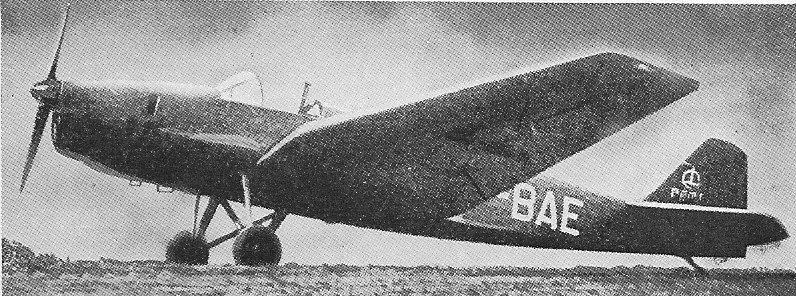
On October 20, 1948 there was flown a prototype of the last variant, Żak-4, meant for a glider towing. It had a 105 hp Walter engine and an open canopy. Once the plane had to make an emergency landing. Attempts were made towing gliders; Zak-4 with a glider Hedgehog need 215-340 m run. Zak-4 with a glider Vulture need to 400-500 m, while Po-2 glider Vulture need 250 m. Since it showed unsuitable for glider towing, the Żak-4 was not built in series, and the prototype was re-fitted with a closed canopy and used as a touring plane in aero club (markings SP-BAE). Due to the much more powerful engine, it towered over the Zak-3 machines.
LWD Zak-4
In December 1963 Żak-3 SP-AAX was transferred to the Air and Space Museum in Krakow. It is preserved in the Polish Aviation Museum in Kraków (disassembled as for 2007)
Variants: Żak-1 (SP-AAC) The first prototype powered by CSS-built Walter Mikron 4-III engine.
Żak-2 (SP-AAE) The second prototype without canopy and powered by Continental A-65 engine.
Żak-3 Main production version with closed canopy and powered by Walter Mikron III engine, 10 built.
Żak-4 (SP-BAE) Prototype of the glider towing version with open canopy (later refitted with a closed one) and powered by Walter engine.
Specifications:
Zak-1 Engine: 65 hp Walter Mikron III Wingspan: 11.75 m / 38 ft 8.5 in Length: 7.5 m / 24 ft 7.25 in Wing area: 15 sq.m / 161 sq.ft Empty weight: 400 kg / 880 lb Gross weight: 620 kg / 1365 lb Cruise: 140 kph / 87 mph Range: 500 km / 310 mi Service ceiling: 5000 m / 16,400 ft
Żak-3 Engine: 1 × Walter Mikron 4-III, 105 hp Length: 7.6 m (23 ft 11 in) Wingspan: 11.8 m (38 ft 8½ in) Height: 1.95 m (6 ft 5 in) Wing area: 17 m² (183 sq ft) Empty weight: 400 kg (880 lb) Loaded weight: 620 kg (1,365 lb) Maximum speed: 160 km/h (86 knots, 99 mph) Range: 400 km (216 nmi, 248 mi) Service ceiling: 3,500 m (11,500 ft) Rate of climb: 2.7 m/s (520 ft/min) Crew: two Capacity: one
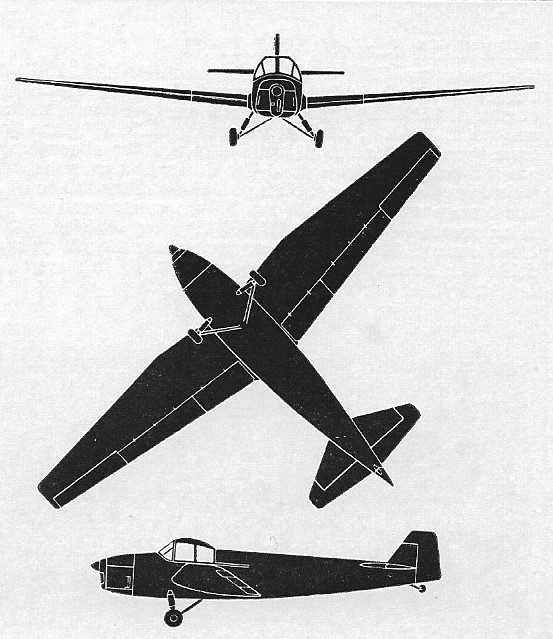
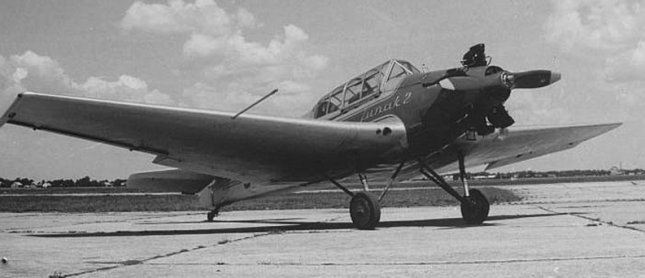
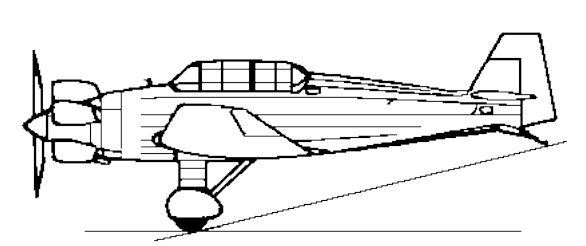
The Junak (Cadet) was developed as a primary trainer to replace the Polikarpov Po-2 in service with the Polish Air Force. A tandem two-seater, the fuselage was a fabric covered welded steel tube fuselage and wing centre section, and wooden outer wing sections.
The prototype Junak first flew on 22 February 1948.
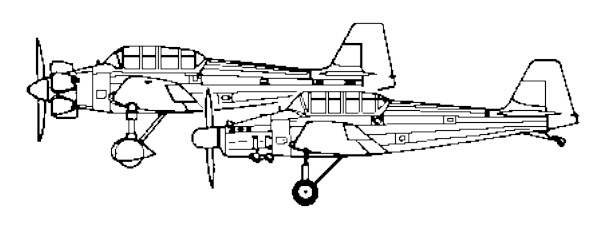
Junak 1, Trainer, Poland, 1949
Junak 2, Training aircraft, Poland, 1948
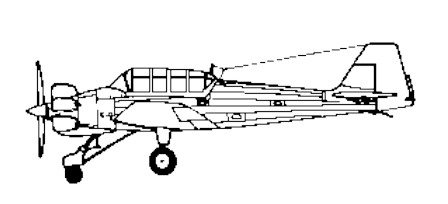
Junak 3 Training aircraft, Poland, 1952
Junak Engine: M-11G, 125 hp Wingspan: 32 ft 9.5 in / 10 m Wing area: 188.4 sq.ft / 17.55 sq.m Length: 24 ft 7.5 in / 7.5 m Height: 6 ft 8.5 in / 2.09 m Empty weight: 1315 lb / 605 kg Loaded weight: 2030 lb / 920 kg Max speed: 143 mph / 230 kph Cruise: 118 mph Landing speed: 50 mph / 80 kph ROC: 690 fpm / 3.5 m/sec Service ceiling: 13,780 ft / 4200 m Seats: 2
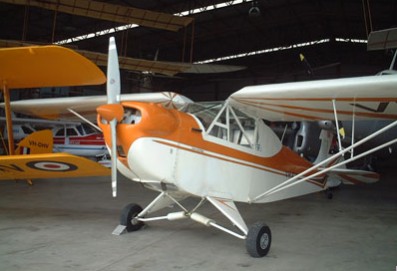
Following the pre-war success of the Luton Minor, Mr. Latimer-Needham designed the two seater Major which first flew on 4 March 1939.
Accommodation is for two per¬sons seated in tandem in an enclosed cabin with a door in the starboard side. Dual controls are fitted. An 11 Imp. gallon fuel tank is fitted behind the firewall. Alternative engines include 62 h.p. Walter Mikron 11, 83 h.p. Agusta GA-70, 55 h.p. Lycoming and 85 h.p. Continental.
A hangar fire at the Phoenix Works in 1943 destroyed the single example of the LA5 Major, a two-seat cabin type, and also spelt the end for the company. C. H. Latimer-Needham founded a new company at Cranleigh, Surrey, in March 1958, appropriately named Phoenix Aircraft Ltd, which acquired the rights for the Minor and Major. Both designs were improved, the first as the LA4A Minor, and built in the UK and in several countries across the world.
The Luton Major was the only British designed two seater aircraft available to amateurs for home building.
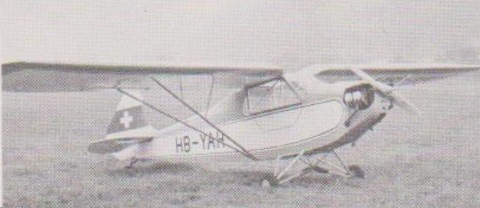
LA.5 Major HB-YAH. Built in Italy, registered and flown in Switzerland
Phoenix Aircraft Ltd. undertook the revision of the Major drawings for amateur construction and the aircraft has since been re-stressed to to permit engine power to 85 hp and gross weight to 1400 lbs and it has been restressed to British Airworthiness Require¬ments. The wing chord is the same as the Luton Minor and the wings fold back for ease of storage and transport.
The tandem-wing LA2 never flew, but its fuselage and other components were incorporated into the LA3. The LA3 (also G-AEPD cn LA.3) was built at Barton-in-the-Clay in 1937. It was powered by an Anzani engine. It survived the War in store in Scotland but was destroyed in the 1950s.
The LA3 itself was redesigned for home-assembly as the LA4 Minor. Designed by Mr. C. H. Latimer-Needham, the first was built at the company’s Phoenix Works at Gerrards Cross, Buckinghamshire, and fitted with a 40hp ABC Scorpion, but subsequent models were home-built from drawings and fitted with many different engines.
The Minor is a single seat aircraft with a two piece wooden two spar wing of 5’ 3” chord, attached to a tubular steel pylon on the fuselage. The wings are divided for ease of building, transport and storage. The wing section is RAF 48. The leading edge is plywood covered, the remainder of the wing being fabric covered. The fuselage is a rectangular all wood structure; the sides and bottom being plywood covered, while the top decking behind the cockpit is fabric covered. The under¬carriage incorporates rubber disc shock absorbers for the main legs and optional brakes. The tailwheel is fully castoring.
The first Luton Minor flew in England in 1936 and in 1960 the design was restressed enabling engines up to 55 hp to be fitted. The Minor was designed for the 37 h.p. Aeronca JAP engine, although the 55 hp Lycoming and converted Volkswagen engines may be installed. A 6.5 Imp. gallon fuel tank is located behind the firewall.
A.W.J.G.Ord-Hume designed a modified Luton LA.4 Minor with a totally enclosed cockpit, designated Ord-Hume OH-7 Coupe (previously known as the Luton LA.4C). Construction of the prototype (c/n OH-7, PAL.1401 G-ARIF) was started at Sandown in 1965 and it was nearing competition in early 1975.
Luton Minor G-AFIU built by C.F.Parker was designated Parker CA.4. It was started in 1938 but not finished. It was stored at Peel Green, Manchester.
The design of the Luton Minor was brought up to date by Phoenix Aircraft Ltd., successors to Luton Aircraft Ltd. In 1959-60 the Minor was accredited as one of the finest single seater amateur aircraft in Europe, and the easiest to build.
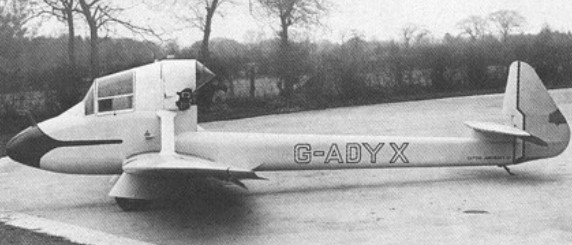
In 1936, Luton Aircraft Ltd of Barton-in-the-Clay, Bedfordshire, flew the Buzzard I, a single-sear open-cockpit wooden ultralight, powered by one 35hp Anzani and designed by C. H. Latimer-Needham. This was rebuilt the following year with short-span wings and enclosed cockpit as the Buzzard II.
Single engined high wing mono¬plane with conventional three axis control. Wing has swept back leading and trailing edges and tapering chord; no tail, canard wing. Pitch control by fully flying canard; yaw control by under wing rudders at half span; roll control by differential canard. Wing braced from below by struts; wing profile; 100% double surface. Undercarriage has three wheels in tricycle formation; no suspension on any wheels. Push right go right nosewheel steering. No brakes. Fuselage, totally enclosed. Engine mounted below wing driving pusher propeller. The Vitality was first announced in mid 1982, using differential canard for roll control and under¬wing rudders at half span for yaw control. In August 1982 Flightlline magazine was told that three Vitalitys had been built and 36 ordered, that production would be concentrated on the two seat version, and that an all new three cylinder 1000 cc radial four stroke was being developed for the aircraft. A few weeks later came the announcement that Luscombe Aircraft was to move into a new factory in November and that the company hoped to have an aircraft produced by the end of February 1983. These aircraft never materialised, however, as the company announced later in 1982 that it had shelved the design, at least until the UK microlight airworthiness regulations were finalised. Although that happened in March 1983, the design rights of Vitality were for sale, along with three prototypes one two seater and two single seaters. The design was first conceived some 11 years before and dusted off in response to the microlight boom.
Engine: Robin EC44, 60 hp. Power per unit area 0.47 hp/sq.ft, 5.0hp/sq.m. Empty weight 236 lb, 107 kg. Length overall 11.7 ft, 3.56 m. Height overall 4.8ft, 1.47m. Wing span 34.0ft, 10.36m. Mean main wing chord 3.8 ft, 1.15 m. Canard span 14.0ft, 4.27m. Mean canard chord 0.95ft, 0.29m. Total wing area 141 sq.ft, 13.1 sq.m. Main wing area 128sq.ft, 11.9sq.m. Canard area 13 sq.ft, 1.2 sq.m. Wing aspect ratio 9.0/1.


 All Aero