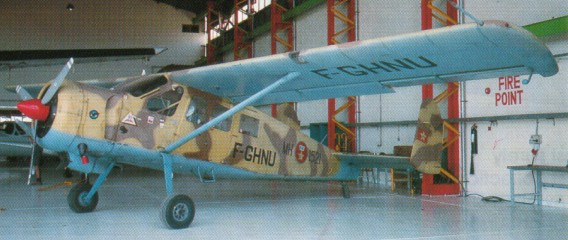
First flown on November 17, 1952, and originally intended as a liaison and ambulance plane, the Broussard saw service in the French attempt to suppress the rebellion in Algeria.
The French Holste M.H.1521M Broussard (Bushman) was primarily used by all the French armed services. Two hundred and thirty were built from 1953 until 1961, with many eventually serving with the air wings of former French colonies. It carried five passengers, two stretchers, or about a tonne of cargo at its military overload weight of 2,714 kg. Powered by the 450-bhp Pratt & Whitney R985, its economical cruise speed was 120 knots.
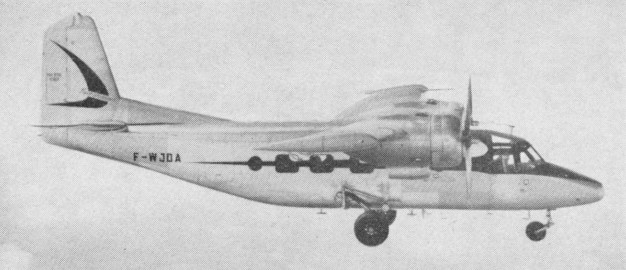
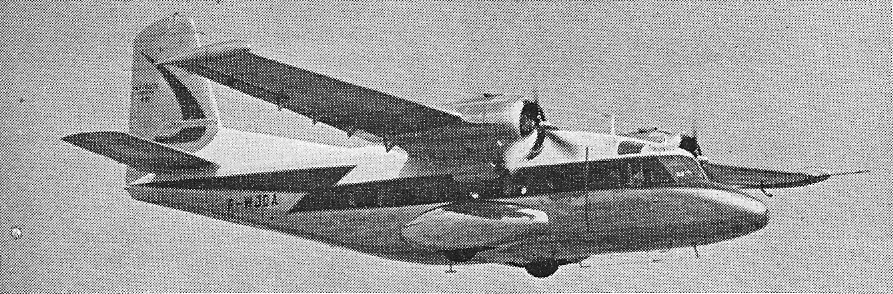
A 17-seat light commuter airliner, known as the M.H.250 Super Broussard started in 1957. The prototype of the MH250, powered by two Pratt & Whitney Wasp-1830 piston engines, flew first on 20 May 1959. It was soon realised that turboprops should be employed and further development resulted in the MH260 (Nord 260) with enlarged fuselage and powered by Turboméca Bastan turboprops.
In 1959 a Max Holse M.H.152 aerial observation monoplane was modified to take a 4450 hp Turbomeca Astazou turbo-prop. The modification, undertaken by SFERMA, first flew on 23 April 1959 and served as a prototype for the M.H.1521 Broussard.
Single seat single engined high wing monoplane with conventional three axis control. Wing has unswept leading and trailing edges, and constant chord; conventional tail. Pitch control by elevator on tail; yaw control by fin mounted rudder; roll control by full span ailerons; control inputs through stick for pitch/roll and pedals for yaw. Wing braced from above by kingpost and cables, from below by cables; wing profile; double surface. Undercarriage has three wheels in tail dragger formation; suspension on all wheels (type NC). Push right go right tailwheel steering connected to yaw control. Optional brakes on main wheels. Aluminium tube framework, without pod. Engine mounted at wing height driving pusher propeller. Dacron wing covering.
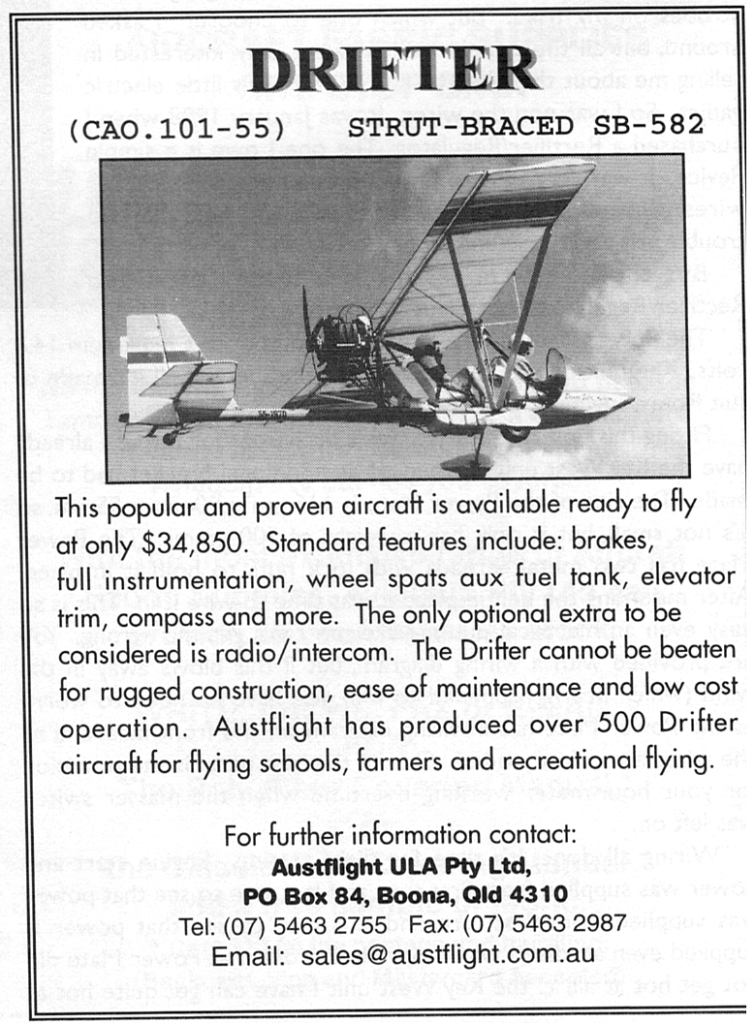
The Drifter started life as a modified Hummer, the brainchild of the late Klaus Hill. Maxair Sports dealer Roy Pinner built the first Drifter from a Hummer kit, with some notable design changes. On the Drifter, in place of the V-tail empennage, Pinner built a conventional cruciform tail, sporting a regular set of stabilizing surfaces — vertical and horizontal. Along with the stabilizing surfaces Pinner constructed a rudder and elevator. Maxair also added bent sheet aluminum to strengthen the fuselage boom. New landing gear built of springy 4130 chrome-moly steel replaced Hummer’s complex aluminum-tube gear. The wing utilizes a flatter profile, sporting a batten-braced lower surface with some curvature, enabling the craft to slice through the air with less effort. And less effort required means that the Drifter flies faster on the same power as Hummer, even though both sport approximately the same wing area, despite Drifter’s higher empty weight.
The Duralumin and Dacron Drifter made its first public appearance as a prototype at Oshkosh in 1982, where it was on static display only, since the aircraft had not at that time completed its flight test programme. The design is by Roy Pinner, marketing director of Maxair Sports, who conceived the Drifter as an improved version of the Hummer from the same company, with a remodelled structure and a conventional tail in place of the characteristic V tail, as designed by Klaus Hill.
The Drifter has been on sale since May 1983, Maxair Sports differentiating the new model from the Hummer, which is still in production, by emphasising its sprung suspension on the main undercarriage and its increased track, which allows more rough¬terrain use. It also points out that the tail has become conventional, with large control surfaces, and that the ailerons are now full span. The improved control authority of the Drifter gives better cross wind capabilities and its performance has been increased by the 38.5 hp delivered by its twin cylinder in line Kawasaki TA440A engine. Priced in 1983 at US$5500.
The XP 503 was first introduced at Oshkosh in 1983. A two-seat high wing microlight powered by a pusher 48 hp Rotax 503. Max speed is 63 mph.
By 1984 600 Drifters had flown.
Its cable-braced wing and aluminum fuselage tube resulted in a rigid design that was soon expanded to include a two-seat trainer version and a short-wing, overpowered single-seat hot rod that was well outside ultralight limits. Some Drifters were equipped with monohull or dual floats.
March 1999
Maxair declared bankruptcy in 1991, and the Drifter project was picked up by Phil Lockwood, who had worked for Maxair. Lockwood Aviation has reintroduced the design. When powered by the 582 Rotax engine the craft will climb out at 900 feet a minute cruise a 70 m.p.h. and stall in the 38/40 m.p.h. range.
Leza Lockwood Drifter
Drifter Engine: Kawasaki TA440A, 38.5 hp at 6000 rpm. Propeller diameter and pitch 58 x 36 inch, 1.47 x 0.91 m. V belt reduction, ratio 2.25/1. Max static thrust 230 lb, 104kg. Power per unit area 3.94 hp/sq.ft, 2.7 hp/sq.m. Fuel capacity 5.0 US gal, 4.2 Imp gal, 18.9 litre. Length overall 19.0 ft, 5.79 m. Height overall 7.6ft, 2.32m. Wing span 30.0ft, 9.14m. Constant chord 5.0ft, 1.52m. Dihedral 4 deg Sweepback 0 deg Tailplane span 7.4 ft, 2.23 m. Fin height 6.0ft, 1.83m. Total wing area 152 sq.ft, 14.1 sq.m. Fin area 15.0 sq.ft, 1.39 sq.m. Tailplane area 26.0 sq.ft, 2.41 sq.m. Wing aspect ratio 5.9/1. Wheel track 6.0 ft, 1.83 m. Wheel¬base 15.6 ft, 4.72 m. Tailwheel diameter over¬all 4 inch, 10 cm. Main wheels diameter overall 12 inch, 30cm. Empty weight 233 lb, 106kg. Max take off weight 505 lb 229 kg. Payload 272 lb, 123kg. Max wing loading 3.32 lb/sq.ft, 16.2 kg/sq.m. Max power loading 13.1 lb/hp, 5.9kg/hp. Load factors +6.0, 3.0 design. Max level speed 63 mph, 101 kph. Never exceed speed 63 mph, 101 kph. Max cruising speed 60 mph, 97 kph. Economic cruising speed 50mph, 80kph. Stalling speed 25 mph, 40 kph. Max climb rate at sea level 1100 ft/min, 5.6 m/s. Min sink rate 300 ft/min at 40 mph, 1.5 m/s at 64 kph. Best glide ratio with power off 9/1 at 42 mph, 68kph. Take off distance 100ft, 30 m. Land¬ing distance 100 ft, 30 m. Range at average cruising speed 150 mile, 241 km.
Single seat single engined high wing mono¬plane with two axis control (unconventional three axis control optional). Wing has un¬swept leading and trailing edges, and constant chord; V tail. Pitch/yaw control by elevon; no separate roll control (roll control by spoilers optional). Control inputs through stick for pitch/yaw (and pedals for roll optional). Wing braced from above by kingpost and cables, from below by cables; wing profile; double surface. Undercarriage has three wheels in tail dragger formation; steel spring suspension on all wheels. Tailwheel steering connected to yaw control. Optional brakes on main wheels. Aluminium tube framework, with optional pod. Engine mounted below wing driving pusher propeller. Main boom made from 6061T6 aluminium. Wing covering is Dacron.
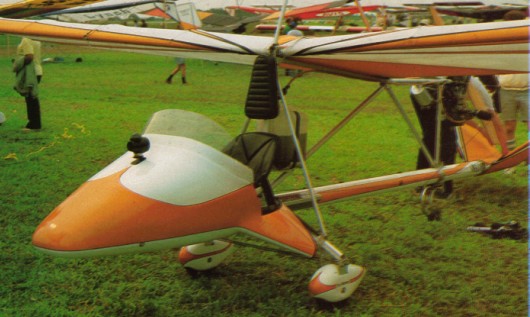
A high-wing monoplane with upright V-tail and spoilers (no ailerons), it was designed as an ultralight and not as a hang glider, with the engine as an afterthought. It features a non-welded, pop-riveted, bolted-together, wire-braced airframe of aluminum tubing. The wire-braced wings are built from aluminum tubing and covered with presewn Dacron, so no dope, glue or rib stitching is necessary. The V-tail is equipped with movable ruddervators acting as rudder and elevator. The main fuselage boom is 5’-diameter 6061 -T6, aluminum, to which the wing and engine support structures are attached. The pilot is seated forward of the wing and controls flight with conventional stick and foot pedals.
In August 1977 Klaus Hill had begun design studies for the Hummer and started work on a prototype in October. Thirty hours of labour and $2000 later in November of the same year, the first prototype was complete. The first production models appeared on 17 March 1978, but the machine did not seem an immediate success as only a dozen were flying by the beginning of the 1980 season. Maxair has since 1982 offered as an option a nose fairing, made of glass fibre with a windscreen, and a fairing for the main undercarriage legs. Originally a two axis design, a new innova¬tion presented on the Hummer at Sun ‘n’ Fun in March 1983, was a wing covering with spoilers sewn in place on the upper surface. Operated by pedals (absent on the two axis machine), these spoilers can also be used together as air brakes to obtain a high sink rate for steep approaches and short field landings. Also available as an option are main wheel brakes, a reduction drive for the Zenoah G25B engine and floats. Price is $4395 in 1982. Worthy of note are two developments of the Hummer, a tandem two seat produced in Switzerland by ULAC and in the USA Maxair’s own Hummer B single seater. In¬tended for heavier pilots, this had its payload increased from 170 to 210 lb (77 to 95 kg) and its maximum gross similarly increased, but the standard 1983 Hummer shows such an improved performance over earlier versions that the type B is no longer required.
Engine: Chaparral snowmobile, 20-hp Top speed: 45 mph ROC: 400 fpm Takeoff dist: 150 ft Ldg dist: 100 ft
Engine: Zenoah 925B, 22 hp at 6000 rpm Propeller diameter and pitch 52 x 32 inch, 1.32 x 0.81 m V belt reduction, ratio 2.2/1 Max static thrust 160 lb, 73 kg Power per unit area 0.16 hp/sq.ft, 1.7hp/sq.m Fuel capacity 5.0 US gal, 4.2 Imp gal, 18.9 litre Length overall 18.0 ft, 5.48 m Height overall 8.3ft, 2.54m Wing span 34.0ft, 10.36m Constant chord 4.4ft, 1.32 m Sweepback 0 degs Tailplane span 8.2 ft, 2.50 m Total wing area 138 sq.ft, 12.8sq.m Wing aspect ratio 8.3/1 Wheel track 3.6 ft, 1.08 m Tailwheel diameter overall 6 inch, 15 cm Main wheels diameter overall 10 inch, 25 cm Empty weight 185 lb, 84kg Max take off weight 440 lb, 199 kg Payload 255 lb, 171 kg Max wing loading 3.18 lb/sq.ft, 15.5 kg/sq.m Max power loading 20.0 lb/hp, 9.0kg/hp Load factors +4.0, 3.0 design Max level speed 60 mph, 97 kph Never exceed speed 97 mph, 101 kph Max cruising speed 45 mph, 72 kph Economic cruising speed 30mph, 48kph Stalling speed 22 mph, 35 kph Max climb rate at sea level 400 ft/min, 2.0 m/s Min sink rate 300ft/min, 1.5m/s Best glide ratio with power off 9/1 at 28mph, 45kph Take off distance 60ft, 18m Landing dis¬tance 100ft, 30m Service ceiling 10,000ft, 3050 m Range at average cruising speed 100 mile, 160 km
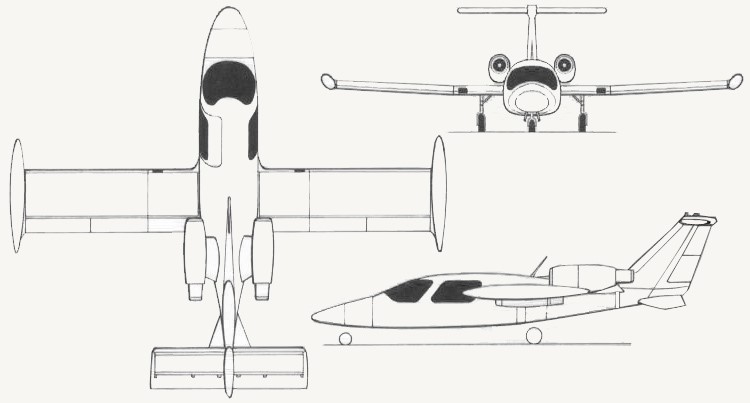
Bob Bornhofen was retired when he got into the aviation business, and had no aviation background. He wondered why he couldn’t buy a personal jet, and in 1998 he decided to create one. Bornhofen has been funding much of the project out of his own pocket.
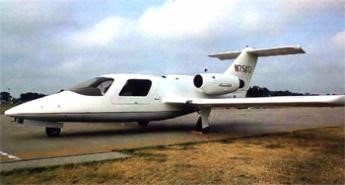
To be marketed as a kit, the Twinjet has a pre-preg eglass composite airframe with carbon fiber control surfaces and empennage.
The TwinJet was not certified because it uses two converted surplus GE-T58 military helicopter engines (overhauled and zero-timed).
The TwinJet was designed in anticipation of the FJX-2 engine, which was being developed under the General Aviation Propulsion program. The FJX-2 was going to be a new generation turbofan engine producing 700-800 pounds of thrust.
When delays occurred for that engine, Bob Bornhofen elected to use the T58 engines so he wouldn’t slow the TwinJet development.
The first prototype was flight tested to about 370 knots during a series of tests to determine if the aircraft had any major certification-related problems.
Engines: 2 x GE-T58 turbojet Wing span: 10,21 m (33 ft 6 in) Wing span, tip tanks: 10,52 m (34.5 feet) Lenth overall: 8,69 m (28 ft 6 in) Height overall: 2,74 m (9 ft 0 in) Empty weight: 2,600 lb MAUW: 5,100 lb Fuel capacity: 270 USgallon Optional fuel: 320 US gallon Max speed 30,000 ft: 480 mph Cruise speed 30,000 ft: 400 mph Single-engine cruise speed 30,000 ft: 230 mph Initial rate of climb: 3,500 fpm Single-engine climb rate: 1,000 fpm Stall at 5,100 lb: 90 mph Range standard fuel: 1,000 miles Range optional fuel: 1,300 miles
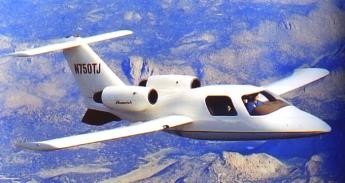
Prototype N750TJ.
Serial number: 1, First flight 4 august 1999. Public debut at EAA Air venture, Oskosh, August 2000. Destroyed on Jan. 24, 2003 in Melbourne, Florida
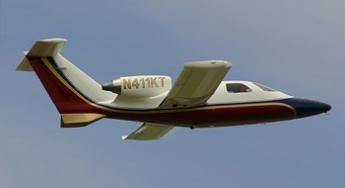
N411KT
Serial number: 2, Owned by Mike Seavall (Longmont, Colorado). It was built from a Maverick Air’s kit. Two years were spent to build it.
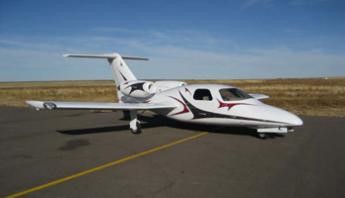
N699VA
Serial number: 3 Professionaly built in 2003. Fitted with 2 T850 engines
German leaders were reluctant to supply the Royal Hungarian Air Force (Magyar Királyi Honvéd Légierő), MKHL, which was seen to be focused on home defence and the possibility of conflict with Romania. Adolf Hitler expressed this in early 1942 when Hungary requested German-built fighters. “They would not use the single-seaters against the enemy but just for pleasure flights!… What the Hungarians have achieved in the aviation field to date is more than paltry. If I am going to give some aircraft, then rather to the Croats, who have proved they have an offensive spirit. To date, we have experienced only fiascos with the Hungarians.”
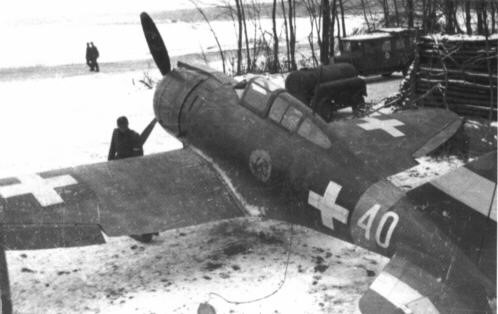
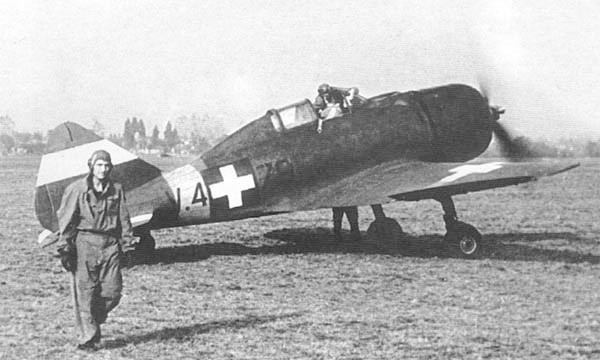
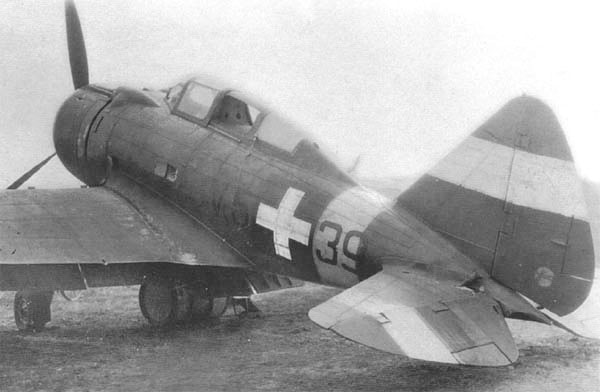
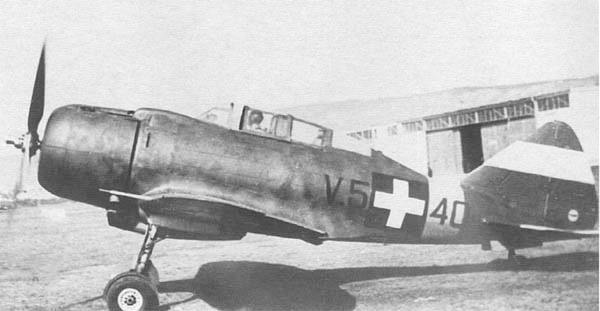
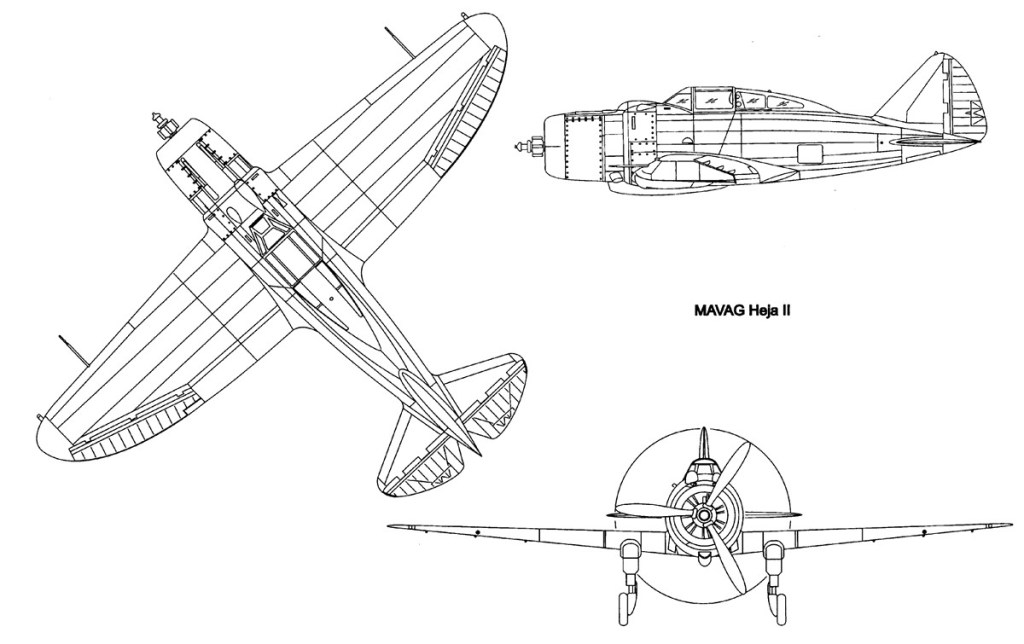
The MKHL consequently became a significant purchaser of Italian aircraft and was the main operator of the Re.2000. December 27, 1939 representatives of the company Reggiane and Head of the Air Force of the Hungarian Ministry of Defence signed a contract for delivery of 70 Re.2000 and agreed preconditions for the licensed production of the aircraft in Hungary producing a total of 200 aircraft, known as MÁVAG Héja (“Hawk”) II built between 1940 and 1942. According to other sources,170–203 aircraft were built.
In December 1939 seventy Reggiane Re.2000 fighters, purchased from Italy, were delivered to the Magyar Királyi Állami Vas-, Acél- és Gépgyárak, (“Royal Hungarian State Iron, Steel and Machine Works”), where they were modified into MÁVAG Héja I (“Goshawk I”) fighters.
The original Piaggio P.XI engines were replaced by the Hungarian-built Manfred Weiss WM K-14 driving Hamilton Standard three-bladed, constant-speed propellers. Using the WMK-14 allowed less dependence on spare parts from Italy. The WM K-14 was a licensed copy of the French Gnome-Rhône 14K engine that necessitated a 1-foot 3-inch (350 mm) lengthening of the fighters’ forward fuselage, to restore the center of gravity to a safe position. The Piaggio engine was itself also a copy of the Gnome-Rhône 14K, but less reliable than the original. On January 5, 1940 the Hungarians sent one WMK-14 to Italy to study, however, Reggiane did not want to make Re.2000 for Hungary with other than the original power plant.
In early 1940 the Hungarian delegation headed by engineer Tibor Takatsi was sent to Italy for the acquisition of the technical documentation for the license production of Re.2000. The Italians have provided all the necessary drawings by 11 October 1940.
The Hungarians at the same time held talks with Germany on the subject of joint construction of the Bf. 109. The interstate agreement to this effect was signed on June 6, 1941 however, the Hungarians could only count on 1943 to receive the Messerschmitt fighter for its air force. The Ministry of Defense was considering a draft MAVAG Hejja II as a transition to the 109.
Breda-Safat 12.7 mm machine guns were replaced by Hungarian Gebauer machine guns of the same calibre, with a rate of 1000 rounds per minute. Ammunition was a 300 round drum cartridge, under the hood. The modified Re.2000s had were named Hejja – Hungarian translation of the word Falco.
A decision was soon made to produce more Héja fighters under license in Hungary as the MÁVAG Héja II (Goshawk II). The new Héja II was entirely Hungarian with locally produced airframes, engines and armament. The new fighter differed from the Reggiane fighter in a number of ways. Armament was changed to twin 0.50 inch (12.7 mm) Gebauer fixed forward-firing guns in the upper nose with 300 rounds each. Length was 27 ft 6.25 inch (8.39 m), and maximum level speed was 301 mph (485 km/h) at 13,780 ft (4,200 m). Endurance was 2 hours and 30 minutes. Manfred Weiss originally planned to build 329 WMK-14B – 247 engines and 82 Hejja replacements. The project was completed by June 1941, and the first fighter Hejja II with the new motor was raised in the air the pilot Tasilo Seshenem (Taszilo Szechenyi). The first Re.2000, received new motor (V401), was successfully tested, and the Ministry of Defence ordered 100 aircraft, denoting them Hejja II. MAVAG planned to build two sets of 25, in the first (V4 + 71 – V4 + 95) and 75 in the second (V4 + 96 – V5 + 70).
The first MÁVAG Héja II took to the air on 30 October 1942, and in total MÁVAG built a further 203 Héjas for the Royal Hungarian Air Force. The last aircraft was completed on 1 August 1944 when production ceased. 98 were completed in 1943 and 72 in 1944 although the variant was regarded as no longer suitable for combat against the latest Soviet fighters. Hungary requested an additional 50–100 Re.2000 airframes made in Italy, as suitable engines and armament could be locally manufactured and other countries expressed interest, including Finland (100 examples), Portugal (50), Spain, Switzerland and Yugoslavia. However, no airframes were available.
After the first combat experience on the eastern front the Re.2000s were modernized. From August 1941 an 8 mm pilot armour was istalled, and an additional 100-liter self-sealing fuel tank istalled in the fuselage. The rear cabin windows were covered by sheet metal. The Ministry of Defence has also expressed the wish “… to MAVAG Hejja II was able to carry 250 or 500 kg bombs under the fuselage.” To do this it was necessary to completely revise the power circuit of the aircraft.
The first aircraft received from Italy were sent to Debrecen to strengthen home defences, as there was danger that the growing crisis over Transylvania could lead to a conflict with Romania. Conflict was avoided and the Hungarian Reggianes were used on the Eastern Front, in the war against the Soviet Union. The first seven Re.2000 were sent to the front on an experimental basis in autumn 1941. Flying alongside the Fiat CR.32s of 1/3 Fighter Company, the Reggiane pilots claimed eight kills, for one loss, during three months of combat, against Soviet Air Force.
Héja-II
The first series of 25 aircraft was started in November 1941. Engine WMK-14B was fitted with a three-blade propeller Hungarian variable pitch. The engine had a slightly larger diameter (3.2 m) than the Italian Piaggio.
MAVAG finished the first series Hejja II at the beginning of July 1942. In the production it was found that the Italian glued fuel tanks had a large percentage of leaks. Chief Engineer Takatsi urgently developed smaller fuel tanks for replacement. Now the plane had 22 tanks in the central part of the wing, each with a capacity of 20 to 25 liters. After minor modifications of aircraft of the first series ended in October 1942, the Hungarian Ministry of Defence had ordered 100 more Hejja II on September 29 before starting the laying of the second series of 75 aircraft. The third series began with the construction in September 1943. Aircraft of the second series was completed March 7, 1944, the latter two have been modified in a dive bomber. They got the brake bars on the wings and the ability to carry up to 500 kg bombs. Later this version was rebuilt on another aircraft (V6 + 60).
By April 1944, the MKHL still deployed four Héja IIs in 1/1 Fighter squadron and four Hejas II in 1/2, all of them based in Szolnok for home defence duties, along with about 40 Bf 109s and Messerschmitt Me 210s. The last sortie for the licence-built Reggiane Re.2000 occurred on 2 April 1944. That day, 180 bombers from the USAAF 15th Air Force, escorted by 170 fighters, bombed the Danube Aircraft Works and other targets in Budapest. The Hungarian fighter control centre in the Géllert hill, near Budapest, scrambled one wing of Hejas from 1/1 Fighter squadron, along with 12 Bf 109G-4/G-6S and a couple of Messerschmitt Me 210Cas-1s from the Experimental Air Force Institute (RK1). The Hungarians reported 11 aerial victories, of which six were confirmed, while USAAF pilots claimed 27 MKHL aircraft shot down. However, later records showed only two Honvéd pilots were killed.
By March 1944, imports of various parts and tools from foreign contractors began to fade. British bombers on the night of 3 to 4 April 1944 destroyed plants for the production of aircraft and engines, burned most of the warehouses and the end of April production stopped. Manfred Weiss were bombed on 27 July completely disabling the motor plant, assembly plant, and warehouses. In a fire 25-30 still unfinished third series of aircraft were destroyed.
The last Hejja II (V6 + 87) flew on 11 October 1944. Four or five aircraft remained on the factory airfield waiting flight in late December 1944 when Soviet troops were in the vicinity. Hungarian engineers blasted them with hand grenades. Total produced 203 fighter Hejja II.
The Royal Hungarian Air Force (RHAP) did not use MAVAG Hejja II on the Eastern Front. Most of these fighters was used as a trainer aircraft, even though quite a few Hejja II took part in the defense of the airspace of Hungary by the Allied bombers.
In late 1942, it was planned to arm the night fighter squadron 5/1 eight Hejja II. These aircraft were to have a German radio equipment; however, it remained in the plans.
On March 19, 1944 German armed forces entered into Hungary to prevent the collapse of the Axis. The Germans forbade test flights of aircraft built. This ban remained in force until April 1, when the 15th US Army Air started regular bombing Hungarian goals. Despite the attacks, and a critical shortage of spare parts, the Hungarians had commissioned 30 MAVAG Hejja II during April. The lack of parts has reached a critical stage, many built aircraft could not get off the ground.
Héja-II
On April 13, 1944 Budapest was attacked by American bombers, accompanied by P-38s from the 1st Fighter Group, led by Lieutenant Alford (Alford). Pilots of the R-38s reported the downing of two Re.2001 to the west of Lake Balaton, which were actually MAVAG Hejja II. The Americans will only hit one of them.
Air Defense Forces raised eight Hejja II 1/2. squadron from Szolnok to cover the south of Budapest. Four Hejja bombers attacked the 454th Group, but was interrupted by the attack, stumbled upon a dense barrage fighters. Two Hejja were damaged, and one was forced to belly land. The remaining four Hungarian fighter bombers were unable to catch up, faced with a P-47 325th Fighter Group. American pilots had reported a downed Re.2001 and one damaged. Again there is an error in the identification. Lieutenant Eugene Emmons won the victory, and the lieutenant. George Novotny content damage the second fighter. These losses are confirmed by the Hungarian side. In September, many of the half-Hejja II were still expecting different units and parts, compasses, variometers, and machine guns. Twenty fighters had no propellers, ten – without engines.
During the last months of 1944, 101/6 Training Squadron “Puma” has had six flying MAVAG Hejja II. The last official report, mentioning Hejja II was dated to February 22, 1945. It stated that Hejja II (V6 + 09) crashed during a training flight.
Royal Hungarian Air Force 2 Vadászszázad based at Szolnok Század Héja 1/2.Század ‘Keresztes pók 2/1.Század ‘Keresztes pók 1/1.Vadászszázad 2/1.Vadászszázad 1/1.Század Dongó,Önálló Vadász Osztály (OVO)
Héja II Engine: 1 × Manfred-Weiss 14kfs Mistral-Major, 694 kW (1030 hp) Wingspan: 11.00 m (36 feet 1 inch) Wing area: 20.40 sq.m Length: 8.39 m (27 feet 6 inches) Height: 3.10 m (10 feet 2 inches) Empty weight: 2,070 kg (4,563 pounds) Loaded weight: 2,520 kg (5,555 pounds) Maximum speed: 485 km/h at 4,200 m (301 mph at 13,780 feet) Range: 900 km (560 miles) Service ceiling: 8,138 m (26,700 feet) Max ceiling: 9400 m Maximum rate of climb: 750 m / min Endurance: 2 hr 30 min Armament: Two fixed forward-firing 12.7 mm (0.50 inch) Gebauer machine guns Crew: 1
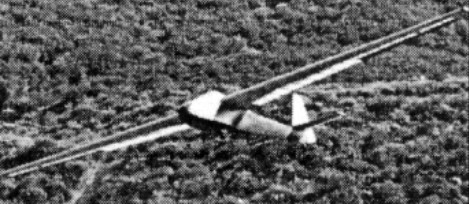
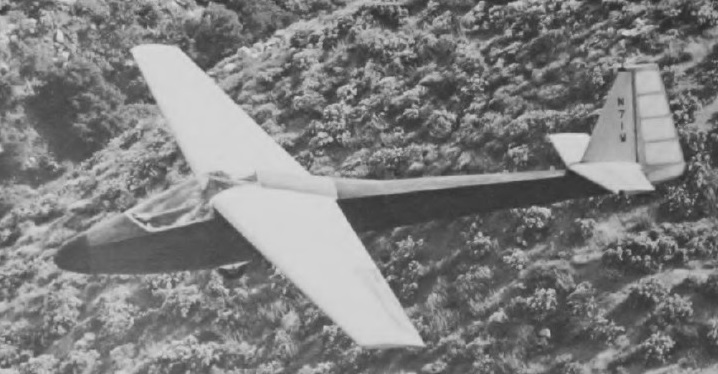
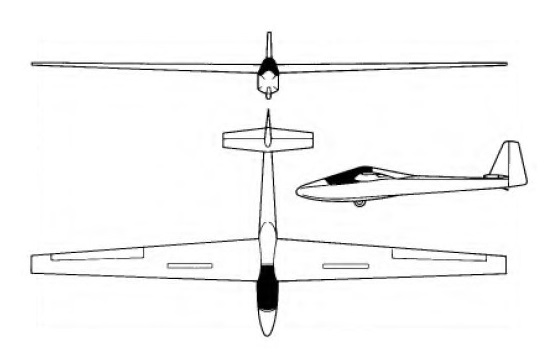
Jim Maupin of San Pedro, CA offered an inexpensive way to get into the action, with his homebuilt sailplane Woodstock, designed with the philosophy, “Build it light, build it small, build it cheap and simple.” Only basic tools are needed. Woodstocks wing, designed by lrv Culver, is built around a single main spar, formed as a hollow box out 8 feet and as a c-section beyond. Ribs are sawn from ¼-inch fir plywood, glued to the spar fore and aft. Spar runs the full length of the wing. Wing forward of the spar is covered with 1/4 -inch birch ply as a D section. Fuselage and tail are equally simple to build. An info kit was $5, plans $105 ($115 overseas).
Woodstock was designed with a wing having an 18 % section for the root, 13 % at the tip and no twis. The principal design objectives were low cost and simplicity of construction. Douglas Air was used for all major structural parts and all tail and wing skins were birch. It first flew in 1978 and won the Sailplane Homebuilders Association design contest in 1984. A tail wheel is an option instead of a skid. The main wheel is fixed. Approach control is by wing top surface spoilers. As an option, wings of 13.1 m./ 43.0 ft.
Woodstock Wing span: 11.89 m / 41.5 ft Wing area: 9.73 sq.m / 104.7 sq.ft Aspect ratio: 14.5 Airfoil: Culver Length 5.43 m / 17 ft 10 in Height: 1.22 m / 4ft 0 in Empty Weight: 111 kg / 245 lb Payload: 95 kg / 210 lb Gross Weight: 206 kg / 455 lb Water ballast: None Wing Load: 20.9 kg/sq.m / 4.29 lb/sq.ft L/DMax: 24 at 72 kph / 39 kt / 45 mph MinSink: 0.79 m/s / 2.6 fps / 1.54 kt Seats: 1
Woodstock 15M Wing span: 15 m / 49.2 ft Wing area: 10.18 sq.m / 109.6 sq.ft Height: 3.5 ft Length: 19 ft Empty Weight: 111 kg / 245 lb Payload: 120 kg / 265 lb Gross Weight: 206 kg / 455 lb Wing Load: 22.69 kg/sq.m / 4.65 lb/sq.ft Aspect ratio: 16.8 Airfoil: Culver Seats: 1 L/DMax: 26.5 72 kph / 39 kt / 45 mph MinSink: 0.79 m/s / 2.6 fps / 1.54 kt Stall: 35 mph Landing gear: single wheel Load limit 5.0 G





 All Aero