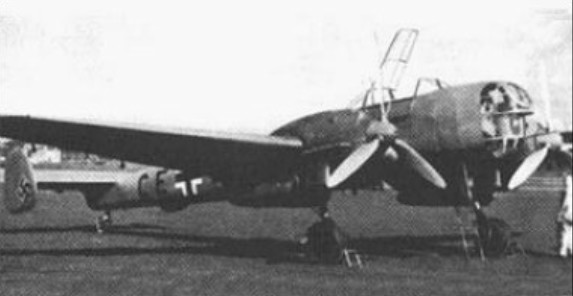
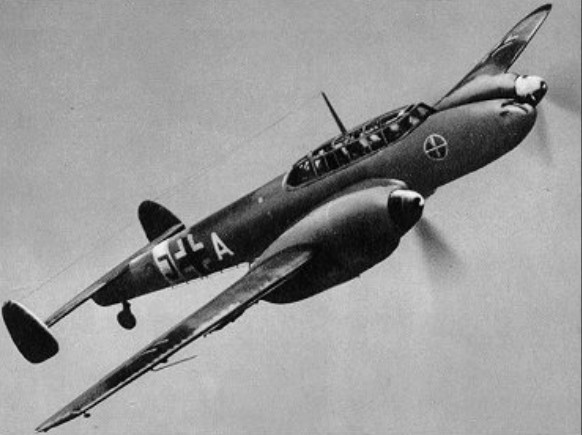
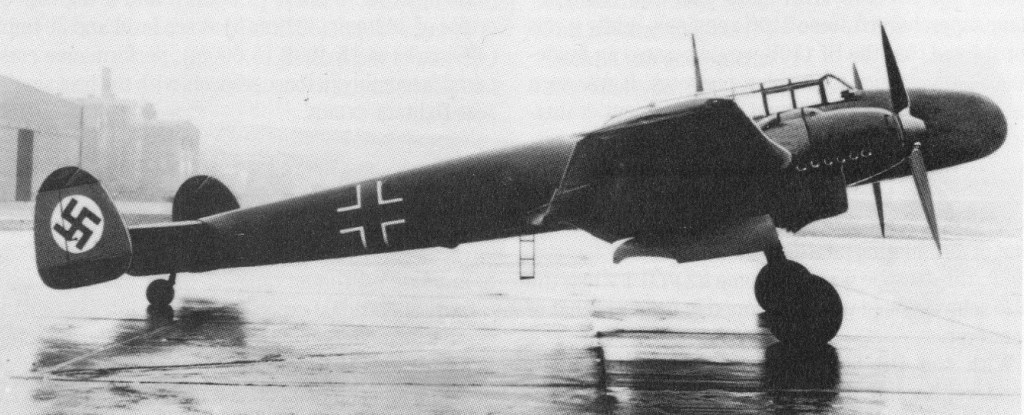
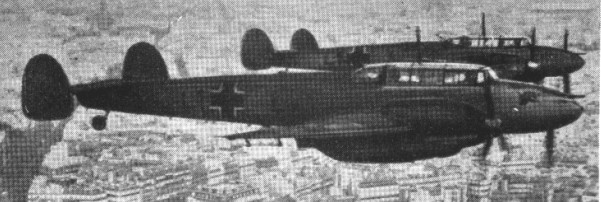
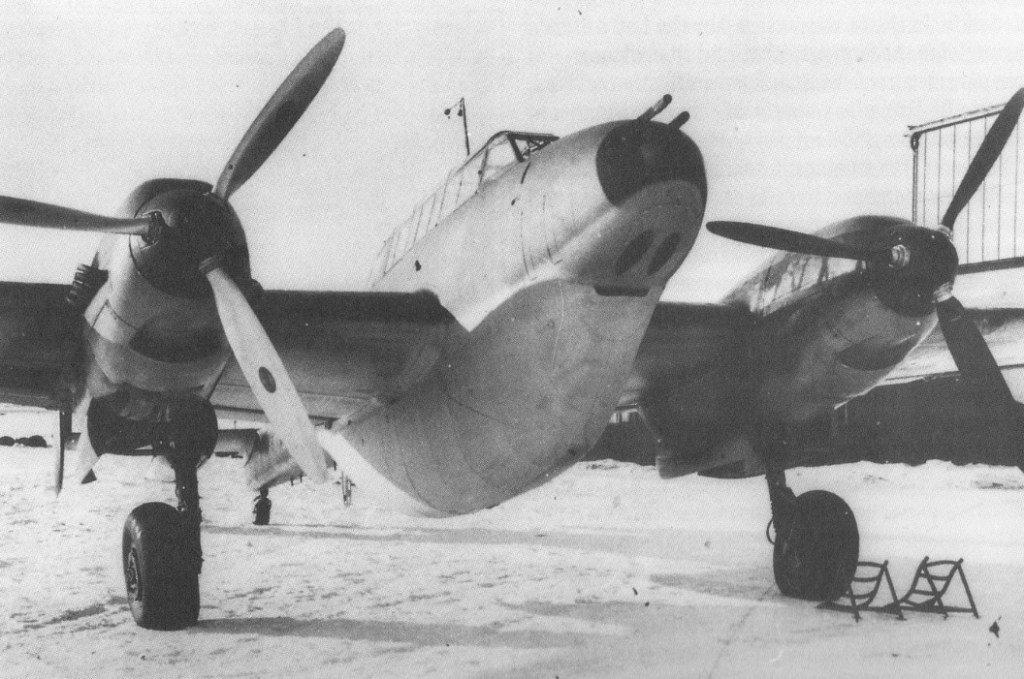
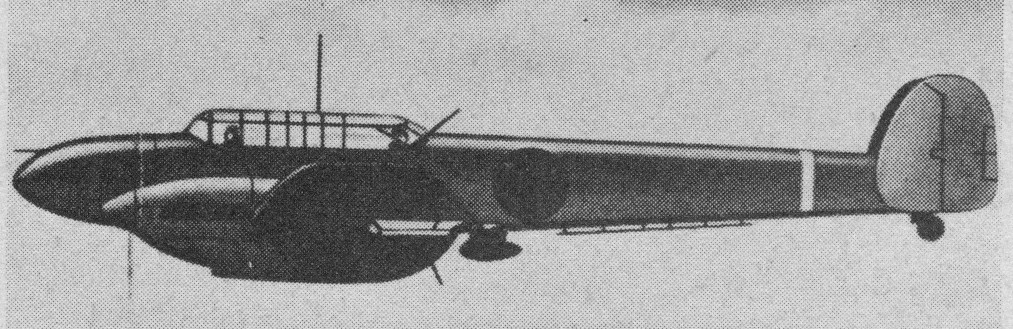
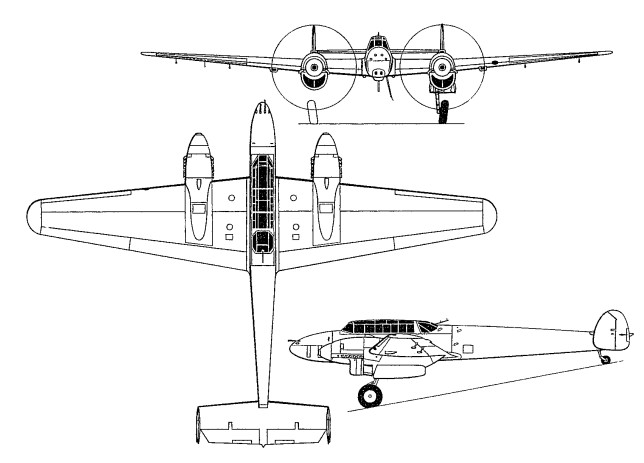
The Messerschmitt Bf162 was developed from the Bf110 Zerstorer (“Destroyer”) fighter but with few common parts. It was created to meet a requirement for a Schnellbomber or fast bomber. The type first flew in 1937. Unofficially named Jaguar, only three prototypes were built before the project was abandoned when the Junkers submission, the Ju88, won the contract.
Superficially resembling the Bf 110, but with a new fuselage, incorporating a glazed nose, initially 65 aircraft were ordered in the 1937/38 programme but due to Messerschmitt committment to the Bf109 and Bf110 programmes coupled with the superiority of th Ju88 this was reduced to 5 with only 3 being completed. The first two models V1 and V2 (werke no 817 and 818 reg. D-AIXE, D-AOBE) were powered by Daimler Benz DB600D and the third model V3 (werke no 819 D-AOVI) was powered by the DB601A. The first two aircraft flew in 1937 the third on the 7th July 1938. The first aircraft (V1) was dismantled after it’s initial flight trials, the second (V2) went to Rechlin and the third (V3) was used alongside the equally ill fated Me161 at Ausberg towing the Me163A.
Jaguar reconnaissance bomber version
Any parts left over including the incomplete V4 and V5 were used in Bf110 production.
Reconnaissance version of the Bf 110, with a new nose. Development was abandoned when it was understood that much simpler modifications of the Bf 110 would do the job.
Two models built the V1 (D-ABBA) powered by 2 Jukers Jumo 210 engines, and the V2 (D-AOFI), powered by 2 Daimler-Benz 600A engines. The V1 went to Rechlin and the V2 went to Augsburg and later to Peenemunde West and was used for towing the Me163A.
The Bf 110 originated from a Reichsluftfahrtministerium requirement of 1934 for a long-range escort fighter or heavily armed Zerstorer (destroyer). With a cantilever low-wing monoplane configuration, this two-seat fighter had an oval-section fuselage, long glazed canopy, high-mounted tailplane with endplate fins and rudders, retractable landing gear, and power plant was two Daimler-Benz DB 600 in-line engines.
The first prototype, the Bf 110 V1 powered by two 910 hp Daimler-Benz DB 600A engines, was flown for the first time on 25 May 1936 at Augsburg-Haunstetten by Dr-Ing Hermann Wurster. During an early test phase a speed of 314mph / 505 kph was clocked in level flight at 10,830 ft / 3300 m at a loaded weight of 11,025 lb / 5000 kg. For a relatively large, twin-engined aircraft it proved very agile and, in mock combat with a pre-series single-seat Bf 109B flown by Ernst Udet, the newly appointed Inspector of Fighter Pilots repeatedly failed to keep his larger opponent in his gun sight for sufficient time to render a hit likely, and experienced some difficulty in staying with the twin-engined fighter in steep turns.
Bf 110 V-1 – the first prototype
In January 1937, as a result of evaluation of a second prototype, the Bf 110 V2, at the Rechlin Erprobungsstelle, instructions were given that Messerschmitt should commence preparations for a pre-production series of aircraft. The proposed series model, the Bf 110A, was to be powered by a pair of DB 600Aa carburettor-equipped engines of 986 hp for take-off. By the time that the pre-series Bf 110A airframes had attained an advanced stage of construction the DB 600 engine was considered basically unsuited for fighter installation and was already being already phased out of production in favour of the direct-fuel-injection DB 601. The Reichsluftahrt-ministerium confidently expected that the DB 601 would be available by the Spring of 1938, when deliveries of the Bf 110 to the schweren (heavy) Jagdgruppen were expected to commence. Accordingly, instructions were issued to curtail the Bf 110A series, adapting the four airframes that had reached an advanced stage in assembly to take Junkers Jumo 210Da engines of 680 hp for take-off.
As it became obvious predictions for DB 601A engine delivery could not be met, the decision was taken to build an interim model, the Bf 110B with direct-injection two-stage supercharged Jumo 210Ga engines. While it was considered that the Bf 110B would possess an inadequate performance for combat purposes, it was seen as an ideal tool for equipment and armament evaluation, and the development of operational techniques.
Me.110C
It was issued during late 1938 to I (Schweren Jagdruppe)/LG 1 of the Lehrdivision, or Instructional division, to formulate tactics and techniques. In January 1939 this Gruppe was to become I(Z)/LG 1 with the Zerstörer. With the DB 601A engine, the Messerschmitt Zerstörer became the Bf 110C, a pre-series of 10 being delivered to the Luftwaffe early in January 1939, and acceptances of the initial production Bf 110C-1 by I(Z)/LG 1 began before the end of that month. Production of the Bf 110C-1 increased rapidly and by the early summer of 1939 Focke-Wulf and Gothaer Waggonfabrik had tooled up to supplement the output of Messerschmitt’s Ausburg-Haunstetten factory, and the MIAG at Braunschweig was preparing to phase into the programme.
By 31 August 1939 a total of 159 Bf 110C fighters had been accepted, although the Quartermaster-General’s strength returns for that date indicated that only 68 of these, plus 27 Bf 110Bs, had actually been taken into the inventory. Three Zerstörergruppen were to be included in the Order of Battle against Poland. Output of the Bf 110C had risen to more than 30 per month, and another 156 were delivered during the first four months of hostilities when production rates rose. The average monthly production during 1940 was 102.6 aircraft.
Early operational experience had resulted in the successive introduction of the Bf 110C-2, differing solely in having FuG 10 HF radio in place of the original FuG 3aU R/T and the Bf 110C-3 which differed in having improved MG FF cannon. These now gave place to the Bf 110C-4 in which some attempt was to provide nominal armour protection for pilot and gunner, normal loaded weight rising 490 lb / 333 kg over that of the Bf 110C-1 to 13,779 lb / 6250 kg. Further escalation in weight resulted from a demand for adaptation of the aircraft for to Jagd-bomber (Jabo) mission, two ETC 250 racks being introduced beneath the fuselage centre section for a pair of 551 lb / 250 kg bombs.
The substantially increased overload weight necessitated more power for take-off and emergency use, and the Jabo Bf 110C-4/B was fitted with DB 601N engines which with increased compression and 96 octane fuel, had a maximum take-off output of 1200 hp with full boost for one minute.
Issued to the Erprobungsgruppe 210, the Bf 110C-4/B fighter-bombers of two staffeln of this unit were to operate throughout the ensuing Battle singly and in small groups.
The Bf 110C escorted the bomber units that devastated Poland at the beginning of World War II, and just before Christmas 1939, Bf 109 and 110 destroyed 12 of a force of 22 Wellingtons which were making a reconnaissance of Heligoland Bight.
A parallel development was the Bf 110C-5 which had a single Rb 50/30 reconnaissance camera in the cockpit floor, forward-firing armament being restricted to the quartet of machine guns. This sub-type was to reach the Aufklärungstaffeln, or reconnaissance squadrons, in time to participate in the Battle, initially in mixed units with the Do 17P and Do 17Z.
On 20 July 1940 a total of 278 Bf 110s were available to Luftflotten 2, 4 and 5, and of these 200 were serviceable.
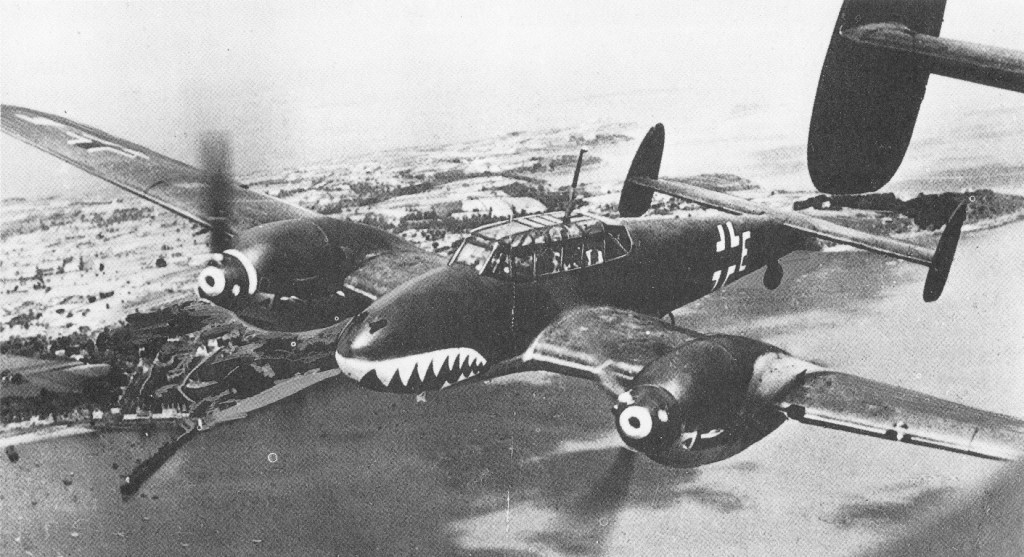
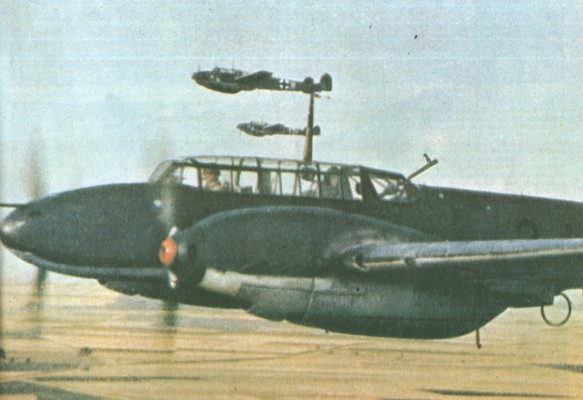
Bf 110C and longer-range Bf 110D were launched against Britain in the summer of 1940, but even before the Battle of Britain had reached a peak, it was clear that the Bf 110 was no match for the RAF’s manoeuvrable single-seat fighters. Indeed it was so vulnerable that this ‘escort’ fighter was unable to operate in British airspace by daylight unless it was itself escorted.
The Bf 110D-0 was the pre-series of the Dackelbauch (Dachsund-belly) equipped version.
Bf 110D-0
The Bf 110D-1 was a so-called langstrecken, or long-distance, Zestörer with a 264 ImpG / 1200 lt auxiliaet fuel tank made of plywood and dubbed a Dackelbauch (Dachsund-belly). It was found to ‘hang up’ under extremely low temperatures after its fuel had been exhausted, the fumes remaining in the tank tending to explode.
The Dackelbauch (Dachsund-belly) suffered disastrously on 15 August when flown by I/ZG 76. One-third of 21 participating aircraft were lost.
Bf 110C
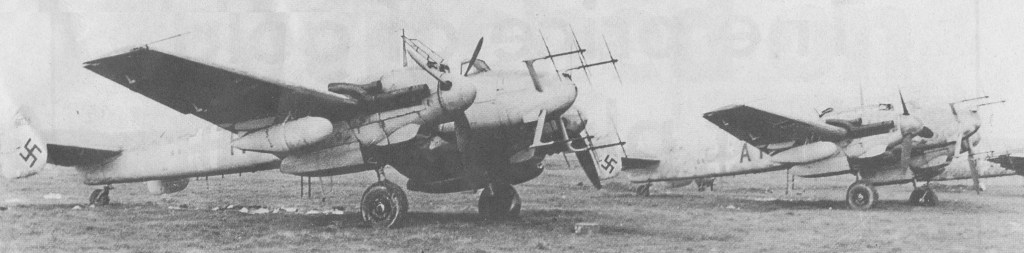
Despite its failure in this role, the Bf 110 was to prove a most valuable and successful night fighter until more advanced aircraft entered the scene in the latter stages of the war. Bf 110E with DB 601N engines and Bf 110F with DB 601E engines formed the nucleus of such operations. Considerable success was gained by these aircraft in conjunction with Wiirzburg radar, the pilots being directed by ground controllers into an interception position.
The three-seat night-fighter Bf 110F was followed into production by a series of Bf 110G with DB 605B engines, the early versions serving as fighter bombers. However the four-seat Bf 110G-4a, -4b, -4c, and -4d variants were provided with differing airborne radar installations for operation as night fighters. Final production version was the Bf 110H, generally similar to the Bf 110G but equipped with heavier armament. It is worth recording a significant factor in favour of the Bf 110, so often dismissed as a complete failure. During early 1944 almost 60% of the entire German night-fighter force was composed of variants of the Bf 110.
Otto Fries’s Me 110 at St Trond, Belgium, 1943
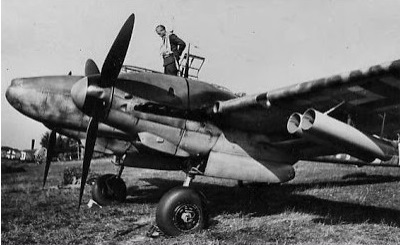
Bf 110G of III/ZG.26 Summer 1943 at Plantlȕnne with twin wing-mounted Doppelrohr BR 21 motar rocket launchers.
The spotting of modern twin-engined monoplanes in combat led to the belief that Japan was using imported German Me.110s. These were allocated the allied code name Doc, remaining in recognition manuals until the spring of 1943, and was then dropped.
A total of 6,050 of these aircraft was built before production ended in March 1945.
Bf 110C-1 Engines: 2 x DB 601A-1, 1050 hp Armament: 2 x 20mm MG FF cannon, 180 rds / 4 x 7.9mm MG 17 mg, 1000 rds / 1 x 7.9mm MG 15, 750 rds Max speed SL: 295 mph / 475 kph Max speed 19,685ft / 6000m: 335 mph / 540 kph High cruise SL: 262 mph / 422 kph High cruise 16,400ft / 5000m: 304 mph / 490 kph Economic cruise 13,780ft / 4200m: 217 mph / 350 kph Range at Econ cruise: 680 mi / 1095 kph Fuel, drop tanks: 121 Imp.Gal / 550 lt Max range, max fuel: 876 mi / 1410 km
Bf.110-E2 Engines: 2 x Daimler Benz DB601A
Bf.110-F2 Engines: 2 x Daimler Benz DB601F.
Bf 110F-4a Engines: 2 x Daimler-Benz DB601F, 1350 hp Wingspan: 53 ft 4.75 in Length: 39 ft 8.5 in Height: 11 ft 6 in Empty weight: 11,577 lb Combat weight: 14,884 lb External fuel: 66 Imp.Gal standard Max speed: 311 mph at 14,760 ft Cruise: 278 mph at SL Service ceiling: 35,760 ft Range: 745 mi Armament: 2 x 20mm MG FF cannon / 5 x 7.9mm MG 17 machine guns Radar: FuG Lichtenstein BC
Me 110 G Zerstörer Engines: 2 x Daimler Benz DB 605 B-1, 1455 hp Length: 42.815 ft / 13.05 m Height: 13.714 ft / 4.18 m Wingspan: 53.314 ft / 16.25 m Wing area: 413.338 sq.ft / 38.400 sq.m Max take off weight: 20705.0 lb / 9390.0 kg Weight empty: 11232.3 lb / 5094.0 kg Max. speed: 297 kts / 550 km/h Landing speed: 81 kts / 150 km/h Cruising speed: 275 kts / 510 km/h Service ceiling: 26247 ft / 8000 m Cruising altitude: 19619 ft / 5980 m Wing loading: 50.23 lb/sq.ft / 245.0 kg/sq.m Range: 486 nm / 900 km Max range: 1305 miles Crew: 3 Armament: 4x MG 151/20. 1x MG 81 Z
Bf 110G-2 Engines: 2 x DB-605, 1065kW Max take-off weight: 7100 kg / 15653 lb Empty weight: 5600 kg / 12346 lb Wingspan: 16.2 m / 53 ft 2 in Length: 12.3 m / 40 ft 4 in Height: 4.1 m / 13 ft 5 in Wing area: 38.5 sq.m / 414.41 sq ft Max. speed: 595 km/h / 370 mph Cruise speed: 450 km/h / 280 mph Ceiling: 10000 m / 32800 ft Range: 1200 km / 746 miles Armament: 4 machine-guns, 5 cannons Crew: 2
Bf 110G-4d/R3 Engines: 2 x Daimler-Benz DB605B-1, 1475 hp Wingspan: 53 ft 4.75 in Length: 41 ft 6/75 in Height: 13 ft 1.5 in Empty weight: 11,245 lb Combat weight: 20,727 lb Max speed: 342 mph at 22,967 ft Cruise: 317 mph at 19,685 ft Service ceiling: 26,248 ft Range: 1305 mi Armament: 2 x 30mm MK 108 cannon / 2 x 20mm MG 151 cannon / 2 x 7.9mm machine guns Radar: FuG 220b Lichtenstein SN-2 and FuG 227/1 Flensburg
Design of the Bf 109 was initiated by Bayerische Flugzeugwerke in late 1933, following issue by the Reichsluftfahrtministerium (RLM) of a specification for a monoplane fighter to replace the Arado Ar 68 and Heinkel He 51 in Luftwaffe service. The need was not then urgent, but the RLM believed that by competitive evaluation and with reasonable time available for development, they would have a worthwhile fighter when the moment came for it to enter operational service. Submissions were made by Arado, Bayerische Flugzeugwerke, Focke-Wulf and Heinkel: those of the second and last companies were selected for construction and evaluation, with each initially to build ten examples.
Heinkel’s He 112 was the first to fly (in the summer of 1935) but it was the Bf 109 that was to be built in very large numbers. Both of these prototypes made their first flight under the power of a 695 hp Rolls-Royce Kestrel in-line engine, as the Junkers Jumo 210 in-line engine – around which both had been designed- was not available in time. Using the Me 108 airframe as the basis for the design; the wings, undercarriage, rear fuselage and tail of the new Me 109 fighter were the same as in the Me108. The prototype, powered by a Roll-Royce Kestrel, first flew in May 1935, piloted by Haus Knoetzsch, from the factory airfield between Ausburg and Haunstettem.
The second and third prototypes were completed with the intended Jumo 210A rated at 680 hp for takeoff.
Follow-on prototypes utilized several other engines until settling on the Daimler-Benz inverted-V, liquid-cooled engine that powered subsequent airframes throughout its wartime production.
The new fighter’s first public demonstration took place at the 1936 Olympic Games held in Berlin, but the plane’s first real impact on the aviation world came during the international flying meet held in Zurich in the summer of 1937. Five Bf 109s took part and demonstrated outstanding climbing, diving, and maneuverability, along with astonishing speed.
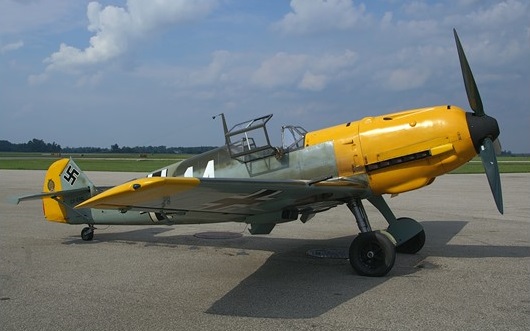
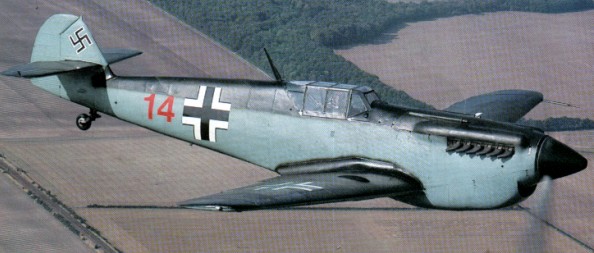
Bf 109
The initial example of the first production model, the Bf 109B, left the Ausburg-Haunstetten assembly line in February 1937 enabling Geschwader JG 132 Richthofen conversion to begin almost immediately at Juterborg-Damm.
Bf.109B
In March twenty-four Bf 109Bs were shipped direct from the factory to the Tablada airfield, Seville, Spain, for use by the Condor Legion. 2 Staffel of Jagdgruppe 88 achieved operational status by late April 1937. Bf 109B-2 and variants of the Bf 109C were flown by the Condor Legion in the Spanish Civil War.
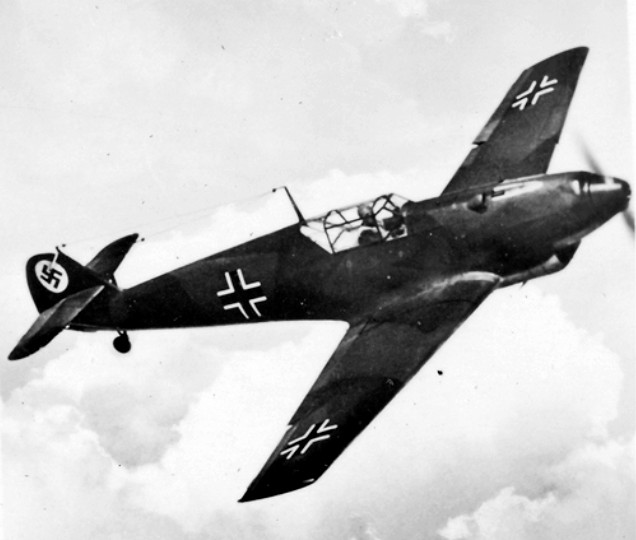
A single-seat fighter of all-metal construction, the Bf 109 was a cantilever low-wing monoplane, the wing having automatic leading-edge slots, large slotted trailing-edge flaps, and ailerons which drooped when the flaps were right down. The main landing-gear units were retractable but most versions had a non-retractable tailwheel. The tail unit was conventional, but the tailplane was braced by struts until a tailplane of cantilever structure was introduced with the Bf 109F.
First production version to enter service with the Luftwaffe was the Bf 109B-1 powered by a 635 hp / 473.2kW Jumo 210D engine, followed by the 109B-2 with a 477kW Jumo 210E and later with a 499kW Jumo 210G. Armament of the Bf.109B 1was three machine guns.
Series manufacture of the Bf 109B gave way to the successively improved Bf 109C and D, but these retained the Jumo engine. Design emphasis was now being placed on the Bf 109E with the new Daimler-Benz engine.
On 11 November 1937 Bf 109 V13, fitted with a specially-boosted Daimler-Benz DB 601 engine, raised the world airspeed record for landplanes to 379.38 mph / 610.53 kph.
The first series Bf 109E began the leave the assembly lines at the beginning of 1939, all production of the fighter by the parent company having been transferred to Regensburg. The Erla Maschinenwerk at Leipzig and the Gerhard Fieseler Wetke at Kassel had become the principle suppliers of the Bf 109 and the Wiener-Neustädter-Flugzeugwerke in Austria was preparing for large scale manufacture of the fighter. The DB 601A engine of the Bf 109E had received final clearance for service use late in 1938 and, in addition to being built by the Daimler-Benz plants at Genshagen and Marienfelde, this was being produced by the Henschel Flugmotorenbau at Altenbauna and the Niedersachsische subsidiary of the Büssing-Werke of Braunschweig.
The direct injection enabled the Messerschmitt to out-dive its opponents, reduced fuel consumption, and afforded better results from relatively low octane fuel. The DB 601A was rated at 1175 hp for take-off.
The Bf 109E retained the 40-mile (65 km) range FuG 7 R/T equipment of the earlier versions along with the Carl Zeiss C/12C reflector sight, and armament of the initial Bf 109E-1 comprised four 7.9mm Rheinmetall Borsig MG 17 machine guns. It had been decided to standardise on the more lethal if slower firing 20 mm MG FF cannon as a wing-mounted weapon as supply allowed.
The Bf 109E-3 followed the E-1, retaining the twin fuselage-mounted synchronised MG 17 machine guns with 1000 rounds per gun and mating them with two MG FF cannon, each with 60 rounds. No armour for the pilot or fuel tanks was provided, nor bullet-proof windscreen.
Bf 109E-3 – September 1940
Bf 109 production barely exceeded 400 in 1938 whereas 1092 of the E-model were built between 1 January and 1 September 1939. At the invasion of Poland 1056 Bf 109s were on strength, of which 946 were serviceable.
On Sunday 8 October 1939 at around 3.00pm two French fliers named Villey and Casenobe shot down one Messerschmitt 109 each near Landau, during an aerial combat between 5 Curtiss Hawks of the French ‘Red Devil’ Squadron (4 Sqn 2nd Fighter Group), and for Me 109s. These were the first French kills of the war.
Three Bf.109E were sold to Japan in 1942, coded ‘Mike’ by American Intelligence
Incorporated into the 109E were a cockpit of revised design and embodying heavier framing together with 8mm seat armour weighing 53 lb / 24 kg and a curved plate attached to the hinged canopy weighing 28.6 lb / 13 kg. The fire rate of the MG FF was being improved and was to be introduced by the E-4 which rapidly replace the E-3 during the summer and autumn of 1940.
Bf 109E
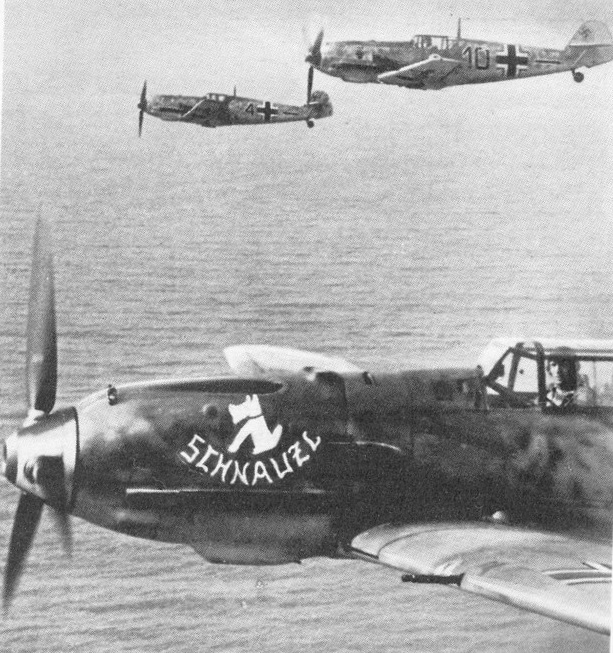
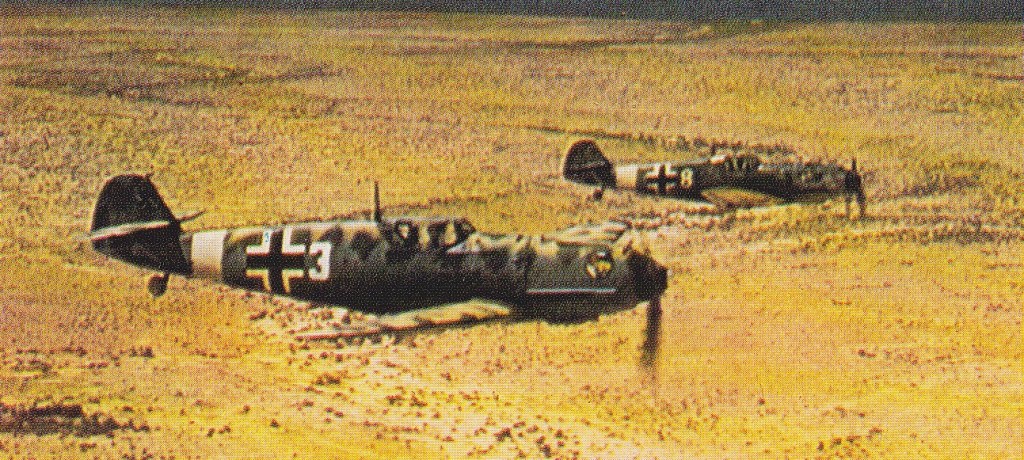
The 109D was followed into service by the Bf 109E with 820kW DB 601A engine. In addition to production for the Luftwaffe, some 300 examples of this type were exported. The Bf 109E was the principal version used in the Battle of Britain and was followed by the Bf 109F with an 894.2kW DB 601N or 969kW DB 601E engine. The Bf 109F had much cleaner aerodynamic lines, introducing the unbraced tailplane and retractable tailwheel.
Messerschmitt Bf-109E-4
The Spitfire, the Bf 109’s first major opponent, was slightly faster and definitely more maneuverable, but its performance at altitude was inferior. There was also little difference in pilot ski between the Luftwaffe and the Royal Air Force, although pilots in the RAF had the advantage of fighting over their own country, while the critical range of the Bf 1 09s limited German fighting time to about twenty minutes.
The Bf 109E 3 which formed the standard equipment of Luftwaffe squadrons in the Battle of Britain in 1940 had an 1100 hp Daimler Benz DB601A engine and was armed with one 20 mm cannon and four machine guns.
Bf109E4
The Bf.109E controls tended to heavy up as speed increased, demanding more physical effort than its British contemporaries. The absence of a trimmer necessitated continuous application of rudder at high speeds, and it suffered an incipient swing during takeoff and landing. A big advantage was its direct fuel injection.
Also licence built by Fiesler.
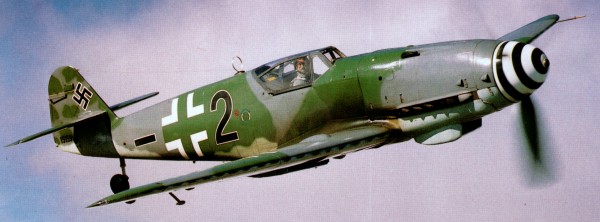
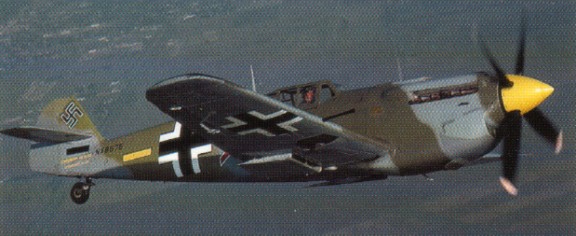
The Bf 109G or Gustav was first flown as a type in 1944, with the G-10 having an enlarged supercharger to enable it to be used as a high altitude fighter in defence of the Reich. With a service ceiling of 41,000 feet, the Gustav G-10 was also the fastest of the series with 426 mph at 24,000 feet. Armament was one 30mm cannon and two 13mm machine guns, all in the nose. Modified around the 1475 hp DB605 engine, the Gustav also introduced cockpit pressurisation, crucial from late 1942 onwards as the fighter Gruppen struggled to repel high altitude USAAF daylight bomber raids. The Bf109 was the most abundantly produced fighter manufactured by either side in the 1939-45 war. When German production stopped, the G series of the Bf 109 was produced in far greater numbers than any other model, 21,000 being completed by the end of 1944. This machine had two MG 131 machine guns, a single 30-mm MK 108 cannon firing through the spinner, and sometimes carried two underwing MG 151/20 weapons.
Postwar Spain continued licence manufacture of the Gustav as the Merlin engined Hispano 1112M Buchon.
A significant quantity of Bf 109G 1s and G2s were assembled by IAR at Brasov from main parts supplied by the Germans. These fighters received white serial numbers on their fin in the ‘White’ 200 series. The next sub version assembled at IAR was the Ga 4, a total of 15 being finished up to the factory being dispersed in the summer of 1944 due to Allied bombings. The first one was rolled out in April 1944. The Ga 6 was the next sub version to be manufactured at IAR-¬Brasov. The first one, ‘Black’ 316, was test flown only in early February 1945. Nevertheless, none of the IAR manufactured Bf 109Ga 6s saw action during World War Two.
The mainstay of the Luftwaffe’s fighter arm, over 30,000 were built of the Gustav variant alone between 1941 and 1945. It has been estimated that about 35,000 Bf/Me 109 were built between 1937 and 1945.
Last versions to see limited use were the increased-span Bf 109H and a refined version of the Bf 109G, designated Bf 109K. And right at the end of the war final German deliveries amounted to 19 examples of the Bf 109K-4 with more power and armament as well as a pressurised cockpit.
Production of the Bf 109 continued in Czechoslovakia and Spain during early post-war years, and some Czech-built S-99 were used in a training role until 1957.
Nazi Germany saw the Spanish Civil War as an ideal conflict in which to test its renascent forces and their new weapons, and therefore supported the ideologically allied Nationalists with small but high-quality forces. The air component was the Legion Condor, which began to arrive in November 1936 and included as its fighter element Jagdgruppe 88, initially comprising three Staffeln with He 518 biplanes. In January 1937 three Bf 109B prototypes were trialled in Spain, their success prompting the despatch from March 1937 of the first 24 of an eventual 45 Bf 109B-2s for service with 1. and 2.J/88 as well as the Nationalists’ 5-G-5. This immature fighter proved generally superior to all its opponents, and Bf 109s notched up J/88’s 100th ‘kill’ in January 1938, more than tripling this score by the time the Germans pulled out of the war in March 1939 after gaining invaluable tactical experience.
In the mid-war years, Germany bolstered the Italian air force with numbers of fairly advanced fighters. The initial deliveries comprised sufficient Bf 109F fighter-bombers (in F-4/B and F-4/R1 variants). Further reinforcement was necessary in 1944: the Italians thus received the upengined and upgunned Bf 109G model in the form of 28 G-6, 97 G-10 and four G-12 variants. As a bomber interceptor the Bf 109G 6 was armed with two MG 131 machine guns, a single MK 108 30 mm. cannon firing through the propeller shaft and two MG 151/20 under wing guns.
“Mistletoe” aircraft (officially codename “Beethoven”), also known as father-and-son or piggy-back aircraft, were composite aircraft, made up of two planes, one riding on the other’s back. There were two basic types of Mistletoe. Both used a pilotless Ju.88 bomber as the bottom plane; it carried a 3.5 ton explosive warhead and was guided to the target by a fighter pilot on top. The guide plane was either a Me.109 (as the S-1 Mistletoe), or a Fw-190 (as the S-2 Mistletoe), which would abandon the Ju.88 shortly before it exploded. The Mistletoe composite aircraft were tested at Nordhausen and Peenemünde at the beginning of 1944. On the night of 24-25 June 1944, five S-1 Mistletoes were first used operationally. Approximately 250 Ju.88 were converted to Mistletoes.
HA-1109
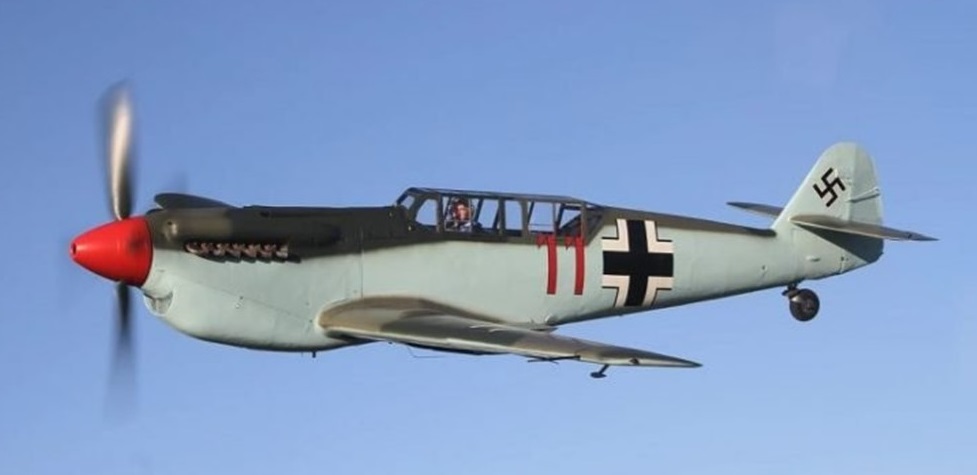
In 1943 Hispano received a contract to build the Messerschmitt Bf 109G under license for the Spanish Air Force. Designated Hispano HA-1109, it was powered initially by a Hispano-Suiza HS-12Z engine and later, in HA-1109/1110 Buchon variants, by the Rolls-Royce Merlin.
Although 233 single seat fighters were built, only two dual-control two seat trainers were built. The first was powered by the Hispano-Suiza 12Z and designated HA-1110-K1L.
CASA of Spain built the RR Merlin powered Messerchmitt 109 as the HA1112. The second two-seater was built with a Merlin 500 engine and designated HA-1112-M4L. The HA-1110-K1L was eventually converted to an HA-1112-M4L.
1954 Hispano Aviation HA-1112-M4L G-AWHC
A number of Buchóns were deployed to Spanish Sahara (1957-58) to battle Moroccan insurgents and their allies. The Buchóns were primarily tasked with giving close air support to army units on the ground. During the battle, the HA-1112 earned the distinction of being the last member of the Bf-109 family to participate in actual battle.
Buchóns stared in iconic movies such as: “Der Stern von Afrika” (The Star of Africa) A German film from 1957 focusing on the Luftwaffe ace, Hans-Joachim Marseille. “Battle of Britain” The legendary British film from 1968 features many Buchóns filling the Bf-109 role. “Memphis Belle” The 1990 American film about the Boeing B-17 bomber of the same name. “The Tuskegee Airmen” A 1995 American film about the famous fighter group of all African American pilots in WWII. “Dark Blue World” A Czech film from 2001 about Czechoslovakian pilots in the RAF during WWII.
HA1112
Avia S-199
In Czechoslovakia, Avia produced the Messerschmitt 109 as the Avia S-199 Mezek.
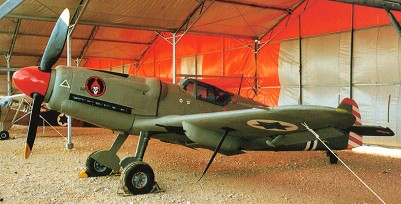
The AVIA C.210 single-seat fighter was built during the early post-war year by the former Avia factory for the Czech Air Force. Derived from the Daimler-Benz powered Me 109G-14 and comparable with the Me 109K-18, the C.210 was powered by a 1340 hp Junkers Jumo 211F engine. The Me 109G-14 was built in Czechoslovakia as the C.10 and, in two-seat trainer form, as the C.110. A number of C.210 were exported to Israel.
Bf.109B 1 Engine: 635 hp Jumo 210D. Armament: 3 x machine guns.
Bf 109B-2 Span: 9.87m (32tt4.5in) Length: 8.55m (28ft 0.7 in) Powerplant: l x Junkers Jumo 2l0Da, 537kW (720 hp) Armament: 3 x 7.92-mm (0.312-in) mg Max T/O weight: 2150 kg (4,740 lb) Max speed: 289 mph at 13,125ft Operational range: 430 miles.
Bf.109C Engine: Junkers Jumo 210
Bf.109D Engine: DB 600
Bf.109E Engine Daimler Benz DB 601A, 1,100 h.p. Wing span 32.3 ft. (9.84 m.) Length 28.5 ft. (8.68 m.) Normal take-off weight: 5875 lb / 2665 kg Weight empty 4,420 lb. (2,005 kg.) Fuel capacity: 88 ImpG / 400 lt Max speed SL: 290 mph / 466 kph Max speed 6560ft/2000m: 322 mph / 518 kph Max speed 14,560ft/4449m: 348 mph / 560 kph Ceiling 36,000 ft. (11,000 m) ROC: 3280 fpm / 1000 m at 5400 lb / 2450 kg Time to 9840 ft / 3000m: 3.6 min Endurance: 1.1 hr at max continuous pwr, 19685 ft / 6000 m Range cruise: 410 mi / 660 km at 233 mph / 375 kph at 22,965 ft / 7000 m Seats: pilot. Armament: 3 x 20 mm cannon and 2 x 7.9 mm mg
B.109E-0 Pre-production variant Engine: DB 601A, 1100 hp / 820 kW Armament: 4 x 7.92mm / 0.312 mg
Me 109 E-1 Production variant Engine: Daimler-Benz 601Aa, 1085 hp Length: 28.543 ft / 8.7 m Height: 11.253 ft / 3.43 m Wingspan: 32.48 ft / 9.9 m Wing area: 176.530 sqft / 16.400 sq.m Max take-off weight: 5699.9 lb / 2585.0 kg Weight empty: 4090.3 lb / 1855.0 kg Max weight carried: 1609.7 lb / 730.0 kg Max speed: 308 kts / 570 km/h Initial climb rate: 2755.91 ft/min / 14.00 m/s Service ceiling: 33136 ft / 10100 m Wing load: 32.39 lb/sq.ft / 158.00 kg/sq.m Range: 324 nm / 600 km Endurance: 2 h Crew: 1 Armament: 2x MG 17 7,9mm; 2x MG FF 20mm;1x MFG FF 20mm
Bf.109E-1B Fighter/Bomber
Bf 109E-3 Engine: Daimler-Benz DB 601Aa, 1175 hp / 876 kW Wingspan: 32 ft 4.5 in / 9.87 m Length: 28 ft 4.5 in / 8.64 m Height: 8 ft 2.25 in / 2.50 m Wing area: 174.05 sq.ft / 16.17 sq.m Empty wt: 4189 lb / 1900 kg MTOW: 5875 lb / 2665 kg Max speed: 348 mph / 560 kph at 14,560 ft / 4440 m Time to 3290 ft / 1000m: 1 min 6 sec Service ceiling: 34,450 ft / 10,500 m Range: 410 mi / 660 km Armament: 2 or 3 x 20mm cannon, 2 x 7.92 mm (.312 in) mg Seats: 1
Bf.109E-4 Armament: 2 x 7.92mm / 0.312 mg, 2 x 20 mm cannon
Bf.109E-4/B Fighter/Bomber
Bf.109E-5 Reconnaissance fighter Engine: DB 601Aa
Bf.109E-6 Reconnaissance fighter Engine: DB 601N, 1200 hp / 895 kW
Bf.109E-8 Engine: DB 601E, 1350 hp / 1007 kW
Bf.109E-9 Reconnaissance fighter
Me 109F-3 Engines: 1 x Daimler Benz, 1300 hp Wing span: 32 ft 6.5 in (9.92 m) Length: 20 ft 0.75 in (8.86 m) Height: 11 ft 2 in (3.4 m) Max TO wt: 6063 lb (2750 kg) Max level speed: 391 mph / 630 kph
Bf 109F-4/B
Bf 109F-4/R1
Bf 109G Engine: Daimler Benz DB 605A Max speed: 387 mph (623 km/h) at 23,000 ft (7,000 m).
BF 109 G-6 Wingspan 9.92 m (32 ft. 6.5 in.) Length 9.02 m (29 ft. 7 in.) Height 3.4 m (11 ft. 2 in.) Empty Weight 2,700 kg (5,953 lb) Speed: 387 mph at 22,970 ft Range: 450 miles Armament: two MG 131 mg, one MK 108 30 mm. cannon firing through the propeller shaft and two MG 151/20 under wing guns.
Bf 109G-6 Engine: 1 x Daimler Benz DB 605AM, 1342kW Max take-off weight: 3150 kg / 6945 lb Wingspan: 9.92 m / 32 ft 7 in Length: 9.02 m / 29 ft 7 in Height: 3.40 m / 11 ft 2 in Wing area: 16.05 sq.m / 172.76 sq ft Max. speed: 621 km/h / 386 mph Ceiling: 11750 m / 38550 ft Range: 720 km / 447 miles Armament: 2 x 13mm machine-guns, 3 x 20mm cannons Crew: 1
Bf 109G-10 Engine: Daimler-Benz DB605D.
Bf 109G-12
Bf 109K-4 Powerplant: l x Daimler-Benz DB605ASCM, 1491 kW (2,000 hp) Span: 9.97m (32ft 8.5in) Length: 8.85m (29ft 0.5 in) Armament: 1 x 30-mm and 2 x 15-mm cannon Max TO weight: 3600 kg (7,937 lb) Max speed: 452 mph at 19,685ft. Operational range: 366 miles.
Hispano HA-1112-M1L Buchon Engine: Rolls-Royce Merlin 500-45, 1400 hp Wingspan: 32 ft 6.5 in Wing area: 172.2 sq.ft Length: 29 ft 10.5 in Height: 8 ft 6 in Empty weight: 5855 lb MTOW: 7011 lb Max speed: 419 mph at 13,000 ft Max ROC: 5580 ft/min Range: 475 mi Armament: 2 x 20 mm cannon Bombload: 8 x 22 lb rockets
Avia C.210 Engine: 1340 hp Junkers Jumo 211F Max speed: 432 mph Range: 350 mi Normal loaded weight: 7800 lb Wingspan: 32 ft 6.5 in Length: 29 ft 6 in Height: 12 ft
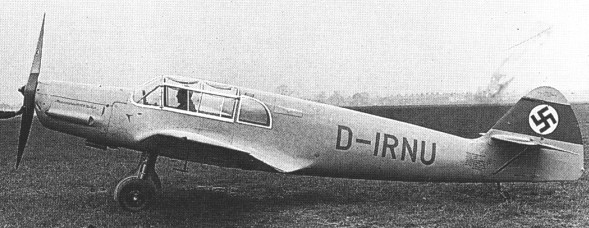
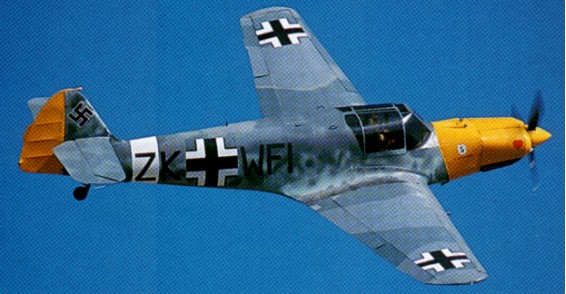
In 1934 Messerschmitt designed the M37, later to become the Bf 108 Taifun, for the German team taking part in the 1934 Challenge de Tourisme International. The original design was for a light tourist two-seater, and even though the Challenge was not a great success for the Bf 108, as the best German pilot Theo Osterkamp only came in fifth, the RLM still ordered thirty-two Bf 108s.
The M 37 prototype flew first in spring 1934 powered by a 250 PS (247 hp, 184 kW) Hirth HM 8U inverted-V engine, which drove a three-blade propeller. It could cruise at 145 knots and was orig¬inally equipped with full span flaps and spoilers for lateral control. It featured automatic Handley Page leading edge slats, a retractable undercarriage, fully stressed skin fuselage construction and flush rivets.
Although it was outperformed by several other aircraft in the competition, the M 37’s overall performance marked it as a popular choice for record flights. Particular among these traits was its extremely low fuel consumption rate, good handling, and superb takeoff and landing characteristics. One of the first major changes made to the production variants was to adapt the fuselage for a four-seat configuration.
Production as the Bf 108 Taifun began in 1934 and the first foreign pilot who tested the Bf 108 was Charles Lindbergh.
The Bf 108A first flew in 1934, followed by the Bf 108B in 1935. The production of the improved version, the Bf 108B, was set-up in November 1935. The B version was redesigned to be a four-seater with a new 179kW Argus As 10C engine. The Bf 108B was a very modern light aircraft with an all-metal airframe, retractable undercarriage, adjustable propeller, and with excellent flight characteristics.
The military version of the Taifun was the Bf 108B-2 and was acquired by the Luftwaffe in 1939. It was widely employed during the war years by all operational Luftwaffe units as a light liaison aircraft. The nickname Taifun (German for “typhoon”) was given to her own aircraft by Elly Beinhorn, a well known German pilot, and was generally adopted.
In 1941 the Bf 108D replaced the B on the production line. An Argus As 10R engine powered the D version and included the new Argus automatically adjustable propeller and improved fuel assembly.
Production was transferred to the S.N.C.A. du Nord factory at Les Mureaux in France in 1942, where 170 Bf 108D were completed before the liberation of France in 1944. In total 626 military Taifuns, versions B-2 and D-1, were produced. At least 180 civilian or export versions, Bf 108B-0 and B- 1, were produced.
French production continued after the war where another 115 aircraft as the Nord 1000 and Nord 1002 Pengouin were manufactured. 285 were built post-war.
Nord 1002
Production of the Bf 108 amounted to 885 aircraft in total.
The Hungarian Air Force had eight Taifuns, both the Italians and Rumanians had three, the USSR bought two and Switzerland and Yugoslavia had twelve each. One aircraft was used in Chile, one or two in Japan and one was in Australia. The Bulgarian Air Force had six and at least one was in Spain. One Bf 108B-1, coded XC44, was operated by the US Embassy in Berlin. Two Bf 108B-1s were flown by the German Embassy in London but the RAF confiscated these two aircraft in 1939. After the war, one Bf 108B-2 was flown in Czechoslovakia, two in Poland, one in Denmark and one in Sweden. Some 115 Bf 108Ds (Nord 1000) were used by the French Air Force and Navy until the late 1950’s.
The Ilmavoimat / Maavoimat evaluated both the Bf108 but considered the design unsuitable for their overall requirement, correctly assessing the aircraft as a light passenger aircraft unsuitable for combat reconnaisance and without any real STOL capability.
Bf 108B Taifun 1 x Argus As 10C, 179kW / 237 hp Max take-off weight: 1385 kg / 3053 lb Empty weight: 880 kg / 1940 lb Wingspan: 10.50 m / 34 ft 5 in Length: 8.30 m / 27 ft 3 in Height: 2.30 m / 7 ft 7 in Wing area: 16.40 sq.m / 176.53 sq ft Max. speed: 300 km/h / 164 kts / 186 mph Service ceiling: 5000 m / 16400 ft Range: 1000 km / 540 nm / 621 miles Endurance: 4 hr Initial climb rate: 787.4 ft/min / 4.00 m/s Seats: 4
Nord 1001 Engine: 240hp Renault 6Q-10, 240 hp Span: 34ft 6in (10.51m) Width wings folded: 10 ft 7 in Length: 27ft 3in (8.3m) Height: 7 ft 7 in Max wt: 2990 lbs (1355kg) Max speed: 186 mph (299 kmh) at 5000 ft Cruise: 160 mph at 6000 ft TO speed: 70 mph Ldg speed: 65 mph Stall: 53 mph TO roll at 3000 lb: 950 ft TO to 50ft: 1120 ft Ldg rol: 750 ft Ldg from 50 ft: 1100 ft ROC: 1200 fpm Ceiling: 23,500 ft Range: 620sm (997 km)
Nord 1002 Engine: 240hp Renault 6Q-11, 240 hp
Nord 1002 Engine: 240hp Argus As 10c V8 Span: 34ft 6in (10.51m Length: 27ft 3in (8.3m) Max wt: 2990 lbs (1355kg) Speed: 186mph (299 kmh) Range: 620sm (997 km)
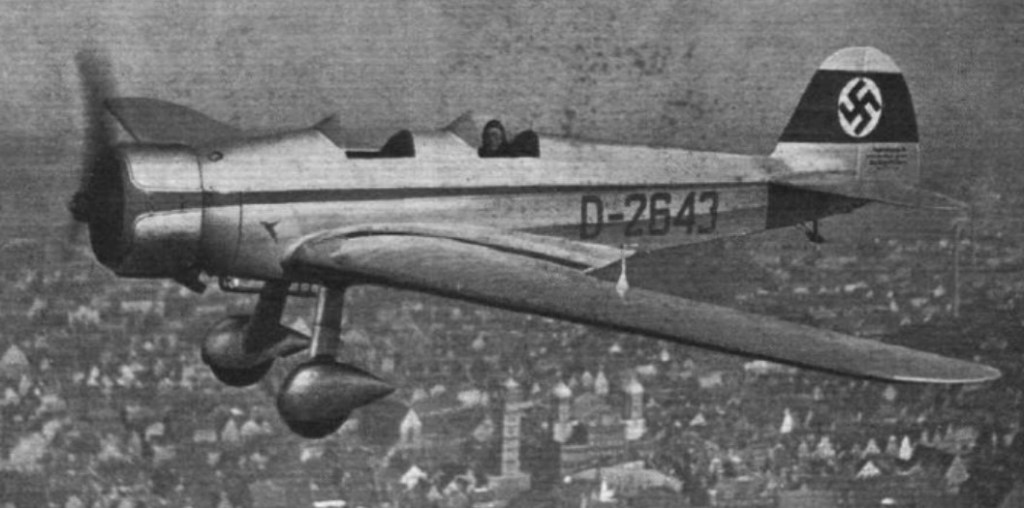
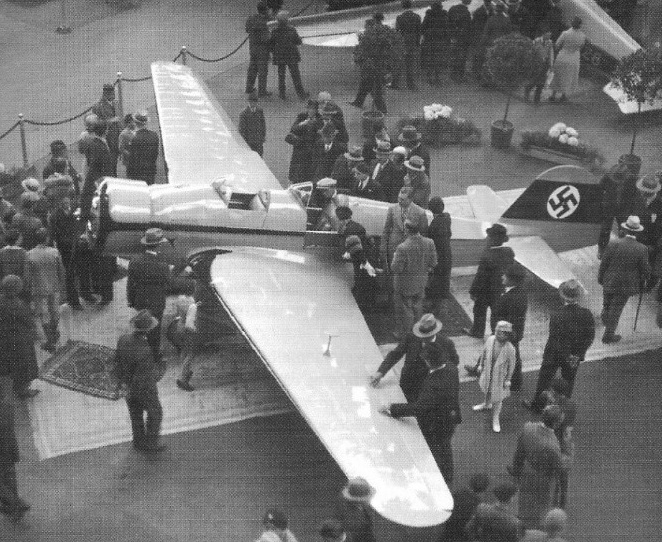
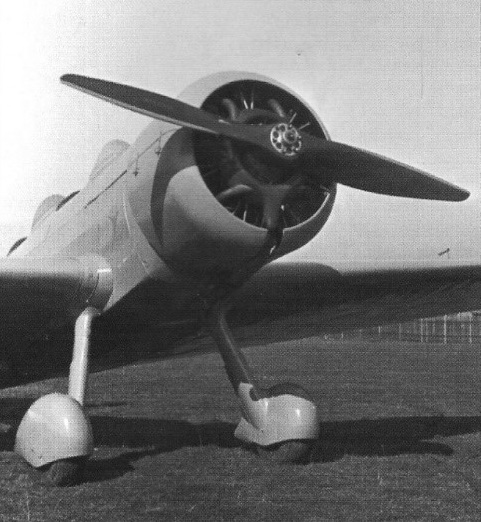
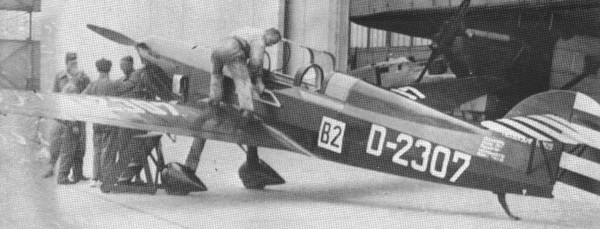
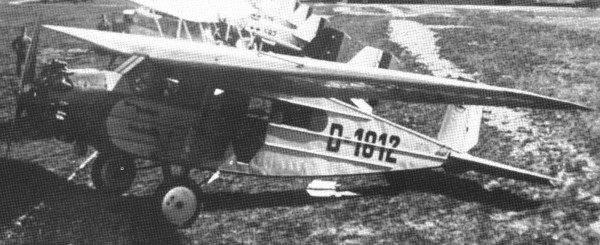
During 1927-33, Messerschmitt designed a series of six sport planes, the single-seat M.17 and M.19, and the two-seat M.23, M.27 M.31, and finally the M.35. With the exception of the M.23, none sold in large numbers. They were all single-engine low-wing cantilever monoplanes with open cockpits and fixed undercarriage. The M.35 kept the extended fuselage of the M.27 and combined it with an undercarriage of single leg, spatted form.
Two different engines were used. The M35a had a 112 kW (150 hp), seven-cylinder radial Siemens Sh 14a, and the M.35b a 100 kW (135 hp) four-cylinder inline inverted air-cooled Argus As 8b. The former was the shorter and faster of the two. The aircraft first flew in 1933.
The aircraft was first shown to the public and potential buyers at the 1934 Aerosalon in Geneva. In that year, Rudolf Hess won the Zugspitz trophy in a M.35. In 1934-1935, Wilhelm Stör won the German Aerobatic Championship in a M.35b, and in 1935 the women’s prize was taken by Vera von Bissing in a similar machine. Stör can be seen flying an M.35 in daring acrobatic maneuvers during the 1935 German film Wunder des Fliegens (Miracle of Flight).
Despite these successes and strong performances at other venues in the late 1930s, only 15 M.35s were built, 13 registered in Germany, one in Spain and reputedly one in Romania. Though the M.35a was faster, the M.35b was commoner; only two M.35as are definitely identified.
M.35a Powerplant: 1 × Siemens Sh 14a, 110 kW (150 hp) Wingspan: 11.57 m (37 ft 11.33 in) Wing area: 17.0 m2 (183 sq ft) Length: 7.48 m (24 ft 6 in) Height: 2.75 m (9 ft 0 in) Empty weight: 500 kg (1,102 lb) Gross weight: 800 kg (1,764 lb) Maximum speed: 230 km/h (143 mph, 124 kn) Cruise speed: 195 km/h (122 mph, 106 kn) Range: 700 km (435 mi, 378 nmi) Service ceiling: 5,800 m (19,000 ft) Rate of climb: 5.05 m/s (994 ft/min) to 1,000 m (3,200 ft) Crew: two
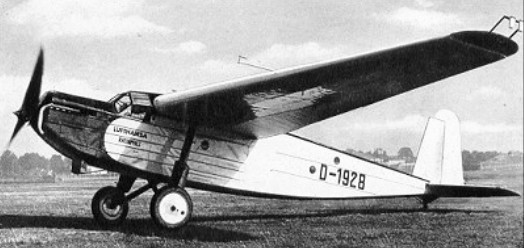
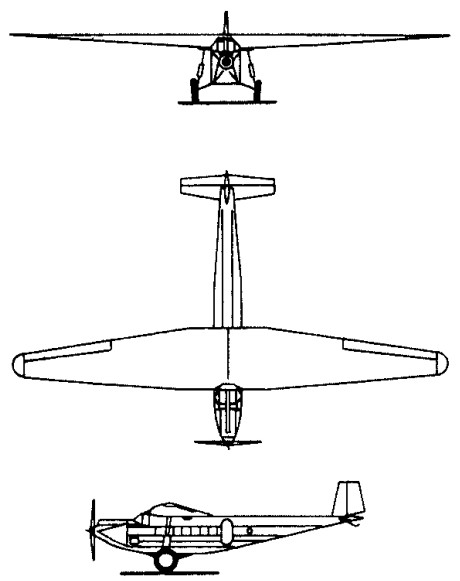
Developed from the M-18, the first M20 prototype flew on February 26, 1928, and crashed on its initial flight killing the pilot Hans Hackmak. The second aircraft flew on August 3, 1928.
There were 3 models: a,b, and b2.
13 aircraft went to DLH and one to DVS. A number of crashes led Lufthansa to refuse to accept any more M20s, which resulted in the Messerschmitt company, Bayerische Flugzeugwerke (BFW) going bankrupt on 1 June 1931.
Eight survivors went to the Luftwaffe as trainers, the last one crashing in 1943. One was sold to Varig in Brazil in 1937 and flew on to 1948.
M 20b Engine: 1 x BMW-VI, 500kW Max take-off weight: 4800 kg / 10582 lb Wingspan: 25.5 m / 83 ft 8 in Length: 15.9 m / 52 ft 2 in Height: 4.2 m / 13 ft 9 in Wing area: 65.0 sq.m / 699.65 sq ft Max. speed: 220 km/h / 137 mph Cruise speed: 180 km/h / 112 mph Ceiling: 5000 m / 16400 ft Range w/max.fuel: 1000 km / 621 miles Crew: 2 Passengers: 8-10







 All Aero