Designed as a replacement for the Bf 109 in 1940, the Me 309 was assigned a low priority. Advanced in concept, with tricycle landing gear, a pressurized cockpit, and cannon armament, the Me 309 was never satisfactory.
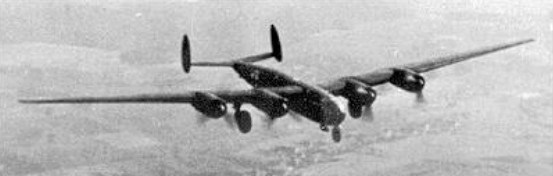
Me.309 V1
Four were built before the RLM cancelled the project.
In 1937, a long range aircraft was in the development stage, Projekt 1061, which was to be powered by four individual engines, and have a range of 20000 km (12428 miles). Due to more important projects in development at the time (mainly the Bf 109 and 110), Projekt 1061 was only sporadically worked on until late in 1940. The German Naval Warfare Department wrote to Reichsmarschall Göring on August 10, 1940 that long range aircraft with a range of at least 6000 km (3728 miles) would be needed to reach the planned German Colonial Reich in central Africa. Also, about this time the RLM issued a requirement for long range aircraft with a range of at least 12000 km (7457 miles), to reach from French bases to the United States, in anticipation of the coming war with the U.S. Therefore, the work on Projekt 1061 was stepped up, with Willy Messerschmitt on December 20, 1940 informing designers Wolfgang Degel, Paul Konrad and Waldemar Voigt of the requirements for this long range aircraft.
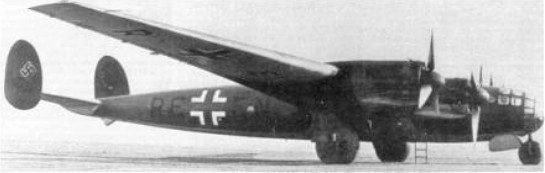
Three models were built. V1 (RE+EN) flew first in December 1942 with Junkers Jumo 211J-1 engines developing 1425 hp, it flew again on 2nd May 1944 with more definitive BMW 801G-2 engines. With a take off weight of 22000kg (48,400lb) it obtained a speed of 490km/h.at sea level. It spent a short time with Transportstaffel 5 and was eventually destroyed in an air raid at the end of the war.
V2 had BMW801G-2 engines, but was destroyed before it’s first flight in an air raid in 1943.
V3 was the forerunner for the Me264 A0 and was armed with MG131 and MG151 guns and had 3 Rb50/30 cameras, but was scrapped before the end of the war.
The “B” model was planned with 6 DB603 engines or with 4 BMW801E engines plus two BMW 018 turbojets.
The initial requirements were for a 20000 km (12428 miles) range, capability for military and civilian roles, at least a 5000 kg (11023 lbs) bomb load to be carried in an internal bomb bay, smaller bombs to be carried externally on under-wing pylons and to have a very clean airframe. In early 1941, Messerschmitt received an order to build six prototype Projekt 1061 aircraft, which were given the designation of Me 264. If the aircraft proved capable, a further 24 aircraft were to be built for “harassing attacks against the United States”. At the same time, Messerschmitt continued to work on a six engined version of the Me 264, Projekt 1075. Since the Messerschmitt design offices were running at full capacity, part of the design work was delegated to the Fokker Works in Amsterdam.
On January 22, 1941, the General Staff of the Luftwaffe demanded a long range aircraft for the submarine war. Because of its overoptimistic performance and weights data, the RLM chose the Me 264 as the best choice. Several schemes were proposed by the Messerschmitt design bureau to extend the range of the Me 264, including towing one Me 264 by another to altitude, in flight refueling by a second Me 264, adding two more engines bringing the total to six and using take-off rocket pods for overload takeoff conditions. With these recommendations, it was felt that a range of 18100 km (11247 miles) and a bomb load of 5000 kg (11023 lbs) could be achieved, and a range of 26400 km (16405 miles) without any bombload. Armament for both versions would have consisted of remote controlled turrets with either MG 131 or MG 151. In early 1942, GFM Milch canceled or reduced numerous development projects, including reducing the number of Me 264 prototypes from six to three, due to the worsening war situation. On February 28, 1942, the Me 264 development was to be temporarily turned over to the Dornier works, but they too were operating above their capacity. The Wesser Aircraft Works in southern Germany were also considered, but nothing came of this idea either. A commission headed by Lt. Col. Petersen arrived at the Messerschmitt-Augsburg complex on April 24, 1942 (at the orders of Milch) to check the actual performances of the Me 264, where it was found that the performances were about 90% of what Messerschmitt had been stating. Strangely enough, the very same day Willy Messerschmitt was cleverly presenting the RLM with the idea of using the Me 264 in “Atlantic Missions”, and harassing attacks on the American east coast. Shortly afterwards, on May 7, 1942, another detailed report was yet again submitted stating that the Me 264 with a takeoff weight of 45000 kg (99207 lbs) and powered by four Jumo 211J engines could attain a range of 13000 km (8078 miles), and with four BMW 801 engines a range of 14000 km (8700 miles) could be reached. To add to the confusion again, on May 16, 1942 a meeting was held concerning all long range aircraft. It was decided that any flights over 13500 km (8389 miles) would need in flight refueling, and General Jeschonnek had already turned down this option in February 1942 (even though initial in flight refueling tests with a Fw 58 and a Ju 90 had been successful). This ended (at this time) all discussions of harassing attacks against American targets, also reconnaissance missions over the Trans-Siberian railroad and even Equatorial Africa.
According to a study dated April 27, 1942, the long distance aircraft should be able to fly reconnaissance missions as far as Baku, Grosnyj, Magnitogorsk, Swerdlowsk, Tiffis or Tshejabinsk in the USSR, and flights to Dakar, Bathurst, Lagos, Aden and southern Iran were also reachable. Not only were New Jersey and New York in the U.S. within range, but also targets in Ohio, Pennsylvania and even Indiana; in addition, there were plans to station some Me 264s on Japanese bases on islands northeast of the Philippines, to fly reconnaissance missions as far as Australia, India and much of the Pacific area.
By mid-July of 1942, three Me 264 prototypes were being constructed. It was hoped that the Me 264 V1 could be ready for flight testing by October 10, 1942, but again this was optimistic due to delayed and sometimes missing component deliveries. By the end of August 1942 it was obvious that the October maiden flight could not be attained because of the excessive delay in the main landing gear delivery from VDM and the promised Junkers engines were also late. A general skepticism was creeping in concerning the numerous delays in getting the first Me 264 in the air, and again the consensus from the RLM and General Staff of the Luftwaffe was leaning towards the Junkers Ju 290 and the six engined Ju 390.
Meanwhile, the construction of the first prototype V1 was progressing very slowly at Augsburg. At last, on December 23, 1942, the Me 264 V1 was ready for its first test flight, which lasted 22 minutes. The landing gear was left down due to safety concerns. The test flights were later made at Lechfeld, because it had a sufficiently long concrete runway to accommodate the large Me 264, but could test only the first prototype due to the fact that the airfield facilities only had one hanger large enough to house the Me 264 V1.
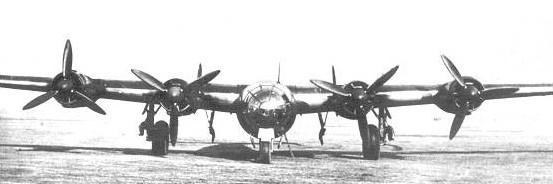
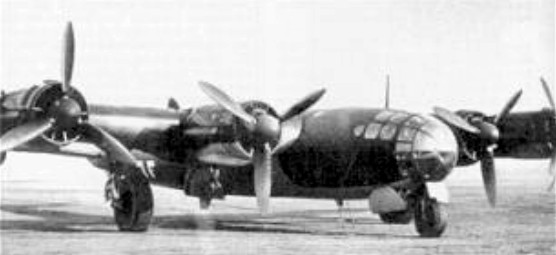
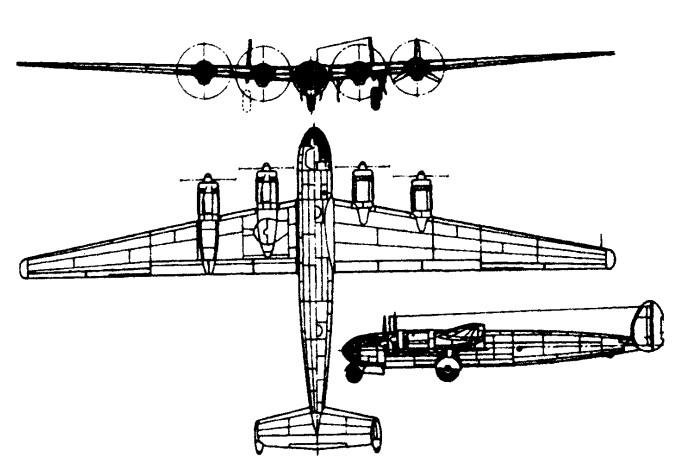
The Me 264 V1 had a very “clean”, all metal fuselage with a circular cross section throughout. Just behind the extensively glazed nose and cockpit was a galley, crew rest area and walkway to the rear of the plane above the lower, enclosed bomb bay. The wings were shoulder mounted, slightly swept back and tapered. They contained a single main spar and one auxiliary spar, with the wing loads being transferred through the main spar and two auxiliary bulkheads into the fuselage. The entire fuel supply was stored in the large wings. All control surfaces were conventional, including split flaps on the inner wing. The tailplane, with its twin fins and rudders, was electrically adjustable during flight. A tricycle landing gear system was designed, which was unusual for such a large aircraft at this time. A single nose wheel was used, although testing had been done for a twin nose wheel configuration using a converted Bf 109 (work number 5603). The test showed a loss of manoeuvrability, but no shimmying. Because of the ever increasing weight demands, the main landing gear was also to be strengthened, and even a droppable auxiliary main gear was considered. The exterior of the Me 264 V1 was puttied and sanded all over, to give the smoothest possible finish. The engines used on the first prototype were the 12 cylinder, liquid cooled Junkers Jumo 211J-1 . These were the same engines used on the Junkers Ju 88A-4 models, and to save time even the Ju 88 nacelles and radiators were utilized. The Me 264 V2 was to have extended wing tips and 1000 kg (2200 lbs) of armor added around the more vital parts of the aircraft. It was reportedly being readied for preflight ground tests when it, too, was destroyed in an air raid.
During the flight testing in 1943, the fate of the Me 264 still hung in the balance. Admiral Dönitz and the Supreme Naval War Staff favored the Focke-Wulf Ta 400. However, since this aircraft wasn’t supposed to be ready before 1946, it was decided that the Ju 290, He 177 and the Ju 390 should be produced in the interim to provide maritime reconnaissance. A teletype message reached Messerschmitt in May 1943, stating that the Me 264 should be abandoned. This caused some astonishment, because just a week earlier the RLM had insisted upon the completion of the Me 264 prototypes. In June 1943, Messerschmitt contacted Hitler to inform him on how well the Me 264 development was progressing, hoping that Hitler would intervene in his behalf. On July 8, 1943, at a meeting in the Supreme Headquarters, Hitler promised his support for the continued production of the Me 264 to Messerschmitt, but only for maritime uses. At the same time he dropped his decision to bomb the east coast of the U.S., because “the few aircraft that could get through would only provoke the populace to resistance”. Only one day later, GFM Milch agreed to continue the construction of the three Me 264 prototypes for the purpose of studies only. Göring, Milch, Friebel and Messerschmitt met on October 14, 1943 to discuss further development possibilities. According to Messerschmitt, the components for the first five prototypes were completed, but he lacked the necessary space and facilities in which to construct them. To get the space for the Me 410 production, all the Me 264 final assembly building jigs were moved from the Augsburg plant and stored at Gersthofen. Later that day, GFM Milch wanted to stop the Me 264 completely, in order to concentrate on the Me 262 jet fighter, to which Göering agreed. One day later, the production orders for the Focke-Wulf Ta 400 was cancelled, mainly because the Focke-Wulf resources were needed for the Fw 190D-9 and Ta 152 production.
On June 29, 1944, the Trial Establishments Headquarters definitely stated that the Me 264, as well as the Ju 390, would be unsuitable for operational deployment since its fitting with the entire military equipment and payload would excessively increase the takeoff weight and the wing load. Then on July 18, 1944 the only Me 264 prototype was destroyed in an air raid along with the assembled components of the following two prototype and 80% of the production facilities. Although numerous attempts were made to save the Me 264 program, Admiral Dönitz got Hitler to agree on September 23, 1944 that all work on the Me 264 project should be stopped. Less than a month later, on October 18, 1944 an unmistakable directive was received. The “Reichsmarschall Technical Order Nr. 2” stated: “The production of the Me 264 is herewith cancelled”. This confirmed the end of the eight year development program that led to only one test aircraft that was far from being operationally ready.
The V4 model was planned to use four high performance BMW 801 E engines with turbochargers and GM-1 boost system. Another idea was a provision as a long range transporter, which would carry 12 to 17 paratroopers and be armed with one FLH 151Z remote controlled turret. It was considered that two additional drop tanks could extend the Me 264’s range to 13600 km (8451 miles) and a top speed of 580 km (361 mph) at an altitude of 6300 meters (20700 feet), with an estimated flight time of 41 hours. Another version was to add two Jumo 004 jet engines outboard of the four radial BMW engines, and was submitted to the Luftwaffe for evaluation. It was even considered to include a towed Me 328 pulsejet powered fighter for protection.
A variety of engines were considered for the Me 264, including a four Jumo 004C jet engined version, a two or four BMW 028 turboprop engined version and a twin BMW 018 turbojet powered version. Another project was to have used Ritz heat exchangers to greatly increase range. The most unusual powerplant idea was for a steam turbine that was to develop over 6000 horsepower. Fed by four boilers and driving one of two forms of propeller – the first, of 17.5 ft (5.4 m) diameter, revolving at 400 500 rpm, the second, only 6.5 ft (2.0 m), turning at 6,000 rpm, fuel would have been in a mixture of powdered coal and petroleum. The main advantages to this engine would be constant power at all altitudes and simple maintenance. The Me 264 so allocated was destroyed in an air raid.
An armed long distance reconnaissance version (Me 264A) would have been equipped with three Rb 50/30 cameras, and armed with one MG 130/2, one DHL 151Z, one MG 151 and perhaps two MG 131 for the lateral positions.
The long range bomber version (Me 264B) was supposed to be fitted with four BMW 801E radial engines and an additional two Jumo 004C jet engines. The armament was similar to the above reconnaissance model, except the single MG 151 would be replaced with one MG 131. Its total weight would be 48100 kg (106041 lbs), or 49900 kg (110010 lbs) with the two Jumo 004C jet engines. The range would have been, with a 3000 kg (6614 lbs) bomb load, 11600 km (7208 miles) without the Jumo jet engines and 8500 km (5282 miles) with the jets. With the jet engines installed, the aircraft should have been able to reach a top speed of 655 km/h (407 mph) at 6700 meters (21981 feet). A top ceiling of 14500 meters (47572 feet) could be reached due to the pressurized cockpit. A naval version would be equipped with four Jumo 222E/F high altitude engines, plus the two Jumo 004C turbojets. the maximum offensive load was calculated to be 6000 kg (13228 lbs). It was also recommended at this point that the fully glazed cockpit should be replaced with a stepped cockpit, also, the defensive armament was being continually revised until all the turrets were remotely controlled, and revolved through 360 degrees. A new turret was even developed, armed with two MG 213 revolver cannon, then under development.
There was also a high altitude bomber version being designed, which would have been equipped with four BMW 801 E/F radial engines with superchargers. The cockpit was planned to be pressurized from the beginning. Since the rest of the plane would not be pressurized, remote controlled defensive armament would have to be installed. According to factory documents of July 9, 1943, this version was based on a 39000 kg (85979 lbs) takeoff weight, which included a 3000 kg (6614 lbs) bomb load, and was to utilize the jettisonable additional landing gear. The minimum penetration distance would have been 3500 km (2175 miles) at an altitude of 12000 meters (39370 feet), at a cruising speed of 640 km/h (398 mph). It would have required a climbing time of 70 minutes to reach this altitude. Again, the Jumo 222 E/F would have been the most efficient engines for high altitude operations, and it was planned to re-equip this aircraft when these engines became available.
5100 kg (11243 lbs) drop tanks were designed in September 1944, and were ready to be manufactured when the cancellation order arrived. Even after the cancellation order was received, work continued by many Messerschmitt engineers and designers in December 1944 on a courier version of the Me 264, with a range of 12000 km (7457 miles) and a load of 4000 kg (8818 lbs). At this point in time, the work done was merely a way to protect the Messerschmitt employees from being conscripted into the army.
Messerschmitt Me 264 V1 Flight Tests
December 23, 1942 Test Pilot: Karl Baur Airfield: Augsburg After extensive taxiing trials, the Me 264 made its maiden flight. The duration of this first flight was 22 minutes, and for safety reasons the landing gear was left down. On landing, the airframe was damaged in the area of the flap mounts when the aircraft rolled over the end of the runway due to the failure of the brake system.
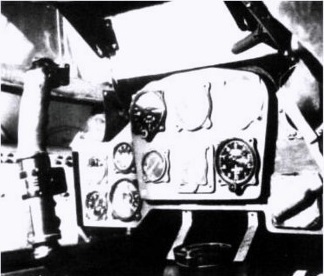
January 20, 1943 Test Pilot: Karl Baur Airfield: Augsburg The second test flight was made. Karl Baur complained that the forces on the controls were too high, about the poor placement of the instruments and of exhaust fumes penetrating into the cockpit.
January 22, 1943 Test Pilot: Karl Baur Airfield: Augsburg The Me 264 was transferred to Lechfeld.
January – February, 1943 Test Pilot: Karl Baur Airfield: Lechfeld On the fifth test flight, the underside of the fuselage was damaged when it accidentally contacted the ground. Also, the hydraulic system of the landing gear failed, making it impossible to retract the gear.
February, 1943 Test Pilot: Karl Baur Airfield: Lechfeld Baur reported some problems with the inner flaps and a defective nose wheel. Despite some changes to the control surfaces, the forces against them were still too high and the changes had displaced the center of gravity. The nose wheel problems were fixed, and now the retraction functioned properly. Also, some minor defects were found in the electrical cables of the intercom system.
February, 1943 Test Pilot: Gerhard Caroli Airfield: Lechfeld Caroli also found that the forces against the control surfaces were still too high, especially at high speed. Small defects were still present in the radio system and landing gear.
February, 1943 Test Pilot: Karl Baur Airfield: Lechfeld During two flights by Baur, a speed of 600 km/h (373 mph) was reached. The faulty trimming and controls revealed that an eventual change in the entire control system would be inevitably needed. Flights with two or three engines were found to be satisfactory, but in flights with the automatic controls it was found that the servos were too low powered to control such a heavy aircraft.
March 2, 1943 Test Pilot: Karl Baur Airfield: Lechfeld Stability tests were continued.
March 4, 1943 Test Pilot: Karl Baur Airfield: Lechfeld A test of the polare system was cut short when after 15 minutes of flying time, the third engine began to smoke and had to be cut out. At this time, 11 test flights had been made totaling 12 hours flight time.
March 23, 1943 Test Pilot: Karl Baur Airfield: Lechfeld After the faulty engine was changed, the critical altitude tests were made. Several other test flights were made this day, mainly to check the longitudinal stability. Also, the first measures to improve the rudder effect was made.
March 23, 1943 Test Pilot: Karl Baur Airfield: Lechfeld During landing, the left oleo leg broke, which was probably not fully locked down, causing some damage.
March 23 – May 21, 1943 Airfield: Lechfeld During repairs, a new steering column, a reinforced wing skin, a modified nosewheel drive and a complete radio were added. Also, a new emergency tail skid was added, a changed tailplane and four new Jumo 211J engines were installed.
May 22 – June 5, 1943 Test Pilot: Karl Baur Airfield: Lechfeld Continued high forces against the ailerons and rudder surfaces were found. Six flights were made totaling 12 hour 16 minutes.
June 2, 1943 Test Pilot: Flight Capt. Wendel Airfield: Lechfeld Serious problems arose when the nosewheel jammed during retraction.
June 10, 1943 Test Pilot: FBM Böttcher Airfield: Lechfeld Reported that the cockpit excessively heated up in the summer sun.
August 11, 1943 Airfield: Lechfeld The Me 264 V1 was taken out of service, and re-equipped with BMW 801 twin row radial engines.
March 18, 1944 Airfield: Lechfeld The Me 264 V1 was slightly damaged in an air raid, and was quickly repaired.
April 14, 1944 Airfield: Lechfeld During the first test roll with the new engines, the brake shoes tore off.
April 16, 1944 Airfield: Lechfeld The Me 264 V1 was transferred to Memmingen.
April, 1944 Airfield: Memmingen During the 38th test flight, the emergency skid was torn out after a rough landing. When the rudders were fitted with balances, the excessive vibrations almost ceased.
late April, 1944 Test Pilot: FBM Scheibe Airfield: Lechfeld Scheibe, from the Rechlin Trial Establishment, complained about the canopy reflections during his test flight. He also indicated that the excessive airframe vibrations were the number one problem to fix.
late April, 1944 Test Pilot: Colonel Barsewich Airfield: Memmingen Barsewich, from the Chief Reconnaissance Department, judged the Me 264 V1 too slow for combat missions, even though the aircraft was about 10% faster than with the Jumo 211J engines.
early May, 1944 Test Pilot: Lt. Colonel Knemeyer Airfield: Memmingen After an uneventful flight, Knemeyer was completely enthusiastic about the Me 264, in his opinion all problems could be overcome in the further testing and refinement of the aircraft.
April 17 – May 17, 1944 Test Pilot: Karl Baur Airfield: Memmingen Flight testing was performed for tailplane flutter and the emergency tail skid. The rear of the plane was found to be too heavy.
April 26 – May 3, 1944 Test Pilot: Captain Nebel Airfield: Memmingen Three test flights were made by Capt. Nebel of the Rechlin Test Establishment to finally redress the tail vibrations. To avoid building an entire new tail, balance weights were added to get the vibration problems under control. Since the problem was not solved, a larger tail plane seemed inevitable.
June 5, 1944 Test Pilot: Karl Baur Airfield: Memmingen More stability tests were made, with a small improvement. However, the flights were complicated by the continuous problems with the Patin system.
June 6, 1944 Test Pilot: Karl Baur Airfield: Memmingen Extreme rudder fluttering was found in the 380 – 450 km/h (236 – 280 mph) range. Also criticized were the too soft automatic controls, which had to be adjusted again.
June 26, 1944 Test Pilot: Karl Patin Airfield: Memmingen A climb flight with combat performances was prematurely cut short when the fuel pressure of both inner engines fell to zero. After checking the fuel pumps, several defects were found. Also, the failure of the Patin, radio and electrical systems caused intensive repairs.
July 18, 1944 Airfield: Memmingen The Me 264 (RE+EN, work number 264000001) was damaged during an air raid. The extent of the damages was too severe for the damage to be repaired.
Specifications:
Messerschmitt Me 264 V1 Span: 38.9 m /127 ft 7 in Length: 20.115 m / 66 ft Height:4.3 m / 14 ft 1 in Wing Area: 127.7 sq.m / 1374.56 sq.ft Fuselage Diameter: 2.2 m / 7 ft 3 in
Messerschmitt Me 264 V3 Span: 43 m / 141 ft 1 in Length: 20.115 m / 66 ft Height:4.3 m / 14 ft 1 in Wing Area: 127.7 sq.m / 1374.56 sq.ft Fuselage Diameter: 2.2 m / 7 ft 3 in Empty Equipped Weight: 23360 kg / 51500 lbs Crew (6) Weight: 540 kg / 1191 lbs Fuel Weight: 19700 kg / 43438 lbs Oil Weight: 1260 kg / 2778 lbs Nitrous Oxide Weight: 680 kg / 1500 lbs Normal Loaded Weight: 45540 kg / 100416 lbs Max. Auxiliary Fuel & Tanks Weight: 10500 kg / 23152 lbs Max Overload Weight: 56040 kg / 123568 lbs Jettisonable Takeoff Equipment Weight: 4300 kg / 9481 lbs Cruising Speed: 350 km/h / 218 mph Max Speed: 545 km/h / 339 mph Service Ceiling: 8000 m / 26240 ft Max Range: 15000 km / 9315 miles Max Endurance: 45 hours Climb Rate (overload): 120 m/min / 393 ft/min. Landing Speed: 160 km/h / 99 mph Takeoff Run (Normal Load w/ RATO): 1500 m / 4920 ft
The Me 163D was developed with retractable tricycle undercarriage, then moved to Junkers as the Ju 248, and then renamed again Me 263. Compared with the Me 163, the Me 263 had a larger, longer fuselage, retractable wheeled landing gear, a larger fuel tank, and a new rocket engine with a ‘cruise chamber’.
The V1 prototype built by Junkers was tested as a glider (after aero-towed) before being returned to Messerschmitt for powered flight trials. The aircraft flew for the first time on 31 December 1944.
Construction of two more prototypes was started but they were captured by Russian forces.
There is no evidence that the Me 263 ever made a powered flight.
Power: Walter 109-509C rocket Fuel: T-Stoff and C-Stoff Armament: 2 x 30mm MK.103 cannon / 150 rds Max speed at 9840 ft: 590 mph Climb rate: 13,800 fpm Service ceiling: 52,500 ft approx Endurance max pwr: 15 min Range: 100 miles Wingspan: 31 ft 2 in Length: 25 ft 10.25 in Wing area: 193 sq.ft Empty weight: 4410 lb Max weight: 11,687 lb
Messerschmitt’s P.1065 design had originated as early as 1938 when the Reichsluftfahrtministerium had requested the company to design a twin-engined fighter able to utilise the new turbojet engines being developed in Germany. After inspection of the mock-up, three prototypes were ordered on 1 June 1940.
It was initially designed around the Axial Flow BMW003 turbojet. In the axial flow turbojet air is compressed after entering the front of the engine by a series of compressor stages or fans, in the middle of the engine fuel is added and the mixture ignites, the rapidly expanding gases then pass through a turbine connected to the forward compressor stages before exiting the jet pipe. The design has the advantage of having a much smaller cross-section although it does suffer much more if debris are ingested into the engine.
There was a great deal of doubt over how much power the BMW engine would produce, estimates of less than 2,000lbs of thrust forced the designers to a twin-engine configuration as the only way to produce an aircraft capable of sufficient performance while carrying a useful warload. The smaller diameter of the engine however made it possible to suspend the engines below the wings without requiring excessively long main undercarriage legs to achieve ground clearance.
The construction of the first prototype ME262 V1 began in January 1941 and it was ready for flight long before its turbojet engines, early bench tests of these were very disappointing at just 570lbs of thrust, far too low for practical use. This led to the first prototype V1 being fitted with a conventional 750hp Jumo 210A in the nose driving a wooden propellor in order to flight test the airframe. It was ready for taxi trials on the 17th April 1941 and flew for the first time on the 18th April fitted with a tail wheel rather than the tricycle undercarriage that would be a feature of the later design.
The aircraft flew a total of 23 times on piston engine power up until 8th May 1941 when it finally received its pre-production BMW003 engines. The engines were rated at 1085lbs but the first flight was a disaster with both units failing, it was only saved from total loss by the by its piston engine and propeller which allowed a safe landing. The ME262 would not fly again with BMW engines until October 1943 when it was fitted with redesigned BMW003a engines. A small reciprocating engine is used for starting.
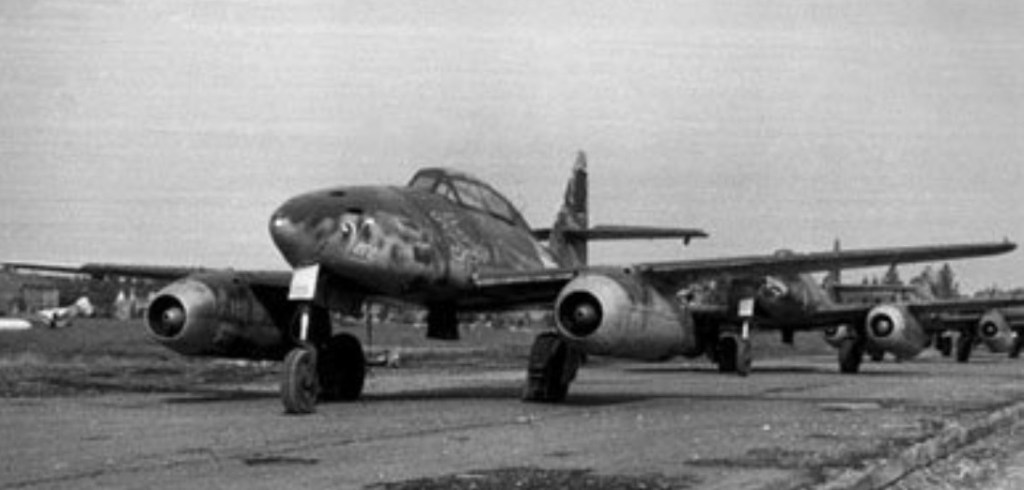
Of conventional all-metal stressed-skin construction, the wing had moderate sweepback, long-span ailerons, trailing-edge flaps, and full-span automatic leading-edge slots. The engines were mounted beneath the wing to preclude a complex wing-spar structure and the landing gear was of retractable tailwheel type. The fifth prototype introduced a non-retractable nosewheel unit and the sixth was the first to have a fully retractable tricycle-type landing gear necessitating the main undercarriage to be moved back 3ft in the wing.
Standard fuel for the Jumo jet is a brown coal oil known as J-2 and distinguished by a particularly disagreeable odor. Diesel oil and aviation gasoline may also be used but the latter is not considered practicable due to an extremely high rate of consumption.
The second and third prototypes V2 & V3 were modified to take the Jumo 004, this required a nacelle 10% larger in diameter and 16% longer. To counteract this the horizontal stabilizer was enlarged and the wings were swept back. V3 was the first to fly on the 18th July 1942 (piloted by Fritz Wendel) at Leipheim near Günzburg, Germany, with Jumo 004AA0 engines of 1,850 lbs thrust, V2 was completed in July 1941 but did not fly until 1st October 1942. The development program was expanded during this time to include two further prototypes and fifteen pre-production aircraft. The last two prototypes V4 & V5 flew on the 15th May 1943 & 26th June respectively.
In April 1941, Willy Messerschmitt actually proposed to fit a 35° swept wing (Pfeilflügel II) to the Me 262. Though this suggestion wasn’t implemented, he continued this line of thought with the projected HG II and HG III high-speed derivatives of the Me 262 in 1944, which were designed with a 35° and 45° wing sweep respectively.
ME262 V1 first flew again on jet power alone on the 20th March 1943 with Jumo 004A-0 engines, the piston engine had been removed and replaced with 3 x 30mm cannon and a partially pressurized cockpit added. It completed 65 flights up until the 7th July 1944 when it suffered a catastrophic engine failure; it was damaged beyond repair in the subsequent forced landing.
Five of the fifteen pre-production aircraft were allocated versuchs numbers to replace prototypes that had been lost or damaged and to expand the test program. The first of these 130001 V1+AA flew on the 17th October 1943 powered by Jumo 004B-0 engines. These weighed 220lbs less than the 004A while still delivering 1,980 lbs thrust. The aircraft also included fully retractable tricycle undercarriage. The aircraft completed a total of 28 flights until it crashed on the 9th March 1944 in a fatal accident.
The most significant impact on the development of the ME262 was the inability of Junkers (and BMW before them) to produce state of the art engines without the proper materials. This is demonstrated when considering the combustion chambers of the Jumo 004 which were made of ordinary steel sprayed with aluminium for heat resistance which led to frequent engine failures. The compression flow was also unstable at moderate speeds in addition to issues with fuel flow regulation which limited the effectiveness of the aircraft and resulted in an average engine life of around 20 hours.
Me 262A-2a
Armament for the 262 was to have consisted of two 55-mm cannon, but these, though designed, were not yet in production. Hitler then favored the installation of 50-mm tank guns but Goering countered with a reminder that the barrels would extend six feet beyond the nose, thus impairing the plane’s stability and performance. Eventually, four MK 108s (30-mm cannon) were selected as standard armament for the A-1 fighter version and two cannon of like caliber for the A-2 bomber. Synchronized to converge at between 400 and 500 yards, the guns were generally fired at about 800 yards in order to compensate for the plane’s high speed. Reflector gun sights were first installed, later to be replaced by newer gyroscopic sights. Reportedly, a few Me-262s carried six guns and there is evidence of a plan to install two batteries of twelve R4M rockets under each wing. These would have been launched at Allied bomber formations at more than a mile’s distance.
Armor protection consists of 16-mm head and shoulder plates and a forward cockpit bulkhead of the same thickness. Absence of armor and proximity of a fuel tank to the rear of the pilot is apparently discounted due to the plane’s high speed. German pilots interrogated on this point were confident that nothing in the air could match them.
The Me-262’s high performance is due not only to the power generated by its two big Jumo turbines but to an airframe that is fundamentally sound, aerodynamically clean. The horizontal stabilizers are situated well out of the slipstream and so there is no flutter at high speeds. Extremely thin wings minimize the factor of compressibility.
Test flights continued over the next year but the engines continued to be unreliable. Although airframe modifications were completed by 1942, production never began until 1944 when the production engines — which due to the shortage of strategic materials like tungsten had to be completely redesigned to employ alloys of inferior temperature resistance — finally started to work.
Production plans in August 1944 called for 500 in December, 600 in January and February, 800 in March, but by war’s end no more than 1,400 had been produced. Of these, half were destroyed in training accidents and by Allied attacks on German airfields. Most of the remaining 700 were either shot down or crashed due to failure of jet units. Others were destroyed by retreating Germans and only a handful remained to enlighten Allied Technical Air Intelligence squads.
The first delivery (A-0 to Rechlin) was in May 1944.
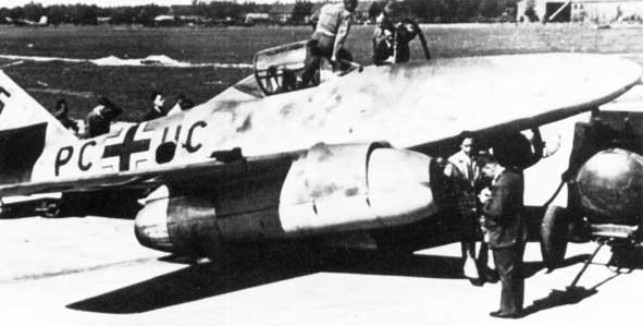
First major version was the Me 262A-1a Schwalbe (Swallow) interceptor (first flown June 7 1944), armed with four 30mm MK 108 cannon mounted in the nose. It was powered by two 8.825kN Junkers Jumo 109-004B-1 eight-stage axial-flow turbo-jets. A number of variants were built with differing armament. The other major version was the Me 262A-2a Sturmvogel (Stormbird) bomber. This was produced at the insistence of Adolf Hitler – a decision which caused considerable overall production delays. It carried, in addition to the standard MK 108 armament, one 1,000kg, two 500kg or two 250kg bombs. As with the Schwalbe, there were a number of variants, mainly for armed or unarmed reconnaissance.
The first experimental combat unit (EK 262) was formed on June 30, 1944, entered operational service, at Juvincourt, France on 10 July 1944, and the first regular combat (8/ZG26) in September 1944.
The Me 262A 1a Schwalbe (Swallow) became operational with the Kommando Nowotny on 3 October 1944 and was used, initially, against USAAF Bombers. There were many problems but with a speed advantage of some 70 mph over the fastest Allied escort fighter and its heavy armament of four 30mm cannons, it was a formidable new fighter.
With 522 gallons of fuel, 360 rounds of ammunition, the A-1 takes off at 15,550 pounds. The A-2 with its two guns, 160 rounds of ammunition, and one 500-kg or two 250-kg bombs, weighs 15,400 pounds.
Without bomb load or auxiliary fuel tank the Me-262 requires from 900 to 1,100 yards for take-off on concrete and from 1,100 to 1,400 yards on a grass field. The normal required take-off run of 1,100 yards is reduced to 650 by means of two A.T.O. rockets having a total thrust of 1,000 kg. As few German airfields were equipped with concrete runways, Autobahns were frequently used for operations.
At full throttle, a straight and level speed of 830 kph (515 mph) can be maintained for ten or fifteen minutes. Cruising speed is approximately 465 mph and speeds of 650 mph in dives were not uncommon. Willi Messerschmitt quotes a maximum speed of 560 mph in level flight and at any altitude. That American test pilots were able to get no more than 525 mph out of the plane under favorable conditions he attributes to consid¬erable variance in individual jet units. Messerschmitt also admits to inferior construction due to inadequate materials and lack of skilled labour.
Endurance of the Me-262 ranges from 45 to 90 minutes. Stall characteristics are good, ailerons respond well and it is capable of all combat manoeuvres. Spoilers fitted along the leading edge project automatically at about 300 kph (186 mph) when the plane is in a gliding anile and at about 450 kph (279 mph) when in a climbing position. Turns are not attempted at speeds of less than 350 kph. If throttle is advanced too quickly at less than 7,000 rpm, engines are likely to fail, a characteristic which has resulted in a number of take-off accidents.
The standard approach against bomber formations, which were travelling along at cruise speed, called for the Me 262 to approach the bombers from the rear at a higher altiude, diving in below the bombers to get additional speed before zooming up again to their level and opening fire with its four 30 mm cannon at 600 m range.
Reportedly, Allied bomber gunner were finding that their electric gun turrets had problems tracking the jets. However, due to the jets’ straight line approach, traverse rates were actually not as important as target acquisition itself, which was difficult because the jets closed into firing range very quickly and had to remain in firing position only very briefly using their standard attack profile.
On 3 October 1944, the German Lechfeld Aerial Test Unit was set up under Major Nowotny. The test unit was made up of two squadrons stationed at Achmer and Hesepe airfields near Osnabrück, a total of 40 Me 262s. On 4 October, four Me 262s took off from Achmer for the first time. Two were shot down over the take off field, and a third was shot down while landing, by Canadian Spitfires of 401 Sqn. The Lechfield Unit managed to shoot down 25 four-engined bombers in a month, but at a cost of 35 jets.
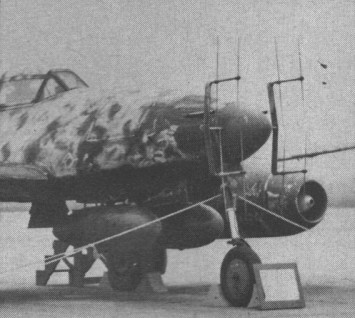
The Me 262A-2 night fighter is a radar-equipped two-seater, and has external tanks for additional range, a lengthened cockpit, and radar antenna.
In February 1945 the German 7th Fighter Wing under Col. Steinhoff, the only Luftwaffe wing armed with Me 262, reported that it was ready for deployment. Squadrons of the 3rd Fighter Wing assumed the task of protecting the jet fighters during take-off and landing. There was one other umit of Me 262 fighters, the 44h Fighter Group, whose commanders included General Galland – the fighter general removed from office by Goring – and several other fighter officers who had fallen into disfavour.
In March 1945 three Me 262A airframes were taken from the assembly line and converted as two seaters by substituting an 88-gallon fuel tank for the aft 198-gallon tank and using the created space for the observer’s seat. To compensate for the reduction of fuel, two 66-gallon drop tanks were attached under the fuselage and an FuGe 218 radar array was fitted in the nose. The standard four 30 mm MK108 armament was retained and it was proposed to tow a 198-gallon auxiliary tank to increase patrol endurance. This aircraft was designated Me 262B-2a; the first prototype crashed during flight trials, killing the observer.
Me.262B-1A
Me 262B-1a/U1
The Me 262B-1a/U1 was used for trials of the Lichtenstein SN-2 (FuG 220) interception radar and Hirschgeweih antennae, equipped with twin under fuselage auxiliary fuel tanks.
Me 262B-1a/U1
Tactics against the Me 262 developed quickly to find ways of defeating it despite its insurmountable speed. Allied bomber escort fighters (specifically P-51s) would fly high above the bombers to gain extra speed in a dive down to protect the bombers, thus reduce the speed advantage of the Me262. The Me262 was less manoeuvrable than the P-51 and trained allied pilots could catch up to a turning Me262; but the only reliable way of dealing with the jets was to attack them in the take-off and landing phase of their flight, and on the ground. Accordingly, Luftwaffe air fields that were recognized as jet bases were frequently bombed by medium bombers, and Allied fighters patrolled over the fields to attack jets that were trying to land on their bases. The Luftwaffe countered these moves by installing Flak alleys along the approach lines in order to protect the Me 262s from the ground, and providing top cover with conventional fighters during the take-off and landing phase.
A Hawker Tempest Mk.V was the first Allied plane to shoot down a Me262, and won number of victories over these jet fighters, while the Lavochkin was the only Soviet fighter to encounter a German jet, with La-7 ace Ivan Nikitovich Kozhedub fighting and downing one Me262 jet on February 15, 1945 over eastern Germany. Kozhedub apparently later said that his success was mainly due to the Me262 pilot attempting to out-turn his more manoeuvrable plane.
In the end, the overwhelming numbers of allied planes meant that the jets had no overall effect on the war. On March 18, 1945, 37 Me 262s intercepted a force of 1,221 bombers and 632 escorting fighters. They managed to shoot down 12 bombers and one fighter for the loss of three Me 262s. Although a four to one ratio was exactly what the Luftwaffe was dreaming about, it represented only one per cent of the attacking force — more were lost to mechanical problems.
Although the Me 262 had a negligible impact on the course of the war—shooting down an estimated 150 Allied aircraft for the loss of 100 Me 262s, the majority of aircraft grounded for lack of fuel.
Only 1,433 Me 262s were built, 500 of those destroyed during Allied bombings, leaving less than 300 jets to enter into the final days of combat.
Willy Messerschmitt regarded the Me 262 as it went into production only as an interim type. His interest in high-speed flight that had led him to initiate work on swept wings starting in 1940 is evident from the advanced developments he had on his drawing board in 1944. While the Me 262 HG I (Hochgeschwindigkeit – high speed) that was actually flight-tested in 1944 had only small changes compared to combat aircraft, most notably a low-profiled canopy to reduce drag, the HG II and HG III designs were far more radical. The projected HG II variant combined the low-drag canopy with a 35 degrees wing sweep and a butterfly tail. The HG III aircraft had a conventional tail, but a 45° wing sweep and the jet turbines embedded in the wing root.
Messerschmitt also conducted a series of carefully controlled flight tests with the series production Me 262. In these dive tests, it was established that the Me 262 was out of control in a dive at Mach 0.86, and that higher Mach numbers would lead to a nose-down trim that could not be countered by the pilot. The resulting steepening of the dive would lead to even higher speeds and disintegration of the airframe due to excessive negative g loads.
The HG series of Me 262 derivatives was estimated to be capable of reaching trans-sonic Mach numbers in level flight, with the top speed of the HG III being projected as Mach 0.96 at 6 km altitude. Despite the necessity to gain experience in high-speed flight for the HG II and III designs, Messerschmitt undertook no attempts to exceed the Mach 0.86 limit for the Me 262.
After the war, the Royal Aircraft Establishment — at that time one of the leading institutions in high-speed research — re-tested the Me 262 to help with the British attempts at breaking the sound barrier. The RAE achieved speeds of up to Mach 0.84 and confirmed the results from the Messerschmitt dive tests as accurate. No attempts were made to exceed the Mach limit established by Messerschmitt.
After Willy Messerschmitt’s death, the former Me 262 pilot Hans Guido Mutke claimed to be the first person to break the sound barrier on April 9, 1945 in a Me 262. This claim is only based on Mutke’s memory of the airspeed indicator reading and is disputed.
During the war the Germans set up a number of assembly plants in Czechoslovakia for the production of the Messerschmitt Me 262. After the war the manufacturing infrastructure remained intact, so production could start up again for the new owners.
All jigs, tools and components for the Messerschmitt Me 262 jet fighter in Czechoslovakia at the time of the German surrender were seized by the Soviet forces and then handed over to the newly restored Czechoslovak government by Marshal Ivan Konev. Forward fuselages and other components of the Me 262 had been manufactured at Letnany, some components had been produced in converted railway tunnels, and the CKD and Walter works had built the Junkers Jumo 004 turbojet, assembly of the fighters having been undertaken at Cheb, near the German border. Sufficient components were recovered for Avia to build 17 single- and two-seat Me 262s, the first single-seater flying as the S 92.1 on 27 August 1946.
The first Avia S 92.1 was assembled at Letnany Research Institute in 1945 (PL-01), with the airframe coming from Avia and the engines from the repair works in Malesice (the Junkers Jumo 004 now called the M-04). The S 92’s first flight was with Avia’s chief pilot Antonin Kraus in control. Tested pilots included RAF veteran Major Jiri Manak.
On 5 September, this aircraft was lost in an accident, a second, S 92.2, flying on 24 October, and what was referred to as the first series aircraft, a two seater (CS 92.3), following on 10 December. Dubbed the Turbina (Turbine), the S 92 was demonstrated to a Yugoslav delegation which placed an order with Avia for two examples, although, in the event, these were not delivered. The seventh aircraft, CS 92.7, was experimentally fitted with BMW 003 turbojets, the thrust of which had been boosted to 950kg, but flight testing was not entirely successful and the aircraft was re-engined to take the standard Jumo 004 turbojets. The eleventh and twelfth aircraft, S 92.11 and S 92.12 were completed during 1949.
Czech production included Avia S-92 code V-34(cn 51104), the fourth Czech-built. The fourth aircraft was first example armed with a pair of 30mm Rheimettal MK 108 cannon.
Avia S 92 Turbina
Delivery of the first S 92 to the Czech air force was in June 1948. In October 1950, with twelve being made in all (nine S 92 and three CS 92) equipping the 5th Fighter Flight at Mlada-Milovice airport, until they were grounded for use as instructional airframes in 1951. One of them is on display at the Prague Aero museum.
By the time Yugoslavia showed interest in buying the S 92, Avia was looking at closing down the production line to make way for new up to date aircraft and when Avia were given a licensed to make the Mig 15 (they were all ready making the Yak 23 as the S 101) the S 92 facilities were broken up.
Me 262 A1 Schwal Engines: 2 x Jumo 004 B-1, 8829 N Length: 34.777 ft / 10.6 m Height: 12.598 ft / 3.84 m Wingspan: 40.945 ft / 12.48 m Wing area: 233.579 sq.ft / 21.7 sq.m Max take off weight: 14103.2 lb / 6396.0 kg Weight empty: 8379.0 lb / 3800.0 kg Max. speed: 469 kt / 869 km/h Service ceiling: 37566 ft / 11450 m Wing loading: 60.48 lb/sq.ft / 295.0 kg/sq.m Range: 567 nm / 1050 km Crew: 1 Armament: 4x MK108 30mm
Me 262A-1a Type: single-seat fighter Engines: 2 x Junkers Jumo 004B-1/-2/-3 turbojets , 1,980lb (900kg) Span: 12.5m / 40 ft 11.5 in Length: 10.6m / 34 ft 9.5 in Height: 3.83m / 12 ft 6.75 in Wing area: 21.7 sq.m / 233.58 sq ft Ceiling: 11450 m / 37550 ft Empty weight: 4000kg Loaded weight: 7045kg Maximum speed: 540mph (870km/h) Climb rate: 1200m/min Ceiling: 11,500m Range on internal fuel: 1050km (650 Miles) Armament: 4 x 30mm MK 108 cannon / Two with 100 rounds each, two with 80
Me 262A-1a/U1 Engines: 2 x Junkers Jumo 004B turbojets , 1,980lb (900kg) Span: 12.5m Length: 10.6m Height: 3.8m Wing area: 21.7 sq.m / 233.58 sq ft Ceiling: 11450 m / 37550 ft Empty weight: 4000kg Loaded weight: 7045kg Climb rate: 1200m/min Ceiling: 11,500m Range on internal fuel: 1050km (650 Miles) Armament: 2 x 30mm MK 103, 2 x 30mm MK 108 cannon, 2 x 20mm MG 151/20
Me 262A-1b Engines: 2 x Junkers Jumo 004B turbojets ,1,980lb (900kg) Span: 12.5m Length: 10.6m Height: 3.8m Wing area: 21.7 sq.m / 233.58 sq ft Ceiling: 11450 m / 37550 ft Empty weight: 4000kg Loaded weight: 7045kg Climb rate: 1200m/min Ceiling: 11,500m Range on internal fuel: 1050km (650 Miles) Armament: 4 x 30mm MK 108 cannon / Two with 100 rounds each, two with 80, 24 spin-stabilised R4/M 55mm rockets
Me 262A-2a Type: single-seat bomber Engines: 2 x Junkers Jumo 004B turbojets ,1,980lb (900kg) Span: 12.5m Length: 10.6m Height: 3.8m Wing area: 21.7 sq.m / 233.58 sq ft Ceiling: 11450 m / 37550 ft Empty weight: 4000kg Loaded weight: 7045kg Maximum speed: 470 mph (755km/h) Climb rate: 1200m/min Ceiling: 11,500m Range on internal fuel: 1050km (650 Miles) Armament: 4 x 30mm MK 108 cannon / Two with 100 rounds each, two with 80 Bomb load: 2 x 500kg
Me 262B-1a Type: two-seat night fighter Engines: 2 x Junkers Jumo 004B turbojets ,1,980lb (900kg) Span: 12.5m Length excluding radar aerials: 11.8m Height: 3.8m Wing area: 21.7 sq.m / 233.58 sq ft Ceiling: 11450 m / 37550 ft Empty weight: 4000kg (B-1a 4400kg) Loaded weight: 7045kg (B-1a 6400kg) Maximum speed: 497 mph (800km/h) Climb rate: 1200m/min Ceiling: 11,500m Range on internal fuel: 1050km (650 Miles) Armament: 4 x 30mm MK 108 cannon / Two with 100 rounds each, two with 80
Me 262B-2a Engines: 2 x Junkers Jumo 004B turbojets ,1,980lb (900kg) Span: 12.5m Length: 10.6m Height: 3.8m Wing area: 21.7 sq.m / 233.58 sq ft Ceiling: 11450 m / 37550 ft Empty weight: 4000kg Loaded weight: 7045kg Climb rate: 1200m/min Ceiling: 11,500m Range on internal fuel: 1050km (650 Miles) Armament: 4 x 30mm MK 108 cannon / Two with 100 rounds each, two with 80, 2 x inclined MK 108 behind the cockpit in Schrage Musik installation (D) SG 500 Jagdfaust with 12 rifled mortar barrels inclined in nose (E) 50mm MK 114 gun or 48 R4/M rockets
Avia S.92 Turbina Engine: 2x Malesice M-04B (Jumo 004) turbojets Wing Span: 12.5 m / 41 ft 0 in Length: 10.58 m / 35 ft 9 in Height: 3.83 m / 13 ft 7 in Wing area: 21.80 sq.m / 234.65 sq ft Weight: Empty 4,000 kg / 8819 lb MTOW: 7,045 kg / 15532 lb Maximum Speed: 870 km/h / 541 mph Rate of climb: 1220 m/min / 4000 ft/min Ceiling: 11,450 m / 37550 ft Range: 1,050 km / 652 miles Crew: 1 Armament: 4x 30 mm cannon
Avia CS.92 Engine: 2 x Malesice M-04B (Jumo 004) turbojets Wing Span: 12.5 m Length: 10.58 m Height: 3.83 m Weight: Empty 4,000 kg / Loaded 7,045 kg Maximum Speed: 870 km/h Ceiling: 11,450 m Range: 1,050 km Crew: 1 Armament: 4x 30 mm cannon
Originally designed as a long-range record-breaking aircraft, the Me 261 had an extremely slender fuselage, but two DB606 engines – each consisting of two coupled DB601 V-12s. Work continued even during the war, because of their advanced design. With their cramped fuselages they had little military value, however. Three were built, one was used for reconnaissance flights in 1943.
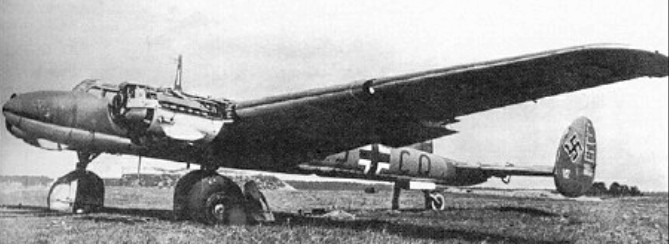
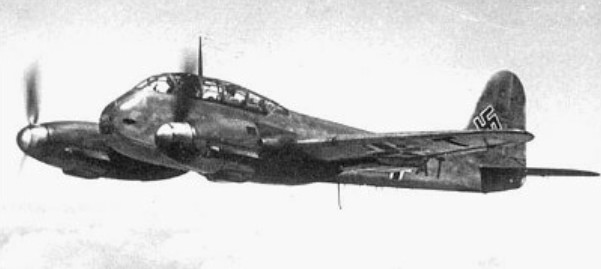
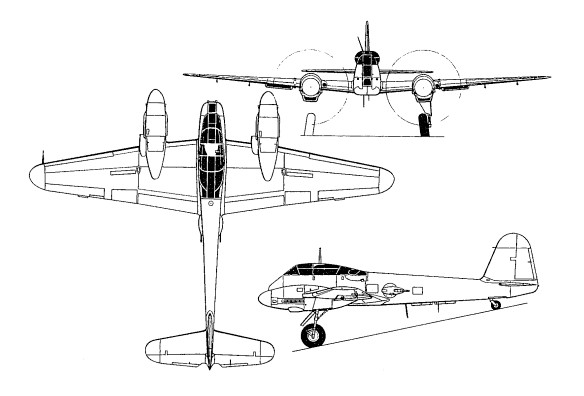
Originated in 1937, the Me 210 was designed as a superior twin-engined multi-purpose aircraft to replace the Bf 110. In autumn 1938 RLM awarded a contract to Arado and Messerschmitt simultaneously for the development of a Bf 110 replacement. The resulting Messerschmitt design consisted in a mere improvement of the basic design with more powerful powerplants and heavier armament. Arado’s answer to the requirements was the Ar 240 but confidence in the original Bf 110 long-range fighter and bomber-destroyer concept led at the beginning of 1938 to Messerschmitt being asked to design an eventual successor. The result was the Messerschmitt Me 210 which first flew on 5 September 1939, powered by two 1,050 hp (783 kW) Daimler-Benz DB 601A engines. It proved to be extremely unsatisfactory, being difficult to handle and suffering from extreme instability.
After the first flight test of the Me 210 V1 the plane had to be heavily modified for its flying capabilities were barely poor. It had problems with longitudinal and lateral stability, and these were not suitable for a firing platform such as a combat aircraft. The design was improved by deleting the original twin vertical surfaces, similar to those of Bf 110, and fitting a large traditional vertical stabilizer and rudder with the aircraft flying on 23 September. A slight improvement was apparent, but in spite of a number of modifications carried out on the two prototypes they continued to display poor handling characteristics, being prone to stalling and spinning, but by mid-1940 a first batch of airframes was in final assembly.
Even while test flying was still going on, the RLM placed an order of 1000 Me 210As in mid-1940. The first 15 Me 210s were earmarked as test aircraft and on 5 September 1940 the program suffered the first of a number of crashes when the second prototype broke up during diving trials, fortunately the pilot escaped.
The first flight of a pre-production 210A-0 was in April 1941. The first pre-production planes were under trials in a new established special test unit Erprobungsgruppe 210 at the end of 1940. The ErG 210 was to conduct operational testing of the Me 210 and develop combat tactics for the fighter-bomber. This unit was already well known, during the battle of Britain in Summer 1940, while it mainly flew the Bf 110s and 109s awaiting for Me 210 deliveries. Its first leader was Hauptmann Walter Rubensdörffer, killed in action in a Bf 110 over England before he could ever fly a Me 210. Another important victim was Oberleutnant Heinz Forgatsch of 3./SKG 210. He died in an accident while testing a Me 210 at Rechlin. Production began in Spring 1941 in both the Augsburg and Regensburg factories.
Such were the problems encountered that eight pre-production Me 210A-O and 13 production Me 210A-l aircraft were added to the test program, but in spite of this very little improvement was evident, and it was obvious that only major design changes would have any chance of correcting the faults. At this stage such a move would have caused an unacceptable delay in the production program, so deliveries began and 64 were supplied starting in April 1941 in two variants, the Me 210A-l destroyer-bomber which was armed with two 20 mm MG 151/20 cannon and two 7.92 mm (0.31 in) MG 17 machine guns, and the Me 210A-2 fighter-bomber which had a maximum bomb load of 4,4091b (2000 kg). By the end of 1941 the test program was over and the final evaluation was that it was still an unsuitable firing platform for its stability problems. Messerschmitt modified a pre-production plane (Me 210 A-0 NE+BH Werk Nr. 101) with lengthened rear fuselage (lengthened by 1½ panels) and redesignating it with the Versuch-number V17 on 14 March 1942. This modification was very successful in increasing the plane’s handling qualities. Another important modification was the fitting, in July 1942, of wing leading edge slots. Soon after flying tests it was ordered to retrofit all Me 210 As with this device.
However, on 14 April 1942, after about 200 Me 210s had been delivered (this number including two Me 210B-0 pre-production and two Me 210B-l production reconnaissance aircraft), construction was halted in favour of a resumption of manufacture of the Bf 110 to give time to try to resolve some of the Me 210’s shortcomings. The stability problem was solved finally by introducing automatic wing leading-edge slots and redesign of the rear fuselage, which was lengthened by 3 ft 1 1/2 in (0.95 m) and made deeper. The improvements were tested and the design was submitted with the proposal that the 1,750 hp (1305 kW) Daimler-Benz DB 6O3A engine should be used to provide better performance, This appealed to the RLM, as a solution of this kind would allow a number of unfinished Me 210 airframes to be used, and Messerschmitt was given the go-ahead and the designation 410 assigned to the revised design. The final Me 210 delivery was in April 1942.
Although introduced into operational service in Me 210A, B and C versions from early 1941, most were being replaced within two years.
The rear gunner controlled rear-facing machine guns in twin barbettes which gave much trouble in early service. Forward-firing armament was two cannon and four machine guns.
The Hungarians built the Me 410C in the Danube Aircraft Factory and used it successfully. Messerschmitt had supplied jigs and tools, and a new factory had been built for production when the German decision to stop its own Me 210 program was made. The Hungarians nevertheless decided to proceed and one of the pre-production Me 210A-0s had been fitted with 1,475 hp (1100 kW) DB 605E engines as a prototype for the Me 210C. The engines were license-built by Manfred Weiss.
Production started in 1943 with the Luftwaffe receiving two-thirds and Royal Hungarian Air Force one-third of the aircraft built.
The Me 210C had the wing slots and new rear fuselage, and production deliveries from the Hungarian factory started at the beginning of 1943. They were split on the basis of one-third to the Royal Hungarian air force and two-thirds to the Luftwaffe. Production was slow to develop, but by early 1944 the first Hungarian units had been formed. Production ended in Hungary in March 1944, by which time 267 Me 210Cs had been built in two variants, the Me 210C-1 reconnaissance/bomber-destroyer aircraft, and the Me 21OCa-1 bomber-destroyer/dive-bomber. In contrast with the Luftwaffe, Hungarian pilots liked the Me 210 and used it as a close-support aircraft and dive-bomber.
A total of 267 Me 410’s had been constructed before production ended in March 1944.
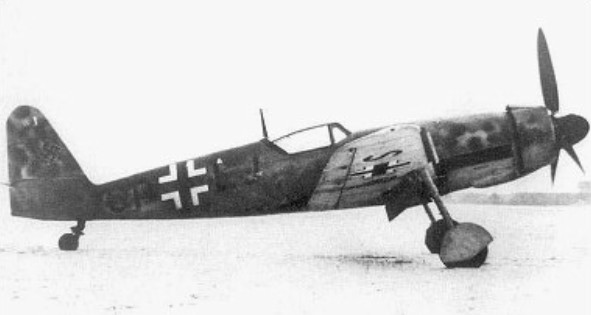
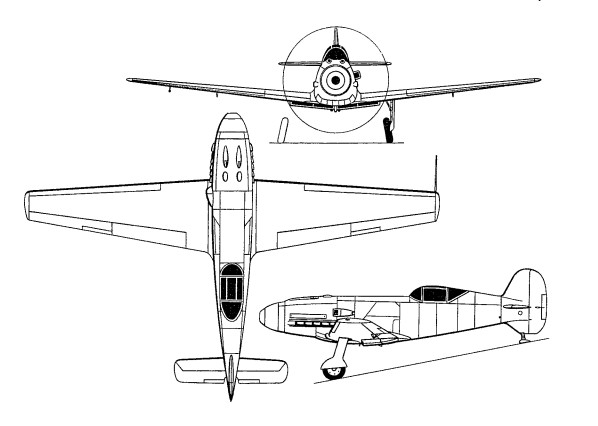
A high-altitude fighter programme, not related to the earlier Me 209 record aircraft, the two built were essentially re-engined Bf 109s with longer wings and tails. After official cancellation the development continued under the name Me 109L.
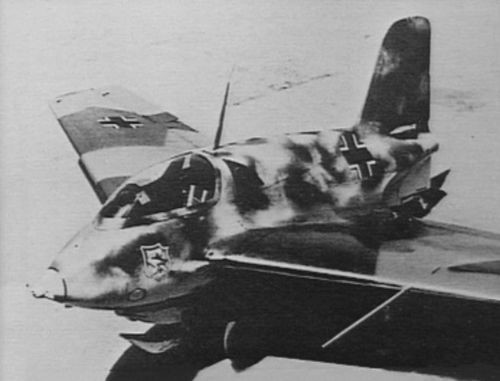
The Messerschmitt Me 163 Komet (comet) rocket interceptor stemmed from prolonged research by Dr Alex¬ander Lippisch over 15 years before the war. The heart of Projekt X was a rocket engine developed by Hellmuth Walter. Lippisch’s task was to design a tailless aircraft to go with it. Even he was not allowed to have blueprints of the power¬plant for the airframe he was designing. The result of this clandestine effort was a tailless rocket research craft designated the DFS 194 which began flight trials with a 400 kg (882 lb) thrust liquid fuel Walter rocket motor at the Baltic coast test site of Peenernfinde in August 1940. While test pilot Heini Dittmar flew this test bed, reaching 550 kph (341.8 mph) in level flight, Lippisch and his team pressed on with the next stage of Projekt X at the Messerschmitt Werke in Augsburg. The ultimate aim was to produce a rocket powered interceptor fighter.
In the mid 1930s the German Air Ministry were supporting the work of rocket engine designer Hellmuth Walter, issuing him a contract to develop a 400 kg / 882 lb thrust motor. In the mean time, Alexanderander Lippisch had been working at the German Institute for the Study of Sailplane Flight (DFS) and was given the order to produce a second prototype of his DFS 39 tail-less aircraft to test the potential of a rocket powered airframe. The work would see DFS build the wings and Heinkel build the fuselage.
Lippisch discovered the wing mounted rudders would likely cause unacceptable flutter, so he redesigned the airframe to include a large conventional central fin and rudder. Redesignated DFS 194 it was fitted with a small propeller engine and a landing skid. A takeoff dolly was mounted under the landing skid, it being jettisoned shortly after takeoff.
Dr Lippisch and his staff were transferred to Messerschmitt’s works at Augsburg in January 1939, with the partially completed DFS 194. The decision was also made to by-pass the prop driven version and move directly to rocket power.
The completed airframe was shipped to Peenemünde West in early 1940.
The Comet’s wooden, plywood-covered wings are of special swept-back design with a marked wash-out of incidence towards the tip. The fuselage is of metal construction. “Elevons” which serve both as elevators and ailerons are located outboard in the wings; there are no horizontal tail surfaces.
Three development prototypes of the DFS 194 were ordered by the RLM and the first two were completed by the spring of 1941, when unpowered gliding flights began from the factory airfield. The engineless Messerschmitt Me 163 attained a top speed of 850 kph (528 mph) in a dive test.
In early 1940 the DFS 194 was equipped with a rocket motor at Peenemünde. After test flights by Heini Dittmar had confirmed speeds of up to 550km/h on the power of a single 2.94kN Walter motor, there was sufficient interest to initiate development. In 1941 the first Me 163 prototype was being tested in gliding flight and shortly after was fitted with a 7.35kN Walter RII-203 rocket motor. On 2 October 1941 Heini Dittmar cast off from a Messerschmitt Bf 110 tow-plane at 4000 m (13,125 ft), fired the Me 163V-1’s rocket motor and accelerated rapidly reached 1004.5 kph (623.8mph); two months later the Me163B Komet was ordered into production.
Speeds of up to 915km/h were achieved (limited by the volume of liquid propellants carried) and to gain some idea of the speed potential, this aircraft was towed to a high altitude before being released. Flown under power, a speed of over 1,000km/h was attained before the engine had to be throttled back because the aircraft was becoming uncontrollable.
This success saw the development of the first production prototype, now designated Me 163. Flight testing began in the Spring of 1941. These were a series of unpowered flights before the Me 163 V1 was shipped to Peenemünde for installation of the improved Walter RII-203 engine.
On 2 October 1941, the Me 163 V1 piloted by Heini Dittmar set a new world speed record of 1004.5 kph / 623.8 mph. After this performance, the RLM instructed Lippisch to design an improved version around a more powerful motor under development. The resulted in the Me 163B. The first prototype, the Me 163 V3, was completed in April 1942, but it was not until early autumn that the first Walter 109-509A motors were ready for installation.
Plans proceeded during 1943 to equip the first operational units with the Me 163B-1a. Production Me 163Bs were po¬wered by Walter 109 509A2 rocket motors using T Stoff (hydrogen peroxide) and C Stoff (hydrazine hydrate, methyl alcohol and water) to give a thrust of 1700 kg (3,748 lb).
The new motor employed a ‘hot’ system in which the oxygen was ignited for additional thrust and better fuel efficiency. Flight testing of the first series of Me 163B-0 pre-production aircraft proceeded throughout 1942.
The fuselage of the Komet was made of metal but its wing was of wooden construction. The leading edge of the wing featured long slats in front of the elevons. Early Me 163B 0 aircraft were armed with a pair of 20 mm guns, but Me 163B 1 fighters carried two 30 mm weapons. The aircraft possessed no conventional landing gear, but took off from a trolley, which was jettisoned immediately after take off and at the end of the flight the Komet was landed on the skid. The small propeller on the nose served to drive a generator which supplied electrical power for the radio and instruments. Armour includes a nose cone constructed of 15-mm plate.
Laminated bullet-resisting glass gives the pilot added protection from frontal attack. Two triangular plates comprise the side cockpit armor. No provision is made for defense against attack from the rear except the plane’s high speed.
The production Me 163B’s 1500 kg (3307 1b) thrust Walter HWK 109-509 rocket motor was fuelled with a highly volatile mixture of C stoff (methyl alcohol, hydrazine hydrate and water) and T stoff (hydrogen peroxide with additional hydrocarbon stabilizers) which would explode at the least provocation. The Komet carried more than 2000 kg (4409 lb) of fuel and climbed to 12,000 m (39,370 ft) in 3 minutes 30 seconds. The Walter HWK 109-509A rocket motor made use of a steam generator that used calcium permanganate as a catalyst to produce steam when a small amount of T-Stoff was added via an electric starter motor, the resulting steam starting the turbine to begin pumping the two fuels to the rocket motor. The starter motor was switched off, and the rocket motor was throttled through its five positions until it reached maximum thrust.
Messerschmitt Me 163 B-1 Komet
After rocket¬ing high, the Komet pilots would use their remaining fuel to dive at high speed through the ranks of bombers firing on them with the Me 163B’s two 20mm MG 151/120 or 30 mm MK 108 cannon, or with the SG 500 Yagdfaust (hunter’s fist) 50 mm (1.97 in) weapon system, which fired shells vertically upwards from the top surface of the Komet’s wing when a bomber’s shadow triggered its photo electric cell firing circuit.
Series production began at dispersed facilities by Klemm, but was later transferred to Junkers, as a result of quality control problems. An operational training unit, Erprobungskommando 16 (EK 16) was formed during July 1943 at Peenemünde West, but moved to Bad Zwischenahn before the first group of pilot trainees arrived. The unit received its first group of 36 pilot trainees in the summer of 1943 and by May 1944 the first operational Me 163 wing, Jagdgeschwader 400 (JG 400) was created under the command of Hauptmann Wolfgang Späte. The unit was ordered to defend the synthetic oil refineries at Leuna from its base at Brandis, near Merseburg. The same day several Me 163s over Wesermude attacked a formation of B-17s of the 3rd Air Division and shot down one. P-38 escorts of 479th FG tried in vain to intercept the fighters.
Two additional units fighter groups, II and III/JG 400 were formed before the end of the war, but only saw limited combat against single aircraft.
On 28 July 1944 the Luftwaffe deployed for the first time the Me 163B fighter. Seven Comets were flown by JG400, which had been formed in Wittmundhafen out of the 16th Test Unit.. JG400 was assigned to protect the synthetic fuel plants. That day the US 359th Mustang Fighter Group saw five Me 163s over Merseburg. “They cooly carried out a number of attacks on our unit”.
The same day several Me 163s over Wesermüde attacked a formation of B-17s of the 3rd Air Division and shot down one. P-38 escorts of 479th FG tried in vain to intercept the fighters.
JG 400 made interceptions of Allied bombers on 7th and 28th of July 1944, without success, but on 16 August Fw Siegfried Schubert scored the types first success. He scored three victories before his death in that October. The only other major USAAF interceptions were on 24 August (4 B-17s shot down by 1 Gruppe), 11th September, and 2nd November.
Although the aircraft’s two 30mm MK 108 cannons were capable of downing a four engined bomber with only a few hits, the Komet’s high speed, and the cannons’ slow rate of fire and short range, made effective gunnery nearly impossible. As a result, the Me 163 pilots recorded a total of only nine confirmed kills. (Schubert 3 kills, Kelb, Schiebeler, Ryll, Strasnicky, Glogner, & Bott one each). After completing an attack, the pilot had to glide back to base as the fighter only carried enough fuel for eight minutes of powered flight.
In response to combat reports, alternative weapons were including the SG 500 recoilless ‘Jägerfaust’. Five were mounted in either wing and fired by photocell trigger as the aircraft passed below.
Further combat sorties were curtailed by order by the end of 1944 due to pilot losses as high as 30%. On 14 April 1945, the remaining aircraft at Brandis were destroyed and the remaining personnel ordered to join the army. The official order to disband 1./ and II./JG 400 was issued on 20 April 1945.
An improved variant with greater endurance and a tricycle undercarriage, the Me 163 C was also produced in small numbers, but was not flown operationally. A few examples of a two seat trainer, the Me 163 S were also completed. The slightly larger Me 163C development – with aerodynamic refinements, pressurised cockpit and blister-type canopy, and more powerful Walter 109-509C rocket motor and auxiliary cruising jet – was built only in prototype and pre-production form. It did not enter service, although it was almost ready for delivery to Luftwaffe squadrons at the time of the German surrender. With this version, endurance was increased from eight-ten minutes to twelve minutes of powered flight. It was faster by 40 mph, weighing 11,280 pounds.
The Me 163D was developed in to the Me 263. The aircraft was briefly known as the Junkers Ju 248 V1.
Produced in only small numbers, about 360 examples were completed.
Official top speed of the Comet, contrary to Messerschmitt’s statement, is 550 mph at 20,000 feet and above. Armament consists of two 30-mm cannon, one in each wing root, firing a total of 120 rounds. Normal flying weight of the 163 is 9,500 pounds; wing span is just over 30 feet, length, slightly under 20.
The fuels in the Komet were highly corrosive and would dissolve organic material (such as the pilot). To avoid this, the pilots would wear special asbestos fibre suits. A bumpy landing sometimes caused unburned fuels to mix and ignite.
Me 163B Komet Wing span: 30 ft 7 in (9.32 m) Length: 18 ft 8 in (5.69 m) Engines: 1 x Walter, 3300 lb Max TO wt: 9042 lb (4110 kg) Max level speed: 596 mph ( 960 kph)
Me 163B-la Powerplant; 1 Walter HWK 509A-1 (or A-2), 3,748lb (1700kg) thrust Fuel; C-stoff: 57% methyl alcohol, 30% hydrazine hydrate, 13% water – T-stoff: 80% hydrogen peroxide, 20% stabilisers Max. speed: 559mph sea level to 39,400ft (12,000m) Service Ceiling; 39,400ft (12,000m) Climb: 1.48 minutes to 6,600ft (2,000m) Climb: 2.02 minutes to 13,100ft (4,000m) Climb: 2.27 minutes to 19,700ft (6,000m) Climb: 3.45 minutes to 39,400ft (1 2,000m) Endurance; 7min 30sec Range; Approx 80 miles (130km) Empty weight: 4,1901b (1900kg) Max takeoff weight: 9,0521b (4310kg) Wing span: 30ft 7in (9.40m) Length: 19ft 2in (5.85m) Height: 9ft (2.75m) on takeoff dolly Wing area: 199.1 square feet (18.5sq.m) Armament Two 30mm Rheinmetall – Borsig MK 108 cannon / 60 rpg
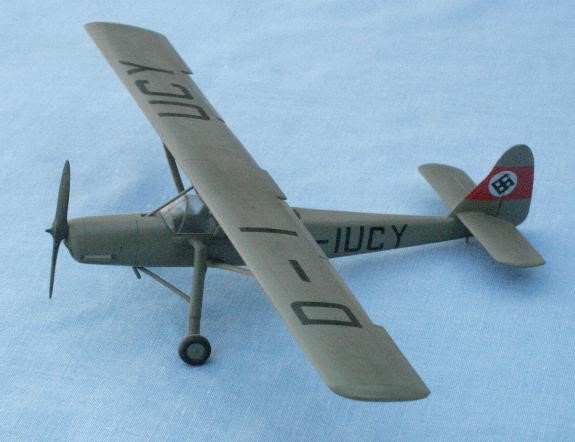
During the autumn of 1935, the considerable potential of the Fieseler Fi 156 project for the tasks of short range reconnaissance and aerial observation had prompted the RLM to draw up a requirement for an army co-operation and observation aircraft with its performance parameters. The requirement stipulated the use of the Argus As 10 or the Hirth HM 508 engine and placed emphasis on short field performance, maximum possible all-round view for the two crew members, and a wide range of speed. It was intended that the resultant aircraft, which the Siebel Si 201 was also designed to compete for, would be evaluated in competition with the Fi 156.
The Bf 163 followed closely the formula established by the Fi 156 in being a high-wing braced monoplane with a metal structure, automatic leading edge wing slots, double slotted flaps, and an exceptionally tall undercarriage. The aircraft’s most interesting feature was the provision for varying the incidence of the entire wing which swivelled on its mainspar, the bracing struts being attached to the fuselage by ball joints and changing their angle with movement of the wing. Construction of the sole prototype was entrusted to Weserflug Flugzeugbau GmbH, Bremen Lemwerder, though it retained the RLM prefix for BFW (Bf).
The plane normally carried a crew of two (three in an emergency). Its wings were foldable for rail transport. The structural design of the plane resembled that of the Bf 108 Taifun, in particular, as regards fuselage construction, engine mount and cowl, shape of horizontal tail surfaces etc.
Most information has been lost in time, but a weight breakdown table, originating from the Augsburg design office, proved extremely valuable in that it provided a clear picture of the equipment carried by the plane and of the weights of the various components, thus permitting a rough estimate of their dimensions. The list also proved of great value in a later phase of the reconstruction, when wing and landing gear positions were established by calculating the approximate centre of gravity location.
The next “find” was a couple of more precise dimensional figures (wing span and area). As the shape of the wing was known to have been rectangular, it was now a simple matter to provisionally establish the overall wing dimensions. With the length of the Argus As 10 C engine known, the overall length of the fuselage could be roughly determined.
Various people had mentioned the incidence control system, but nobody seemed to remember clear¬ly just how it had worked and where the linkage had been at¬tached to wing and fuselage.
Questioning the pilot who had been in charge of testing the Bf 163 led to the dis¬covery of the plane’s registration, which in turn, enabled H. J. Ebert to identify the a/c in the back¬ground of two snapshots of the old Messerschmitt Archives. Un¬fortunately, the two photos were rather foggy and showed only part of the plane. Yet they supplied a wealth of most welcome informa¬tion, in particular, about the verti¬cal position of the tailplane and the true shape of fin and rudder.
H. J. Ebert found an elementary ¬view of a “Fieseler Storch like plane” in a 1944 issue of “Luft¬fahrt & Schule”. It depicted what must have been an early design sketch of the Bf 163, clearly showing the latter’s unique wing incidence control system, the posi¬tion of the main wing strut, the peculiar semi cantilever landing gear, but a different fuselage contour.
A report titled “A comparison of the amount of riveting opera¬tions for various aircraft types” detected shortly afterwards in the old WFG archives contained a diminutive schematic drawing: the basic outline of the outer panel of the Bf 163 wing. Using the data contained in this report (list of numbers of rivets, wing , slot and flap ribs etc.), it was now possible to re establish the structural design of the outer wing panels and using the available other wing data that of the entire wing.
First flown on 19 February 1938, the Bf 163 V1 proved to have similar performance characteristics to those of the Fi 156 but was more complex and expensive. Although some components for a second prototype were manufactured, the Bf 163 V2 was not completed and further work on the Bf 163 was terminated in favor of the Fieseler Fi 156.
The Ilmavoimat / Maavoimat evaluated the Bf 163 but considered that as the Germans had already ordered the Fi 156 Storch into production, while the Bf 163 was a good aircraft it was so similar in performance and capabilities to the Fi 156 that it probably wasn’t going anywhere. It remained under consideration but as an unlikely fallback option, given that Bayerische Flugzeugwerke (BFW) was unlikely to produce the aircraft only to meet a small Finnish order. License production was contemplated.
In a very rare decision, the RLM issued the airframe designation number 8-163 for the Me 163 Komet rocket-propelled interceptor, after having used the number for the Bf 163. The two aircraft are distinguished by the abbreviation: the earlier Bf 163, and the later Me 163. The new “Me” prefix was adopted for all new designs of Messerschmitt aircraft, after the company’s official name of Bayerische Flugzeugwerke (BFW) was changed to Messerschmitt AG in July of 1938.
With a Crew of 2, the Messerschmidt Bf 163 was powered by a single Argus As 10C 8-cylinder inverted-vee air cooled engine, 179 kW (240 hp) and had a maximum speed of 112mph. Performance characteristics overall were very similar to the Fi 156.
















 All Aero