A modification of the underpowered 1910 MacKensie-Hughes triplane, which featured heavily back-staggered wings that have been seen as predecessors of the Handley-Page flaps. Even with a stronger 60 hp ENV engine it failed to fly, and was apparently abandoned after a take-off mishap at Brooklands in March 1911.
John Bevins Moisant designed and built two aircraft between August 1909 and 1910, before he became an officially licensed pilot. His first was the Moisant Biplane.
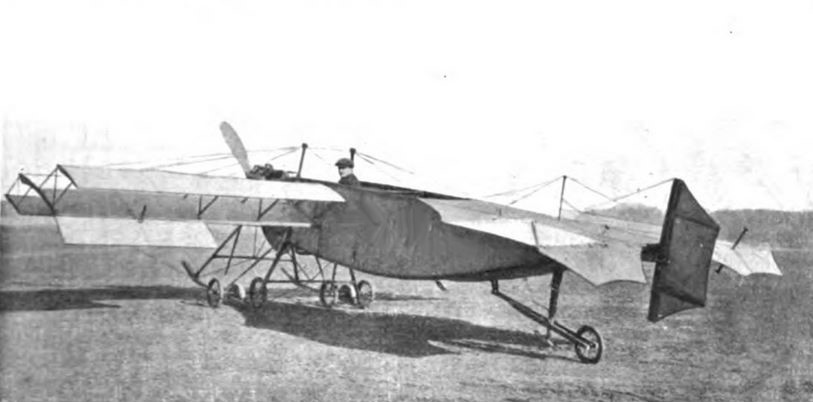
Moisant designed and built the Le Corbeau / Crow in 1910.
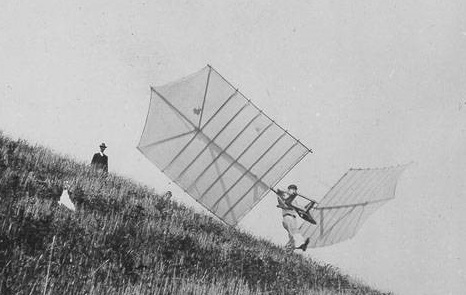
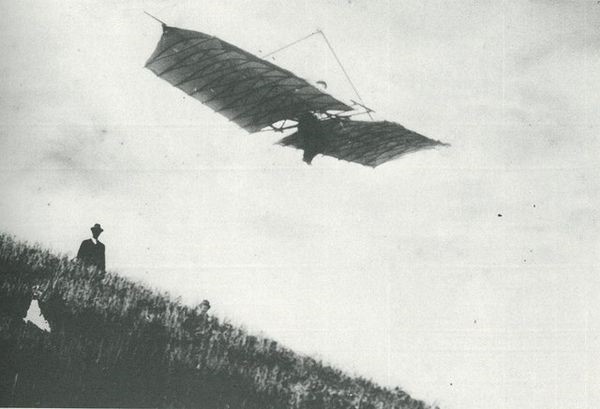
One of the gliders built by Charles Proteus Steinmetz – the “Wizard of Schenectady” – and others in 1894. While working for General Electric at Schenectady, N.Y., Steinmetz organized a band of fellow flying machine enthusiasts into the Mohawk Aerial Navigation Company, and over the summer of 1894 built and tested a man-carrying kite and two true gliders. None were particularly successful.
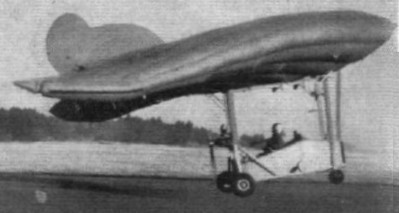
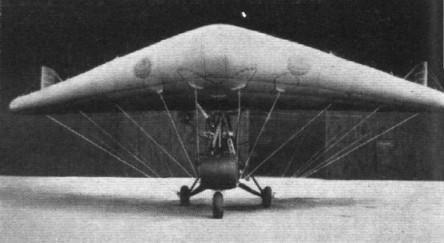
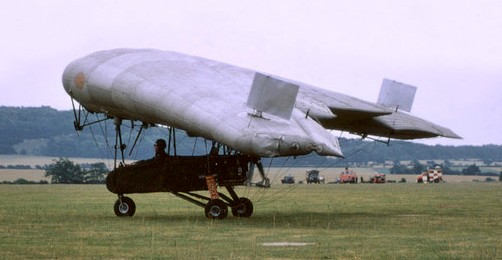
In 1955 ML Aviation at White Waltham designed and produced a portable flying machine called the ML Utility ML.1. Given the serial number XK776, the aircraft featured an inflatable rubberised fabric wing and quick release fittings enabling the aircraft to be rigged and de-rigged fairly quickly.
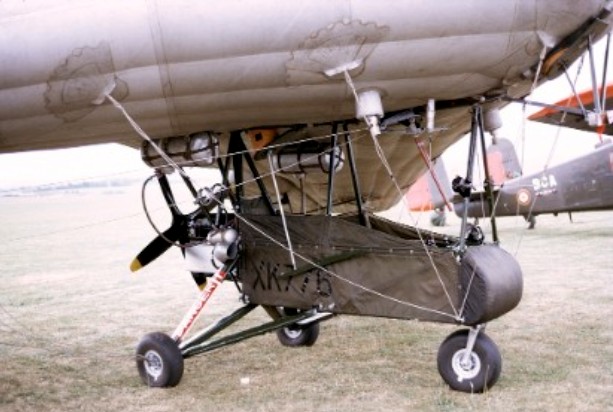
Over the period of a year, the prototype fuselage was redesigned from the box like structure, to a slimmer, longer structure with tandem seating fir a pilot in the front, and passenger. The tricycle undercarriage, with swivelling nosewheel, changed from wheels on a horizontal axle to rear wheels mounted on legs.
The 65 hp McCulloch pylon mounted pusher of the prototype was changed in the Mk.1 to a Walter Mikron in a cowling faired into the rear of the fuselage. Fuel was a mix of methanol, benzole, and petrol. Cruising speed increased from 45 mph to 58 mph.
The inflatable rubberised-fabric wing, of delta planform, was cleaned up. The basic structural method was retained with the upper and lower surfaces being connected by a number of porous fabric diaphtrams running spanwise and maintaining a symmetrical aerofoil profile developed from NACA 0024. After initial inflation on the ground, the wing is maintained at its correct internal pressure, under 1 lb/sq.in, by an electric pump and relief valve. The prototype had a windmill operated pump.
Control was by inflated elevons over almost the full span of the trailing edge, operated by cable from an inverted control column mounted on the fuselage superstructure. Vertical stabilising surfaces fitted near the wingtips replaced the central fin of the prototype.
The whole wing can be deflated and packed in a bag. The wing is attached to the superstructure by a series of toggles, and flying wires lead from patches on the wing undersurface to points on the fuselage and undercarriage members.
Despite evaluation by the British Army Air Corps at Middle Wallop further production was not taken up. The flight characteristics were unusually slow and the machine was then stored until saved by the Army Air Corps museum.
This was an experimental 2-seat observation aircraft built in 1957 for the Army. Fuselage consisted of a canvas bathtub type fuselage reminiscent of some later microlight aircraft. XK776 was the first of three inflatable wing aircraft flight tested between 1954 & 1960. It went to Cardington on 27/11/69, and is now preserved at the Museum of Army Flying at Middle Wallop.
Utility Mk.1 Engine: Walter Mikron III Span: 35 ft 0 in Overall length: 23 ft 3 in Overall height: 10 ft 6 in Wing area: 400 sq.ft Dry weight: 450 lb Fuel: 85 lb Pilot weight; 180 lb Passenger weight: 180 lb Baggage weight: 40 lb Total weight: 935 lb Max speed: 68 mph Cruise: 58 mph Stall: 30 mph Rate of climb: 740 fpm Takeoff distance: 210 ft Endurance: 2 hr 30 min Ceiling: 5000 ft Root chord: 17 ft 6 in Tip chord: 5 ft 9 in Wheelbase: 7 ft 1 in Track: 5 ft 4 in
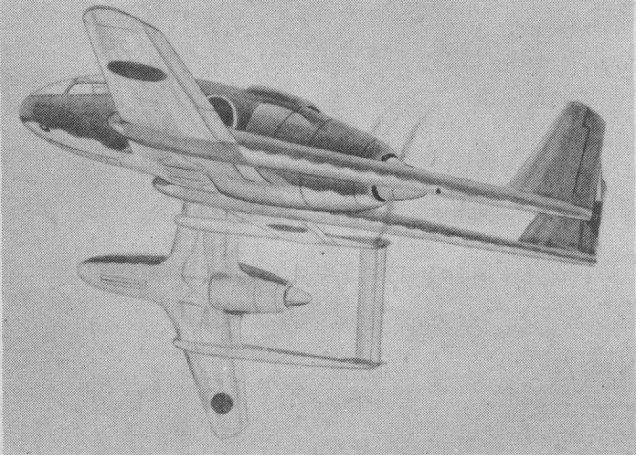
The Mitsubishi J4M1 was discovered in a captured document, receiving the allied code name ‘Luke’. Although featuring in a December 1944 recognition manual, the prototype was never completed.
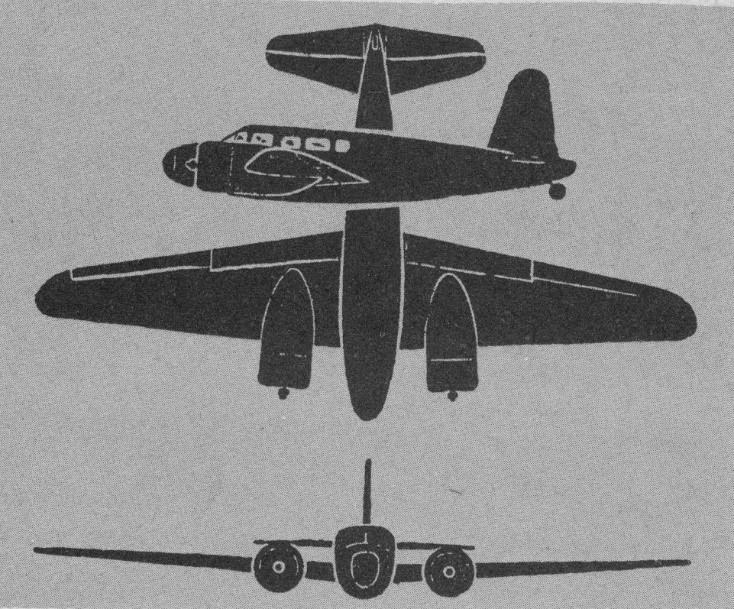
Widely described early in the war, and included in the first allied code list, the Darai medium bomber, or anything like it, was never produced or imported by Japan. It does look like the American Bennet BTC-1 described in a 1940 Japanese magazine.
JA21MJ Mitsubishi MRJ-90 at Nagoya Komaki on 15th September 2016
In 2003 the Japanese government started a five-year, ¥50 billion ($420 million) research program to study an indigenous regional jet for 30 to 90 passengers, led by Mitsubishi Heavy Industries (MHI). In 2004 MHI was focused on a 2m high by 2.8m-wide, four-seat abreast cabin, seating 30 to 50 passengers, and was hoping to fly a prototype in 2007 and deliver the first aircraft in 2010. In 2005 it switched to a larger 70-90 seat category. The Mitsubishi Regional Jet (Japanese: 三菱リージョナルジェット), or MRJ for short, is a twin-engine regional jet aircraft seating 70–90 passengers manufactured by Mitsubishi Aircraft Corporation, a partnership between majority owner Mitsubishi Heavy Industries and minority owner Toyota Motor Corporation with design assistance from Toyota affiliate Subaru Corporation, itself already an aerospace manufacturer.
MHI launched its concept at the 47th Paris Air Show in June 2007, showing a full-scale cabin mock-up and aiming to be the first regional jet all-composite airframe, with certification targeted for 2012. Mitsubishi formally offered the MRJ to airlines in October 2007 after being the first airframer to select the Pratt & Whitney PW1000G geared turbofan offering a 12% reduction in thrust specific fuel consumption, rated at 15,000 lbf (67 kN) thrust on the 70- to 80-seat MRJ70 and 17,000 lb thrust (75.7 kN) on the 86- to 96-seat MRJ90, projecting a ¥150 billion ($1275 million) development cost.
MHI officially launched the Mitsubishi Regional Jet Program on March 28, 2008 with an order for 25 aircraft (15 firm, 10 optional) from All Nippon Airways, targeting a 2013 introduction. Flight testing was scheduled for late 2011 and the $1.9-billion programme necessitates 300-400 sales to recoup its cost.
In September 2009 Mitsubishi unveiled extensive design changes, using aluminium instead of carbon fibre composites for the aircraft’s wings and wingbox; the remaining composite parts will make up 10-15% of the airframe: the empennage, horizontal tail and vertical tail. The cabin height is increased by 1.5 in (4 cm) to 80.5 in (204 cm) and the fuselage height is increased to 116.5 in (296 cm), giving a rounder cabin, wider and higher than its competition. The program was delayed six months with final design frozen in mid-2010, first flight delayed to the second quarter of 2012 and deliveries to early 2014.
As the MRJ90 MTOW of 39.6 t is above the US regional carriers scope clause of 39 t, SkyWest and Trans States Holdings could convert their MRJ90 orders for 100 and 50, respectively, to the 1.4 m shorter MRJ70: 67% of the 223 firm MRJ90 orders. But the MRJ70 seats only 69 in two classes and attain the 76 seats scope close limit only in all-economy: Mitsubishi wants to increase seating within its fuselage to compete with the currently compliant Embraer E-175 and Bombardier CRJ900.
On 15 September 2010, the Mitsubishi Aircraft Corporation announced that it had entered the production drawing phase and was proceeding with the manufacturing process. Assembly of the first aircraft began in April 2011 with construction of the emergency escape for the cockpit.
In early 2013, Pratt & Whitney delayed the PW1200G certification to the “latter half” of 2014, after the MRJ first flight scheduled for late 2013. On 22 August 2013, Mitsubishi announced a third delay to the program, and that the first flight would take place in the second quarter of 2015 instead of end-2013, while the first delivery to launch customer ANA would take place in the second quarter of 2017 instead of 2015, due to parts delivery problems including Pratt & Whitney engines. On 7 September 2013 were exhibited a prototype of the left wing and four aluminium sections: forward fuselage, front mid fuselage, aft mid fuselage and aft fuselage, to be assembled in October 2013. Mitsubishi has hired foreign experts to help with relations with suppliers, ground tests, flight tests, and certification.
Pictures of the first fully assembled MRJ90 were available on 26 June 2014. An official rollout occurred on 18 October 2014.
The maiden flight of the MRJ90 took place on 11 November 2015. On 24 December 2015, Mitsubishi announced a one-year delay for the first delivery of the MRJ, to mid-2018. The delay was attributed to insufficient wing strength and the redesign of the landing gear for better safety. Much of the flight testing for the MRJ90 will take place in Moses Lake, Washington, due to the crowded airspace in Japan causing scheduling difficulties. Static strength test were completed on November 1, 2016 and confirmed that the airframe could withstand 1.5 times the maximum load.
In January 2017, a further two-year delay was announced, pushing the expected first delivery to mid-2020. This resulted from moving the avionics bay and wiring looms and in March 2017 the flight certification program was extended from 2500 to 3000 flying hours. The development cost ballooned to 350 billion yen (US$3.17 billion) and the project might never able to fully recover its costs. Mitsubishi originally planned to use five flight test aircraft and two ground test aircraft.
In June 2017, 940 hours of flight tests have been done and the four prototypes have an above 98% availability. On 21 August, FTA-2 experienced a flameout 170 km (92 nmi) west of Portland International where it landed, partial damage was confirmed in the PW1200G and the test fleet was grounded until the cause is known. Flight testing resumed on 6 September.
By December 2017, the MRJ test campaign was half done with 1,500 flight hours and less than 1% cancelled due to technical issues.
In January 2018, the avionics bay rearrangement and rerouted wiring were almost complete to be adequate for extreme events such as bomb explosions or water ingress underfloor. Upgrades and ground tests were performed on four flight test aircraft from February to March 2018 at Moses Lake, preceding flight testing for natural icing, avionics and autopilot, performance, stability and control.
In April 2018, the test fleet had logged 1,900 flight hours as Mitsubishi plans displaying it at the July 2018 Farnborough air show. In May 2018, the flight-test fleet is attaining 2,000 hours and as most of the flight envelope is explored.
On 26 April 2017, the fifth MRJ was complete in ANA livery, lacking only engines and nose cone, aircraft number six and seven had their fuselage and wings joined without the tails and the eighth, the first MRJ70, was at the assembly line start; Mitsubishi could manufacture 12 aircraft concurrently: in station one are joined fuselage sections, in station two the landing gear, wings and horizontal stabilisers are attached, in section three the major components are assembled, in outfitting takes place in section four and ground tests in station five, then the completed aircraft moves to painting.
All Nippon Airways was the first customer, with an order for 15 MRJ 90s and an option for 10 more. In March 2008, and again in October 2008, Sankei Shimbun and Fuji Sankei Business I reported that the government of Japan would buy ten MRJs to serve as short-haul and small-field VIP transports, supplementing the existing Japanese Air Force One Boeing 747 aircraft.
At the July 2012 Farnborough Airshow, SkyWest agreed to buy 100 MRJ90s, to be delivered between 2017 and 2020. The deal is worth $4.2bn at list prices. During the 2013 Regional Airlines Association conference, held in Montreal, Quebec, Canada, Mitsubishi announced that ANI Group Holdings, which firmed a MoU for 5 MRJ aircraft in June 2011, cancelled the deal, without giving further details.
The MRJ future was fragile after six years of delays, with 70% of the backlog shared by two US regional carriers bounded by scope clauses: the MRJ90 is too heavy and the smaller MRJ70 accommodates seven seats less than the 76 permitted.
MRJ70 Engines: 2 x Pratt & Whitney PW1215G, 69.3 kN (15,600 lbf) Fan diameter: 56 in (142 cm) Wing span: 29.2m / 95 ft 10in Length: 33.4m / 109 ft 8in Tail height: 10.4m / 34 ft 2in Max takeoff weight: 40,200 kg (88,626 lb) Max landing weight: 36,200 kg (79,807 lb) Max zero fuel weight: 34,000 kg (74,957 lb) Typical cruise speed: Mach 0.78 (447 kn; 829 km/h) Range: 3,740 km (2,020 nmi) Operating ceiling: 11,900 m (39,000 ft) Takeoff field length (MTOW, SL, ISA): 1,720 m (5,650 ft) Landing field length (MLW, Dry): 1,430 m (4,700 ft) Passengers: 69 to 80 Seat pitch: 74–79 cm (29–31 in) – 91 cm (36 in) Cabin Height: 2.03 m / 6 ft 8in Cabin Width: 2.76 m / 9 ft 1in Cabin length: 33.4m / 109 ft 8in
MRJ90 Engines: 2 x Pratt & Whitney PW1217G, 78.2 kN (17,600 lbf) Fan diameter: 56 in (142 cm) Wing span: 29.2m / 95 ft 10in Length: 35.8m / 117 ft 5in Tail height: 10.4m / 34 ft 2in Max takeoff weight: 42,800 kg (94,358 lb) Max landing weight: 38,000 kg (83,776 lb) Max zero fuel weight: 36,150 kg (79,697 lb) Operating empty weight: 26,000 kg (57,320 lb) Fuel Capacity: 12,100 L (3,200 US gal) Typical cruise speed: Mach 0.78 (447 kn; 829 km/h) Range: 3,770 km (2,040 nmi) Operating ceiling: 11,900 m (39,000 ft) Takeoff field length (MTOW, SL, ISA): 1,740 m (5,710 ft) Landing field length (MLW, Dry): 1,480 m (4,860 ft) Passengers: 81 to 92 Seat pitch: 74–79 cm (29–31 in) – 91 cm (36 in) Cabin Height: 2.03 m / 6 ft 8in Cabin Width: 2.76 m / 9 ft 1in
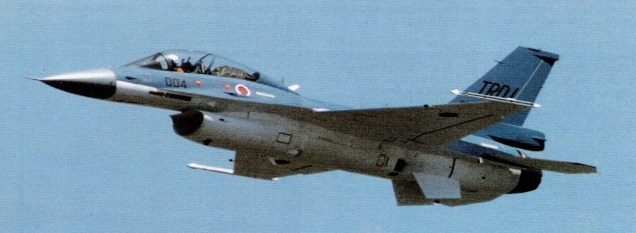
The Japanese-developed F-2 fighter support aircraft, intended to replace F-1 and based on F-16 but incorporating new technologies was developed jointly with Lockheed. The fighter uses an all-composite wing. The Japanese Defense Agency approved a 55 aircraft purchase for 2000-1.
Early in October 1987, Japan announced that the FS-X would be a derivative of an existing US aircraft, the choice of the basic airframe being either the F-16 of the F-15. The F-16 derivative was selected by the Japanese Self-Defense Agency with formal endorsement of the Japanese National Security Council in October 1987.
The first prototype flew on 7 October 1995, and the first squadron to be equipped with the F-2 was formed in 2000.
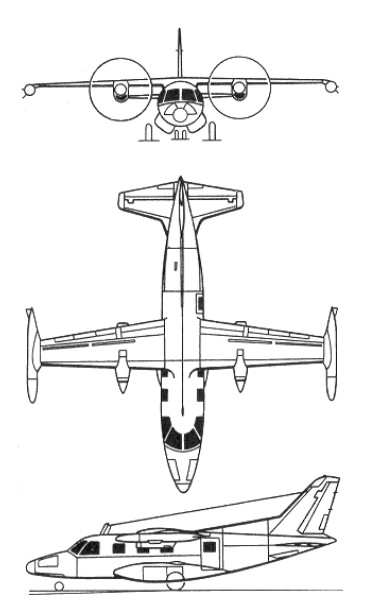
In 1959, MHI started on a utility/ executive aircraft aimed at the emerging business aviation market. It was announced in April 1962 that Mitsubishi were to build one flying prototype and a structure test airframe of a shoulder-wing twin-turboprop utility aircraft under the XMU-2 designation. A mock-up had been built and the aircraft is described as being similar in appearance to the Aero Commander, but smaller, with a circular-section fuselage. The engines were to be French or Canadian turboprops of 500 hp each.
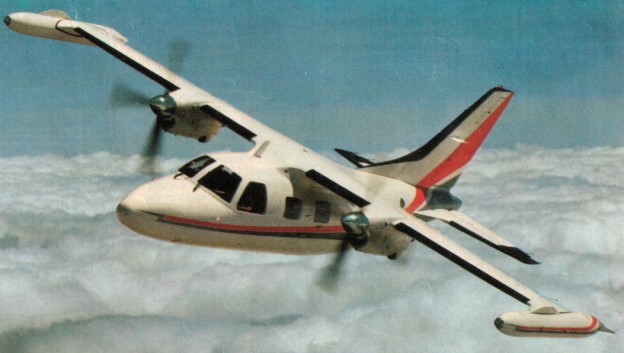
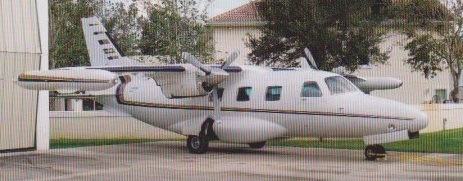
On 14 September 1963 the first of four prototypes was flown, a cantilever high-wing monoplane with a pressurised fuselage, retractable tricycle landing gear and two wing-mounted turboprop engines. The first MU 2 prototype flew pow¬ered by French Turbomeca Astazou en¬gines. The fourth airplane to be tested was fitted with an early version of the Garrett AiResearch TPE 331, and all subsequent MU 2s have been powered by TPE 331 turboprops. By 1965, the short body MU 2B was certified by the FAA for use in the U.S. and sales to American firms began. To achieve roll control when the wing required full span flaps, Mitsubishi developed a small spoiler that resides at about the two thirds chord position and extends along most of the wing’s span.
Since 1965, MHI has improved the MU 2 as the technology of general avia¬tion aircraft advanced, but with the ex¬ception of powerplants and systems, very few changes in the airframe were neces¬sary. As more power was added, a speed increase of 15 percent and a gross weight increase of 30 percent was achieved. The first significant changes to the MU 2 ap¬peared in 1968 when the aircraft was fitted with larger tip tanks and powered by 705 eshp TPE 331s.
Initial production versions were the MU-2A with Turbomeca Astazou turboprops, MU-2B with Garrett TPE331 turboprops and a similar MU-2D, an unpressurised multi-role MU-2C for the Japanese Ground Self-Defence Force, a search-and-rescue MU-2E, and the MU-2F with uprated TPE331 engines.
Models B and D were powered by 605 shp and seated 7-9 passengers. The Model F represented a boost in power to 705 shp.
Certification of the MU-2B-26A is FAA A10SW, and the MU-2B-30 JCAB 25.
The first stretched (by 1.88 m) MU 2 was the G model, which was based on the MU 2F and introduced in 1969. The Model G featured increased seating capacity for up to 11 people, and the powerplant of the MU-2F.
In 1971, the eshp of the AiResearch turbines was increased to 724 for use on the long bodied MU 2J and the short bodied MU 2K, which were introduced in mid 1972. Both utilizing 724-shp turboprops and offering seating arrangements that corresponded to Models F and G, respectively.
Subsequent versions have included the MU-2J with more powerful engines, and MU-2K combining MU-2F fuselage and MU-2J powerplant.
Mitsubishi MU-2J N113SD
The MU 2L and M models (variants of the MU-2J and MU-2K respectively), with their increased gross weights and added soundproofing, were an¬nounced at NBAA in September, 1974. Fitted with full span, high lift flaps and two Garrett AiRe¬search TPE 331 6 251M engines, rated at 776 equivalent shaft horsepower on the L model and at 724 eshp on the M model. Thus, both Mitsubishis have power loadings of 8.1 pounds of aircraft per horsepower for the MU 2L ¬and 7.9 lbs/hp for the MU 2M. The L and M model use AiResearch cabin pressurization systems with Hamil¬ton Standard air conditioning utilizing bleed air from the engines. The MU 2L, nine feet longer inside than the MU-2M, providing ac-commodations for a pilot and from seven to ten passengers. The MU 2L uses 178 square feet of wing area and a NACA 64A415 airfoil to produce a high speed wing that carries a load of 65 pounds per square foot.
The MU-2L and MU-2M were discontinued in 1976 and replaced by the MU-2N and MU-2P with Garrett TPE331-5-252M engines. The 90 inch, three blade propellers that were standard on MU 2Ls and Ms are replaced on the latest models by 98 inch, four¬blade props that turn at 1,591 rpm on take off, only 80 percent of the revolu¬tions previously used. Because of the slower turning propellers, the propeller tip speeds are reduced about 100 feet per second in spite of the increased prop diameter needed to produce the same thrust horsepower available on older MU 2s. The result is a dramatic 25 per¬cent reduction in perceived noise levels within the cabin and no loss in per¬formance.
The new aircraft are designated the MU 2N and the MU 2P (the latter model has the shorter fuselage). In addition to larger, slower turning propellers, both models are equipped with the Woodward fuel control units; a move which will mark a return to the fuel con¬trol units utilized by Mitsubishi in their early MU 2 models. Purchasers of L or M model Mitsubishis have the option to upgrade their new aircraft to the stan-dards of the MU 2N or MU 2P, respective¬ly, should they wish to have the slow turning engines with the Woodward fuel controllers.
The MU 21P 98 inch four blade propellers have been slowed 20 percent, to 1,591 rpm for takeoff and 1,561 during cruise. According to the factory, that reduces the interior noise level by 25 percent. A vertical fin now sprouts from the top of each tip tank, to help improve low-¬speed roll stability, and there’s a new taxi light in the nose of each tank. A new windshield can be seen in the cockpit; the new glass creates less distortion. Spoilers replace the ailerons to good advantage; they remain equally effective at all airspeeds, eliminate adverse aileron yaw and, most significantly, permit space for almost full span double slotted Fowler flaps. When fully ex¬tended, the flaps increase wing area by 24 percent and reduce stalling speed by 24 knots. Taking off at Vmc (93 knots) allows the airplane to clear a 50 foot obstacle in 1,800 feet at gross on a standard day. In fact, the airplane’s single engine rate of climb is 760¬ fpm, at a typical weight of 9,250 pounds. The MU 2P is a short coupled machine, and this shows up during takeoff and landing. Bluntly stated, the MU 2P is lacking in pitch¬ control power, and some piloting effort is re¬quired to compensate for that shortcoming. The problem is apparently limited to the short fuselage version; the longer body MU¬2s, including the new four blade MU 2N, do not display any pitch difficulties. When leav¬ing or entering ground effect during takeoff or landing, the low mounted tailplane is af¬fected more than the high wings because of the particular relationship between them, and this produces a forward pitching force. The MU 2P, with its short fuselage and narrow center of gravity, demonstrates the effects of this nose down load more vividly than do most airplanes.
An ar¬rangement was struck with Mooney Aircraft for assembly and marketing of the MU 2, and that lasted until it was dissolved in 1970 after Mooney had been purchased by Butler Aviation. But as early as 1967, Mitsubishi Aircraft International, Inc. had been formed, and by 1970, MAI was in a position to take over both the assembly of MU 2s in San Angelo and marketing of the product. Mitsubishi Aircraft Interna-tional, Inc., a U.S. corporation based in San Angelo, Texas was responsible for assembling MU 2s and marketing them in the US and throughout the world.
The MU-2S is the Japan Air Self-Defence Force patrol aircraft, which resembles the civilian aircraft but has a shorter fuselage and bulbous radar nose.
The MU-2N and MU-2P evolved into the Solitaire (standard fuselage) and Marquise (stretched fuselage), respectively. Both airplanes have 1,000 ¬horsepower engines, wet wing fuel tanks that hold an additional 40 gallons and are certificated to 31,000 feet. The MU 2 designation will be dropped. The Solitaire succeeded the MU 2P, and the Marquise the larger, slower MU 2N.
The Solitaire is powered by two Garrett TPE331-10-501M turboprops producing 727 shp at maximum continuous power or 689 shp at recommended cruise power of 96% RPM. Each engine turns a Hartzell 98-inch four-blade prop and provides a 475-fpm single-engine rate of climb when loaded to full gross. With a cabin pressurization differential of 6.0 psi, a sea-level cabin can be maintained up to 14,000. The Marquise, which is 6 feet 2 inches longer, is powered by two turboprops, each producing 778- shp for takeoff or maximum continuous operation and 738 shp at recommended cruise power. Single-engine rate-of-climb is 410 fpm at full gross, and cabin pressurization differential is the same as the Solitaire. The long-fuselage Marquise accommodates a crew of two plus seven to nine passengers; and the Solitaire, seating a crew of two plus six or seven passengers.
Sales of the Mitsubishi MU 2 passed the 700 mark in July 1981 when the total reached 702. Since the twin turboprop business transport was introduced in 1966, 518 were sold in the USA, 20 in Canada, 58 in Latin America, 36 in Europe, nine in Africa, eight in Australia, one each in the Middle East and Asia and 51 in Japan. The last 100 aircraft were sold since September 1979.
Napier NZ Jan 84
When production ended at the end of 1983, 831 MU-2s of all versions had been built, including 73 military versions.
MU 2 prototype Engines: 2 x Astazou II turbo-prop, 415kW Wingspan: 10.3 m / 33 ft 10 in Length: 10.1 m / 33 ft 2 in Height: 4.0 m / 13 ft 1 in Wing area: 16.6 sq.m / 178.68 sq ft Max take-off weight: 3600 kg / 7937 lb Empty weight: 2072 kg / 4568 lb Max. speed: 525 km/h / 326 mph Cruise speed: 523 km/h / 325 mph Ceiling: 11000 m / 36100 ft Range w/max.fuel: 2830 km / 1759 miles Crew: 1-2 Passengers: 5-13
MU-2B-26A Engines: 2 x Garrett TPE-331-252M, 605 shp. Seats: 7/9.
MU-2B-60 Marquise Engines: 2 x Garrett TPE-331-10-501M, 715 shp. Props: Hartzell 4-blade, 98-in. Seats: 9/11. Length: 39.4 ft. Height: 13.7 ft. Wingspan: 39.2 ft. Wing area: 178 sq.ft. Wing aspect ratio: 7.7. Maximum ramp weight: 11,625 lbs. Maximum takeoff weight: 11,575 lbs. Standard empty weight: 7650 lbs. Maximum useful load: 3975 lbs. Zero-fuel weight: 9950 lbs. Maximum landing weight: 11,025 lbs. Wing loading: 65 lbs/sq.ft. Power loading: 8.1 lbs/hp. Maximum usable fuel: 2700 lbs. Best rate of climb: 2100 fpm Service ceiling: 29,400 ft. Max pressurisation differential: 6 psi. 8000 ft cabin alt @: 27,300 ft. Maximum single-engine rate of climb: 410 fpm @ 152 kts. Single-engine climb gradient: 158 ft/nm. Single-engine ceiling: 14,800 ft. Maximum speed: 309 kts. Normal cruise @ 20,000ft: 295 kts. Fuel flow @ normal cruise: 592 pph. Endurance at normal cruise: 4.1 hrs: Stalling speed clean: 100 kts. Stalling speed gear/flaps down: 81 kts. Turbulent-air penetration speed: 191 kts. Takeoff distance (50′) 2,170 ft Landing distance (50′) 2,200 ft
MU-2B-400 Solitaire Engines: 2 x Garrett TPE-331-10-501M, 665 shp Props: Hartzell 4-blade, 98-in Seats: 7/9 Length: 33.3 ft Height: 12.9 ft Wingspan: 39.2 ft Wing area: 178 sq.ft Wing aspect ratio: 7.7 Maximum ramp weight: 10,520 lbs Maximum takeoff weight: 10,470 lbs Standard empty weight: 7010 lbs Maximum useful load: 3510 lbs Zero-fuel weight: 9700 lbs Maximum landing weight: 9950 lbs Wing loading: 59 lbs/sq.ft Power loading: 7.8 lbs/hp Maximum usable fuel: 2700 lbs Best rate of climb: 2250 fpm Service ceiling: 31,000 ft Max pressurisation differential: 6 psi. 8000 ft cabin alt @: 27,300 ft Maximum single-engine rate of climb: 475 fpm @ 150 kts Single-engine climb gradient: 190 ft/nm Single-engine ceiling: 16,900 ft Maximum speed: 321 kts Normal cruise @ 25,000ft: 309 kts Fuel flow @ normal cruise: 526 pph Endurance at normal cruise: 4.6 hrs Stalling speed clean: 104 kts Stalling speed gear/flaps down: 78 kts Turbulent-air penetration speed: 182 kts
MU-2J
MU 2L Engines: 2 x AiResearch TPE 331¬6 251M, 776 eshp Max cruise pwr: 767 eshp Prop: Hartzell 90in Constant speed, full feather with reverse pitch Span: 39 ft. 2 in Overall length: 39 ft. 5 in Overall height: 13 ft. 8 in Wing area: 178 sq. ft Cabin length: 19 ft. 8 in Cabin width: 4 ft. 11 in Cabin height: 4 ft. 3.2 in Baggage compartment: 44 cu. Ft Seats: 8 11 Empty weight: 6,380 lbs Standard equipped weight: 7,570 lbs Max takeoff weight: 11,575 lbs Max ramp weight: 11,625 lbs Useful load (with std equip): 4,055 lbs Payload with full fuel: 1,603 lbs Usable fuel capacity: 366 US gal Max cruise: 340 mph Rate of climb at sea (10,350 lbs): 2,630 fpm ROC SE: 675 fpm Service ceiling (10,350 lbs): 29,600 ft Service ceiling (10,350 lbs) SE: 15,450 ft Stall speed: 88-115 mph Max range 30 min res: 1450 miles Takeoff distance over 50 ft. at 11,575 lbs: 2170 ft Ldg dist from 50 ft. at 9,473 lbs: 1880 ft Pressurization: 6.0 psi Cabin alt @ 24,000 ft: 6200 ft
MU 2M Engines: 2 x AiResearch TPE 331¬6 251M, 724 eshp Max cruise pwr: 715 eshp Prop: Hartzell 90in Constant speed, full feather with reverse pitch Span: 39 ft. 2 in Overall length: 33 ft. 3 in Overall height: 12 ft. 11 in Wing area: 178 sq. ft Cabin length: 11 ft Cabin width: 4 ft. 11 in Cabin height: 4 ft. 3.2 in Baggage compartment: 43 cu. Ft Seats: 7 9 Empty weight: 5,920 lbs Standard equipped weight: 6,864 lbs Max takeoff weight: 10,470 lbs Max ramp weight: 10,520 lbs Useful load (with std equip): 3,656 lbs Payload with full fuel: 1,204 lbs Usable fuel capacity: 366 US gal Max cruise: 365 mph Rate of climb at sea (9,250 lbs): 2,840 fpm ROC SE: 760 fpm Service ceiling (9,250 lbs): 32,200 ft Service ceiling (9,250 lbs) SE: 18,000 ft Stall speed: 84-112 mph Max range 30 min res: 1680 miles Takeoff distance over 50 ft. at 10,470 lbs: 1800 ft Ldg dist from 50 ft. at 8338 lbs: 1600 ft Pressurization: 6.0 psi. Cabin alt @ 24,000 ft: 6200 ft Wing loading: 58.8 lb/sq.ft
MU-2N Engines: 2 x Garrett TPE 331-6-251M, 715 hp Seats: 11 Wing loading: 65 lb/sq.ft Pwr loading: 8.1 lb/hp Gross wt: 11,625 lb Empty wt: 7570 lb Equipped useful load: 4040 lb Payload max fuel: 1601 lb Range max fuel/cruise: 772 nm/2.6 hr Range max fuel / range: 1112 nm/ 4.5 hr Service ceiling: 25,000 ft Max cruise: 291 kt Max range cruise: 250 kt Vmc: 99 kt Stall: 79-105 kt 1.3 Vso: 103 kt ROC: 2200 fpm SE ROC: 420 fpm @ 152 kt SE Service ceiling: 12,000 ft Min field length: 2200 ft Cabin press: 6 psi. Fuel cap: 2439 lb
MU 2P Engines: 2 x AiResearch TPE 331 5 252M, 665 shp Props: Hartzell four blade, full feathering, reversible Length: 33 ft 3 in Height: 12 ft 11 in Wingspan: 39 ft. 2 in Wing area: 178 sq. ft Wing loading: 58.8 lb/sq.ft Power loading: 7.9 lb/hp Seats: 7 Empty wt: 7,050 lbs Useful load: 3,420 lb Payload with full fuel: 1,236 lbs MTOW: 10,470 lb Usable fuel cap: 364 USG/2,184 lbs Max landing wt: 9,955 lb Max ROC: 2,450 fpm SE ROC: 475 fpm SE climb gradient (150 kt Vyse): 190 ft/nm Service ceiling: 32,200 ft Certificated ceiling: 28,000 ft SE service ceiling: 16,800 ft Max cruise at 16,000 ft: 306 kts Econ cruise at 24,000 ft: 272 kt Duration at max cruise: 3.9 hrs Duration at econ cruise: 5.9 hrs Stalling speed, clean: 103 kts Stalling speed, full flaps: 78 kts Pressurization differential: 6 psi 10.000 ft. cabin at: 31,200 ft.





 All Aero