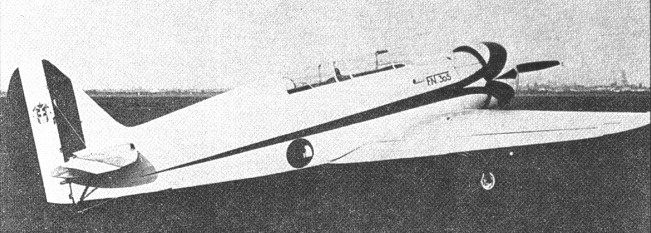
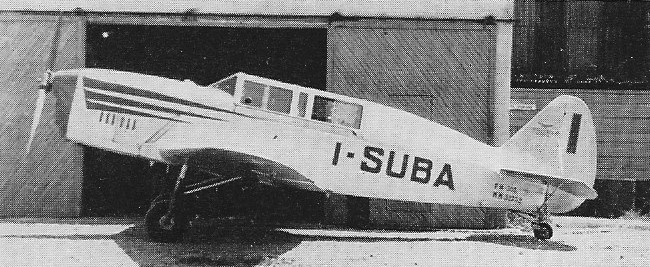
First flown in January 1935, the F.N.305 training, touring and sporting aeroplane had single or tandem seating under a large glasshouse canopy and, with a 149-kW (200-hp) Fiat A.70S radial, attained a fair level of performance thanks to its retractable landing gear. Several one-off variants were produced before Piaggio started building the F.N.305A two-seat version with the Alfa-Romeo 115 inline. The type was used by the Italian air force as a tighter trainer and liaison aeroplane. Between 1937 and 1943 production totalled 258 including small numbers of the F.N.305B and F.N.305C single-seaters with open and enclosed cockpits respectively.
An experimental version, the F.N.305-D, established s long-distance record by flying from Rome to Addis Ababa.
F.N.305 Wingspan: 27 ft 9 in Wing area: 129.12 sq.ft Length: 22 ft 11 in Height: 6 ft 10.5 in Empty weight: 1320 lb Loaded weight: 1980 lb Max speed: 211 mph Cruise: 189 mph Service ceiling: 22,950 ft Range: 435 mi
F.N.305A Powerplant: l x Alfa-Romeo 115-1, 142kW (190 hp) Span: 8.47m (27ft 9.5in) Length: 7m (22 ft 11.5 in) Armament: 1 or 2 x 7.7-mm (0.303-in) mg Max T/O weight: 900kg (1,9841b) Max speed: 193 mph Operational range: 311 miles.
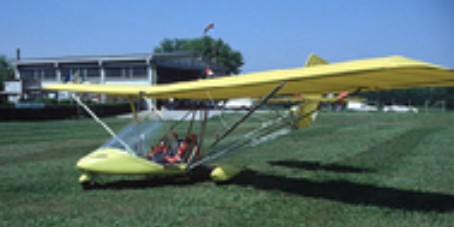
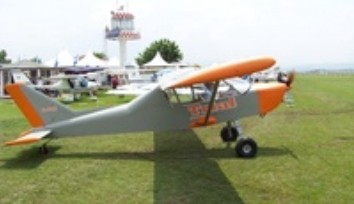
Now considered a classic of Italian ultra-lights, the Groppino is the basic for excellence, for the school and who that want an economic ultralight aircraft, simple and fun. The aircraft is equipped with dual controls and nose wheel steering.
The cockpit offers great visibility and the aircraft is constructed entirely of metal. The aircraft engine is a very sturdy and reliable Rotax 912 ULS so you can travel at a cruising speed of 125 mph (201 km / h) with a fuel consumption of around 17 liters / h. Price 2009: 61900 EURO
Foldable wings, all metal frame construction with central chrome molybdenum. Large door on right side that allows easy access to front and rear seat. Tundra wheels equipped to operate on rough terrain. The Jabiru engine ensures efficient and low noise while maintaining excellent performance.
Stall: 32 kt / 37 mph / 60 kmh Cruise: 86 kt / 99 mph / 160 kmh VNE: 119 kt / 137 mph / 220 kmh Empty Weight: 285 kg / 628 lbs MTOW Weight: 450 kg / 992 lbs Take-off distance (50ft obstacle): 390 ft / 120 m Landing distance (50ft obstacle): 330 ft / 100 m
Engine: Rotax 503, 52 hp Wing span: 9.9 m Wing area: 16.7 sq.m MAUW: 450 kg Empty weight: 180 kg Fuel capacity: 30 lt Max speed: 120 kph Cruise speed: 80 kph Minimum speed: 45 kph Climb rate: 4 m/s Seats: 2 Fuel consumption: 15 lt/hr
In 1988 Textron was contracted to supply three 400hp IO-720-D1B engines for the N-5. The contract provided for three specially equipped engines to be supplied for the N-5 prototypes, with an option on production engines from late-1990.
Nanchang developed the N-5A agricultural aircraft, first flown on 26 December 1989. The N5A received its CAAC production certificate in the 1990s. By 1995, eight had been built.
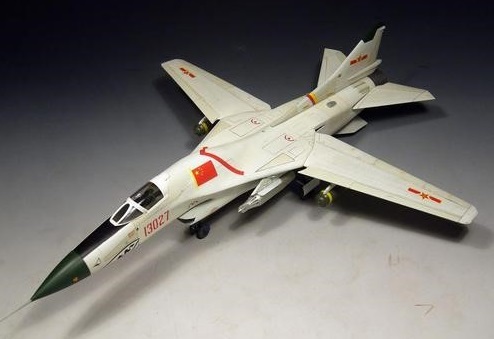
In the mid-’70s, China managed to get their hands onto Egyptian MiG-23BNs and -MSs, and downed American F-111s. Using this captured technology, Nanchang was asked to develop a swing-wing strike aircraft for the PLAAF. Originally, plans centered around a quick domestic copy of the MiG-23BN. However, when PLAAF requirements added air-to-air capabilities, the MiG-23BN would prove inadequate. Plans then shifted to repurposing the F-111 electronics for the new design. Chinese industry proved incapable of producing systems as small as the design called for, forcing a major redesign that made the Q-6 comparable in size to the Su-24. The side intakes of the MiG-23 proved inadequate for dogfighting, so they were relocated to the chin, while the inadequate engine was to be replaced with the domestically-produced WS-6 turbofan. Overall, however, the project quickly proved to be beyond the means of the Chinese aerospace industry. Development dragged on as much of the intended onboard systems proved too difficult to copy. While an advanced fly-by-wire system (first of its kind for China) was developed for the Q-6’s swing wings, it proved to be 12% heavier than the one employed on the MiG-23. The WS-6 proved to be failure as well, and thus, in 1989, with requirements shifting away from swing-wing designs, the Q-6 was finally cancelled.
As Shenyang began developing MiG-19s locally under the J-6 name in 1958, the PLAAF requested the development of the design into a dedicated attack aircraft. Shenyang assigned the same project manager as the one in charge of the J-12 program. The aircraft was designated Qiangjiji-5 (Q-5) which stands for Attack aircraft 5. A long list of changes was made to the MiG-19 design, making the new aircraft virtually unrecognizable. The intakes were moved to the fuselage sides to make space for a radar, while the aircraft was lengthened and area ruled to make space for an internal weapons bay and reduce transonic drag, respectively. The wing root 30mm cannon of the J-6 were replaced with 23mm cannon, but payload was doubled to 2,000kg, and the number of hardpoints was increased from four to six. Meanwhile, larger, less swept wings were added. Although it was designed by Shenyang, further development and production were assigned to Nanchang. The prototype was completed in 1960, but due to the political climate at the time, was cancelled before it took flight in 1961.
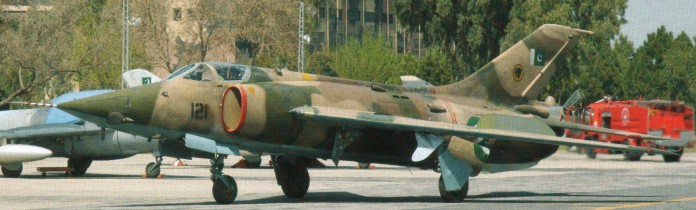
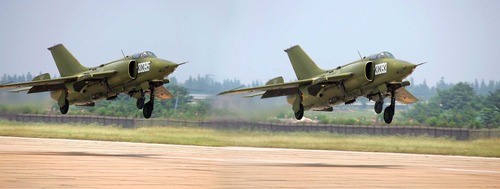
The prototype program was kept alive by small team and resumed officially 1963, when the PLAAF revived the project and moved it to Nanchang. First flight took place on 4 June 1965, featuring an area ruled fuselage for minimum transonic drag, cockpit armour protection, a “solid” nose and a weapon bay (for early test and production aircraft, but omitted from improved production versions). The Q-5 (particularly its wing) is based on the Mikoyan-Gurevich MiG-19, already built in the People’s Republic under the designation Shenyang J-6. Slightly longer than its ancestor, the Q-5 differs considerably in profile by reasons of a ‘solid’ nose and cheek air inlets made necessary by transfer of some avionics from the centre fuselage to make way for an internal weapons bay (now used for additional fuel), although the MiG’s four wing strongpoints and root-mounted cannon are retained for close support work. Over¬all length was increased, and wing span was extended to compensate. An internal weapons bay was incorporated, but this is now used to house additional fuel, increasing internal fuel capacity by 70 per cent. External stores are carried on four underwing and four under-fuselage stations. Powered by the same Soviet-designed, Chinese-built engines as the J-6, this variant has a taller fin and a narrower centre fuselage. A camera mounted on starboard side of the nose is for gunnnery recording only.
Performance was found to be slightly worse than the J-6 at high altitude, but it was just as fast at low altitudes. Further modifications were found necessary, leading to flight test of two much modified prototypes from October 1969. Known in the West as the Nanchang A-5 ‘Fantan-A’ and to the People’s Liberation Army Air Force as the Qiangjiji-5 (Attack Aircraft Type 5), the Q-5 was revealed in limited detail only during 1980.
Series production was approved at the end of 1969, with deliveries beginning 1970. A total of approximately 1000 aircraft were built, of which nearly 600 were the improved Q-5IA variant. A small number, perhaps a few dozen, of the Q-5IAs were modified to carry nuclear weapons. The nuclear capable Q-5A first flew on 1st August 1970. The Q-5A added two more hardpoints. On 7th January 1972, a Q-5A dropped a 20 kT nuclear bomb on Lop Nor nuclear test site in northwest China.
A long-range variant emerged, replacing the interal bay with a fuel tank, and the late production Q-5D received advanced HUDs, laser designators, and FLIR. In the late 1980s, there were plans to upgrade the Q-5 fleet with the avionics of the AMX International AMX, but these plans fell through after sanctions over the heavy-handed response to the 1989 Tiananmen Square protests.
Exported from 1983 as the A-5, North Korea was the first export customer for the aircraft, buying 40 Q-5As.
Peak production levels were attained in the early 1970s, and by 1978 production had almost come to an end. Export orders from North Korea, Burma and Pakistan, together with additional local requirements, caused production to be increased in the early 1980s. 40 or more were delivered to Pakistan in 1982-3. Pakistan required an eventual total of some 150 of this type.
1984 production models at Nanchang were the Q-5-III for Chinese use, and the A-5C for export. The A-5C (Q-5III) is the improved version of the Q-5I variant. It was flight tested in late 1980 and certified for production on 20 October 1981 and was exported in 1983 to Bangladesh (20) and Pakistan (52).
In 1988 the A-5M version first flew with a ranging radar, and simultaneously the Q-5K Kong Yun entered testing with a French avionics package.
A small number of aircraft were modified to carry nuclear weapons designated Q-5A. The Q-5B was equipped with a Doppler radar in a reshaped nose and was capable of carrying two torpedoes for maritime strike missions. Q-5I was the first improvement of the Q-5 design. The internal bomb bay was deleted in favour of more internal fuel storage to extend the aircraft’s range. The landing gear was strengthened and two extra hardpoints were fitted. Some of the Q-5I aircraft for the Navy were fitted with Doppler radar making it capable of using the C-801 Anti-Ship Missile.
The Q-5IA is an upgraded Q-5I featuring two extra underwing hardpoints and a new gun/bomb-sighting system. Later RWR was added which resulted in the Q-5II. The Q-5IA was further enhanced and offered for export designated A-5C (Q-5III). The A-5C incorporated many modifications including upgraded avionics and AIM-9 Sidewinder AAM capability.
Upgrade programmes involving Western avionics such as laser rangefinder, INS, and HUD systems from Thomson-CSF started in 1986 with France (Q-5K Kong Yun based on the Q-5II) and Italy (A-5M), but Kong Yun programme terminated in 1990. The all-weather Q-5M (A-5M) incorporated the nav/attack system from the AMX aircraft, and made its first flight on 30 August 1988 and 24 aircraft were ordered by Myanmar. Later that year the A-5M prototype crashed and somewhere in the second half of the 1990s the program was ultimately stopped. Some sources say that Myanmar bought 24 A-5Cs from China instead.
In late 2003, Sudan was reported to have acquired 15-20 A-5Cs from China, believed to be financed by Iran. Reports indicated that Sudanese pilots were trained in China, Iran and locally in Sudan. Pakistan Air Force instructors were said to be involved in the training of Sudanese aircrew, particularly at Dezful-Ardestani Air Base in southern Iran. In January 2007, two Sudanese Air Force A-5Cs (serials 402 and 403) deployed to Nyala Airport, southern Darfur, with at least one more (410) being deployed later. Sudan failed to submit a prior request to the UN for their deployment, as required under UN Security Council resolution 1591.
The two-seat JQ-5J version was developed by Hongdu Aviation Industry Group (HAIG). It was first revealed to the public in the form of a model at the Zhuhai Air Show in December 2004. In addition to the redesigned front fuselage the aircraft features a larger vertical tail. The first prototype JQ-5J made its maiden flight on 25 February 2005.
Q-5 Powerplant: two 3250-kg (7,165-1b) thrust Shenyang Wopen-6 (Tumansky R-913F-811) afterburning turbojets Wing span: 9. 70 m (31 ft 10 in) Length 16.73 m (54 ft 10.5 in) Height 4.51 m (14 ft 9.5 in) Empty weight: 6494 kg (14,317 lb) Maximum take-off weight: 12000 kg (26,455 lb) Maximum speed 11000 m (36,090 ft): 1190 km/h (739 mph) or Mach 1.12 Maximum speed sea level: 1210 km/h (752 mph) Service ceiling 16000 m (52,495 ft) Combat radius lo-lo-lo max load: 400 km (249 miles) Combat radius hi-lo-hi: 600 km (373 miles) Armament: two 23-mm Type 23-2 cannon (with 100 rpg) in wing roots Hard points: four wing and four fuselage pylons carrying (normally) 1000 kg (2,205 lb) or (maximum) 2000 kg (4,409 lb) of ordnance
Q-5A
Q-5 Fantan A Engine: 2 x Wopen WP-6. Installed thrust (dry / reheat): 51 / 64 kN Span: 9.7 m Length: 15.7 m Wing area: 28 sq.m Empty wt: 6500 kg MTOW: 12,000 kg Warload: 2000 kg Max speed: 1.1+ Mach Ceiling: 16,000 m T/O run: 1250 m Ldg run: 1050 m Combat radius lo-lo-lo: 400 km Fuel internal: 3700 lt Air refuel: No Armament: 2 x 23 mm Hard points: 8
Q-5B
Q-5I
Q-5IA
Q-5II
Q-5III / A-5C Powerplant: two 31.87 kN (7,165 lb st) Shenyang Wopen-6 (WP6) afterburning turbojets Length 16.25m (53 ft 4 in) Height 4.52m (14 ft 10 in) Wing span 9.70m (31 ft 10 in) Empty weight: 6494 kg (14,317 lb) Max Take-Off Weight: 12000 kg (26,455 lb) Max level speed at 11.000m (36,000 ft) Mach 1.1 or 1190 km/h (740 mph) Service ceiling 15,850 m (52,000 ft) Armament: two Type 23-2K 23mm cannons with 100 rounds per gun; up to 2000 kg (4,410 lb) of ordnance
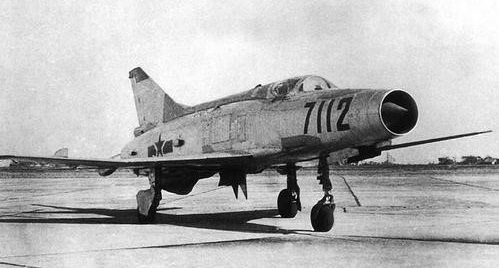
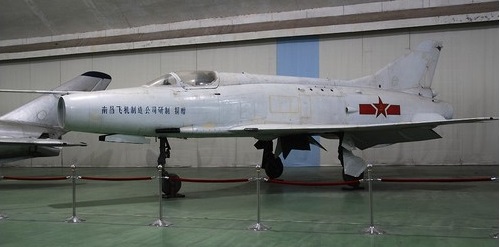
In the mid 1960s, the North Vietnamese had shown the efficacy of the use of “guerilla interceptors” – small aircraft operating from camouflaged airfields to ambush enemy aircraft. While the PLAAF recognized the practicality of such operations and wished to apply them locally, the aircraft currently available for the role – MiG-17s, -19s, and -21s – were less than ideal. Thus, in 1969, Nanchang was issued requirements for a new lightweight fighter with a loaded weight under 4,500kg. Development proceeded and by August, they were performing wind tunnel testing, and by the next year, the design had started prototyping. The resulting J-12 was simple, coming in at 4,530kg. The J-12 was armed with a single 30mm and 23mm cannon in the wing roots, and was powered by a single WP-6Z turbojet. To simplify the design, it used only an optical gunsight, and lacked area ruling. To facilitate rough airfield operations, intake flow could be diverted through auxiliary ports on the fuselage sides.
When the J-12 first flew in December 1970, testing revealed a top speed of 1,300km/h, making the J-12 the lightest supersonic fighter ever to fly. Range was a short 688km, making the design effectively a point-defence interceptor. The only guided munitions that the aircraft could carry were simple IR-guided short range AAMs. In all, nine J-12s were built, with testing continuing until 1977. At this point, the shortcomings of the design were found to greatly outweigh its benefits, and the design was cancelled in favour of further development of the J-7 and J-8.
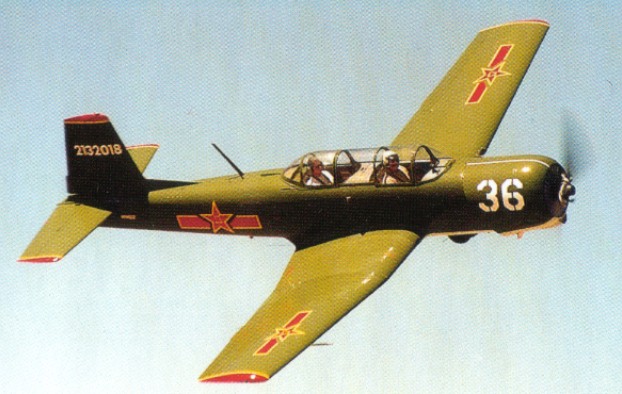
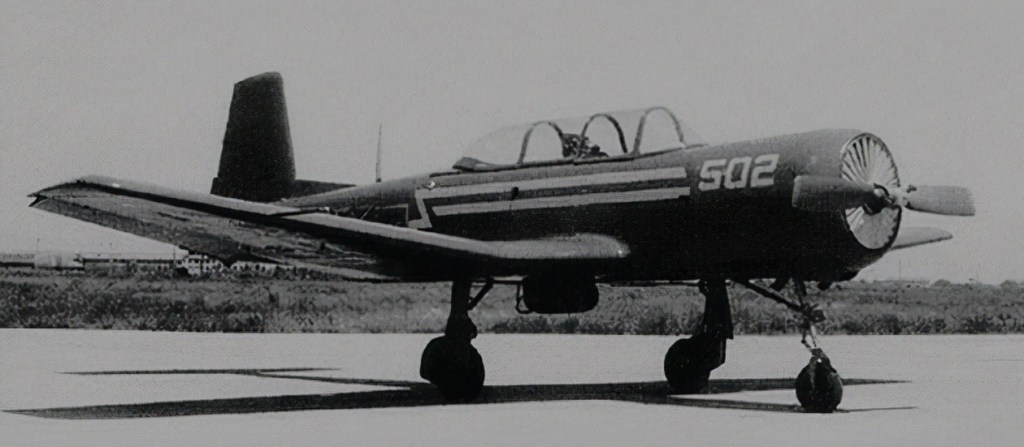
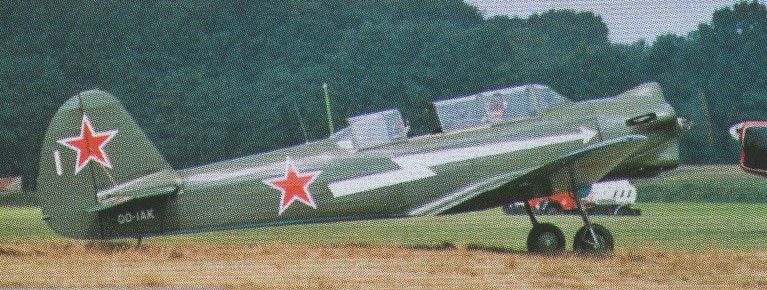
In the early 1950s, the primary trainer aircraft used by the Air Force was the Soviet Yak-18. At that time, the Nanchang Aircraft Factory was able to independently produce the aircraft in accordance with Soviet drawings. The steel frame of the Yak 18 type of steel frame, the structure of the outer cover was relatively backward, and the airborne power supply was insufficient. Designers such as Xu Shunshou believe that it is no longer necessary to introduce the improved Yak 18A, and it is entirely possible to independently develop a primary trainer based on domestic technical strength.
In July 1957, the Chujiao 6 design was begun, and the prototype flew for the first time in August of the following year. On January 5, 1962, Chujiao-6 completed the design finalization. After the successful test flight of the Chujiao 6 in Nanchang, many people in the aviation industry system and the air force still believed in the Soviet aircraft and advocated the production of the Yak 18A. Until a new leader of the Aviation Industry System took office, he decided to continue to improve the elementary trainer 6.
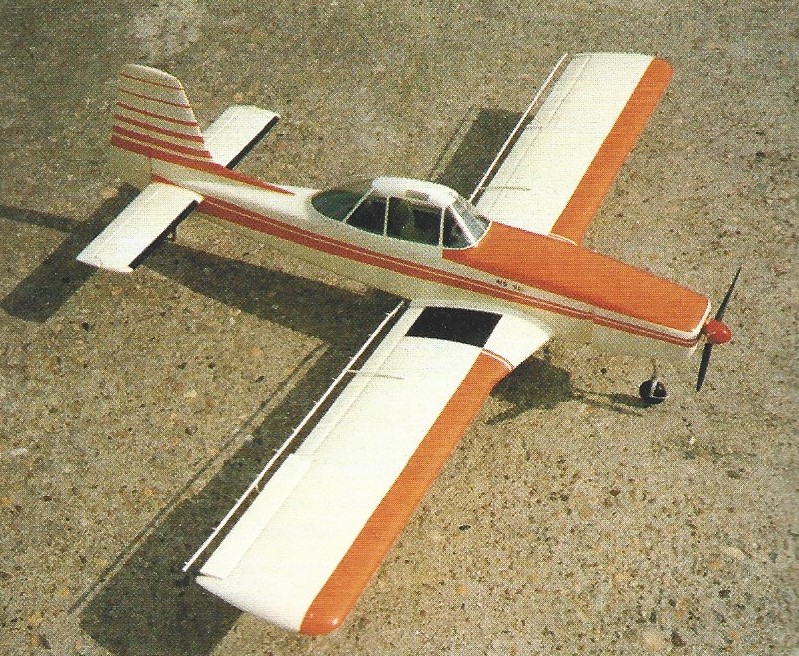
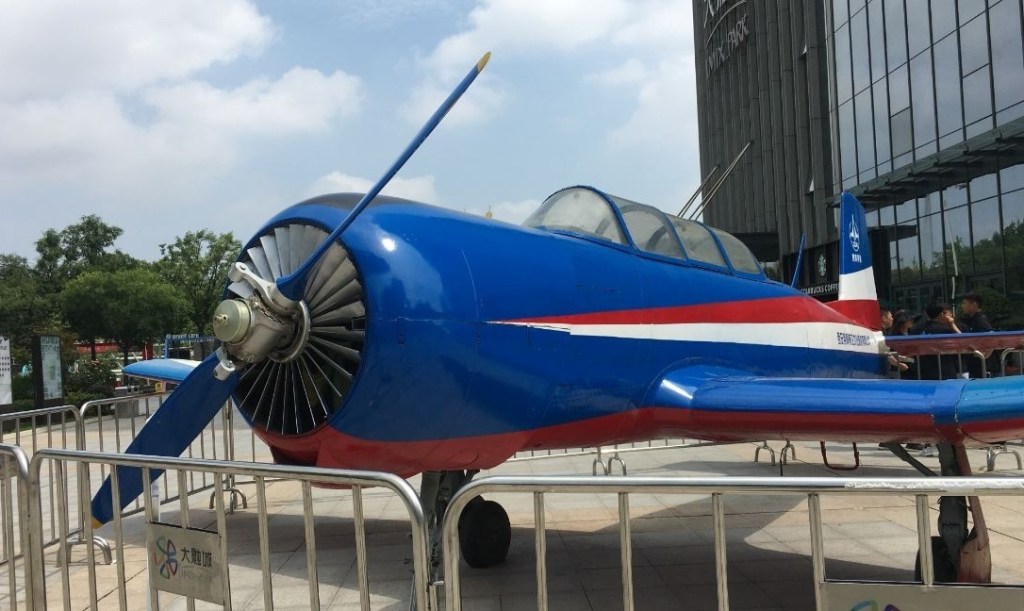
The body of Chujiao 6 adopts an all-metal thin-skinned shell structure, which is similar to the Yak 18 in appearance. The actual fuselage, wings and front three-point landing gear are all new designs.
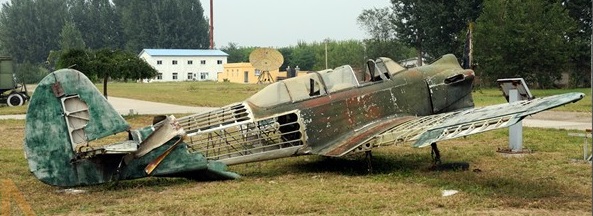
A Chinese derivative of the Yak-18, and development of the CJ-5, the CJ-6 is aerobatic, with a fully retracting undercarriage.
A military primary trainer, approximately 2000 were built for the Peoples Liberation Army Air Force from 1962. It has also served with the air forces of Albania, Bangladesh, Cambodia, Tanzania and Zambia.
The improved CJ-6A still being built in the late 1990s in very low volume for the same radial piston-engined primary training role.
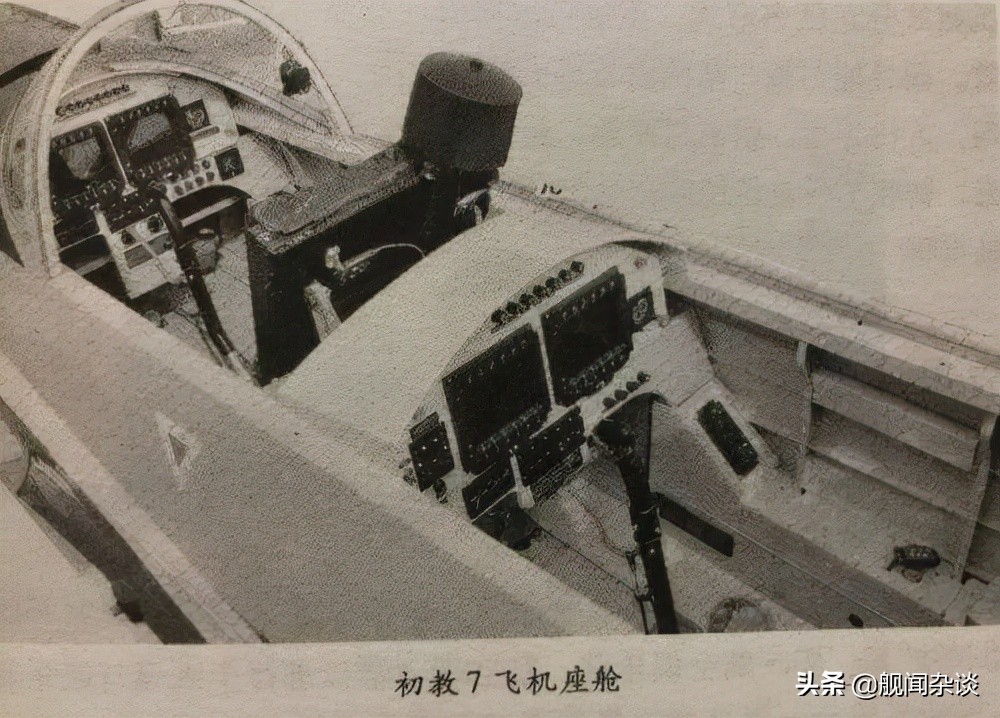
Elementary Education 6 also has many shortcomings: the onboard equipment is backward, there is no ejection rescue system, the cockpit is not sealed, the noise is loud, and the operating environment is not good in cold weather. Therefore, the domestic development of a new generation of primary trainers has been brewing since the 1990s. In August 2007, Chujiao 7 was formally established, and the first flight was successful in 2010, and it was publicly unveiled at the Zhuhai Air Show.
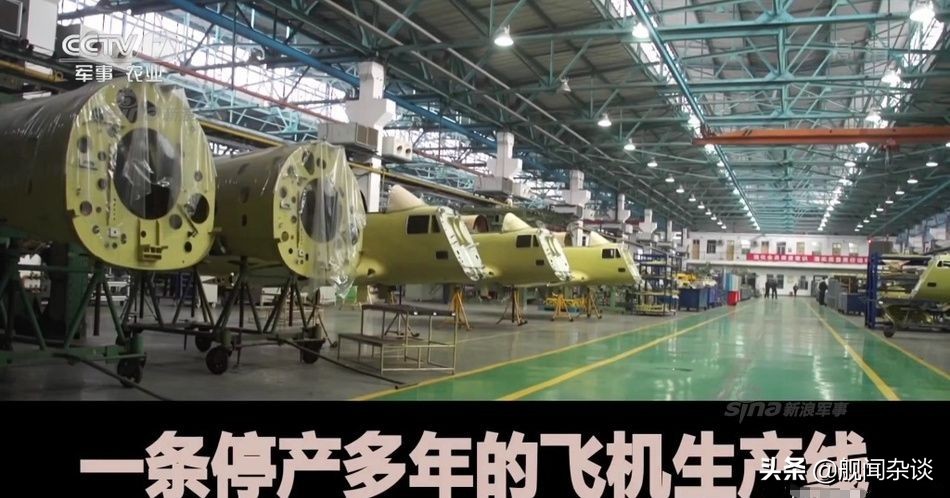
In 2015, Hongdu Company officially began to resume primary education 6. It can be seen in the news that there are a large number of newly manufactured Chujia 6 in the Hongdu Aviation Workshop. The production number of the fuselage shows that the output is at least dozens of aircraft. The Air Force has resumed bulk purchase of Chujia 6, and Chujia 7 is completely yellow.




 All Aero