National Aerospace Laboratories Saras / Hindustan Aeronautics Saras

In mid 1980s, Research Council recommended that National Aerospace Laboratories should study the civil aviation requirements of India and recommended ways and means of establishing a viable civil aviation industry. It further recommended that NAL should carryout a formal techno economical feasibility study of a multi role Light Transport Aircraft (LTA – renamed SARAS in October 1993). The feasibility study (November 1989) showed that there was a significant demand for a 9–14 seat multi-role LTA in the country and estimated a market potential of about 250–350 aircraft in the next 10 years. NAL submitted the feasibility study report to RC in November 1990 and started its search for an industrial partner.

The project began in 1991 as a collaboration with Russia (Myasishchev had a similar project called the Duet), but financial trouble led the Russians to drop out early in the project, in 1997. The project almost came to a halt when it was hit by US-imposed sanctions in 1998, after India’s nuclear tests in Pokhran. It was recommenced in September 1999 upon receiving development approval from the Cabinet Committee on Economic Affairs in June 1999.

The project of ‘Saras’ was sanctioned on 24 September 1999 with initial schedule of its maiden flight by March 2001.

The original design target parameters included a maximum take-off weight of 6,100 kg and a maximum payload of 1,232 kg, a high cruise speed of over 600 km/h, an endurance of six hours, a maximum flight altitude of 12 km (cruise altitude 10.5 km), short take-off and landing distances of about 600 m, a maximum rate of climb of 12 m/s, a low cabin noise of 78 dB, a range of 600 km with 19 passengers, 1,200 km with 14 passengers and 2,000 km with eight passengers, a high ‘specific range’ of 2.5 km/kg and a low cost of operation of Rs. 5/km.

The Saras was designed to fly both day and night from semi-prepared airfields and grass runways. It was designed adhering to the FAR-25/23 standard regulations and can offer air taxi and commuter services.
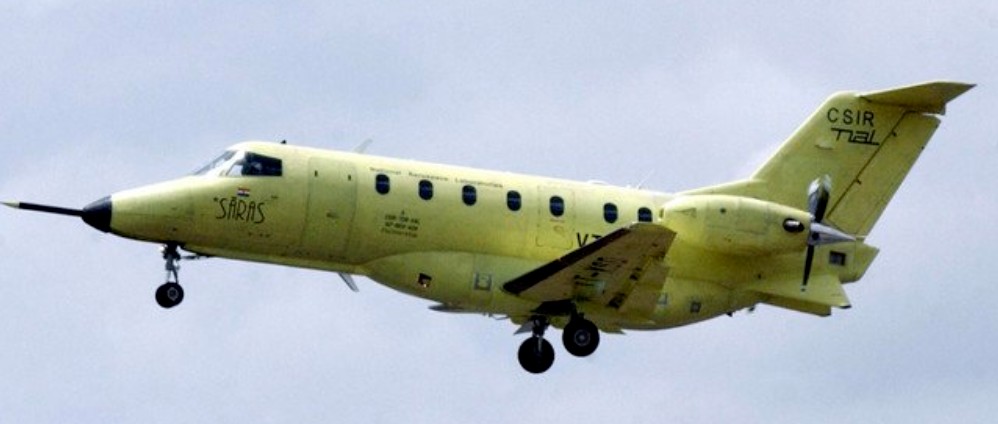
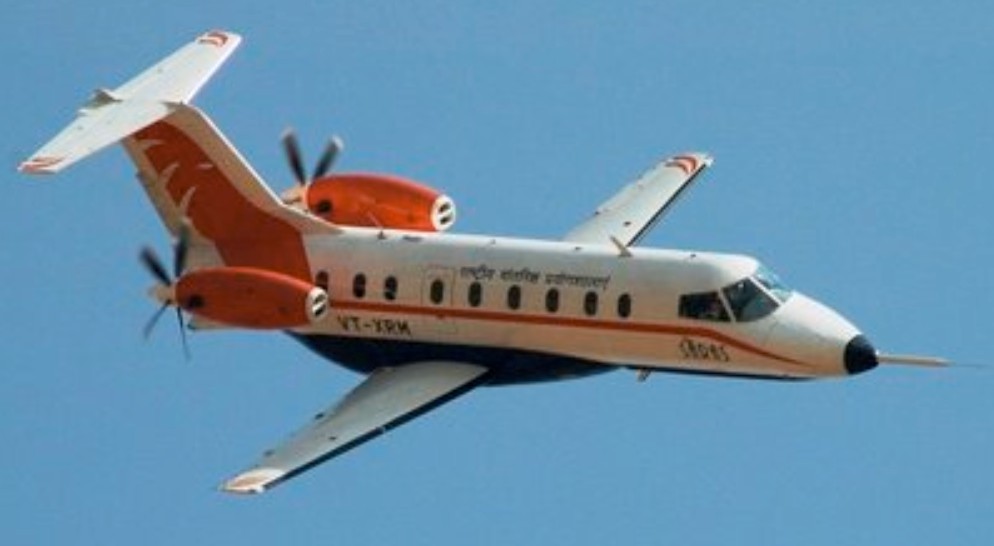
The first Saras (PT1) completed its maiden flight at the HAL airport in Bangalore on 29 May 2004 powered by two 850hp Pratt & Whitney PT6A-66 turboprop.

While the designed empty weight of the aircraft is around 4,125 kg, the first prototype weighed in around 5,118 kg. This was to be addressed by including composite wings and tail by the third prototype. It is being upgraded with 1,200hp Pratt & Whitney PT6A-67A engines to accommodate the overweight, new propellers and modern flight control and electrical systems.

The airframe of Saras-PT2 was built with lighter composites to reduce its overall weight by about 400 kg from its first prototype, which was overweight by about 900 kg. The PT2 was powered by Pratt & Whitney PT6A-67A engine and completed maiden flight on 18 April 2007. A 2.65m diameter Hartzell five-bladed propeller will be fitted to each engine. The propellers can make 1,700rpm in pusher configuration.

The IAF has signed up with National Aerospace Laboratories, Bangalore for the purchase of 15 Saras aircraft.“NAL signed a memorand­um of understanding with IAF to sell 15 Saras aircraft. The Kanpur unit of Hindustan Aeronautics Ltd will manufacture these planes,” The 14-seater twin-engine ai­rcraft would be used for coastal surveillance as well as tr­aining young cadets on transport flying.

On 6 March 2009, 2 Indian Air Force test pilots, Wing Commander Praveen Kotekoppa and Wing Commander Dipesh Shah along with a Flight Test Engineer Squadron Leader Ilayaraja, were killed when the second prototype Saras aircraft crashed and caught fire in an open field near Bidadi, about 30 km from Bangalore. A court of inquiry found that wrong engine relight drills given to the pilots caused the crash.
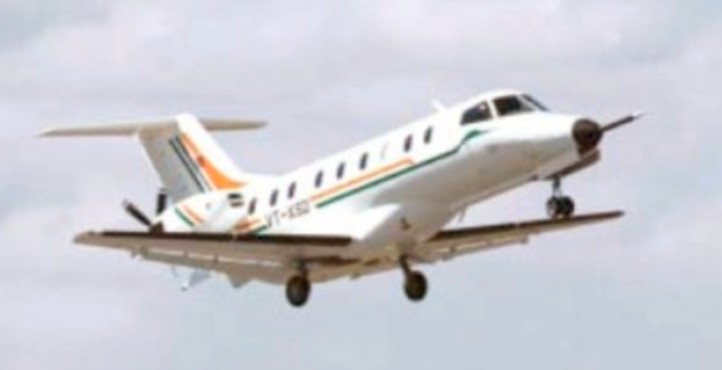
Saras
Engines: 2 × Pratt & Whitney Canada PT6A turboprop, 2150 shp (1634 kW)
Wingspan: 14.70 m (48.23 ft)
Length: 15.02 m (49.28 ft)
Height: 5.20 m (17.06 ft)
Useful load: 1,232 kg (2,710 lb)
Max. takeoff weight: 7,100 kg (15,653 lb)
Maximum speed: 550 km/h
Cruise speed: 450km/h
Range: 920 km
Ferry range: 1,935km
Service ceiling: 7,500 m (24,600 ft)
Rate of climb: 10.5m/s
Endurance: 4 hours 45 minutes
Crew: 3 (Pilot, Co-Pilot, Flight Engineer)
Capacity: 14 passengers

NASA AD-1 / Ames AD-1

Robert T. Jones of Ames calculated that an aircraft’s wing made to pivot 4 degrees to the fuselage might halve the fuel consumption. Specifications bases, in particular geometric configuration were established by NASA based on one made by Boeing. In consultation with the Rutan Aircraft Factory, Ames and Dryden built the AD-1 oblique wing aircraft in 1977, a twin jet composite aircraft with direct controls and a top speed of 175kts (324kph). Set perpendicular to the fuselage for takeoff and landing, the oblique wing could be made to rotate up to 60 degrees for higher speed flight and between 1979 and 1982, demonstrated the feasibility of such a concept, performing three landings with the wings pivoted at 45 degrees.

The test aircraft’s 32 foot wing can be pivoted 60 degrees during cruise, to reduce drag while still allowing high airspeeds. In the conventional position, the wing should provide ample lift and stability for takeoffs, landings and low speed manoeuvres. Designated the AD 1, the test aircraft is 40 feet long, has a gross weight of 2,000 pounds and is powered by two 220 pound thrust turbojets. The structure was made entirely of fiberglass.

The aircraft was delivered by Aimes at Dryden Flight Research Center at Edwards Air Force Base in March 1979. The first flight was performed by test pilot NASA Thomas C. McMurtry December 21, 1979. Thomas flew only the 79 flights until 7 August 1982.

Although the oblique wing is still considered by some as a viable concept for large transport, unpleasant flight characteristics of the AD-1 at certain angles discouraged designers to adopt this configuration.

Gallery

Engines: 2 x Microturbo TRS-18, 220 lb / 100 kg
Wing span: 9.85 m / 34 ft 2 in
Length: 11.82 m
Wing area: 8.60 m²
Aspect ratio: 11.2
Thickness/chord: 12%
Loaded weight: 809 kg
Empty weight: 535 kg
Max speed: 220 knts
Min speed: 74 knts
Seats: 1

NASA QSRA

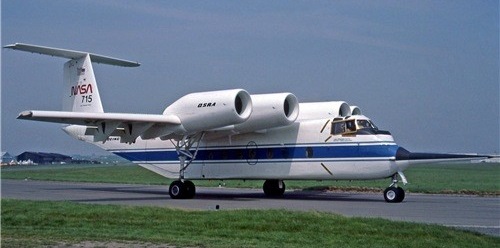
QSRA – A Quiet Short-Haul Research Aircraft built under contract to the U.S. National Aeronautics and Space Administration by Boeing. Following a short flight-test period at Boeing, the plane was delivered to NASA Ames in California to continue the design flight test programme. The advanced research vehicle is actually a remanufactured twin-engined C-8A Buffalo built originally by de Havilland Canada and owned for several years by NASA, Boeing created an all-new wing incorporating boundary layer control, four Lycoming turbofans which exhaust over the upper surfaces of the wings and new engine nacelles and cross-ducting, Coanda flaps, a new but similar tail and installed new instrumentation.

Objective of the QSRA is to build an experimental flight research aircraft aimed at developing the technology for quiet short-haul commercial airliners of the future with short takeoff and landing capabilities. Another purpose is to explore the operating procedures of such an airplane in the airport terminal environment.

The QSRA has four engines of 7500 pounds thrust each mounted above the wing and exhausting over the wing. This arrangement provides “upper surface blowing” much like the Boeing YC-14 military prototypes. In union with the specially designed wing and flap system, extremely high lift is generated with very low noise.

Engines: 4 x Lycoming turbofan

NASA Space Shuttle / Rockwell Space Shuttle

There had long been the desire to have a reusable vehicle that could be launched into Earth orbit, have the ability to manoeuvre in space, re enter Earth’s atmosphere and land conventionally on an airfield. The first step in this direction was made with lifting body research aircraft which, in turn, led to design of the Space Shuttle Orbiter, for which Rockwell International became prime contractor in July 1972.

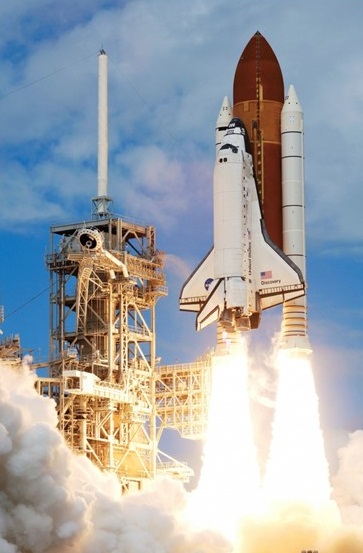
A large vehicle with a thick section wing of double delta planform, the SSO has a fuselage which conforms to lifting body outlines. Mounted in the rear fuselage are three Rocketdyne SSME rocket engines, each developing 417,300 lb (189287 kg) thrust for launch, at which time the SSO has mounted beneath it a large external fuel tank for the SSME rocket engines, and at each side of the tank a solid propellant rocket booster. The whole assembly is launched with the main engines and the boosters firing; after burn¬out the boosters are jettisoned and recovered by parachute, the main engines then being fed from the external fuel tank, which is jettisoned just before entry into orbit. Having completed its orbital mission, during which the SSO is controlled by orbit manoeuvring and reaction control engines, a de orbiting manoeuvre is initiated and, at a high angle of attack, the SSO re enters Earth’s atmosphere to make an unpowered but otherwise conventional aircraft type landing.

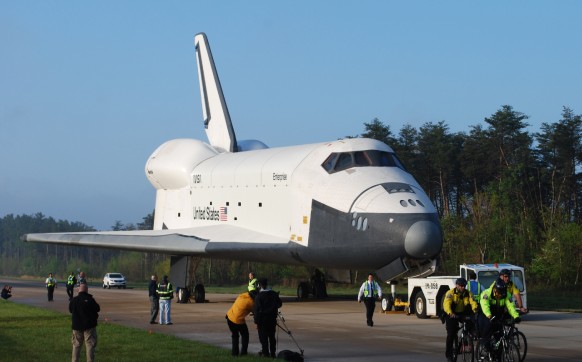
It was not until 13 August 1977 that the Enterprise and its crew were launched in free flight from the SCA at a height of 22,800 ft (6950 m), to make a gliding and unpowered flight to a conventional landing at Edwards AFB, California.

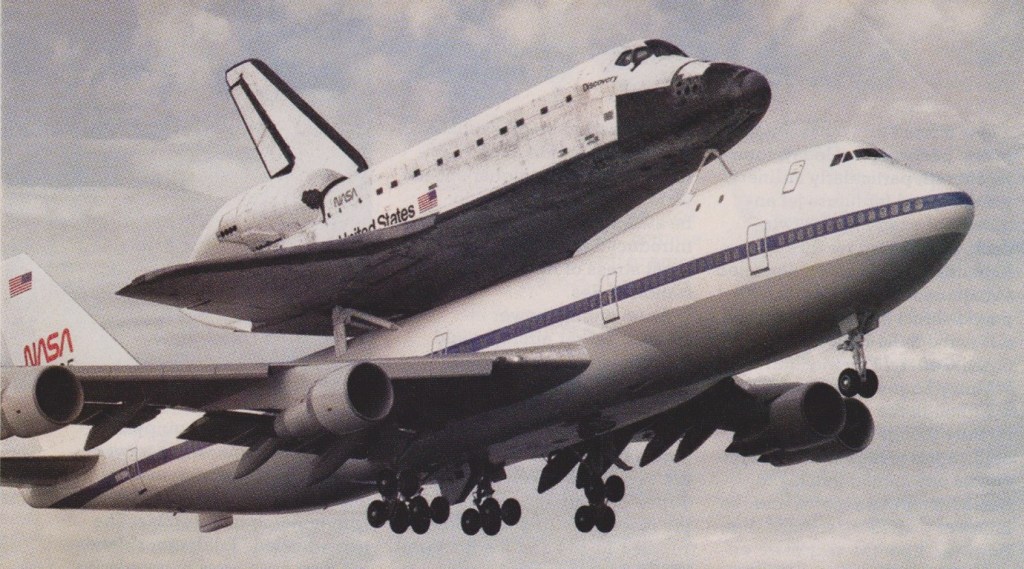
Boeing 747 123 Shuttle Carrier Aircraft (SCA) (NASA 905)

Almost four years later, on 12 April 1981, the spacecraft OV 102 Columbia, crewed by astronauts John Young and Robert Crippen, lifted off from Cape Canaveral on the first orbital mission. It then completed 37 orbits of the earth in 54 hours and on 14 April made a near perfect unpowered 200 mph (322 km/h) landing on Runway 23 at Rogers Dry Lake, Edwards AFB, California. The first ever “soft” return from space in a re-usable craft that is part spaceship and part aeroplane.

The Columbia was subsequently flown back to Cape Canaveral on the back of its Boeing 747 mother-plane for full examination and preparation for the next mission.

Enterprise

Gallery

Boosters: 2 x Solid rocket, 1,315,430 kg (2,900,000 lb) thrust each

Nash Petrel / Procter Aircraft Associates Petrel

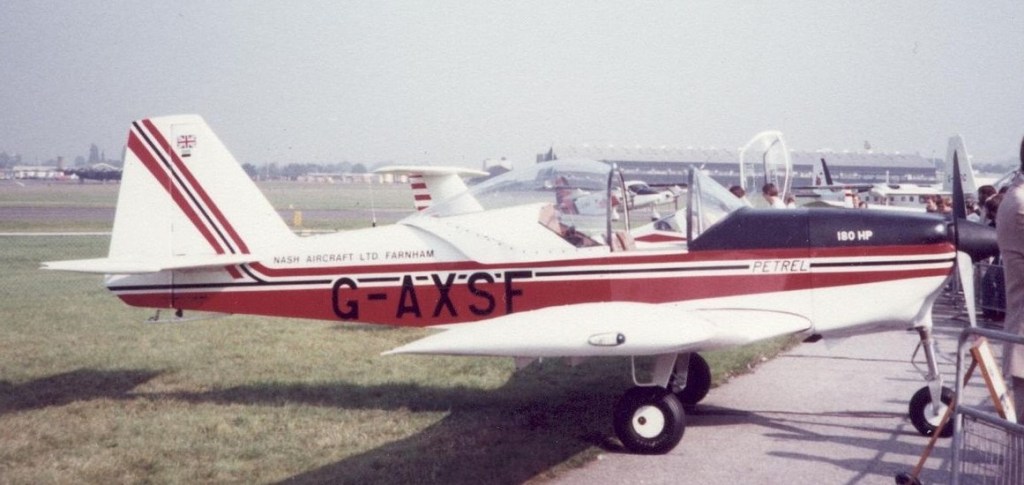
Prototype Nash Petrel at the Farnborough SBAC Show in September 1982

The Nash Petrel also known as the Procter Petrel is a two-seat aerobatic or glider tug aircraft. It was designed for amateur production by Procter Aircraft Associates of Camberley, Surrey, England.

Based on the earlier Mitchell-Procter Kittiwake design, the Petrel is an all-metal low-wing cantilever monoplane of conventional design powered by a 130 hp Rolls-Royce Continental O-240-A piston engine. By the time the aircraft first flew on 8 November 1980, Procter had changed ownership and had been renamed Nash Aircraft Ltd.

Only two aircraft were built, the prototype registered G-AXSF and one built by apprentices at the British Aircraft Corporation factory at Preston in 1973, registered G-BACA. G-BACA had a serious fault with the landing gear and only flew 15 hours before being grounded. The prototype still exists but without a current certificate of airworthiness. It is presently fitted with a Lycoming O-360-A3A engine.

Powerplant: 1 × Avco Lycoming O-320-D2A, 89 kW (119 hp)
Wingspan: 8.94 m (29 ft 4 in)
Wing area: 12.63 m2 (135.9 sq ft)
Aspect ratio: 6.6:1
Airfoil: NACA 3415
Length: 6.22 m (20 ft 5 in)
Height: 2.23 m (7 ft 4 in)
Empty weight: 540 kg (1,190 lb)
Max takeoff weight: 762 kg (1,680 lb)
Fuel capacity: 104.5 L (27.6 US gal; 23.0 imp gal)
Maximum speed: 210 km/h (130 mph, 110 kn)
Cruise speed: 195 km/h (121 mph, 105 kn)
Stall speed: 74 km/h (46 mph, 40 kn) (flaps down)
Rate of climb: 5.6 m/s (1,100 ft/min)
Crew: 2

Nardi FN.315

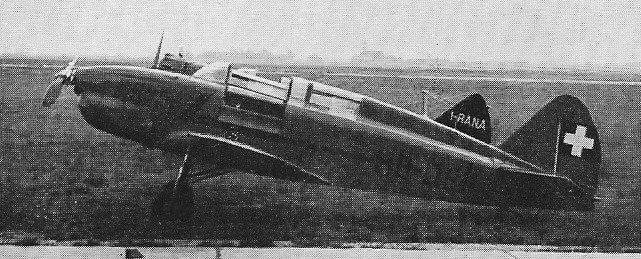
As a 1938 development of the FN305, there were also 25 F.N.315 intermediate trainers with the 172-kW (230-hp) Hirth HM 508D inline, a revised canopy, a new tail unit, flaps and increased dihedral on the outer wing panels.

The F.N.315 was also produced with the Alfa Romeo 115-1 of 185 hp.

The F.N.315 was exported to six countries, and a light-attack version was flown experimentally.

Engine: Hirth HM 508, 172 kW (230 hp).
Wingspan: 27 ft 9 in
Wing area: 129.12 sq.ft
Length: 22 ft 11 in
Height: 6 ft 10.5 in
Empty weight: 1562 lb
Loaded weight: 2255 lb
Max speed: 239 mph at 8200 ft
Cruise: 220 mph at 11,480 ft
Time to 13,120ft: 6 min 40 sec
Cruise range: 590 mi