Pilatus PC-6 Porter / Turbo-Porter / UV-20 / Fairchild AU-23A Peacemaker

PC-6/B2-H4

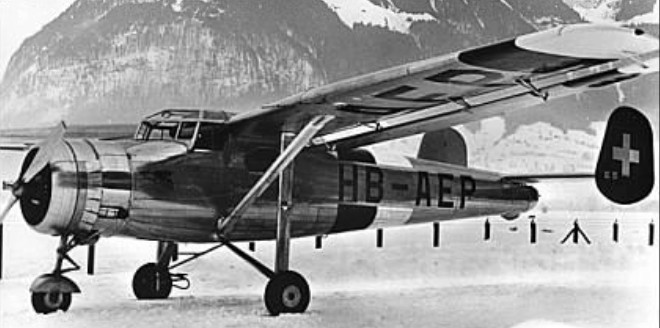
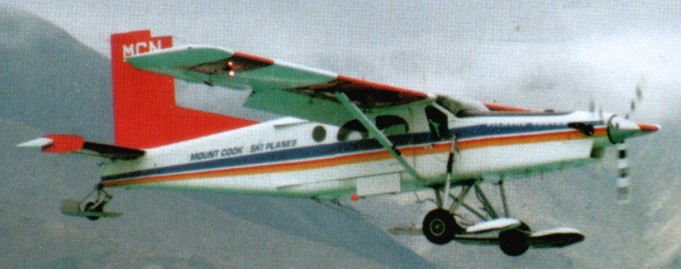
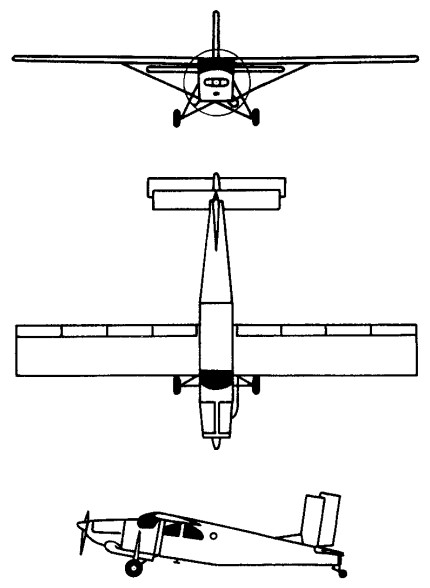
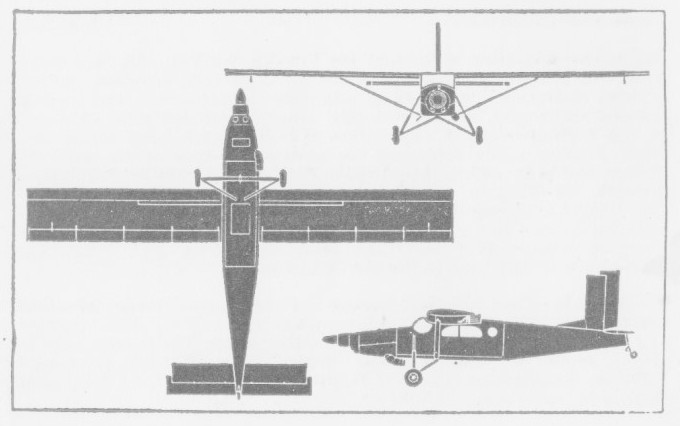
The Pilatus Porter PC 6 first flew on 4 May 1959 and remained in production in 2005. Once marketed as the “Heli Porter” by Fairchild in the US, this name more accurately describes the type’s abilities, although its true success came only after the turboprop engine was introduced to the design from May 1961 onward.
Pilatus PC-6 Article

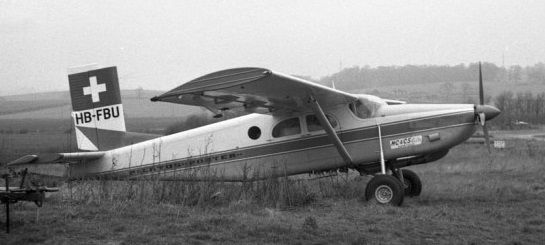
Porter PC-6/350-H2 HB-FBU

After the first of five prototypes flew on 4 May 1959, a pre-series of twenty aircraft was completed by mid-1961. A second series of twenty had been delivered by mid-1963. One was delivered to the Colombian Air Force.

The PC-6 was available with the 340 hp geared and super-charged GSO-480-B1A6 or the 350 hp geared TGO-540-B1A engines.

The Turbo-Porter development first flew on 2 May 1961, powered by a Astazou IIE turbo-prop.

Entering production in 1961, the Turbo-Porter light STOL utility transport, derived from the piston-engined Porter, has been built in substantial numbers for both civil and military applications. Identical to the earlier PC-6, except the engine, the PC-6A Turbo-Porter is equipped with a Turbomeca Astazou II 530 shp engine in place of the Lycoming GSO-480 of 340 hp. Cruise is 170 mph carrying eight passengers or an 1160 lb payload. Take-off distance is 425 ft and it can be equipped low-pressure tires for grass fields, skies or floats.

Production later changed to the improved Astazou IIG engine.

Fairchild possessed a US manufacturing licence for the Turbo-Porter, and in early 1964 was offering the type, re-engined with a Pratt & Whitney PT6A-6 turboprop. Two Astarzou-powered Turbo Porters were evaluated by the US Army during February-March 1964.

Operated by the US Army as the UV-20A Chiricahua.

In production since 1985, the 1987 production version of the Turbo-Porter was the PC-6/B2-H4, which has an increased payload. This was achieved by improving the aerodynamic efficiency of the aircraft by fitting new wing-tip fairings and an enlarged dorsal fin for increased weights, and is normally fitted with six quickly-removable seats in the main cabin. All PC-6s built since mid-1985 are of the H4 variant. Earlier PC-6/B1-H2s and /B2-H2s can be retrofitted to H4 standard if equipped with an electrical longitudinal trimming system. By mid-1986 456 PC-6s of all models had been delivered to civil and military operators, including those built under licence by Fairchild, as the AU-24 Peacemaker, in the USA.

The Credible Chase programme, an off shoot of Pave Coin, in which a number of aircraft were evaluated by the USAAF at Eglin AFB in order to come up with a new light-strike attack aircraft for the South Vietnamese Air Force, resulted in a 15 each order for the Helio Stallion and Fairchild Peacemaker. These aircraft, carrying the designa¬tions AU 24 and AU 23 respectively, are militarised versions of their commercial counterparts, but have increased gross weights, underwing and fuselage hardpoints and Gatling guns firing from the cabin doors.

Fairchild production of Pilatus Turbo-Porters begun June 1966; 15 of COIN version delivered to USAF as AU-23A Peacemaker, transferred to Royal Thai Air Force.

The PC-6/B1-H2 and B2-H4 were certified under Switzerland Federal Office for Civil Aviation FOCA F 56-10.

More than 480 PC-6s had been delivered by 1990.

As the certification of the PC-24 Super Versatile Jet got closer, in July 2017 Pilatus announced it was discontinuing the PC-6 Porter. The Porter has seen one of the longest continuous production runs of any airplane model since it first rolled off the line in Switzerland in 1959.

While the production line has been running for nearly six decades, the number of airplanes produced is nowhere near mass-produced. The Swiss manufacturer has delivered a little more than 500 of the multi-mission high-wing airplane and approximately another 100 Porters were produced in the United States under license.
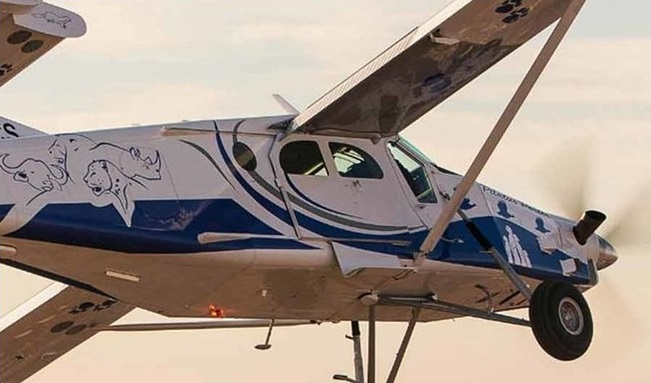
Pilatus said orders have dropped in recent years. Pilatus will continue to take orders for the airplane until mid 2018 and will cease production in early 2019. Pilatus has also committed to supporting the existing fleet for at least the next 20 years. There will be no layoffs of employees as a result of the production termination. Instead, workers from the PC-6 product line will transfer to the PC-24.

Gallery

PC-6 Porter
Engine: Lycoming GSO 480, 340 hp
Wingspan: 49 ft 10.5 in
Length: 33 ft 5.5 in
Height: 10 ft 6 in
Wing area: 306.8 sq.ft
Empty wight: 2360 lb
Loaded weight: 4320 lb
Max speed: 143 mph
Max cruise: 135 mph
Econ cruise: 125 mph
ROC: 1025 fpm
Service ceiling: 23,950 ft
Max range: 750 mi

PC-6 Turbo-Porter
Engine: 1 x P&WAC PT6A, 410 kW.
Wing span: 15.87 m / 52.07 ft
Wing area: 30.15 sq.m / 324.54 sq.ft
Overall length: 10.90 m / 35.76 ft
Height: 3.20 m / 10.50 ft
Track: 3.00 m
Empty wt: 1270 kg.
MTOW: 2880 kg
Payload: 960 kg.
Fuel internal: 645 (+490) lt
Capacity: 10 pax.
Design diving speed (VD): 167 kt
Never exceed speed (VNE): 151 kt
Design cruising speed (VC): 119 kt
Max. flap extended speed (VFE): 95 kt
Stall speed (idle power) flaps up (VS): 58 kt
Stall (idle power) flaps dn (VSO): 52 kt
Max. operating altitude: 25,000 ft
Service ceiling (at max. weight): 20,500 ft
Max. rate of climb at sea level: 1,010 ft/min
Max. rate of climb at 5,000 ft: 935 ft/min
Take-off ground roll at sea level: 197 m / 646 ft
Take-off dist to 15 m (50 ft): 475 m / 1,558 ft
Landing ground roll at sea level: 127 m / 417 ft
Landing distance from 15 m (50 ft): 315 m / 1,033 ft
Take-off ground roll at sea level: 197 m / 646 ft
Take-off distance to 15 m (50 ft): 440 m / 1,443 ft
Max. Range at opt. speed, no reserves, at 10,000 ft: 500 nm
Endurance at opt. speed, no reserves: 4 h 20 min
Max range with underwing tanks: 870 nm
Endurance with underwing tanks: 7 h 35 min
Average fuel consumption: 148 litres/h (39 US gal/h)

PC-6A H2
Engine: Turbomeca Astazou IIE turboprop, 523 shp.
Max speed: 170 mph
Normal cruise 80%: 155 mph at 9800 ft
ROC: 1700 fpm
Service ceiling: 28,000 ft
Max range: 620 mi
Endurance: 4 hr 20 min
Empty weight: 2248 lb
MTOW: 4320 lb
Wingspan: 49 ft 10.5 in
Length: 36 ft 1 in
Height: 10 ft 6 in
Wing area: 306.8 sq.ft

PC-6-B1-H2
Engine: P&W PT6A-20, 550 shp.

PC 6 B2 Turbo Porter
Engine : Pratt & Whittney PT A-27
Length: 36.089 ft / 11.0 m
Height : 10.499 ft / 3.2 m
Wingspan : 49.869 ft / 15.2 m
Wing area : 310.003 sq.ft / 28.8 sq.m
Max take off weight : 6107.9 lb / 2770.0 kg
Weight empty : 2932.7 lb / 1330.0 kg
Max. weight carried : 3175.2 lb / 1440.0 kg
Max. speed : 132 kt / 244 km/h
Initial climb rate : 1968.5 ft/min / 10.0 m/s
Service ceiling : 32808 ft / 10000 m
Wing load : 19.68 lb/sq.ft / 96.0 kg/sq.m
Range : 721 nm / 1336 km
Endurance : 6 h
Crew : 1+7

PC-6/B2-H2
Engine: P&WAC PT6A-27, 550 hp / 507kW
Wingspan: 15.87 m / 52 ft 1 in
Length: 10.9 m / 36 ft 9 in
Height: 3.2 m / 11 ft 6 in
Wing area: 30.15 sq.m / 324.53 sq ft
Wing loading: 15.57 lb/sq.ft
Pwr loading: 8.8 lb/hp.
Gross wt: 4850 lb
Empty wt: 2680 lb.
Equipped useful load: 1973 lb
Payload max fuel: 851 lb.
Range max fuel/cruise: 388 nm/2.9 hr
Range max fuel / range: 461 nm/ 3.6 hr.
Service ceiling: 30,000 ft
Max cruise: 135 kt.
Max range cruise: 130 kt
Stall: 44-50 kt.
1.3 Vso: 57 kt
ROC: 1270 fpm.
Min field length: 770 ft
Fuel cap: 1122 lb.
Seats: 11.

PC-6-B2-H4
Engine: PT6A-27, 680 shp (508 kW) flat-rated at 550 shp (410 kW).
Wing area: 29sq.m.
MTOW Std: 4850 lb
MTOW Special cat: 6000 lb
Cruise: 120-135 kt
Stall: 44-50 kt.
TO run: 370 ft
TO 50 ft: 780 ft
Range (@4850 lb): 450 nm
Payload: 2000 lb.
Pax cap: 11
Turbo Porter

Pilatus P4

The Pilatus P-4 represented another attempt by the company to get into the market for civil aircraft, but this five-seat cabin monoplane had little more success than its SB-2 predecessor. Of braced high-wing monoplane configuration, with fixed tailwheel landing gear, a braced tail unit and a 142kW Avco Lycoming O-435 engine, the P-4 had accommodation for a pilot and four passengers. All passenger seats were removable easily so that the P-4 could be used as a cargo carrier, or as an air ambulance accommodating two stretchers and two medical attendants.

P-4
Engine: 1 x Avco Lycoming O-435, 142kW
Max take-off weight: 1500 kg / 3307 lb
Wingspan: 11.85 m / 39 ft 11 in
Max. Speed: 245 km/h / 152 mph
Crew: 1
Passengers: 4

Pilatus P3

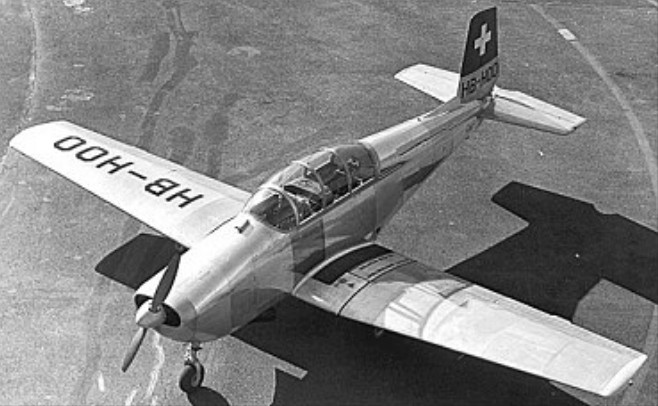
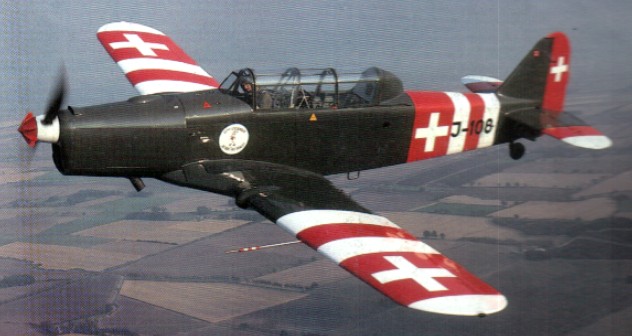
The success of the P-2 led to development of a new general-purpose trainer under the designation Pilatus P-3, the prototype of which was flown for the first time on 3 September 1953. Intended for use as both a primary and advanced trainer, the P-3 is of cantilever low-wing monoplane configuration and differs from its predecessor by being of all-rnetal construction. It has retractable tricycle landing gear, but as the P-3 was required by the Swiss air force for ‘all-through’ training, from the primary stage to the point of passing on to the de Havilland Vampire jet trainer, a lower-powered engine was adopted, the Avco Lycoming GO-435-C2A. Like the P-2 that preceded it into service, the P-3 has similar standards of equipment or weapons for comprehensive pilot training by day or night. A total of 72 P-3s was built for the Swiss air force, and in 1993 a handful of these remain in service.

Pilatus P3 Article

A small number were supplied to Brazil, but these were superseded by indigenous trainers by 1993.

P-3
Engine: 1 x Avco Lycoming GO-435-C2A, 194kW
Max take-off weight: 1500 kg / 3307 lb
Loaded weight: 1110 kg / 2447 lb
Wingspan: 10.4 m / 34 ft 1 in
Length: 8.75 m / 29 ft 8 in
Height: 3.05 m / 10 ft 0 in
Wing area: 16.5 sq.m / 177.60 sq ft
Max. speed: 310 km/h / 193 mph
Ceiling: 5500 m / 18050 ft
Range: 750 km / 466 miles
Crew: 2

P3-05
Engine: Lycoming GO-435-C2A, 260 hp
Propeller: Hartzell HC-83V20-2C, 3-blade

Pilatus P2

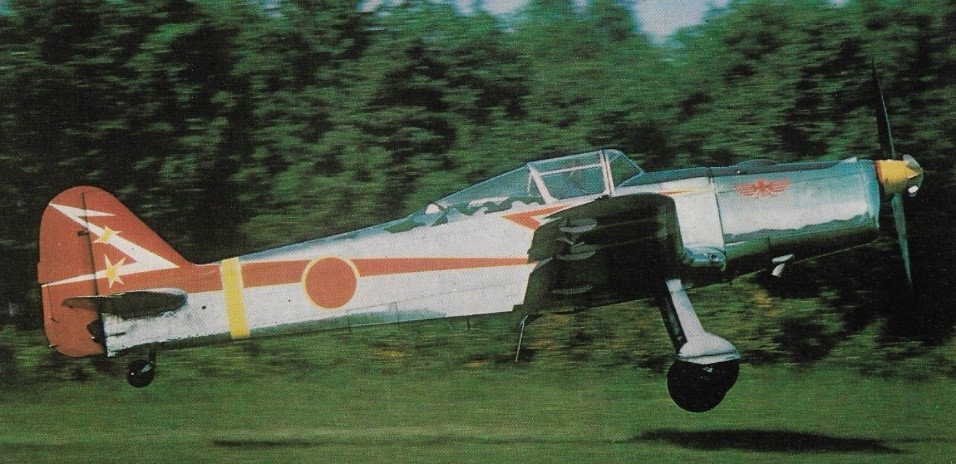
The P-2 first flew in 1945 as a trainer for operation from high-altitude airfields, fitted with night-flying, radio and oxygen equipment.

The first 27 were built as pilot trainers while the balance of 26 were built for weapons and observer training. They were built using many parts from stocks of Bf109 components.

Gallery

P-2
Engine: 1 x Argus As 410 A-2, 347kW / 465 hp
Max take-off weight: 1970 kg / 4343 lb
Empty weight: 1520 kg / 3351 lb
Wingspan: 11 m / 36 ft 1 in
Length: 9.07 m / 30 ft 9 in
Height: 2.7 m / 9 ft 10 in
Wing area: 17 sq.m / 182.99 sq ft
Max. speed: 340 km/h / 211 mph
Cruise speed: 305 km/h / 190 mph
Range: 865 km / 538 miles
Crew: 2

Pilatus B4 / Nippi B 4

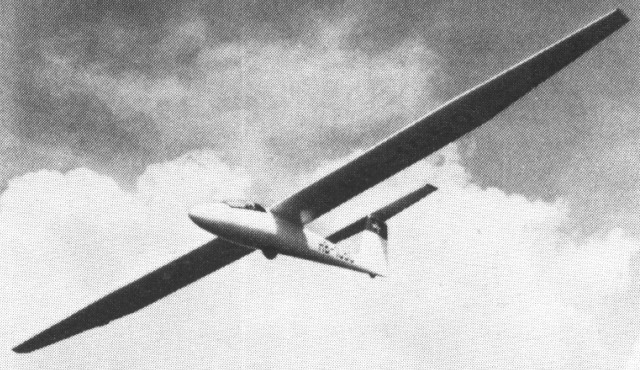
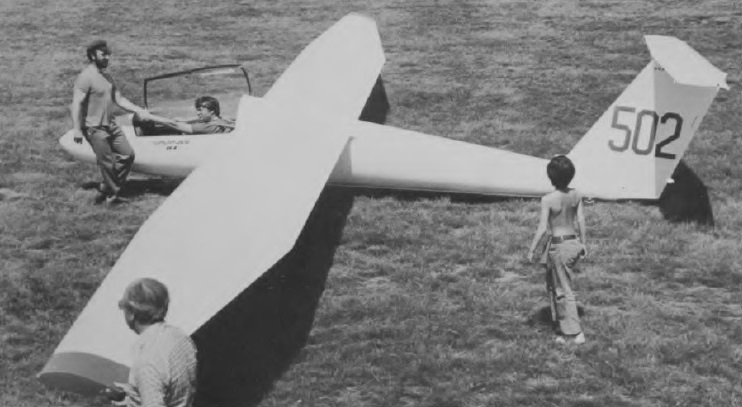
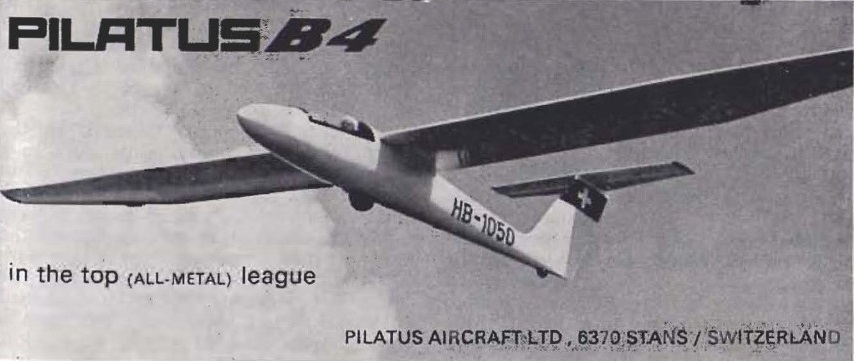
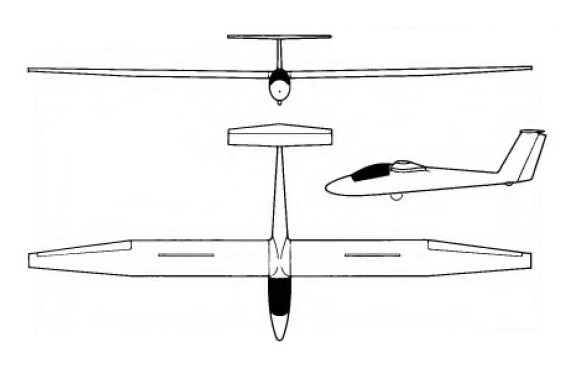
The only glider manufactured by Swiss aircraft manufacturer. First flying in 1972 the Pilatus B4 is an all-metal design to Standard Class specifications. It has full aerobatic capability including inverted maneuvers.

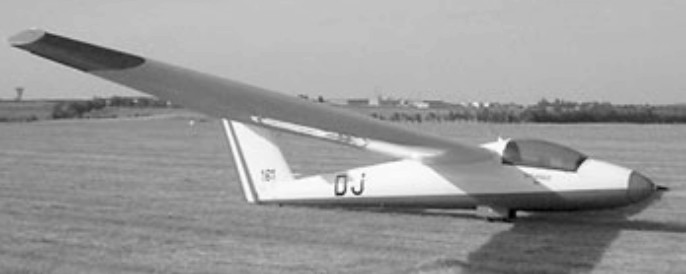
The B4 is a cantilever shoulder-wing monoplane with a T tail; the wings are of light alloy with a U-shaped light alloy main spar and hard PVC foam ribs between the metal ribs; the large skin panels are attached to the main spar by a single row of countersunk rivets, and the ailerons are of similar construction. There are light alloy spoilers in the wing upper surfaces at the 60% chord line. The semi-monocoque fuselage is also of light alloy, with a flush-riveted skin, and the rear fuselage consists of two half-shells riveted together. The light alloy T-tail has PVC ribs and a fixed-incidence tailplane, and the elevator has a bias spring for trimming. The landing gear consists of a non-retractable unsprung Tost monowheel with drum brakes, although a retractable one can be fitted if the customer desires, and there is a fixed tailwheel; small doors enclose the monowheel when retracted. The pilot sits in a semi-reclining position under a sideways-hinging canopy that is jettisonable in flight, and a battery radio and oxygen system are optional.

Pilatus B4-PC11

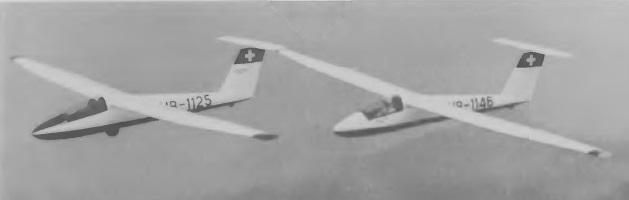
Certification for full aerobatic manoeuvres was granted in January 1975. Of all-metal construction, the type was designed by Ingo Herbot as a private venture and first flew in prototype form, as the B-4, in 1966; the design was taken over and developed by Pilatus as the B4-PC11, which first flew in 1972. Swiss certification was granted on 12 June that year, and the first delivery was made shortly afterwards. Seventy eight B 4s were sold in 1977, and 320 were in operation.

More than 330 examples of the Standard Class Swiss single-seater had been delivered to customers in no less than 30 countries by March 1978, and the production rate was as high as 7-8 aircraft per month.

On 19 June 1978 Pilatus announced the sale of all manufacturing and sales rights in the B4 to the Japanese firm of Nippi – Nihon Kikoki Kabushiki Kaisha (or Japan Aircraft Manufacturing Co Ltd) so as to be able to concentrate on production and development of the PC-6 Turbo-Porter and PC-7 Turbo-Trainer.

The first Nippi-built B4-PC11 AF was rolled out on 1 June 1979 and initial production was to be at three per month after Japanese certification. The first Nippi-built B4-PC11 AF made its maiden flight on 25 November 1979. Pilatus was to continue the product support of Swiss-built examples.

Number of aircraft built to 6/30/81 400.

Pilatus B4-PC11

Pilatus B4
Wing span: 49 ft 2.5 in
Length: 21 ft 6.5 in.
Seats: 1
Wing loading: 5.13 lb/sq.ft.
Aspect ratio: 16.1
Max TO wt: 770 lb.
Empty wt: 506 lb
Useful load: 264 lb.
Max speed: 130 kt
Rough air speed: 130 kt.
Stall: 30 kt
Lift to drag: 35 @ 46 kt.
Sink: 2.1 fps @ 39 kt.

B4-PC11
Wing span: 15.0 m / 49 ft 2.5 in
Length: 6.57 m / 21 ft 6.5 in
Height: 1.57 m / 5 ft 1 in
Wing area: 14.04 sq.m / 151.1 sq ft
Wing section: NACA 643 618
Aspect ratio: 16.0
Empty weight: 230 kg / 507 lb
Max weight: 350 kg / 772 lb
Water ballast: None
Max wing loading: 24.93 kg/sq.m / 5.1 lb/sq ft
Max speed: 129.5 kt / 240 km/h
Stalling speed: 33.5 kt / 62 km/h
Min sinking speed: 0.64 m/sec / 2.1 ft/sec at 39 kt / 72 km/h
Max rough air speed: 129.5 kt / 240 km/h
Best glide ratio: 35 at 46 kt / 85 km/h

B4-PC11AF
Wing Span: 15m / 49.2ft
Wing Area: 14.04sq.m / 151.1sq.ft
Length: 21 ft 7in
Height: 5 ft 2 in.
Empty Weight: 230kg / 506lb
Payload: 120kg / 264lb
Gross Weight: 350kg / 770lb
Wing Load: 24.93kg/sq.m / 5.13lb/sq.ft
Min Sink @ 39 kts / 45 mph: 0.64 m/s / 2.1 fps / 1.24 kt
L/D Max: 35 @ 85 kph / 46 kt / 53 mph
Max speed: 129 kts / 149 mph (in smooth air)
Stall speed: 33 kts.
Rough air airspeed: 86 kts
Max aero-tow speed: 112 mph
Airfoil: NACA 64(3)-618
Aspect ratio: 16.1
Seats: 1

Pilatus SB-2 Pelican

First product of Pilatus Flugzeugwerke AG was a four/six-seat light transport designated Pilatus SB.2 Pelican, a braced high-wing monoplane with fixed tricycle landing gear, powered by a 336kW Pratt & Whitney Wasp Junior radial engine. The pilot and co-pilot/navigator were seated in a separate compartment forward of the wing leading edge, with a main cabin below the wing which could be arranged to accommodate two to four passengers according to layout. The Pelican, which was first flown during 1944, failed to gain any commercial interest.

SB-2
Engine: 1 x Pratt & Whitney Wasp Junior, 336kW
Wingspan: 15.5 m / 51 ft 10 in
Max. Speed: 250 km/h / 155 mph
Crew: 2
Passengers: 2-4

PIK Pik-27

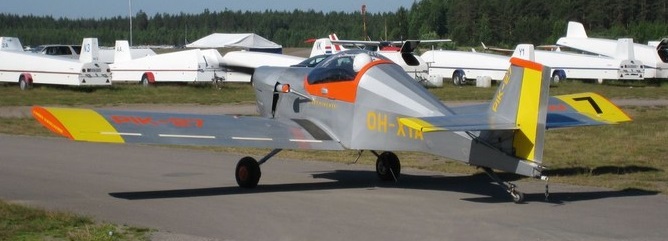
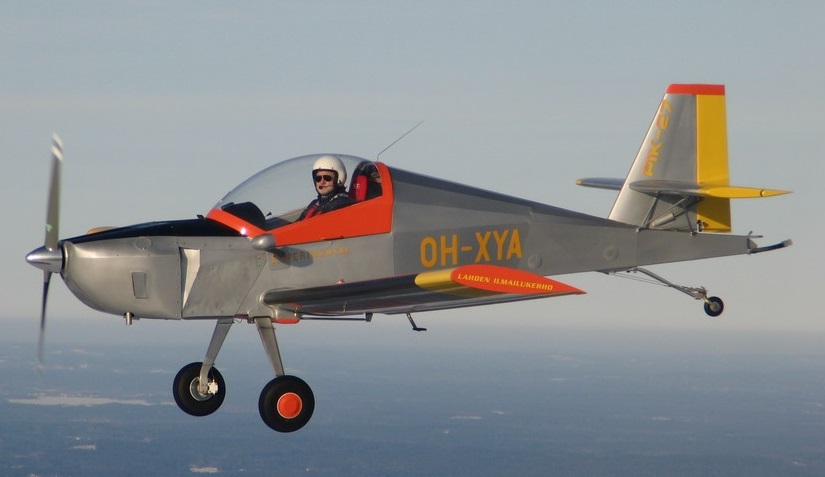
The Pik-27 design was begun by DI Aki Suokas with the objective of operating costs at a reasonable level, but not at the expense of safety. The design was to require minimal maintenance and only the necessary systems were included.

The prototype OH-XYA bears the excess weight of a prototype and it was anticipated the next would be at least 30-40 pounds lighter. The prototype weight includes a 70 m tow rope with a built-in reel.

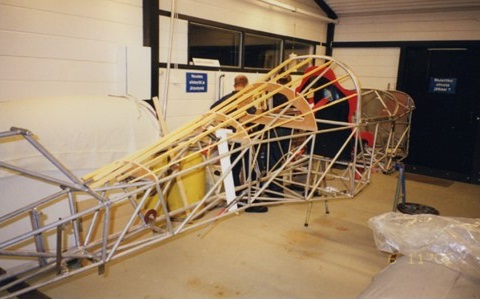
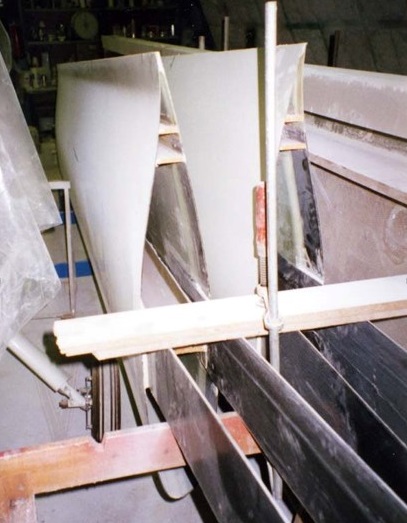
The PIK-27 low-wing monoplane has GRP wing construction and a fabric-covered SAF2205 steel-tube fuselage. The material has a very high elongation at break (25%), which improves the chances of settlement in the event of an accident. Another plan was for a 4130 fuselage.

The wings were traditional glider technology of glass reinforced PVC foam laminate surfaces, with fuel tanks in the wing.

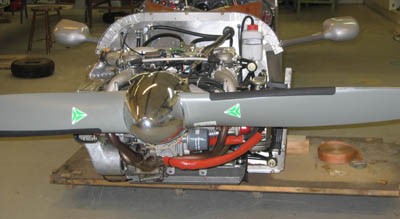
The Windcraft Oy built prototype (OH-XYA) was first flown December 2006, powered by a 115 hp Rotax 914. The Rotax 914 is a supercharged engine, meaning it does not lose power as density increases. The Rotax 914 maintains full power for flight level 150.

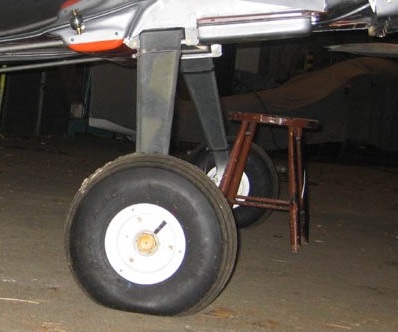
The undercarriage and brakes are the same style as the Cessna 172. The landing gear is quite high for a large propeller optimized for low speeds. The propeller has a diameter of 1.95 meters.

The Pik-27 was offered as kit and fits the US LSA definition (FAR CR 1.1). The wings and tail have to be molded. Wings can be joined by the builder if the transportation of a 9 m long package is difficult. The frame could not be deliver welded.

Gallery

Pik-27 prototype
Engine: Rotax 914
Span: 9.1 m / 29.8 ft
Wing area: 9.0 m² / 96.9 sqft
Wing profile: LS (1) -0417 mod
Length: 6,125 m / 20.1 ft
Height: 2.92 m / 9.6 ft
Empty weight: 410 kg / 904 lbs
Maximum take-off weight: 595 kg / 1312 lbs
Fuel capacity: 90 liters / 24 USg
Stabilizer area: 2.24 m² / 24.1 sqft
VNE: 270 kph / 146 kts
VA: 198 kph / 107 kts
VS: 81 kph / 44 kts
Loading: +4.7 g / -2 g
Maximum sailplane tow: 850 kg / 1874 lbs

PIK PIK-26 Mini-Sytky

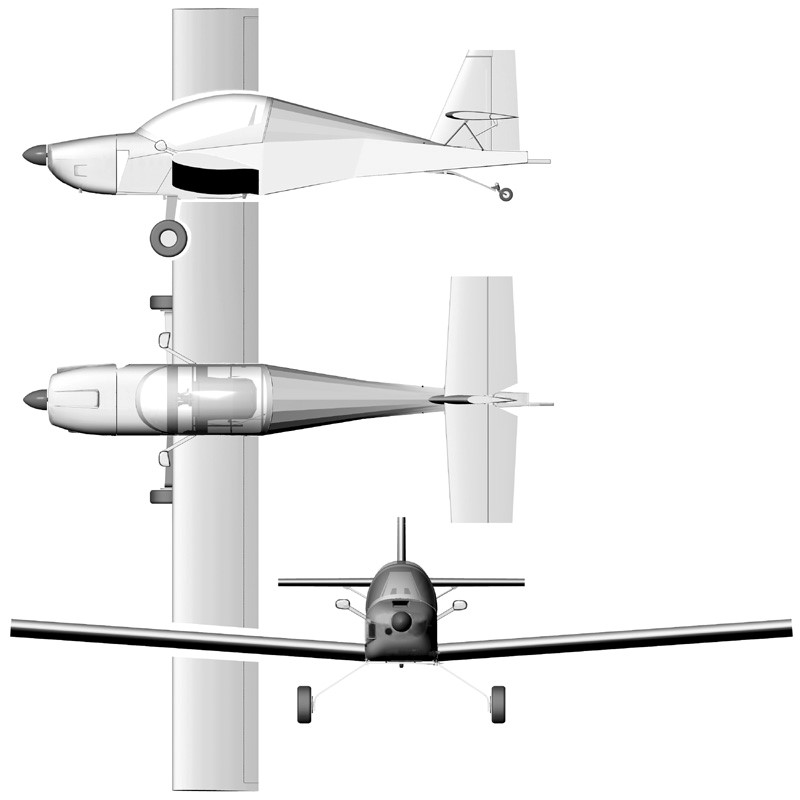
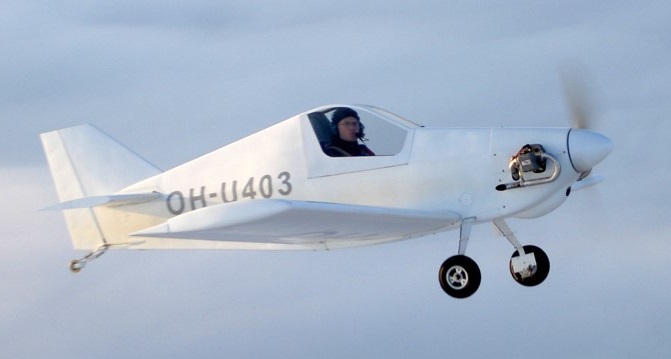
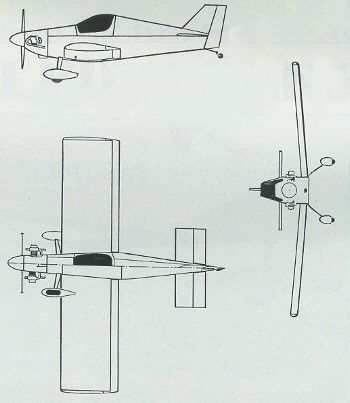
The PIK-26 Mini-Sytky is a single-seater ultra-light aircraft. The structure is entirely wood, except the wing and rudder which are cut from PVC foam. The one-piece wing attaches with two bolts to the main arch of the frame and its rear spar to the lower part of the backrest. Hinged flaps are fitted. The wing can be detached from below, leaving the frame resting on the landing gear.

The cockpit features a sidestick.

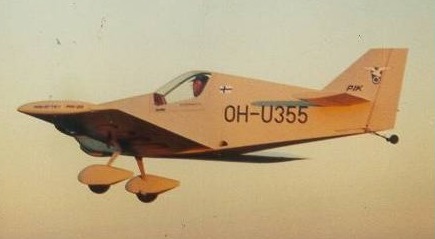
Designed by Kai Mellén and first built in 1996, at least four ave been built: OH-U355, OH-U356, OH-U403, and OH-U404. .

Mini-sytky OH-U403
Engine: Mosler MMCB HO2, 35 hp
Propeller: 48 “(122cm) x 38 “(96.5 cm)
Wing span: 5.24 m
Wing chord: 1.15 m
Wing area: 6 sq. m
Airfoil: GAW-2
Length: 4.33 m
Height: 1.22 m
Load limit: +3.8, -1.5 g
Empty Weight: 144 kg
Gross Weight: 250 kg
Fuel capacity: 27 lt / 20 kg
Useful Load: 106 kg
Luggage capacity: 5 kg
Vne: 190 km/h
Top Speed 3250 rpm: 180 km/h
Cruise@3000rpm: 160 km/h
Stall w/flaps: 55 kph
Stall clean: 60 km / h
Maximum flap speed: 120 km / h
Maximum manoeuvre speed: 125 km / h
Fuel Consumption: 7-8 lt/hr
Rate of Climb: 3.2 m/s
Takeoff Distance: 170 m
Landing Distance: 250 m
TO to 15 m: 600 m
Landing dist from 15 m: 500 m
Climb speed: 100-110 mph
Endurance: 3.25 hr
Range: 475 km
Wing loading: 41.6 kg/sq.m
Seats: 1
Wheel track: 1.21 m
Wheelbase: 3.27 m
Rudder: 0.22 sq.m
Vertical stabilizer: 0.56 sq.m
Vertical stabilizer profile: NACA 0011
Rudder: 0.38 sq.m
Rudder profile: NACA 0009
Aspect Ratio: 4.56
Didedral: 4 degrees
Aileron movement: – 35, + 27
Flap deflection: 16 deg
Rudder movement: + – 28 deg
Elevator movement: 20 deg up, 12 deg down
Tires: LAMB 11.400-5 (6ply)
Wheels: 5 ” AZUZA
Brakes: AZUZA, mechanical

PIK PIK-25

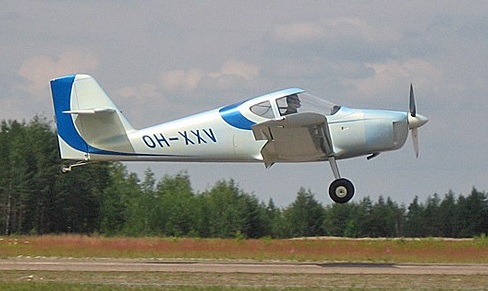
The 1983 PIK-25 Varttimarkka (Quarter Mark) was a 2-seat ultralight of GRP construction. Powered by a VW HO4 engine the project was abandoned.

In 2007 the project was completed privately by Jarmo Hakala of the Finnair flying club and registered OH-XXV.

PIK-25 OH-XXV
Engine: 1 x 100/120 hp WV 1.9 TDI JH1
Wing span: 8.8 m
Length: 6.6 m
Empty weight: 595 kg
MTOW: 850 kg
Fuel capacity: 240 l
Cruise 75% (75hp): 115 mph (less than 2000 ft)
Stall speed: 65 mph
Stall speed with flaps: 55 mph
3.8G max
Fuel consumption 75% (75hp): approx. 14 l / h