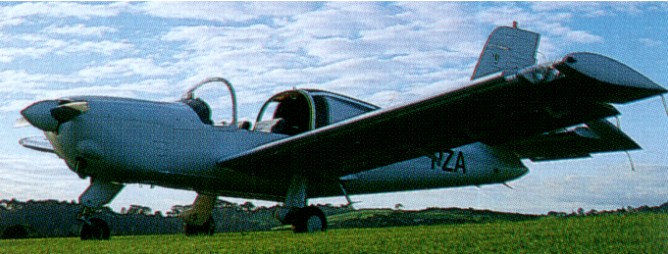
French production of the Rallye series stopped in the 1970s and PZL took it over, along with all production licences. Derived from the SOCATA MS884 Rallye, PZL did development of its own, with a softer trailing-arm undercarriage, some geometric changes on the flaps and more work on those distinctive leading edge slats, which now move in and out more gently and tend to stay there. Engineering changes also include better alloys and corrosion treatment. PZL made 500 or so Franklin-powered Koliber Is, then set about certifying the Koliber II under FAR Part 23 amendment 29. A four place, all metal factory built nose wheel aircraft.
Certification of the Koliber 150 is under European Aviation Safety Agency EASA A.091, and the PZL-Koliber 150A under FAA A69EU.
In 1985 construction began of five airframes of an improved M-24 Dromader Super, one intended as a static test specimen, two as flying prototypes with the 746kW ASz-621R engine, and another two with the 860kW P.Z.L. K9-AA engine. The first of these flew on 14 July 1987 and all were flying by November 1988.
The Super was fitted with longer wings, from 17.7 metres on the M-18 to 19.9 metres on the M-24. The fuselage was also stretched from 9.5 metres to 10.8 metres, in¬cluding a larger hopper.
Of the five built, one as a test airframe, with the remaining four flown, however, none were sold and all were with¬drawn from use by 1998 and stored engineless.
However, no production of the type was launched. The M-24T turboprop version, fitted with an 875kW PT6A engine in an extended nose, was planned, but only existed in mock-up form.
WSK-Mielec M 24 Dromader Super Cropduster, Poland, 1987 Length : 35.433 ft / 10.8 m Height: 12.467 ft / 3.8 m Wingspan : 65.289 ft / 19.9 m Wing area : 484.38 sqft / 45.0 sq.m Max take off weight : 11025.0 lb / 5000.0 kg Weight empty : 6328.4 lb / 2870.0 kg Max. weight carried : 4696.7 lb / 2130.0 kg Max. speed : 119 kts / 220 km/h Landing speed : 59 kts / 110 km/h Cruising speed : 103 kts / 190 km/h Initial climb rate : 590.55 ft/min / 3.00 m/s Service ceiling : 13123 ft / 4000 m Wing load : 22.76 lb/sq.ft / 111.0 kg/sq.m Range : 972 nm / 1800 km Engine : PZL Kalisz 9 AA, 871 hp Crew : 1-2
Two prototypes of the scaled-down reduced-capacity M-21 Dromader Mini were flown, the first, 5P-PDM, powered by a 447kW P.Z.L.-3S engine on 18 June 1982 followed by the second, fitted with a geared PZL-3SR 599 hp version. The aircraft had no centre wing section and the span was reduced to 14.51 metres and the length to 9.48 metres.
Although the type was provisionally certificated, no production has followed. Both examples of the M-21 were withdrawn in June 1990.
The even smaller Dromader Mikro, proposed in 1982, did not proceed further.
Engine: A PZL-35R radial, 599 hp Wing span: 14.51m Length: 9.48m
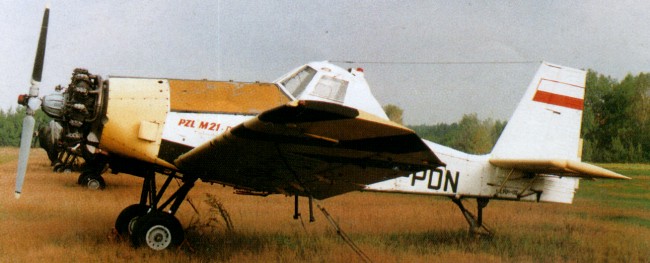
The M-18 was designed in co-operation with Rockwell International in the USA to FAR Part 23 standards. It uses several components of the then Rockwell S2R Thrush, including the outer wing panels. The cockpit is a sealed unit and has a similar layout to the Snow S2D-600. With a requirement for a crew seat, the rear canopy was later redesigned with a hatch on the port side for entry to a rear facing seat. The earlier M-18 models that were converted and new production aircraft were designated M-18A.
Described as a low wing agricultural mono¬plane with fixed landing gear, the unswept cantilever wings are of constant chord, with 2o 30’ dihedral on the centre section and 6o on the outer panels. The wing sections are NACA4416 at the root and NACM412 at the tip. The aircraftis fitted with a steel-capped wing spar with all-metal, two section, trailing-edge flaps, actuated hydraulically. Metal slotted ailerons and metal wing tips complete the 58’ wing span and 430.56 sq ft wing area.
The fuselage is of all-metal tubular construc¬tion and incorporates an all-metal tailplane. It stretches 31 feet long and in a flying attitude stands at 15’01”. The hopper is made from glass fibre and has a capacity of 2,500 litres, or 660 US gallons. The aircraft’s empty weight is 5,445 lbs with a maximum take-off weight of 11,684 lbs. It has a maximum speed of 138 knots and a stalling speed, with flaps extended, of 59 knots. The pilot being accommodated in a cockpit stressed to survive an impact of 40g. Special materials and treatment limit airframe corrosion to a minimum.
PZL-Mielec built three prototype aircraft powered by the uprated P.Z.L. ASz-621R engine. The first, for testing, was non-flying, but the second aircraft, SP-PBW, and the third aircraft, SP-PBZ, first flew on 27 August 1976 and 2 October 1976 respectively. From April 1978, a batch of ten pre-production aircraft were built, of which two were non-flying test aircraft. Five of them used for operational trials, in Eastern Europe and and two were used in trials in Egypt during the summer of 1978. Another was test flown (on 11 November 1978) as a firefighter to test the concept. The Polish type certificate was issued on 27 September 1978 and two aircraft from this batch were sold to Yugoslavia the following year.
Deliveries of the second batch of five air¬craft began in 1980, with four going to Canada. Canadian certification of the fire-fighting version was awarded on 10 March 1980. Another batch of ten aircraft was built in 1980, six of which went to Canada.
Production of the M-18 began following the receipt of Polish certification on 27 September 1978, but came to an end in 1984, shortly after the M-18A two-seat version was certificated by the Polish authorities. A dedicated two-seat agricultural trainer, designated the M-18AS, was constructed with a smaller hopper to allow an instructor to sit behind the pilot, and flew for the first time on 21 March 1988. Five were built by 1992.
In common with most East European air¬craft, Dromaders are built in batches. This is evident in the constructor number sequences. In the Soviet Union series of numbers are used, however, PZL-Mielec used an alphabetical and numerical sequence. The prototype Dromaders used 1ZP and the production Dromader 1ZO. Mielec has produced a two-seat trainer Dromader, the M-18BS, first flying in November 1997.
The fifth batch to come out of Poland saw the first aircraft, 1ZO05-01, being delivered to the USA as N42255. Of the fifteen aircraft built, nine were sold to the United States, three to Hungary and two to Cuba. The fifteenth airframe was used for spares. In 1981 the Polish com¬pany had two new customers. Turkey purchased four aircraft and South Africa two. Hungary, Cuba and the USA were the main buyers until 1982, when Bulgaria purchased four aircraft and followed with another fourteen by the end of that year. From December 1983, the Greek Air Force took delivery of eighteen aircraft for use as fire bombers. As mentioned above, Cuba took delivery of their first M-18 in January 1981 and by October1988, forty-six aircraft had been reg¬istered in that country.
The nine-cylinder, supercharged radial engine, the AS-621z, which drives the four-blade PZL-Warszawa SP.00 propeller, has been the only power plant supplied by the factory. Operators in the United States have taken advantage of this large airframe with some replacing the PZL radial with turbine power. Turbine Conversion of Nunica, MI, converted some M-18/M-18A aircraft by installing P&WPT-6A-45 and -65 series engines and 800 US gallon hoppers. Delta Turbines have also converted a number of Dromaders to turbine power, fitting a TPF-33-10UA. One of the most unusual conversion was the installation of a 1000 shp Lycoming T53-L-3 from a Grumman OV-1 Mowhawk.
By the end of 1997, six hundred and eighty-three aircraft had been registered and more air¬craft were awaiting assembly.
The M-18B Dromader is certified under European Aviation Safety Agency EASA A.056.
PZL Mielec M-18a Engine: 1 x P.Z.L. Kalisz ASz-62IR radial, 746kW Max take-off weight: 4700 kg / 10362 lb Empty weight: 2470 kg / 5445 lb Wingspan: 17.7 m / 58 ft 1 in Length: 9.47 m / 31 ft 1 in Height: 3.7 m / 12 ft 2 in Wing area: 40.0 sq.m / 430.56 sq ft Max. speed: 237 km/h / 147 mph Cruise speed: 185 km/h / 115 mph Range: 520 km / 323 miles
M18A Engine: ASz-621RM, 967 hp Prop: AW-2-30, 4 blade Wing span: 58 ft Wing area: 430.56 sq.ft Length: 31 ft Hopper cap: 2500 lt (660 USG) Empty wt: 5445 lb MTOW: 11,684 lb Max speed: 138 kts Stall: 59 kts
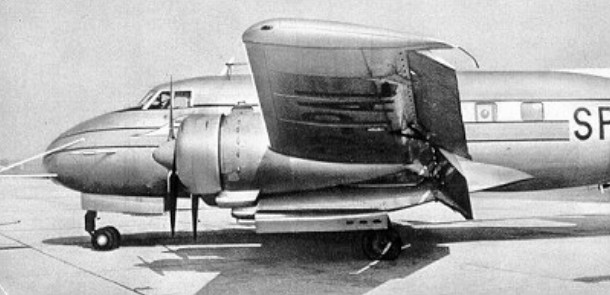
One of the P.Z.L. Mielec early postwar projects was the P.Z.L. Mielec MD-12 short-range light transport, the first of several prototypes flying initially during August 1959.
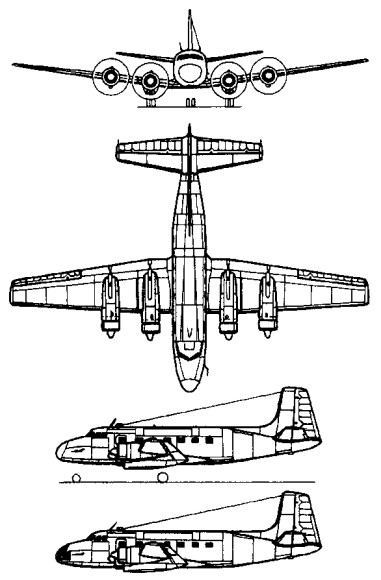
A cantilever low-wing monoplane of all-metal construction, it had retractable tricycle landing gear and was powered by four Narkiewicz WN-3 radial engines in wing-mounted nacelles. Accommodation was provided for a flight crew of two on a separate flightdeck, and the main cabin could accommodate 20 passengers or, when cleared of its easily-removed seating, up to 1900kg of cargo.
Only four aircraft, including one four static trials, were built: 1st prototype SP-PAL, 2nd SP-PBD and the 4th was MD-12F SP-PBL prototype, the one that survived in Krakow Museum.
The MD-12 did not progress beyond the prototype stage, but a photographic survey version was produced in small numbers. Designated MD-12F, and first flown in prototype form on 21 July 1962, this had its internal accommodation arranged for a crew of up to seven, providing four camera positions and a darkroom at the rear of the cabin. Plans was cancelled after the fatal crash of the first MD-12 prototype
MD-12F Engines: 4 x Narkiewicz WN-3, 246kW Wingspan: 23.2 m / 76 ft 1 in Length: 15.8 m / 52 ft 10 in Height: 5.95 m / 20 ft 6 in Wing area: 57.0 sq.m / 613.54 sq ft Max take-off weight: 7000 kg / 15432 lb Loaded weight: 5025 kg / 11078 lb Max. speed: 305 km/h / 190 mph Ceiling: 5200 m / 17050 ft Range w/max.fuel: 2100 km / 1305 miles Crew: 2 Passengers: 20
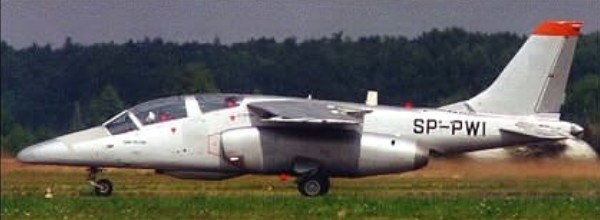
Launched 1977, leading to 1980 Polish Ministry of National Defence Iskra-22 requirement for combat-capable jet trainer. The I-22 prototype made its first flight on March 3, 1985 and the type was revealed in October 1986 as a twin-jet advanced trainer/light-attack aircraft.
First production order (for nine aircraft, only five of which were completed in I-22 configuration) announced September 1991; first of these (serial number 103) made first flight 5 May 1992, handed over to Polish Air Force (with second aircraft 105) 24 October 1992; next three (201, 202 and 203) delivered February 1994 (203 since lost).
Reappraisal in 1995 indicated that I-22 with PZL-5s was underpowered, and the four survivors were due to be upgraded to M-96 standard during 1996-97 (K-15 engines, Martin-Baker seats and improved avionics). Earlier proposal to suspend Iryda development and buy 36 ex-German Alpha Jets was reversed in December 1995; funding concentrated instead on M-93K improvements and evaluation of M-96. The five survivors were delivered to PZL for conversion.
Equipment includes a ventral 23mm gun pod, four underwing hardpoints for up to 2,000kg of stores, a nose-mounted 13mm camera gun, 1FF, and a radar warning receiver. The landing gear is designed for rough-field operations and provision is made for a brake parachute.
I-22 Iryda Engines: 2 x PZL-5 SO-3W22 turbojets, 10.7kN Wingspan: 9.6 m / 32 ft 6 in Length: 13.2 m / 43 ft 4 in Height: 4.3 m / 14 ft 1 in Wing area: 19.9 sq.m / 214.20 sq ft Max take-off weight: 6900 kg / 15212 lb Empty weight: 4700 kg / 10362 lb Max. speed: 840 km/h / 522 mph Cruise speed: 570 km/h / 354 mph Ceiling: 11000 m / 36100 ft Initial climb rate: 7283.46 ft/min / 37.0 m/s Range w/max.fuel: 902 nm / 1670 km Range w/max.payload: 420 km / 261 miles Armament: 1 x 23mm GSz-23 cannon, 200 rounds Hardpoints: 4 Bombload: 2000kg Crew: 2
I-22 Iryda Engines: 2 x PZL-5 SO-3W22 K-15 turbojets, 15 kN Wingspan: 9.6 m / 32 ft 6 in Length: 13.2 m / 43 ft 4 in Height: 4.3 m / 14 ft 1 in Wing area: 19.9 sq.m / 214.20 sq ft Armament: 1 x 23mm GSz-23 cannon, 200 rounds Hardpoints: 4
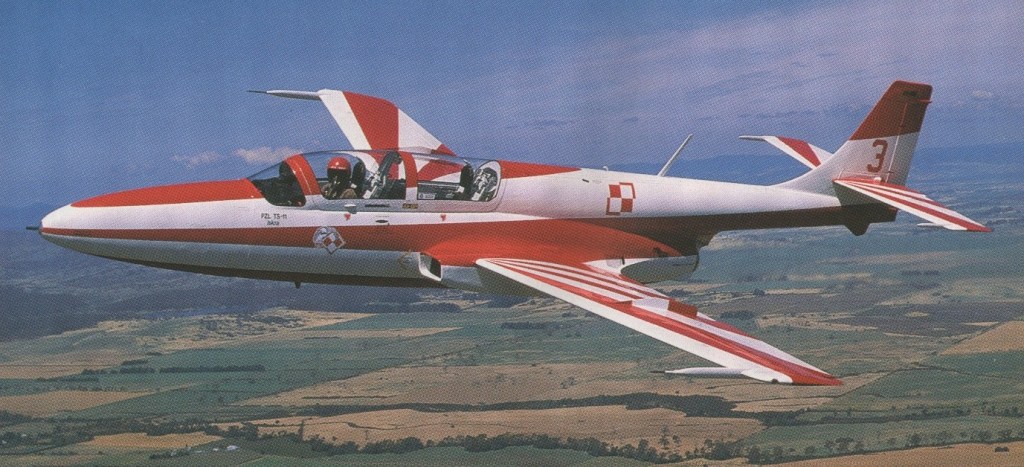
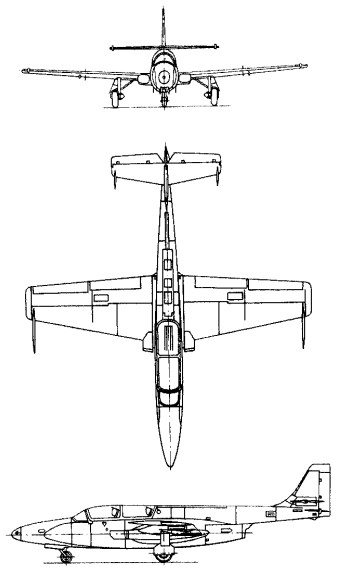
Design of the P.Z.L. Mielec TS-11 Iskra (Spark) two-seat turbojet-powered primary and advanced trainer began in 1957, being intended as a replacement for the TS-8 Bies two-seat basic trainer. Four prototypes were built, and the first flight of the type was recorded on 5 February 1960.
Following type approval during 1961 initial deliveries began in March 1963, and the TS-11 became operational with the Polish air force in 1964. Since that time well over 500 have been built, manufactured not only for use by the nation’s air force, but also for export to India, which procured 50. A cantilever mid-wing monoplane of all-metal construction, the TS-11 has retractable tricycle landing gear and is powered by a single turbojet mounted within the fuselage, aft of the cockpit.
Early aircraft were powered by the Polish-designed HO-10 turbojet developing 780kg thrust, but from the mid-1960s TS-11s have been powered progressively by the 2,205 lb / 800kg thrust SO-1 turbojet, the similarly rated but improved SO-3, or the uprated SO-3W. The Iskra was being replaced in Polish air force service by the I-22 Iryda.
Later developments were the Iskra 100 with attack capability and the Iskra 200, built as single and two seaters. The Indian Air Force also operated the Iskra 100.
Limited production of the 1987 version of the TS-11, the Iskra-Bis DF, continued at Mielec. The Iskra-Bis DF is a tandem-seat combat and reconnaissance trainer powered by a single uprated 10.8kN SO-3W turbojet. It is equipped with a 23mm cannon in the forward fuselage, an S-13 camera gun, and four underwing hardpoints for 100kg of bombs, rockets, and gun pods. For recon¬naissance training three cameras may be carried, one in each intake fairing and one in the cockpit floor.
Engine: 1 x Narkiewicz turbojet, est 1,760 1,980 lbs.t. (800 900 kgp) Max speed, 497 mph (800 kph) Service ceiling 39,370 ft (12 000 m) Loaded weight, 7,496 lb. (3 400 kg) Span, 32 ft 9.5 in (10 m) Length, 36 ft 1 in (11m) Height, 10ft 10 in (3.3 m)
PZL-WSK TS 11 bis DF Iskra Engine: 1 x SO-W3, 1100kg Installed thrust: 10.8 kN Span: 10.06 m / 33 ft 0 in Length: 11.15 m / 37 ft 7 in Wing area: 17.5 sq.m / 188.37 sq ft Height: 12 ft 6 in / 3.500 m Empty wt: 2560 kg / 5644 lb MTOW: 3840 kg / 8466 lb Max speed: 770 kph / 478 mph Initial ROC: 1140 m / min Ceiling: 37730 ft / 11,500 m T/O run: 660 m Ldg run: 720 m Fuel internal: 1200 lt Range: 675 nm / 1250 km Armament: 1 x 23 mm Hardpoints: 4 Bombload: 400kg Crew: 2
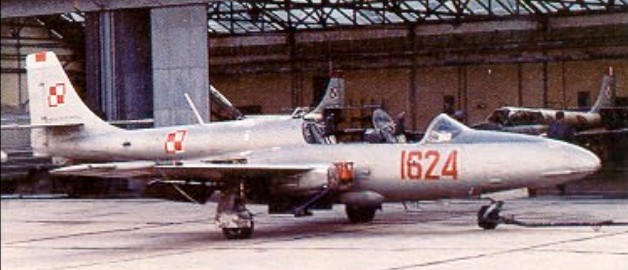
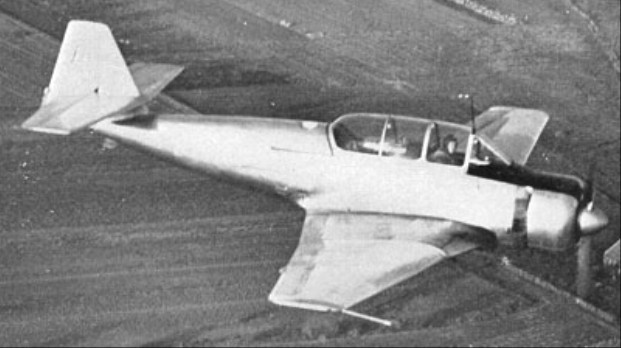
On 23 July 1955 the first prototype was flown of a two-seat basic trainer designated P.Z.L. TS-8 and later named Bies (Fiend). A cantilever low-wing monoplane with retractable tricycle landing gear, powered by a Narkiewicz WN-3 radial engine and accommodating two in tandem beneath a jettisonable transparent canopy, initial deliveries to the Polish air force began in 1958.
The type established several class speed records, and that set on 20 May 1957, of 320.362km/h over a 2000km closed circuit, remained unbeaten until August 1982.
Built until 1962, this fully aerobatic trainer remained in service for some six years, initial deliveries of the TS-11 Iskra which replaced it in service in the Polish air force beginning in 1964.
Engine: 340 hp / 246kW Narkiewicz WN 3 Span, 34 ft 5 in (10.5 m) Length, 27 ft 10 in (8.5 m) Wing area, 205.6 sq.ft (19.1 sq.m) Height, 3.3 m (11 ft 10 in) Empty weight, 2,359 lb (1070 kg) Loaded weight, 5,417 lb (1550 kg) Max speed, 194 mph (312 kph) Cruise, 168 mph (270 kph) Initial climb, 1340 fpm (6.8 m/sec) Service ceiling, 19,685 ft (6000 m) Range 497 mls (800 km)
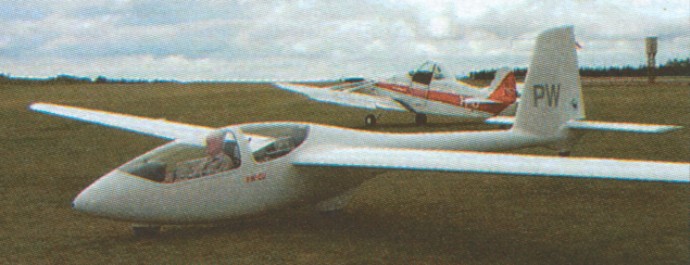
The tandem two place metal framed sailplane was designed by Jerzy Krawczyk and Eugeniusz Pelczar as a basic training glider and first flew in 1985. It has an oleo pneumatic sprung fixed main wheel, a tail wheel and a rubber sprung nose skid. Approach control is by top and bottom surface Schempp-Hirth type airbrakes.