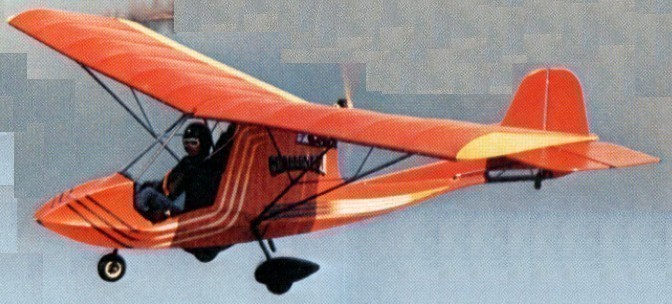
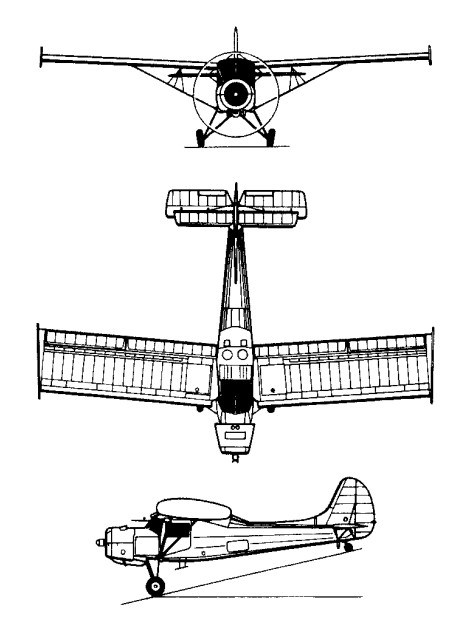
Single seat single engined high wing mono¬plane with conventional three axis control. Wing has unswept leading and trailing edges, and constant chord; cruciform tail. Pitch control by elevator on tall; yaw control by fin mounted rudder; roll control by spoilers; control inputs through stick for pitch/roll and pedals for yaw. Wing braced from below by struts; wing profile; double surface. Undercarriage has three wheels in tricycle formation, with additional tailwheel. Suspen¬sion on all wheels. Push right go right nosewheel steering connected to yaw control. Aluminium tube framework, partially enclosed. Engine mounted at wing height driving pusher prop¬eller.
Designed by Dave Goulet and first flown in 1983, this ultralight made its debut at Sun ‘n’ Fun in March 1983 at Lakeland, Florida. Thanks to the fabric covering the whole of the framework and a windscreen over the cockpit area, it has an excellent glide ratio, 11/1 being claimed by the manufacturer. At that time little detailed information was available from Quad City Ultralights on what was really no more than a prototype, but since then the Challenger has gone on sale as a kit requiring 50 h for completion and costing $5495. Rigging time is expected to be in the order of 30 min by one person from a trailer, according to the manufacturer. The aircraft can also be towed on its own undercarriage.
Power comes from the KFM 107 with electric start and reduction drive.
In 2010 LSA Quick-build kits were from US$9,215 to US$12,965 ex engine and engine options were Hirth F-33, Rotax 447/503/582, and HKS 700E.
The Challenger qualifies for Part 103 ultralight or 51% kit for Experimental – Amateur-Built, can be flown with Sport Pilot Permit, and qualifies as a Light Sport Aircraft.
Engine: KFM 107ERV, 25 hp at 6000 rpm Propeller diameter and pitch 52 x 24 inch, 1.32 x 0.61 m V belt reduction, ratio 2.0/1 Power per unit area 0.20 hp/sq.ft, 2.1 hp/sq.m Fuel capacity 5.0 US gal, 4.2 Imp gal, 18.9 litre Length overall 18.8 ft, 5.72 m Height overall 6.0ft, 1.83m Wing span 32.0ft, 9.75m Constant chord 4.0 ft, 1.22 m Sweepback 0 degs Total wing area 128 sq.ft, 11.9sq.m Wing aspect ratio 8.0/1 Empty weight 242 lb, 110kg Max take off weight 530 lb, 240kg Payload 288 lb, 131kg Max wing loading 4.14 lb/sq.ft, 20.2 kg/sq.m Max power loading 21.2 lb/hp, 9.6kg/hp Max level speed 63 mph, 101 kph Never exceed speed 70 mph, 113 kph Max cruising speed 60 mph, 97 kph Stalling speed 28 mph, 45 kph Max climb rate at sea level 700 fpm, 3.6 m/s Best glide ratio with power off 11/1 Service ceiling 10,000 ft, 3050 m
Engine: Rotax 277 (268 cc). 28 hp Static thrust: 235 lbs HP range: 28-40 Empty weight: 242 lb Max weight: 500 lb Wing span: 31ft 6in Wing area: 142 sq.ft Height: 6 ft Length: 18 ft 6 in Wing loading: 3.52 lbs/sq.ft Power loading: 17.86 lbs/hp Fuel cap: 5 USG Construction: Aluminium, Dacron Max speed: 63 mph Cruise: 55 mph Stall: 25 mph Vne: 80 mph Cross-wind capability: 25 mph Climb rate: 500-700 fpm @ 40 mph Design load: +4, -2.5g Glide: 10-1 Seats: 1 Range: 150 sm Take off dist: 150 ft Ldg dist: 150 ft Service ceiling: 12,500 ft
Quad City Ultralights Aircraft Challenger UL Engine: Rotax 447, 40 hp HP range: 28-50 Length: 18.5 ft Wing span: 31.5 ft Wing area: 142 sq.ft Empty weight: 254 lb Gross weight: 500 lb Fuel capacity: 5 USG Cruise: 55 mph Stall: 27 mph Range: 140 sm Rate of climb: 700 fpm Takeoff dist: 250 ft Landing dist: 250 ft Cockpit width: 24 in Landing gear: nosewheel
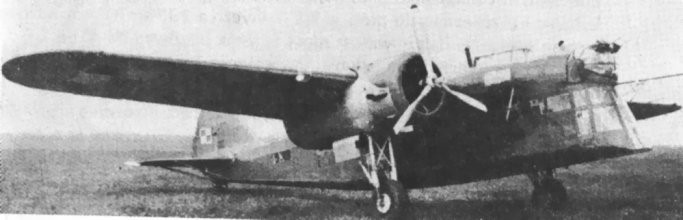
The LWS-6 Żubr (PZL.30, wisent / Bison) was a Polish twin-engined medium bomber, produced by the LWS factory before World War II. A short series was used for training only, because it was inferior to the contemporary PZL.37 Łoś design.
The PZL.30 was designed by Zbysław Ciołkosz) for PZL in the early 1930s, initially as a 12-passenger passenger airliner. When the Polish Airlines LOT bought Douglas DC-2 aircraft instead, the design was converted to a bomber, with a projected bomb load of 1,200 kg. The PZL.30 was developed as a less-advanced, alternative medium bomber design, in case the more modern bomber design, the PZL.37 Łoś would fail. The first prototype, designated PZL.30 (or PZL.30BI) was flown in March 1936 by Bolesław Orliński.
The maiden flight of the PZL.30 took place only three months before the PZL.37 Łoś prototype flew. Although developed at the same time as the PZL.37, the PZL.30 was inferior to its counterpart, being slower, had a much smaller bomb load than the Łoś and yet was produced at a similar price.
The PZL.30 prototype, initially powered with two 420 hp Pratt & Whitney Wasp Junior engines, was further refitted as the PZL.30BII, with more powerful Bristol Pegasus VIII engines. The aircraft was accepted for a limited production run by the LWS state factory in Lublin, of which Ciołkosz became the technical director and project lead. The second prototype was designated LWS-4.
It was planned to produce 16 aircraft for the Polish Air Force, with the designation: LWS-6 Żubr. The Żubr was given a military code number 71 and the series was to have factory numbers 71.1 to 71.17, but the aircraft were given different code numbers eventually due to secrecy.
The production aircraft incorporated further changes, among others the landing gear retracting into the fuselage sides was changed to more conventional one, retracting into the engine nacelles. After a prototype crashed on 7 November 1936, caused by de-laminating plywood wing skins, the wing had to be reinforced. Due to this increased weight, the LWS-6 had a smaller bomb load than expected. A modified prototype was made with a double tail fin, and flown at the end of 1937. The definitive variant, however, in the course of production, returned to a single enlarged tail fin configuration. A series of 15 aircraft were built in 1938.
In 1937 the factory proposed to build a floatplane torpedo bomber variant LWS-5, instead of developing LWS-1 (R-XXA) design by Jerzy Rudlicki. It was supposed to be fitted with two Short floats of the Lublin R-XX prototype. At first the Polish Navy exhibited interest and work on the LWS-1 was cancelled despite its progress, but then due to problems with LWS-5 development, work on the prototype was canceled. It was evident that the underpowered LWS-5 could not carry an effective offensive load.
Apart from the Polish Air Force, the Romanian Air Force showed an interest in the Żubr prototype in 1936, and considered a purchase of 24 aircraft. On 7 November 1936, after the Pegasus-powered prototype encountered a mid-air structural failure and crashed at Michałowice, all on board dying, including two Romanian officers on board, Romania ordered the PZL.37 Łoś instead.
The LWS-6 was a conventional high-wing cantilever monoplane. It featured mixed construction (metal and wood). The fuselage was rectangular in cross-section, made of a metal frame, covered with metal (upper fuselage) and canvas (sides and bottom) with the front section made of duralumin. Wings were of wooden construction and plywood covered. There was a crew of four: pilot, commander-bombardier, radio operator and a rear gunner. The bombardier was accommodated in the glazed nose, with a forward twin machine gun turret with a notable pointed “beard” below the turret. The pilot’s canopy was located above the fuselage, offset to the left. The rear gunner operated twin machine guns in a semi-retractable upper dorsal turret, elevating to a working position, along with a “trap” ventral position, operating the same way. The main undercarriage retracted into engine nacelles. The aircraft was powered by two Bristol Pegasus VIII radial engines, normal power: 670 hp (500 kW), take-off power: 680 hp (520 kW). Bombs were carried in a bomb bay in the fuselage, the maximum load was 660 kg.
A total of 15 LWS-6 bombers were delivered to the Polish Air Force in 1938-1939. From the outset, they were considered obsolete, and were assigned to training units, mainly to the 3rd Training Dyon. In operational service, the LWS-6 revealed several faults, for example, the undercarriage retracted on some aircraft during landing. Reportedly, the crews later flew with the undercarriage permanently locked down. As training aircraft they had their armament removed. There was only one crash, without fatal injuries.
During the invasion of Poland in 1939, Żubrs were not used in combat. Several were destroyed on the ground, along with many other training aircraft. The Germans captured several LWS-6s, including the twin-tailfin prototype, and used them for blind flying training until at least 1942 (among others, in Blindflugschule Schleissheim). Ironically, the Luftwaffe service of this bomber was longer than the Polish one.
The Soviets captured four aircraft after their invasion on Poland and subsequently used them as communication aircraft.
LWS-6 Engines: 2 × Bristol Pegasus VIII, 680 hp (520 kW) Wingspan: 18.50 m (60 ft 8 in) Wing area: 49.5 m² (532.6 ft²) Length: 15.40 m (50 ft 6 in) Height: 4 m (13 ft 2 in) Empty weight: 4,788 kg (10,533 lb) Loaded weight: 6,747 kg (14,843 lb) Max takeoff weight: 6,876 kg (15,127 lb) Useful load: 1,959 kg (4,319 lb) Maximum speed: 341 km/h (212 mph) Cruise speed: 280 km/h (174 mph) Range: 750-1,250 km (466-776 mi) Service ceiling: 6,700 m (21,975 ft) Rate of climb: 408 m/min (6.8 m/s) (1,338 ft/min) Wing loading: 129 kg/m² (26.4 lb/ft²) Crew: four (pilot, commander-bombardier, radio operator, rear gunner) Armament: 2 × 7.7 mm Vickers F machine guns in nose turret 2 × 7.7 mm Vickers F machine guns in upper dorsal rear turret 1 × 7.7 mm Vickers F machine gun in ventral underbelly position Bombload: 660 kg (1,450 lb)
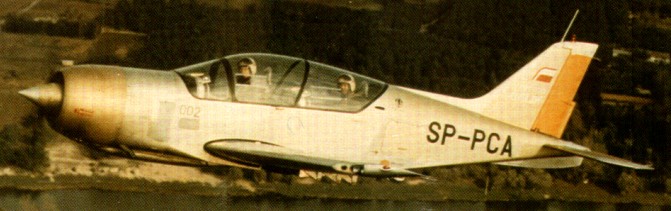
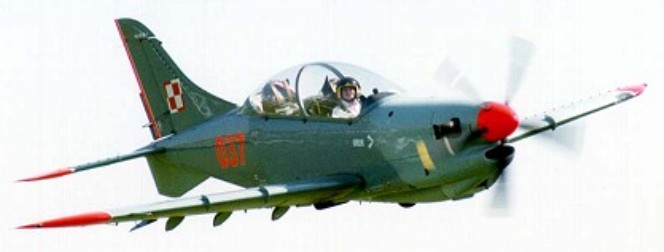
Design of the P.Z.L. 130 Orlik (Spotted Eaglet) piston-engined two-seat primary and basic trainer began in 1981 as a successor to the TS-8 Bies. Construction of four airframes, one for static test plus three flying prototypes, began in 1982
The first aircraft flew on 12 October 1983, followed quickly by the second. However, the third aircraft did not fly until January 1985, and the two pre-production machines which followed did not take to the air until February 1988, owing to serious delays in deliveries of the 246kW Vedeneyev M14Pm nine-cylinder Russian powerplant.
By that time P.Z.L. was seriously looking for another engine, and one contender was the company-produced but less powerful Kalisz K8-AA, which took the underpowered second pre-production aircraft into the air in March 1988. Although testing continued over the next two years, and included an evaluation by the Polish air force, the piston-engined Orlik was abandoned in 1990.
The original piston-engined PZL-130 Orlik was powered by a 268kW Vedeneyev radial engine driving a three-blade fixed-pitch propeller. The Orlik is of all-metal construction with a low-set cantilever wing and pneumatically operated retractable tricycle landing gear, and is of typical trainer configuration with the pupil and instructor seated in vertically staggered tandem seats under a side-hinged single-piece canopy. For the primary and basic stages of the flight training program, the Poles considered a piston engine adequate, and with this unit driving a constant-speed propeller the Orlik is suitable for all stages of the program between preselection and acrobatics. The provision of two underwing hardpoints also allows the type to be used in the weapon training, counter-insurgency, and reconnaissance roles.
Modular cockpit instrumentation allows rapid conversion between roles. Two underwing stores pylons are provided on the piston-powered version. Other uses envisaged include reconnaissance, light ground-attack, and target towing. Its maximum level speed is 197kt, with a cruise speed of 174kt. Range with maximum fuel is 765 n.m. and ceiling is over 17,000ft.
The three pre-production aircraft built all had different powerplants and ratings. These were the 560kW Motorlet M601D (P.Z.L. 130TM), the 410kW PT6A-25A (P.Z.L. 130T), and the 708kW PT6A-62 (P.Z.L. 130TP), and all flew in 1989/90.
In 1985, while waiting for supplies of M14Pm powerplants, PZL re-engined the third prototype with a Pratt & Whitney Canada PT6A-25A turboprop. The prototype PZL-130T Turbo-Orlik, developed in collaboration with AirTech of Canada, flew for the first time on 13 July 1986. Aimed primarily at export customers, the Turbo-Orlik has four underwing hardpoints, and was to be marketed by AirTech.
The -130T was provisionally certificated in January 1987, but the prototype PZL-130T crashed that month in Colombia during a demonstration to the Air Force, killing AirTech’s president.
In 1991, following the powerplant tests, the Polish air force placed an order for 48 P.Z.L. 130TBs powered by the Czech M601E engine and the first production Turbo-Orlik was delivered at the end of 1992.
Export sales were being sought for the PT6A-62-engined P.Z.L. 130TC, the PT6A-25C-equipped P.Z.L. 130TD, and the PT6A-25A-engined P.Z.L. 130TE ‘economy’ version, with a limited equipmentfit and minus ejection seats.
PZL-130 Orlik Engine: one 330-hp (245-kW) Vcdencycv M-l4Pm radial Maximum speed 211 mph (340 km/h) at optimum altitude Initial climb rate 1,378 ft (420 m) per minute Service ceiling 13,945 ft (4,250 m) Range 880 miles (1,416 km) Empty weight, 2,529 lb (1,147 kg) Maximum take-off 3,527 lb (1,600 kg) Wing span 26 ft 3 in (8.00 m) Lngth 27 ft 8.75 in (8.45 m) Heght 11 ft 7 in (3.53 m) Wing area 132.19 sq ft (12.28 sq.m)
PZL-130TB Turbo-Orlik Engine: 1 x Motorlet M601E turbo-prop, 560kW Max take-off weight: 2000 kg / 4409 lb Loaded weight: 1600 kg / 3527 lb Wingspan: 9.0 m / 30 ft 6 in Length: 9.0 m / 30 ft 6 in Height: 3.5 m / 12 ft 6 in Wing area: 13.0 sq.m / 139.93 sq ft Max. speed: 501 km/h / 311 mph Range w/max.fuel: 970 km / 603 miles Crew: 2
PZL 130 TM Turbo Orlik Engine: M 601 E, 483 shp Length: 28.543 ft / 8.7 m Height: 11.483 ft / 3.5 m Wingspan: 26.247 ft / 8.0 m Wing area: 132.397 sq.ft / 12.3 sq.m Max take off weight: 4359.3 lb / 1977.0 kg Weight empty: 2976.8 lb / 1350.0 kg Max. weight carried: 1382.5 lb / 627.0 kg Max. speed: 274 kt / 507 km/h Landing speed: 80 kt / 149 km/h Cruising speed: 237 kt / 438 km/h Initial climb rate: 3188.98 ft/min / 16.20 m/s Service ceiling: 32808 ft / 10000 m Wing loading: 33.01 lb/sq.ft / 161.0 kg/sq.m Range: 540 nm / 1000 km Crew: 2 Hard points: 6 External load: 720kg
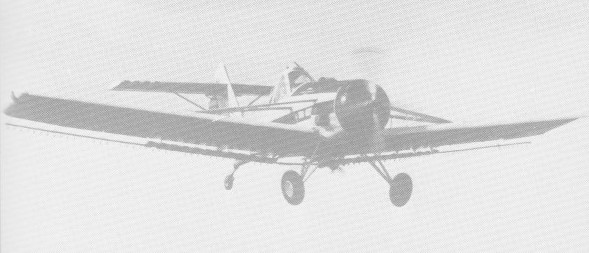
In early 1972 design was initiated for a new agricultural aircraft to replaceme the Z-37 Cmelak. Of braced low-wing monoplane configuration with fixed tailwheel landing gear, a T-tail, and enclosed accommodation for the pilot. First flown in P.Z.L. 106 prototype form on 17 April 1973, then powered by a 298kW Avco Lycoming IO-720 engine, it was followed by five more prototypes, one of which was similarly powered, but four each had a P.Z.L. 3S radial that was the chosen powerplant for production aircraft, the first version being the P.Z.L. 106A Kruk (raven) of which series construction began in 1976. Generally similar to the prototypes, it differed primarily by adopting a conventional tail unit and a larger-capacity chemical hopper, features adopted as standard on all production aircraft.
Subsequent P.Z.L. 106A variants have included the P.Z.L. 106AR which introduced a geared P.Z.L. 3SR engine and a larger-diameter propeller; the P.Z.L. 106AS prototype with a 746kW P.Z.L-built Shvetsov ASz-62IR radial engine and, following satisfactory tests, 60 P.Z.L. 106A aircraft operated overseas by Pezetel were converted to this powerplant; and the initial version of the Turbo-Kruk, the P.Z.L. 106AT, which, powered by a 567kW Pratt & Whitney of Canada PT6A-34AG turboprop engine, flew for the first time on 22 June 1981.
PZL-106
The prototype of an improved version of the P.Z.L. 106A was flown on 15 May 1981. Designated P.Z.L. 106B, this introduced a redesigned wing of increased span and area, and the 106B, 106BR and 106BS production variants superseded the corresponding A-series aircraft during 1982. These were followed by the P.Z.L. 106BT Turbo-Kruk which first flew on 18 September 1985. Powered by a 538kW Czech-built Motorlet M601D turboprop engine, improvements included increased sweep back on the wing, a taller fin and improved chemical payload. Production of all versions of the Kruk had totalled some 250 aircraft by 1990, including 54 exported to East Germany, and 60 plus Kruks used by the Pezetel agricultural air service organisation operating in Egypt. By 1992, however, production was reported to be at a standstill.
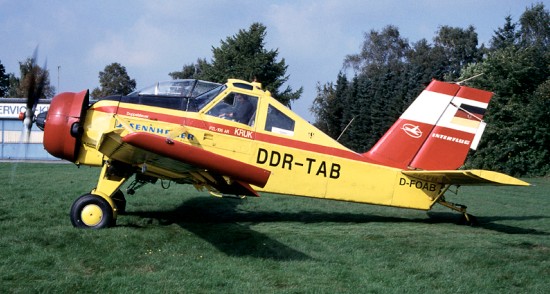
Interflug ordered 53 PZL-106A of which c/n 48040 was converted to a dual-control trainer. After the end of the DDR and elimination of Interflug all Kruks were put out of service.
(D-FOCA) PZL-Okecie 106 A Kruk 07810140 marked DDR-TCA
PZL 106 Kruk Engine: 584 hp Length: 29.856 ft / 9.1 m Height: 10.892 ft / 3.32 m Wingspan: 48.556 ft / 14.8 m Max. speed: 76 kts / 140 kph Service ceiling: 15092 ft / 4600 m Crew: 1
PZL 106B Engine: 1 x PZL 3S radial, 441kW / 600 hp Max take-off weight: 3000 kg / 6614 lb Loaded weight: 1670 kg / 3682 lb Max. speed: 137 km/h / 85 mph Ceiling: 4600 m / 15100 ft Range: 1100 km / 684 miles
PZL 106 BT Turbo Kruk Engine: M 601 D, 537 shp Length: 33.465 ft / 10.2 m Height: 12.467 ft / 3.8 m Wingspan: 49.213 ft / 15.0 m Wing area: 341.219 sq.ft / 31.7 sq.m Max take off weight: 7717.5 lb / 3500.0 kg Weight empty: 3704.4 lb / 1680.0 kg Max. weight carried: 4013.1 lb / 1820.0 kg Max. speed: 135 kt / 250 km/h Landing speed: 49 kt / 90 km/h Cruising speed: 92 kt / 170 km/h Initial climb rate: 1181.1 ft/min / 6.0 m/s Wing loading: 22.55 lb/sq.ft / 110.0 kg/sq.m Range: 486 nm / 900 km Crew: 1
Engine: M 14 P, 261 hp Length: 28.215 ft / 8.6 m Height: 9.186 ft / 2.8 m Wingspan: 41.667 ft / 12.7 m Wing area: 181.912 sq.ft / 16.9 sq.m Max take off weight: 3682.4 lb / 1670.0 kg Weight empty: 2105.8 lb / 955.0 kg Max. weight carried: 1576.6 lb / 715.0 kg Max. speed: 135 kts / 250 km/h Landing speed: 51 kts / 95 km/h Cruising speed: 127 kts / 235 km/h Initial climb rate: 1043.31 ft/min / 5.30 m/s Service ceiling: 18045 ft / 5500 m Wing loading: 20.3 lb/sq.ft / 99.0 kg/sq.m Range: 540 nm / 1000 km Crew: 1+5
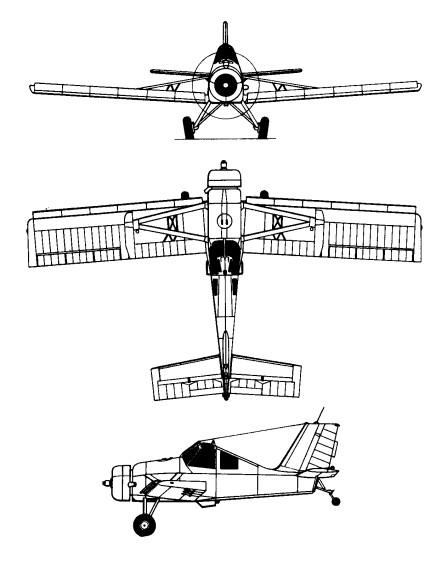
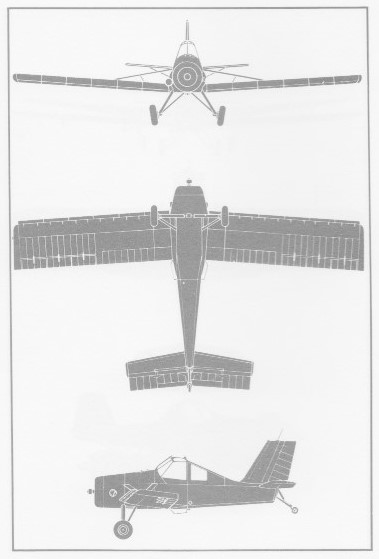
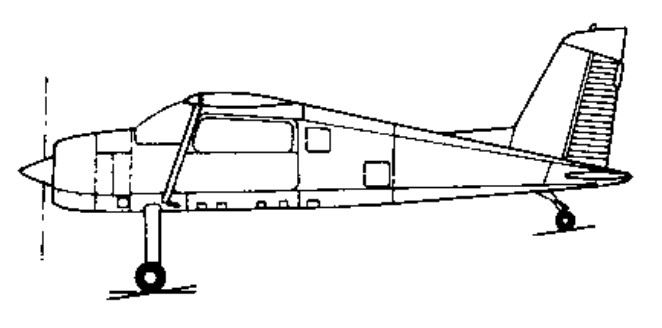
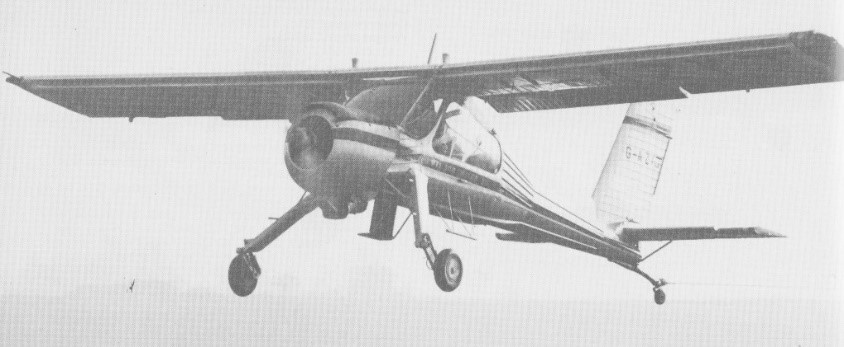
Designed as a successor to the Polish-built Yak-12 and the P.Z.L. 101 developed from it, the original P.Z.L. 104 Wilga 1 (Thrush) prototype, powered by a 134kW Narkiewicz WN-6 flat-six engine, was flown for the first time on 24 April 1962.
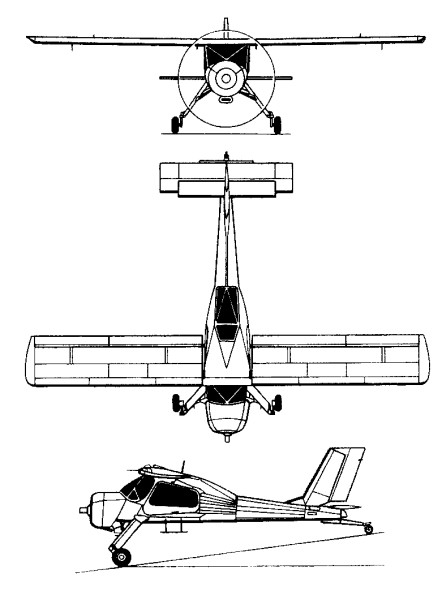
A cantilever high-wing monoplane with fixed tailwheel landing gear and an enclosed cabin, it was followed by prototypes of the Wilga 2P and Wilga CP, powered by the 138kW Narkiewicz WN-6RB2 and 168kW Continental O-470-13A or O-470-L flat-six engines respectively. Intended as a general-purpose aircraft, the P.Z.L. 104 was offered initially in versions equipped for use as a four-seat passenger-carrying or liaison aircraft; for club flying, glider towing or parachuting; for agricultural use with a 500-litre hopper for dust or liquid application; and as an air ambulance carrying pilot, doctor, two stretcher patients and medical equipment.
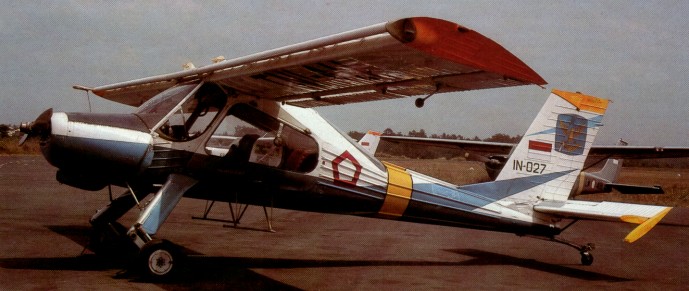
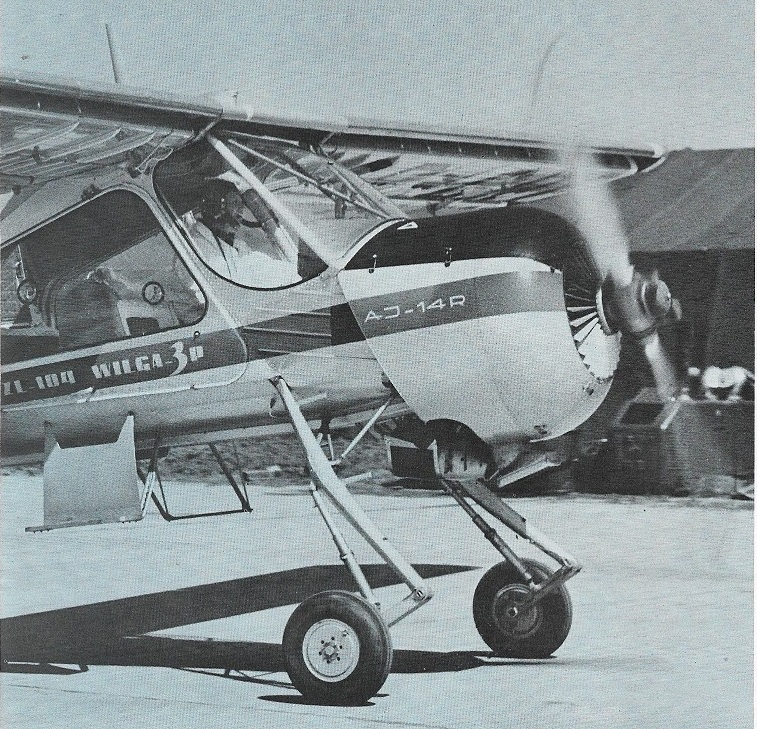
Following construction of a number of prototypes, the type entered production initially as the Wilga 3A club aircraft and the Wilga 3S air ambulance. In 1967 the design was revised to give better cabin accommodation and with improved landing gear, production beginning in 1968 of the Wilga 35 which, powered by a 194kW Ivchenko AI-14R engine, had flown for the first time on 28 July 1967, and of the Wilga 32 with a 172kW Continental O-470-K flown on 12 September 1967. This last version was built under licence in Indonesia as the Lipnur Gelatik 32 (rice bird) with a Continental O-470-R engine of similar output. The Wilga 35 first flew on 28 July 1967.
The later versions have automatic wing leading edge slats, an all moving tailplane and a detachable under-¬fuselage cargo container.
PZL-104-3P
The Wilga’s design incorporates an air powered starting system for one. It looks complex, but it has one advantage in that batteries are almost worthless in extreme cold. The landing gear incorporates a short trailing beam at the end of each main gear strut so that its wheels recoil up and rearward, enhancing its ability to handle rough, off airport landings. Engine cooling is designed to cope with wide air temperature extremes, long climbs and rapid descents. The cowl shutters, manually operated by a knob in the cockpit open fully to cool the 620 cubic inch radial on a climb, then close tightly so the airplane can perform its patented 4,000fpm descents without warping the cylinder heads. The airplane is not only adapted very nicely to hauling sailplanes aloft but also to winter operations without fancy cold weather kits. The engine will run on anything from 70 octane fuel up. A gear driven supercharger provides a constant boost of about three inches, and it has a two blade constant speed prop.
The wing is strutless, fully cantilevered; the ailerons droop with full flaps for landing, and there’s a fixed, full span leading edge slot. The tailcone carries its structural members outside the skin, giving the impression of widely spaced corrugations; Four low bucket seats occupy the cabin, with an aft cargo compartment under glass. It has dual flight controls except for trim, and both rudder pedals carry toe brakes. The throttle and prop controls are designed to be operated with one hand; their rates are nicely matched so that for a go around, you grab both handles and push.
The Wilga demonstrates excellent STOL performance, accelerating crisply and lifting off at a radical climb angle. At sea level, the airplane is said to produce a climb of 1,240 feet per minute at its gross weight of 2,711 pounds, which is lighter than a Cessna 180 but with more horsepower to heft it. This airplane’s empty weight is 1,874 pounds, and it carries 252 pounds of fuel; its payload, after allowing for oil and incidentals, is probably around 550 pounds. The Wilga is slow, producing only 104 knots at maximum cruise on about 15 gallons per hour.
Wilga 35
Developments of the Wilga 35 have included the Wilga 35A intended for aero-club use; the Wilga 35H floatplane fitted with Airtech (Canada) LAP-3000 floats; the multi-purpose Wilga 35M fitted with a 260kW M-14P radial engine, flown in prototype form in 1990; the Wilga 35P tourer or air-taxi version; and the Wilga 35R agricultural variant. A version generally similar to the Wilga 35, but meeting US FAR Part 23 requirements, is designated the Wilga 80. The first of these flew on 30 May 1979, and is available in three versions, the 80A, for aero-club use, the 80H floatplane, and as the 80R for agricultural use. A more radical redesign, originally identified as the Wilga 88, has become the P.Z.L. 105 Flamingo. The Wilga 35 and 80 remain in production in 1993, by which time P.Z.L. had sold around 900 variants to countries around the world.
Certification of the PZL-104 Wilga 35A is under European Aviation Safety Agency EASA A.061.
Some 800 PZL 104 have been manufactured, but was no longer in production in 1991.
Wilga 2 Engine: 185 hp Narkiewicz WN-6RB2 Wingspan: 36 ft 5 in Length: 26 ft 3 in Height: 8 ft 10 in Wing area: 166.84 sq.ft Empty weight: 1543 lb Loaded weight: 2535 lb Max speed: 124 mph Cruise: 106 mph ROC: 886 fpm Service ceiling: 13,125 ft Normal range: 4235 mi Max range: 625 mi
Wilga 2P Seats: 4
Wilga 2R Agricultural version
Wilga C Export version prototype
Wilga 3P Initial production Seats: 4
Wilga CP / Gelatik As 3P, with engine change
Wilga 3A Parachuting, glider towing
Wilga CA As 3A, with engine change
Wilga 3C As CP, new tailplane, tailwheel and forward inclined gear legs
Wilga 3D Dual control version of 3P
Wilga CD As 3D with engine change
Wilga 3R Ag version of 3P
Wilga CR As 3R with engine change
Wilga 3S Ambulance version of 3P
Wilga CS As 3s with engine change
Wilga 32 / Gelatik 32 1967 improved version
Wilga 32A Aeroclub version
Wilga 32P Passenger version
Wilga 32S Ambulance version
Wilga 35 As 32 Engine: Ivchenko AL-14R, 260 hp Wingspan: 36 ft 5 in / 11.13 m Length: 25 ft 6.75 in / 8.10 m Empty weight equip: 1874 lb / 850 kg MTOW: 2755 lb / 1250 kg Max cruise: 104 kt / 120 mph / 193 kph ROC SL: 1245 fpm / 380 m/min Service ceiling: 15,025 ft / 4580 m Range max fuel, 30min res: 366 nm / 422 mi / 680 km Seats: 4 Glider tow weight: 1433 lb / 650 kg Multi-glider max combined tow weight: 2480 lb // 1125 kg Cabin length: 7 ft 2.5 in / 2.20 m Cabin width: 3 ft 10 in / 1.20 m Cabin height: 4 ft 11 in / 1.50 m
Wilga 35 Engine: 260 hp PZL built Ivchenko IA 14RA radial Prop: 8 ft 8 in (2,65 m) dia two blade wood Wing span: 36 ft 4.75 in (11.14 m) Length: 26 ft 6.75 in (8.10m) Wing area: 166.8 sq.ft. (15.50 sq.m) Gross weight: 2,711 lb (1,230 kg) Max cruising speed: 120 mph (193 km/h) Max range: 410 miles (660 km) Seats: 4
Wilga 35A Engine: 1 x Ivchenko AI-14RA radial, 194kW / 256 hp Max take-off weight: 1300 kg / 2866 lb Loaded weight: 900 kg / 1984 lb Weight empty: 1830.2 lb / 830.0 kg Wingspan: 11.12 m / 37 ft 6 in Length: 8.1 m / 27 ft 7 in Height: 2.96 m / 10 ft 9 in Wing area: 15.5 sq.m / 166.84 sq ft Max. speed: 195 km/h / 121 mph Cruising speed: 104 kts / 193 km/h Ceiling: 4040 m / 13250 ft Range: 670 km / 416 miles Crew: 1 Payload: 3 Pax
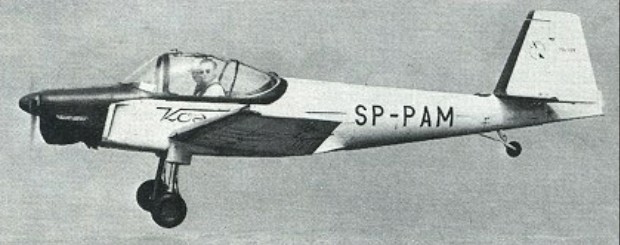
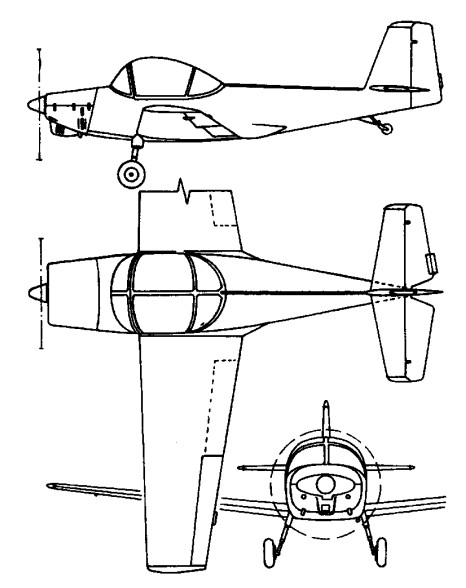
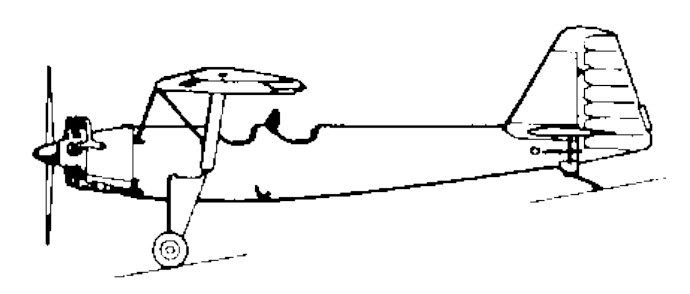
On 23 May 1958 P.Z.L. flew the prototype of a two-seat semi-aerobatic light monoplane to which it allocated the designation P.Z.L. 102, later giving it the name Kos (Blackbird). Of all-metal construction, except for fabric-covered tail control surfaces, this had fixed tailwheel landing gear, seated two side-by-side in an enclosed cockpit and, as first flown, was powered by a 48kW (65-hp) Nar-kiewicz WN-1 flat-four engine. Further prototypes preceded the production P.Z.L. 102B flown first in October 1959, which was powered by a Continental C90-12F engine, and the type was built in moderate numbers before production ended in 1964.
PZL 102B Engine: 1 x Continental C90-12F, 71kW Wingspan: 8.5 m / 28 ft 11 in Length: 6.95 m / 23 ft 10 in Height: 1.9 m / 6 ft 3 in Wing area: 11.0 sq.m / 118.40 sq ft Max take-off weight: 655 kg / 1444 lb Empty weight: 418 kg / 922 lb Max. speed: 190 km/h / 118 mph Ceiling: 4600 m / 15100 ft Range: 640 km / 398 miles
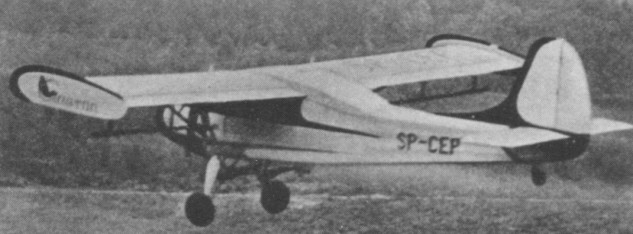
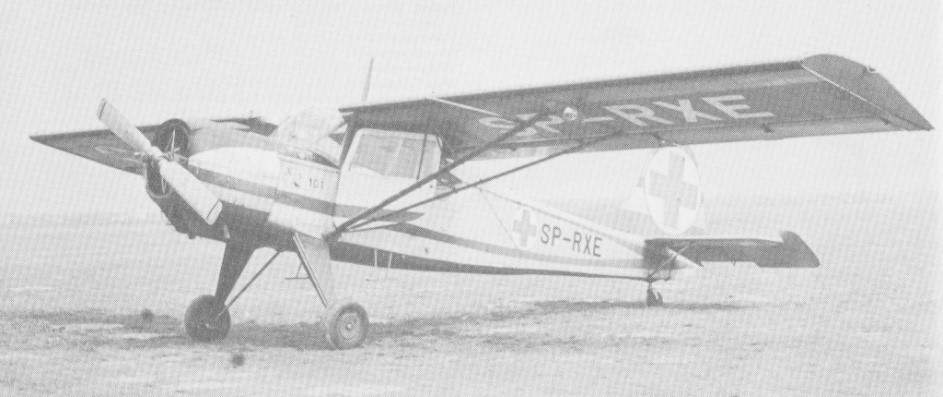
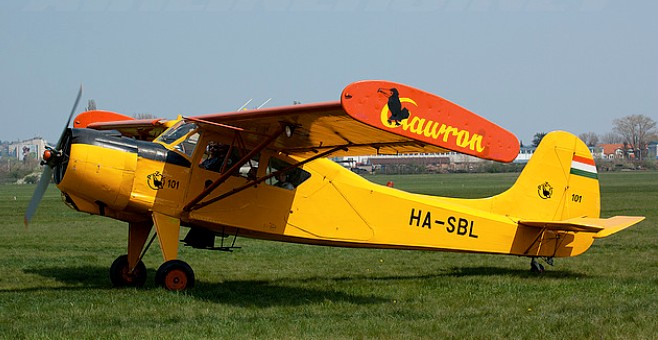
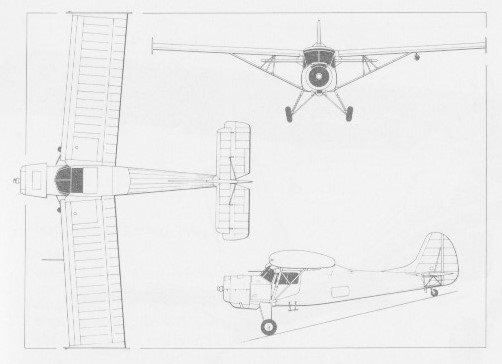
The PZL 101 was developed from the Yak-12M, which was licence-produced in Poland. The first prototype flew on 15 April 1958. Series production started in 1960.
Three basic versions were built; agricultural, ambulance and utility, with equipment according to role. Initially manufactured in two versions, the PZL 101G2 could accommodate four people.
Late production aircraft have laminar-flow wingtips instead of the original type fitted with endplates.
By 1968 a total of 325 Gawrons were built including 143 for export.
Production ceased in 1973 after more than 330 had been built.
PZL-Okecie PZL-101A Gawron
Engine: 1 x Ivchenko AI-14R radial, 260hp Wingspan endplate tips: 12.68 m / 41 ft 7.5 in Wingspan laminar tips: 13.03 m / 42 ft 9 in Length: 9.0 m / 30 ft 6 in Height: 3.12 m / 10 ft 3 in Max take-off weight: 1660 kg / 3660 lb Empty weight ag: 1025 kg / 2260 lb Empty weight ambulance: 1068 kg / 2354 ln Max. speed: 180 km/h / 112 mph Cruise speed ag: 130 km/h / 81 mph / 70 kt ROC ag: 162 m/min / 530 fpm Service ceiling ag: 3280 m / 11,100 ft Range int/fuel ag: 660 km / 410 miles / 356 nm Range ext/fuel ag: 1140 km / 708 miles / 614 nm Cabin volume: 2.55 cu.m / 90 cu.ft Capacity: 4 seats / 500 kg / 1100 lb / 175 Imp.G / 800 lt / 660 lb / 300 kg
A 1986 single-piston-engined, retractable-gear design intended for military pilot selection and civilian pilot training, the M-2600 prototype flew on July 18, 1986, powered by a 153kW engine. Some assemblies from the M-20 Mewa (licence-built Piper Seneca) were used in the Iskierka’s wing, tail unit, landing gear, and electrical systems.
PZL Mielec M 26 Iskierka Engine: Lycoming AEIO 540 L1B, 221 hp Length: 27.231 ft / 8.3 m Height: 9.843 ft / 3.0 m Wingspan: 28.215 ft / 8.6 m Wing area: 150.696 sq.ft / 14.0 sq.m Max take off weight: 3087.0 lb / 1400.0 kg Weight empty: 2072.7 lb / 940.0 kg Max. weight carried: 1014.3 lb / 460.0 kg Max. speed: 184 kts / 340 km/h Landing speed: 59 kts / 110 km/h Cruising speed: 167 kts / 310 km/h Initial climb rate: 1574.8 ft/min / 8.00 m/s Wing loading: 20.50 lb/sq.ft / 100.0 kg/sq.m Range: 875 nm / 1620 km Crew: 2