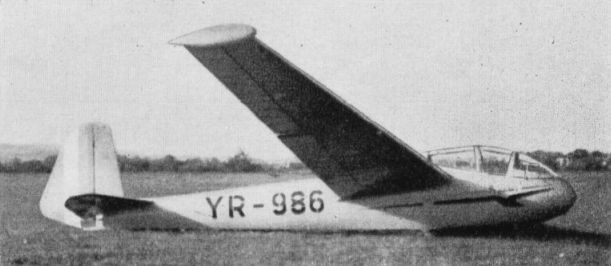
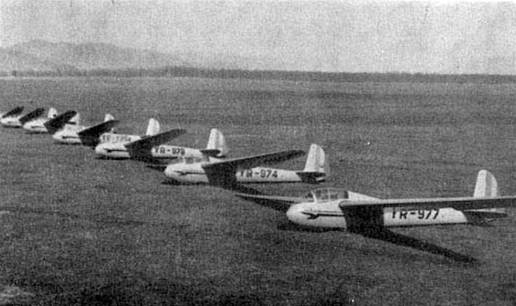
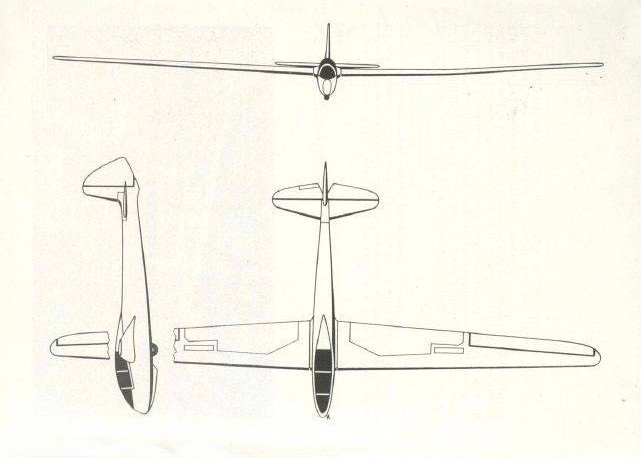
The second of Ing Vladimir Novitchi’s sailplanes to go into service with Romanian clubs was the RG-9 Albatros tandem two-seater trainer, which first flew in prototype form on 1 June 1958, and of which 25 were built. It is of conventional wooden construction, characterised by a cantilever mid wing and a long cockpit canopy with two separate sideways opening sections for pilot exit and entry. The wooden wings each have a plywood leading edge torsion box and fabric covering aft of the spar; air brakes are fitted and the wooden ailerons are fabric covered. The fuselage is a plywood monocoque, and the landing gear consists of twin wheels under the centre fuselage plus a skid under the nose. The cantilever tail unit is of wooden construction.
Span: 54 ft 0 in Length: 26 ft 2 in Wing area: 215 sqft Aspect ratio: 13.5 Empty weight: 639 lb Max weight: 1,036 lb Min sinking speed: 2.79 ft/sec at 38.5 mph Best glide ratio: 25:1 at 49 mph
The IFIL-Reghin RG-5 Pescăruș (English: Herring gull) or CIL Reghin RG-5 Pescăruș was a Romanian single seat glider designed by Vladimir Novitchi and built in Romania in the 1950s, intended for club use. It was a mid-wing cantilever monoplane. Like the rest of the aircraft, the wing was wooden, built around a single spar and mounted with 1.66° of dihedral. Plywood skinning from the spar forward and around the leading edge formed a torsion box; the rest of the wing was covered with a mixture of ply and fabric. In plan the wing was symmetrically straight tapered, with squared tips, where there were small tip bodies or plates. It had wood-framed, fabric-covered, balanced ailerons which reached out to the wing tips. DFS (Schempp-Hirth) type airbrakes were mounted at mid-chord, just inboard of the ailerons. There were no flaps.
The RG-5 had a ply monocoque fuselage with its single cockpit ahead of the wing, enclosed by a multipart, sideways-opening canopy which reached to the nose. It landed on a fixed monowheel under mid-wing, with a skid that reached from the nose to under the leading edge, assisted by a small tail bumper. The fuselage tapered markedly from the cockpit aft to a conventional wooden-framed, fabric-covered empennage. Both tailplane and fin were straight edged, with the former mounted forward of the fin at shoulder position and carrying rounded elevators. Together the fin and rudder were flat topped. The rudder hinge was at the trailing edge of the elevators, leaving the rudder, broad and straight edged to its rounded heel, clear to extend down to the keel.
The RG-5 Pescăruș was first flown on 8 September 1957.
Twenty-six were constructed by Intreprinderea Forestierǎ di Industrializare a Lemnului (FILI) from 1958, going to Romanian gliding clubs.
Wingspan: 15.10 m (49 ft 6 in) Wing area: 15.40 m2 (165.8 sq ft) Aspect ratio: 14.60 Airfoil: Göttingen 549 (modified) Length: 7.38 m (24 ft 3 in) Empty weight: 210 kg (463 lb) Gross weight: 300 kg (661 lb) Stall speed: 50 km/h (31 mph, 27 kn) Aertowing speed: 120 km/h (75 mph; 65 kn) Maximum glide ratio: best 27 at 76 km/h (47 mph; 41 kn) Rate of sink: 0.76 m/s (150 ft/min) minimum, at 60 km/h (37 mph; 32 kn) Wing loading: 19.5 kg/m2 (4.0 lb/sq ft) Crew: One
The Romanian organisation of Cil Reghin began developing gliders to the design of Ing Vladimir Novitcni in 1953, starting with the RG-4 Pionier primary trainer.
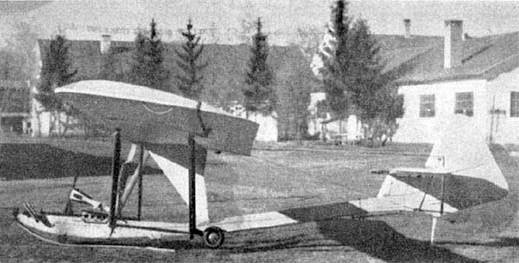
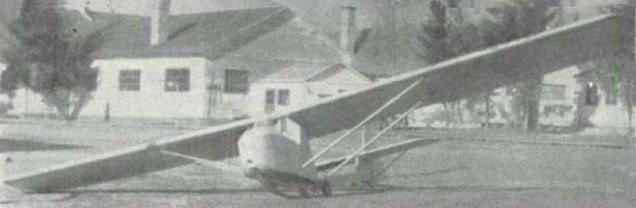
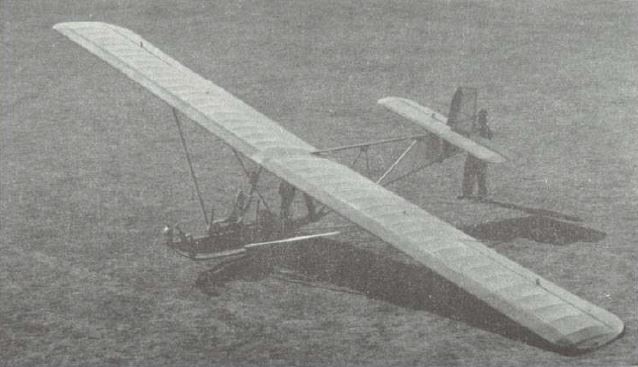
The RG-4 Pionier was a single seat primary glider built in Romania in the 1950s. Designed by Vladimir Novitchi and very much in the 1930s Zögling tradition with the pilot exposed on a simple beam fuselage under the leading edge of a high wing. This wing was supported over the fuselage beam on a set of N-form, cross braced struts and by a pair of parallel lift struts on each side to the wing at about one third span. The wing, which was wood framed, was mounted with 2.8° of dihedral, had parallel chord and was unswept. There were plain, fabric covered ailerons out to the wing tips.
The RG-4 landed on a fixed monowheel under the wing trailing edge, with a skid that reached from the nose to under mid chord, assisted by a small tailskid. It had a conventional empennage with a parallel chord tailplane and elevators, similar in plan to the wing, mounted in front of the narrow fin, held above the fuselage on a short step and braced from below with a single strut on each side. Despite its forward position the elevators still required an elevator cut-out for rudder movement. As well as carrying the broad, near triangular rudder, the fin also anchored a pair of bracing wires on each side to reduce horizontal flexing of the fuselage beam. One of these ran to the wing underside, the other to the fuselage under the wing.
The RG-4 Pionier was first flown on 1 May 1954. A batch of fifty was produced by Intreprinderea Forestierǎ di Industrializare a Lemnului (FILI).
Wingspan: 10.45 m (34 ft 3 in) Wing area: 14.8 sq.m (159 sq ft) Aspect ratio: 7.0 Airfoil: NACA 60 modified Length: 5.75 m (18 ft 10 in) Height: 1.2 m (3 ft 11 in) Empty weight: 100 kg (220 lb) Gross weight: 188 kg (414 lb) Stall speed: 40 km/h (25 mph, 22 kn) Never exceed speed: 165 km/h (103 mph, 89 kn) placard, in smooth air Rough air speed max: 100 km/h (62 mph; 54 kn) Winch launch speed: 90 km/h (56 mph; 49 kn) Maximum glide ratio: best 14.5 at 58 km/h (36 mph; 31 kn) Rate of sink: 0.90 m/s (177 ft/min) minimum, at 52 km/h (32 mph; 28 kn) Wing loading: 12.7 kg/sq.m (2.6 lb/sq ft) Crew: One
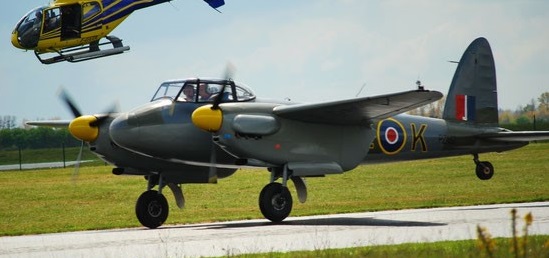
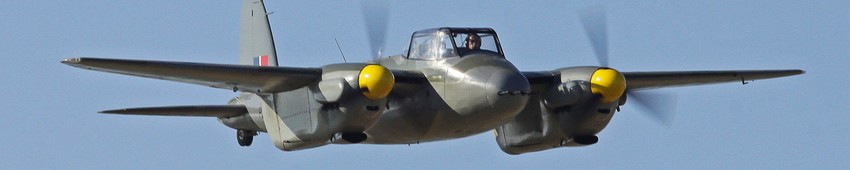
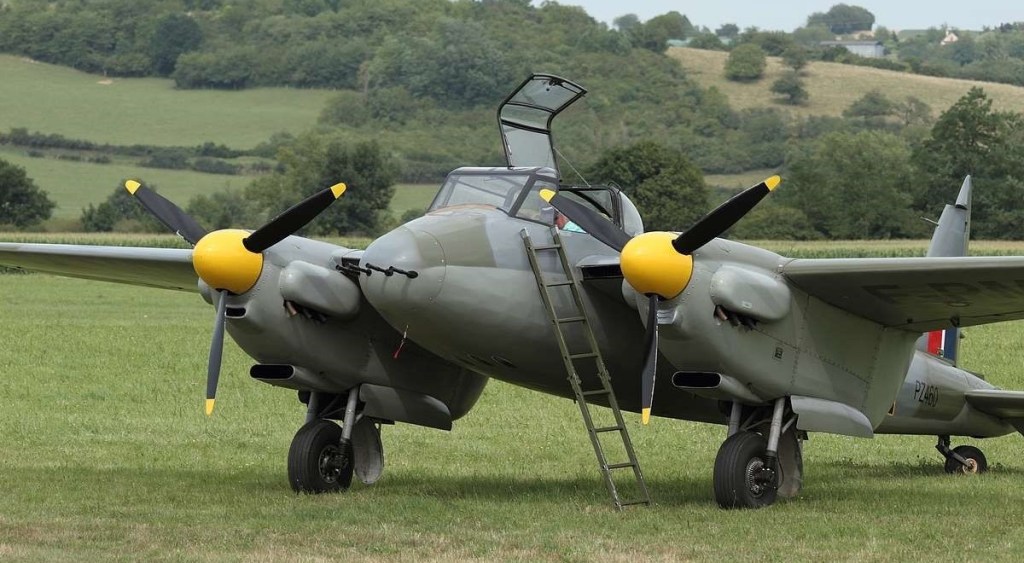
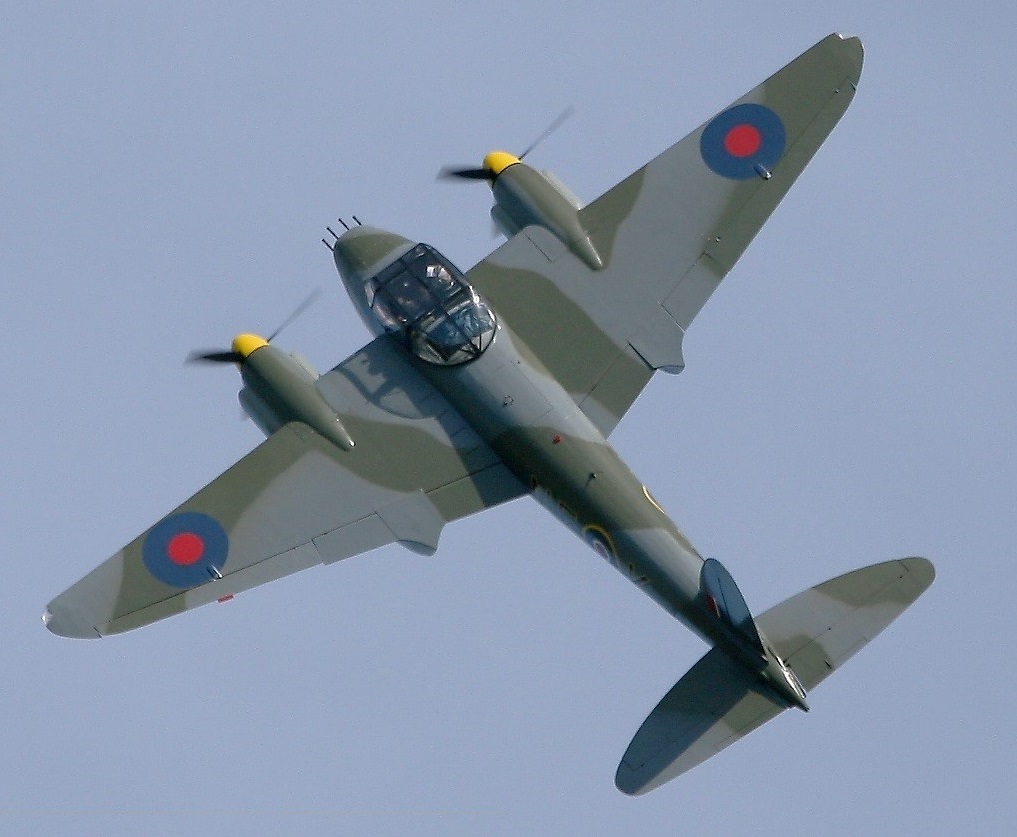
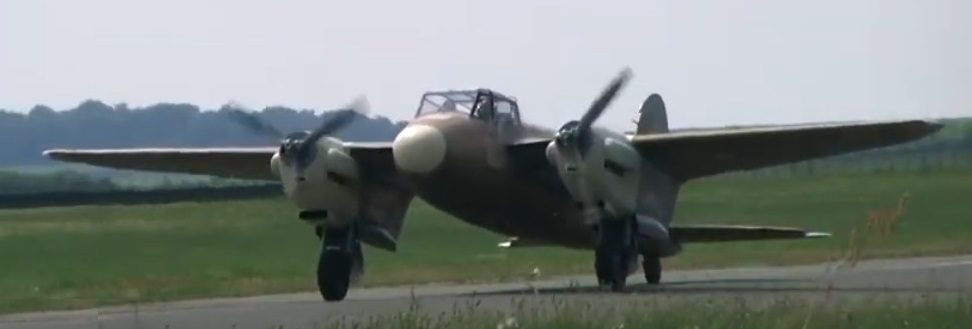
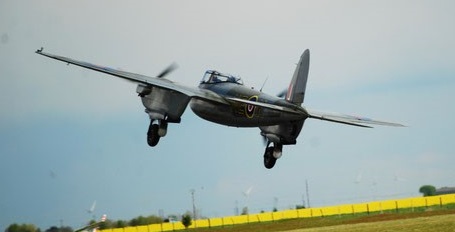
The French association Reconstruction Répliques Avions Anciens began work on 3/4-scale de Havilland Mosquito replica the replica in 1995 and required over 30,000 hours of work before it was ready for the first test at the Fontenay-le-Comte airfield.
The first engine test was carried out earlier this year and were then followed by high-speed ground tests. The first flight took place on April 23, 2011.
This replica of a British WWII bomber overturned on 6 August 2015 after touching the ground in Fontenay-le-Comte. The pilot is seriously injured.
Thursday evening, at 8:45 p.m., the plane approached an airstrip at the aerodrome of Fontenay-le-Comte, in the south-Vendée. This three-quarter-length replica of a Mosquito, a British WWII bomber, returns to its “base” after a commemoration, in Jonzac, in Charente-Maritime. On board: Hervé Thebaud, the pilot, an instructor from Île d’Yeu; and Jean-Paul Bichon, the co-pilot, a resident of Luçon, both in their sixties.
According to several witnesses, the landing “is going well”. Shortly after touching the ground, “a hundred meters from cutting the throttle”, during the “taxiing” phase, the aircraft got slightly askew. At this precise moment, it tilts forward, “like a wooden horse”, and completely overturns, until the fin hits the ground. He ends his race on his back. An aerodrome mechanic is already running towards the aircraft. Seeing the aircraft’s turn signals still on, he said to himself that it was absolutely necessary to “cut the battery to prevent it from causing a fire” with the fuel escaping from the tank. It then contains “at least 400 liters of gasoline”. When the mechanic arrives in front of the machine, the pilot and the co-pilot are aware and can press the button. The co-pilot is the first to exit, with the help of the mechanic who broke the window. The pilot was extricated after an hour by the firefighters, “quickly on the spot”. Seriously injured, he will later be directed to Nantes. Its vital prognosis is not engaged. On the aerodrome, around thirty firefighters cover the aircraft with a carpet of foam. The last left at 12:30 am Several people, including the co-pilot who returned from the emergency room, then got busy to get the Mosquito out of the airstrip. It is when trying to turn it over with a crane that the tail, which was already hanging on by a thread, becomes detached. The plane had required 17 years of work. According to a member of the Luçonnaise association which built it (Replicas and reconstruction of old planes), it will be “difficult to repair”.
Ironically, the Mosquito had, the same day, flew over Jonzac in homage to the crew of an Allied bomber that crashed there on August 6, 1944.
Wingspan: 12.04 m Length: 9.30 m Height: 2.45 to 2.53 m
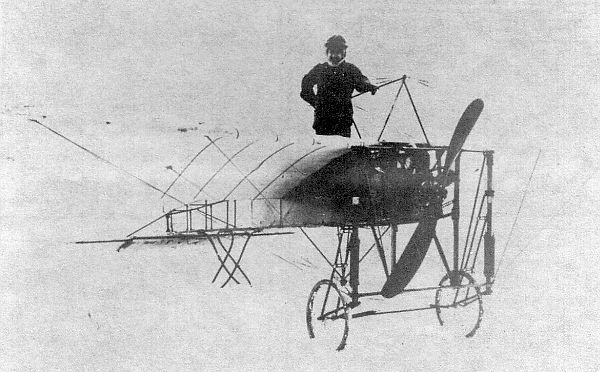
Based on the Bleriot XI, and designed in 1910 by Russian Nikolai Vasilyevich Rebikov, the Rossia B (Pуссиа Б) was built by the Shchetinin works in St. Petersburg, Russia.
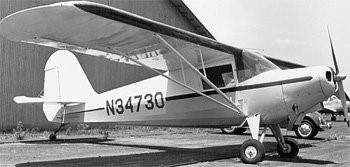
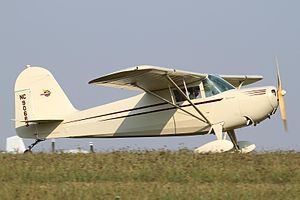
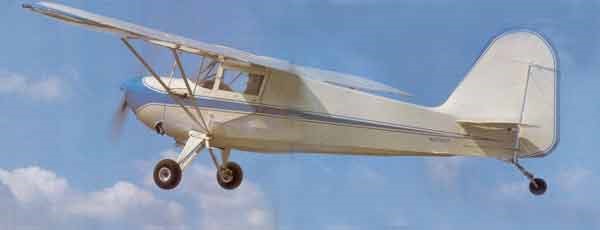
Rearwin Aircraft and Engines introduced the Skyranger in 1940 as a side-by-side two-seat cabin monoplane. Designed by Gene Salvay and George A. Stark, the Skyanger was first flown on 9 April 1940, given Aircraft Type Certificate #729 in 1940.
This aircraft was first produced in four versions: the 175 with a 75-hp Continental, the 180 with an 80-hp Continental, the 180F with a 80-hp Franklin, and the 190F powered by a 90-hp Franklin engine. Seating two people side-by-side, it featured a fabric-covered steel tube fuselage and wooden wing and it sold for about $3000. It had a conventional landing gear with a tailwheel.
About 85 were built by 1941. The Skyranger was the last design of Rearwin Aircraft. Production stopped in 1942 because of the war effort.
In 1942 the Rearwin Airplane Company was purchased by Commonwealth Aircraft of Kansas City, Missouri. In 1943 the company was reorganized as the Commonwealth Aircraft Corp. The Commonwealth Skyranger 185, with its Continental C-85-12 engine, new from the factory on Long Island was about $3,000 in early 1946.
Commonwealth 185
In 1946 Commonwealth re-established the construction of the Skyranger at their Valley Stream plant for just one year. By November of 1946, production of the Skyranger stopped due to market pressures. It had many minor modifications but was essentially the same aircraft. The Skyranger 185 is fabric covered. The fuselage is welded steel tubing, and the wing has wood spars and ribs. A full electrical system was standard, and the aircraft has a large baggage compartment, and wing slots which give better aileron control at low speeds. Two 12.5-gal. wing tanks were standard, 18-gal. tanks were an option. As the anticipated post-war boom in civil aviation had not then started, Commonwealth went bankrupt in 1947, after 275 Skyrangers were built by Commonwealth.
Serial numbers in the 1500s were built by Rearwin. Serial numbers in the 1600s are Commonwealth 185 Skyrangers.
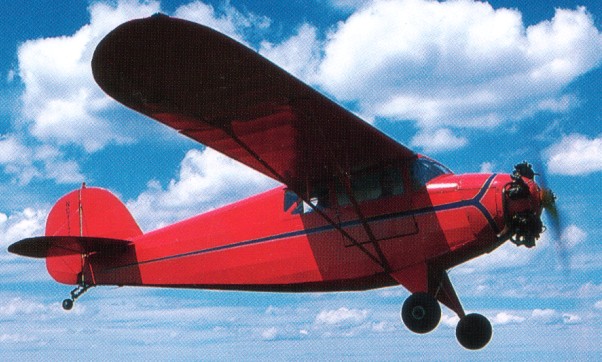
Built in the US in the 1930s. A two seat, light touring cabin monoplane, powered by a 90hp Ken Royce 5F or Le Blond 5F radial. Capable of 120mph at 1,000ft.