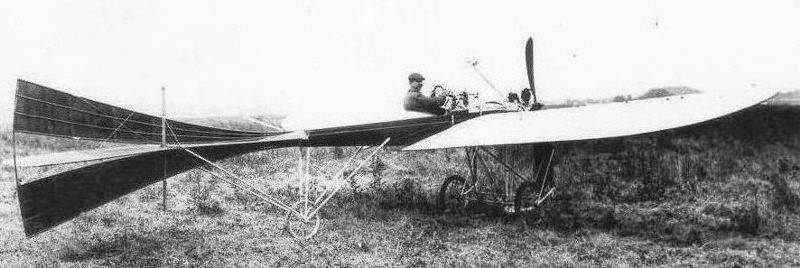
The Reynard R.4 Primary was an open seat primary glider with an open girder fuselage and a high, wire braced wing.
The wing was rectangular in plan, with ailerons at the tips but no flaps or airbrakes. N-form struts from the wing supported a girder about 8.5 ft (2.6 m) long and curved on the underside to form a landing skid. The pilot’s seat and controls were placed, exposed, on its upper surface just ahead of the wing. Lift wires ran from this girder to the underside of the wing beyond mid-span and a pair of landing wires on each side were fixed to the apex of a two strut, triangular central cabane or kingpost above the wing.
Behind the wing trailing edge and the end of the lower girder the rear fuselage was a tapering, vertically orientated, two bay Warren truss, ending at a vertical cross member which supported the rudder. The triangular tailplane and fin were mounted on the horizontal upper fuselage beam and the straight edged rudder extended down through a cut-out between the elevators to the lower beam.
It was designed and at least five built in the UK in 1930 by Reynard Gliders, Leicester. Some Reynards were built with a hinged nacelle to give the pilot better protection from the weather, though still in an open cockpit. To compensate for the extra side area the rear two bays of the fuselage were fabric covered.
It has been suggested that at least two R.4s were built with steel tubed rather than wooden rear fuselages, under the name Reynolds R.4 after the contemporary bicycle tube frame manufacturer.
The Reynard could be bought complete for £45 or built from plans costing 21/- (1 guinea or £1.05) and was regularly advertised in 1930-1. Several were built and active in the early 1930s with UK gliding clubs. One was demonstrated to the Leeds club in October 1930 and they received the first of two the following month. The Bradford, Halifax, Leicester and Ulster Gliding Clubs also had Reynards.
The two Reynards that received BGA certificates of airworthiness, BGA 166 and 167 had serial number R.4/5 and R.4/6 respectively BGA 166 was used by the Leeds and later Bradford Gliding Clubs. BGA 167 was used by the Ulster Gliding Club from 1931, they fitted a nacelle when they rebuilt it aircraft in 1933. This glider went to the Dublin Gliding Club in 1934 and was still active the following year.
Wingspan: 34 ft 2 in (10.41 m) Aspect ratio: 6.6 Length: 18 ft 3 in (5.56 m) Height: 7 ft 2 in (2.18 m) Crew: 1
The R-1 was an experimental twin-engine monoplane with variable- incidence wings, first flown with normal wings on 16 December 1949, and with articulated wings in 1951.
Original patents taken out in 1938 and an aircraft built in 1940, but was destroyed during the war. Two prototypes were built, of wooden construction, powered by two Renault 6R engines.
The outer wing panels are articulated on an oblique hinge-line and these orientate automatically in turbulent air, the varying incidence absorbing the loads imposed.
Engines: two Renault 6R, 216 hp Wingspan: 43 ft 2.5 in Length: 30 ft 2 in Height: 11 ft 11 in Empty weight: 4950 lb Loaded weight: 6490 lb Max speed: 202 mph Time to 3280 ft: 4 min 10 sec Ceiling: 19,025 ft
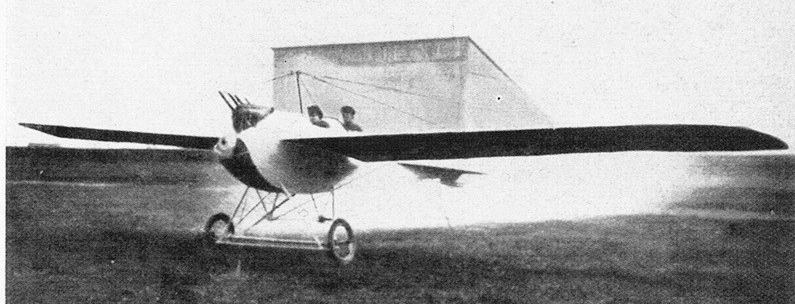
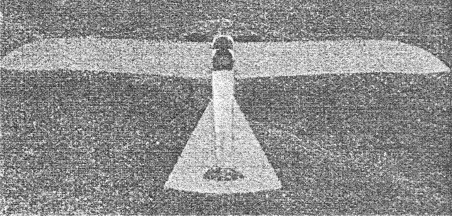
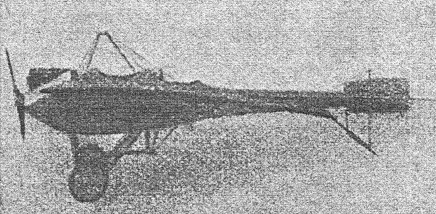
Requillard’s monoplane made its official appearance at Juvisy, France, in June 1910, flown by Marc Pourpe. The machine was very slender and streamlined, with long and triangular fixed tail surfaces, the rudder in two parts connected at the trailing edges to allow the elevator to move up and down between them. It was powered by a 50 hp Gnome. It was reported to have flipped onto its back on its first tests.
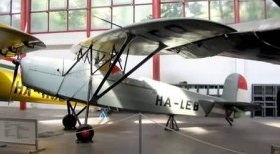
Training and liaison aircraft, Hungary, first flown in October 1940
Engine: Hirth HM 504 A2, 104 hp Wingspan: 31.004 ft / 9.45 m Wing area: 145.314 sq.ft / 13.5 sq.m Length: 19.948 ft / 6.08 m Height: 8.301 ft / 2.53 m Max take off weight: 1653.8 lb / 750.0 kg Weight empty: 1036.4 lb / 470.0 kg Max speed: 97 kts / 180 km/h Cruising speed: 86 kts / 160 km/h Service ceiling: 14764 ft / 4500 m Wing loading: 11.48 lb/sq.ft / 56.0 kg/sq.m Range: 351 nm / 650 km Armament: None Crew: 1
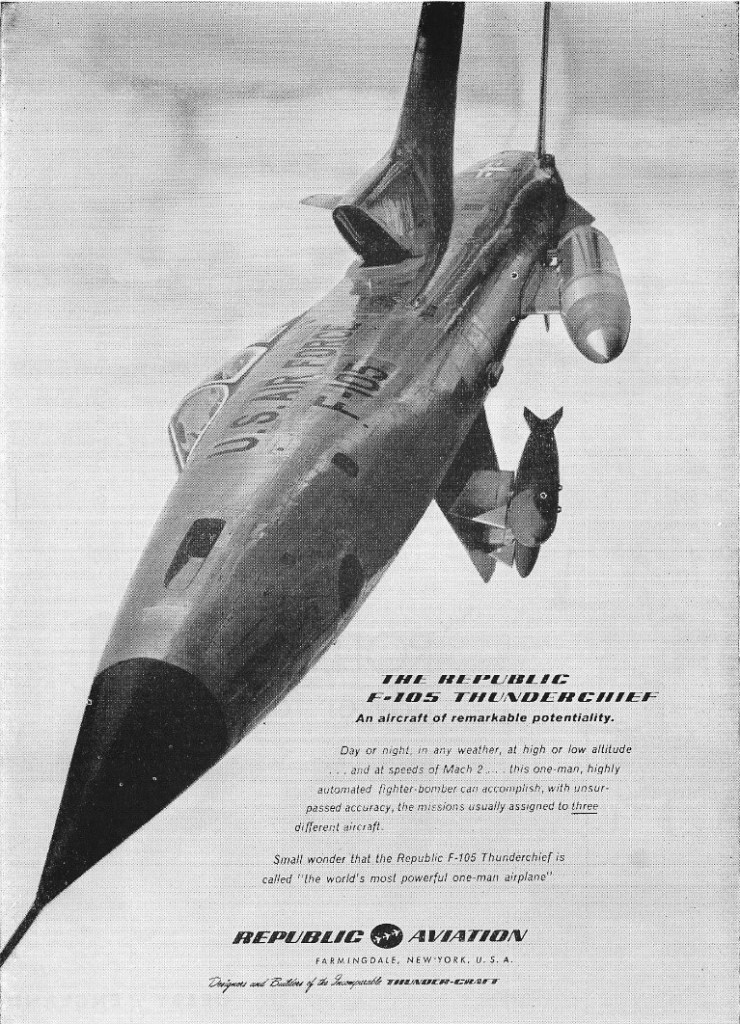
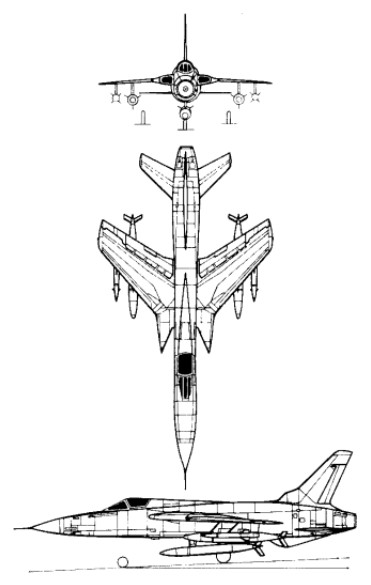
In 1951 Republic began private venture develop¬ment of a single seat tactical fighter bomber which the company anticipated would be a successor to the F 84F Thunderstreak. The F-105 Thunderchief, or company model AP-63. Alexander Kartveli’s design team originally intended a straight fuselage for the craft but, after seeing NACA data assembled by Richard Whitcomb, was won over by the wasp-waist or ‘area rule’ configuration which enhanced transonic flight performance. At first intended for the Allison J71 engine and powered in prototype form by the Pratt & Whitney J57, the F-105 attained its successes with the 7802kg thrust Pratt & Whitney J75-P-19W turbojet which provided 11113kg thrust with afterburning. Its mid-mounted wing, swept 60 degrees, and the F-105 stood high on its tricycle gear.
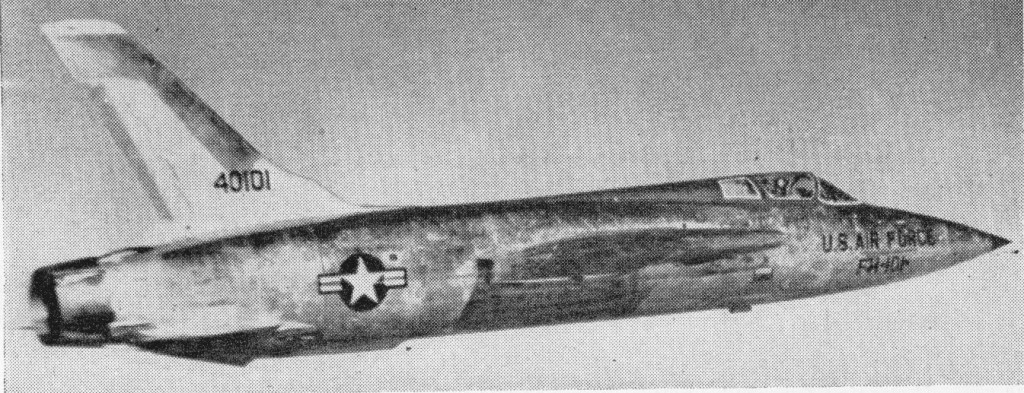
Development began when two J57-powered YF-105As commenced flying 22 October 1955, soon followed by 15 aircraft designated JF-105B and F-105B for test programmes.
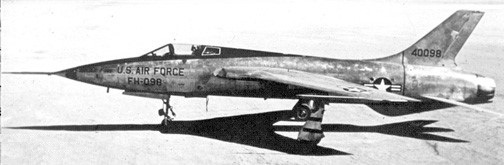
The two 1955 YF-105A, 54-0098 and 54-0099, were service testers with 15000 lb P&W J57 engines. The first flew on 22 October 1955, piloted by Russell M Roth.
Republic YF-105A 54-0098
The F-105A was not built in favour of the F-105B. Three RF-105A photo-recon version were built in 1956.
F-105B
Production F-105Bs, long delayed by development problems, began to roll from Republic’s Farmingdale line during 1958 and the USAF accepted its first machine on 27 May 1958. The 335th Tactical Fighter Squadron, temporarily moved to Eglin AFB, Florida, began to work up in the new aircraft only to find that, given its complexity and production slippages, it would not become operational until 1960. Meanwhile, a two-seat strike variant, the F-105C, had reached the mock-up stage but was not built.
December 1960
Though technical problems persisted and critics were calling the ‘Thud’ a maintenance nightmare, Republic proceeded with the F-105D variant which afforded true, all-weather capability by introducing General Electric FC-5 fully integrated automatic flight fire-control system.
The F-105 has mid-set sweptback wings, sweptback tail surfaces, and a one-piece all-moving tailplane mounted low on the fuselage and with a ventral stabilising fin. The ailerons are used only at low speeds and the main roll control is by five section spoilers forward of the large slotted flaps on each wing. The leading edge is variable-camber. ‘Clover-leaf’ air brake is around the exhaust nozzle. Each undercarriage leg has a single wheel, the mains retracting into the wings and nose wheel retracting forward.
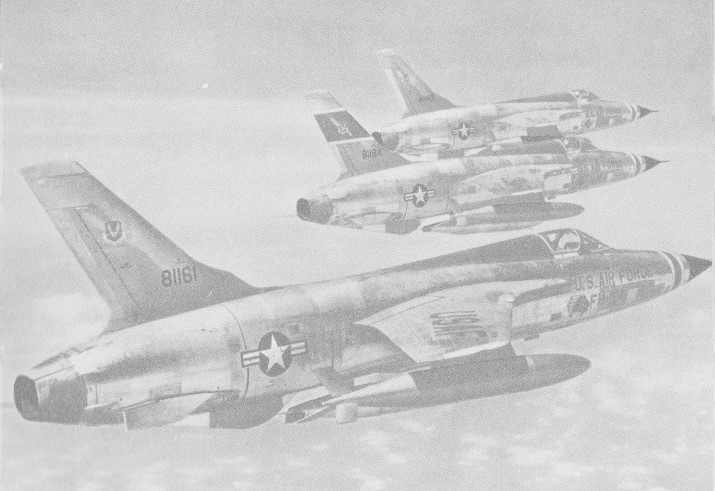
The F 105D was powered by a Pratt & Whitney J75 P 19W turbojet engine that develops 26,500 lb thrust (with after¬burning). The F-105D’s fuselage was lengthened by 0.381m. Some 610 were manufactured, and first flight took place at Farmingdale 9 June 1959. The F-105D model soon equipped all three squadrons of the 4th Tactical Fighter Wing at Seymour Johnson AFB, North Carolina. United States Air Forces in Europe (USAFE) were the first overseas recipient of the F-105D, the 36th TFW at Bitburg AB, West Germany re-equipping from 12 May 1961 and the 49th TFW at Spangdahlem soon following. In the early 1960s, with a war growing in Asia, F-105Ds joined the 18th TFW at Kadena AFB, Okinawa.
F-105D
The F-105D was by now a proven ordnance-carrier. More than 14,000 lb (6,350 kg) of weapons can be carried on under fuselage/wing stations. An internal weapons bay was also provided, and both conventional and nuclear weapons can be deployed. With multiple ejector racks (MER), it could carry an impressive load of external fuel, ECM gear, and eight 340kg bombs on long-range missions. The F-105D could also operate with the Martin AGM-12 Bullpup air-to-surface missile, which was to prove remarkably ineffective against ‘hard’ targets in Vietnam and would be observed bouncing off the Thanh Hoa Bridge. In addition, the F-105D model could carry 70mm rocket pods, napalm canisters and the AIM-9 infra-red (IR) air-to-air missiles, while its integral M61A1 Gatling-type 20-mm cannon proved invaluable in the dual roles of air-to-air combat and air-to-ground strafing. A late-model variant of the F-105D was the F-105D T-Stick II fitted with additional avionics which bestowed all-weather bombing capability, housed in a prominent dorsal fairing extending along the spine of the fuselage to the tail.
The F-105E was another two-seat variant that was not developed.
In May 1962 Republic proceeded with the tandem two seat F-105F. The first aircraft of this type (62 4412), which made its first flight 11 June 1963, was some 900kg heavier as well as slightly longer than earlier Thunderchiefs in order to accommodate the second crewman in tandem. The second F 105F, which flew for the first time on July 25 1963, flew thirty seven demonstration flights from Andrews AFB on August 18th, turn¬around being consistently completed within twenty minutes. The performance of the two seat F 105F is within 3% of the single-seat F-105D.
The two seat F 105G, developed from the F 105F combat/trainer version, carries advanced ‘Wild Weasel’ equipment to detect emissions from enemy radar sites, controlling surface-¬to air missiles, and missiles which can destroy the sites.
143 F-105Fs were delivered and 61 were later reconfigured for the electronic warfare or ‘Wild Weasel’ role in Vietnam, at first under their original designation and later as the F-105G.
After cancelling all airshows for two big summer months the Airforce Thunderbirds reverted back into F-100s in August 1965 to complete the season. They had started in Republic F-105s but a series of accidents throughout the Air Force grounded all Thunderchiefs.
Thunderbird F-105s
The F-105D, F-105F and F-105G all fought in North Vietnamese skies, the F-104D model fighter-bomber so extensively that over half of the 610 built eventually fell to Hanoi’s air defences. After withdrawal from South East Asia in 1969-70, the Thunderchief soldiered on in Reserve and Air National Guard units, eventually flying its final sortie in 1984. At one time no fewer than 14 USAF and 11 ANG squadrons operated the type, which was built to the extent of 833 examples. Perhaps because of its complexity, no F-105 was ever exported.
F-105B Engine: 1 x Pratt & Whitney J75-P-5, 25,000 lb No built: 75
F-105D Engine: 1 x Pratt & Whitney J75-P-19W, 76.5kN / 26,500 lb reheat Wingspan: 10.59 m / 35 ft 9 in Wing area: 35.77 sq.m / 385.02 sq ft Length: 19.61 m / 64 ft 4 in Height: 5.97 m / 20 ft 7 in Max take-off weight: 23967 kg / 52838 lb Empty weight: 12474 kg / 27501 lb Fuel capacity: 1000 Imp.Gal Aux fuel weapons bay: 290 Imp.Gal Underwing & fuselage fuel: 3 x 375 Imp.Gal Max. speed: 1208 kt / 2237 km/h / 1420 mph / M2.15 at 36,000 ft Cruising speed: 508 kt / 940 km/h Ceiling: 12560 m / 41200 ft ROC: 34,500 fpm Range w/max.fuel: 3846 km / 2390 miles Crew: 1 Armament: 1 x 20mm cannon, M61 Vulcan/1029rds, 6350kg of weapons Hardpoints: 6 Inflight refuel: yes
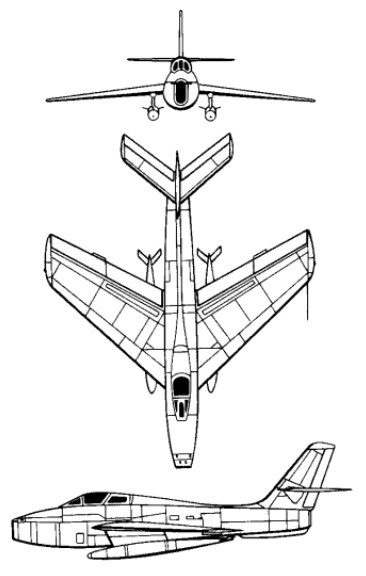
The design evolved to compete with the XF-92 was the Republic XF-91 Thunderceptor. This was based on the F-84F Thunderstreak swept-wing derivative of the F-84 Thunderjet straight-winged tactical fighter.
Ordered in 1946, the wing was of the variable-incidence type to permit a higher angle of attack for take-off and landing, but this feature was combined with a planform of inverse taper and thickness, together with leading-edge slots. Thus the chord and thickness of the wing increased from root to tip, producing more lift at the tip than at the root, and this arrangement dictated that the main landing gear units retract outward into the thick tips rather than inward into the thin roots.
The XF-91 was built to test the use of rocket power to boost a jet fighter in combat. In addition to a 2359kg / 5200-lb thrust General Electric J47-GE-3 turbojet, the two XF-91s each employed four 680kg thrust Reaction Motors XLRII-RM-9 rocket motors mounted two-each above and below the jet exhaust. With all five powerplants burning, the XF-91 was supersonic in level flight, attaining 1812km/h.
The first XF-91 made its initial flight on 9 May 1949 on jet power alone. By late 1949, evaluation of the rocket boost powerplant began. In December 1952 the type exceeded Mach 1.
The first XF-91 was refitted with a nose radome housing APS-6 radar above the engine intake. The second machine was retrofitted with a V-shaped butterfly tail and tested with this configuration after it was determined, in 1951, that the XF-91 would not be placed into production.
This second airframe was eventually destroyed while the first has been retained by the Air Force Museum in Dayton, Ohio.
XF-91 Wingspan: 9.53 m / 31 ft 3 in Length: 13.18 m / 43 ft 3 in Height: 5.69 m / 19 ft 8 in Wing area: 29.73 sq.m / 320.01 sq ft Max take-off weight: 10800 kg / 23810 lb Empty weight: 7190 kg / 15851 lb Max. speed: 1812 km/h / 1126 mph Ceiling: 14000 m / 45950 ft Range: 1600 km / 994 miles
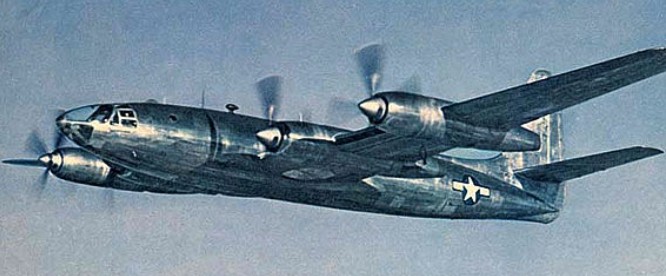
Development of the XF-12 photo-reconnaissance airplane began in 1944 when it appeared that a fast, specialized reconnaissance airplane would be needed during the final stages of the war in the Pacific. The XF-12 was roughly the same size as the C-54, hut it was much heavier and had more than twice as much power. The four turbo¬supercharged, 3,000hp (2,200kw) Pratt & Whitney Wasp Major engines were enclosed in long, slender nacelles that extended well beyond the wing trailing edges. The wing and empennage shared a resemblance with those of the F-84 Thunderjet. The fuselage was a slender teardrop shape, unbroken even by the windshield. Each main landing gear had a very large single wheel to fit inside the confines of the laminar flow wing. The Rainbow had its own darkroom in order to develop reconnaissance images on the way back from a long photo mission.
The first of two XF-12 prototypes was completed and flown on February 7, 1946. Subsequent experimental flight tests showed that it had lived up to its promise, and it passed into the service-test phase in June 1947. The XR-12 delivered to the Air Force crashed on its second test flight. The other Rainbow was sent to a gunnery range.
Unfortunately, the day of high-performance reciprocating engine-powered military airplanes had passed and the anticipated contract for 20 production F-l2As never materialized.
Republic still hoped to make the Rainbow into a 46-seat airliner, which they called the RC-2. Their selling point was speed, for which customers would pay a premium. Unfortunately, the expected postwar boom was not immediate and the airlines bought the slower but roomier DC-4 and Boeing 377 instead.
XF-12 Engine: 4 x Pratt & Whitney R-4360 Wasp Major, 2250kW Max take-off weight: 45950 kg / 101303 lb Wingspan: 39.36 m / 129 ft 2 in Length: 28.59 m / 94 ft 10 in Height: 8.63 m / 28 ft 4 in Wing area: 152.30 sq.m / 1639.34 sq ft Max. speed: 684 km/h / 425 mph Cruise speed: 640 km/h / 398 mph Ceiling: 13000 m / 42650 ft Range: 7000 km / 4350 miles Crew: 5-7
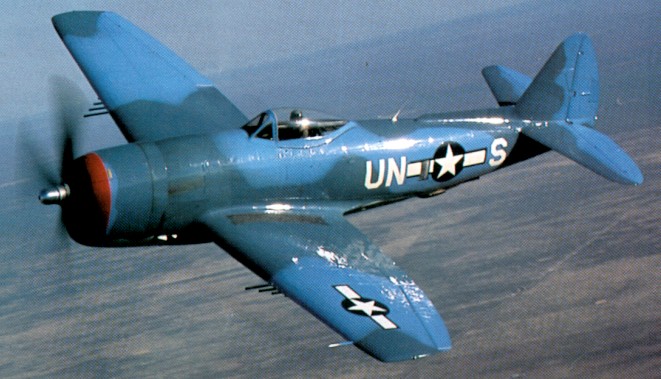
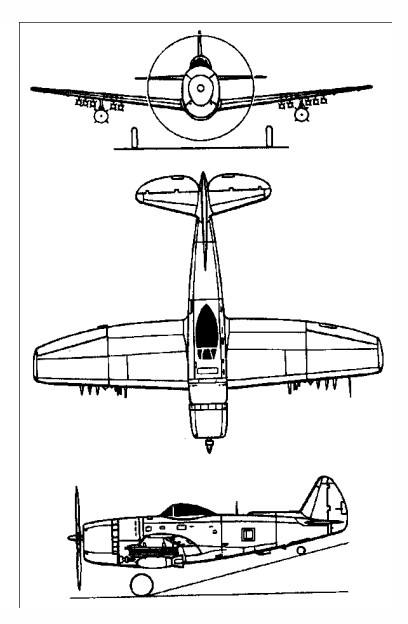
The P-43 Lancer design developed further into the P-47 Thunderbolt for USAAF. Designed by Alexander Kartveli, to provide ground clearance for the 12′ four-blade prop, the unique telescoping landing gear was 9″ shorter when retracted. First flew in its XP-47B prototype form on 6 May 1941.
Eglin Field testing effects of machine gun and cannon on P-47
The first P-47B production delivery was on 18 March 1942.
The P-47C had a mach .73 (556 mph) terminal dive and a .69 (525 mph) red-line.
A dorsal fin was added to compensate for the loss of aft keel surface and introduced on P 47D 27 RE and subsequent batches. P-47D had a mach .72 (550 mph) red-line dive speed and rolled 91 d/s @ 300 mph
XP-47H
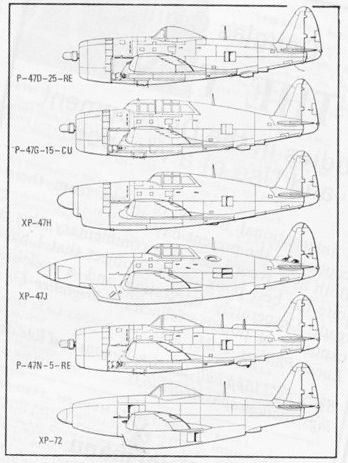
In 1943, two P-47D-15-RE airframes (serials 42-23297/23298) were selected for testing with the new experimental 2300 hp Chrysler XIV-2220-1 sixteen-cylinder inverted Vee liquid-cooled engine. These aircraft were redesignated XP-47H. The liquid-cooled Chrysler engine with its large under-fuselage radiator radically changed the appearance of the Thunderbolt, and increased overall length to 39 feet 2 inches. With the increased power and improved streamlining, a maximum speed of 490 mph was anticipated.
Although the project was begun in August 1943, the two P-47D-15-RE airframes were not actually converted until 1945. Test flights began on July 26, 1945. One of the XP-47Hs actually attained a speed of 490 mph in level flight. The Chrysler engine failed to deliver the promised power output, and the maximum speed attained during tests was only 414 mph at 30,000 feet, poorer performance than the “stock” P-47D. In any case, the Chrysler XIV-2220 engine never achieved production and the advent of jet propulsion killed any further USAAF interest in the development of even faster piston-engined fighters. Consequently, no further work was undertaken on the XP-47H project.
The XP-47J differed from other Thunderbolts in its engine, being powered by a ‘C’ series Double Wasp or Pratt & Whitney R-2800-57 driving a four-blade 13-ft Curtiss Electric propeller —employed after a plan to try out a contra-rotating propeller was dropped. But the XP-47J also had a distinctive cowling shape with an engine-cooling fan below and set back from the propeller hub. And there were other differences from standard Thunderbolts, some trivial: the six .50-calibre guns with 267 rounds per gun protruded from the wing leading edge in a different manner from those of other P-47s. The XP-47J was first flown on August 2, 1944 at the manufacturer’s Long Island, New York, facility and subsequently evaluated at Wright Field, Ohio. Apart from its remarkable high speed, the XP-47J could climb at 4,705 ft/min, reached a speed of 811kph, and the service ceiling was 45,000ft. Maximum range was 1,070 miles at 10,000ft. The XP-47J did not enter production.
XP 47J
P-47M had a P&W R2800-56.
Modified with longer, stronger wings, the P 47N could carry addi¬tional fuel for long distances flown in the Pacific War. Some 1,816 of this last production version were built. The P-47N dove to mach .83 (632 mph)
XP-47N Thunderbolt
Production began at Republic’s plant in Farmingdale, though others were also built at a Republic factory in Evansville, Indiana, and by Curtiss Wright in Buffalo, New York. A total of 15,863 built, of which 15,329 were built during Second World War. They were priced at $83,000+ Production was at Farmingdale (suffix -RE) and Evansville IN (suffix -RA), as well as subcontract to Curtiss for P-47G.
During WW2, Thunderbolt’s ratio of aerial combat victories to losses was 4.6:1 in downing 2,752 enemy aircraft, besides destroying 3,315 more on the ground. Official records also credit P-47 with some 9,000 locomotives and 86,000 railroad cars, 6,000 armored vehicles and tanks, and 68,000 trucks.
P-47B Engine: Pratt & Whitney R-2800-21 Double Wasp, 2000 hp Wingspan: 40 ft 9.25 in / 12.4 m Length: 34 ft 10 in Height: 12 ft 8 in Empty weight: 9010 lb / 4087 kg MAUW: 12,700 lb / 5760 kg Max speed: 412 mph ROC: 2800 fpm / 855 m/min Service ceiling: 38,000 ft Range int/fuel: 575 mi Armament: 8 x 0.5in Colt-Browning 267, 350 or 425 rds each
P-47C Engine: Pratt & Whitney R-2800-59 Double Wasp, 2300 hp Wingspan: 40 ft 9.25 in / 12.4 m Length: 36 ft 1.25 in / 11.03 m Height: 14 ft 2 in / 4.03 m MAUW: 14,925 lb Max speed: 433 mph ROC: 2800 fpm / 855 m/min Service ceiling: 42-43,000 ft / 13,000 m Armament: 8 x 0.5in Colt-Browning 267, 350 or 425 rds each
P-47D Engine: Pratt & Whitney R-2800-59 Double Wasp, 2300 hp (most) Wingspan: 40 ft 9.25 in / 12.4 m Length: 36 ft 1.25 in / 11.03 m Height: 14 ft 2 in / 4.03 m Empty weight: 10,700 lb / 4853 kg MAUW: 19,400 lb / 8800 kg Max speed: 428 mph / 690 kph ROC: 2800 fpm / 855 m/min Service ceiling: 42-43,000 ft / 13,000 m Range int/fuel: 1000 mi / 1600 km Max range ext/fuel: 1900 mi / 3060 km Armament: 8 x 0.5in Colt-Browning 267, 350 or 425 rds each Hardpoints: 3-5 Bombload: 2500 lb / 1134 kg
P-47D Engine: 1 x Pratt & Whitney R-2800-59W Double Wasp, 1890kW / 2800 hp Propeller: Hamilton Standard 24E50, 6507 A. O. Wingspan: 12.43 m / 41 ft 9 in Wing area: 27.87 sq.m / 299.99 sq ft Length: 11.02 m / 36 ft 2 in Height: 14 ft 2 in Empty weight: 4513 kg / 9950 lb Max take-off weight: 7938 kg / 17500 lb Fuel capacity: 308 Imp.Gal Max. speed: 697 km/h / 433 mph at 25,000 ft Max ROC: 7280 fpm Ceiling: 12495 m / 41000 ft Range: 950 mile Range w/max.fuel: 3058 km / 1900 miles Crew: 1 Armament: 6 x 12.7mm machine-guns, 1134kg of weapons External load: 2500 lb
Republic P-47D-28-RA Engine; 1 x 2,430 h.p. Pratt & Whitney R-2800-59 radial Prop; 13ft-diameter Curtiss Electric C5425-AI14 Wingspan; 40ft 9.5in Length; 36ft 1.75in Height; 14ft 0in Wing area; 300 sq.ft Empty weight; 10,0001b Gross weight; 14,5001b Maximum weight; 17,5001b Maximum speed; 423 m.p.h. at 30,000ft Landing speed; 105 m.p.h. Climb to 15,000ft; 6.2min Climb to 20,000ft; 8.5min Climb to 25,000ft; 11 min Climb to 30,000ft ; 14min Service ceiling; 42,000ft Maximum range; 1,030 miles at 10,000ft (5.3hr) Normal range; 590 miles at 25,000ft Armament; 6 or 8 x 0.50in machine guns 267-425 rounds per gun Maximum bomb load; 2,5001b Number built 1,028 P-47D-28-RA at Evansville, Indiana, USA
P-47G Engine: R2800, 2300 hp Max speed: 433 mph @ 30,000ft Service ceiling: 40,000 ft.
P-47M Engine: Pratt & Whitney R-2800-55 or -77 Double Wasp, 2800 hp Wingspan: 40 ft 9.25 in / 12.4 m Length: 36 ft 1.25 in / 11.03 m Height: 14 ft 8 in MAUW: 14,700 lb Max speed: 470 mph ROC: 2800 fpm / 855 m/min Service ceiling: 42-43,000 ft / 13,000 m Armament: 6 x 0.5in Colt-Browning mg
P-47N Engine: Pratt & Whitney R-2800-55 or -77 Double Wasp, 2800 hp Wingspan: 40 ft 9.25 in / 12.4 m Wing area: 321.951 sq.ft / 29.91 sq.m Length: 36 ft 1.25 in / 11.03 m Height: 14 ft 8 in Weight empty: 11003.0 lb / 4990.0 kg MAUW: 21,200 lb / 9616 kg Internal fuel: 594 Imp.Gal Wing load: 67.45 lb/sq.ft / 329.0 kg/sq.m Max speed: 467 mph / 751 kph / 406 kt Cruising speed: 261 kt / 483 km/h ROC: 2800 fpm / 855 m/min Service ceiling: 42-43,000 ft / 13,000 m Max range ext/fuel: 2350 mi / 3800 km Armament: 8 x 0.5in Colt-Browning 267, 350 or 425 rds each Hardpoints: 3-5 Bombload: 2500 lb / 1134 kg Crew: 1
XP-47H Engine: Chrysler.
XP-47J Max speed: 504 mph ROC: 4705 fpm Service ceiling: 45,000 ft Max range: 1070 miles
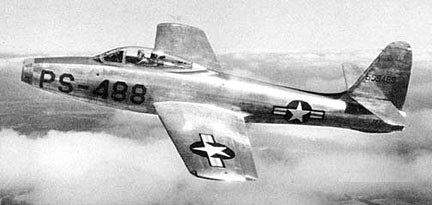
The first prototype Republic XP-84 made its maiden flight on 28 February 1946, powered by a General Electric J35 engine.
Fifteen YP-84A were built in 1946 for service trials; 45-59482 to 45-59496.
Republic YP-84A 45-50490
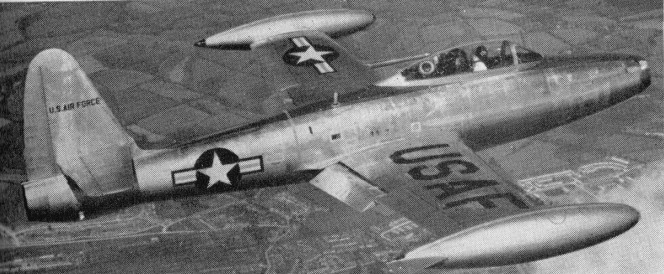
Dubbed ‘Thunderjet’, the straight-winged F-84 saw operational service in Korea from December 1950, first as an escort fighter to B-29 bombers and then in the ground attack role. The F-84G was developed to carry nuclear weapons for tactical warfare and was used by TAC and SAC; F-84Gs without nuclear weapon delivery systems were supplied to various NATO air forces and no less than 4,457 straight-wing Thunderjets were built.
F-84E Thunderjet
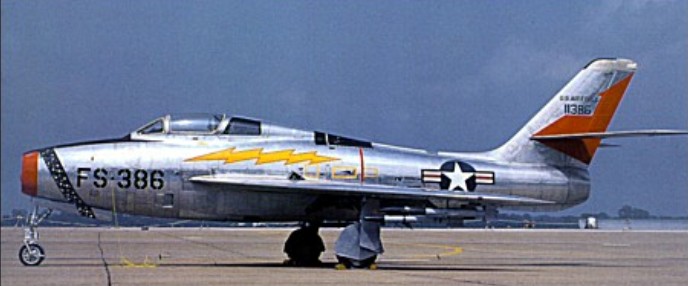
Although it shared the same generic designation number as the straight-winged F-84 Thunderjet, the Republic F-84F Thunderstreak was essentially a new aircraft. The prototype XF-84F was an F-84E Thunderjet fitted with 40 degree sweptback wing and tail, and longer, faired-in cockpit hood. It was powered by a 5200 lb Allison J-35-A-25 turbojet. When Curtiss-Wright acquired a license to build the Armstrong Siddeley Sapphire turbojet in America, Republic fitted an imported Sapphire in the YF-84F prototype which flew on 14 February 1951. The USAF ordered this aircraft into production, with a Wright-built J65 Sapphire, as the F-84F Thunderstreak.
The RF-84F served as the backbone of NATO tactical strike forces, operating with Belgium, France, Italy, Greece, the Netherlands, Turkey and West Germany.
Yugoslavian F-84Gs
On 10 March 1953, five days after a Polish pilot had defected with his MiG-15 to the Danish island of Bornholm, two Czechoslovakian MiG attacked two American F-84G Thunderjets over Regensburg in Bavaria. One of the Thunderjets was shot down by the 23mm and 37mm cannon of one of the MiGs. The pilot ejected safely over Czechoslovakian territory.
By 1955 the F-84F Thunderstreak was the standard U.S.A.F. fighter-bomber, replacing F-86 Sabres and F-84E and -G Thunderjets. Can carry the tactical atomic bomb, and can be carried itself by GRB-36 “mother-plane”. Versions carried by GRB-36 have anhedral (downswept) tailplane.
Initially conceived by Republic dating 1949, the Thunderstreak was first flown in prototype form as the YF-84F on 3 June 1950, this aircraft using a standard F-84E fuselage with a swept wing and being powered by a single Allison YJ35-A-25 engine rated at 2359-kg (5,200-lb) thrust. Early flight testing of this aircraft very quickly revealed that the performance left a great deal to be desired and it was therefore decided to incorporate the British Sapphire (Wright J65) engine, impetus for the change being largely provided by US involvement in the Korean War, although in the event the F-84F did not see action in that conflict. Adoption of the more powerful engine in turn necessitated some redesign and it was not until late 1952 that the first production specimen made its maiden flight. Altogether 2,711 F-84Fs were built for service with allied nations from the late 1950s onwards.
F-84F
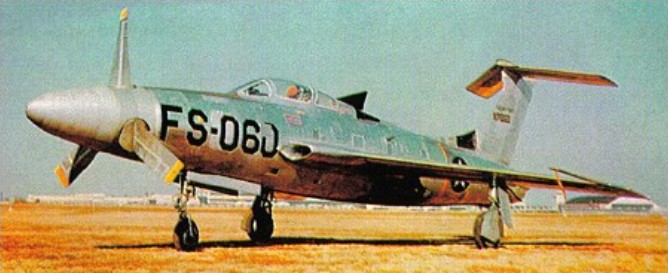
A specialized photo-reconnaissance derivative of the F-84 known as the RF84F Thunderflash was evolved more or less concurrently, this being most easily recognized by its revised air inlet layout which permitted the battery of cameras to be mounted in the extreme nose section. The RF-84F Thunderflash photo-reconnaissance aircraft had cameras in lengthened nose, only 4 guns, and wing-root air intakes. It too can be carried by GRB-36. The first prototype flew in February 1952. Including the prototype YRF-84F, 716 Thunderflashes were built, almost half of this figure being destined for overseas service under the terms of the Mutual Defense Aid Program, examples being supplied to Italy, Greece, West Germany, Turkey, the Netherlands, Belgium, Denmark, Taiwan, France and Norway.
It has another distinction so far as the USAF is concerned, being the aircraft with which flight refuelling techniques for fighters were developed.
RF-84F
A total of 4457 F-84 “Thunderjet” were built.
The second attempt to use the B 36 as an aircraft carrier took place in 1955 and 1956. Seeking a reconnaissance aircraft with sufficient range to reach the Soviet Union, the USAF came up with FICON, which stood for Fighter In CONvair. By hitching a Republic RF 84 Thunderflash to a B 36, the photo-reconnaissance jet’s range could be extended from 3220 km (2000 miles) to 19,310 km (12,000 miles). Some thought was also given to a nuclear bomb equipped Thunderstreak substituting for the Thunderflash. Twenty five RF 84Fs were modified for parasite duty. On a typical mission the mother ship B 36 would depart from Fairchild Air Force Base, Spokane, Washington to be joined in the air by an RF 84K (as the parasite Thunderflashes were designated) from Moses Lake Air Force Base. The fighter would be hoisted into the B 36’s bomb bay.
F-84G Thunderjet
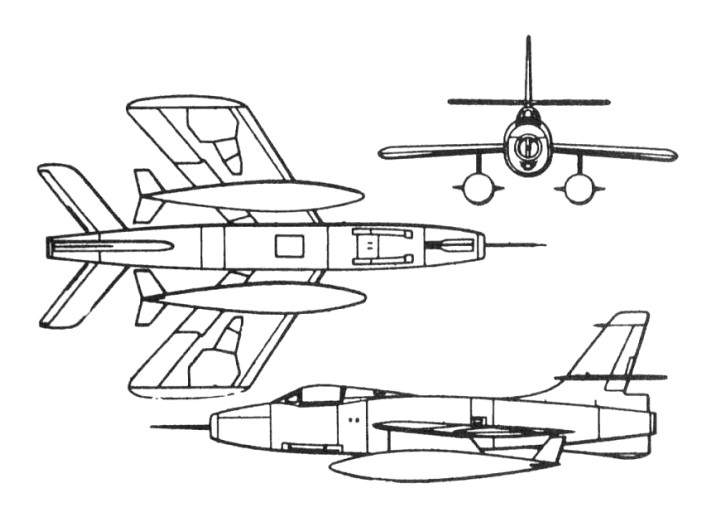
The F-84G Thunderjet featured conventional ailerons, elevators, rudder and trailing edge flaps. An air-brake is under the centre fuselage. The tricycle undercarriage has a single wheel on each unit, the mains retracting inward into the wings, and nose-wheel retracts rearward.
Even in the mid-1950s the superiority of the jet powerplant for combat aircraft was questioned by some. A modern technology propeller driven by a turbine (a turboprop) offered high speeds, long endurance and low landing speeds. To test this concept the USAF commissioned two XF-84Hs from Republic.
XF-84H
Powered by the Allison XT-40 coupled turboprops driving a singe supersonic blade propellor, the noise the F-84H made has been described as an ‘unholy shriek’, leading to the nickname ‘Thunderscreech’. Resonance off the ground made groundcrew physically sick. The two aircraft only made a dozen test flights, all but two of which resulted in emergency landings and the USAF refused to accept it for their own tests, cancelling the programme in 1956.
The first XF-84H spent 40 years on a pole at Bakersfield Airport, California, its propeller slowly (and quietly) rotated by an electric motor.
F-84E Thunderjet Fighter-bomber Engine: 5,000 lb. thrust Allison J35-A-17 turbojet. Wingspan: 37 ft. 5 in Length: 38 ft. 5 in Loaded weight: 18,000 lb. Max. speed: 630 m.p.h. Ceiling: over 45,000 ft Normal range: 1,700 miles In flight refueling: yes Armament: 6x.50 in. machine-guns Bombload: 4 x 1,000 lb. bombs or up to 32 x 5 in. rockets. Crew: 1
Republic F-84F Thunderstreak Type: single-seat strike fighter Powerplant: one 3275-kg (7,220-lb) thrust Wright J65-W-3 turbojet Maximum speed 1118 km/h (695 mph) at sea level Initial climb rate 2499 m (8,200 ft) per minute Service ceiling 14020 m (46,000 ft) Combat radius, clean 724 km (450 miles) Ferry range 3444 km (2,140 miles) Maximum take-off 12701 kg (28,000 lb) Wingspan 10.26 m (33 ft 7¼ in) Length 13.23 m (43 ft 4¾ in) Height 4.39 m(14 ft4¾ in) Wing area 30.19 sq.m (325 sq ft) Armament: six 12.7-mm (0.5-in) M3 machine-guns Bomb load, 2722 kg (6,000 lb) Crew: 1
RF-84F Thunderflash Engine: Wright J65-W-7, 7800 lb Wingspan: 33 ft 7 in Length: 47 ft 7.75 in Height: 15 ft Max speed: 679 mph at SL Max ROC: 8000 fpm Service ceiling: 46,000 ft Max range: 2200 mi Armament: 4 x .50 in mg
F-84G Thunderjet Engine: 1 x Allison J35-A-29, 24.9kN / 5600 lb Wingspan: 11.4 m / 37 ft 5 in Length: 11.7 m / 38 ft 5 in Height: 3.8 m / 12 ft 6 in Wing area: 24.2 sq.m / 260.49 sq ft Wheel track: 16 ft 6 in Max take-off weight: 8455-10670 kg / 18640 – 23523 lb Empty weight: 5033 kg / 11096 lb Max. speed: 970 km/h / 603 mph Cruise speed: 775 km/h / 482 mph Ceiling: 12350 m / 40500 ft Range w/max.fuel: 1680 km / 1044 miles Armament: 6 x 12.7mm machine-guns Bombload: 4500 lb Crew: 1
XF-84H Engine: 1 x 5850 hp Allison XT40-A-1 turboprop Wingspan: 10.18 m / 33 ft 5 in Length: 15.67 m / 51 ft 5 in Height: 4.67 m / 15 ft 4 in Max take-off weight: 8123 kg / 17908 lb Max. speed: 837 km/h / 520 mph Crew: 1