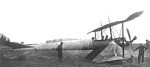
The 1911 tractor biplane designed and built by Henri Coanda carried 1 pilot and 3 passengers.
Span: 53’6″
Length: 41′
Gross weight: 2480 lb
Speed: 75-80 mph
The 1911 tractor biplane designed and built by Henri Coanda carried 1 pilot and 3 passengers.
Span: 53’6″
Length: 41′
Gross weight: 2480 lb
Speed: 75-80 mph
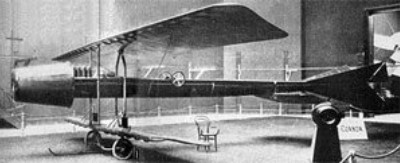
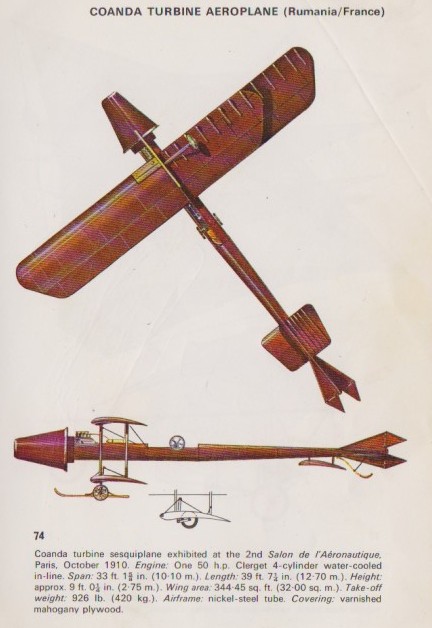
With the support of the engineer Gustave Eiffel and the scholar Paul Painlevé, who helped him to obtain the necessary authorizations, Henri Marie Coandă made preliminary aerodynamic experiments and built, in the body shop of Joachim Caproni, the first jet-powered aircraft, actually a jet plane. This invention by Romanian inventor Henri Coanda amazingly appeared in 1910 as the world’s first jet-propelled aircraft. The “Coanda 1910”, as it came to be known, was showcased at the Paris Second International Aeronautical Exhibition and was a technological marvel for its time. Before its time, the Coanda design fell into relative obscurity.
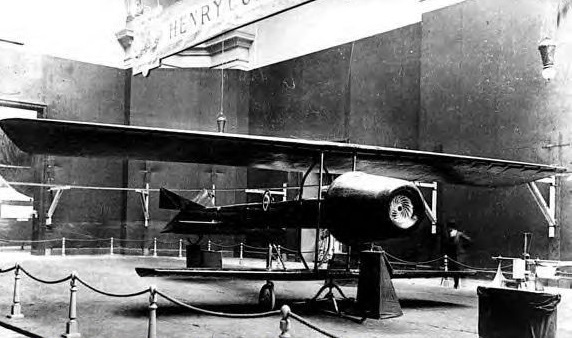
The Coanda 1910 was of a traditional aircraft design of a sesquiplane layout, with front-mounted engine. The “jet” engine was mounted at the extreme front of the thin fuselage, made up mostly of wood covered over with fabric (along with struts and wiring) and possibly some metal added to the wings. The pilot was to sit behind the engine in an open-air cockpit with very little protection. The undercarriage was fixed just under the lower wing and featured two wheels and complimented with a landing skid. The tail section ended in a cruciform-type arrangement.
In terms of its “jet” powerplant, the Coanda 1910 featured a combination of piston engine and jet engine power – relying on internal combustion. The traditional combustion engine provided power to a compressor to generate compressed air. The compressed air was then mixed with fuel, ignited and forcibly extracted from special chambers mounted on either side of the fuselage. The resulting force of the expelled reaction was to provide forward momentum for the aircraft.
The Coanda 1910 achieved a single short flight in an accidental way. While ground testing the engine with Henri Coanda at the controls, the powerplant forced the plane airborne for a short time. As Henri himself was not a pilot by trade, he quickly lost control of the aircraft and crashed to the ground throwing him clear of the burning wreckage (though not without slight injuries). Despite the loss of the machine, Henri noted an effect occurring with the expelled gases and how they seemed to conform to the sides of his aircraft. This observation alone would lead Henri to research that would span decades more in what would eventually culminate in the “Coanda Effect”.
It is said that Gustave Eiffel told him: “Young man, you were born 30 years too early!” In the end, Henri Coanda’s 1910 invention was never furthered into practical use.
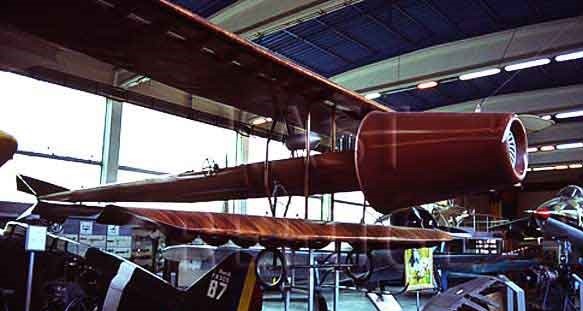
Engine: 1 x 4 cylinder in-line water-cooled, 50hp, driving a compressor for 450 lb of thrust.
Length: 41.01ft (12.5m)
Width: 33.79ft (10.30m)
Accommodation: 1
Maximum Take-Off Weight: 926lbs (420kg)
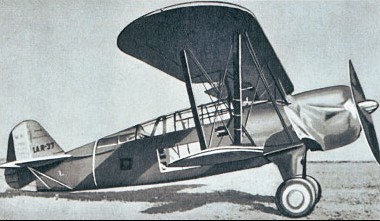
The I.A.R.37 prototype was built to the design of engineers Grossu-Vizuru and Carp. Flown for the first time in 1937 by company pilot Max Manolescu, it was intended to meet an official requirement for a tactical bombing and reconnaissance aircraft. An unequal-span biplane, the I.A.R.37 had fixed main landing gear and was powered by an I.A.R. K.14 radial engine. Its three-man crew was accommodated beneath a continuous glazed canopy, the observer seated between pilot and gunner and provided with full dual controls, a Romanian-designed Estopey bomb-sight, radio and a camera. Defensive armament comprised four machine-guns and the offensive load 12 50kg bombs or six 100kg bombs on underwing racks.
The I.A.R.37 entered production.in late 1938 and was built in small numbers before being succeeded in 1939 by the interim I.A.R.38, which differed mainly in its powerplant.
An attempt to modify an IAR 37 into a dive bomber was made in the summer of 1940. No 5, redesignated IAR 371, performed the Romanian dive bombing premiere on July 16 with a test diving from 4,000ft (1,200m), piloted by Emil Droc, test pilot of the IAR factory. Several modifications (including the cockpit canopy and fuselage side glazing) were made to the IAR 37 design before it was fitted with a German BMW 132A radial engine, giving birth to the more reliable IAR 38.
In January 1939, even before all 50 examples of the –37 had been completed production was shifted in favour of the IAR 38. The last IAR 37, No 47 was first flown on June 16, l939.
The final number of IAR 38s actually manufactured is still unclear, the existence of a photograph depicting ‘Red’ 89 suggests that possibly 90, even up to 120, such aircraft could have been finally produced at Brasov.
The -38 was soon displaced on the production line by the I.A.R.39.
The increased fuel consumption of the more powerful IAR K1 4 engine installed in the IAR 39s decreased the aircraft’s range to 350nm (650km), equal to the similarly equipped IAR 37.
Of the total production of 325 I.A.R.37, 38 and 39 aircraft, over 200 were I.A.R.39s, 96 built under sub-contract by the S.E.T. company and over 100 by I.A.R.
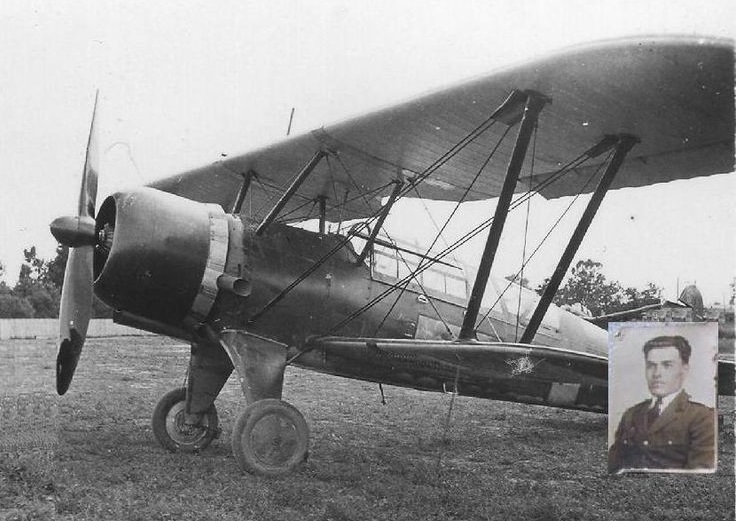
By the end of 1940 the I.A.R. biplanes were in large-scale service with Fortelor Aeriene Regal ale Romania (Royal Romanian Air Force) or FARR. They equipped a number of squadrons attached to the various army corps and by June 1941, when Romania supported the German offensive against the Soviet Union, the three reconnaissance flotile of the FARR had 18 eskadrile, 15 of which were equipped with I.A.R. biplanes. In July 1942 the air expeditionary force in the Soviet Union had been re-formed as Corpul I Aerian and had several groups equipped with the I.A.R.39. Eleven reconnaissance eskadrile were operating with the army co-operation flotile during the 1944 offensive in the Ukraine, most of them with I.A.R.39s on strength. Post-war the new Communist republic was declared at the end of 1947, and the reorganised air arm, known as the FR-RPR (Fortele Aeriene ale Republicii Populare Romania) had a small number of I.A.R.39s for training and liaison duties for several years.
The last member of the IAR 37/38/39 family was withdrawn from service in mid 1960s.
IAR-37
Engine: I.A.R. K.14-II C32, 649 kW (870 hp)
Empty weight: 4,892 lb (2,219kg)
Crew: 3
50 built (IAR)
IAR-38
Engine: BMW 132A, 522 kW (700 hp)
Empty weight: 5,070 lb (2,300kg)
Taller tail.
75 built (IAR).
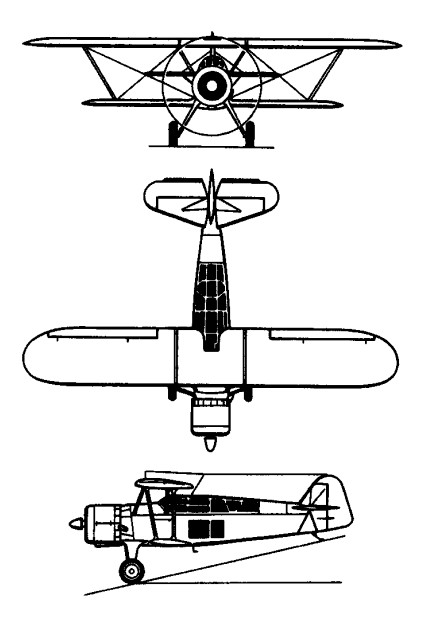
IAR-39
Engine: 1 x IAR K.14-IV C32, 16 kW (960 hp)
Wingspan: 13.10 m / 42 ft 11.75 in
Length: 9.60 m / 31 ft 6 in
Height: 3.99 m / 13 ft 1 in
Wing Area: 40.30 sq.m / 433.79 sq ft
Take-Off Weight: 3085 kg / 6801 lb
Loaded Weight: 2177 kg / 4799 lb
Max. Speed: 336 km/h / 209 mph / 182 kn
Service Ceiling: 8000 m / 26245 ft
Range: 1050 km / 652 miles / 567 nmi
Armament: 3 x FN (Browning) 7.92mm machine-guns
Bombload: 288kg (635lb) or 144 air-grenades
Crew: 3
255 built (95 at IAR and 160 at SET).
two-seat aerobatic training/ touring biplane (1934)
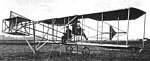
The 1909 Cluzan biplane was designed and built by Cluzan in France.
Span: 33’9″
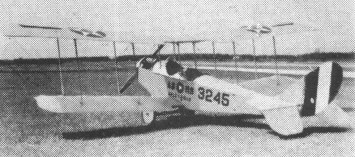
The Jenny is a three-quarter scale replica of the famous Curtiss JN4D Jenny Trainer. Although this ultralight version has a rear cockpit it is there purely for aesthetics and is non-functional. The airframe is gussett riveted aluminium tubing covered in a doped dacron finish. Centre mounted joy stick, rudder pedals.
I flew one many years ago here in Australia. A delightful short range aircraft. The ailerons do not exist. What there is are spoilers on the tops of the upper wings and controlled by a linen cord that pulled them up thus spoiling the air flow. Spoiler up and the lift on the other side raised that wing thus a turn. Real STOL take-off and landing. Mt first experience with a two stroke. Love to own this Curtiss Jenny! Now I can say that I have flown both a Curtiss Jenny and a Boeing! (A Stearman).
David Prossor
Engine: Cuyuna ULII-02 (429 cc) 35 hp.
Prop: 198cm.
Static thrust: 296 lbs.
Empty wt: 248 lbs.
Wing span: 28’4”.
Wing area: 186 sq.ft.
Height: 7’6”.
Length: 17’.
Fuel cap; 5 USG.
Construction: Alumnium, Dacron.
Max wt: 500 lbs.
Stall: 21 mph.
Max speed: 62 mph.
Vne: 69 mph.
Econ cruise speed: 45 kts.
Climb rate: 1000 fpm @ 40 mph.
Design limit: +4, -2g.
Glide ratio: 5.5-1.
Wing loading: 2.69 lbs/sq.ft.
Power loading: 14.29 lbs/hp.
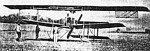
The 1911 biplane designed and built by Louis Clement was built of all steel tube.
Span upper: 43’9″
Span lower: 30’8″
Length: 34’5″
Gross Weight: 1600 lb
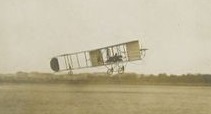
Also known as the Clément-Bayard biplane, the biplane of 1910 was constructed by the firm Letord et Niepce and fitted with a 43 hp 4-cylinder Clément-Bayard motor.
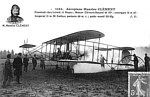
Span: 38’2″
Length: 37’9″
Weight: 1100 lb gross
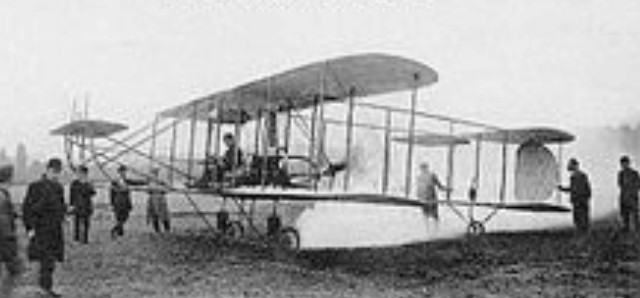
It was constructed at Leotard et Niepce and powered by a 43 hp Clement-Bayard motor.
Engine: Clement-Bayard, 43 hp
Wingspan: 11.6 m / 38 ft
Wing area: 60 sq.m / 645.8 sq.ft
Length: 11.5m / 37.7 ft
Weight: 500 kg / 1102.5 lb
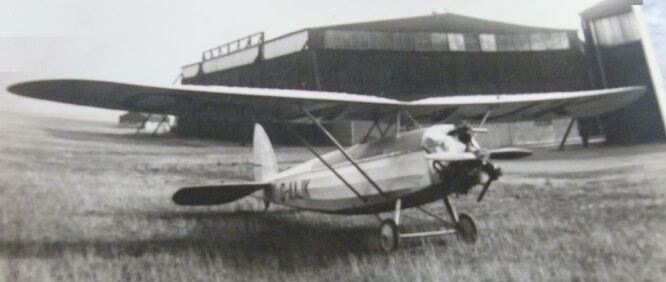
The Clarke Cheetah was a single seat biplane designed in 1929 by J.Clarke with diagonal interplane struts. Powered by a Blackburn engine, it used the lower wings of the Halton Mayfly G-EBOO.
First flown at Brough in 1929 as G-AAJK cn.1.
It was converted in 1930 to a parasol monoplane configuration by A.C.Thomas and partners.
It was broken up in 1937 and donated its wing to the Martin Monoplane G-AEYY.
Wingspan: 29 ft 0 in
 All Aero