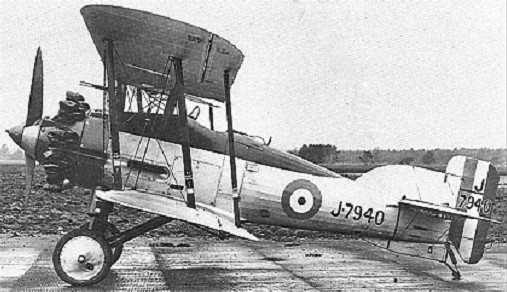
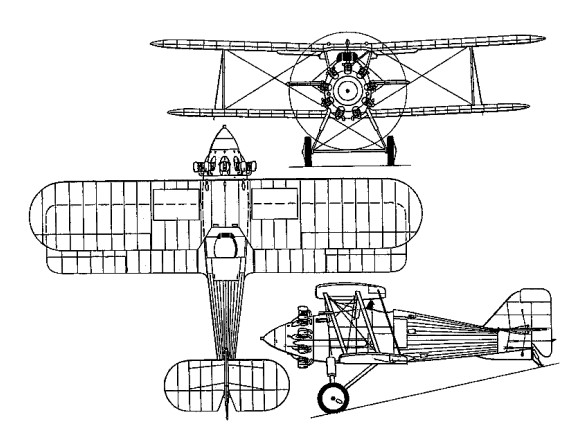
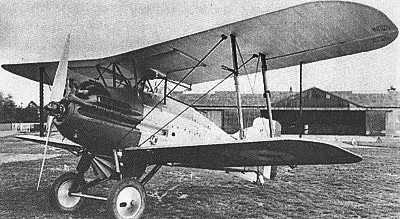
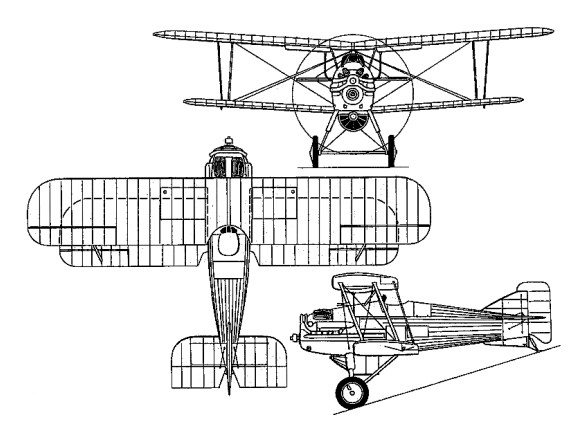
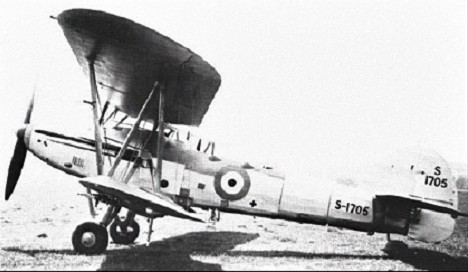
The second all-metal fighter designed by H P Folland, the Goldfinch was ordered in January 1926 as an all-metal version of the Gamecock, but, as initially completed, the prototype embodied a proportion of wood in its fuselage structure. After initial trials, the prototype was reworked, a lengthened, all-metal fuselage and revised tail unit being applied. In its new form, the prototype Goldfinch was delivered to Martlesham Heath late 1927. Powered by a supercharged 450hp Bristol Jupiter VIIF nine-cylinder radial, and having two 7.7mm Vickers Mk I synchronised machine guns, the Goldfinch offered an extremely good performance, but in competing for a production contract to Specification F.9/26 it was bested by the Bristol Bulldog.
Max take-off weight: 1468 kg / 3236 lb Empty weight: 933 kg / 2057 lb Wingspan: 9.14 m / 29 ft 12 in Length: 6.78 m / 22 ft 3 in Height: 3.20 m / 10 ft 6 in Wing area: 25.48 sq.m / 274.26 sq ft Max. speed: 277 km/h / 172 mph
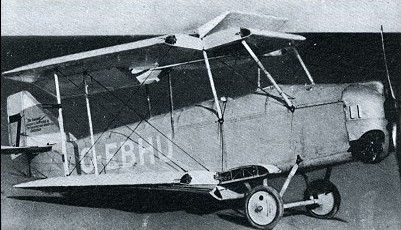
An ultralight biplane with folding wings for storing the aircraft in a garage.
Engine: 1 x Carden Max take-off weight: 186 kg / 410 lb Empty weight: 128 kg / 282 lb Wingspan: 5.49 m / 18 ft 0 in Length: 5.03 m / 16 ft 6 in Height: 1.83 m / 6 ft 0 in Wing area: 9.57 sq.m / 103.01 sq ft Max. speed: 105 km/h / 65 mph Range: 225 km / 140 miles
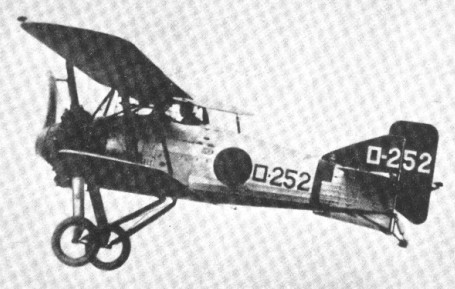
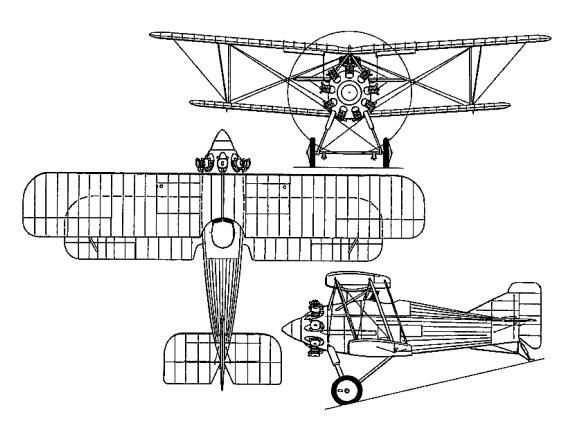
During 1926, in which year Gloucestershire Aircraft changed its name to Gloster Aircraft, the company was approached by the Japanese Nakajima, which (together with Aichi and Mitsubishi) had been asked to submit a design for a new shipboard fighter for the Imperial Japanese Navy. At this time, H P Folland was designing a shipboard fighter as a company venture. Named Gambet, the prototype was of wooden construction and powered by a 420hp Bristol Jupiter VI nine-cylinder radial, armament consisting of two 7.7rnm Vickers guns mounted in troughs in the fuselage sides. This prototype was acquired by Nakajima in July 1927, together with manufacturing rights. After modification by a team led by Takao Yoshida and installation of a 520hp Nakajima built Jupiter VI engine, the Gambet competed against prototypes of indigenous design and was ordered into production in April 1929 as the Navy Type 3 Carrier Fighter (A1N1).
Nakajima A1N1-2
Engine: 1 x Bristol Jupiter VI, 313kW Max take-off weight: 1395 kg / 3075 lb Empty weight: 912 kg / 2011 lb Wingspan: 9.70 m / 31 ft 10 in Length: 6.49 m / 21 ft 4 in Height: 3.25 m / 10 ft 8 in Wing area: 26.38 sq.m / 283.95 sq ft Max. speed: 245 km/h / 152 mph Ceiling: 7070 m / 23200 ft
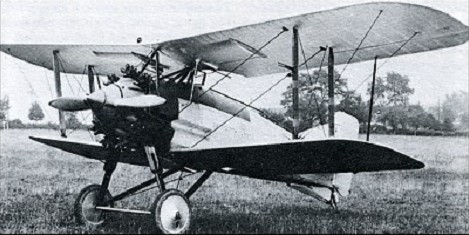
Three prototype Guan single-seat high-altitude fighters were ordered at the beginning of 1925 primarily to test the application of turbo-supercharged engines to fighters. Of mixed construction, with metal fuselage, wooden wings and fabric skinning, and provision for the standard twin synchronised 7.7mm Vickers gun armament, the first prototype was completed in June 1926, with a geared 450hp Napier Lion IV with an exhaust-driven turbo-supercharger below the propeller shaft. The second prototype followed early in 1927 with a direct drive 525hp Lion VI and turbo-supercharger mounted above the propeller shaft. Difficulties with the turbosuperchargers led to cancellation of the third prototype and abandonment of the development programme.
Take-off weight: 1725 kg / 3803 lb Empty weight: 1348 kg / 2972 lb Wingspan: 9.70 m / 31 ft 10 in Length: 6.70 m / 21 ft 12 in Height: 3.10 m / 10 ft 2 in Wing area: 27.68 sq.m / 297.94 sq ft Max. speed: 282 km/h / 175 mph
One prototype, first flown in April 1932. No production.
TSR.38 Engine: 1 x 690hp Rolls-Royce Goshawk VIII Max take-off weight: 3649 kg / 8045 lb Empty weight: 1970 kg / 4343 lb Wingspan: 14.02 m / 45 ft 12 in Length: 11.38 m / 37 ft 4 in Height: 3.51 m / 11 ft 6 in Wing area: 56.76 sq.m / 610.96 sq ft Max. speed: 233 km/h / 145 mph Ceiling: 6096 m / 20000 ft Armament: 2 x 7.7mm machine-guns, 770kg of bombs Crew: 3
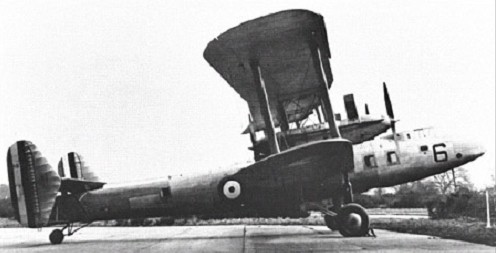
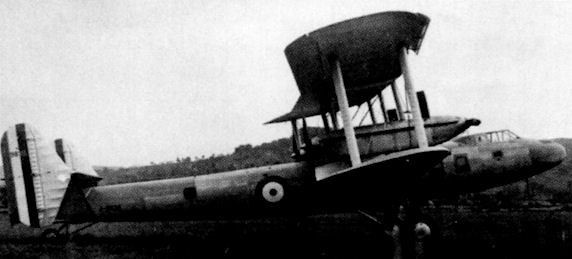
The appearance in 1930 of the four-engined troop carrier (TC) TC.33 was a complete break from their tradition and was the only four-engined aircraft that Gloster ever built. It was designed led by Henry Folland to meet Air Ministry specification C.16/28, which required the ability to carry 30 troops and their equipment for 1,200 miles (1,930 km) and was the same specification that produced the Handley Page H.P.43 and the Vickers Type 163.
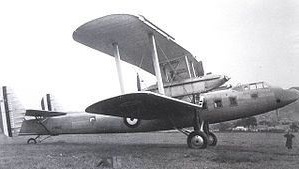
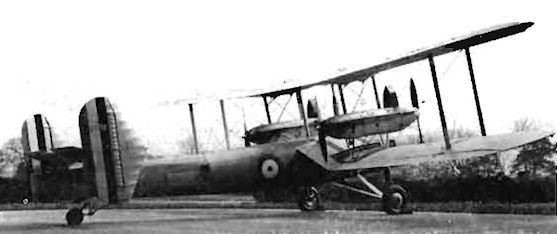
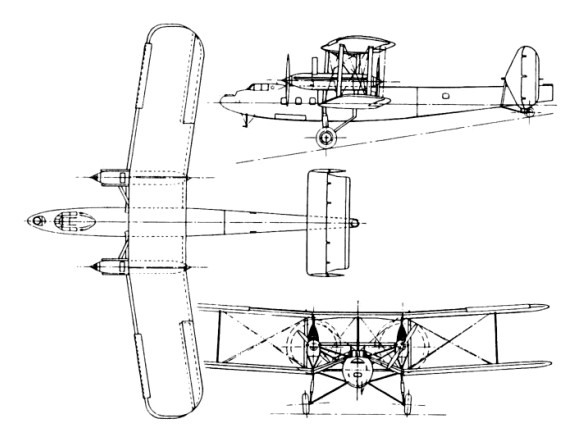
The TC.33 was a large single bay all-metal biplane with no stagger and 7° sweepback. Both wings had metal lattice spars and metal ribs with fabric covering. The lower wing was unusual in that its centre section had marked anhedral so that the main spars met at the top of the fuselage, leaving the interior unobstructed. The outer end of this centre section was strut braced to the lower fuselage. The TC.33 also had a lower wing of (slightly) greater span than the upper.
The four evaporatively cooled Rolls-Royce Kestrel engines were mounted in two nacelles, each containing a tractor-pusher pair together with their steam condenser and mounted between the wings at the end of the centre section. They were each carried by two vertical struts above the nacelle, complicated strutting below and by further strutting to the lower wing roots. The wide (22 ft 6 in (6.8 m)) split axle undercarriage had vertical legs from the front wing spar at the same point and bracing from the axles to the fuselage.
The fuselage was oval in cross section and smoothly metal skinned. The cockpit was enclosed, but there were open gunners’ positions at nose and tail. Like the cockpit, the long main cabin was heated and soundproofed. There was a large hatch in the floor for heavy loads with an integral hoist mounted above it, plus a smaller roof hatch through which loads could be lowered by crane. The biplane tail unit had conventional fabric covered endplate fins and rudders, but the tailplanes were sesquiplane type. The upper tailplane and elevator was strut mounted above the fuselage and the much narrower chord lower part fixed to the lower fuselage.
The prototype was completed in January 1931 and, because the hangar doors were low, the undercarriage had to be assembled in two trenches. The aircraft was winched in and out of the hangar by way of these trenches.
The TC.33 first flew on 23 February 1932. Development flying showed it had good performance but suffered from elevator and rudder flutter. The former was cured with mass balancing but the rudder flutter persisted, particularly in high speed dives until the rudders were redesigned.
It was exhibited at the 1932 RAF Hendon Display and then went on to RAF Martlesham Heath for trials. Once in the air, the TC.33 was judged a pleasant machine to fly, but it was crucially let down by its full load take off performance. Even at Martlesham it was hard to get it off the ground in a reasonable distance. The undercarriage behaviour was also criticised. Because of these concerns over take off performance at English temperatures and altitudes, the Air Ministry did not place an order, judging it would not cope with the hot and high conditions found at many RAF fields across the Empire. Thus J9832 was the only one of its kind. None of the C.16/28 contenders were awarded a production contract.
Engines: 2 × Rolls-Royce Kestrel IIIS, 580 hp (432 kW) & 2 × Rolls-Royce Kestrel IIS, 580 hp (432 kW) Props: 12 ft 6 in (3.8 m) diameter two bladed fixed pitch tractor & 11 ft 0 in (3.3 m) diameter two blade fixed pitch pusher Length: 80 ft 0 in (24.38 m) Wingspan: 95 ft 1 in (28.98 m) Height: 25 ft 8 in (7.82 m) Wing area: 2,493 ft2 (231.60 m2) Empty weight: 18,399 lb (8,346 kg) Gross weight: 28,884 lb (13,101 kg) Maximum speed: at 13000 ft (3,960 m) 142 mph (227 km/h) Service ceiling: 19,100 ft (5,821 m) Rate of climb: to 10,000 ft (3,050 m) 408 ft/min (2.1 m/s) Armament: 2 × 0.303 in (7.7 mm) Lewis gun, in front and rear positions & 3,600 lb / 1,633 kg bomb load on racks below fuselage Crew: 4 Capacity: 30 troops
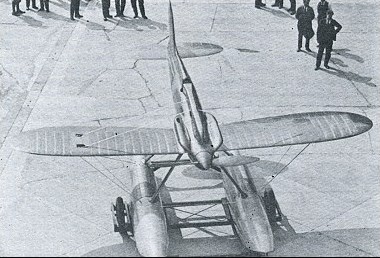
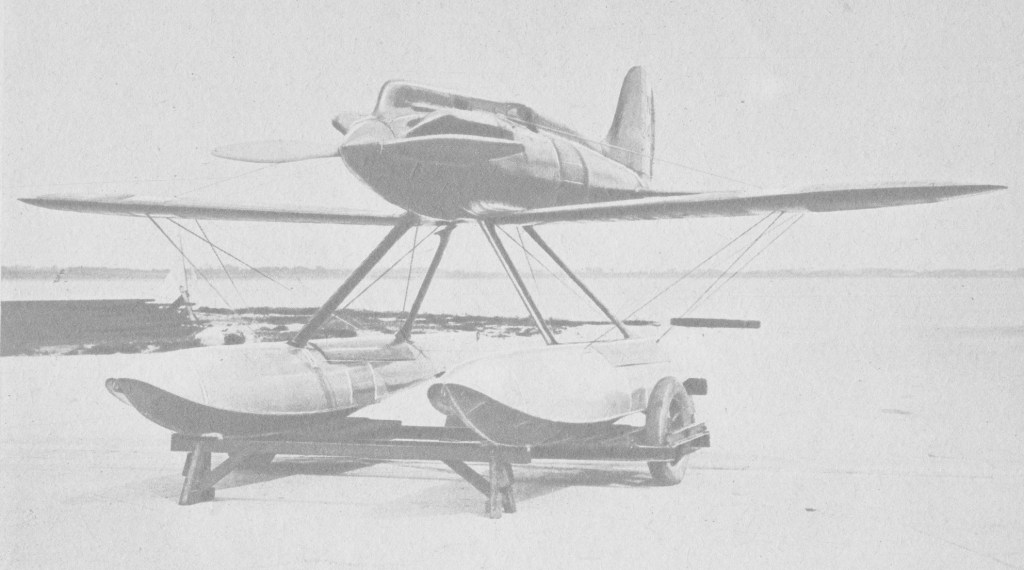
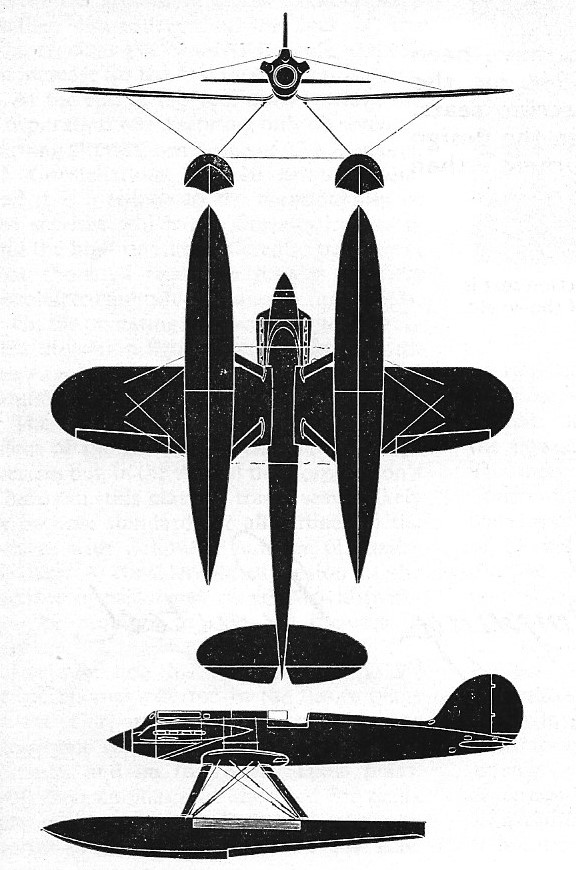
Further development of the Gloster III, the Gloster VI was the first monoplane. With spruce sheet-covering, the VI was powered with a Napier Lion VIID V-12.
Two specially built single seat racers were entered for the 1929 Schneider Trophy Contest, N249 and N250. Technical snags, petrol feed and air intake, could not be solved in time to prevent the entries from being withdrawn.
N249, flown by F/Lt G.H. Stainforth of the RAF High Speed Flight, on 10 September 1929, broke the absolute speed record averaging 336.3 mph over Calshot.
Engine: 1 x Napier Lion VIID, 984kW Max take-off weight: 1669 kg / 3680 lb Empty weight: 1036 kg / 2284 lb Wingspan: 7.92 m / 25 ft 12 in Length: 8.23 m / 27 ft 0 in Height: 3.29 m / 10 ft 10 in Wing area: 9.85 sq.m / 106.02 sq ft Max. speed: 565 km/h / 351 mph
Gloster IVB Engine: 1 x Napier Lion VIIB, 660kW Max take-off weight: 1499 kg / 3305 lb Empty weight: 1185 kg / 2612 lb Wingspan: 6.90 m / 22 ft 8 in Length: 8.03 m / 26 ft 4 in Height: 2.79 m / 9 ft 2 in Wing area: 12.91 sq.m / 138.96 sq ft Max. speed: 475 km/h / 295 mph
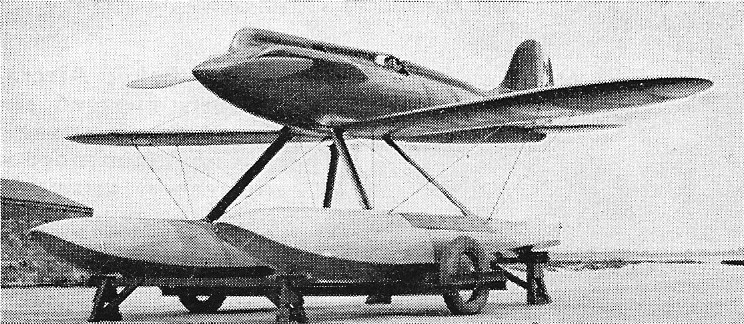
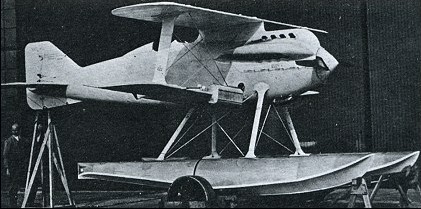
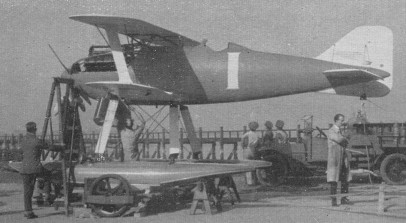
Built for 1925 Schneider Trophy races. The Gloster IIIA (High Speed Flight N-195) was the most successful of all the Gloster Schneider entries. It came 2nd in the 1925 race held in Baltimore, USA. The winner was Doolittle in the renowned Curtiss R3C-2. A second IIIA (N-194) was held in reserve for this race.
Engine: 1 x Napier Lion VII, 522kW Max take-off weight: 1343 kg / 2961 lb Empty weight: 1033 kg / 2277 lb Wingspan: 6.10 m / 20 ft 0 in Length: 8.18 m / 26 ft 10 in Height: 2.95 m / 9 ft 8 in Wing area: 14.12 sq.m / 151.99 sq ft Max. speed: 405 km/h / 252 mph