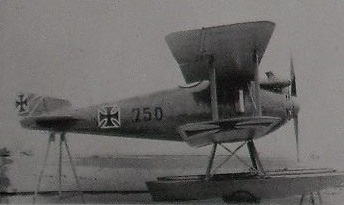
160 hp Mercedes 1917
160 hp Mercedes 1917
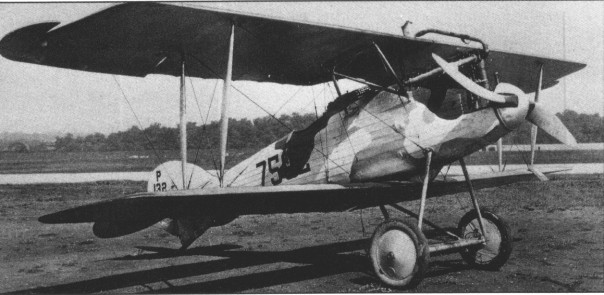
Late in 1917 the prototype D.VI appeared. The D VI followed the D II series and was built for the January 1918 German fighter competition. Two versions, one with a 160 hp water cooled Mercedes DIII engine and another with an improved 180 hp Mercedes, were entered in the fighter design competition of January 1918. There they lost to the Fokker that was to become the D.VII.
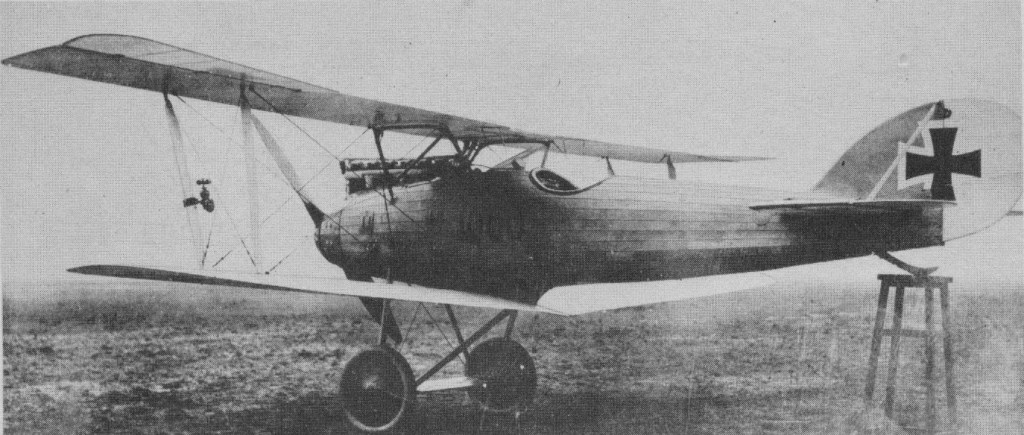
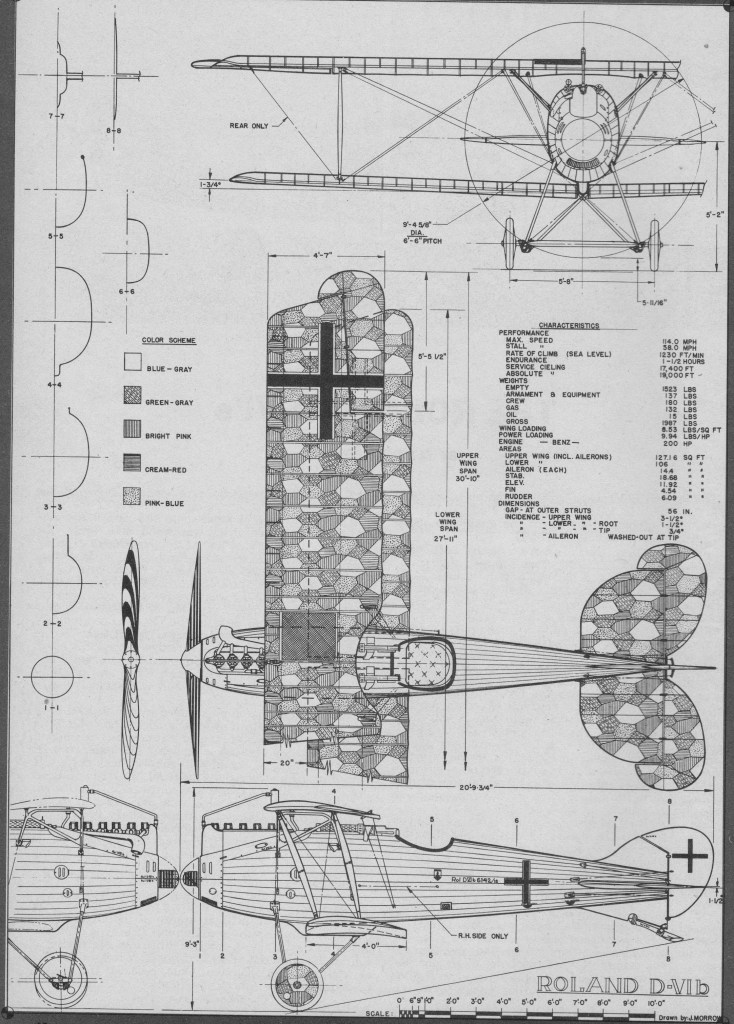
There was little to distinguish the standard production D.VIa from the earlier D.VIb other than the designation lettering on the side of the fuselage and the visible details of the different engines. Early models in each series had the radiator filler cap on the centre line of the upper wing while later models had it at the right side of the radiator. Late V.VI’s and all production S.VIb’s had a diagonal brace wire running from the lower rear wing strut to the upper wing overhang. Late model D.VIb’s were mostly identified by the installation on wider elevators which had aerodynamic balance areas extending forward to the hinge line. Serial numbers were not accurate because many D.VIb’s had earlier serials than late D.VIa’s.
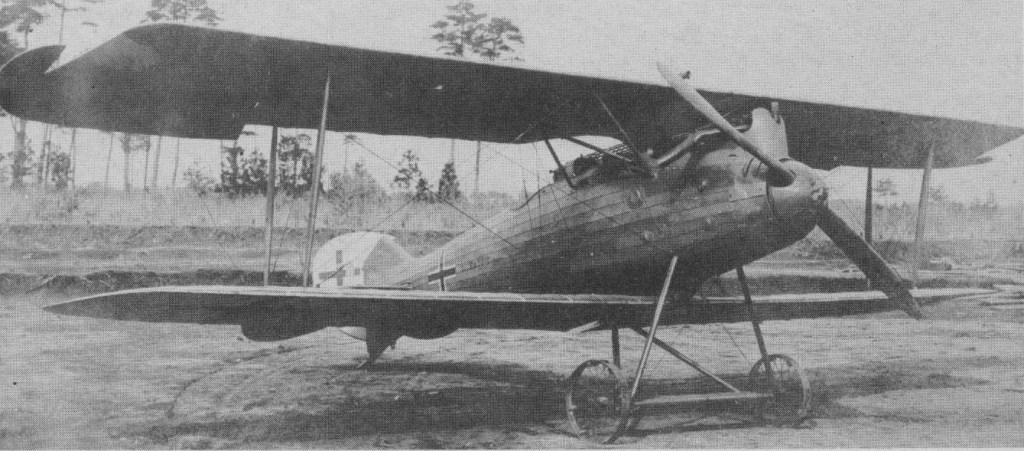
The D.VI wings were built up of wood spars and ribs, fabric covered. While the stabiliser was wood and fabric, the vertical fin on all but a few of the experimental prototypes was plywood covered. A unique feature was the fuselage construction. Roland used longitudinal strips of solid wood tapered to conform to the fuselage lines and planed to a wedge-shaped cross section to allow overlapping of adjacent strips exactly like shiplap in a “clinker-built” boat. This was officially termed “Klinkerkonstruction” and was exclusive with Roland.
Centre section bracing consisted of two welded steel tube assemblies instead of individual struts; outer wing struts were wood. Landing gear struts were streamlined steel tubing cross-braced with wire. The axle, secured to the landing gear struts with rubber shock cord, was carried inside a streamlined spreader bar fairing hinged at its top to allow upward movement of the axle when under load. The lower wing was not attached to the bottom of the fuselage but mounted on a narrow external keel that projected below the fuselage proper. The rear landing gear struts also attached to this keel where it joined the rear wing spars.
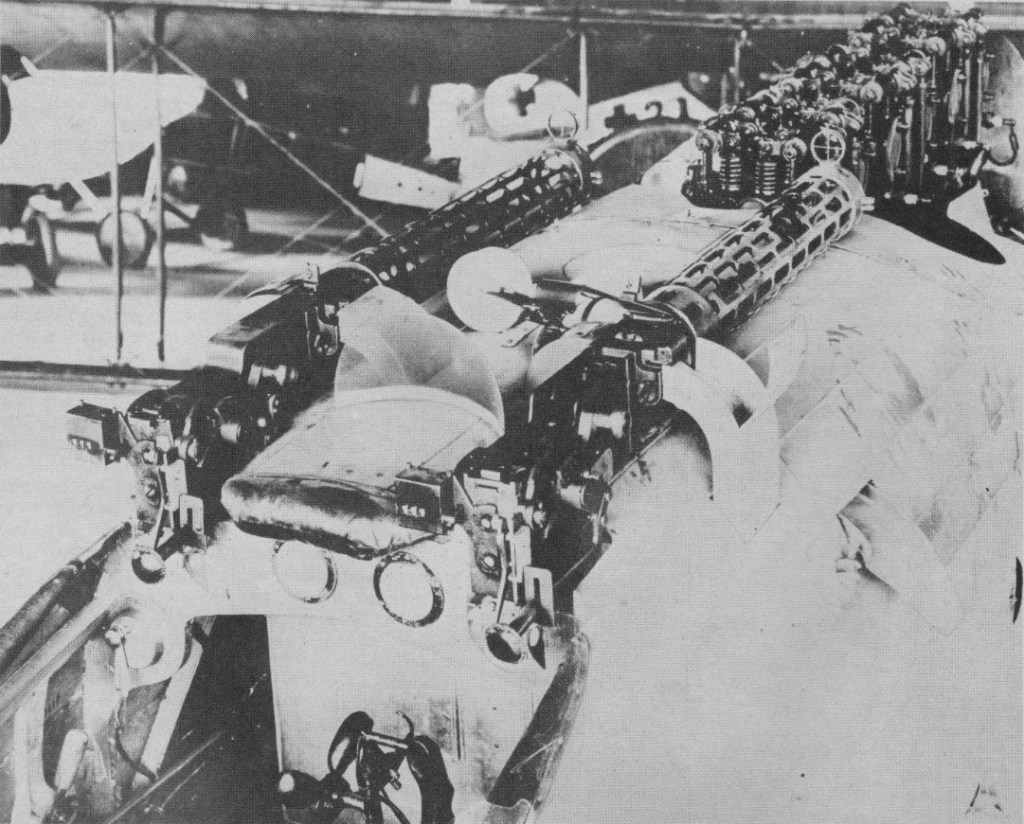
Installation of the radiator in a flat position in the centre section of the upper wing was standard practise. This type of installation was adequate in northern an central Europe but postwar tests of a C.VIb at McCook Field, Dayton, Ohio, revealed the cooling inadequate under American climatic conditions.
The aileron control system was adapted from that of the French Nieuport 11 and 17 in that a steel torque tube projected from the hinge line of the aileron to the centre section over the cockpit. Cables from control horns on the tube connected directly to a rocking beam under the control stick. The D.VI was the first German fighter to feature a horizontal stabiliser that could be adjusted for in-flight trim. The entire stabiliser pivoted about the rear spar. Other fighters with trim control had bungee springs or set screws attached to the stick.
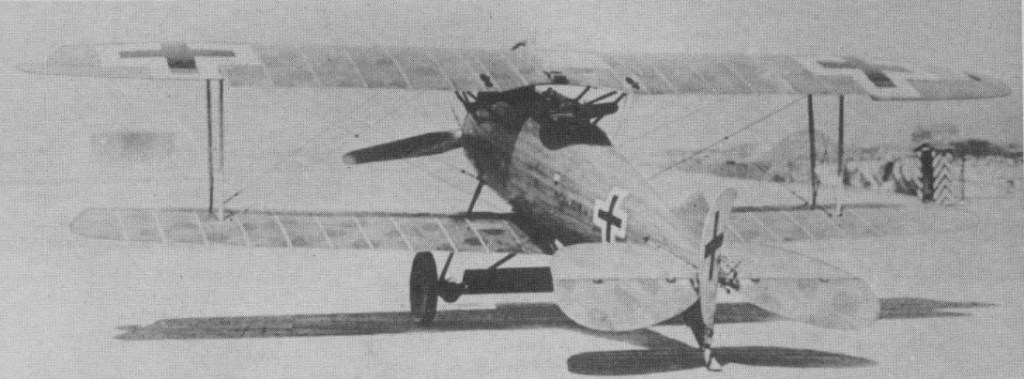
Later evaluation resulted in production orders for two improved Rolands, the D.VIa with the 180 hp Mercedes and the D.VIb with a new model 185-200 hp Benz, another six cylinder. Both of these engines had been tested in experimental D.VI, which were themselves undergoing considerable aerodynamic refinement, and no special designations were applied to identify the various prototypes by powerplant or other feature.
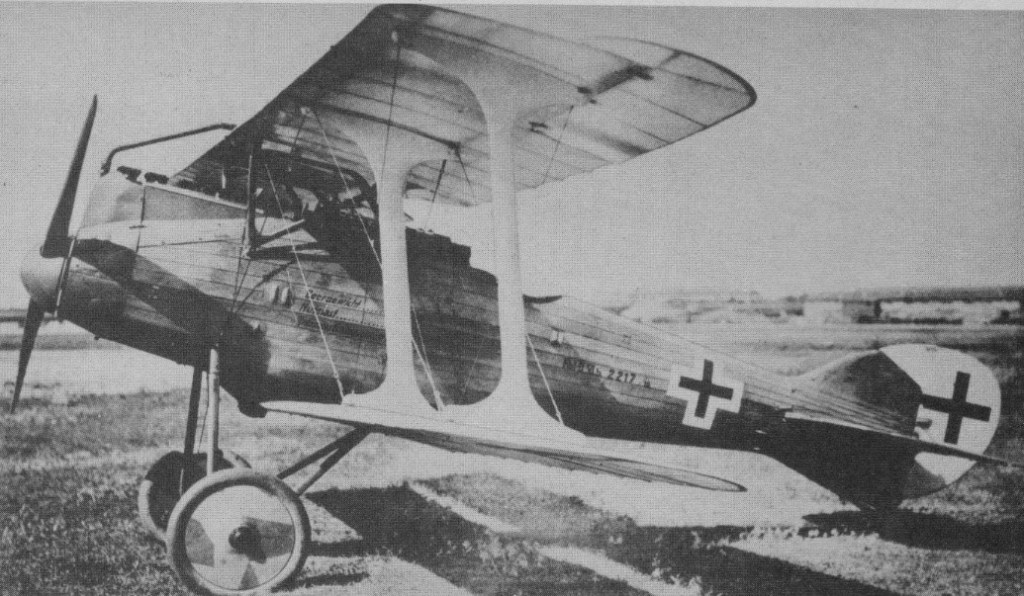
The Roland D.VI reached the front in service quantities shortly after the Fokker D.7. A few D VIs were used over the Western Front, while others went to the German navy for the defence of seaplane bases.
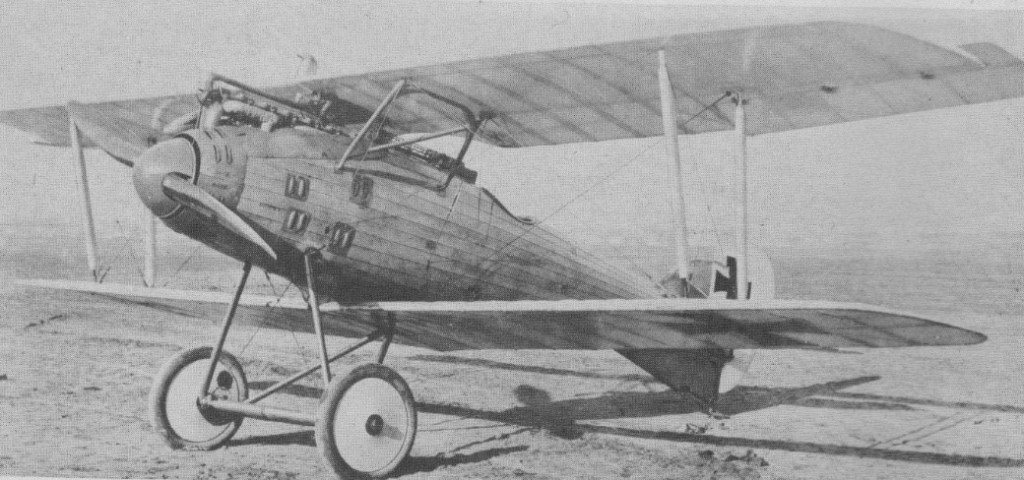
D.VI / D.VIa
Engine: Mercedes DIII, 119-kW (160-hp).
D.VIb
Span: 9.4m (30ft l0in)
Length: 6.3m (20ft 8in)
Powerplant: l x Benz Bz.IIIa, 149kW (200 hp)
Armament: 2 x 7.92-mm (0.312-in) LMG 08/15 mg
Max T/O weight: 860 kg (1,896 lb)
Max speed: 114 mph
Operational endurance: 2 hr
The single D V prototype had a more refined fuselage structure compared to the D.III.
The D III introduced a revised and shallower fuselage over which the upper-wing centre section was supported on cabane struts, but only a few were built.
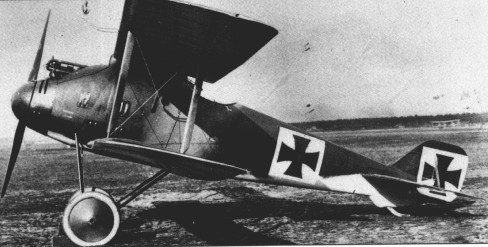
As a result of the success of the Roland C.II two-seater, Roland began building a single-seat fighter on the same lines. The resulting D.I first flew in July 1916, and after refinement became the D.II.
A single bay biplane, the two-spar wings, with fabric covering, had ailerons on the top wing only. The plywood covered wooden semi-monocoque fuselage with integral fin. The control surface were fabric covered steel tube.
The D II, which retained the same 119-kW (160-hp) Mercedes DIII engine but featured a number of drag-reducing revisions as well as a modified empennage. Armament wa on the top of the forward fuselage.
The D II began to enter service early in 1917, and was complemented by the D lIa with a more powerful 180 hp Argus engine.
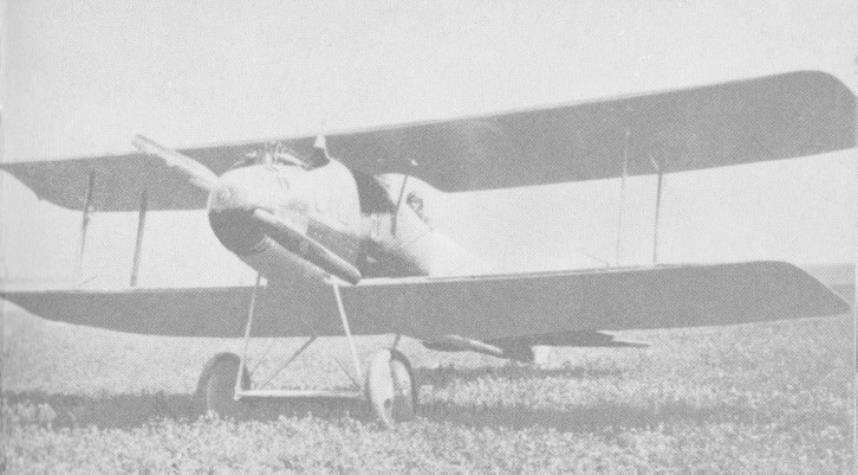
They were flown mainly on the quieter sectors of the Western Front and did not normally equip completely any squadrons. The D II and D la were not popular in service, pilots complaining about lack of vision and heavy controls.
About 300 were built.
D.II
Engine: Mercedes DIII, 119-kW (160-hp).
D.IIa
Engine: Argus As.III, 180 hp
Wing span: 29 ft 2.5 in
Wing area: 236.8 sq.ft
Length: 22 ft 9 in
Height: 9 ft 8 in
Empty weight: 1400 lb
MTOW: 1753 lb
Max speed: 112 mph at SL
Endurance: 2 hr
Armament: 2 x Spandau
The D I was in essence the C II two-seater scaled down as a single-seat fighter. The type was nicknamed Haifisch (shark) for its deep fuselage with the slightly swept upper wing attached directly to it. The D I first flew in July 1916, and was produced in small numbers. The D II began to enter service early in 1917, and was complemented by the D.Ia with a more powerful engine. The D II and D la were not popular in service, pilots complaining about lack of vision and heavy controls.
D.I
Engine: Mercedes DIII, 119-kW (160-hp).
D.Ia
Span: 8.94m (29ft 4in)
Length: 6.93m (22ft 9in)
Powerplant: l x Argus As.lll, 134kW (180 hp)
Armament: 2 x 7.92-mm (0.312-in) LMG 08/15 mg.
Max T/O weight: 795 kg (1,753 lb).
Max speed: 112.5 mph.
Operational endurance: 2 hr.
1915
Seats: 2
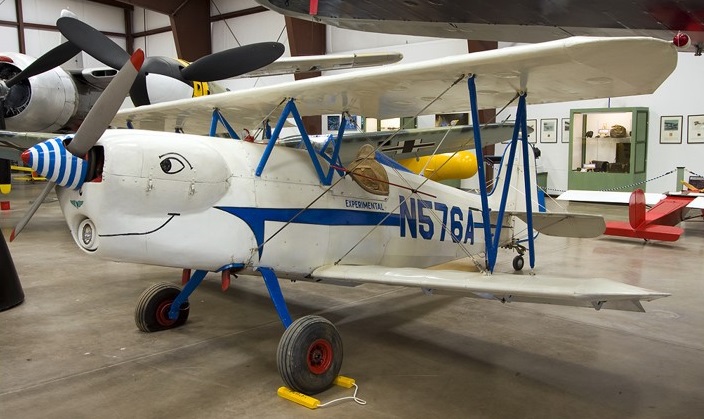
The Lewann DD-1 built in 1964 and registered N576A C/n 1 was in the Planes of Fame Air Museum at Valle Airport, AZ, USA in October 2017.
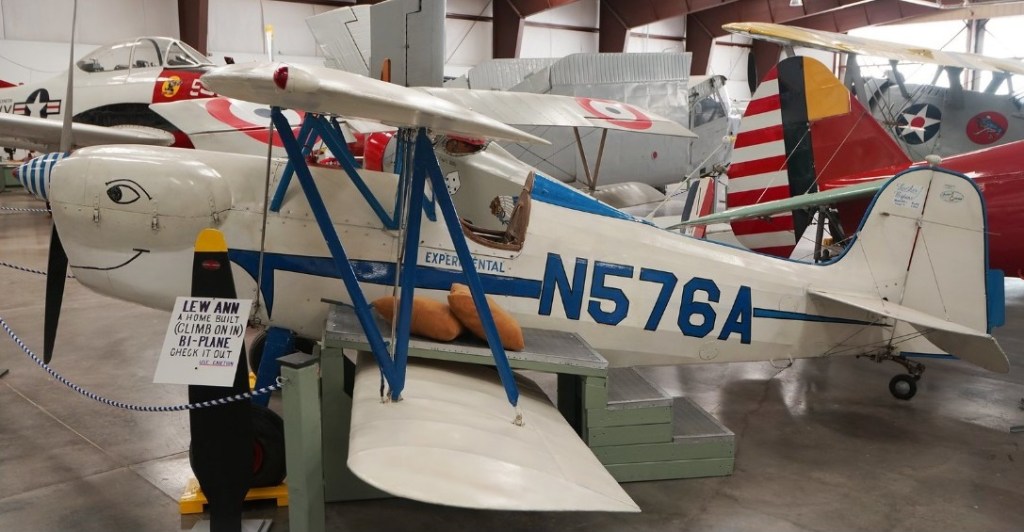
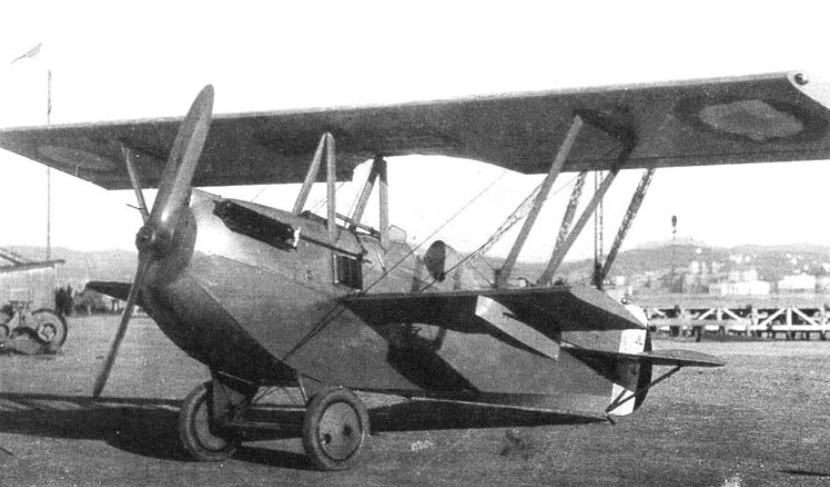
The Levy Biche LB.2 was a single seat French sesquiplane fighter aircraft designed to be used from aircraft carriers. With a watertight fuselage, jettisonable wheeled undercarriage and small under-wing floats, it could survive emergency sea touchdowns; it could also be fitted with seaplane type floats.
The LB.2 was designed as a shipboard fighter. It was a single bay sesquiplane, with outward leaning parallel pairs of interplane struts and wire cross bracing. The wings were strictly rectangular in plan, the lower plane smaller in both span and chord. The upper wing carried full span ailerons. Its flat sided fuselage was watertight and its belly deep; in emergency touchdowns at sea the undercarriage could be jettisoned with the aircraft stabilised with two small rectangular cross section, planing floats mounted on the lower wing underside below the interplane struts.
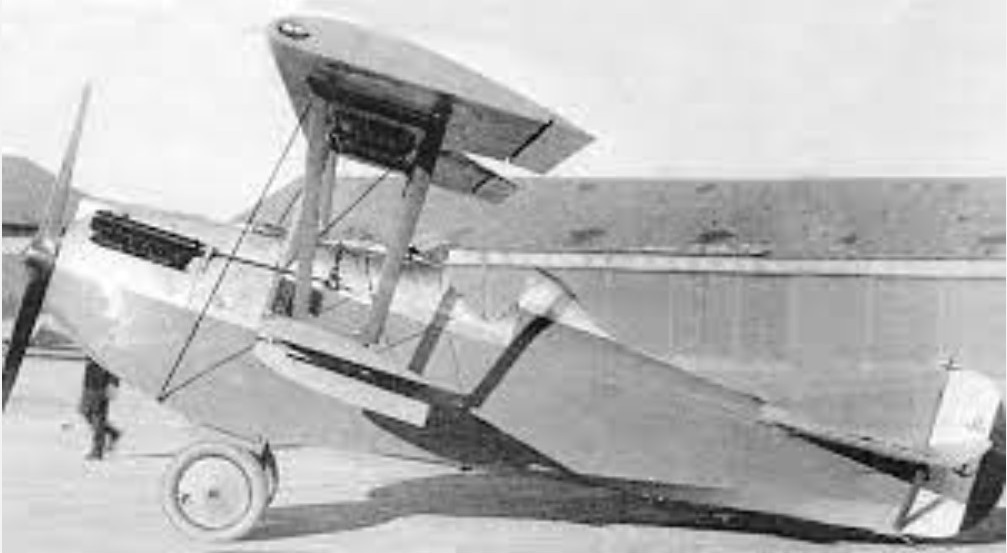
The LB 2 was powered by a 246 kW (330 hp) Hispano-Suiza 8Fe upright water-cooled V-8 engine. The upper wing was high above the fuselage on cabane struts and had a rounded cut-out in the trailing edge over the pilot’s open cockpit to enhance his view. He had a short, faired headrest. The fuselage tapered aft and had distinct narrow keel to enhance its water surface behaviour. The braced tailplane was wide chord and triangular in plan, carrying split elevators; the fin was also broad and triangular, with a deep, curved rudder that reached down to the bottom of the extreme keel, where there was a very small tailskid. The jettisonable main fixed conventional undercarriage structure had two short V-struts, supporting a wire cross braced single axle and mainwheels. Armament consisted of a pair of 7.7 mm (0.303 in) Vickers machine guns.
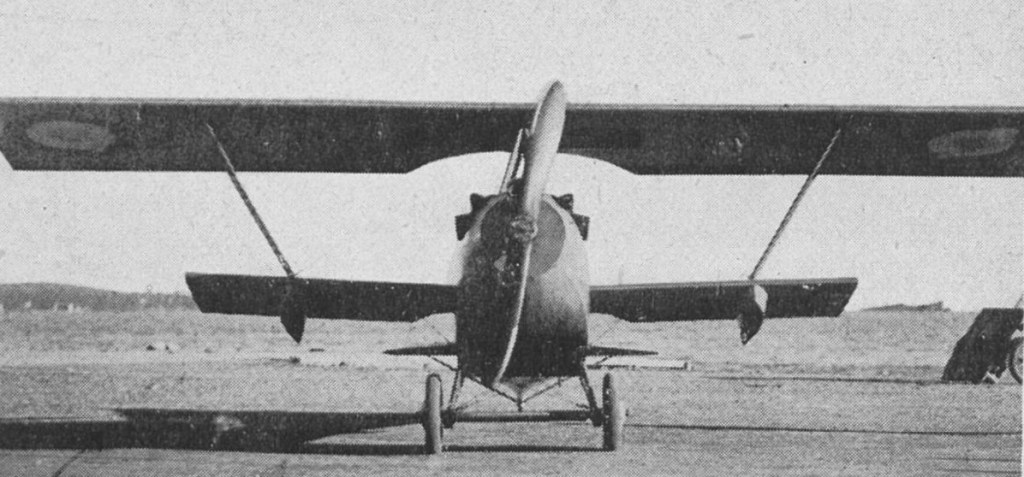
The first flight was in 1927 and by October that year it had also flown with seaplane style floats. Soon after, Constructions Aéronautiques J Levy became bankrupt and production rights were purchased by Etablissements P. Levasseur. The latter built twenty production aircraft during 1928-9, designated LB.2 AMBC.1, which served on the experimental French aircraft carrier Béarn, commissioned in May 1927, as well as from shore bases.
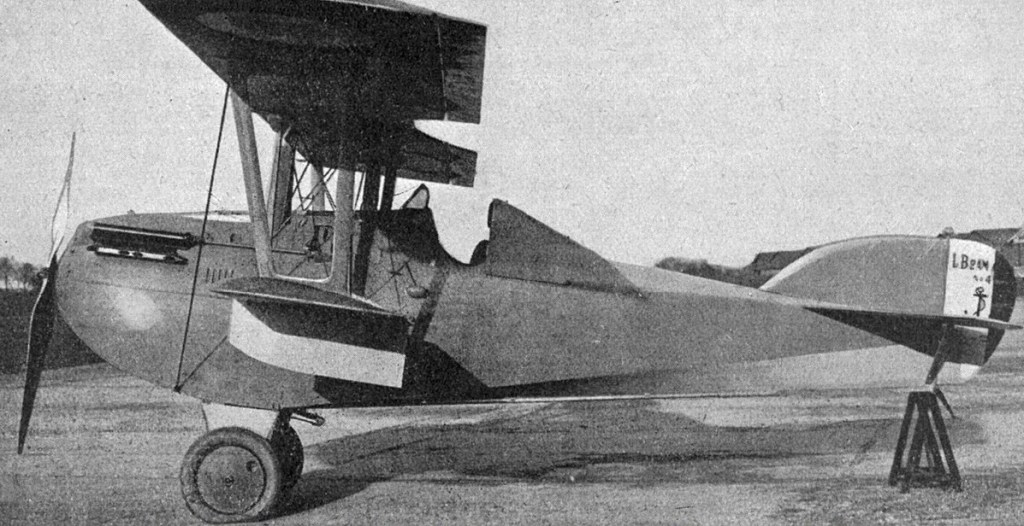
The LB.2 remained in service with French Naval Aviation until 1932, when they were replaced by Wibault 74 fighters.
Powerplant: 1 × Hispano-Suiza 8Fe, 250 kW (330 hp)
Propeller: 2-bladed fixed pitch
Wingspan: 10.40 m (34 ft 1 in)
Wing area: 24.00 m2 (258.3 sq ft)
Length: 7.525 m (24 ft 8 in)
Height: 3.488 m (11 ft 5 in)
Empty weight: 920 kg (2,028 lb)
Gross weight: 1,350 kg (2,976 lb)
Maximum speed: 219 km/h (136 mph, 118 kn)
Stall speed: 88 km/h (55 mph, 48 kn)
Time to 5,000 m (16,000 ft): 25 minutes
Wing loading: 55.4 kg/m2 (11.3 lb/sq ft)
Power/mass: 0.182 kW/kg (0.111 hp/lb)
Crew: One
Armament: 2× 7.7 mm (0.303 in) Vickers machine-guns
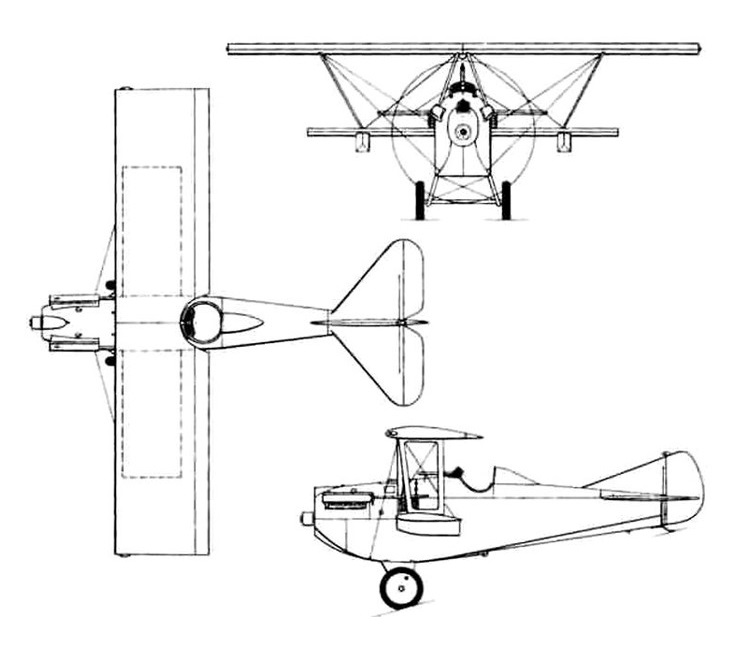
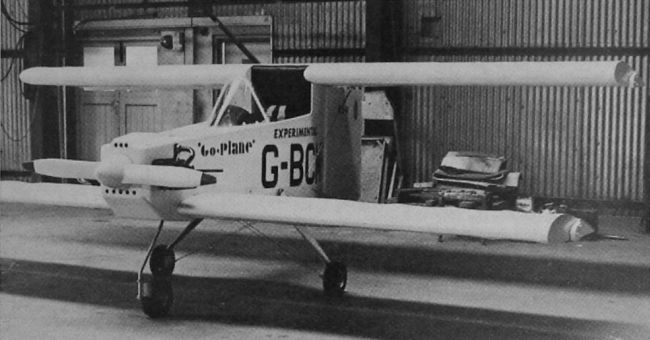
The Levi RL-6 Go-Plane is a single-seat tandem wing design with tricycle undercarriage. Either a double monoplane or a staggered biplane, with its rudder integrated into the fuselage but no tail, in the traditional sense, or tailplanes.
By the end of 1974 Renato Levi of Newport, Isle of Wight was conducting test on the RL-6 Go-Plane G-BCMF c/n EAA3678, at Bembridge. It was a Bembridge Airfield on 16 November 1974 for the purpose of its maiden flight. It was damaged beyond repair in the course of that on 16 November 1974.
The CAA cancelled the registration of G-BCMF on 5 December 1983.
 All Aero