Biaster Bipo
Paraglider circa 1997/8.
Wing area: 39 sq.m
Certification: Afnor
Pilot weight: 130-220 kg
No. of cells: 44
Wing span: 117 m
Aspect ratio: 3.51
Price (1998) 6160000 Lr
Author: Terry
Para Delta Ben Hur T5
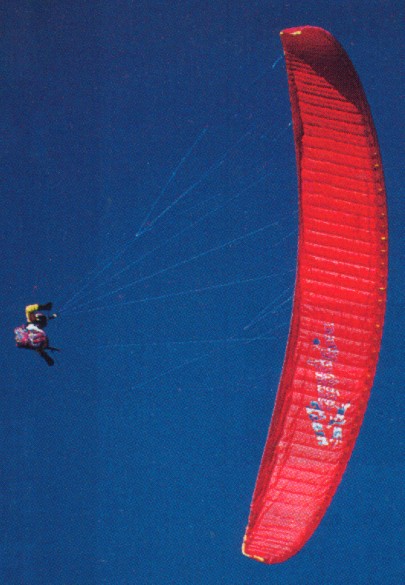
Ben Hur G
Paraglider circa 1997/8.
Wing area: 31.54 sq.m
Pilot weight: 95-125 kg
No. of cells: 63
Wing span: 12.1 m
Aspect ratio: 4.64
Price (1998) 6646000 Lr
Ben Hur M
Paraglider circa 1997/8.
Wing area: 29.2 sq.m
Certification: Afnor
Pilot weight: 85-110 kg
No. of cells: 59
Wing span: 11.2 m
Aspect ratio: 4.37
Price (1998) 6516000 Lr
Ben Hur T 5 deg dg
Paraglider circa 1997/8.
Wing area: 28.1 sq.m
Pilot weight: 85-110 kg
No. of cells: 98
Wing span: 12.71 m
Aspect ratio: 5.75
Price (1998) 8735000 Lr
Ben Hur 5 deg m
Paraglider circa 1997/8.
Wing area: 26.3 sq.m
Certification: Afnor
Pilot weight: 80-105 kg
No. of cells: 90
Wing span: 11.65 m
Aspect ratio: 5.16
Price (1998) 8600000 Lr
Para Delta
1998: Via Quasimodo 3, 1-43100 Parma, ITALY
Paraglider builder
Para-Cycle Segovia
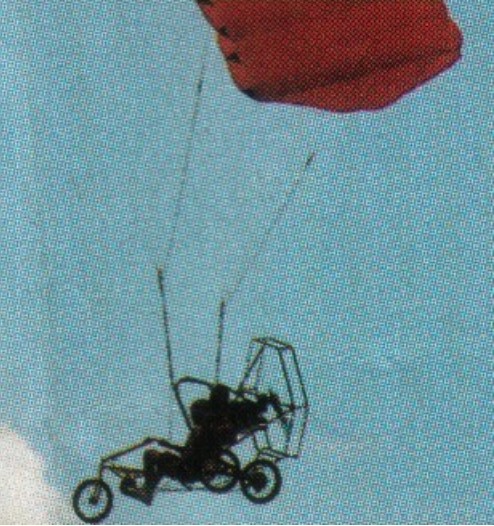
First manufactured in the USA in 1997. The unit is a street legal pedalling trike. A parachute and motor are attached by three bolts.
Engine: 2si 460F, 40 hp
hp range: 22-50
Height: 6 ft
Length: 6.8 ft
Wing span: 39 ft
Wing area: 400 sq.ft
Empty weight: 147 lb
Gross weight: 467 lb
Fuel capacity: 2.5 USG
Cruise: 26 mph
Range: 40 sm
Rate of climb: 400 fpm
Takeoff dist: 100 ft
Landing dist: 25 ft
Service ceiling: 10,000 ft
Seats: 1
Para-Cycle
1998: PO Box 1906, Windermere, FL 34786, USA.
Trike builder
Paraborne Skytrike
Parachute, Trigear trike unit
Paraborne Mustang
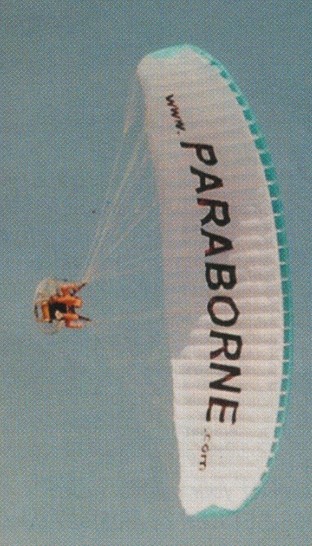
Paraborne Buckshot / Goodwin Buckshot
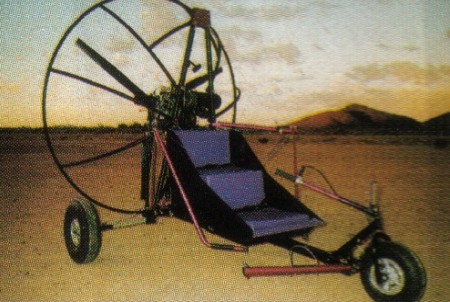
The Goodwin Buckshot is an American powered parachute that was designed and produced by FL Goodwin of Phoenix, Arizona and introduced in 1998.
Designed as a US FAR 103 Ultralight Vehicles two seat trainer, it features a parachute-style high-wing, two seats in side-by-side configuration, tricycle landing gear and a single engine in pusher configuration. The standard engines supplied were the 45 hp (34 kW) 2si 460F-45 and the 45 hp (34 kW) Zenoah G-50 engine, although any light, two-cylinder, two-stroke engine can be used.
The aircraft is built from bolted anodized aluminium tubing to save weight. In flight steering is accomplished via foot pedals that actuate the canopy brakes, creating roll and yaw. On the ground the aircraft has tiller-controlled nosewheel steering. The main landing gear does not incorporate suspension and the aircraft relies on large tundra tires to provide this.
The aircraft was distributed by Paraborne Aviation of Kissimmee, Florida. The Buckshot is out of production.
The rectangular canopy is made from double ripstop, mylar and kevlar. The trike design utilises shroud lines and risers.
Engine: Rotax 503, 46 hp
hp range: 40-65
Height: 7 ft
Length: 9 ft
Wing span: 50 ft
Wing area: 502 sq.ft
Empty weight: 230 lb
Gross weight: 730 lb
Fuel capacity: 13.5 USG
Cruise: 26 mph
Rate of climb: 700 fpm
Takeoff dist: 50 ft
Landing dist: 30 ft
Service ceiling: 10,000 ft
Seats: 2
Buckshot
Engine: 1 × 2si 460F-45, 45 hp (34 kW)
Empty weight: 230 lb / 104 kg
Fuel capacity: 13.5 U.S. gallons / 51 lt / 11.2 imp gal
Cruise speed: 25 mph / 22 kph / 40 km/h
Crew: one
Capacity: one passenger
Unit cost: US$9000 (2001)
Paraborne Aviation
1998: PO Box 423217, Kissimmee, FL l 34742, USA.
Trike and paraglider builder
Papin & Rouilly Gyroptère
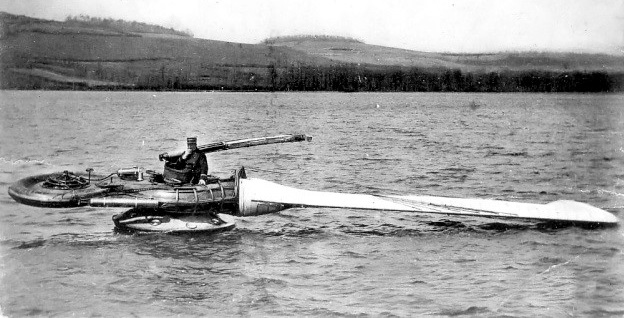
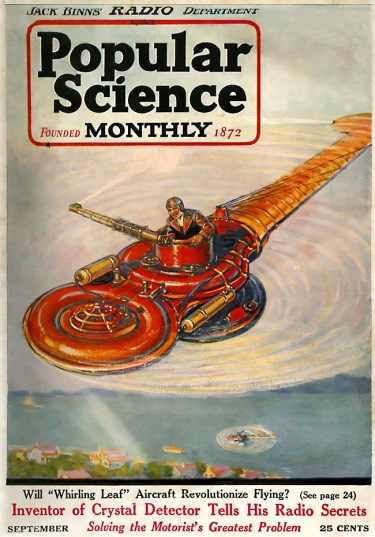
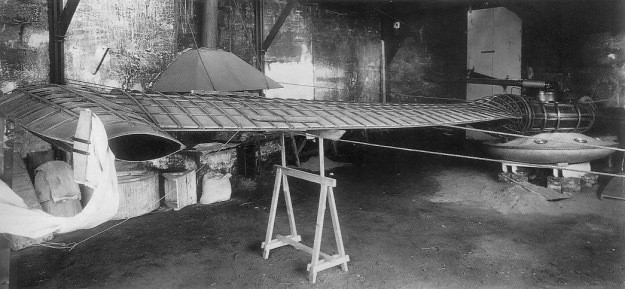
The Gyroptere was designed in France from 1911-1914 by Alphonse Papin and Didier Rouilly. Their monocopter was based on the sycamore seed; a single blade extends from the seed to spin the seed and slow its descent as it falls. Though unsuccessful, the machine was the first air-jet helicopter. Papin and Rouilly obtained French patents 440,593 and 440,594 for their invention and later obtained U.S. patent 1,133,660 in 1915 (filed in 1912).
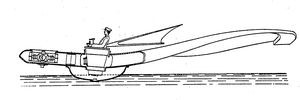
Construction of Papin and Rouilly’s Gyroptere began in February 1914 and was completed in June of the same year. The prototype was named Chrysalis (Chrysalide). Constructed of molded wood, the Gyroptere was well built with compound curves and a smooth sweep of its single, long, airfoil-shaped blade. The fabric-covered blade was hollow and approximately 19.5 ft (5.9 m) long and 4.4 ft (1.33 m) wide, giving it an area of 130 sq ft (12 sq m). The blade was counterbalanced by an 80 hp (60 kW), nine-cylinder Le Rhone rotary engine. The pilot occupied a nacelle between the blade and engine. The bottom of the nacelle included a structure to support the machine while it was on the ground or act as a float when on water.
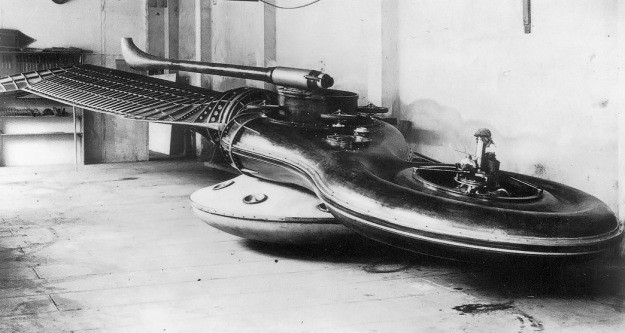
The Le Rhone engine was started with a pulley system. The engine, turning at 1,200 rpm, drove a fan that produced an output of just over 250 cu ft (7 cu m) of air per second. The air, along with the engine’s hot exhaust for thermal expansion, was directed through the length of the blade and exited the blade’s tip through a nozzle on the trailing edge at 330 ft/s (100 m/s). This jet of air would turn the blade, and the gyroscopic force of the motor would lift the blade into a positive angle of attack. The nacelle that carried the pilot was centered on the axis of rotation. The nacelle was mounted on ball-bearings and was centered against four horizontal rollers. The entire machine weighed 1,100 lb (500 kg), which was 220 lb (100 kg) more than originally planned.
The pilot controlled the Gyroptere through the use of two foot pedals: one pedal opened a valve to admit air to the blade; and the second pedal allowed air into an L-shaped tube above the craft that served as a rudder for directional control. The L-shaped tube was directed by the pilot; its discharge provided forward thrust, steering, and stabilized the center drum to prevent it from spinning with the blade. A switch in the nacelle allowed the pilot to engage or disengage the engine.
The outbreak of World War I delayed testing until 31 March 1915. During tests on Lake Cercey (Reservoir de Cercey), near Pouilly-en-Auxois, France, the craft achieved a rotor speed of only 47 rpm, well below the 60 rpm calculated as necessary for liftoff. Even so, the machine was wildly out of balance, and the blade repeatedly contacted the water, damaging itself and shaking up the pilot. In addition, the Le Rhone engine used was not powerful enough; the Gyroptere had been designed to use a 100 hp (75 kW) engine which could not be obtained.
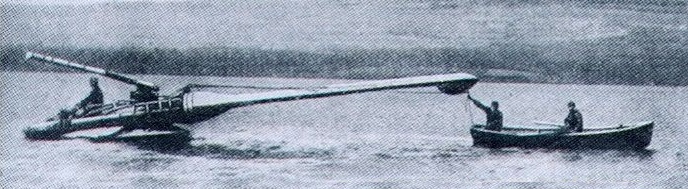
A military commission observing the test determined that such a machine could not aid the war effort and halted further evaluation. The Gyroptere remained at Lake Cercey until it was sold for scrap in 1919.