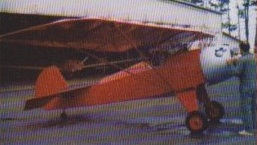
In 1981 Michael Platzer designed and built Germany’s first legal ultralight with three axis control, the P.4 Motte. It has a spaceframe fuselage and dural tube wings.
A parasol UL, the Motte was rebuilt and fitted with a converted Nissan Micra automobile engine.
P4 Motte BR Engine: Rotax 462, 52 hp Wing span: 8.2 m Wing area: 11.4 sq.m MAUW: 285 kg Empty weight: 170 kg Fuel capacity: 40 lt Max speed: 145 kph Cruise speed: 125 kph Minimum speed: 50 kph Climb rate: 4 m/s Certification: Vz Seats: 1 Fuel consumption: 13 lt/hr Plan price (1998): 1000 DM
In Germany, just after the end of World War I, the 1919 Versailles treaty imposed a ban on powered flight. As a result there was a rapid increase of interest in gliding. Rheinhart Platz, the chief designer for Fokker’s after June 1916, perceived a role for a glider that was cheap to buy, costing less than “one good pedal cycle”, and cheap to maintain, while being robust and capable of being transported, by train or otherwise, and rapidly erected by one man.
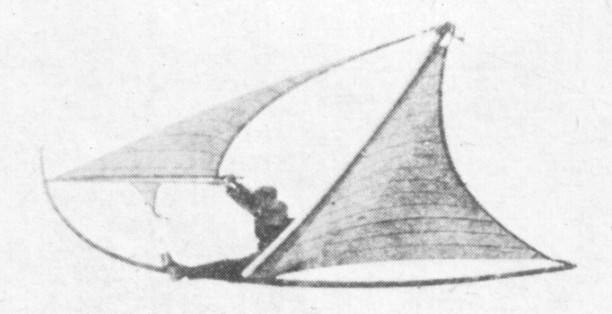
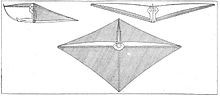
In the winter of 1922/23 Reinhold Platz designed and constructed a glider. The idea occurred during a sailing trip on the Schelde. To a certain extent sailing on water can be compared (aerodynamically) with gliding. After several tests with small and large models, Platz constructed a full size glider. Its fuselage comprised a curved steel tube with a circular section wooden beam inserted through it at the rear. The wing spars were two wooden masts which were inserted into two receptacles welded to the fuselage tube near the pilot’s seat. The “main sail”, or wing, was attached to these two masts. The two separate forward jibs were attached to jib masts, which could be moved by the pilot simultaneously or separately as required. By moving the two jibs up or down, longitudinal control was obtained. By moving one jib up and the other down, lateral control was possible. They were initially hinged together at their leading edges, but later the hinge point was moved rearwards towards the aerodynamic centre to reduce pilot load and separated only behind the hinge.
Since there were no ribs, the airfoil was determined by the airflow and the pilot, as for the sloop’s jib. The main wing, a single surface stretched between the spars and the extreme tail, also had its camber determined by the airflow, like the mainsail of the sloop. Both wing sheets were produced by sewing together narrow strips of material; the longitudinal joints between them are prominent in some back lit, better quality images.
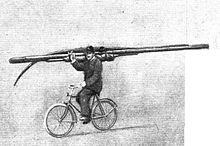
The glider had a wing span of 6.60 metres and weighed 40kg. It could be assembled by one man within 15min, and dismantled within 10min. The Platz could be disassembled into a 3,300 mm (130 in) × 350 mm (14 in) × 250 mm (10 in) pack, weighing 40 kg (88 lb) in fifteen minutes and reassembled in ten. Transport by bicycle, with care, was possible.
Free flight trials began some 50 flights without pilots and with increasing loads (up to 75 kg (165 lb)) into strengthening wind and eventually over sandhills as high as 25 m (82 ft). With a pilot in place, the glider was then flown tethered like a kite, first flying in February 1923. Several people, with weights up to 100 kg (220 lb) flew it this way, all reporting that forewing control loads were low. In February 1923 it was free flown in a moderate wind over 10 m (33 ft) dunes. Platz decided that the dunes did not provide usable soaring, their next goal, after which the experiments would end. He noted that, whilst his design could not compete with the best conventional gliders, it had met the initial targets outlined above and thought it or something similar would be of great value, seemingly content to leave others to judge his design.
Platz glider being transported
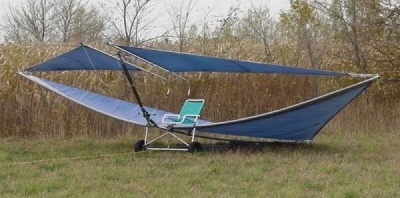
Modern copies have since been built.
Wingspan: 6.60 m (21 ft 8 in) Wing area: 16.0 m2 (172 sq ft) Empty weight: 40 kg (88 lb) Crew: One
General layout of the Platz glider; not a scaled or detailed drawing
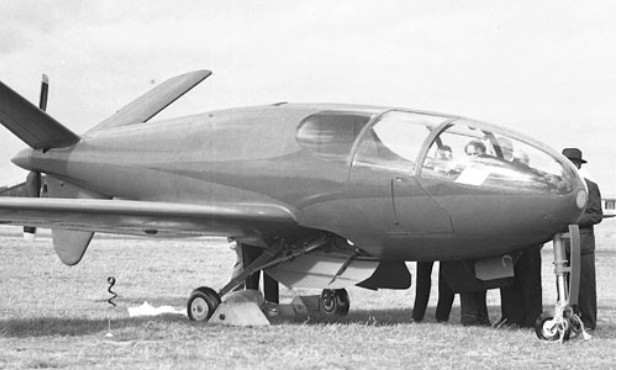
A three-seat light aircraft with vee tail and pusher propeller, the Planet Satellite was powered by a Gipsy Queen 32 via an extension shaft. The first aeroplane constructed entirely of magnesium sheet, and with retractable tricycle undercarriage.
Designed and built by J.N.D.Heenan of Croydon, UK, in 1948, the Satellite appeared at the 1948 Farnborough Airshow. Construction of the prototype G-ALOI c/n 1 was completed at Redhill,
Chronic vibration problems brought attempts at flight to a close at Blackbushe in 1949. After a period of store at Redhill it was broken up in 1958.
A second prototype, c/n 2, was built and used in the construction of the Firth helicopter G-ALXP.
Engine: Gipsy Queen 32 Wingspan: 33.08 ft Length: 26.03 ft
UK Built Satellite three-seat light aircraft with vee tail and pusher propeller in 1949. The first aeroplane constructed entirely of magnesium sheet, it was powered by a Gipsy Queen engine, but did not fly and was subsequently broken up. Fuselage of the second prototype was used in the Firth helicopter.
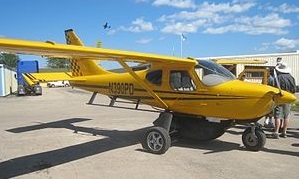
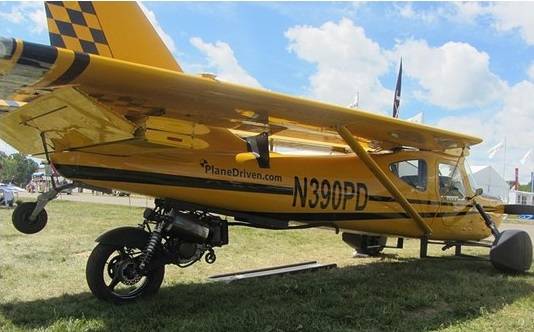
The Plane Driven PD-1 is a modification to the Glasair Sportsman 2+2 to convert it into a practical roadable aircraft. Trey Johnson, a homebuilt aircraft built the PD-1, intended to be an aircraft first, and a car second. The approach uses a mostly stock aircraft with a modified landing gear “pod” that carries a separate engine for road propulsion.
The engine pod carries a separate engine for road travel with its own fuel tank. The wheels are driven through an automatic transmission with a reverse gear. The lightweight fuselage coupled with a low power engine allows 25 miles per US gallon (9.4 L/100 km; 30 mpg imp) fuel economy with 5 US gallons (19 L) of usable fuel. The aircraft is registered in Washington State as a motorcycle due to its 3-wheel configuration.
PD-2 pod installation
The PD-1’s wings fold along its sides, and the main landing gear and road engine pod slide aft along special rails, creating a driving configuration. The driving configuration compensates for the rearward center of gravity created by the folded wings, and provides additional stability for road travel.
The wings are hinged to allow them to rotate and fold back against the rear fuselage of the plane. The horizontal stabilizer is also hinged to reduce the width of the vehicle in road travel mode.
The prototype was constructed using Glasair’s two weeks to taxi program. It was started on March 29, 2010, and the modified prototype was test flown by July 21, 2010.
The vehicle can cruise at a speed of up to 140 mph in normal flight even with the road engine sitting as dead weight.
The prototype was displayed at the Experimental Aircraft Association Airventure airshow in 2010. The company’s second generation refinement was code named the PD-X, with intention of building a marketable aircraft based on the PD-X test results.
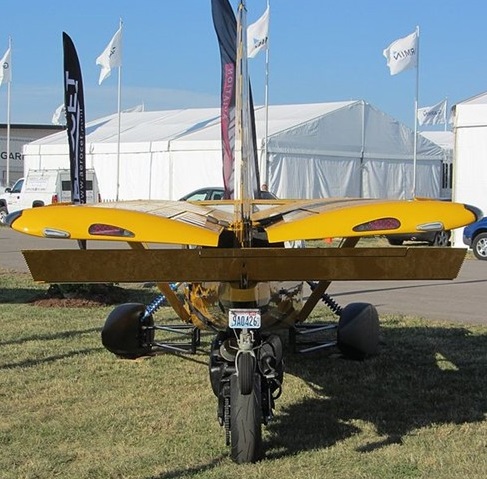
PD-2 rear
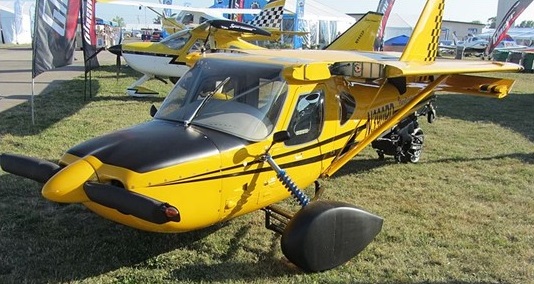
A second generation version of the PD-1 using the same Sportsman airframe as the PD-1, the PD-2, uses two forward mounted wheels with suspension in a conventional landing gear layout. A single rear wheel is mounted aft on the pod containing the second engine for road use. An updated pod was developed using a 50 hp four cycle engine with casters that fits into the baggage compartment. A custom lightweight four-piece carbon-fiber ramp can be used to load the pod without lifting. Gas milage is 24mpg in ground use.
PD-2 on display
PD-1 Engine: 1 × Lycoming IO-390, 210 hp (160 kW) Engines: 2 × 500cc Yamaha Phazer 4 Cycle, 80 hp (60 kW) each Wingspan: 35 ft (11 m) Wing area: 131 sq ft (12.2 m2) Aspect ratio: 9.1 Length: 23 ft (7.0 m) 24 feet 8 inches with wings folded Fuel capacity: 50 US gallons Cruise speed: 122 kn (140 mph; 226 km/h) Capacity: 2 persons
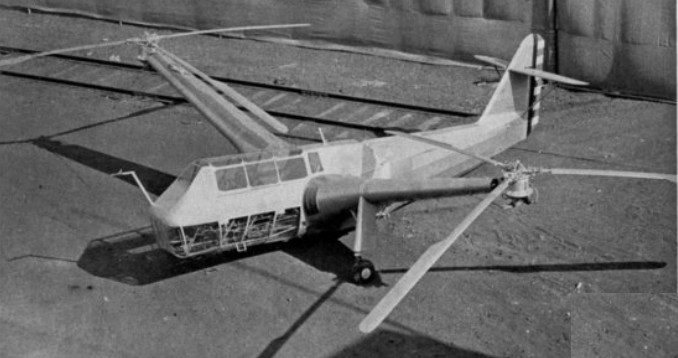
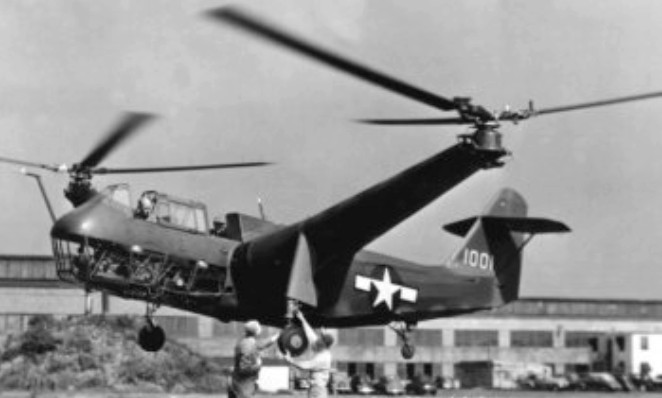
In July 1940 the Platt-LePage Aircraft Co. won the competition to build a helicopter designated XR-1.
The first flight of the XR-1 took place in May 12 1941, a number of teething problems developed with the control system, causing delays in progress, along with test pilot Lou Leavitt refusing to fly the XR-1 in forward flight.
In June of 1943 Col. H.F. Gregory took the XR-1 up and proceeded to fly the XR-1 at speeds of up to 100 miles per hour, and completed the first close course flight of the XR-1. By the summer of 1943 the XR-1 was flying with much better control, when on July 4, 1943 the XR-1 was damaged in a crack up due to the loss of a rotor blade, further slowing testing.
XR-1A
In October 1943 the second model XR-1A made its first flight, and was found to have better flying characteristics than the XR-1. Numerous flight tests were carried out and by June of 1944 the XR-1A was flown from Eddystone Pennsylvania, to Wright field in Dayton Ohio, passing through a dangerous mountain pass and flying through a long stretch of bad weather, during which the XR-1A encountered a grounded Sikorsky SR-4 along the way.
By August of 1944 rebuilt XR-1 was back in the air and slowly progress was made in solving the control problems, In March of 1945 just a few days after a new control system was installed that solved some the problems with longitudinal stability, the Air Corps cancelled all contracts with Platt-LePage, including seven additional YR-1A helicopters that were to be built.
Design and construction was started on an experimental helicopter PL-1, with Laurence LePage keeping the U.S. Air Corps informed of their progress during the early construction of their machine. At this time there were no funds for the U.S. Air Corps to purchase a helicopter, so the Platt-LePage design went forward as a private venture, later with the passage of the Dorsey Bill H.R.8143, the U.S. Air Corps held a competition for Rotary Winged Aircraft, and Platt-LePage redesigned the PL-1 to meet military needs and the design became known as the PL-3.