Pützer Elster

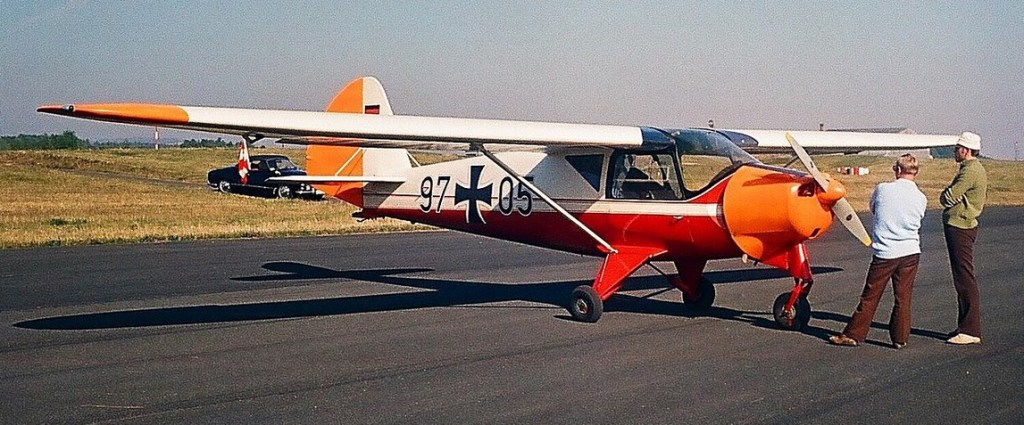
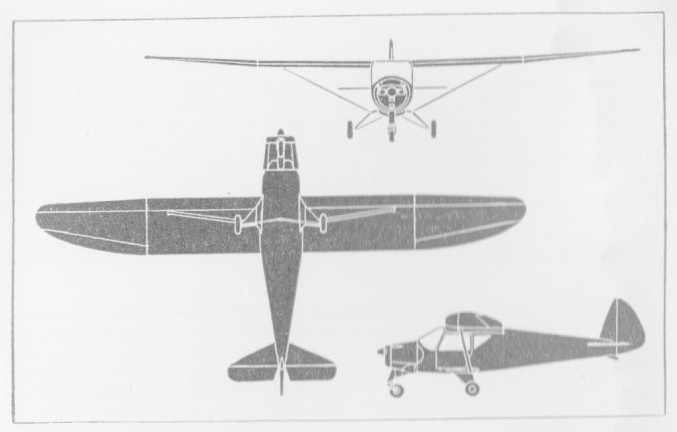
Elster-B

Alfons Pützer KG known primarily as sailplane manufacturer; produced an improved motorized version of the Doppelraab sailplane, known as the Elster in 1957. Small batch produced for German club use.

In post war Germany, General Aviation flight was not permitted until 1956. At the time of this rejuvenation, the Porsche 678 aircraft engine was being developed. This was based on the 4 cylinder Porsche 356 car engine. This air cooled engine was modified for the aviation environment.

At this time Alfons Pützer was also developing the Elster A airframe, powered by the 52HP 678/3 Porsche engine. The prototype was powered by a 52 hp Porche 678/3 engine.

This was followed by the Elster B version powered by the 75 HP Porsche 678/4 engine and the Rolls Royce Continental C-12F and C-14F engines. The 95 hp C90-12F version was selected for use by the Federal German Luftwaffe’s sport flying groups and production deliveries began in 1960, 21 being built.

The Elster-C is specifically for glider towing, powered by a 150 hp Lycoming O-320 engine.

Elster B
Engine: Continental C90-12F, 95 hp
Wingspan: 43 ft 4 in
Length: 23 ft 3.5 in
Height: 8 ft 2.5 in
Wing area: 188.368 sq.ft
Empty weight: 1014 lb
Loaded weight: 1543 lb
Max speed: 104 mph at SL
Cruise: 93 mph
ROC: 720 fpm
Service ceiling: 16,100 ft
Range: 272 mi

Elster B

Pützer

Alfons Pützer KG

Germany
Alfons Pützer KG known primarily as sailplane manufacturer; produced an improved motorized version of the Doppelraab sailplane, known as the Elster in 1957. Small batch produced for German club use. Alfons Pützer and Comte Antoine d’Assche, director of the French company Alpavia SA, formed a new company in 1966, Sportavia-Pützer, to produce the Fournier series of light aircraft.

Purvis-Wilson Helicopter

Believed to be the first rotary-winged aircraft ever patented (US patent #1,028,781), the Purvis-Wilson Helicopter of 1910 was powered by two 7hp motors. A single seater with three-bicycle-wheeled cart with a 24′ vertical shaft for two rotors, funds ran out before their creation flew outside of a brief, tethered test-hop in its barnlike workshop.

Reports claimed it later flew, untethered and piloted by Purvis, momentarily in a show for investors, then crashed and flailed itself to pieces as Purvis ran from it.

Pulsar Aircraft Corp.

Tri-R Technologies has sold the two KIS designs to Pulsar Aircraft Corporation. Pulsar Aircraft Corp. previously rescued the Pulsar design from the original company’s bankruptcy. They then improved the design and offered a new, larger version called the Super Pulsar 100. They also keep the original legacy Pulsar design alive under the name of Pulsar XP. The KIS designs are a natural step for Pulsar as they use the same materials and factory part process as the two Pulsars. And they were looking to expand their line with a four seater. Pulsar Aircraft Corp. provides support for homebuilders who purchased their kits from the previous companies.
KIS TR-1 – Now named the Pulsar 150
KIS TR-4 – Now named the Super Cruiser

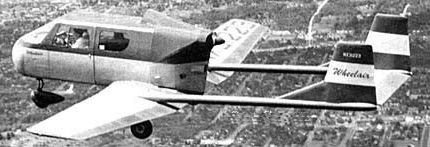
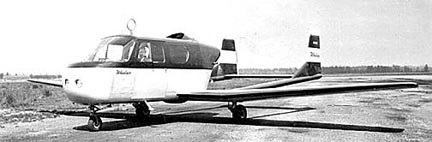
Puget Pacific Planes Wheelair IIIA

Designed by Donald Wheeler the 1947 III-A was a prototype all-metal, twin-boom, rudderless twin-tail, tricycle-gear, post-war “plane of tomorrow” based on Wheeler’s prize-winning design in a national magazine.
The prototype first flew in April 1947.

Featuring a two-control system and offered for $5,000-5,500, only the one was built (NX31223). Originally powered by a 190hp Lycoming O-435 pusher, and also with 170hp a Lycoming GO-290-AP.

The company filed bankruptcy in 1949.

Engine: Lycoming O-435, 190hp
Wing span: 37’0″
Length: 26’7″
Useful load: 1150 lb
Maxspeed: 140 mph
Cruise speed: 120 mph
Stall: 52 mph
Range: 580 mi
Ceiling: 11,500′
Seats: 4

Pterodactyl Ptraveler

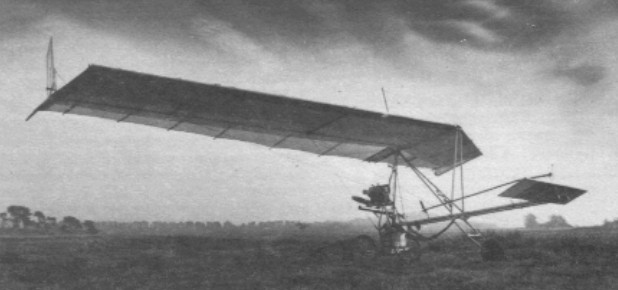
Single seat single engined high wing mono¬plane with two axis control. Wing has swept back leading and trailing edges, and tapering cord; no tail, canard wing. Pitch control by fully flying canard; yaw control by tip rudders; no separate roll control; control inputs through stick for pitch/yaw. Wing braced from above by kingpost and cables, from below by cables; wing profile Klaus Hill (Fledgling); double surface. Undercarriage has three wheels in tricycle formation; bungee suspension on all wheels. No ground steering. No brakes. Aluminium tube framework, without pod. Engine mounted below wing driving pusher propeller.

The Ptraveler is a Pfledgling 430D with a fully flying canard, and can be regarded as a ‘back to front’ Pfledgling NFL, with the elevator moved to the front. The two main horizontal lateral tubes of the Pfledgling frame are elongated towards the front to carry the extra control surface, creating a two axis control ultralight with a side mounted stick. This operates the canard via a pushrod with ball joints at the end, and acts on the tip rudders via control cables. However, the seat is still a simple band of cloth as in the earlier models and allows the Ptraveler pilot to adjust the aircraft’s centre of gravity in flight by weight shift.

Making its appearance in 1980, this single-seater retains the Cuyuna 430D engine with¬out reduction drive. Apart from the canard, the structure remains unchanged from the Pfledgling 430D and the performance is similar. Various options are, however, now available on the Ptraveler, of which the most important is a three axis conversion using large spoilerons mounted some 6 inch (15 cm) above the wing. These spoilerons deploy by rotating forward and down and, depending on the installation method chosen, can be moved either by the pedals or by the stick (the tip rudders being operated by the pedals in the latter case); the customer can thus choose unconventional or conventional three axis control.

Other options are nosewheel steering, both push right go right and push right go left arrangements being available, and a parachute system.

Price in kit form: $4926 in 1983.

Engine: Cuyuna 430D, hp at 5500 rpm
Propeller diameter and pitch 36 x 16 inch, 0.91 x 0.41 m
No reduction
Max static thrust 165 lb, 75 kg
Power per unit area 0.19hp/sq.ft, 2.0 hp/sq.m
¬Fuel capacity 2.5 US gal, 2.1 Imp gal, 9.5 litre
Length overall 16.8 ft, 5.08 m
Height overall 9.1ft, 2.77m
Wing span 33.0ft, 10.06m
Mean chord 5.5 ft, 1.65 m
Chord at tip 4.5 ft, 1.34 m
Total wing area 173 sq.ft, 16.1 sq.m
Main wing area 162 sq.ft, 15.1 sq.m
Canard area 11.0sq.ft, 1.0sq.m
Main wing aspect ratio 6.7/1
Nosewheel diameter overall 14 inch, 36 cm
Main wheels diameter overall 20 inch, 51 cm
Empty weight 200 lb, 91kg
Max take off weight 465 lb, 211kg
Payload 265 lb, 120kg
Max wing loading 2.87lb/sq.ft, 13.9 kg/sq.m
Max power loading 15.5 lb/hp, 7.0kg/hp
Load factors; +4.4, 3.3 ultimate
Max level speed 55 mph, 88 kph
Never exceed speed 55 mph, 88 kph
Max cruising speed 40 mph, 64 kph
Economic cruising speed 35 mph, 56 kph
Stalling speed 24 mph, 38 kph
Max climb rate at sea level 400 ft/min, 2.0 m/s
Min sink rate 400ft/min, 2.0m/s
Best glide ratio with power off 8/1
Take off distance 125 ft, 38 m
Landing distance 50 ft, 15 m
Service ceiling 15,000 ft, 4570 m
Range at average cruising speed 120 mile, 193 km