Renard R-31 / R-32

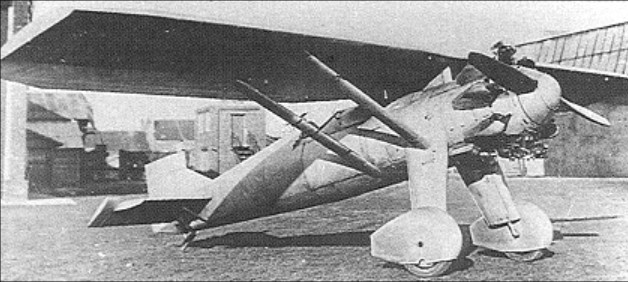
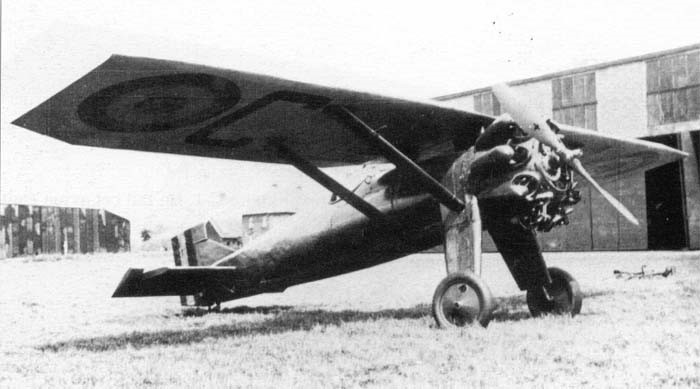
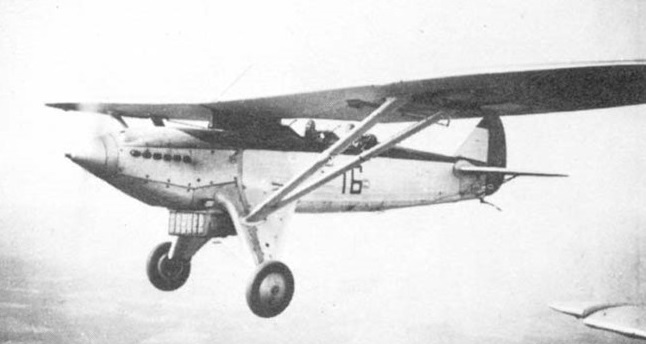
In view of replacing the ageing Breguet XIX observation aircraft of the Aéronautique Militaire Belge, the Renard company developed a twin seat parasol-wing aircraft which in the first studies was designated as Renard RR (for Rolls-Royce). The renamed Renard R.31 was designed by Alfred Renard of Constructions Aéronautiques G. Renard to meet a requirement of the Belgian Air Force for a short ranged reconnaissance and army co-operation aircraft.

It was a parasol monoplane of mixed construction, powered by a Rolls-Royce Kestrel engine, with a welded steel tubing structure with metal sheet covering the forward fuselage and fabric covering of the remainder of the airframe. The wing was held in position by a single Vee strut on each side, conjoined with its fixed under carriage. Armament consisted of one or two forward-firing 7.62 mm Vickers machine guns and one 7.62 mm Lewis machine gun in flexible mount in rear cockpit. There was also a rarely used provision for dropping four 10 kg bombs under the wings.

Powered by a Rolls-Royce Kestrel II engine developing 487hp, it first flew at Haren airfield at Evere, near Brussels, on 16 October 1932, piloted by Renard test-pilot Charles Rooms.
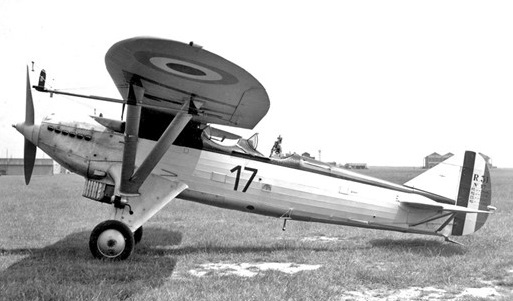
The Aéronautique Militaire placed an order for 28 R.31s was placed in March 1934, with six to be built by Renard and the remainder by SABCA. One aircraft was fitted with a Lorraine Petrel engine for evaluation, but this was later replaced by the normal Kestrel engine.

After 1936 a second aircraft was fitted with an enclosed canopy and a Gnome-Rhône Mistral Major radial engine, becoming the R-32, with this then being replaced by a Hispano-Suiza 12Y engine, but the R-32 did not show sufficiently improved performance to gain a production order. The Renard R-32 was reworked as a normal R.31 thus becoming the 35th machine for the AéM.

A further six R.31s were ordered in August 1935 by the AéM. The aircraft received the military registrations N-1 to N-35.

The R.31 entered service with the Belgian Air Force in 1935, replacing the Breguet 19 in the 9e and 11e Escadrilles d’Observation based at Liège. In service, it was not popular, as it had poor handling, being vulnerable to entering flat spins if mishandled, with all aerobatics therefore being banned.

All the Renard R-31’s were used by the Bierset based observation squadrons – 9/V/1Aé (Sioux on blue circle) and 11/VI/1Aé (Sioux on red circle). At the start of the war 21 aircraft were available who were operational during the whole of the “18 day Campaign” flying their last mission on May 27th, 1940.
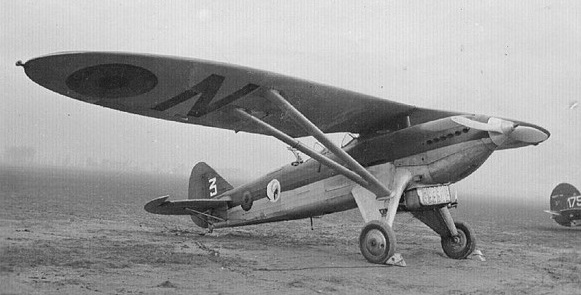
The R.31 was hopelessly obsolete, and those that were not destroyed on the ground in the early hours of the German Blitzkrieg invasion of Belgium in May 1940 were ravaged by German fighters as they bravely attempted to gather information on the German invasion. None apparently functioned as ground support aircraft during the brief Belgian Army resistance, flying 54 reconnaissance sorties in support of the Allied forces defending Belgium, with the last mission (which was also the final mission flown by the Belgian Air Force in its attempt to repel the Germans, being flown on the afternoon of 27 May 1940. Following the German occupation of Belgium, the Luftwaffe had no interest in the machines and those that had survived the initial onslaught were unused or were destroyed. Overall, these machines had no significant impact on the war although they were briefly involved.

As not a single Renard R.31 remains anywhere in the world, a number of volunteers at the Royal Army Museum at Brussels is building a 1/1 scale replica using the original blueprints.

Renard R-31 Aircraft Histories

Renard R.31
Engine: 1 × Rolls-Royce Kestrel IIS V-12, 358 kW (480 hp)
Wingspan: 14.40 m (47 feet 2¾ inches)
Length: 9.20 m (30 ft 2 in)
Height: 2.92 m (9 ft 7 in)
Wing area: 32 m² (344 ft²)
Empty weight: 1,330 kg (2,926 lb)
Loaded weight: 2,130 kg (4,686 lb)
Maximum speed: 294 km/h (159 knots, 183 mph) at 4,000 m(13,120 ft)
Cruise speed: 238 km/h (129 knots, 148 mph)
Range: 650 km (351 nm, 404 mi)
Service ceiling: 8,750 m (28,700 ft)
Wing loading: 66.6 kg/m² (13.6 lb/ft²)
Power/mass: 0.17 kW/kg (0.10 hp/lb)
Climb to 2,000 m (6,560 ft): 5.5 min
Climb to 5,000 m (16,400 ft): 11.7 min
Crew: 2
Armament: 2 or 3 7.62 mm Vickers machine guns
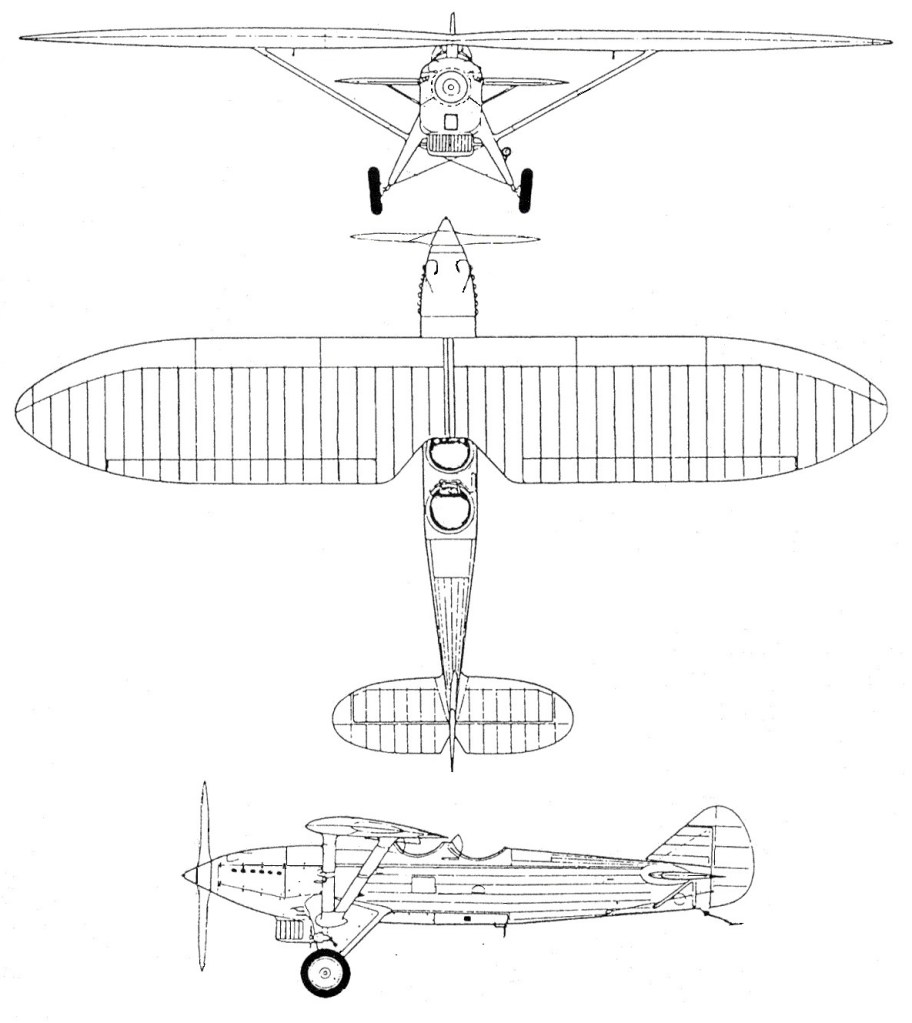
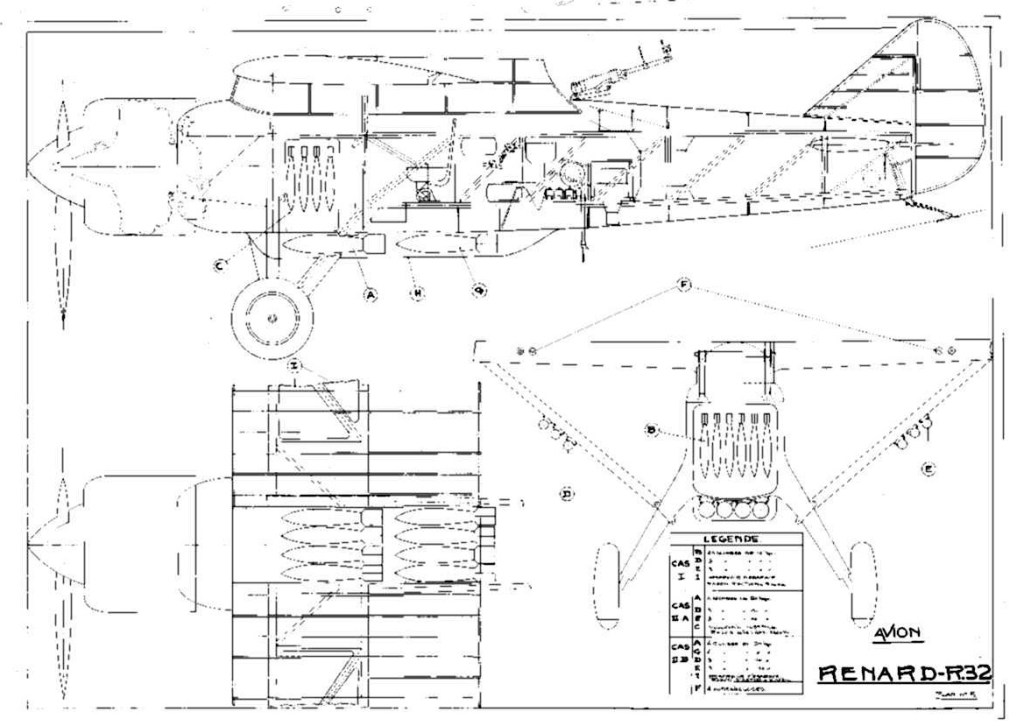
Renard R-31
Renard R-32

Renard R-30-300

This 4 passenger tri-motor was designed in response to an official Belgian request for a long range transport aircraft for the Belgian Congo. It met all the design requirements but by the time it flew in 1931 it was already obsolete and only one was completed.

Engines: 3 x 120 h.p. Renard 5 cylinder radials
Span: 49’3″
Length: 32′ 10″
Height: 11′ 2″
Wing area: 360 sq ft
Empty Weight: 3,410 lb
Gross Weight: 5040 lb
Max Speed: 131 mph
Range: 700 miles
Service ceiling: 23,000 ft

Renard Epervier

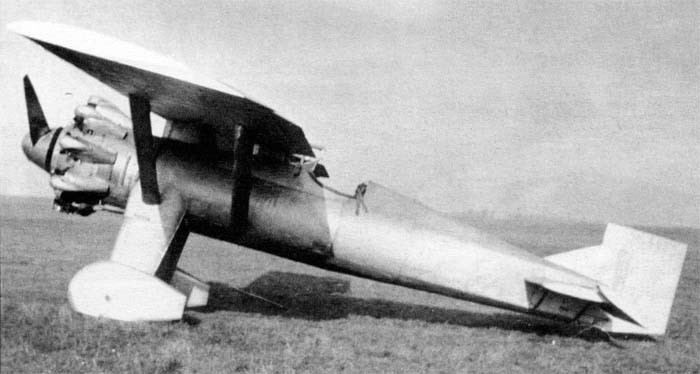
Designed by Georges and Alfred Renard to compete in a government-sponsored design contest, the Epervier (Sparrowhawk) single-seat all-metal fighter monoplane was intended for a 12-cylinder liquid-cooled Hispano- Suiza 12 J Vee-type engine. Unavailability of this power plant led to installation of a 480hp Gnome-Rhone Jupiter VI nine-cylinder radial in the first prototype, which was built by Stampe et Vertongen as the Epervier Type 2 and flown in 1928. The Epervier Type 2 carried an armament of two synchronised 7.7mm guns and was lost on 11 September 1928 after failing to recover from a flat spin.

A second prototype, the Epervier Type 2bis, introduced revised streamlined fairings for the cantilever mainwheel legs, mainwheel spats and cylinder aft-fairings, and was built by SABCA (Societe Anonyme Beige de Constructions Aeronautiques) under contract for Alfred Renard. Since Alfred Renard was both chief designer for Renard and technical director of Stampe, it is hard to keep the two firms separate. Demonstrated early in 1930 in competition with various foreign types for an Aviation Militaire order, the Epervier Type 2bis was rejected in favour of the Fairey Firefly.

A further development of the basic design, the Epervier Type 3 powered by a 480hp Rolls-Royce “F” engine and utilising mixed construction and a redesigned wing, was studied under government contract, but was not built.

Type 2bis
Powerplant: 1 × SABCA Jupiter, 360 kW (480 hp)
Wingspan: 10.20 m / 33 ft 6 in
Wing area: 20.00 sq.m / 215.28 sq ft
Length: 7.00 m / 23 ft 0 in
Height: 2.76 m / 9 ft 1 in
Empty weight: 794 kg / 1750 lb
Max take-off weight: 1300 kg / 2866 lb
Wing loading: 62.5 kg/m2 (12.8 lb/sq ft)
Power/mass: 3.49 kg/kW (5.74 lb/hp)
Maximum speed: 273 km/h (170 mph, 147 kn)
Maximum speed at 4,000 m (13,000 ft): 265 km/h (165 mph; 143 kn)
Maximum speed at 5,000 m (16,000 ft): 261 km/h (162 mph; 141 kn)
Stall speed: 99 km/h (62 mph, 53 kn)
Service ceiling: 9,300 m (30,500 ft)
Practical ceiling; 8,600 m (28,200 ft)
Time to 4,000 m (13,000 ft): 8 minutes 30 seconds
Time to 5,000 m (16,000 ft): 12 minutes 35 seconds
Crew: 1
Guns: 2x synchronised fixed forward firing 7.7 mm (0.303 in) Vickers machine-guns

Renard Epervier

Renard

Societe Anonyme Avions et Moteurs Renard
Constructions Aeronautiques G. Renard

Belgium
Societe Anonyme Avions et Moteurs Renard was established in 1927 as aero-engine manufacturer, and produced the Epervier all-metal single-seat fighter in 1928-1929 with Sabca Jupiter engine designed by Alfred Renard.

Constructions Aeronautiques G. Renard founded about 1929 to build commercial aircraft designed by Renard. First two types were R.17-100 four-seat single-engine cabin monoplane and R-30-300 tri-motor five-passenger cabin monoplane. R-31 reconnaissance and R-33 training monoplanes appeared in 1932-1933; advanced low-wing single-seat fighter R-36 with Hispano-Suiza engine exhibited at 1937 Brussels Aero Show.

Company was inactive during Second World War, but began to reorganise in 1945.

Rensselaer Polytechnic Institute RP-2

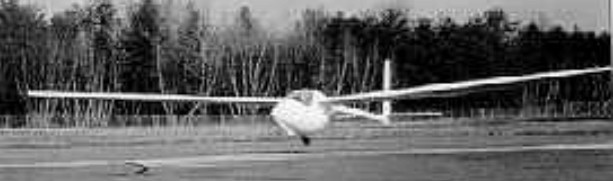
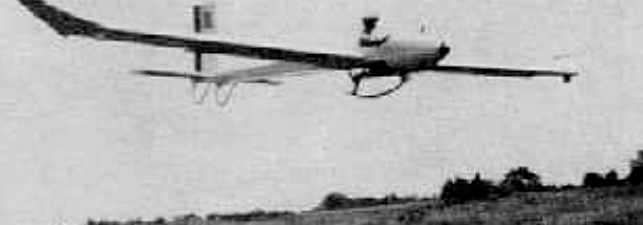
The RP-2, which first flew in 1985, was designed by Steven J. Winckler as a part of the Composite Aircraft Program, Glider of the Rensselaer Polytechnic Institute of Rensselaer, NY. The wing is equipped with split flaps for approach control.

Wing span: 13.5m / 44.25ft
Wing area: 11.1sq.m / 120sq.ft
Empty Weight: 124kg / 273 lb
Payload: 74kg / 164lb
Gross Weight: 198kg / 437lb
Wing Load: 17.83kg/sq.m / 3.64lb/sq.ft
Seats: 1
Aspect ratio: 16.4
L/D max: 29 at 72 kph/39kt/45mph
Min sink: 0.69m/s / 2.25 fps / 1.33 kt
Airfoil: Boeing 80-163
Construction: GFRP/CFRP/ Kevlar

Rensselaer Polytechnic Institute RP-1

The RP-1 which first product of the Composite Aircraft Program, Glider of the Rensselaer Polytechnic Institute, a project partly supported by NASA. The RP-1, although operated with an FAA airworthiness certificate, was also designed to permit foot launching.

Span: 11.5m / 37.5 ft
Wing area: 12 sq.m / 129 sq.ft
Empty Weight: 53 kg / 116 lb
Payload: 67 Kg /149lb
Gross Weight: 120 kg/ 265 lb
Wing Load: 10 kg/sq.m / 2.05 lb/sq.ft
Aspect ratio: 11
Seats: 1
L/D max: 20 52 kph / 29 kt / 33 mph
Min sink: 0.61 m/s / 2.0 fps / 1.18 kt
Airfoil: Wortmann FX-63-137
Structure: composite/ Kevlar/ PVC foam

Renegade Light Sport Aircraft Carbon Pitts / Lil Rascal

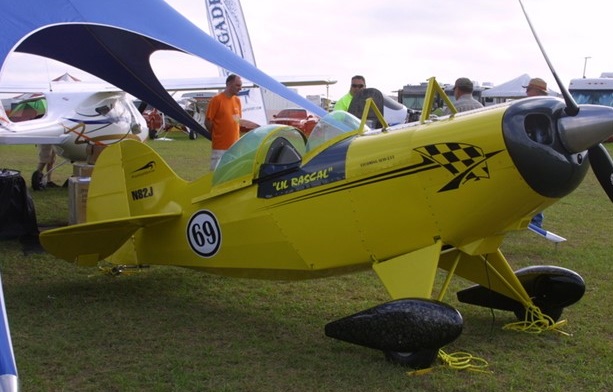
Renegade Light Sport LLC has put a carbon fiber spin on the aerobatic Pitts S1C from Steen Aero, and christened the plane the Renegade “Lil Rascal.” Previously known as the Carbon Pitts, Renegade was notified by Aviat that it held a trademark on the word “Pitts,” necessitating the name change. Renegade says this aircraft is right in line with Renegades’ business model of taking the best of the old dependable engines, airframes, and more, and putting the company’s modern, state-of-the art touch to the projects.

Renegade elected to drop the FK-12 Comet project and instead bring a proven airframe to the marketplace which conforms to the LSA, ASTM standards. Renegade says the Rascal has the best of the old S1C airframe however it’s is 4 inches wider, 6 inches longer in the cockpit, sporting a new all carbon fiber wing design, with full span ailerons, and complete carbon wing with no fabric what so ever. Both the top and bottom wings are all of a light-weight, extremely strong construction. Preliminary tests show the airplane is a 12 G machine, but Renegade restricts the G rating to 6 positive and 3 negative, the rating Lycoming puts on their new LSA specific inverted Christian Eagle oil system engine. The Rascal Sports comes standard with an all Glass Dynon 10″ Skyview digital G meter cockpit, and smooth leather interior.

The Lil Rascal series feature a 4130 welded chromoly steel fuselage, spring steel landing gear and are biplanes with 4 ailerons. The wings and many parts of the fuselage are going to be made from carbon to add strength and cut down on weight.

It has the Lycoming AEIO -233 engine, the first four of which made by Lycoming are in Renegades Hangar. The prop is the new ground adjustable Sensenich black on carbon.

The LSA-compliant Lil Rascal LS1 (single-seat) and LS2 (two-seat), are both models powered by the fuel-injected electronic-ignition Lycoming AE-IO-233 LSA engine. The all-U.S. built fully aerobatic birds will make weight to the LSA spec. Price: US$125,000. Both models will be certified as S-LSA.

LS1
Engine: Lycoming AE-IO-233
Empty weight: 650 lb
Cruises: 120 kt
Stall: 41 kt
Seats: 1

LS2
Engine: Lycoming AE-IO-233
Empty weight: 750 lb
Seats: 2