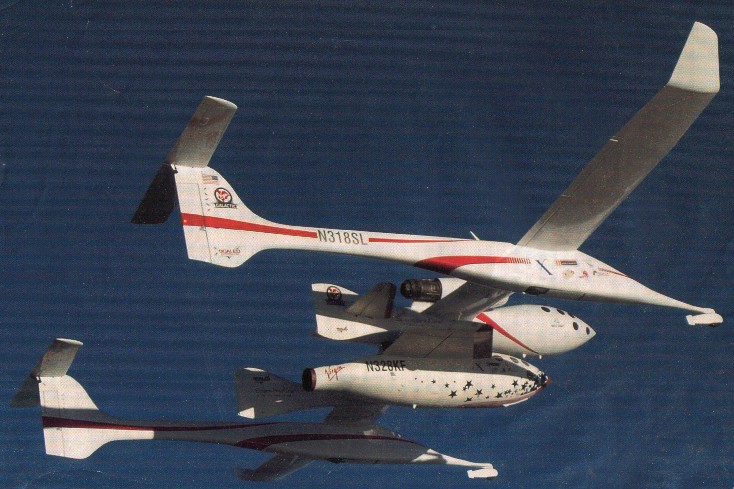
The six passenger SpaceShipTwo is carried aloft by WhiteKnightTwo.
Virgin Galactic’s SpaceShipTwo made its second successful powered flight on 5 September 2013 from Mojave Air and Space Port in California.
SpaceShipTwo, funded by billionaire Richard Branson, was carried to an altitude of 42,000 feet attached to the “mothership” and then climbed to 69,000 feet under its own power before descending back to Mojave.
“In addition to achieving the highest altitude and greatest speed to date, the test flight demonstrated the vehicle’s full technical mission profile in a single flight for the first time … All of the test objectives were successfully completed,” the company said.
Designed to ferry a sub-orbital spacecraft between its twin fuselages, the Scaled Composites White Knight Two, first flown in 2008, can ascend to a maximum height of 70,000 feet. The pilot steers from the right fuselage.
Burt Rutan leads one of 27 teams from seven countries competing for the US$10 million (NZ$16 million) X Prize, to be given to the first private entrepreneur who can put three people into sub-orbital space and do it again with the same equipment within two weeks by the end of 2004.
The team is funded by Microsoft co founder Paul Allen.
SpaceShipOne will piggyback aboard a mother aircraft known as the White Knight, to an altitude of 48,000 feet (14,600 metres). On release, SpaceShipOne’s 18,000 lb thrust rocket engine burns for 80 seconds, accelerating the aircraft at three times the force of gravity to reach Mach 3.2 (3860kph) by the time the engine burns out at 160,000 ft (48,700m). Coasting the rest of the way, losing power and slowing down. At 200,000ft, the pilot and passengers in the future experience weightlessness, which lasts three to four minutes as the spacecraft attains its maximum altitude of 340,000ft, virtually stops, then falls back to 200,000ft (60,000m), when it begins to feel the atmosphere once again. The key is to decelerate gently in the upper atmosphere by controlling the angle during descent and maximising drag, making for a much safer and more comfortable ride.
SpaceShipOne, the rocket plane funded by Microsoft cofounder Paul G Allen, appeared to top its required altitude within minutes of firing its rockets in 2004. The plane took, off from a desert runway slung to the belly of a carrier plane with a test pilot at the controls. It was released at about 13,800m and fired its rockets to climb to an altitude of 100km.
The configuration selected was a twin engine pusher-tractor tandem wing vehicle with twin booms connecting the tip of the forward wing through the center wing terminating at the vertical fin. The cabin was only large enough to accommodate the crew of two and provisions for the estimated 9 day flight.
Structural sample testing was conducted as the first step in the program to determine the lightest materials and fabrication processes available appropriate to the vehicle requirements. It was determined that .010-inch graphite tape skins, with 1/4-inch Nomex honeycomb core would provide adequate structure, and, with suitable application of film adhesive, would also be an adequate fuel barrier. The spars were made from graphite tape and Nomex cores, and were autoclave-cured by an outside vendor.
The result was an airplane with a structural weight/gross weight fraction of only 9%; significantly lower than any existing man-rated airplane. This was key to the Voyager’s success, because the amount of fuel carried, in relation to the vehicle’s takeoff weight, had the strongest influence on range.
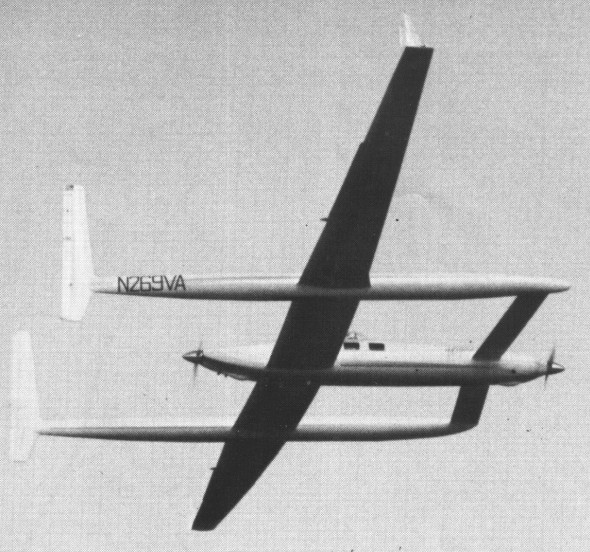
Making its first public debut, at the Oshkosh Fly-in on 29 July 1984, was Rutan’s Voyager. The previously-secret aircraft has been under development for more than three years in the Rutan Aircraft Factory in Mojave, California. The Voyager was designed by aeronautical engineer Burt Rutan, 40, for one special mission: very long range flight. “When we started the analysis, the numbers showed that it might be possible to fly completely around the world non-stop. No one has ever tried it before,” Rutan said, “so that became our goal.”
Carbon fibre and Kevlar comprise the major part of Voyager’s struc¬ture, allowing a wing span of 110.8 feet with an aspect ratio of 33.8. The spars are made from solid, oven-cured, carbon graphite, while the skins are thin carbon fibre sheets over a nomex paper honeycomb core, with no metal anywhere in the basic structure other than fasteners.
The engines are mounted in tandem, one on each end of the fuselage. It is now planned that the front engine will be shutdown and its propeller feathered after enough fuel has burned off to allow the rear engine to sustain flight. Mounted between the canard and main wing are three streamlined bodies: the fuselage (33 feet in length) and two outrigger tanks for fuel.
The structural weight of the Voyager is only 938 pounds yet the take-off weight for the global flight will be 11,236 lbs, more than six times its empty weight of 1,858 lbs. Sixteen separate fuel tanks scattered among the wings, canard, booms and fuselage, contain 1,489 United States gallons of fuel weighing 8,934 lbs, leaving just 534 lbs for the crew of two and support equipment. The final landing weight of the aircraft is expected to be only 2,300 pounds. The pilot sits within a bubble canopy above and to the right of the cabin, which contains a stretcher and an area of relative privacy for the off-duty crew member. Comfort is important, as pilots Jeana Yeager and Dick Rutan expect to spend two weeks on their 25,000 mile flight. Their intended flight path will take them across southern United States, in a curve parallel with the northern coast of Brazil, of f the tip of South Africa, across the southern Indian Ocean and north again over Australia and the Pacific and back to California. Keeping to the oceans will eliminate any political problems associated with over flying potentially hostile countries, and Australia can be relied on to be friendly.
The aircraft’s fuel capacity is 1489 gallons, carried in 17 tanks and metered by only one gauge; the crew will use one seat and one bed during the thirteen day flight, flown at between 12 and 15,000 feet on a cruise of around 110 knots; only 3.2 lbs of paint were used on the exterior; there is only one brake, on the nosewheel, and only one rudder, on the left hand fin. July 1984 the Voyager flew 11,593 miles (almost half way around the world) over a closed circuit course along the Californian coast during a test run.
Dick Rutan made history in 1986 when he and copilot Jeana Yeager made the first non-stop, non-refuelled flight around the world. Their aircraft Voyager was designed by Dick’s brother, Burt. Dick and Jeana took off with 1490 gallons of fuel on board and returned home after flying 26,680 miles non-stop with 18 gallons to spare. The flight took 9 days, 3 minutes and 44 seconds.
Rutan’s canard self-launching sailplane attracted much attention when it won the Sailplane Homebuilders Association Design Contest in 1982. The engine, with electric starter for air starting, erects from and retracts into a bay in the forward fuselage by means of electro-hydraulic power. The canard configuration is intended to make the ship virtually stall-proof as the canard stalls before the main wing, causing the ship to pitch nose-down and preventing the main wing from stalling. That, however, does not mean that mishandling cannot cause very high sink rates. The main wing has trailing edge flaps which also operate as spoilers by the leading edge coming above the top surface of the wing when deploying. The effective spoil flap trailing edge surfaces provide good glidepath control.
The Solitaire is a single-place, self-launching canard sailplane developed for recreational soaring, Landing gear is tandem wheels with wingtip rollers. It features a KSM 107-E. 22-hp engine and a retractable propeller. Its structure is all-composite, with prefab molded fuselage shells. Task Research was the manufacturer of the composite moldings kit for the Solitaire.
By 1990 the Rutan design stable of VariEze, LongEze, Defiant and Solitaire were no longer offered for sale.
L/D Max: 32 93 kph / 50 kt / 58 mph Min Sink: 0.75 m/s / 2.5 fps / 1.48 kt Wing span: 12.7 m / 41.75 ft Wing area: 9.52 sq.m / 102.44 sq.ft Empty Weight: 172 kg / 380 lb Payload: 109 kg / 240 lb Gross Weight: 281 kg / 620 lb Fuel capacity: 5 USG Wing Load: 39.52 kg/sq.m / 6.05lb/sq.ft Aspect ratio: 10.78 Airfoil: wing inboard, Roncz 517, outboard 515 Min. flying speed 32 kts Vmax 115 kts L/D 32:1 @ 50 kts Sink rate 150 fpm @ 40 kts Takeoff run 960 ft Landing roll 500 ft Seats: 1
The Model 40 is the first of Rutan’s de-signs intended for the commercial market. It is an overgrown push-pull version of the VariEze, seating four plus baggage (or plus two children), using two Lycoming engines of 160 hp with fixed-pitch propellers. As on the VariEze, the Model 40’s main landing gear is fixed, but the nosewheel retracts. An all-flying rudder protruding from the bot-tom of the nose is connected in a very sim-ple manner to the turn-and-bank gyro and provides wing-levelling.
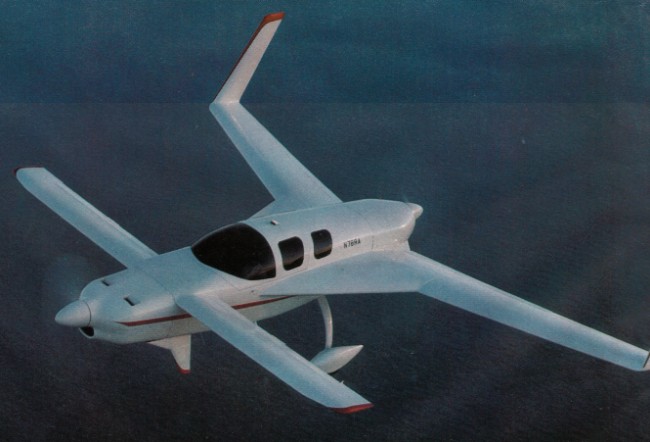
The prototype of this research aircraft, Rutan Model 40 Defiant s/n 001 N78RA, flew first on 30 June 1978. The Defiant was intended as a proof-of-concept of a very safe light twin design, requiring little trim change and no pilot action in case of engine failure, and with good single engine performance. In 1979, the Rutan Aircraft Factory announced they would proceed with certification of a Model 40 Defiant based light twin. Adequate financing was not secured for this project, and the design was modified for homebuilt construction as the Model 74.
In a significant gesture, Rutan presented his twin to the public not at Oshkosh, where his other designs made their de-buts, but at the National Business Aircraft Association meeting. Rutan has had to insist that the Defiant now flying is a “proof of concept,” composite construction prototype rather than a preproduction prototype. Some features that would be necessary in a marketable airplane, such as doors and entry steps, have been omitted in favor of a structurally simple hinged canopy. This free-blown canopy, furthermore, is semi-circular in section and hat, imposed that shape upon the top half of the fuselage, which in a production airplane would have a more squared-off section for better headroom. The cabin, which in fact is as wide and long as any light twin’s, though shallower, is very hard to get into and out of; and, because of the incorrect roof shape and a not very astute placement of armrests and consoles, it is less than comfortable to sit in. If its present empty weight of about 1,500 pounds rose to 1,700 in a production airplane, the Defiant would continue to perform superbly.
The Defiant has fixed landing gear, fixed- pitch props and no flaps; when an engine fails, the pilot merely goes on flying as before. The whole problem of fast reaction of identifying the bad engine, feathering, retracting gear and flaps and of precisely holding a certain airspeed disappears. The wings are swept in order to move their center of lift aft with respect to the rear engine, and to put the vertical sur-faces as far aft as possible for considerations of general arrangement, in short, not aerodynamic refinement.
To this add cruising speeds of over 170 knots at economy settings, astonishing rates of climb and excellent hands-off stability, as well as a useful load that can handle both full cabin and full fuel, and you have an airplane that promises to do everything well. You also have a potentially powerful competitor in the light-twin market, and one that demonstrates convincingly an alternative to conventional airplane design. The Defiant could por-tend a revolution comparable in importance to the abandonment of the biplane in favor of the monoplane.
What makes the Defiant a performer is its light weight and small size. Its span loading (the quotient of weight and wing-span, and a powerful determinant of climb rate) is about the same as that of the Cougar, Duchess and Seminole; but, with the same engines and a gross weight 1,000 pounds lower, the Defiant climbs better than they do on two engines (it takes it 11 minutes to go from sea level to 12,000 feet at gross weight) and at least as well on one. With centerline thrust, like the Cessna Skymaster’s, the Defiant escapes the asymmetry problems of conventional twins. Its power loading is good even on one engine: at moderate weights, in fact, it is that of a 172. Fixed-pitch props mean that you get the best performance at high altitudes.
The Defiant is economical not only in flight performance, but also in design and construction. The choice of fixed-pitch wooden propellers, fixed gear and extremely simple systems is part of Rutan’s ruling philosophy of design: less is more.
There are two separate electrical systems – two batteries, two alternators and two busses – for true redundancy. The fuel system is simple, and the last 45 minutes of fuel are measured and reported with extra accuracy. The control system is as simple as they come: the actuating rods for the elevators (on the front wing, or canard) and the ailerons (on the main wing) are contained mostly within the fuselage.
Model 74 Defiant
Work began on production Defiant Model 74 in 1982.
Rutan had been saying he would never release the Defiant as a homebuilt but Fred Keller arrived at the 1983 Oshkosh in his homebuilt Defiant.
Plans were offered in mid-1984.
By 1990 the Rutan design stable of VariEze, LongEze, Defiant and Solitaire were no longer offered for sale.
Engines: 2 x Lycoming O-320, 160 hp TBO: 2,000 hr Props: wood, fixed-pitch, 69-inch diameter Length: 23 ft Height: 1.9 ft Wingspan: 29 ft Wing area (total lifting surface): 127 sq. ft Wing loading (total lifting surface): 23 lbs. per sq. ft Power loading: 9 lbs. per hp Seats: 4 Empty weight: 1,525 lb Useful load: 1,375 lb Payload with full fuel: 835 lb Gross weight: 2,900 lb Usable fuel capacity: 90 USG/540 lb Maximum landing weight: 2,900 lb Maximum rate of climb: 1,650 fpm Single-engine rate of climb: 330 fpm Single-engine climb gradient at 85 knots (Vyse): 233 ft. per nm Single-engine service ceiling: 7, 100 ft Maximum speed: 196 kt Max cruise, 70% power (2,800 rpm) at 9,500 ft: 188 kt Econ cruise, 55% power at 12,000 ft: 170 kt Duration at max cruise: 5 hr Duration at econ cruise: 6.5 hr Stalling speed, clean: 64 kt
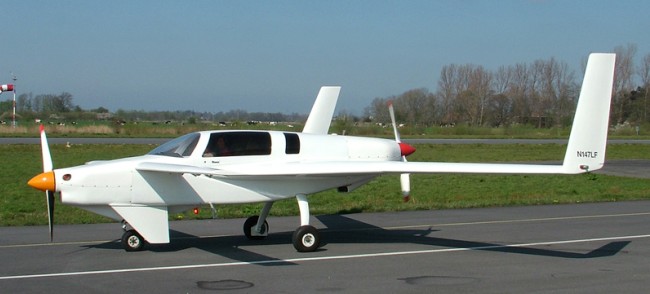
Rutan’s Long-EZ is a larger, heavier version of the VariEze built around the 115-hp Lycoming engine. The airframe will accept 115 to 180 hp. It has over four feet more wingspan and nearly half again the wing area of the VariEze. It takes off in 100 feet less distance and lands in only slightly more than half the distance of the original VariEze. While identical in length — 100 inches — the Long-EZ version is two inches wider.
Final flight-testing of No. 1 Long EZ, N79RA, was done in December 1979.
During one record flight, Dick Rutan logged 52.2 hours on a two-week round trip to Florida from Mojave, averaging a 183 mph airspeed. The Rutan factory estimates that the Long-EZ can be built by relatively competent builders in 800-1000 man-hours or nine months of spare time.
None of the VariEze series has been designed for training purposes. The back seat has a slide control stick, and that was all. There were no rudder pedals or brakes, no throttle, no mixture control, no radio and no intercom in back.
The capabilities of the Long-EZ are indicated by two class records established by Dick Rutan, the designer’s brother: a closed-circuit distance record of 4800.3 miles (7725.3 km) and a straight-line distance record of 4563.7 miles (7344.56 km).
In 1980 cost was US$198,50 at the RAF (Rutan Air Factory) for a set of homebuilder’s plans. In the first five months since long EZ plans have been available, more than 300 sets have been sold.
By 1990 the Rutan design stable of VariEze, LongEze, Defiant and Solitaire were no longer offered for sale.
A rocket powered version of the Long-Ez flew at Mojave in 2002 (see XCOR Aerospace EZ-Rocket).
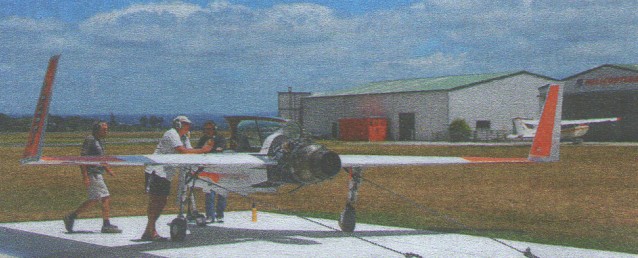
A 2000 lb thrust jet engine Longeze achieves and initial climb rate of 10,000 fpm.
Longeze jet
Variation: Shaw Twin-Ez Task Vantage / Sneeky Pete
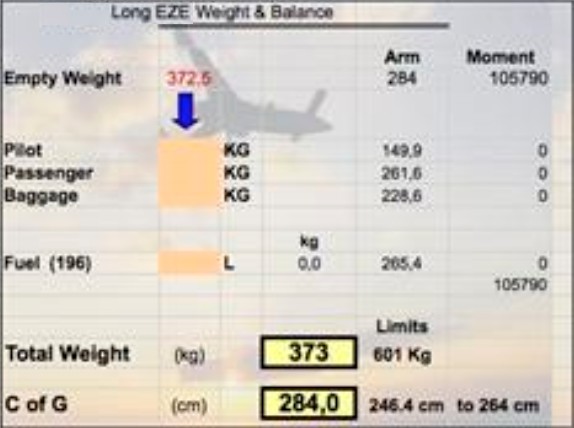
Rutan Long-EZ Engine: Lycoming O-235, 108 hp Fuel type: 80 Propeller makellype: fixed-pitch, wood Landing gear: fixed main, retractable nose Gross weight: 1325 lb Max landing weight: 1300 lb Empty weight std: 700 lb Useful load std: 625 lb Payload full Std. fuel: 313 lb Fuel capacity std: 52 USG Wingspan: 26.3 ft Wing area: 94.8 sq.ft Wing loading: 14.0 lb/sq.ft Power loading: 12.3 Ibs/hp Seating capacity: 2 Cabin doors: Opening conopy Cabin length: 100 in Cabin width: 24.2 in Max level speed: 190 kt / 220 mph Never exceed: 190 kt / 220 mph Cruise speed Best Power 75 % power 8500 ft: 161 kt / 185 mph Cruise speed Best Power 60 % power 12,500 ft: 148 kt /170 mph Cruise speed Best Power 40 % power 12,500 ft: 127 kt / 146 mph Max range w/res 75 % power 8500 ft: 1130 nm / 1298 sm Max range w/res 60 % power 12,500 ft: 1460 nm / 1677 sm Max range w/res 40 % power 12,500 ft: 1848 nm / 2125 sm Fuel consumption 75 % power 8500 ft: 6.7 USgph Fuel consumption 60 % power 12,500 ft: 4.9 USgph Fuel consumption 40 % power 12,500 ft: 3.4 USgph Estimated endurance 60 % power: 10:37 hr Stall speed flops up, gear up: 68 mph Stall speed flops down, gear down:: 66 mph Best rate of climb: 1150 fpm Absolute ceiling: 26,900 ft Service ceiling: 17,000 ft Takeoff ground run: 775 ft Takeoff over 50-ft obstacle: 1600 ft Landing ground roll: 780 ft Landing over 50-ft obstacle: 1800 ft