SIAI-Marchetti F.20 Condor / General Avia F.20 Condor

The four-seat twin-turboprop Condor was designed and developed to the prototype stage by General Avia for military duties such as multiengine and weapons training, maritime surveillance, SAR, anti-tank, and ground attack.

Following the first flight in May 1983, SIAI-Marchetti has been responsible for flight testing the F.20TP Condor aircraft, which can be fitted with two stores pylons under each wing. Low-priority development continued for some time.

SIAI-Marchetti / Savoia-Marchetti

Societa Idrovolanti Alta Italia
Siai-Marchetti Societa Per Azioni

The original company was founded in 1915 as SIAI (Società Idrovolanti Alta Italia – Seaplane company of Northern Italy). After World War I gained the name Savoia, when it acquired the Società Anonima Costruzioni Aeronautiche Savoia, an Italian aircraft company founded by Umberto Savoia in 1915.

The name Marchetti was added when chief designer Alessandro Marchetti joined the company in 1922. Savoia-Marchetti gained prominence with the successful S.55 flying boat. Savoia-Marchetti became famous for its flying boats and seaplanes, which set numerous endurance and speed records. Favoured by Air Marshal Italo Balbo, the company began rapidly prototyping and developing a number of other aircraft, increasingly focusing on warplanes in the lead-up to World War II. However, most of S.M.’s manufacturing capabilities were destroyed in World War Two. It was renamed SIAI-Marchetti in 1943.

Since 1946 engaged in overhaul and repair work and developed new aircraft. SIAI-Marchetti only survived in postwar Italy by building trucks and railway equipment. However it still struggled with insolvency for 6 years after the war before declaring bankruptcy in 1951.

In 1953, the company reopened. Types have included SA.202 Bravo trainer produced jointly with FFA in Switzerland; S.205 four-seater and S.208 development. First flew SF.250 aerobatic trainer in July 1964; became highly successful SF.260 production aircraft for civil and military use (initials in SF.260 denoted design by Stelio Frati). In 1968 company formed a Vertical Flight Division, but increasing helicopter work became associated with Agusta and Elicotteri Meridionale. SM.1019 light multipurpose high-wing monoplane followed 1969, SF.600 Canguro transport 1979 (recently taken over by VulcanAir), and S211 jet trainer and light attack aircraft 1981.

Agusta, which had acquired 30% of SIAI-Marchetti in 1970, had increased its stake to about 60% by 1973 and reached complete ownership in 1983.

Company taken over by Aermacchi January 1997.

S.I.A. Roma

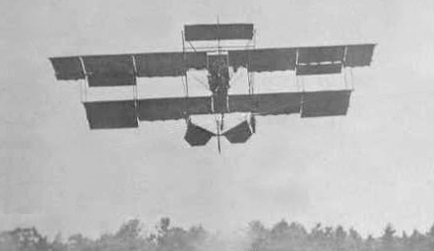
Enrico Luzzatto was a Milan lawyer who owned a typographic industry. After building a couple of planes he formed the “Società Italiana degli Aeroplani” (S.I.A.). In 1913 he designed and built a two-seater, called “Roma”. On May 27, 1913, piloted by Francis Deroy and with a passenger on board, it flew from Milan to Rome in less than six hours, winning the Coppa Ponti. Entered in the first Italian military competition, the “Roma” placed very well in all tests, but an error in flight route between Turin and Milan eliminated it from the competition.

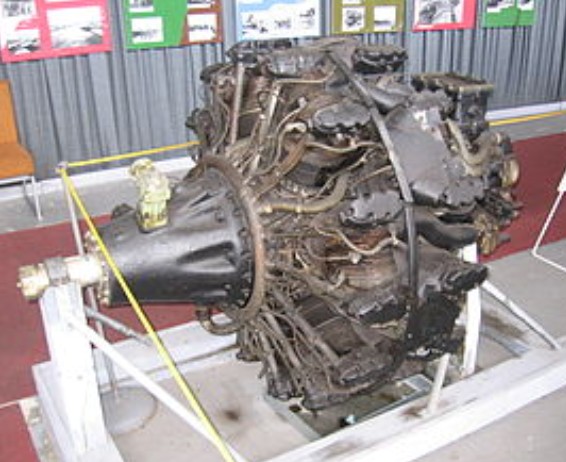
Shvetsov M-82 / ASh-82 / ASh-2TK / ASh-2K (ASh-4K) / Dongan / Harbin HS-7 / HS-8

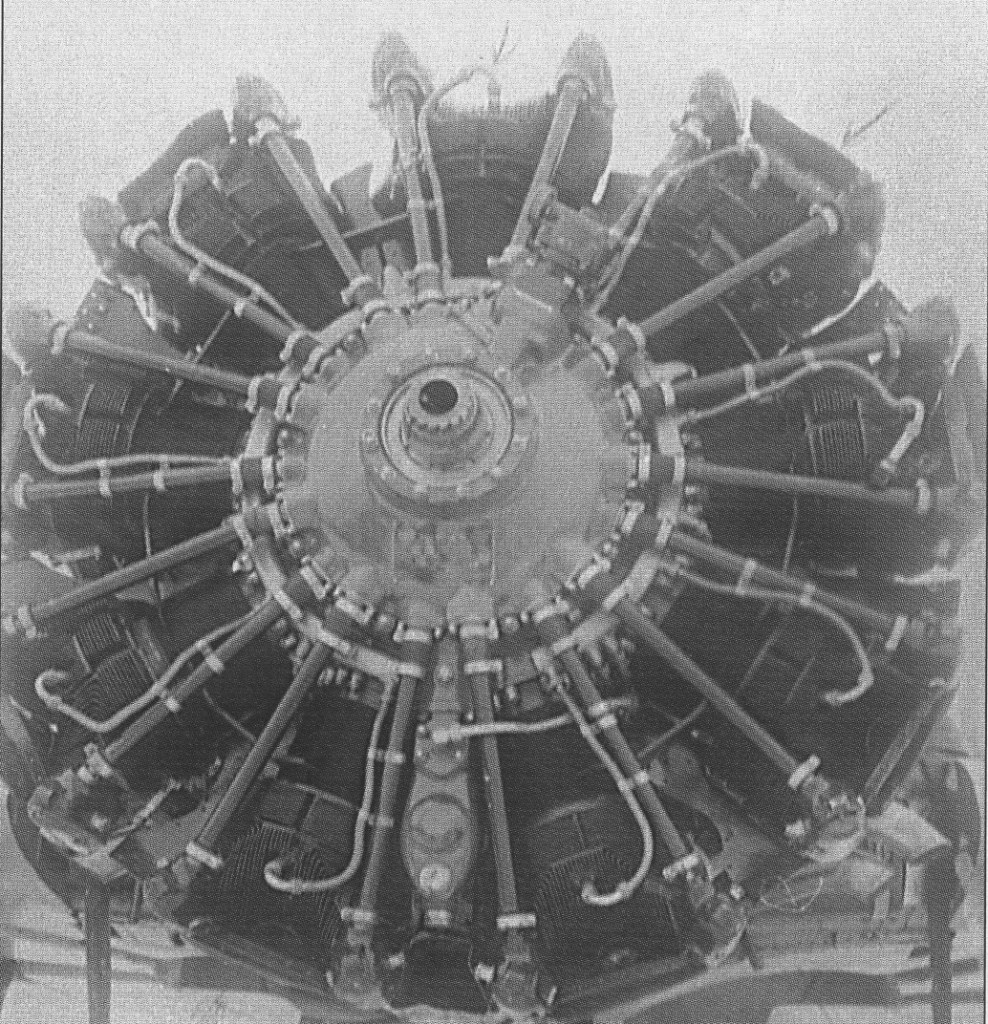
The Shvetsov ASh-82 (M-82) is a 14-cylinder, two-row, air-cooled radial aircraft engine developed from the Shvetsov M-62 and first run in 1940. The M-62 was the result of development of the M-25, which was a licensed version of the Wright R-1820 Cyclone.

Arkadiy Shvetsov developed the Wright Cyclone design, reducing the stroke, dimensions and weight. This allowed the engine to be used in light aircraft, where a Twin Cyclone could not be installed. It entered production in 1940 with Shvetsov & Evich, OKB-19 in Perm, and saw service in a number of Soviet aircraft. It powered the Tupolev Tu-2 and Pe-8 bombers and the inline engine-powered LaGG-3 was adapted for the ASh-82, additionally the famous Lavochkin La-5, Lavochkin La-7 fighters, and the Ilyushin Il-14 airliner were created around the engine. Over 70,000 ASh-82s were built (57.898 of Ash-82, 82F & 82FN in wartime).

Variants:
ASh-82-111 (M-82-111) – First mass-produced ASh-82, with carburettors and one two-speed supercharger. This engine had lubrication and carburettor problems in extreme cold conditions.

ASh-82-112 (M-82-112) – Improved M-82-111 with longer Time between overhaul (TBO) and better reliability. Redesigned carburettors, oil pumps, gear, turbocharger and reinforced pushrods. This engine worked better in the harsh Russian winter.

ASh-82F (M-82F) – Identical to ASh-82 except for longer Time between overhaul and improved cooling and lubrication which allowed unlimited operation at takeoff power.

ASh-82FN (M-82FN) – ASh-82F with gasoline direct injection, power output increased to 1,230 kW (1,650 hp) for takeoff with only a 30 kg (65 lb) increase in engine weight, used by Pe-8 long-range bombers and Lavochkin La-7 fighters.

ASh-82FNU (M-82FNU) – Improved M-82FN with more boost pressure and RPM, power output increased to 1,380 kW (1,850 hp). After all the improvements, the ASh-82FN and ASh-82FNU were two of the most sturdy radial engines of the war.

ASh-21 (M-21) – Single-row 7-cylinder version of ASh-82 for Yakovlev Yak-11 trainer, entered production in 1946.

ASh-82T (M-82T) – New version of the Ash-82FNU developed in the early fifties for civilian aircraft. Previous version twin superchargers were replaced with a large single-speed compressor attached to an after-cooler (the critical altitude was 2,000 m, 6,561 ft). Optionally, the engine was provided with a two-speed supercharger (with a critical altitude of 4,000 m, 13,123 ft, the robustness of the engine allowed to take off in second speed). New alloys were used and some components were upgraded, thus reducing maintenance operations. Special care was put into reducing the engine noise level and an optional exhaust double silencer was available. The engine had a new fuel injection system and improved specific fuel consumption (a 16% reduction at cruise speed compared to 82FNU). A four-blade high efficiency propeller, the Typ AB-50m, was developed for the 82T version. This radial engine had an excellent reputation for its reliability and simple maintenance; there are still aircraft in service with this engine thanks to the inexpensive spare parts and the possibility to use automotive gasoline. The power was 1,900 hp (1,417 kW) at 2,600 RPM for takeoff, with 95 or 100 octane Avgas. Maximum continuous power was 1,630 hp (1,215 kW). Lower octane fuel, 90 octane Avgas or equivalent automotive gas, was allowed with minor modifications and turbocharger Manifold Pressure restrictions that limited the power to 1,700 hp (1,268 kW).

ASh-82V (M-82V) – Helicopter version of the ASh-82T developed in 1952, with axial-flow fan mounted in the fuselage’s front. The engine was connected to a R-5 two-stage planetary primary gearbox with the help of a shaft (which was between the pilots seats). This engine was used in the Mi-4 and Yak-24 helicopters

ASh-2TK and ASh-2K (ASh-4K) – Four-row versions of the ASh-82, developed in the late ’40s. The Shvetsov design bureau took into consideration all available information about the Pratt & Whitney R-4360 and developed an engine with less maintenance operations, longer time between overhaul, direct fuel injection and a simpler supercharging system. The ASh-2TK had a two-stage two-speed supercharging system with intercooler (similar to the ASh-73) that compromised the engine’s long TBO. Finally the ASh-2TK was discarded and a new version was developed, the ASh-4K, with an experimental variable-speed turbocharger and after-cooler, which allowed a cruising altitude of 11,000 m (36,089 ft). The engine had 82.4 litres (5,030 cu in) and 4,000 HP (2,985 kW) at 2,600 RPM (dry). The Ash-2K (ASh-4K) version had 4,700 HP (3.507 kW) wet, with a water-methanol system. For political reasons, these engines were prematurely installed in Tupolev Tu-4LL testbeds at the end of 1950, when the prototypes’ initial tests had barely begun. The engines had various teething and overheating problems, and required a long testing period. Most of the flaws were fixed in the mid-fifties, but the production was cancelled: in those days, the priority for the Soviet Air Force were the turboprop and jet engines.

Dongan HS-7 A Chinese license built copy of the ASh-82V, and the chosen engine for powering modern 21st century reproductions of the Focke-Wulf Fw 190A built in Germany.

Dongan HS-8 A modified version of the Dongan HS-7 which “combined the main body and supercharger of the HS-7 with the reduction gear and propeller drive of the Shvetsov ASh-82T”. Built by Dongan Engine Manufacturing Company (aka Harbin Engine Factory)

Applications:
Amtorg KM-2 (Improved PBY Catalina, built under Consolidated license)
Gudkov Gu-82 (Prototype)
Ilyushin Il-2 (prototype)
Ilyushin Il-12
Ilyushin Il-14
Kocherigin OPB-5 (prototype)
Lavochkin La-5
Lavochkin La-7
Lavochkin La-9
Lavochkin La-11
MiG-5
MiG-9 I-210 (1941 Prototype)
Mikoyan-Gurevich I-211 prototype
Mil Mi-4
Petlyakov Pe-2
Petlyakov Pe-8
Polikarpov I-185 (Prototype)
Sukhoi Su-2
Sukhoi Su-7
Sukhoi Su-12
Tupolev Tu-2
Yakovlev Yak-24

Specifications:
ASh-82
Type: 14-cylinder two-row radial engine
Bore: 155.5 mm (6.122 in)
Stroke: 155.0 mm (6.102 in)
Displacement: 41.2107 L (2,515.3 cu in)
Length: 2.01 m (6ft 7.1 in)
Diameter: 1.26 m (49.6 in)
Dry weight: M-82-112 model: 860 kg (1,894 Ib), M-82FN model: 890 kg (1,962 Ib), M-82FNU model: 900 kg (1,984 lb), M-82T model: 1,020 kg (2,246 lb)
Valvetrain: Pushrod, two valves per cylinder with sodium-cooled exhaust valve.
Supercharger: Single-stage, One TK-2 two-speed centrifugal type supercharger on early production. Two TK-3 two-speed exhaust gas-driven forced-induction compressor on FN and FNU models. For the M-82T: Single-speed centrifugal supercharger with after-cooler. The gear ratio was 7.27:1. Critical altitude: 2,000 m (6,561 ft). Optionally, the M-82T had a two speed supercharger with after-cooler; the second speed gear ratio was 10,2:1. Critical altitude: 4,000 m (13,123 ft). Manifold pressure limit: 1.64 Atm (49.2″) for takeoff and 1.34 Atm (40.15″) at second speed.
Fuel system: Carburettors (early production), direct fuel injection with automatic mixture control. Petrol pump: BNK-10KT.
Fuel type: 90 octane (minimum grade allowed), 92, 95 or 100 octane
Oil system: Two pumps: geared rotation pump MSH-6SV (rear) and swarm pump PMN-T (front). Normal oil temp: 40 to 90°C. Limit temp: 115°C. Minimum oil pressure at low gas: 3 kg/cm2 (42.7 PSI). Minimum oil pressure at cruise: 4.5 kg/cm2 (front pump), 5.5 kg/cm2 (rear pump) (64 PSI front and 78.2 PSI rear)
Cooling system: Air-cooled. Minimum permissible cylinders temp for operation: 120°C. Maximum permissible cylinders temp: 250°C. Maximum permissible at cruise: 225°C. Normal cylinders temp at cruise: 160 to 180°C
Reduction gear: 11:16 (prototypes & M-82-111), 9:16 (M-82-112 and later models)
Power output:
M-82-111 with carburettors:
1,570 hp (1,170 kW) at 2,400 RPM for take-off (Dry), boost rated at 1.55 Atm (46.3″)
1,540 hp (1,148 kW) at 2,400 RPM at 6,656 ft (2,050 m)
1,330 hp (992 kW) at 2,400 RPM at 17,716 ft (5,400 m), boost rated at 1.29 Atm (38.6″)
820 hp (612 kW) at 2,400 RPM at 27,887 ft (8,500 m)

M-82FN with direct fuel injection:
1,650 hp (1,230 kW) at 2,400 RPM for take-off (Dry), boost rated at 1.55 Atm (46.3″)
1,430 hp (1,067 kW) at 2,400 RPM at 16,404 ft (5,000 m)
800 hp (597 kW) at 2,400 RPM at 32,808 ft (10,000 m)

M-82FNU:
1,850 hp (1,380 kW) at 2,500 RPM for take-off (Dry), boost rated at 1.60 Atm (47.88″)
1,650 hp (1,230 kW) at 2,400 RPM at 5,413 ft (1,650 m), boost rated at 1.36 Atm (40.7″)
1,450 hp (1,082 kW) at 2,400 RPM at 15,156 ft (4,650 m), boost rated at 1.36 Atm (40.7″)
810 hp (604 kW) at 2,400 RPM at 34,448 ft (10,500 m)

M-82T with two speed supercharger:
1,900 hp (1,416 kW) at 2,600 RPM for take-off, boost rated at 1.64 Atm (49.2″)
1,630 hp (1,215 kW) at 2,400 RPM at 6,561 ft (2,000 m), boost rated at 1.34 Atm (40.1″)
1,530 hp (1,082 kW) at 2,400 RPM at 13,123 ft (4,000 m), boost rated at 1.34 Atm (40.1″)
721 hp (537 kW) at 2,400 RPM at 31,167 ft (9,500 m)
Specific power: M-82FN: 29.84 kW/L (0.655 hp/in³), M-82FNU: 33.48 kW/L (0.735 hp/in³)
Compression ratio: 7.05:1 (6.90:1 for M-82T)
Specific fuel consumption:
M-82FN: 355 g/hp/hr (0.78 Ib/hp/hr) for take-off, 320 g/hp/hr (0.70 Ib/hp/hr) at nominal power
M-82FNU: 360 g/hp/hr (0.79 Ib/hp•hr) for take-off, 325 g/hp/hr (0.71 Ib/hp•hr) at nominal power
M-82T: 350 to 325 g/hp/hr (0.76 to 0.71 Ib/hp/hr) for take-off, 260 to 280 g/hp/hr (0.568 to 0.611 Ib/hp/hr) at cruise power
Power-to-weight ratio: 1.46 kW/kg (0.89 hp/lb)

Shvetsov M-71

The M-71 radial engine was developed from the Shvetsov M-70, a failed attempt at a two-row version of the single-row Wright R-1820 Cyclone. It used components from the Shvetsov M-63, which was an improved version of the M-25 with more horsepower than the original. Development began at the beginning of 1939 and it was bench tested that August, but did not pass its State acceptance tests until the autumn of 1942. It weighed 970 kg (2,100 lb) and produced 2,000 hp (1,500 kW). Despite this it was flight-tested in a Polikarpov I-185 prototype fighter in March–April 1942. A boosted version, the M-71F, was built in small numbers. It was flown in the prototypes of the single-engined Su-6 and the twin-engined Su-8 ground-attack aircraft in 1943–44 as well as the La-7 fighter in 1944. A version of the M-71F was developed with two TK-3 turbochargers and flight tested in the DVB-102 high-altitude bomber designed by Vladimir Myasishchev during the summer of 1943. Evaluations of the M-71 were generally favorable, but no production capacity was available to use for a brand-new engine during the war.

Applications:
Polikarpov I-185
Sukhoi Su-6
Sukhoi Su-8
Myastichev DVB-102

Specifications:
M-71F
Type: 18-cylinder, two-row, radial engine
Bore: 155.5 mm (6.12 in)
Stroke: 174.5 mm (6.87 in)
Displacement: 59.7 l (3,643 cu in)
Dry weight: 970 kg (2,100 lb)
Supercharger: geared, 1-speed centrifugal supercharger
Cooling system: air-cooled
Power output: 2,200 hp (1,641 kW)
Power-to-weight ratio: 1.05 hp/kg

Shvetsov M-62 / Ash-62 / Ash-63 / Harbin / Dongan HS-5 / PZL-Kalisz ASz-62

M-62

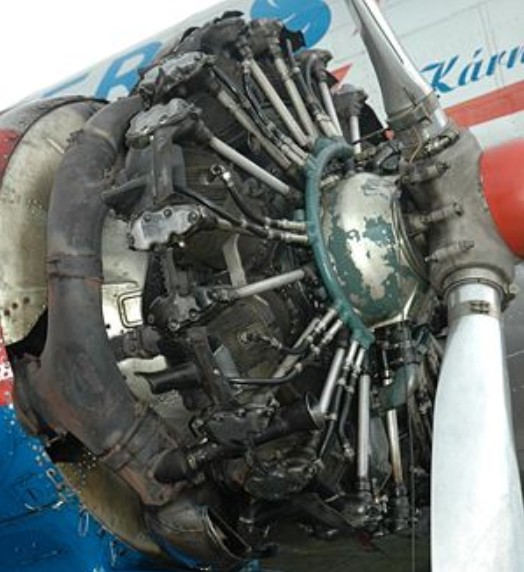
The ASh-62 (designated M-62 before 1941) was a development of the Wright R-1820 Cyclone that had been built in Russia under licence as the Shvetsov M-25. A nine-cylinder, air-cooled, radial aircraft engine, the main improvements included a two-speed supercharger and a more efficient induction system. Power was increased from the Cyclone’s 775 hp to 1,000 hp.

First run in 1937, licenced versions were still in production by WSK “PZL-Kalisz” in Poland as the ASz-62 (as of 2007). The Ash-62 was also produced in China as the HS-5. It is estimated that 40,361 were produced in the USSR.

Polish-built ASz-62IR engines are compatible with FAR-33 requirements. Further developments in Poland are the K9-AA, K9-BA and K9-BB engines, with take-off power of 1178 hp (860 kW), indicated power 698 kW.

The M-63 was an improved version of the M-62 with power output increased to 821 kW (1,100 hp) at 2,300 rpm for takeoff and 671 kW (900 hp) at 2,200 rpm at 4,500 m (14,764 ft) due to a greater compression ratio of 7.2:1 and a higher redline.

Shvetsov Ash-62 installed in a Lisunov Li-2

Applications:
Antonov An-2
Antonov An-6
Lisunov Li-2
de Havilland Canada DHC-3
Neman R-10
Polikarpov I-153
Polikarpov I-16
PZL-106 Kruk (some variants)
PZL-Mielec M-18 Dromader
PZL M-24 Dromader Super (K-9AA)
Sukhoi Su-2
Sukhoi Su-12

Specifications:
M-62
Type: Nine-cylinder single-row supercharged air-cooled radial engine
Bore: 156 mm (6.12 in)
Stroke: 175 mm (6.87 in)
Displacement: 29.8 l (1,819 in³)
Length: 47.76 in (1,213 mm)
Diameter: 54.25 in (1,378 mm)
Dry weight: 560kg (1,235 lb)
Valvetrain: Overhead valves
Supercharger: Two-speed centrifugal type supercharger
Fuel system: Carburetor
Fuel type: 92 RON, 87 (R+M)/2 (AKI) octane rating gasoline
Cooling system: Air-cooled
Power output: * 746 kW (1,000 hp) at 2,200 rpm for takeoff
634 kW (850 hp) at 2,100 rpm at 4,200 m (13,780 ft)
Specific power: 25.03 kW/l (0.55 hp/in³)
Compression ratio: 6.4:1
Specific fuel consumption: 469 g/(kW•h) (0.77 lb/(hp•h))
Power-to-weight ratio: 1.3 kW/kg (.81 hp/lb)

ASz-62 IR
Cylinder: 9
Capacity: 1823 cu.in
Take-Off Power: 1000 HP at 2200 RPM
Max TO power: 5 min
Fuel flow at Max TO pwr: 110 gph
Rated Power: 820 HP at 2100 RPM
Max. Continuous: 738 HP at 2030 RPM
75% Power: 615 HP at 1910 RPM
50% Cruise: 410 HP at 1670 RPM
Fuel flow at 50% Cruise: 45 gph
Propellor Gear Ratio: 0.637 to 1 / 11:16
Typical climb: 1800 RPM and 800 mm Hg manifold pressure
Typical cruise: 1600 RPM and 700 mm Hg
Fuel: 100 Octane Aviation Grade minimum

Short T.5 / S.45 / S.48 / S.49 / S.50

S.45

The Short S.45 — also known as the Short T.5 after its naval serial number — was a training biplane built for Britain’s Royal Navy by Short Brothers in 1912. It was the forerunner of another three identical aircraft (designated S.48, S.49, and S.50 by Shorts) delivered to the Royal Navy and Royal Flying Corps during 1912 and 1913. The Royal Naval Air Service was still operating the type when World War I broke out in 1914.

The design was similar to that of the Short S.36, a sporting biplane built for Frank McClean which he lent to the Navy Flying School, Eastchurch. Cdr Charles Rumney Samson and Capt Eugene Gerrard test-flew the aircraft early in 1912. The pleasing performance of the S.36 led to an order by the Admiralty for two aircraft of similar configuration, but differed in the engine fitted. in March that year. Shorts delivered these as the S.41 and the S.45.

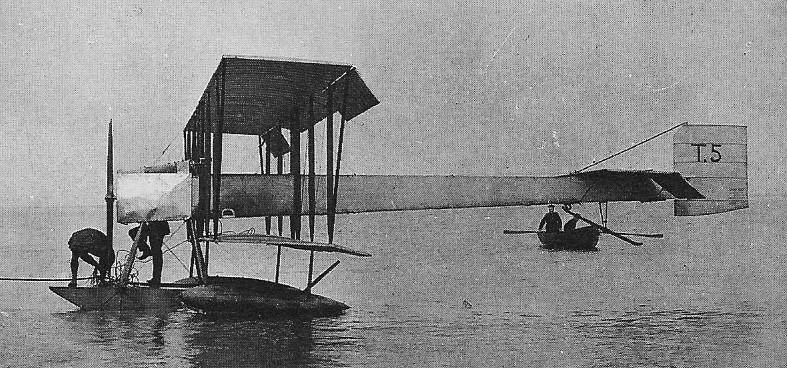
The S.45 was an unequal-span two-bay biplane with a fuselage of square-cross section with the two seats in tandem in open cockpits . The wire-braced wings were unstaggered, and the fuselage was mounted partway between them. Ailerons were fitted only to the upper wing. The tail was cruciform in shape and the undercarriage was designed to be interchangeable to allow the S.45 to be flown as a seaplane or landplane. The machine was powered by a single rotary engine in the nose, turning a two-blade propeller. In seaplane configuration, the undercarriage consisted of a single broad pontoon mounted beneath the fuselage, with airbags on short struts under each wing. A third airbag was later fitted under the tail to keep it out of the water while the aircraft was under tow.

The S.45 flew for the first time on 24 May 1912 as a landplane with Lt Spencer Grey at the controls, and was accepted for Navy service with the serial number T.5 (“T” signifying “tractor”). Together with the S.41, the aircraft participated in the Naval Review at Portsmouth in July. It was soon joined in service by the S.48 (serial 413), which Capt Gerrard delivered to the Central Flying School at Upavon on 10 October. Although evaluated by Capt John Salmond as underpowered, it flew regularly until damaged beyond repair in a landing accident on 3 December when it stalled on approach.

Meanwhile, the S.45 underwent considerable modification, including a new engine cowling, a built-up coaming around the cockpits, revised ailerons, and upper wings of greater span. The wing extensions were braced with a kingpost and wires. Its serial was changed from “T.5” to simply “5” when army and navy aircraft serials were merged into one system in late 1912. In 1913, the S.45 was stationed at Carlingnose, near Rosyth, where it suffered a landing accident and capsized on 4 October.

At the start of 1913, the Central Flying School received two further examples of the type: Capt Gerrard delivered the S.50 (serial 424) on 17 February and the S.49 (serial 423) on 22 February. Not long after, these aircraft disappeared from the records when their serial numbers were reassigned to two Royal Aircraft Factory B.E.8s. Eventually, stripped of their engines and identities, the War Office declared the two airframes to be surplus to requirements, and transferred them to the Admiralty in August 1914. In Royal Naval Air Service hands, the aircraft were re-engined with 100-hp (75-kW) Clerget rotary engines and assigned serial numbers 1268 and 1279. The RNAS operated them at the Navy Flying School and they remained in service at the outbreak of World War I.

S.45
Powerplant: 1 × Gnome Gamma, 70 hp (52 kW)
Wingspan: 42 ft 0 in (12.80 m)
Wing area: 450 sq ft (42 m2)
Length: 35 ft 6 in (10.82 m)
Empty weight: 1,080 lb (490 kg)
Gross weight: 1,500 lb (680 kg)
Maximum speed: 60 mph (97 km/h, 52 kn)
Endurance: 5 hr
Crew: two, pilot and instructor