Siemens-Halske 5 / Sh 13

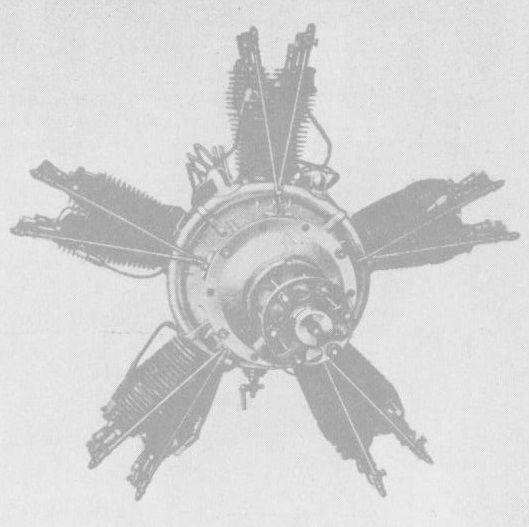
The Sh 13 is low pressure due to the engine being completely ball bearings. Cylinders are all of steel barrel with aluminium alloy ribs being cast on by special process, with aluminium alloy heads held down by six studs and are removable.

Intake ports are at the rear and exhaust ports on the side. The crankshaft assembly is composed of two major castings and front and rear cover plates all of aluminium alloy.

The crankshaft is a two piee single throw and all connecting rods are tubular. The master rod is on two ball bearings. The aluminium alloy pistons have two compression ringa and two oil rings in each. Both the exhaust and intake valves are tulip shaped.

Type: 5 cylinder air cooled radial
Approved Dept of Commerce
Military Rating: 83 hp at 1710 rpm
Commercial Rating: 83 hp at 1710 rpm
Displacement: 317 cu.in
Compression ratio: 5.3
Bore: 4.133 in
Stroke: 4.724 in
Length: 33.8 in
Diameter: 39.25 in
Weight: 247 lb
Fuel consumption: not more than .52 lb/hp/hr
Oil consumption: not more than .027 lb/hp/hr
Lubrication: Dry sump, force feed, low pressure
Ignition: 2 Siemens or Scintilla magnetos
Carburation: 1 Sum Carburetor
Spark plugs: 2 per cylinder Siemens
Price: $2100
Siemens-Halske Sh III

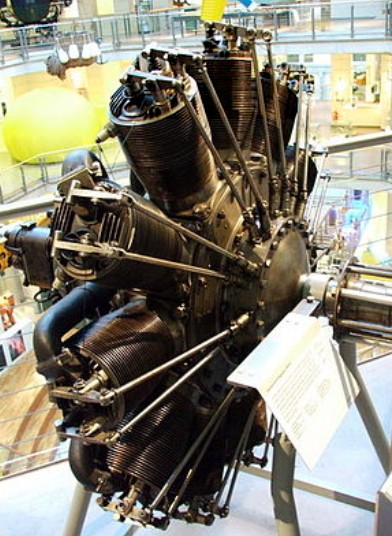
Siemens-Halske’s Sh.III was an 11-cylinder, air-cooled rotary engine developed in Germany during World War I, similar to the Sh.I. It shared with its predecessor the unusual design feature of having its internal workings (crankshaft, connecting-rods, etc.) rotating in a clockwise direction as seen from “nose-on”, within the engine, and the crankcase and propeller (still fastened to the crankcase, as is usual for rotary engines) rotating in the “accepted” anti-clockwise direction. Also unusual for a rotary engine was the inclusion of a true throttle control. Power was rated at 120 kW (160 hp).

The advantages of the engine were increased propeller efficiency through the reduction gearing effect of having the engine effectively running at 1,800 rpm for only 900 rpm of the airscrew, and excellent high-altitude performance due to the high compression ratio achieved. A bonus was the counter-rotating masses tended to cancel out the gyroscopic forces of the engine. This was achieved by using bevel-gears housed in the rear of the crankcase.

Production problems at the Siemens works, and poor quality lubricating oil, gave the Sh.III engines a life expectancy of only seven to ten hours before pistons began to seize. The license-built Rhemag versions of the Sh.III did not have such problems, so the Siemens-made engines were gradually withdrawn from service.

Applications:
Albatros H.1
Albatros D.XI
Pfalz D.VII
Pfalz D.VIII
LFG Roland D.IX
LFG Roland D.XVI
Siemens-Schuckert D.II
Siemens-Schuckert D.III
Siemens-Schuckert D.IV
Siemens-Schuckert D.VI

Specifications:
Type: 11-cylinder rotary engine
Bore: 124 mm (4.88 in)
Stroke: 140 mm (5.51 in)
Displacement: 18.6 L (1,135 cu in)
Dry weight: 195 kg (430 lb)
Cooling system: Air-cooled
Power output: 120 kW (160 hp) (Later variants produced 200-240 hp)

Siegel MS-5 / MS-6

MS-5

Mieczysław Siegel, a village schoolteacher from Skrzynice near Lublin, had already some experience with designing and building fairly amateur gliders when he decided to turn to somewhat more ambitious endeavour of building an aircraft. In 1927 he built a small MS-5 plane with parasol configuration, which was then deliberately destroyed during static tests. A year later Siegel built an improved MS-6 airplane but failed to acquire an engine, which made the designer decide to stick to gliders.

Siegel, Mieczysław

Mieczysław Siegel, a village schoolteacher from Skrzynice near Lublin, had some experience with designing and building fairly amateur gliders when he decided to build an aircraft and in 1927 he built a small MS-5. A year later Siegel built an improved MS-6 airplane but failed to acquire an engine, which made the designer decide to stick to gliders.

Siedek KS 3

Vienna, Austria, 1934 Frühjahrsmesse (Spring Trade Fair)

The Siedek KS 3 was built by Diplom-Ingenieur Richard Siedek in Vienna, Austria. The powerplant was an 80 hp two-stroke aircraft engine, developed by Ingenieur Kraus and Siedek.”

Span: 22 ft 11.6 in (7.00 m)
Length: 16 ft 8.8 in (5.10 m)
Height: 6 ft 6.7 in (2.00 m)
Wing area: 172 sq.ft (16.00 sq.m)
Takeoff weight: 882 lb (400 kg)
Cruise speed: 75 mph (120 kmh)

Siebert Sie 3

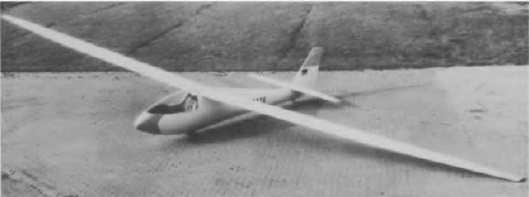
This wooden Standard Class single-seater was designed by Paul Siebert and first flew in prototype form in 1971; by January 1975 a total of 27 had been built by the Paul Siebert Sportund Segelflugzeugbau and sold to Belgium, Holland, Denmark and Portugal as well as to customers in Germany. Permission was being sought from the Luftfahrtbundesamt, the Federal German civil aviation authority, to offer the Sie 3 in a form suitable for amateur construction. Of conventional wooden construction, the Sie 3 is a cantilever high wing monoplane with a constant chord centre section and tapered outer panels; Schempp-Hirth aluminium air brakes are featured. The fin and rudder are swept back and the low-set tailplane is an all-moving surface. Landing gear consists of a monowheel with brake and a tailskid, and the pilot sits under a one-piece flush-fitting cockpit canopy.

Span: 49 ft 2.5 in
Length: 22 ft 0 in
Height: 3 ft 11 in
Wing area: 127.44 sqft
Empty weight: 467 lb
Max weight: 750 lb
Max speed: 124 mph (in smooth air)
Min sinking speed: 2.23 ft/sec at 48.5 mph
Best glide ratio: 34.3:1 at 56 mph