In October 1914 Siemens started design of four-engined aircraft similar to that of Sikorsky in Russia. As entirely new venture company sponsored designs by two Steffen brothers leading to giants R.I-VII of 1915-1917.
Author: Terry
Siemen Schkukert E-I
A monoplane single-seat fighter.
Siemen Schkukert D-IV
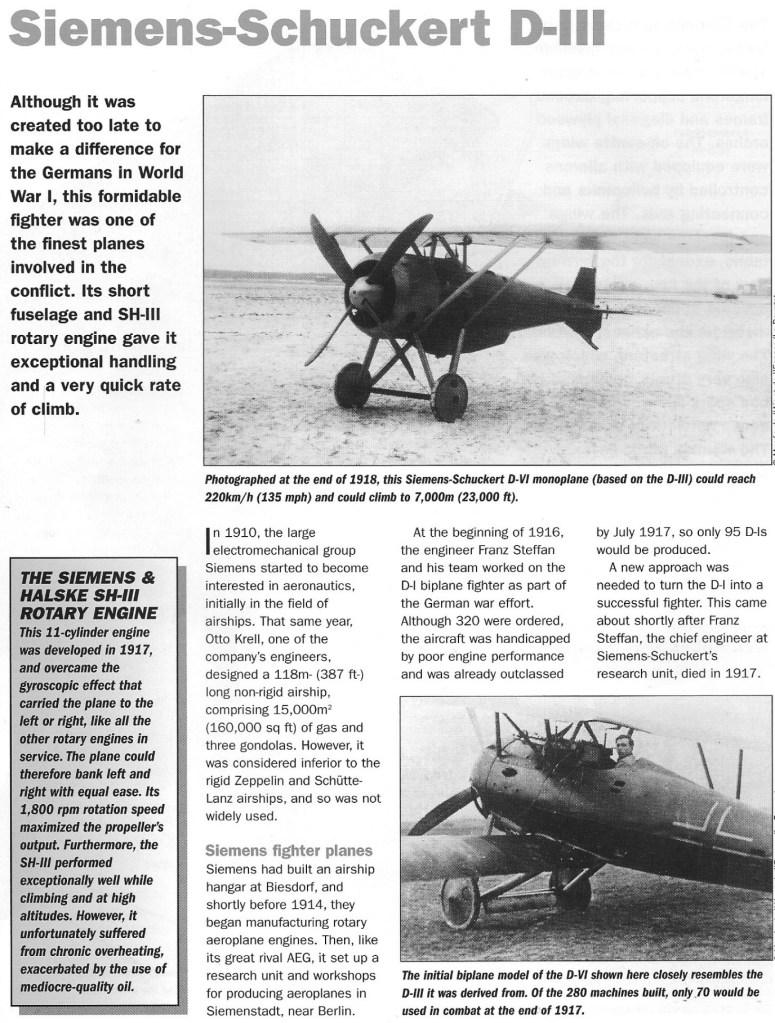
The D III was followed by the D IV, which introduced much aerodynamic refinement for slightly higher speed and still better climb rate. A total of 280 were ordered, but less than 140 D IVs were completed, most entering service after August 1918.
D IV
Engine: l x Siemens-Halske Sh.IIIa, 119kW (l60hp)
Span: 8.35m (27ft 4.75in)
Length: 5.7m (18ft 8.5 in)
Max TO weight: 735 kg (1,620 lb)
Max speed: 119 mph
Operational endurance: 2 hr
Armament: 2 x 7.92-mm (0.312-in) LMG 08/15 mg
Siemens-Schuckert D-III Article

Siemen Schkukert D-II / D-III
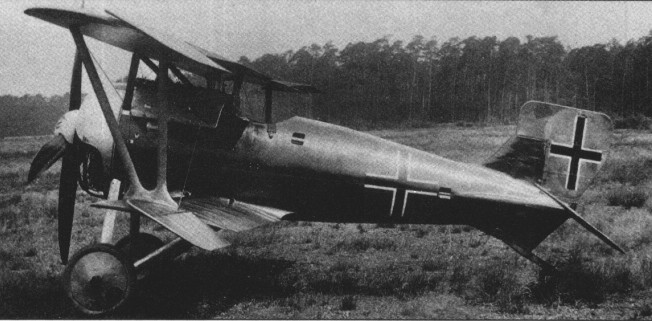
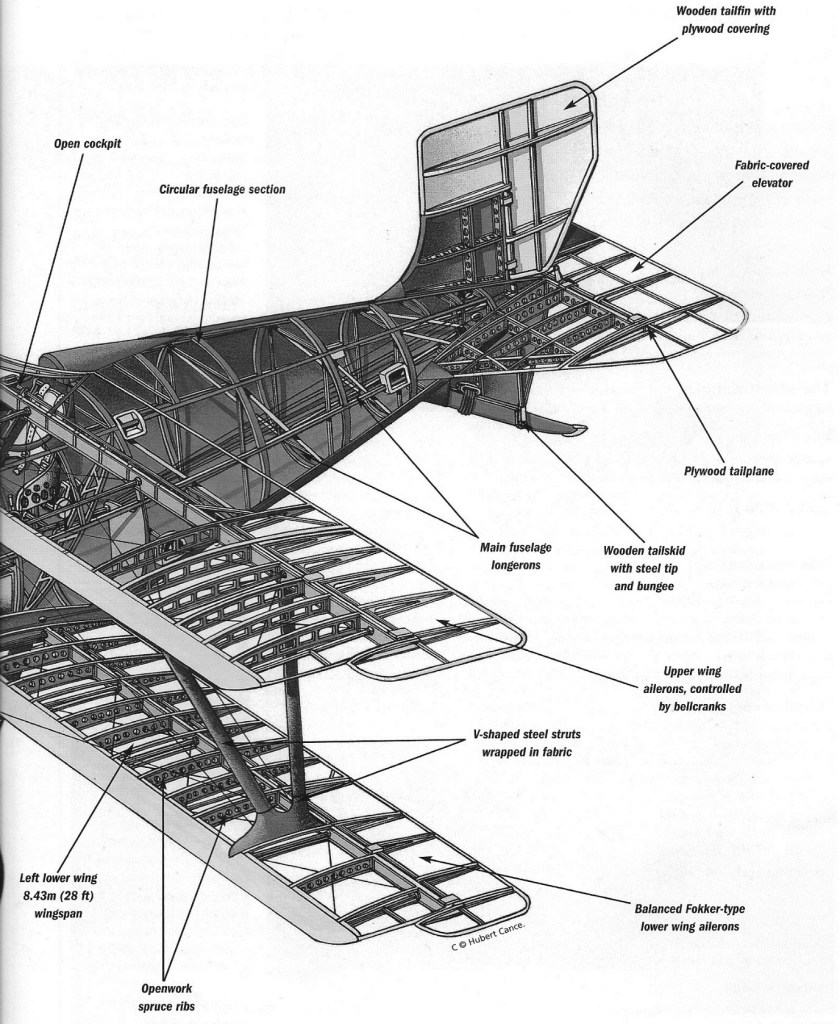
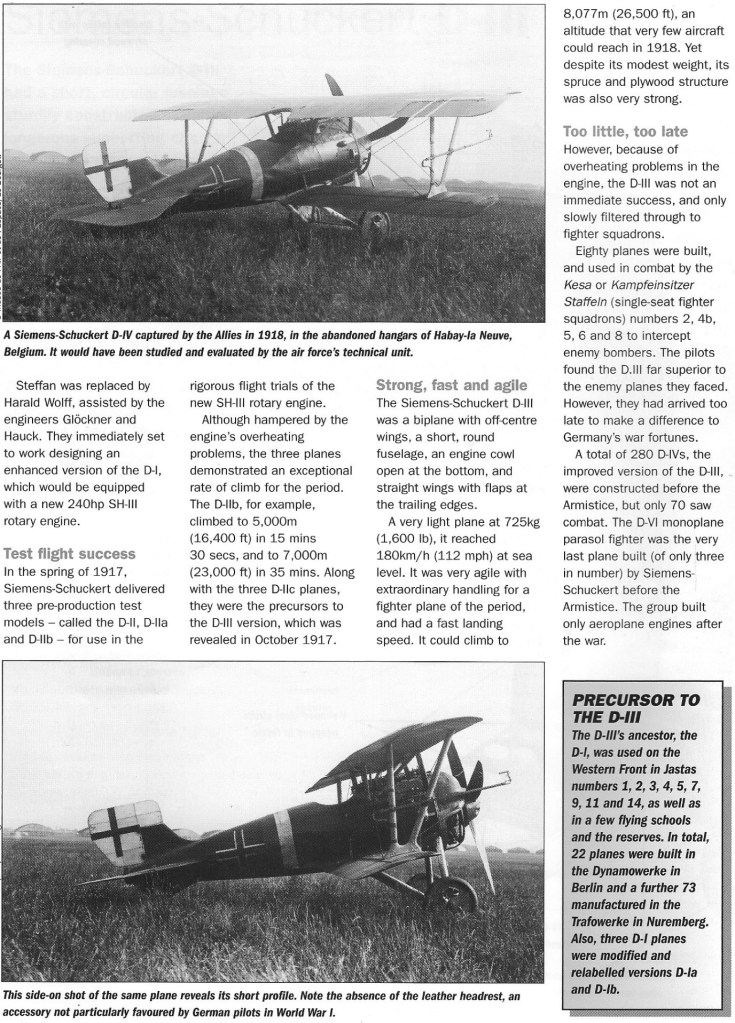
Via the D II prototype Siemens-Schuckert then moved to a completely German design, ordered late in 1917 as the D III equal-span biplane with the 119-kW (160-hp) Siemens-Halske Sh.III rotary engine whose diameter dictated the circular section of the compact fuselage that tapered sharply into the empennage with its large tailplane and angular vertical surfaces. After the teething problems of this engine had been cured, the 50 D IIIs matured as extremely fast-climbing interceptors whose other performance figures were low.
Siemen Schkukert D-1
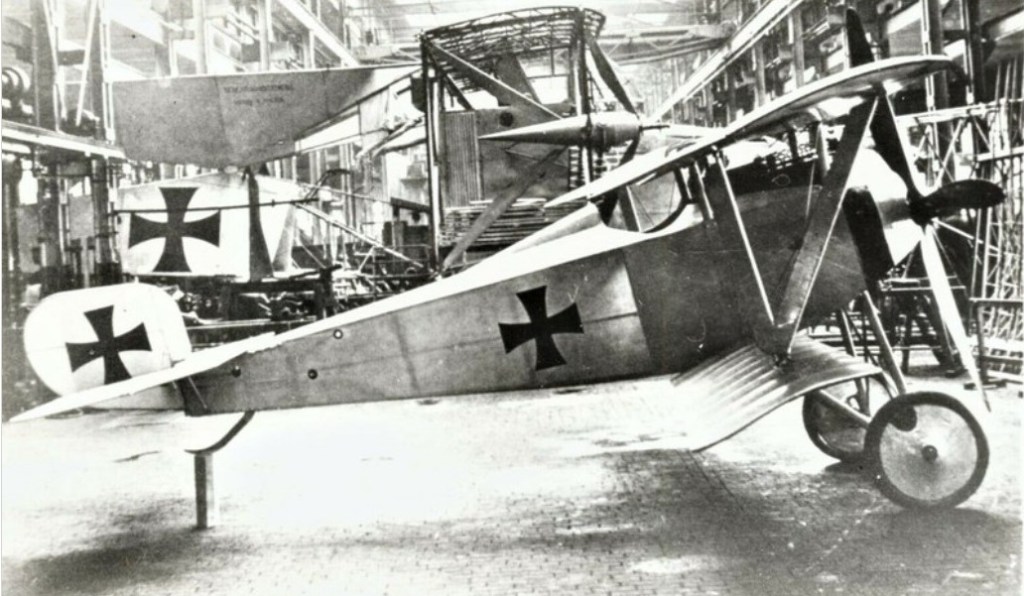
A German copy of the Nieuport 11. Some 150 were ordered into production of which only 94 became operational due to improved aircraft coming into service by mid-1917.
Replica Ultralight:
Circa Reproductions Siemens Schukert
Engine: Siemens-Halske, 110 hp
Siemen Schkukert
Siemens-Schuckert Werke GmbH
Began airship construction in 1907. In 1909 manufactured airplanes, but poor results stopped work in 1911. Airplane department reopened 1914. In October started design of four-engined aircraft similar to that of Sikorsky in Russia. As entirely new venture company sponsored designs by two Steffen brothers leading to giants R.I-VII of 1915-1917. R.VIII, which did not fly, was then world’s largest airplane with span of 158 ft (48.16 m), and had experimental rotating gun-turret. Other advanced projects included steam-turbine monoplane and wire-guided flying bombs. Company also made E-l monoplane single-seat fighter and D-l copy of Nieuport. D-III and D-IV also built in quantity. Fighters were technically very advanced.
Siemens-Halske Sh 15
Radial engine
Siemens-Halske 9 / Sh 12
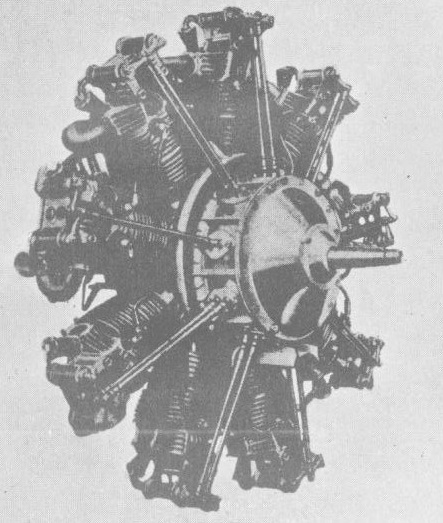
The Siemens-Halske Sh 12 was a nine-cylinder, air-cooled, radial engine for aircraft built in Germany in the 1920s. First run in 1925, it was rated at 80 kW (110 hp).
The Sh 12 is low pressure due to the engine being completely ball bearing. Cylinders are of steel barrel with aluminium alloy heads screwed and shrunk on, and also locked by special nut and counter ring. The intake and exhaust ports are on side.
The crankshaft assembly is composed of two major castings and front and rear cover plates all of aluminium alloy. The crankshaft is two piece single throw.
All connecting rods are tubular. The master rod is on two ball bearings. Aluminium alloy pistons have two compression rings and two oil rings on each pistion. The exhaust and intake valves are tulip shaped.
Accessories available at extra ost were exhaust manifold and Bosch electric starter.
Applications:
Albatros L 68
Albatros L 79
Arado S I
Arado W 2
BFW M.21
BFW M.27
Bücker Bü 133
Udet U-8
Udet U 11 Kondor
Udet U-12
Type: 9 cylinder air cooled radial
Dept Commerce Approved Certificate
Military Rating: 128 hp at 1736 rpm
Commercial Rating: 128 hp at 1736 rpm
Displacement: 517 cu.in
Compression ratio: 5.3-1
Bore: 3.937 in
Stroke: 4.724 in
Length: 32 in
Diameter: 40 1/2 in
Weight: 382 lb dry
Fuel consumption: not more than .53 lb/hp/hr
Oil consumption: not more than .027 lb/hp/hr
Lubrication: Dry sump, forced feed, low pressure
Ignition: 2 Siemens Magnetos
Carburation: 2 Sum carburetters
Spark plugs: 2 per cylinder
Siemens-Halske Sh 6
Radial engine

