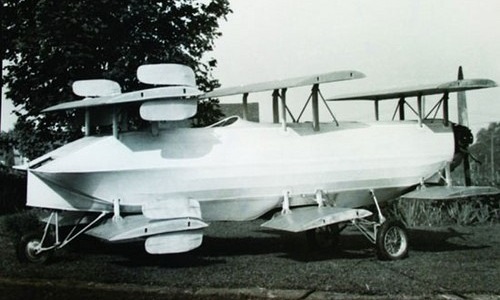
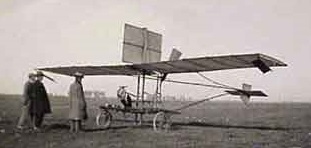
In 1934, electrician and hobbyist Frank Skroback built the first airplane that could be driven on a road. Or the first car that could be flown. It has six wings and an overall width of seven feet, so it can fit inside a lane. The plane was to be auctioned at Red Baron’s Antiques in Atlanta circa 2003.
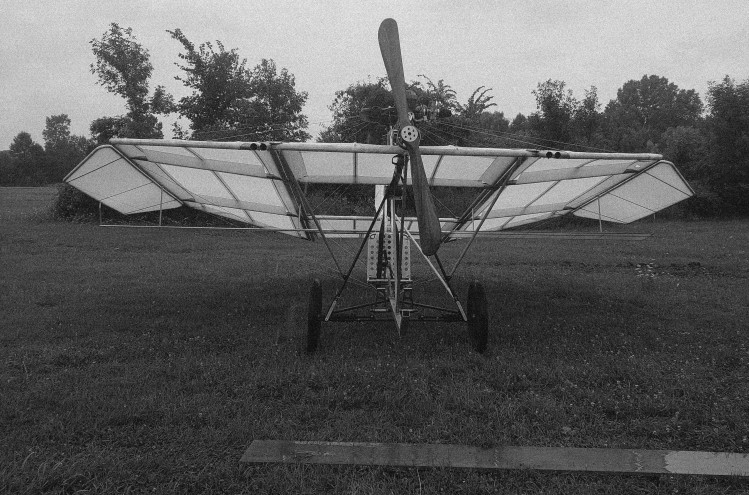
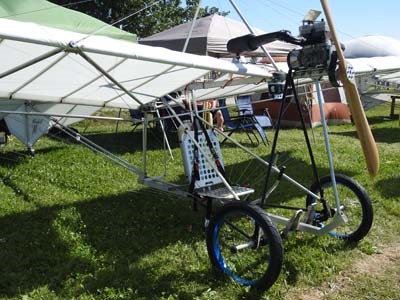
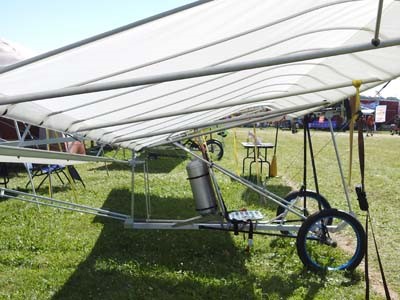
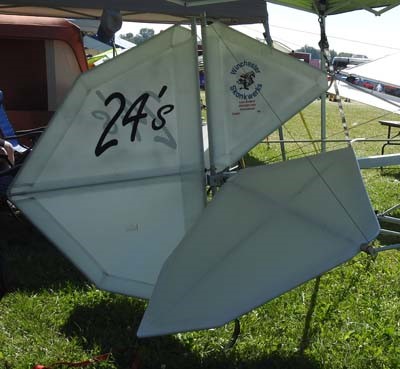
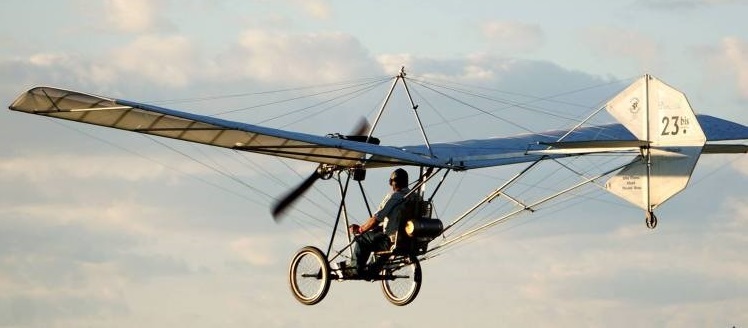
The 24 Bis (that’s what they call the example you see in the images) is a tribute to Alberto Santos Dumont.
The Winchester Skonkwerks Ultralight Research and Development Facility —shortened to Skonkwerks — represents a team from Larsen, Wisconsin. Skonkwerks honored Alberto by first building a 23 Bis and later the 24 Bis. The group describes itself as a “loosely knit organization of friends, flyers, and fanatics… tinkerers, builders, and bullsh###rs. We are engineers, designers, and dreamers hanging out in a little hangar screwing stuff together and making it fly.”
AirVenture Oshkosh 2017
Lee Fischer was the founder of this group of tinkerers that formed after he first showed a highly modified Robertson B1-RD. So much interest was shown in the Demoiselle style of aircraft that he decided to build a 23 Bis. At AirVenture 2015, his friend Mark Solper hinted that it would be “great project to build a pair of ‘evolved’ Demoiselles for a subsequent AirVenture.” This suggestion led to the 24 Bis.
Mark, Lee, and the whole merry band machined and welded the airframe and sewed Dacron wings, all the while learning both new skills and an appreciation for what Santos Dumont and his associates had done more than a hundred years earlier.
The aircraft was flown into Oshkosh.
AirVenture Oshkosh 2017
Weight — 240 pounds Wing Span — 32 feet Wing Area — 192 square feet Never Exceed Speed — 45-50 mph Stall Speed — 14-16 Engine — Rotax 447 Build Time — December 21, 2014 through June 21, 2015
The Winchester Skonkwerks Ultralight Research and Development Facility — let’s shorten that to Skonkwerks — represents a team from Larsen, Wisconsin. Skonkwerks honored Alberto Santos Dumont by first building a 23 Bis and later the 24 Bis. The group describes itself as a “loosely knit organization of friends, flyers, and fanatics… tinkerers, builders, and bullsh###rs. We are engineers, designers, and dreamers hanging out in a little hangar screwing stuff together and making it fly.”
Lee Fischer was the founder of this group of tinkerers that formed after he first showed a highly modified Robertson B1-RD. So much interest was shown in the Demoiselle style of aircraft that he decided to build a 23 Bis. At AirVenture 2015, his friend Mark Solper hinted that it would be “great project to build a pair of ‘evolved’ Demoiselles for a subsequent AirVenture.” This suggestion led to the 24 Bis
Weight: 240# Wing Span: 32′ Length: 19′ Wing Area @ Chord: 176 sq. ft. Wing Area @ Camber: 192 sq. ft. Wing Construction: Tube and Sewn Dacron
The original spelling is currently being used in Winchester Township Wi. Where a hanger was dubbed “The Skonkworks” by a neighbor in the early years. Used by a loosely knit informal organization of like-minded engineers/designers/tinkerers/builders/neighbors and fliers known as the “Lone Buzzerds” an ultralight club, operating out of the “Winchester Skonkworks” or sometimes “Squirrelworks” hanger in Larsen, Wi. To avoid copyright infringement “Kelly Johnson’s” serious looking “skunk” was changed to a comical, whimsical black and white squirrel looking mascot wearing a red crash helmet and giving a smiling “thumbs up.”
The designation “skunk works”, or “skunkworks”, is widely used in business, engineering, and technical fields to describe a group within an organization given a high degree of autonomy, unhampered by bureaucracy; tasked with working on advanced or secret projects. In this case the spelling “Skonkworks” but in most cases; “Skonkwerks” is being used in jest to project an aura of something outside of the norm being worked on, developed or flown; while staying in touch with meager roots. The term fits well within the ultralight community as there is no direct oversight by any government organization, in addition ultralighters generally operate at the bottom of the aviation financial food chain. Not unlike “Li’lAbner” making “moonshine” from an odd variety of items, or whatever they had on hand.
Present but not flown at the Los Angeles Aviation Meet at Dominguez in January 1910. This engine-less plane had unique “ailerons”, being like roller blinds controlled by a lever such that one increases in area as the other decreases. Charles Skoglund was active in the Aero Club of California.
Even before work on the Sk 257 began, Otto Kauba had begun work on a full-fledged fighter to have a 1,750 hp Daimler Benz DB-603 engine. Though it was in direct competition with the Focke-Wulf Ta 152, the RLM were not interested and it did not enter production.