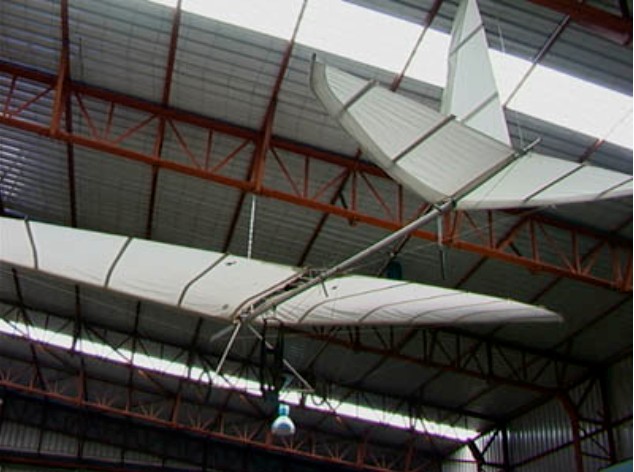
In 1974 Ron Wheeler developed the “Tweetie” hang glider. The Tweetie was almost exactly the same as the Scout only it did not have the engine, the tail plane was fixed and the pilot hung from the A-frame below the wing. Apart from being quite a successful hang glider the Tweetie allowed Ron to experiment and get experience with the Scout design.
Ron Wheeler was born in Melbourne in 1921. The son of a tradesman, he was educated at a local public school and later attended Collingwood Technical College and then Melbourne Technical College where he attained certificates in engineering pattern making and engineering drawing. His education was broken by WWII and he served in the army from 1940-46.
During the 1990s, Cameron strengthened its position, via a string of acquisitions. First, Cameron acquired its main British competitor Thunder & Colt Balloons. Then, it bought the smaller Sky Balloons, which had been formed by former Thunder & Colt employees after the company’s sale. Finally, Cameron.
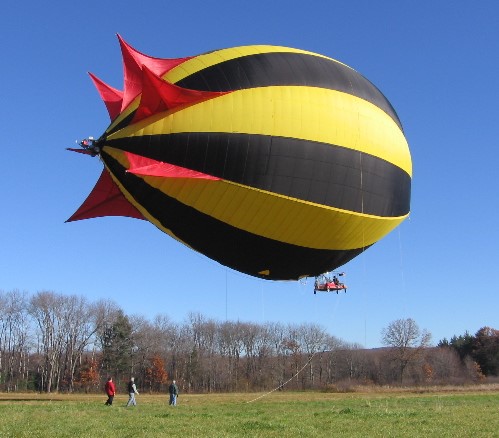
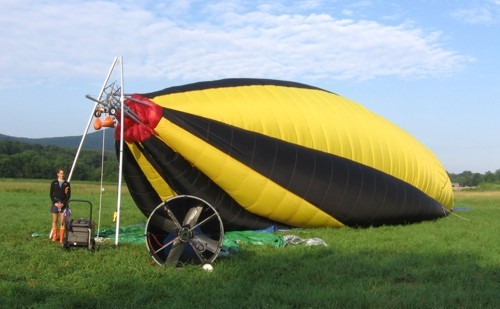
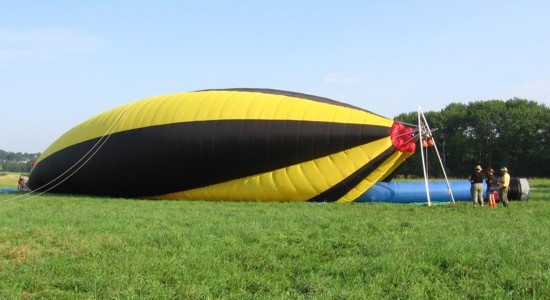
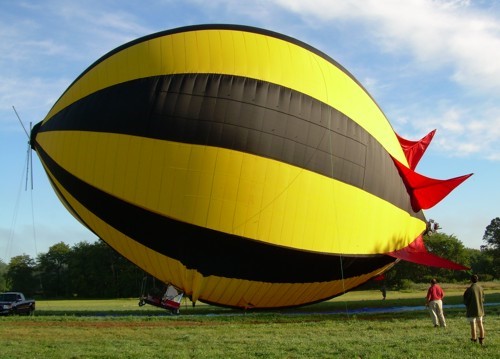
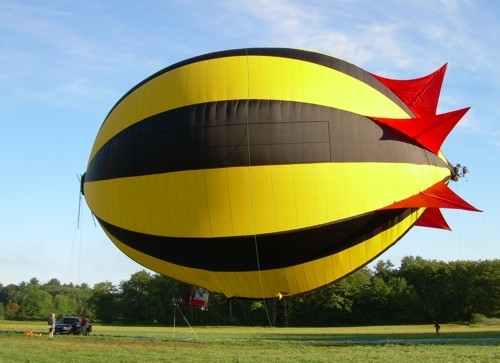
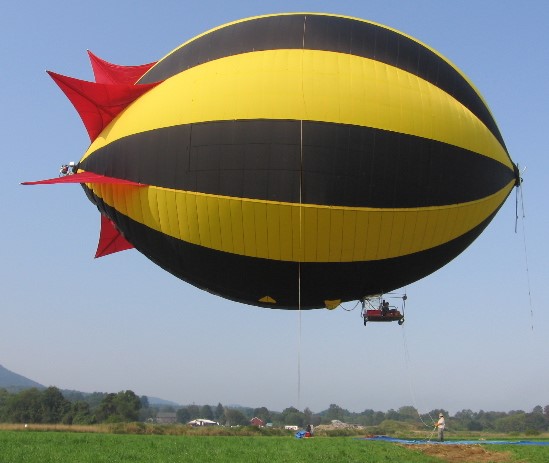
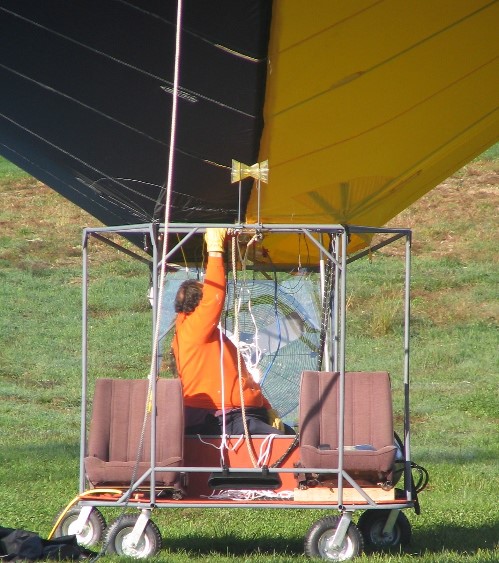
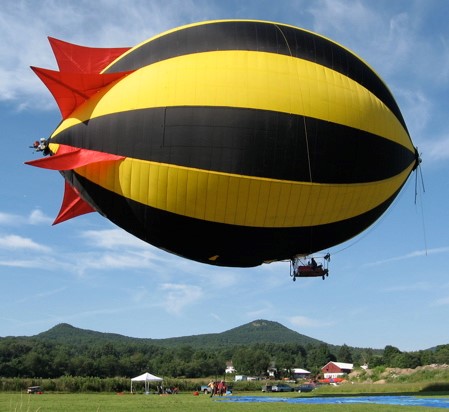
Since 2002 Skyacht Aircraft, Inc. has been developing Personal Blimp. The Personal Blimp uses hot air for lift and silent electric motors for propulsion. Initial flight tests are using a conventional gas-powered motor. Electric motors will be added once these initial tests are complete. Similarly, the initial flight tests are being made with conventional hot air balloon burners. Quiet burners were to be added later. The Personal Blimp flies “low, slow, and smooth.”
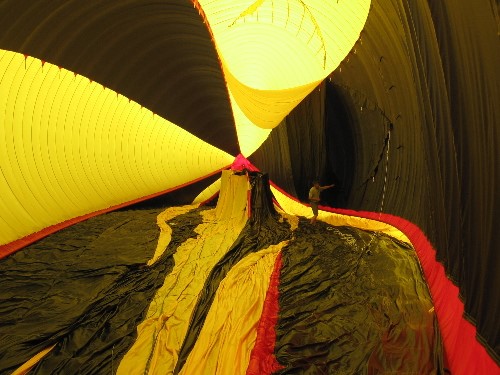
The Personal Blimp hull structure has three main components: 1) the fabric envelope, 2) a set of flexible ribs embedded within the fabric, and 3) a tensioning line that runs along the central axis of the hull.
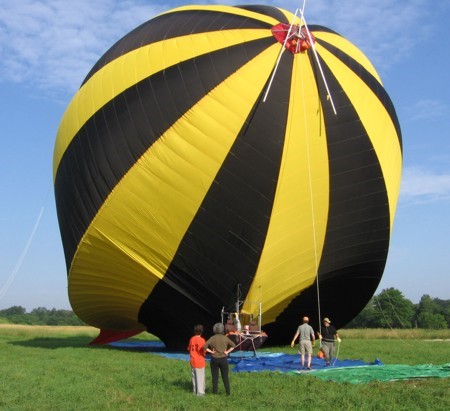
The hull is a “tension structure” wherein the ribs are under compression and the fabric and tensioning line are under opposing tension.
What is new and different about the Personal Blimp hull design is the ease with which one can create a lightweight, sturdy, self-supporting (no fans required) airship envelope.
The fabric of the envelope has several continuous, tubular sleeves sewn into it running from nose to tail. The ribs are inserted into the sleeves. The ends of the ribs are held together at each end. The tensioning line is then connected between the two ends and the whole contraption is inflated by pulling on the tensioning line. As the tensioning line is made shorter the ribs are forced to bend or “bow” outward. The envelope continues to expand until eventually the fabric is pulled taut.
Different shapes can be designed by varying the composition and/or cross section of ribs along their length. For instance, making the ribs more flexible towards the nose gives a blunter shape to the front of the ship. Relatively stiffer ribs can also be used to get a longer, skinnier shape.
When not in use, the Personal Blimp can be deflated and folded for storage. The combination of ready buoyancy control and rapid deflation eliminates not only hangars but also the large ground crews.
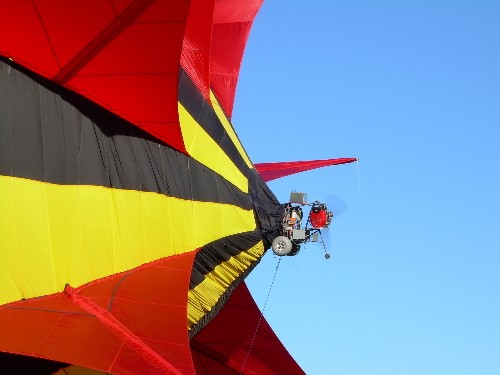
The Personal Blimp has a rigid, but folding, skeleton to allow the envelope to retain its shape without requiring internal air pressurization. Patent (USPTO #6,793,180) for this unique structural design in September of 2004. The Personal Blimp’s rigid but foldable structure provides hardpoints at strategic locations (e.g. on the tail) for mounting systems such as the engine and propeller. With the engine/propeller mounted on the tail, the Personal Blimp can use vectored thrust for steering. This provides far greater maneuverability.
Since its first flight on October 27, 2006, the Alberto has completed more than 50 hours of flight testing. Work focuses on both refining its systems and further expanding its capabilities.
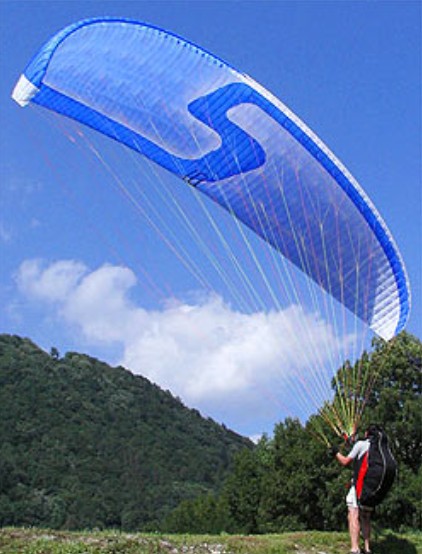
Developed in parallel to Sky’s competition model Eris, the Ares takes some of its aerodynamic and technical characteristics but at Sky say it is accessible to a much wider group of pilots. It is a high performance glider offering high stability and an “excellent” behavior in turn.
The Ares has an aspect ratio of 6, and a speed range from 25 to 55 k/h, with a trim speed of around 38 k/h.
According to the manufacturer, the Ares offers “straight glide (no rearing up and pitching) in smooth air AND while crossing turbulences for improved overall performance”, and it is efficient in weak thermals and steady in rough air.
It is glider aimed at XC, experienced pilots looking for “high performance, wide speed range and outstanding glide”. The Ares was available in 3 sizes.
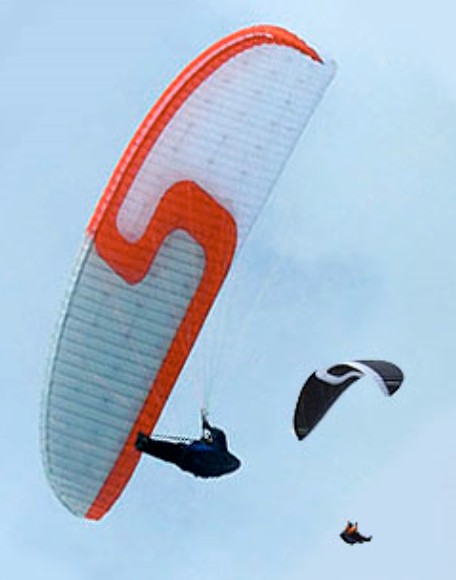
Four years after the first of the Brontes, the Czech manufacturer have a replacement for their most popular glider. Aimed at intermediate to advance pilots who love distance flying, the Brontes 2 offers “maximum passive safety that lets the pilots use the performance limits with no fear of trouble”, according to Sky.
The wing introduces a new profile, different shape and wingtips, a new more efficient speed system, lighter ribs concept (the glider is around 650 gr lighter than the old Brontes) and a leading edge that uses “new technologies”.
In the air, this sport glider is said to be very stable and easy to handle in thermals “and almost intuitive coring”, with a comfortable and precise handling. The Brontes 2 also offers improvements in the speed range, with a “remarkable” top speed and better glide performance. Like the first one, the Brontes 2 is suitable for paramotoring for high performance and competition pilots, as it is rated Afnor Performance. It was available in 4 sizes and 5 color schemes.