A further refinement of the A4 powered by a Renault 8 Fg engine.
Author: Terry
SPAD A.4
Louis Bechereau, chief designer, had been responsible for the exotic A2 and A4, which had a gunner placed in a nacelle hinged to the forward fuselage – ahead of the tractor propeller. This was mainly due to the reluctance of British and French authorities to back the development of an interrupter mechanism, enabling a machine-gun to be fired through the propeller arc. Needless to say, this arrangement was extremely unpopular with its crews. While the A2’s career with the French was cut short, the Russians were forced to retain it in service due to shortage of aircraft, and even acquired a further 10 A4s, a development of the A2.
SPAD A.2
Lotris Bdchereau, chief designer, had been responsible for the exotic A2 and A4, which had a gunner placed in a nacelle hinged to the forward fuselage – ahead of the tractor propeller. This was mainly due to the reluctance of British and French authorities to back the development of an interrupter mechanism, enabling a machine-gun to be fired through the propeller arc. Needless to say, this arrangement was extremely unpopular with its crews. Still, some 90 examples of the A2 were built, 42 for the Aviation Militaire (French Army Air Force) and 57 for the Imperial Russian Air Service. While the A2’s career with the French was cut short, the Russians were forced to retain it in service due to shortage of aircraft, and even acquired a further 10 A4s, a development of the A2.
SPAD / Societe Provisoire des Aeroplanes Deperdussin
Societe Provisoire des Aeroplanes Deperdussin
Societe Parisienne des Avions Deperdussin
Societe des Productions Armand Deperdussin
Societe Pour Aviation et ses Derivees
Silk merchant Armand Deperdussin (1867-1924) was associated from 1910 with a series of notable monoplanes. Built precursor in 1909 for show in a Paris store.
By 1914 monoplanes bearing Deperdussin name were used not only privately but by several military authorities. Designed by Louis Bechereau, these aircraft were especially noted for speed performances in 1912-1913, and in some instances for monocoque construction. Deperdussin, a great promoter, became involved in financial difficulties and in 1915 the company was declared bankrupt.
In 1913 Deperdussin was arrested for embezzlement and the company was taken over by Louis Bleriot and renamed Societe Pour I’Aviation et ses Derives in 1915, thus retaining these initials. Chief technician was at first Bechereau, later Andre Herbemont.
The Deperdussin name had links with several companies, including the British Deperdussin Company with which John Porte was connected. Initials SPAD were also ascribed to Societe Provisoire des Aeroplanes Deperdussin and Societe Parisienne des Avions Deperdussin, as well as Societe des Productions Armand Deperdussin.
Company became world famous for SPAD single-seat fighters and fast reconnaissance adaptations. More than 2,000 fighters built at Suresnes factory alone; great numbers under license in France and elsewhere. Classic tractor single-seat biplane flown late 1915 as SPAD V; developed into SPAD VII of 1916, thus establishing company’s name in aviation history. Characteristic design feature was two-bay wing cellule with special form of bracing. Combination with Hispano-Suiza 8-cylinder vee engine was major factor in success. SPAD XII had a 37 mm engine-mounted gun. From May 1917 improved two machine-gun type XIII replaced VII. Large numbers ordered by U.S. SPAD XX of late 1918 was two-seat fighter to Herbemont design and precursor of new Bleriot-SPAD line of single-strut monocoque-fuselage biplane fighters, built after Bleriot took over SPAD company in 1921 SPAD became Bleriot-SPAD.
Spacek SD-1 Minisport

A mostly wooden UL single seater. Ply cover over foam ribs on wood / carbon spar. Two piece wing, flaperons with mix mechanism, T Tail.
Non-aerobatic.
Plans, parts, and kits were available. 51 % quick build kit from Czech Republic. All fabricated metal pre-made and materials to complete supplied. 2009 Price: 7950 EURO
Kit cost with engine but no instruments NZ$28000.00 incl ballistic chute in 2013.
Engine: 36 HP 2 cyl 4 stroke
Reduction: geared belt 6000RPM about 4 /1
Span: ~6 m,
Length: ~4m
Empty Weight: 130 kg / 287 lbs
MTOW Weight: 240 kg / 529 lbs
Fuel capacity: 28 ltrs
Stall: 35 kt / 40 mph / 65 kmh
Cruise: 92 kt / 106 mph / 170 kmh
VNE: 110 kt / 126 mph / 203 kmh
Climb Rate: 400 ft/min / 2,5-4 m/s
Take-off distance (50ft obstacle): 820 ft / 250 m
Landing distance (50ft obstacle): 980 ft / 300 m
Spacek s.r.o.
Lesní 25
CZ-695 01 Hodonín
Czech Republic
Europe
Built the SD-1 Minisport LSA circa 2000
Sowers-Haugsted Sportplane
The 1935 Sowers-Haugsted Sportplane N14830 was a two-place open cockpit monoplane powered by a 45hp Anzani engine.
Sowers-Haugsted
Marcellus Sowers & C Haugsted
Nevada IA.
USA
Built the 1935 Sowers-Haugsted Sportplane.
Soviet Central Hydrofoil Design Bureau Volga-2

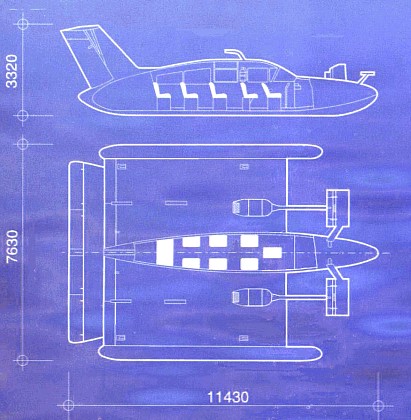
The Soviet Central Hydrofoil Design Bureau developed the eight-seat Volga-2 in 1985.
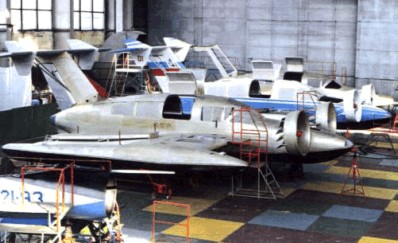

Engines: 2 x Toyota, 155 HP
Empty weight: 1950 kg
Weight full load: 2850 kg
Cruising speed: 120 km/h
Range: 400 km
Crew: 1
Capacity: 8
Soviet Central Hydrofoil Design Bureau KM / Caspian Sea Monster / Lun Class / Alexeyev Hydrofoil Design Bureau Lun Class
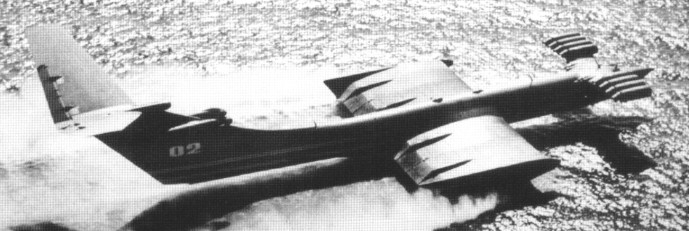
The Monster (its Russian designation was KM, derived from the words Korabl’ Maket or “ship model”) was nothing less than a juggernaut, one of the largest heavier-than-air flying machines ever built. At 500 tonnes it had a 100-tonne MAUW advantage over its fellow winged heavyweight the Boeing 747. No less than ten jet turbines constituted its propulsion system, an array of power used for take-off rather than cruise. Eight turbines were arranged in a shoulder-mounted stub-wing battery just aft of the cockpit. Capable of being deflected under the mainplane where a full-span trailing edge flap would trap their thrust, their combined power could generate an immense lifting force via a hovercraft-like static air cushion to cruise 4 metres above the water
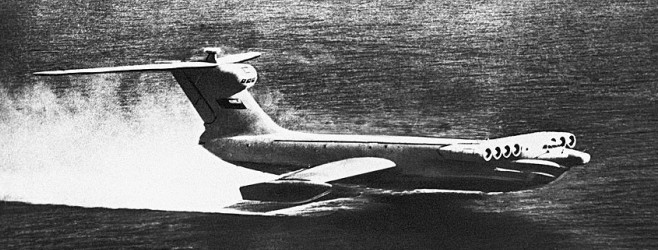
The Lun-class ground effect vehicle (GEV), or sea skimmer, was developed by Russian engineers at the Alexeyev Hydrofoil Design Bureau.
During the Cold War, ekranoplans were sighted for years on the Caspian Sea as huge, fast-moving objects. The name Caspian Sea Monster was given by U.S. intelligence operatives who had discovered the huge vehicle, which looked like an airplane with the outer halves of the wings removed. After the end of the Cold War, the “monster” was revealed to be one of several Russian military designs meant to fly only a few meters above water, saving energy and staying below enemy radar.
The KM, as the Caspian Sea Monster was known in the top secret Soviet military development program, was over 100 m long (330 ft), weighed 540 tonnes fully loaded, and could travel over 400 km/h (250 mi/h), mere meters above the surface of the water.
These craft were originally developed by the Soviet Union as very high-speed (several hundred km/hour) military transports, and were mostly based on the shores of the Caspian Sea and Black Sea. The largest could transport over 100 tonnes of cargo. The only three operational A-90 Orlyonok ekranoplans built (with renewed hull design) and one Lun-class ekranoplan remained at a naval base near Kaspiysk.
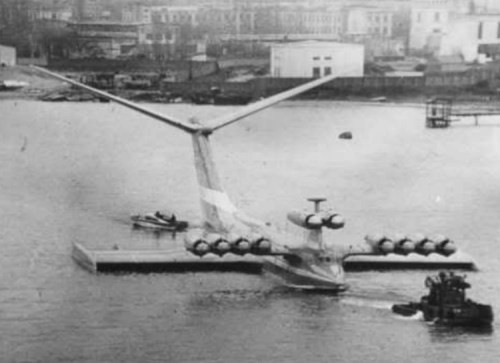
The Lun-class (“Harrier”) Ekranoplan MD-160, dubbed the “Caspian Sea Monster” by US Intelligence services, was one of a kind. It was capable of carrying up to 124 tonnes of troops and equipment, including as many as six nuclear missiles, at speeds up to 560km/h as far as 2000km. Eight Kuznetsov 128.9kN NK-87 turbofans mounted on the front cannards provided the thrust to get the seaplane’s hull up and out of the water and engage the ground effect.
While ground-effect vehicles are a highly efficient way to transport cargo over long distances, the MD-160 had significant drawbacks in its military applications. For one thing, manoeuvrability. Anything resembling a sharp turn was right out, and allowing a wing tip to even sniff the water could result in 500 tonnes of seaplane cartwheeling along the surface of the Caspian. And since the ground effect didn’t actually take effect until the plane was out of the water, the MD-160 had to always take off into the wind.
In 1987, the first flight was made by Lun, an ekranoplan-rocket carrier. It was armed with six guided anti-ship missiles “3M-80 Mosquito”.
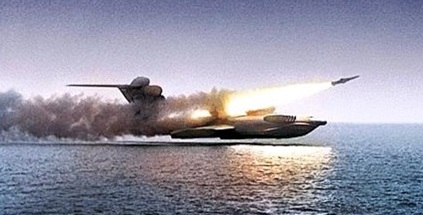
After the successful completion of state tests “Lun” was in 1990 transferred to trial operation. However, the collapse of the Soviet Union led to the cessation of work in this area and the disbanding of the 11th Air Group of the Black Sea Fleet E-Wing.
So while the MD-160 was thoroughly impervious to subsurface mines and torpedoes, its size and complete lack of manoeuvrability made the planes sitting ducks against Western air forces (hence its NATO designation: Duck), often requiring armed escort and forward scouting boats to avoid obstacles. The Ekranoplan carried anti-ship P-270 Moskit guided missiles in six pairs mounted onto its fuselage as well as a pair of 23mm Pl-23 cannons in a tail turret and forward-facing pair under the forward missile tubes.
Despite the the MD-160’s shortcomings, Soviet high command continued to move forward with the program right up until the Soviet Union fell. A second MD-160, destined to be a mobile field hospital, was 90 per cent complete and another 30 A-90 Orlyonok GEVs, meant to strengthen the Black Sea Fleet, were on order when the program’s funding was cut. The MD-160 currently resides at a naval station in Kaspiysk.

MAUW: 540 tonne
Engines: 10
Cruise: 300 kt

