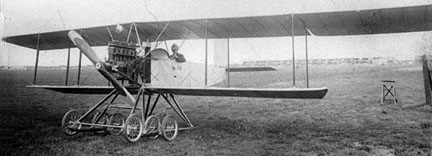
The Stupar 1914 Biplane 1 was Stupar’s first construction while employed by the Aero Works, this one for Hillery Beachy.
The single-place biplane was powered by a Hall-Scott engine, and also a Kirkham 4. A six-wheel undercarriage was fitted.
The Stupar 1914 Biplane 1 was Stupar’s first construction while employed by the Aero Works, this one for Hillery Beachy.
The single-place biplane was powered by a Hall-Scott engine, and also a Kirkham 4. A six-wheel undercarriage was fitted.
Maximillian Stupar was born on Sept. 23, 1885 in Metlika, Slovenia, where he learned the delights of flying kites. Even after his parents uprooted Max from the empire of the Hapsburgs to South Chicago, that joy never left him. He followd the exploits of Octave Chanute, another transplanted European (from France) who had found a home in Chicago and had developed an interest in kites.
Max was inspired by Chanute’s building on the landmark glider experiments of Otto Lilienthal, a German, to write Progress in Flying Machies (1894). This book was the bible of aeronautics. Max’s book, some glider experiments he attempted in the dunes of Indiana, Miller Beach, during 1896, and in Dune park during 1897, provided the design for the Wright brothers’ first airplane.
But while Chanute and the Wright brothers were becoming aeronautical icons, Max managed to elude celebrity. In 1902, as the Wright brothers also experimented with gliders, Max began his own experiments. Instead of taking off from the dunes of Kitty Hawk, Max leaped from the tops of houses, barns, low hills, and slopes of South Chicago.
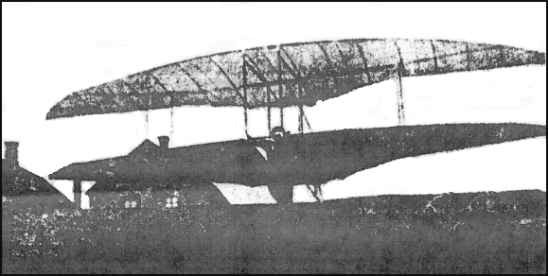
His gliders sometimes reached the awe-inspiring altitude of 300 feet. Some neighbors demanded the kid be given a saliva test. Then, like Octave Chanute, Max moved his experiments to the sands of Dune park, which led in 1908, to his construction of his first airplane. The plane cracked up before Max could test it properly.
Undeterred, Max patterned a plane after the one Louis Bleriot had used to fly the English Channel. He made a test flight to Milwaukee, lifting the hydroplane from the waters of Sandy Beach at 95th and the Big Lake the following year. That plane also had a short life, ignominiously plowing into Chicago’s first airfield, Cicero Field at 22nd and Cicero.
In 1910, he opened the Stupar Aero Works in South Chicago, then sold it in 1912 to the Chicago Aero Works for a one-third ownership, and a position as chief engineer. Between 1912 and 1916, Chicago Aero built 30 airplanes and introduced the Stupar Tractor Biplane, the first biplane to use an enclosed fuselage and tractor propellor.
With a glowing resume that proclaimed Max an aviation pioneer, he left South Chicago, in 1916, to join the Standard Airport Corporation in New Jersey.
With America’s entry into World War I Max returned to Chicago as a member of the inspection service for the new U.S. Air Service, and then went to Buffalo, and finally Washington, D.C., as assistant chief of wood inspection for airplane construction.
Throughout the war, and until 1922, airplanes were made almost exclusively of wood, the so-called “stick and wire” construction. Max knew more about that than just about anybody, having worked closely with several South Chicago lumber firms. He also authored a book entitled “Wood Technology,” as he drifted farther away from the cockpit.
After the war, Max became an engineer with the G. Elias and Brothers Lumber Co., which was just getting into aircraft design. In 1927 joined Curtiss Airplane. He stayed with Curtiss until 1939, as chief of the estimations department, in which post he originated the definitive advanced system of airplane cost estimating.
When war started again in Europe during 1939, not only did Max help develop the modern method of assembly-line airplane construction, he became liason between the government and the aircraft industry, flying all over the country in the process.
On Nov. 27, 1941, near the Dayton field named of the Wright Brothers, Max fell to the earth for the last time.
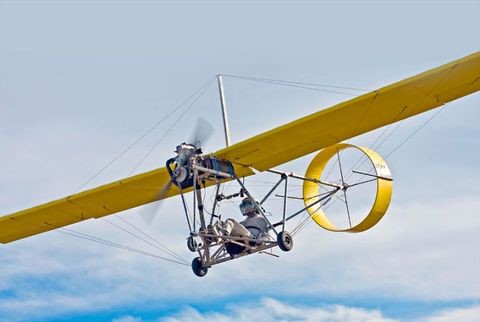
Mark Stull built Lucky Stars with a 4.5-foot-diameter ring tail. It took some clever engineering and some hair-raising test flights to make it work. Stull added a hydraulic damper to ensure that the tail didn’t swing too far to the side, and balanced the tail by adding weights to the ring. He then moved the seat forward to maintain the craft’s centre of gravity.
Christoval
Texas
USA
Built the Stull Lucky Stars light sport aircraft.
A two-seat amphibious flying-boat (first flown 1994). Re-winged S-302.
A two-seat open ultralight floatplane (optional wheels or skis).
A single-seat composites lightplane.
Russia
Founded 1955 at Samara State Aerospace University. Aircraft are A-16 single-seat composites lightplane, Che-15 two-seat open ultralight floatplane (optional wheels or skis), and S-202 two-seat amphibious flying-boat (first flown 1994). Re-winged S-302 and four-seat S-400 projected.
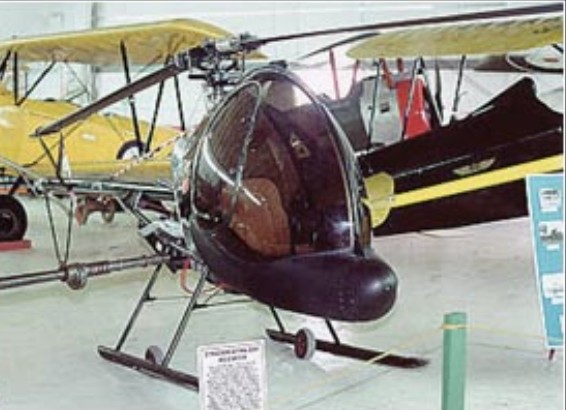
The Struchen (strew-shen) single seat ultralight helicopter was designed and built by Fred Struchen of North Vancouver. He used a combination of helicopter, motorcycle, automobile and hardware store components that were modified as required.
The powerplant is a Honda Civic engine, cooled by a motorcycle radiator. The drive belt came from a Harley Davidson, while the transmission is from a Yamaha and the canopy is created from a residential skylight. Numerous precision parts were machined or modified by the builder.
The Struchen is complete and fully operational, but it is believed that it was never registered or flown by the builder, although it has done low-altitude “hover” tests.
This aircraft was donated to a Canadian museum by its builder in 1996.
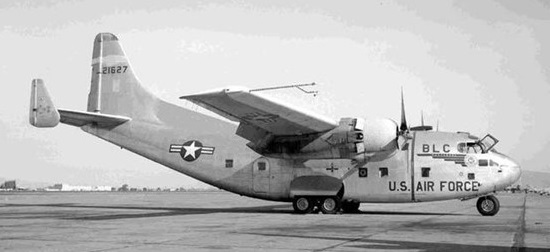
The Stroukoff YC-134, designed in 1956, was based heavily on the Fairchild C-123 Provider. The United States military contracted with Stroukoff Aircraft Corporation to develop an improved version of the aircraft, combining features that the company had developed for the YC-123D and YC-123E.
The product of a US Air Force contract in 1956, a single C-123B from the -CN production block (serial 52-1627) was modified by Stroukoff Aircraft to become the YC-134. This aircraft was heavily modified with the following new features:
New Engines: The YC-134 was equipped with two 3,500 hp (2,600 kW) Wright Turbo Compound R3350-89A radial engines, turning four-blade, thirteen foot Aeroproducts constant-speed fully feathering propellers.
A new thickened wing. In the root of the wing they installed two turbocompressors with 400 hp each
Improved Control Surfaces: The YC-134’s horizontal stabilizers were given endplates to improve directional stability.
Improved landing gear: While the nosewheel from the C-123B was retained, both main gears were given a third wheel to improve weight distribution.
Fuel was no longer housed in the rear of the engine nacelles, but in an expanded center-wing fuel tank. In addition, two plumbed hardpoints for 550-gallon drop tanks were also added to each wing.

Stroukoff’s BLC and Pantobase: the YC-134 was fitted with Stroukoff’s own BLC and all three aircraft had they been delivered were to have been fitted with the Pantobase equipment designed for the YC-123E.
The features gave an empty weight increase over the C-123B from 31,058 lb (14,088 kg) to 37,965 lb (17,221 kg), and a maximum loaded weight increase from 60,000 lb (27,000 kg) to 74,700 lb (33,900 kg). The aircraft’s cruising speed was 219 mph (352 km/h), compared to the C-123B’s 190 mph (310 km/h), and the YC-134 had a 1,600-mile (2,600 km) range with a 24,000 lb (11,000 kg) payload. The BLC allowed the YC-134’s take-off distance to decrease from 1,850 feet (560 m) to 750 feet (230 m), very similar to that of the YC-123D.
The aircraft for the first time rose into air on 19 December, 1956, on the tests were obtained good results, and servicemen ordered two additional machines. On them they installed the modernized boundary-layer control system with one more powerful compressor and “pantobase”. The YC-134 gained the designation “Pantobase” after hydro-skis were added. The YC-134 demonstrated following: takeoff on the earth – 244 m, on the snow and the water – 458 m; path on the earth – 320 m, on the snow – 305 m, on the water – 228 m. In the beginning of 1958 all three YC-134 were transferred to the Air Force.
One conversion to a YC-134 (YC-123D) was made in 1956 (53-8068), powered by two 3500hp Wright R-3350, with similar dimensions to the Fairchild C-123B. Fitted with a boundary layer control system, tailplane endplates, and tandem mainwheels.
The 1958 YC-134A had a sealed and strengthened fuselage and “Pantobase” multi-purpose landing gear fitted with land/water skis and wingtip floats. Began as Chase C-123B 52-1627 rebuild then was modified by Fairchild as YC-123B with wingtip J44 jets, and later reputedly converted by Stroukoff as YC-134A “Pantobase” with R-3350-89A engines and boundary layer control.
The U.S. Air Force, however, deemed that the YC-134 did not offer substantial improvement over the C-123, nor did it have a requirement for a piston-engined amphibious assault transport, and decided to purchase the Lockheed C-130 Hercules.
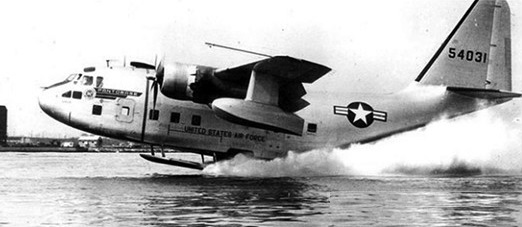
YC-134-SA
Engine: 2 × Wright R-3350-89A, 3,500 hp
Payload: 24,000 lb
Empty weight: 37,965 lb (17,221 kg)
Max. takeoff weight: 74,700 (33,900 kg)
Cruise speed: 219 mph (352 km/h)
Range: 1,600 miles (2,600 km) with 24,000 lb (11,000 kg) payload
Take-off distance: 750 feet (230 m)

