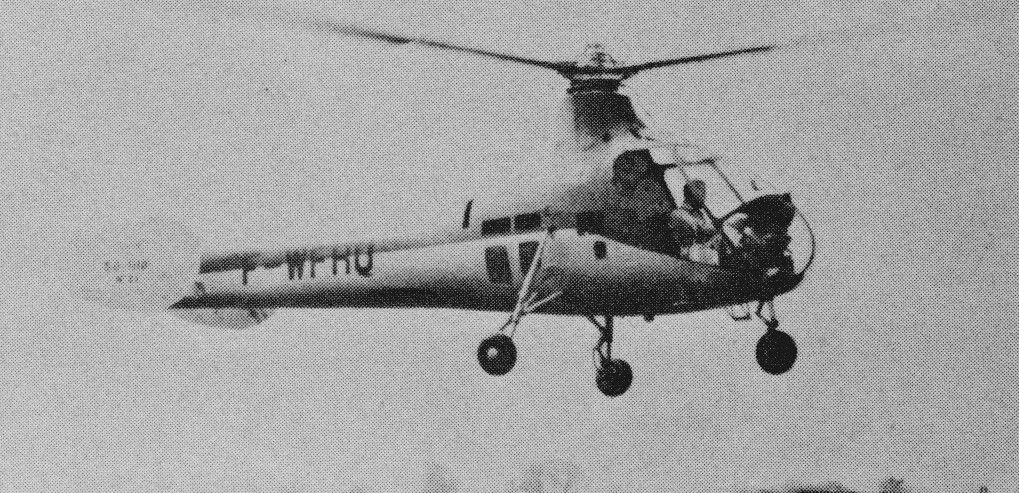
The 1948 experimental Ariel helicopters used tip jets at the blade tips.
The SO.1221 was powered by a cold-jet propulsion system developed by Sud-Ouest for its earlier two prototypes Ariel II and III helicopters. Residual thrust from the engine is ducted to the end of the fuselage and used for directional control.
Engine: 275 h.p. Turbomeca Arrius gas-turbine Rotor diameter: 35 ft 5 in Rotors: 3-blade tip-powered main rotor. Fuselage length: 27 ft 2 in Loaded weight: 2,750 lb Ceiling: 15,000 ft Typical range: 155 miles at 85 mph with 1,000 lb load Seats: 2-3
The 1949 Sud-Ouest SO-1119 Ariel II was the first French reaction jet helicopter to fly. Rotor tip jets were fed by an exhaust-driven compressor driven by a 190-hp Mathis C-40 located in the fuselage.
The SO-1119 Ariel II is at the French Musee de L’Air.
Engine: Mathis C-40, 190 hp Rotor diameter: 35,42 ft Fuselage length: 23.39 ft Max speed: 102 mph ROC: 1082 fpm
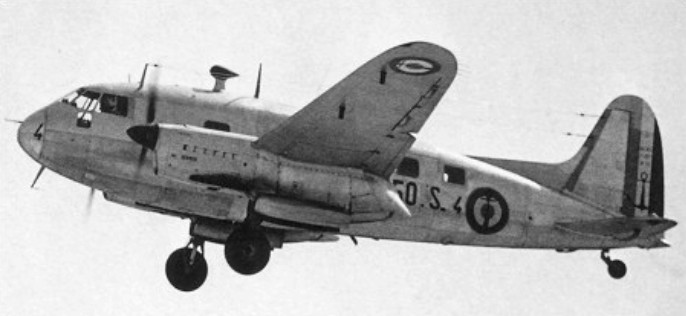
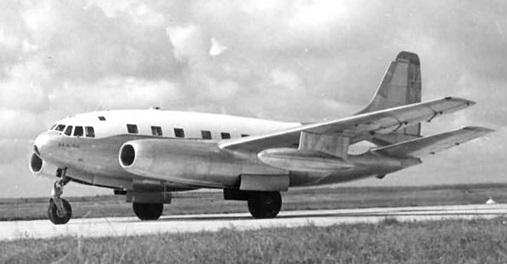
The SO.95 Corse II was a light twin-engined transport, the prototype flying on 17 July 1947. The type was originally fitted with a tailwheel undercarriage, which was retained in the civil version, but the military variant featured a tricycle landing gear. The Corse II was used almost exclusively by the light transport units of the French Naval Air Arm; only two saw regular airline service, operating with Air Services of India between Bombay, Bangalore and Delhi before being withdrawn in 1950.
Engine: 2 x 580hp Renault 12S-02-201 V-12 Max take-off weight: 5600 kg / 12346 lb Wingspan: 18.00 m / 59 ft 1 in Length: 12.32 m / 40 ft 5 in Height: 4.30 m / 14 ft 1 in Max. speed: 330 km/h / 205 mph Ceiling: 7000 m / 22950 ft Range: 1300 km / 808 miles Crew: 2 Passengers: 10-13
Early in 1941, the Groupe Technique de Cannes initiated the design development of a twin-engined pressurised 23-passenger transport, the SO 30N Bellatrix. Prototype construction was complete by November 1942, but the Italo-German Armistice Commission would not permit flight testing. When, a year later, the line of demarcation between occupied and unoccupied zones of France was abolished, the Bellatrix prototype was hurriedly dismantled and the components distributed in farm outbuildings and barns in the vicinity of Draguignan. After the liberation of the area, the components were recovered and returned to the factory where the aircraft was reassembled and, registered F-BALY, flown for the first time on 26 February 1945. In the meantime, design development had been continuing and a 30-passenger version evolved, this, the SO 30R having 1,650 hp Gnome-Rhóne 14R engines in place of the 1,180 hp G-R14Ns and wing area increased from 775 sq ft (72,00 sq.m) to 88264 sq ft (82,00 sq.m). Two prototypes of this version were built, the SO 30R-01 (F-WAYA) with a single fin-and-rudder assembly and which flew on 6 November 1945, and the SO 30R-02 (F-WAYB) with twin fins and rudders.
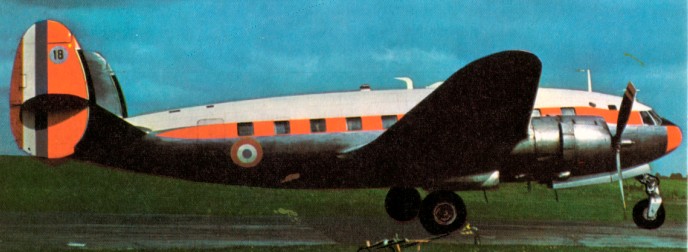
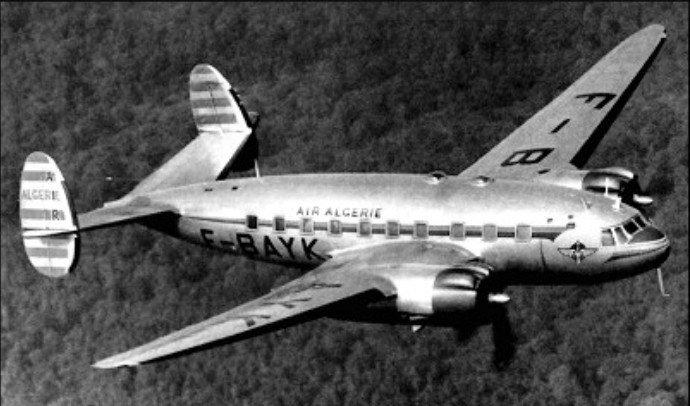
Various changes were subsequently in¬corporated in the design in order to conform with ICAO requirements and Air France recommendations, and the design was still further scaled-up, and a production prototype powered by 1,620 hp Pratt & Whitney R-2800-B43 engines and designated SO 30P Bretagne was flown on 11 December 1947. Production was initiated, and with the 10th aircraft (F-WAYL), flown in September 1949, the -B43 engines gave place to R-2800-CA18s rated at 1,800 hp and developing 2,435 hp with water injection. Internal layouts provided accommodation for 30 or 37 passengers, and the 12th production aircraft (F-WAYO) was later converted as the all-cargo SO 30C with under-fuselage loading doors, trials with this variant commencing on 6 January 1950. Forty-five SO 30P Bretagnes were built, of which 19 went to the Aéronavale and others subsequently to the Armée de lAir. The 24th production example was delivered as a personal transport for the then President of France, eight were used by Air Algêrie, 12 by Air Atlas-Air Maroc (and its successor, Air Maroc), six by Aigle Azur and at least seven by Société des Transports Aèriens de l’Extréme Orient (COSARA).
The SO 30R-02 was eventually modified as a test-bed for Hispano-Suiza-built Rolls–Royce 101 Nene turbojets, this being fitted with a new single fin-and-rudder tail assembly and flown in this form on 15 March 1951, and the second SO 30P (F-WAYD) underwent similar modification for use as a test-bed for the SNECMA Atar 101.
SO 30P Bretagne Engines: 2 x 1620hp Pratt & Whitney R-2800-B43 Double Wasp 14-cylinder radial Max take-off weight: 18900 kg / 41668 lb Wingspan: 26.89 m / 88 ft 3 in Length: 18.95 m / 62 ft 2 in Height: 5.89 m / 19 ft 4 in Max. speed: 416 km/h / 258 mph Ceiling: 6500 m / 21350 ft Range: 1500 km / 932 miles Crew: 2 Passengers: 30-37
SO 30P Engines: 2 x R-2800-CA18 Double Wasp, 1620 hp Empty equipped weight: 29,762 lb (13 500 kg) Loaded weight: 42,990 lb (19 500 kg) Maximum speed: 303 mph (488 km/h) at 18,045 ft (5 500 m) Cruise: 272 mph (438 km/h) at 17,390 ft (5 300 m) Ranges with full reserves: 850 mls (1370 km) with a 7,275-lb (3 300-kg) payload Ranges with full reserves: 310 mls (500 km) with 9,259-lb (4200-kg) payload Wing span: 88 ft 3 in (26,90 m) Length: 62 ft 2in (18,95 m) Wing area: 925.69 sq ft (86,00sq.m) Pax cap: 35
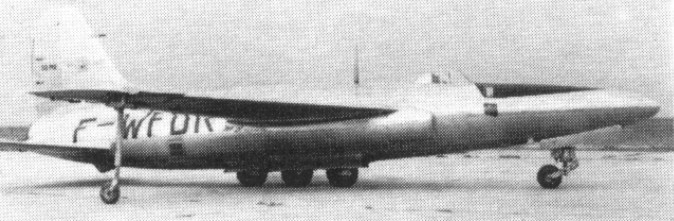
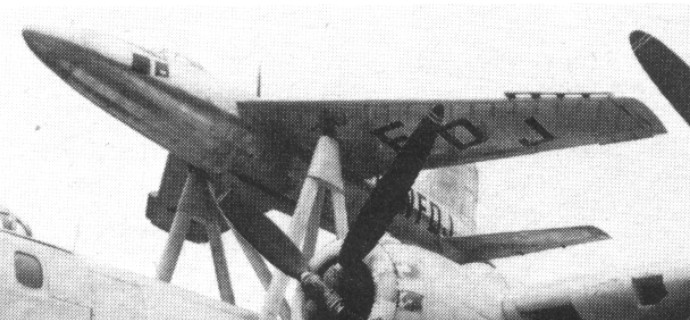
The half-scale model predecessors of the SO 4000 were the SO M.1 glider (F-WFDJ) and the powered SO M.2 (F-WFDK), these featuring a laminar flow wing swept 31 deg at the mainspar, mounted in the high-mid position and combining small ailerons interconnected with spoilers and leading-edge slats. The undercarriage consisted of a retractable central skid with wingtip stabilising skids in the case of the M.1, while that of the M.2 comprised a nosewheel, three main-wheels in train and wingtip outrigger wheels.
The powered M.2 had entered flight test five months earlier than the M.1, on 13 April 1949, when it was flown for the first time at Orléans-Bricy with Jacques Guignard at the controls. The M.2 was powered but was in most other respects, similar to the M. 1.
During its seventh flight in May 1950, with Daniel Rastel at the controls, the M.2 exceeded 621 mph (1 000 km/h) in a shallow dive. For the second phase of its flight test programme, commencing in October 1951, the M.2 was fitted with a modified control system, a revised undercarriage retraction system, provision for the installation of powder rockets to augment thrust at high altitude and wingtip fuel tanks. Empty and loaded weights being raised to 9,369 lb (4 250 kg) and 11,905 lb (5400kg).
Engine: Rolls-Royce Derwent V turbojet, 3,000 lb st (1360 kgp) Span: 3l ft 2 in (9,50m) Length of 32 ft 5.75 in (9,90 m) Wing area: 193.76 sq ft (18,00 sq.m) Empty wt: 8,466 lb (3 840 kg) Loaded wt: 10,362 lb (4 700 kg)
The half-scale model predecessors of the SO 4000 were the SO M.1 glider (F-WFDJ) and the powered SO M.2 (F-WFDK), these featuring a laminar flow wing swept 31 deg at the mainspar, mounted in the high-mid position and combining small ailerons interconnected with spoilers and leading-edge slats. The undercarriage consisted of a retractable central skid with wingtip stabilising skids in the case of the M.1, while that of the M.2 comprised a nosewheel, three main-wheels in train and wingtip outrigger wheels.
After trials attached to a rig mounted above the Heinkel He 274, the M.1 was tested in free flight for the first time on 26 September 1949 after being launched from an SE 161 Languedoc.
France Formed 1935 at Bordeaux-Merignac by the Potez group when it took over the Societe Aerienne Bordelaise. Was intended as a decentralized production source for Potez and Bloch aircraft. A prime responsibility was development and production of Bloch types, especially single-seat fighters derived from MB.150 of 1936. Redesign facilitated production and improved performance, resulting in MB.151 and 152. By June 1940 production totaled about 600, involving five plants. MB.175 twin-engined bomber was in production and was revived after Second World War as torpedo aircraft. Several other prototypes built, including four-engined bomber.
In France, the Socialist Government of the so called Popular Front brought all the companies building military aircraft, aero engines and ar¬mament under its control in 1936. The im¬mediate result was the socialized oblivion of such established companies as Marcel Bloch, Bleriot, Nieuport, Potex, Dewoitine, Hanriot and Farman within half a dozen nationalized groups or Societies Nationales, named ac¬cording to their geographical location (Nord, Ouest, Centre, Midi and so on).
Incorporated in SNCASO 1936, incorporating the factories of Marcel Bloch, Bleriot and Liore et Olivier, subsequently merging with SNCASO and changing name to Ouest Aviation in 1956.
In 1942 completed forerunner of Bretagne twin-engined transport, though not flown until 1945; then used commercially and experimentally. Numerous and varied post-Second World War types included distinctly unusual forms of rotary-wing aircraft. Aeriel (1948) and Djinn (1953) with tip jets, and Farfadet convertiplane (1953).
Aerocentre went into liquidation during 1949, its plants and work being shared by SNCAN (Nord), SNCASO (Sud-Ouest) and engine form SNECMA.
Original designs included S.O.94R twin-engined trainer; S.O.95 Corse, and S.O.30 Bretagne military transports; S.O.4050 Vautour twin-jet bomber; and the S.O.9000 Trident. The S.O.1221 Djinn two-seat helicopter was produced, and Vertol H-21 helicopters were manufactured under license for the French Army. Ouest became part of Aerospatiale.
After World War II, although four of the nationalized groups continued operating un¬der state control, private companies were al¬lowed to resume the design and manufacture of both civil and military aircraft. Some of the pioneering names of French aviation, such as Breguet and Morane Saulnier, returned to prominence, and by 1950 a new one had been added Avions Marcel Dassault.
Loire-Nieuport joined SNCASO in 1942.
SNCASO and SNCASE joined to form Sud-Aviation in 1958.
The Alouette II is a turbine development of the earlier SE-3120 Alouette with 200 h.p. Salmson 9 NH piston engine. A small pre-production batch was under construction, with the first five due for delivery late 1955.
Engine: Turbomeca Artouste II turbine, 360 hp Rotors: 3-blade main; 2-blade tail Rotor diameter: 38 ft Loaded weight: 2,980 lb Ceiling: 14,764 ft Typical range: 323 miles at 106 mph Seats: 5
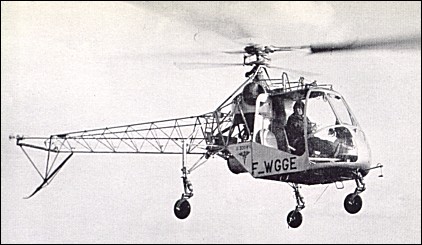
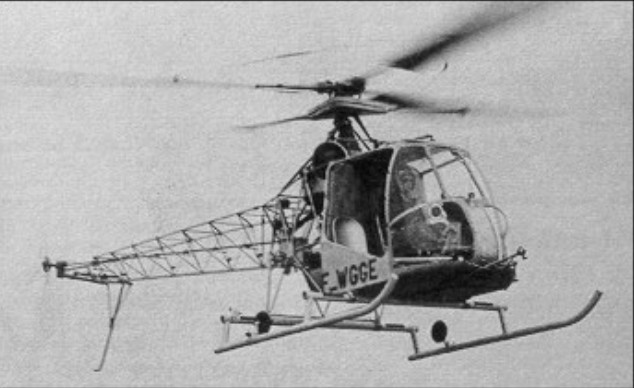
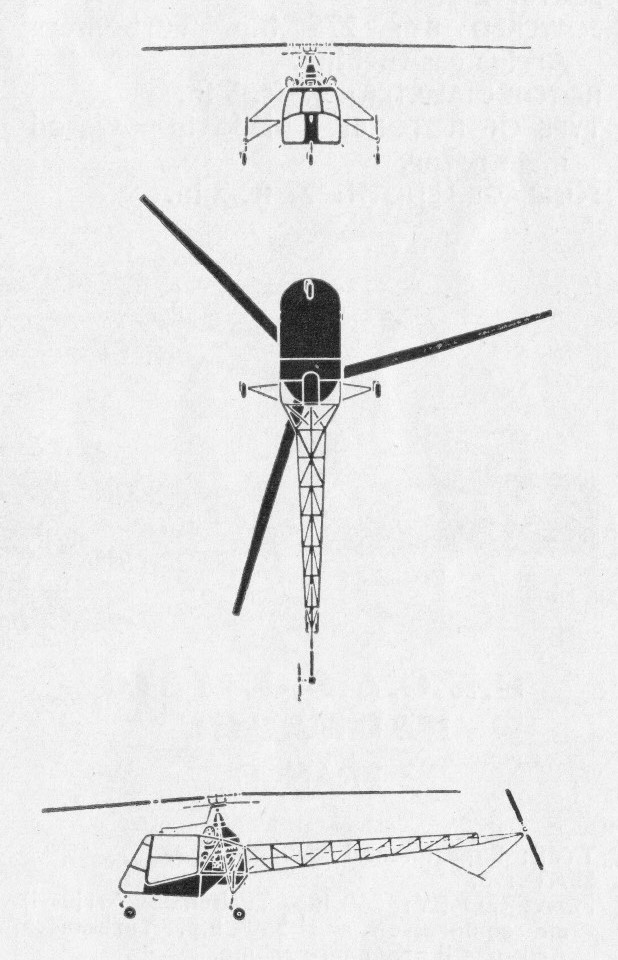
The Sud-Est SE 3120 Alouette (Lark) a three seat light helicopter was designed mainly for agricultural purposes. The first of two prototypes (F-WGGD and -WGGE) was flown on 31 July 1952, powered by a 149kW Salmson 9NH radial engine with an articulated three-blade rotor. Its rotor has three degrees of freedom: pitch, in-plane motion and vertical flapping. Pitch is controlled by means of a stabilizing gyroscope.
In July 1953, established a new international helicopter closed-circuit duration record of 13 hours 56 minutes. Two other prototypes followed, one of which was a three-seater.
It was the first of the successful Alouette family of helicopters.
The basic airframe of the Sud-Est SE-3120 Alouette was completely redesigned to take the 269kW Turbomeca Artouste II turboshaft, and the first of two prototypes, designated SE 3130, was flown on 12 March 1955.
Sud-Est SE.3120 Engine: 1 x Salmson 9NH, 150kW Main rotor diameter: 11.60m Length: 10.45m Max take-off weight: 1150kg Empty weight: 750kg Max speed: 125km/h Service ceiling: 4000m Range: 225km