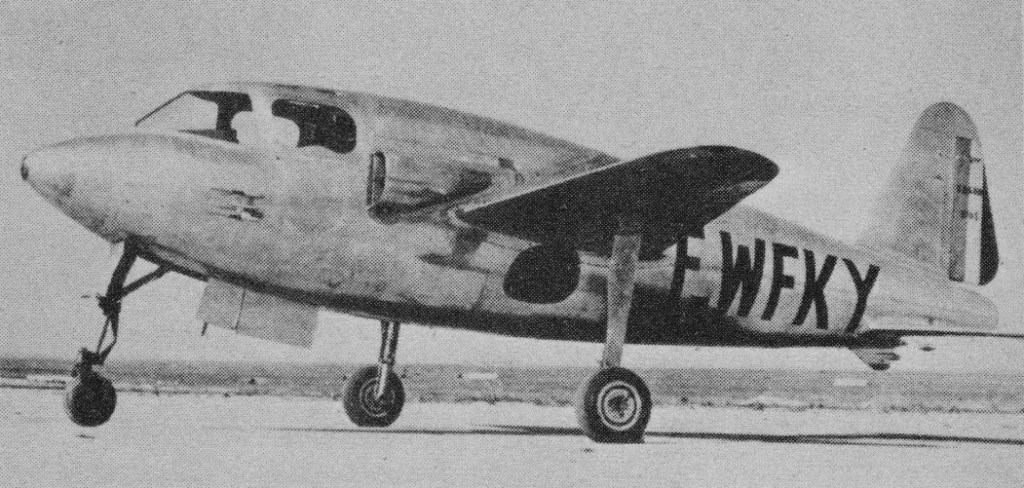
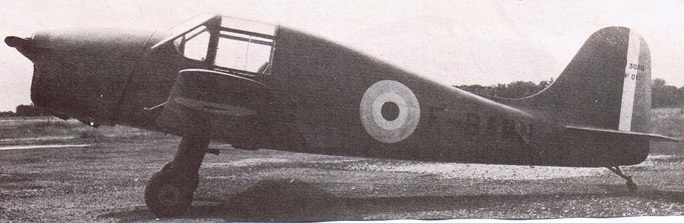
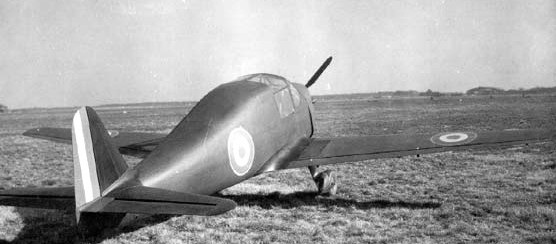
The Sud Ouest SO 6000 Triton, first flying on 11 November 1946, was the first French jet powered aircraft to fly. Five were built. The first was powered by a 1980 lb thrust Junkers Jumo 004-B2 with a nose intake. Later versions had a 4850 lb thrust H-S Nene with both nose and fuselage scoops.
They were used as test beds and side-by-side trainers.
The third built, SO-6000-03, is at the French Musee de L’Air.
Engine: Rolls Royce Nene 101, 21582 N Length: 34.121 ft / 10.4 m Wingspan: 32.644 ft / 9.95 m Wing area: 162.536 sq.ft / 15.1 sq.m Max take off weight: 10363.5 lb / 4700.0 kg Weight empty: 7056.0 lb / 3200.0 kg Max. speed: 513 kt / 950 km/h Cruising speed: 462 kt / 855 km/h Initial climb rate: 9842.52 ft/min / 50.0 m/s Service ceiling: 39370 ft / 12000 m Wing load: 63.76 lb/sq.ft / 311.0 kg/sq.m Crew: 2
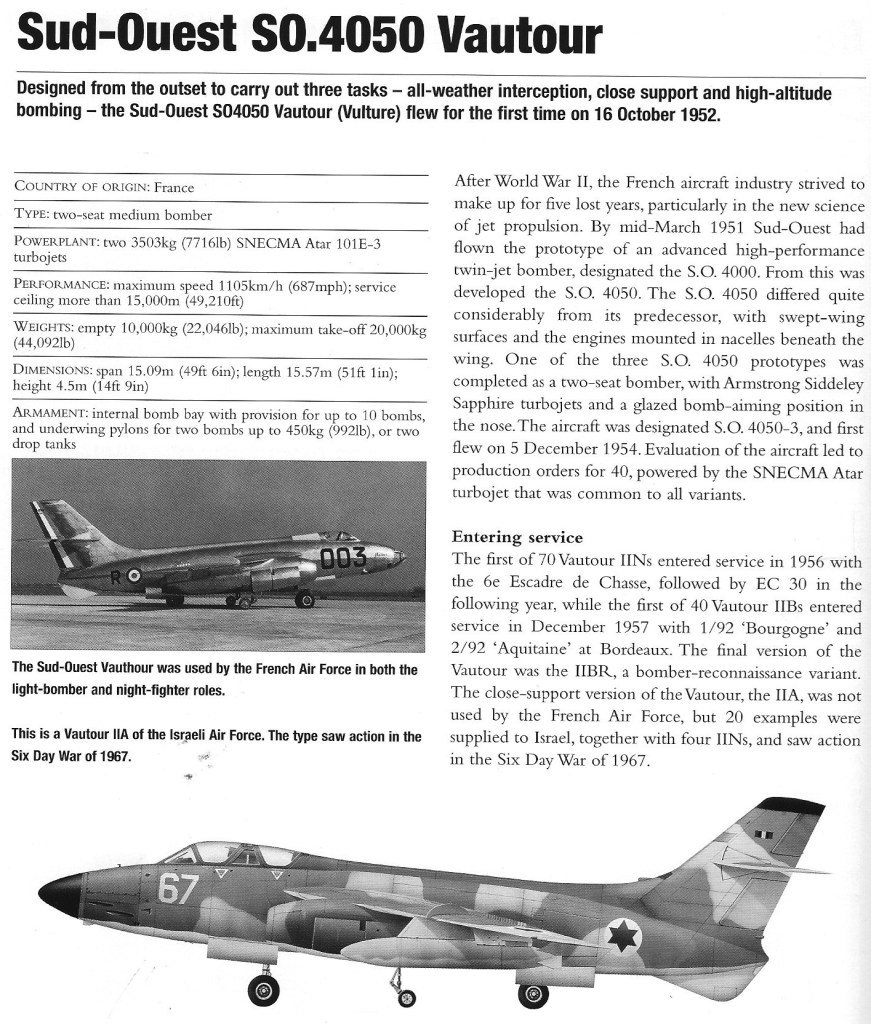
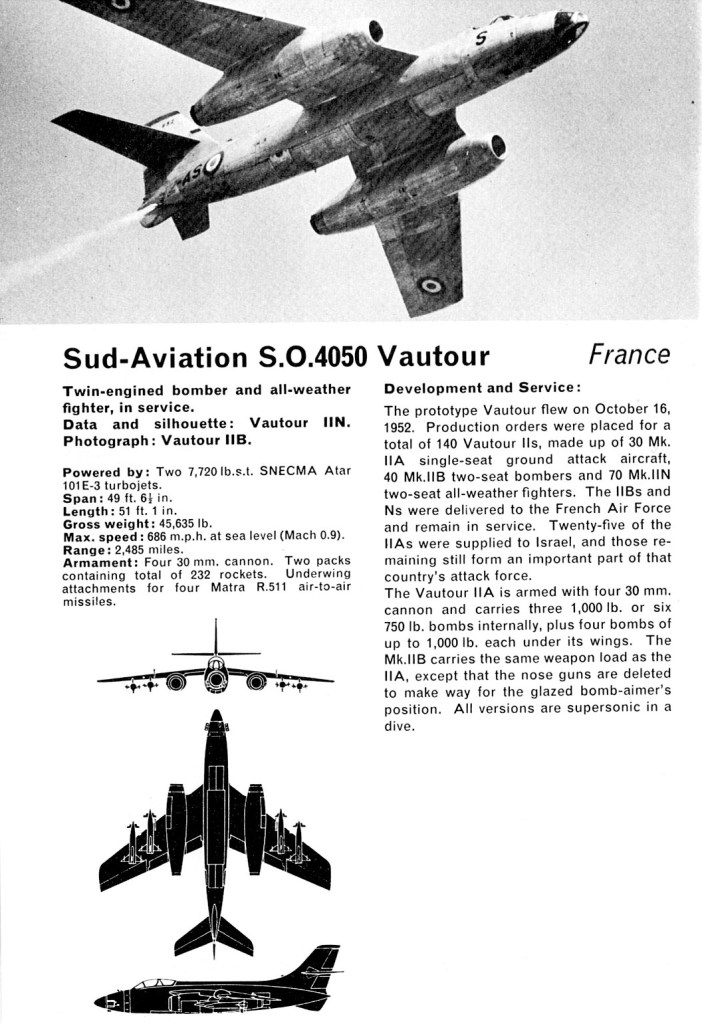
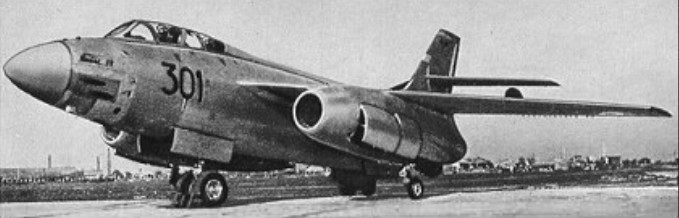
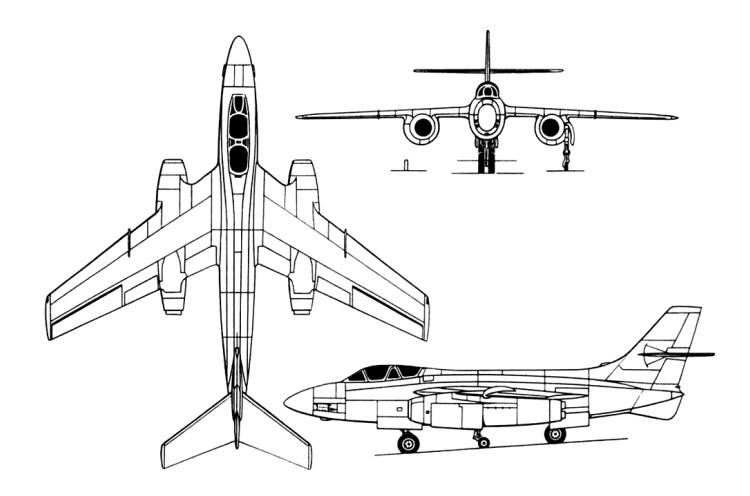
After the cancellation of the SO.4000, the Sud-Ouest design team turned to a more refined type, the SO.4050 Vautour that eventually entered service in three versions optimized for MK.IIN all-weather interception, Mk.IIA close support, and Mk.IIB bombing from medium and high altitudes.
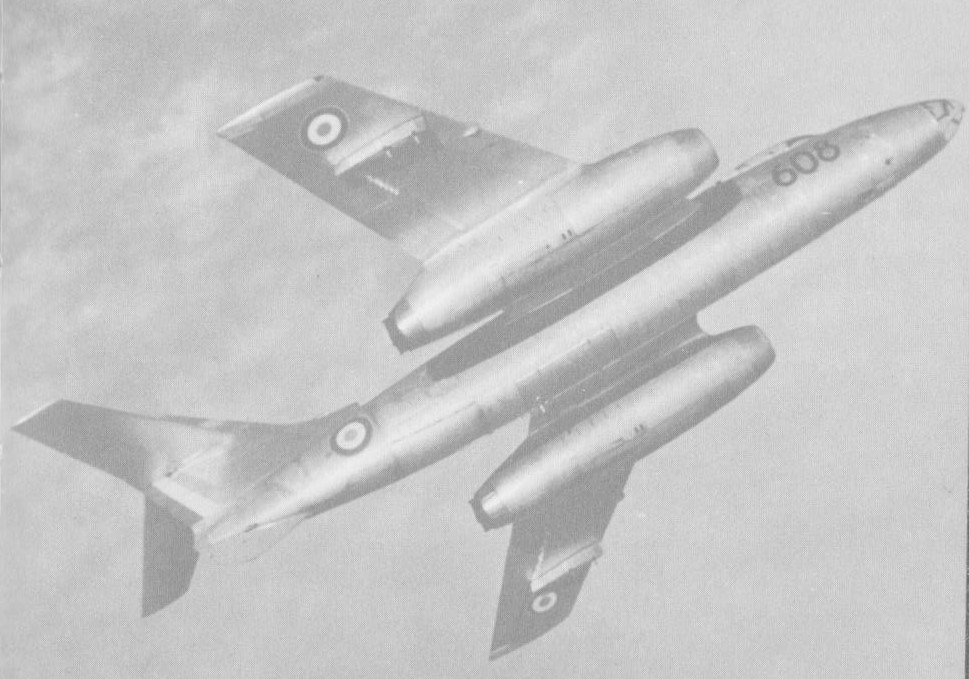
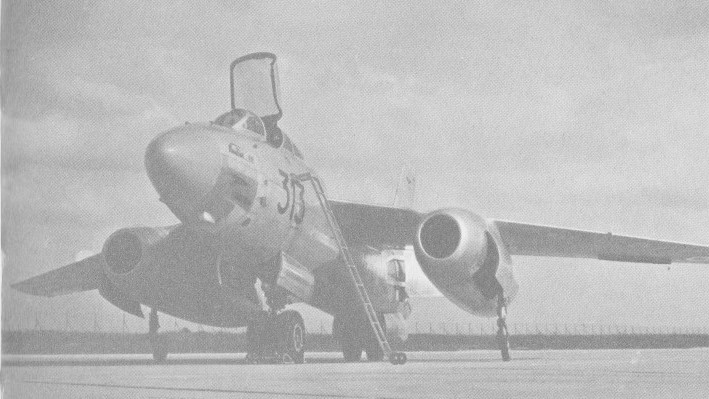
The SNCASO SO.4050 Vautour (Vulture) was first flown on 16 October 1952. Midway in size between small fighters and jet medium bombers, it had the same layout as the much bigger Boeing B 47, with a mid-high 35 degree swept wing, under-slung engines, a fighter type nose cockpit and so-called bicycle landing gear. The front wheels retract forward and the rear wheels rearward. Small balance wheels were under each engine nacelle. Fitted with conventional ailerons, rudder, all-moving tailplane, split flaps, and an air brake on each side of the rear fuselage.
Each engine was fed from its own set of fuel tanks. The inner 17 fuel tanks had an automatic system to “isolate” cells which caught fire or to neutralize leaks in the passages. The pilot could direct or divert flow of fuel in case of damaged pipes or engine malfunction. The Vautour didn’t have inflight refuelling devices. Only the experimental (FR-AF) IIA(R) s/n 8, was tested as an air tanker for the Mirage-4.
The Vautour prototype was the first French twin-jet aircraft to exceed the speed of sound in a shallow dive. Various engines were fitted in the three prototype and six pre-production models but all production Vautours had Atar turbojets.
Produc¬tion took place later in three versions. The Vautour IIA is a single seat tactical fighter, of which 30 were built, the first production machine flying on 30 April 1956. Twenty-five Vautour II-As were supplied to Israel.
Vautour IIA
Vautour IIB
Only one of the six pre-production Vautours was a bomber, the others consisting of two tactical support aircraft and three all-weather fighters. The Vautour IIB had a single seat pilot cockpit similar to that of the Vautour IIA attack version, but added a glazed nose for a navigator/bombardier who could use a conventional bombsight. Navigation was mainly by a twin gyro platform and Doppler radar, and considering the small dimensions of the aircraft an excellent bombload could be carried both internally and externally. The first production aircraft of this IIB sub type flew on 31 July 1957 and eventually 40 were delivered to equip the Armee de l’Air’s 92e Escadre, which was the original operating ele¬ment of the Commandement des Forces Aeriennes Strategiques (strategic air command). Special bomb-dropping gear was developed for them in which the weapons were extended below the bomb bay prior to release, to make possible attack a transonic speeds from all altitudes. The Vautour IIB (redesignated Vautour IIAB after fitting one piece tailplanes in the early 1960s) was replaced by the Dassault Mirage IVA from 1965.
The first of 70 Vautour II-N all weather fighters flew on 10 October 1956.
SO.4050 Vautour II-N
It was in service with the air forces of France (II-Bs and II-Ns) and Israel (25 II-As).
Mk.IIA Engine: 2 x SNECMA Atar 101F-3, 34.3kN, 7716 lb Wingspan: 15.09 m / 49 ft 6 in Wing area: 484.4 sq.ft Length: 15.57 m / 51 ft 1 in Height: 4.5 m / 15 ft 9 in Max take-off weight: 20000 kg / 44093 lb Empty weight: 10000 kg / 22046 lb Internal fuel: 5,364 lt / 17 tanks Weapon bay fuel capacity: 3,000 lt (2 x 1,500 lt tanks) External fuel: 2 drop tanks of 1,300 lt or 600 lt Max fuel capacity: 10,964 lt / 8,771 kg Max. speed: 1105 km/h / 687 mph at SL Ceiling: 15000 m / 49200 ft Armament: 4 x 30mm cannons, 1850kg / 6000 lb of bombs Seats: 1
Mk.IIB Type: two seat bomber Engines: 2 x Powerplant: 2 x SNECMA Atar 101 E 3 turbojets, 3500 kg (7,720 lb) Wing span: 15.1 m (49 ft 6.5 in) Length: 15.55 m (51 ft 0.25 in) Height: 4.32 m (14 ft 2 in) Wing area: 45.00 sq.m (484.4 sq ft) Empty wt: 10470 kg (23,082 lb) MTOW: 21000 kg (46,300 lb) Max speed: 1100 km/h (685 mph) at low level and 950 km/h (590 mph) at 12190 m (40, 000 ft) Radius with max bombload: 930 km (580 miles) Max range: 5950 km (3,700 miles) Armament: internal six bombs of 340 kg (750 lb) Hardpoints: four – 500 kg (1, 102 lb) each Weapon bay fuel capacity: 3,000 lt (2 x 1,500 lt tanks) External fuel: 2 drop tanks of 1,300 lt or 600 lt
Mk.IIN Engines: 2 x SNECMA Atar 101E-3 turbojet, 7716 lb Wingspan: 49 ft 6.5 in Length: 14 ft 1.75 in Wing area: 484.4 sq.ft Empty weight: 23,150 lb MTOW: 45,635 lb Internal fuel: 4426 lt Weapon bay fuel capacity: 3,000 lt (2 x 1,500 lt tanks) External fuel: 2 drop tanks of 1,300 lt or 600 lt Max fuel capacity: 10,026 lt / 8,021 kg Max speed SL: 685 mph Max ROC: 11,800 fpm Service ceiling: 50,000 ft Armament: 4 x DEFA cannon Hardpoints: 4 Seats: 2
IIBR Engines: 2 x Powerplant: 2 x SNECMA Atar 101 E 3 turbojets, 3500 kg (7,720 lb) Max speed: 1100 km/h (685 mph) at low level and 950 km/h (590 mph) at 12190 m (40, 000 ft) Radius with max bombload: 930 km (580 miles) Max range: 5950 km (3,700 miles) Empty wt: 10470 kg (23,082 lb) MTOW: 21000 kg (46,300 lb) Wing span: 15.1 m (49 ft 6.5 in) Length: 15.55 m (51 ft 0.25 in) Height: 4.32 m (14 ft 2 in) Wing area: 45.00 sq.m (484.4 sq ft) Weapon bay fuel capacity: 1 x 1,500 lt tank External fuel: 2 drop tanks of 1,300 lt or 600 lt Max fuel capacity: 9,464 lt
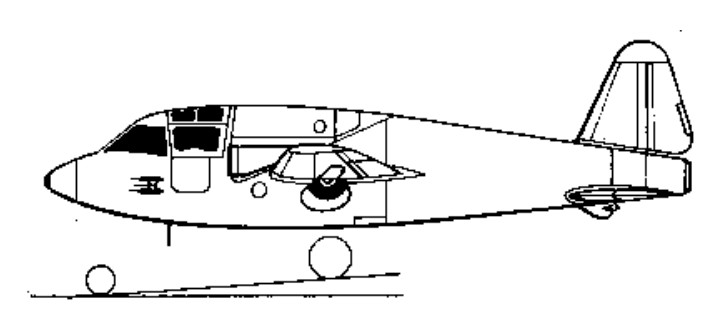
The SO 4000 was developed by the Société Nationale de Constructions Aéronautiques de Sud-Ouest (SNCASO) to meet an Armée de l’Air requirement formulated shortly after WWII for a twin-turbojet bomber capable of high subsonic speeds and having a maximum loaded weight of 25-30 tonnes. The SO 4000 project competed with the NC 270 project tendered by the SNCA du Centre, and after the flight testing of manned scale models, the SNCASO bomber was selected for further development. The half-scale model predecessors of the SO 4000 were the SO M.1 glider (F-WFDJ) and the powered SO M.2 (F-WFDK).
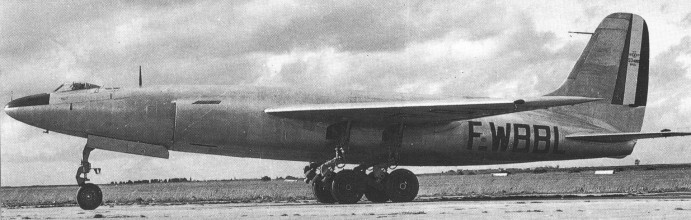
The single prototype of the full-scale SO 4000 bomber, (F-WBBL) had been rolled out for the first time on 5 March 1950. While essentially similar in configuration to the M.1 and M.2, the SO 4000 featured a tall undercarriage comprising a single nosewheel and tandem mainwheels each with independent legs. This undercarriage proved somewhat fragile, collapsing during ground trials on 23 April. After repairs were completed, flight testing finally commenced at Orleans-Bricy on 15 March 1951, test pilot Daniel Rastel being accompanied by flight engineer Pistrak.
The SO 4000 was powered by two Rolls-Royce turbojets mounted side-by-side in the rear fuselage, these being fed via lateral intakes immediately aft of the pressurised forward fuselage. Fuel was accommodated above the weapons bay in the centre fuselage and proposed defensive armament consisted of remotely-controlled gun barbettes at the wingtips. The 31 deg swept wing had a 10 per cent thickness/chord ratio from root to tip and the control arrangement was fundamentally similar to that of the M.2. The initial flight of the SO 4000 was also to prove its last as the undercarriage collapsed once more on alighting, the programme subsequently being discontinued as a result of a reduction in military credits.
Engines: 2 x Rolls-Royce Nene 102 turbojets, 4,980 lb st (2 260 kgp) Fuel cap: 1430 ImpGal (6500 lt) Wing span: 58 ft 7 1/8 in (17,86 m) Length: 64 ft 9½ in (19,75 m) Wing area of 807.32 sq ft (75,00 sq.m) Empty wt: 36,5581b(16 583 kg) Loaded wt: 48,510 lb(22 005kg) Estimated performance – Max speed of 528 mph (850 km/h) at 29,530 ft (9 000 m) or Mach 0.78 and 515 mph (830 km/h) at sea level or Mach 0.675.
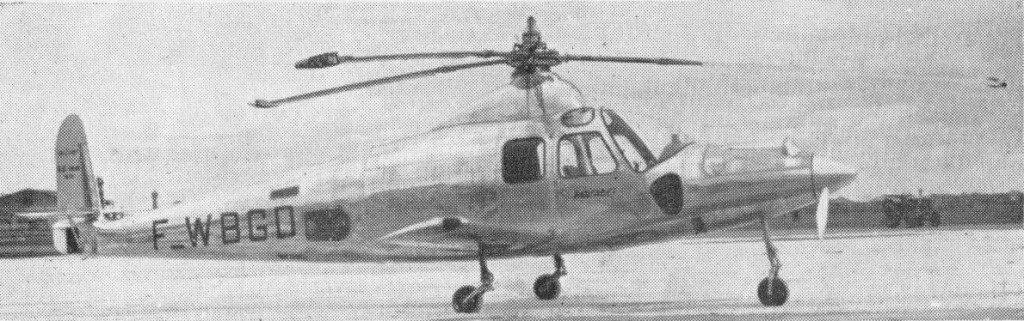
This is the first French convertible. It can take off vertically, hover in the air, land vertically by means of its rotor, and fly forward at a speed greater than that of pure helicopters by means of a fixed wing and an airscrew fully independent of the rotor.
The change from one state to the other is accomplished without any change at all in the external appearance. The SO.1310 is provided with two independent power units. In the rear is an Arrius II 360hp Turbomeca unit, which supplies the jet rotor with compressed air at take-off. The all-metal three-bladed rotor is identical with the one used in the SO.1120 Ariel III, but with a larger diameter.
In the forepart there is a Turbomeca Artouste II turbo-prop engine with a take-off power of 360 hp, operating a variable-pitch airscrew. During forward flight, the rotor originally used for take-off continues to auto-rotate, but with low lift, and the greater part of the lift is transferred to the fixed wing. Mounted over the fixed wing is the pilot’s cabin, fitted with dual control, and in this cabin there is room for either three passengers, a freight load or two stretchers stacked on top of each other.
The Farfadet single prototype F-WBGD first flew on 8 May 1953. Its maiden flight, lasting about twenty minutes, was made as a true helicopter, the following one, on the same day, with the rotor and the airscrew respectively powered by their individual engines.
SO.1310 Farfadet Engine: 1 x 360 hp Turbomeca Artouste II gas turbine & 1 x 360 hp Turbomeca Arrius II gas turbine Rotors: 3-blade tip-powered main rotor; 2-blade propeller Rotor diameter: 11.2m / 36 ft 6 in Wingspan: 6.3m / 19 ft Fuselage length: 10.08m Height: 3.3m Weight fully loaded: 1510kg Empty weight: 995kg Cruising speed as a helicopter: 155km/h Cruising speed as an autogyro: 250km/h Range: 400km / 250 miles at 149 mph Seats: 3
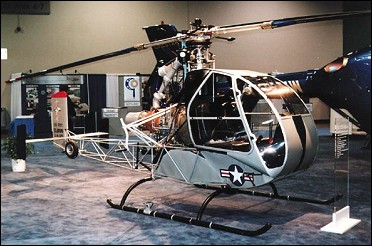
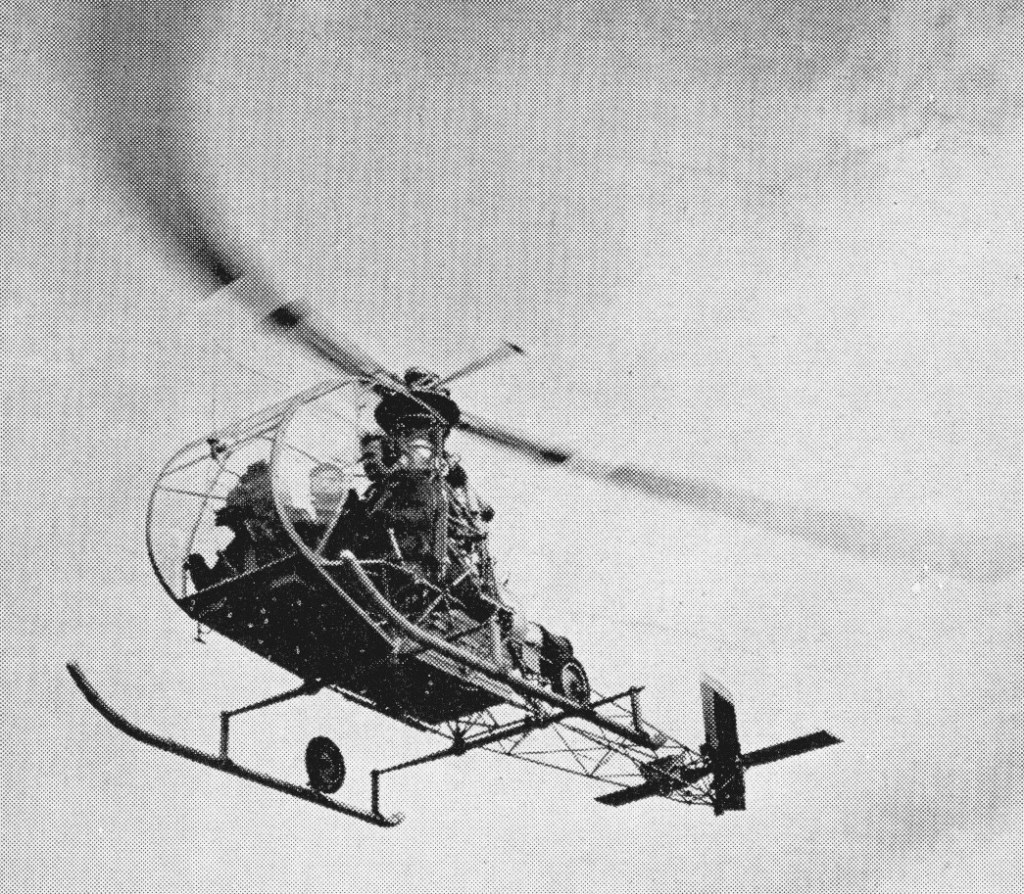
The experience acquired by Sud-Ouest in building its two prototypes of the Ariel led to the SO.1221 Djinn. The Djinn’s began with two single-seat SO.1220 prototypes, F-WGVO and F-WGZX, the first of which made its maiden flight on 2 January 1953. A simple uncovered structure of welded steel tube carrying a two-blade rotor above it, and with a single exposed seat for its pilot. Its powerplant was a Turbomeca Palouste turbo-compressor producing a large volume of compressed air which, using a similar distribution method to that of the Ariel, was discharged at the blade tips. These were both intended primarily to prove the rotor and propulsion systems.
F-WGVO was later fitted experimentally with agricultural spray booms.
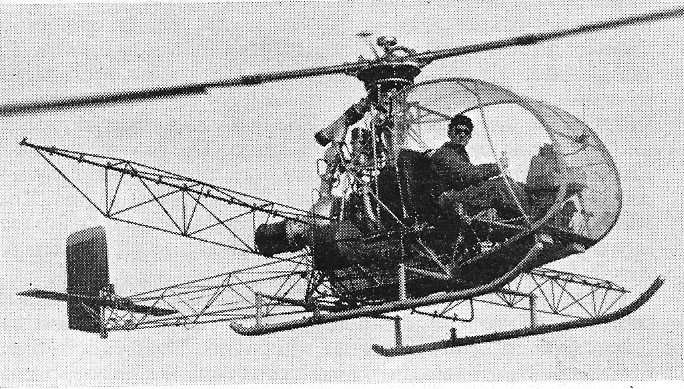
On 16 December 1953 the first of five 2-seat SO.1221 prototypes was flown, having a fully enclosed cabin, two side-by-side seats, an open-framework tail boom, and an all-up weight of 600kg. On 29 December this aircraft established a new altitude record in its class of 4789m.
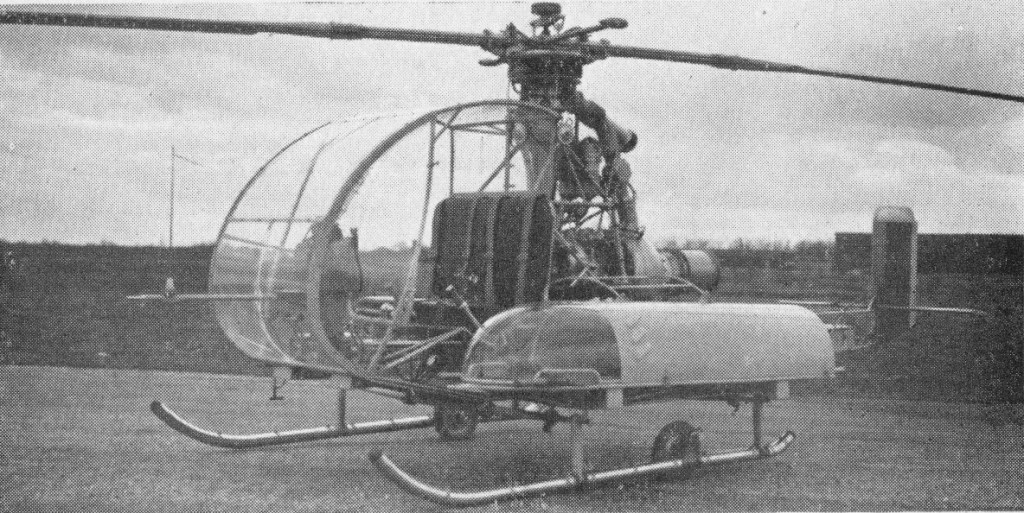
The Djinn was the world’s first production helicopter to make use of the ‘cold jet’ principle of propulsion. This system used a modified Turbomeca Palouste IV engine as a turbo-generator to feed compressed air through the rotor shaft to ejectors built into the tips of each rotor blade. The air itself is in fact warm enough to eliminate the need for other means of de-icing the blades. No tail rotor is fitted, the aircraft having two outrigged fins and a large central rudder that is situated in the line of the residual thrust exhaust from the engine to provide directional control. The craft’s small spartan two-seat cockpit was surrounded by a sectioned bubble-type enclosure and transparent side doors, which combined to provide excellent visibility forward and to both sides. Cockpit instrumentation was quite basic in the standard SO.1221, and The Djinn’s landing gear was of the skid type, with small retractable wheels to facilitate ground handling.
Twenty-two pre-series SO. 1221’s were then built, primarily for evaluation for the French Army, and the first of these was flown on 23 September 1954. Three machines from this batch were evaluated by the U.S. Army, under the designation YOH-1.
In late 1956 the US Army leased three examples for evaluation in the observation role. The Djinn, which had first flown in December 1953, was already in service with the French Army as an observation craft and its success in that role, coupled with its relatively low per-unit cost and fairly basic maintenance requirements, piqued the Army’s interest. The machines obtained by the Army (serials 57-6104 through -6106) were the first helicopters acquired under the new HO (helicopter, observation) classification, and were designated YHO-1. the three YOH-1s were consequently fitted with additional U.S. military-standard avionics and communications equipment for their Army evaluation.
The Army’s engineering and operational evaluation of the YOH-1 found the aircraft to be well built, relatively easy to maintain under field conditions, and an exceptional observation platform. The Djinn was not adopted for service use, however, primarily because the Army faced continuing budgetary constraints and some domestic political opposition to the procurement of French, rather than American (or Canadian) aircraft. In early 1958 all three YOH-1s were returned to Sud-Ouest for ultimate delivery to the French Army.
Chief customer for the Djinn has been France’s Aviation Legere de l’Armee de Terre, which received one hundred of the one hundred and fifty production Djinns completed up to 1961, and still had about half of these in service in mid-1967. The first production aircraft was flown on 5 January 1956, and French and US certification was gained in April 1958. Six were also delivered to the Federal German Heeresfliegerei. The military Djinns operate at a slightly higher gross weight – 800kg – than the civil models. One was used in France for the first experiments in launching Nord SS.10 anti-tank missiles from a helicopter, but the Djinn’s main military functions have been those of observation, liaison, training and (with one pilot and two external litters) casualty evacuation.
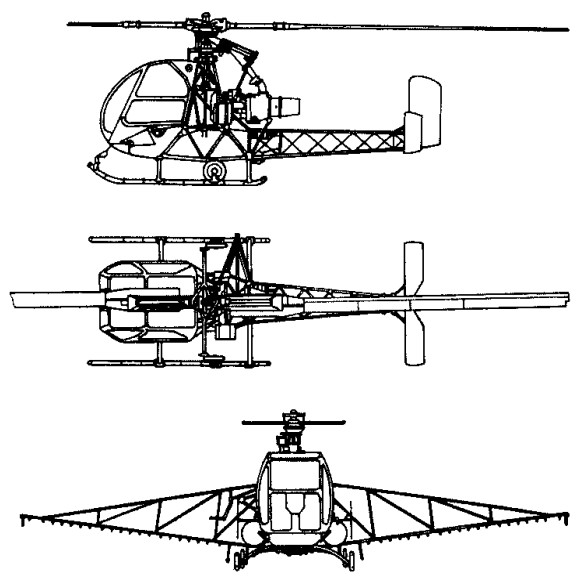
Between forty and fifty civil Djinns were active in ten countries, most of them in an agricultural role, for which Sud-Aviation offered renewed conversion facilities in 1965. The so-called ‘agricopter’ version of the Djinn can carry up to 200 litres of liquid chemical in twin tanks, and is fitted with lateral spray bars for the spraying, dusting or ‘fogging’ of crops with fertilisers or pesticides.
When production ended in the mid-1960s a total of 178 had been built, exported to about 10 countries. Many were used in an agricultural role, equipped with two tanks to contain liquid chemicals and spray bars for its distribution. By the time that production ended Sud-Ouest had twice changed its name, to Ouest-Aviation on 1 September 1956 and Sud-Aviation on 1 March 1957 when it merged with Sud-Est Aviation; this explains why the Djinn is sometimes recorded as the Ouest S.O.1221 or Sud-Aviation S.O.1221.
Sud-Ouest SO-1221 Djinn Engine: 1 x Turbomeca Palouste IV turbo-compressor, 179kW / 237 shp Main rotor diameter: 32 ft 10 in / 10.97 m Fuselage length: 17.388 ft / 5.3m Height: 8.530 ft / 2.6m Width of hull: 6.332 ft / 1.93 m Max take-off weight: 800kg / 1,550 lb Empty weight: 793.8 lb / 360kg Max speed: 70 kts / 130km/h / 75 mph Endurance: 2h 15min Initial climb rate: 1279.53 ft/min / 6.5 m/s Service ceiling: 13123 ft / 4000 m Range: 103 nm / 190 km Typical range: 100 miles at 44 mph Crew: 2