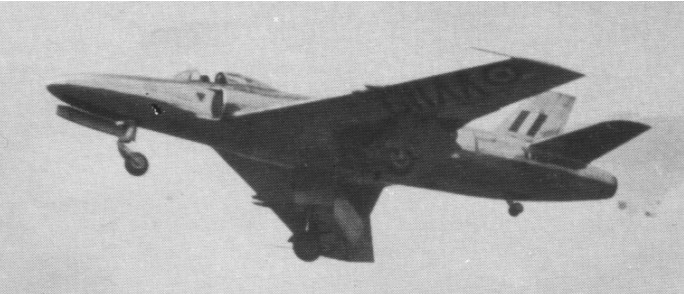
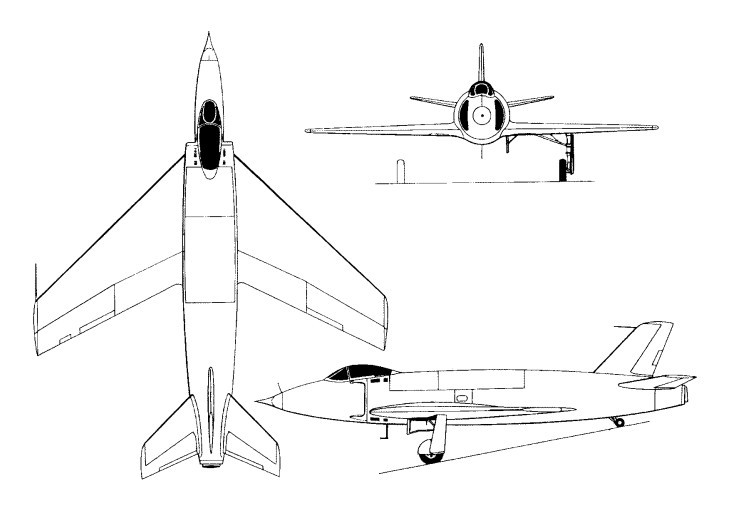
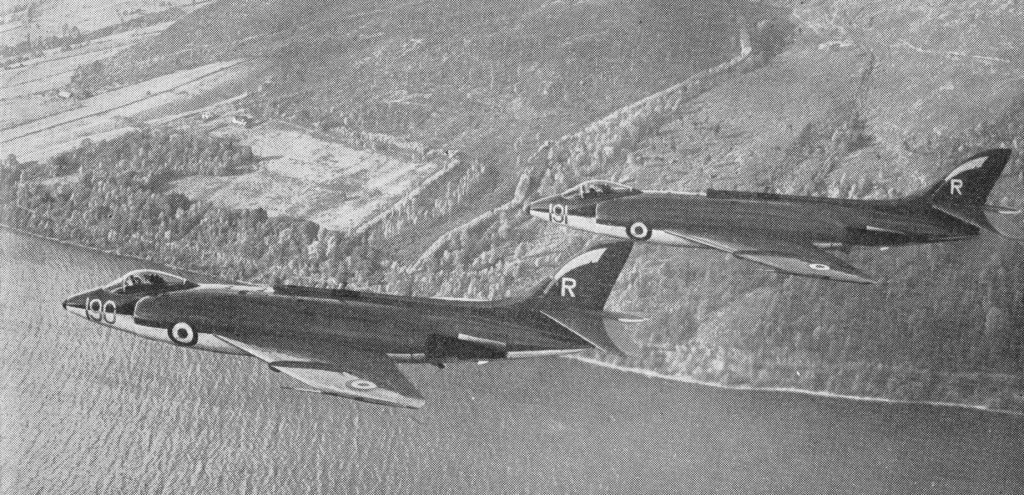
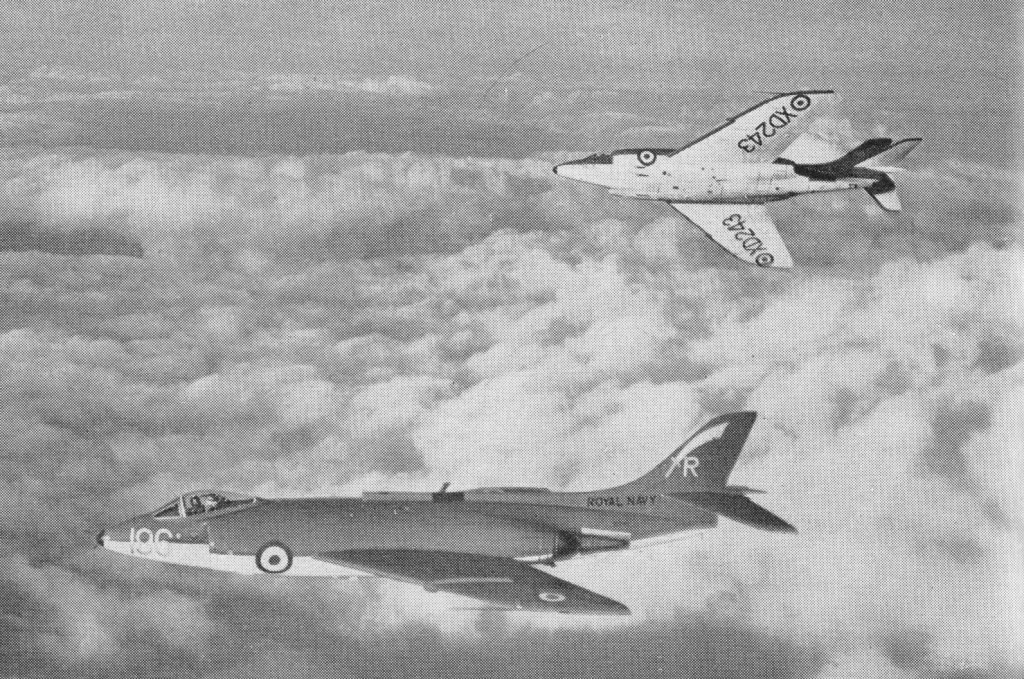
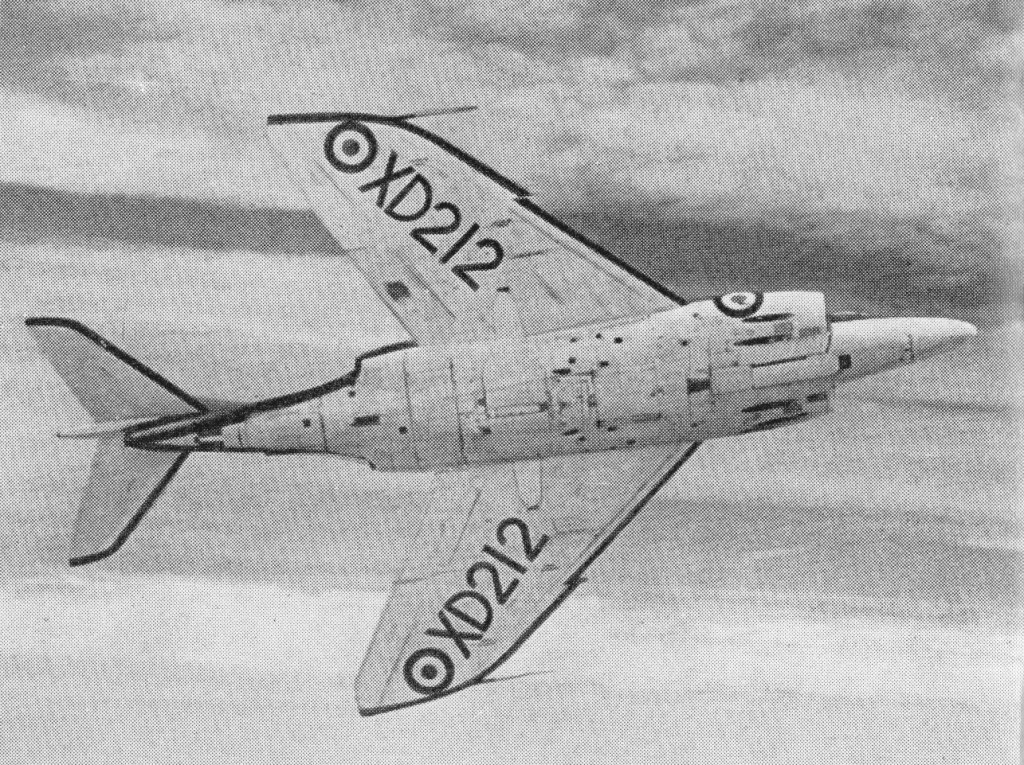
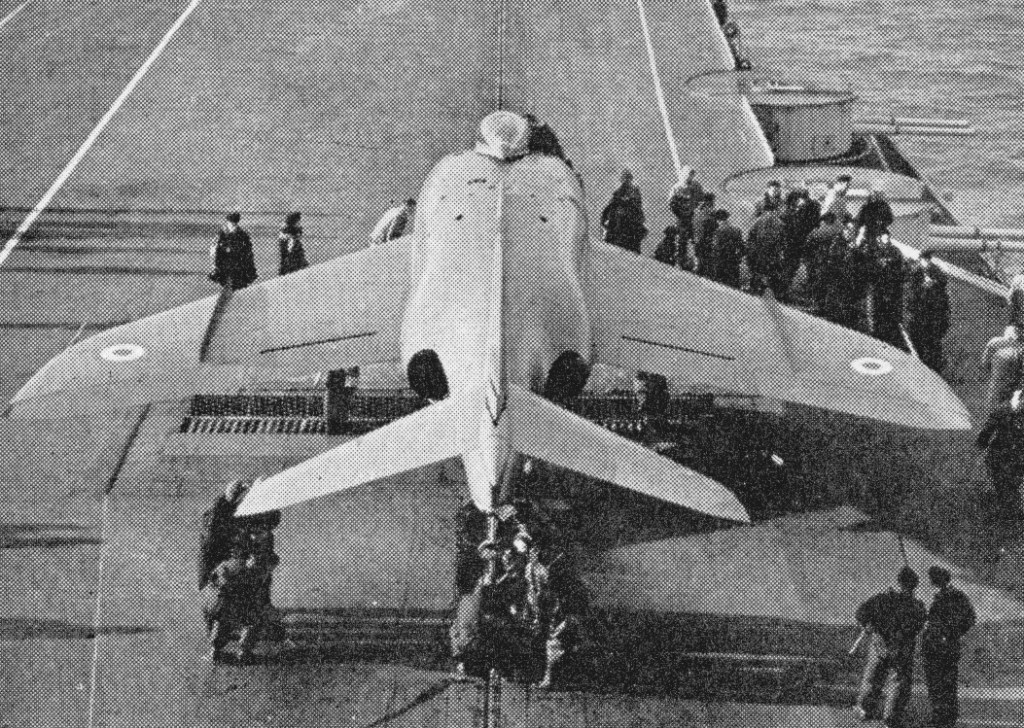
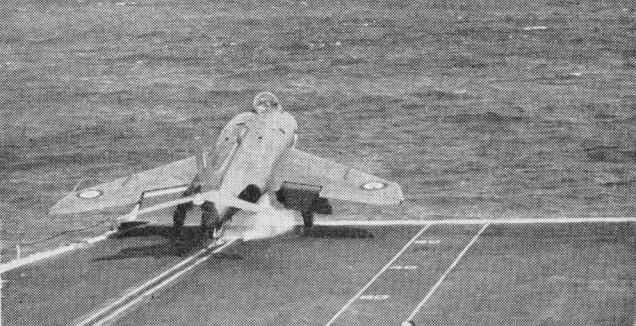
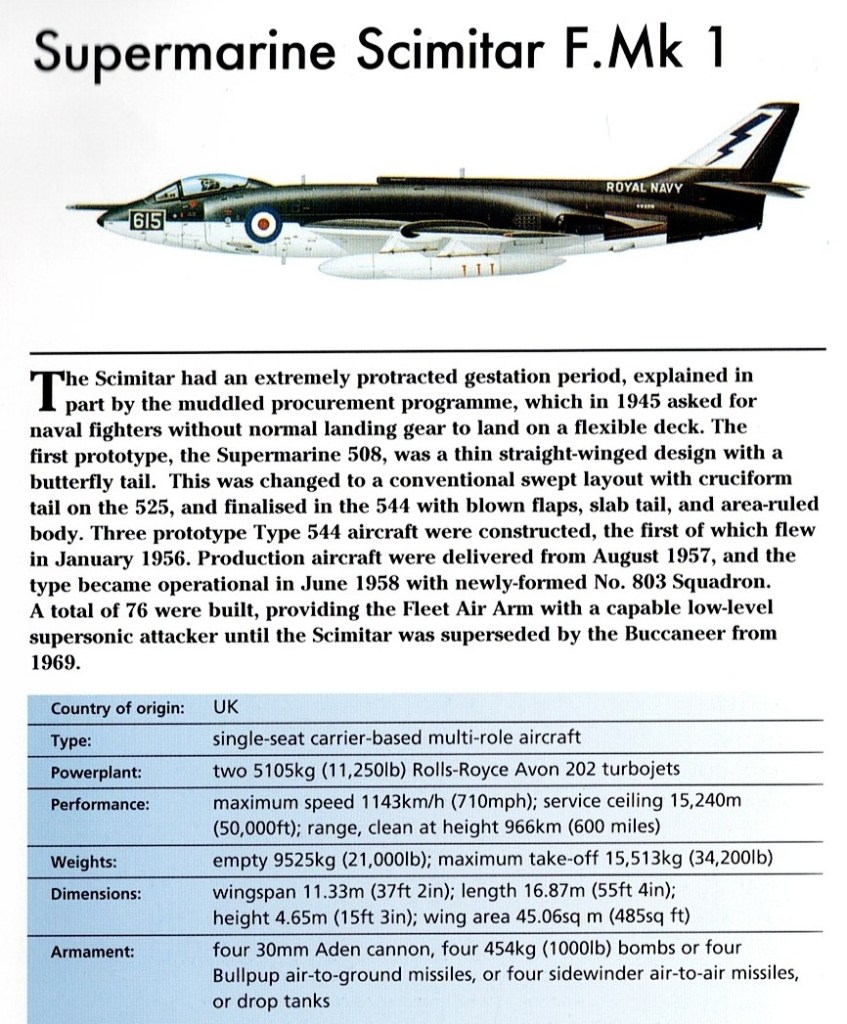
Three aircraft were ordered to Specification N.9/47 for a naval fighter, and, configurationally similar to the Type 505 apart from the undercarriage. In February 1950, the contract covering the third prototype was amended to introduce sweptback wings, and this, as the Type 525, became, in effect, the prototype of the Scimitar.
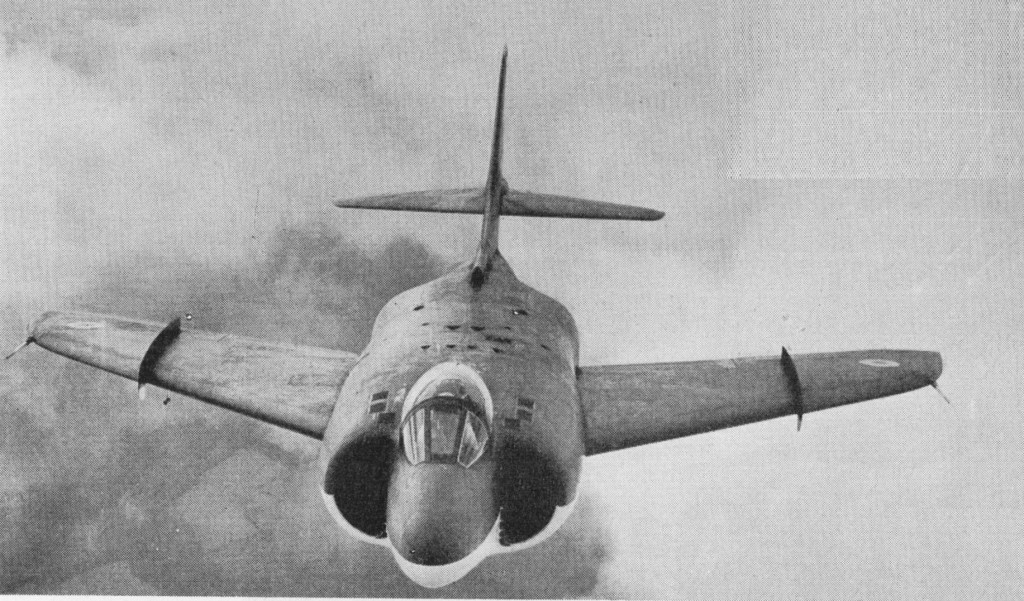
The Type 525 has an all moving tail with narrow chord elevators and a tail braking parachute in the streamlined fairing of the tailplane and fin. A V type arrester hook is housed in clamshell doors below the rear fuselage, and there is a fuel tank of 58 gal. capacity in the fuselage between the two jet pipes. The 525 has slotted ailerons, of a similar type to those of the Swift.
Very large flap area is provided for deck landing, wing flaps being of the chord increasing type with a slot effect, and extra area is gained by two additional hinged surfaces below the fuselage. The wing also has full span slats which are extended for slow speed control. Since the long stroke undercarriage with its large diameter wheels retracts into the fuselage forward of the flaps, fairing doors for the wheel wells are provided and close to preserve the airflow after the undercarriage is extended. The 525 also has fuselage -mounted air brake flaps hingeing forward just below the leading edge of the wing on the fuselage.
During 1946, in response to a contract to build two prototypes of a single-seat high-speed fighter to Specification E.41/46, Supermarine combined sweptback wing and tail surfaces with what was essentially an Attacker fuselage to create the Type 510. This retained the Rolls-Royce Nene 2 engine and tailwheel undercarriage of the Attacker.
The first prototype was flown on 29 December 1948. No armament was fitted, but provision was made for four wing-mounted 20mm cannon. The second prototype, designated Type 528, flew in similar configuration on 27 March 1950, and, on 8 November of that year, the Type 510, fitted with an Attacker-style A-frame arrester hook, made a series of landings and take-offs from the carrier HMS Illustrious.
Later, the first aircraft (now redesignated Type 517) was fitted with a movable rear fuselage permitting the incidence of the integral tailplane to be varied. Meanwhile, the Type 528 was fitted with an afterburning version of the Nene, a lengthened nose and a tricycle undercarriage as the Type 535, flying in this form for the first time on 23 August 1950, and providing the basis for the development of the Swift. Four wing cannon were carried by the 535, but such positioning found no official favour.
The Type 535 proved sufficiently impressive for a 100-aircraft order to be planned if the same company’s Type 541 proved a failure.
Type 510 Max take-off weight: 5534 kg / 12200 lb Wingspan: 9.66 m / 32 ft 8 in Length: 11.61 m / 38 ft 1 in Height: 2.68 m / 9 ft 10 in Wing area: 25.36 sq.m / 272.97 sq ft Max. speed: 1014 km/h / 630 mph
The Superrnarme Attacker prototype had been built to a 1944 specification. The single-seat jet fighter flew for the first time on July 27, 1946. The machine was flown by Supermarine’s test pilot, Mr Jeffrey Quill, from the A&AEE at Boscombe Down, where, as there is not at the firm’s aerodrome at High Post, there is a runway.
The prototype, T5409, was seen at the SBAC show at Radlett the following month.
Named Attacker, the aircraft uses a Rolls-Royce RB.41 (later Nene) centrifugal flow turbojet, a new fuselage and tail mounted on the laminar flow wings of the Spiteful with radiators removed.
The undercarriage was also taken from the Spiteful. The wing retained the Spiteful’s four cannon armament but the radiators for its Griffon piston engine were removed and replaced by fuel tanks.
The result was the Attacker F.Mk.1, a mediocre fighter whose main advantages were cheapness and easy handling at low level. This was put to use by adding bombs in the Attacker FB.Mk.1 version, and the Attacker FB.Mk.2 had powered ailerons and a stronger met¬al-framed canopy. The last of 145 of the three marks was delivered in 1953, also exported to Pakistan, and served until 1957.
Three prototypes were ordered in August 1944 but development was slower than anticipated due to delays in laminar flow wing research, with low speed handling problems proving difficult to solve. As the RAF had begun to lose interest in the aircraft, it was decided that the last two prototypes would be navalised.
The first prototype flew on 27 July 1946 and the second on 17 June 1947 (the name “Attacker” applied on the same day), this differing in having longer stroke undercarriage, smaller fin, enlarged tailplane, increased fuel capacity, arrester hook and an ejection seat. Folding wings would not appear until the production versions were built. By then, the RAF was no longer a prospective customer and the aircraft was ordered only tor the Royal Navy Fleet Air Arm.
The first production Attacker F.1 flew on 5 May 1950 and operational service began in August 1951 with No 800 Squadron FAA. Subsequent versions were the FB.1 fighter-bomber with provision for underwing ordnance and the FB.2 which differed mainly in its Nene Mk.102 engine with a throttle acceleration control unit to prevent flameout if the throttle was opened quickly, such as when performing a go-around. The Attacker served with only two FAA front line squadrons and had been relegated to Volunteer Reserve units by 1954 and retired two years later.
The only export was to the Pakistan Air Force, which received 36 ‘denavalised’ aircraft between 1951 and 1953 for operation from land. These lacked the folding wings and arrester gear of the Royal Navy’s aircraft but were otherwise similar to the Attacker F.1.
Attacker F.Mk.1 Engine: 1 x Rolls-Royce “Nene 3”, 22.24kN Max take-off weight: 5339 kg / 11771 lb Empty weight: 3826 kg / 8435 lb Wingspan: 11.25 m / 37 ft 11 in Length: 11.43 m / 38 ft 6 in Height: 3.02 m / 10 ft 11 in Max. speed: 950 km/h / 590 mph Ceiling: 13700 m / 44950 ft Range: 950 km / 590 miles Armament: 4 x 20mm cannon Crew: 1
Attacker FB.Mk 2 Engine: one 2313-kg (5, 100-lb) thrust Rolls-Royce Nene Mk 102 turbojet Maximum speed 950 km/h (590 mph) at sea level Initial climb (light weight 5216 kg/1,500 lb) 1935 m (6,350 ft) per minute Service ceiling (maximum weight) 11890 m (39,000 ft) Range (with 1 137-litre/250-Imp gal belly tank) 1700 km (1,060 miles) Empty weight 4495 kg (9,910 lb) Maximum take-off 7938 kg (17,500 lb) Span 11.26 m (36 ft 11 in) Length 11.43 m (37 ft 6 in) Height 3.03 m (9 ft 11 in) Wing area 21 sq.m (226 sq ft) Armament: four 20-mm Hispano Mk 5 cannon Bombload: two 454-kg (1,000-lb) bombs or eight rockets
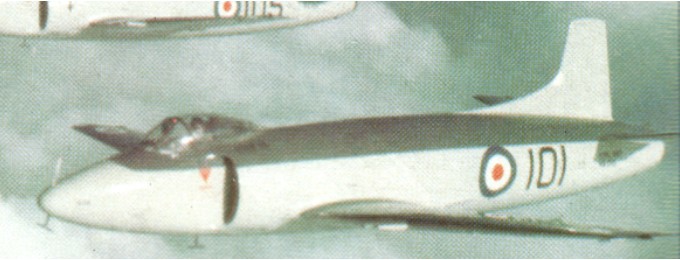
Responding to Admiralty interest in “undercarriage-less” aircraft suitable for operation from flexible decks on aircraft carriers, Supermarine designed the Type 505 single-seat fighter in 1945. Two Rolls-Royce AJ65 (later to be named Avon) turbojets were located side-by-side in a broad centre fuselage to provide a stable base for alighting on the “carpet” and a Vee configuration kept the tail surfaces clear of the jet efflux. An armament of twin 20mm cannon was planned and provision was made to provide for a fixed tricycle undercarriage for flight development and operation from shore bases. It was thus relatively simple to incorporate a retractable undercarriage in the design when Admiralty interest in the flexible deck concept waned in late 1947 and the fighter was modified as the more conventional Type 508.
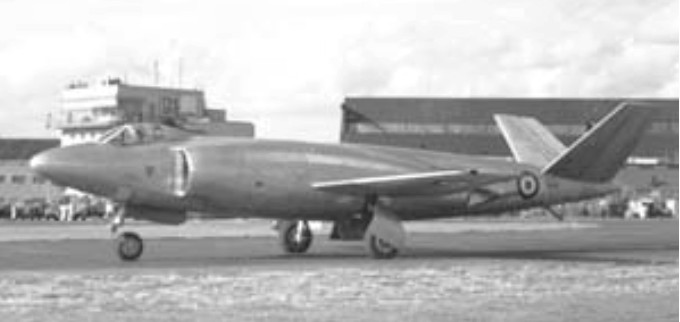
Three aircraft were ordered to Specification N.9/47 for a naval fighter, and, configurationally similar to the Type 505 apart from the undercarriage, the first of these flew on 31 August 1951. The second (as the essentially similar Type 529) followed a year later, on 29 August 1952.
In February 1950, the contract covering the third prototype was amended to introduce sweptback wings, and this, as the Type 525, became, in effect, the prototype of the Scimitar. The Types 508 and 529 were each powered by a pair of 2948kg Avon RA3 engines and had provision for an armament of four 20mm cannon.
To be broken up February 1956
Type 529 Engines: 2 x 2948kg Avon RA3 Empty weight: 8373 kg / 18459 lb Wingspan: 12.50 m / 41 ft 0 in Length: 15.24 m / 50 ft 0 in Height: 3.54 m / 12 ft 7 in Wing area: 31.59 sq.m / 340.03 sq ft Max. speed: 977 km/h / 607 mph
Conceived as a successor to the Spitfire, the Type 371 was projected from November 1942, initially mating a laminar flow wing with a Griffon-engined Spitfire XIV and progressively embracing a new fuselage. Three prototypes were ordered to Specification F.1/43, which was written around the project, and the first of these flew on 30 June 1944. This prototype comprised a Spitfire XIV fuselage with the new wing, a 2,035hp Rolls-Royce Griffon 61 engine and an armament of four 20mm cannon.
Named Spiteful, the second prototype flew on 8 January 1945 with the new fuselage, an all-round vision cockpit canopy and a 2,375hp Griffon 69 driving a five-bladed propeller. Production orders were placed for 188 Spitefuls, but only 16 were flown of 19 built or partially-completed (from April 1945) as the end of World War II and the advent of the jet fighter terminated plans for RAF use of the Spiteful. The designation F Mk 14 was applied to the Griffon 69-powered Spiteful; the proposed F Mk 15 had either the Griffon 89 or 90 with a six-bladed contraprop, and a single F Mk 16 had a Griffon 101 with a three-speed supercharger and five-bladed propeller. The two conversions from the Mark XIV, RB516 and RB518 were fitted with the Griffon 101 engine producing 2,420 hp and a top speed of 494 mph.
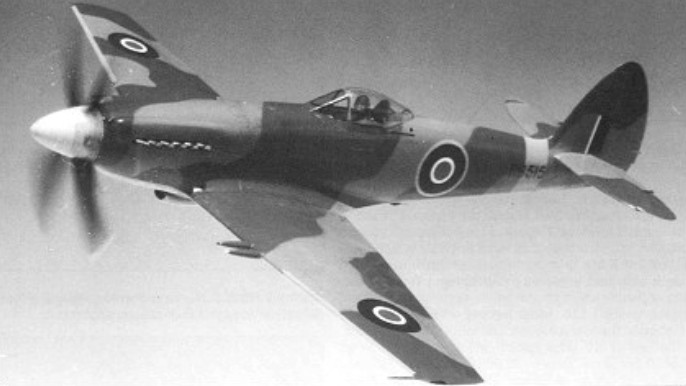
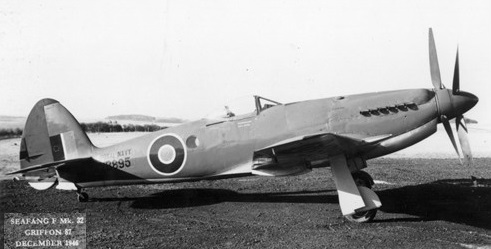
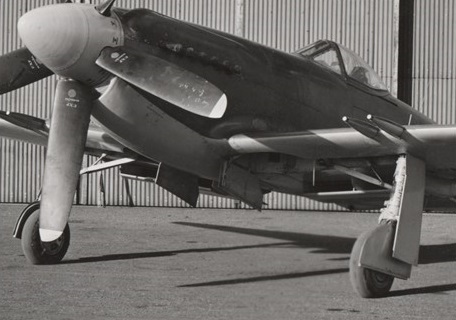
Development of a navalised Spiteful was pursued during 1945 to Specification N.5/45, and a contract was placed for two prototypes and by May 1945 nearly 150 fighters were ordered for production, the name Seafang being assigned. This aircraft was created as part of a project by Supermarine to design a new wing with a laminar profile. This began in November 1942. The machine, designated ‘Type 382’, was based on a Spiteful single seat fighter.
A Spiteful F Mk 15 with a “sting”-type arrester hook was tested early in 1945, and the Seafang prototypes flew in the following year. One of these represented the production Seafang F Mk 31 with Griffon 61 engine and a long-stroke undercarriage, but non-folding wings. The other represented the Seafang F Mk 32 with a Griffon 89 engine with contraprop, and upward-folding wings. The Seafang F. Mk.32 was a second production series that differed drastically from the first Mk.31 variant, and this was the version planned for mass production. Armament comprised four 20mm cannon and provision was made for carrying a pair of 454kg bombs or six 136kg rockets.
The prototype VB895 was only finished in early 1946. The aircraft was equipped with a system that allowed the wingtips to fold up for carrier flight decks. The fighter was powered by a 2350hp Rolls-Royce Griffon 89 engine and coaxial propellers. The design included all the necessary equipment to operate from aircraft carriers. Four 20-mm Hispano cannons made up the main armament, additionally the fighter could carry rockets and bombs.
After completion during 1946-47 of 10 Mk 31s and six Mk 32s (some of which were never flown) production was cancelled, and attempts to interest other countries in purchasing the Seafang also failed.
All the produced aircraft were used extensively for various testing programs.
Spiteful F 14 Max take-off weight: 4513 kg / 9950 lb Empty weight: 3334 kg / 7350 lb Wingspan: 10.67 m / 35 ft 0 in Length: 10.03 m / 33 ft 11 in Height: 4.08 m / 13 ft 5 in Wing area: 19.51 sq.m / 210.00 sq ft Max. speed: 777 km/h / 483 mph Ceiling: 12800 m / 42000 ft Range: 908 km / 564 miles
Supermarine Spiteful F 16 Engine: Rolls Royce Griffon 65, 2342 hp Length: 32.349 ft / 9.86 m Height: 13.419 ft / 4.09 m Wingspan: 35.499 ft / 10.82 m Wing area: 210.006 sq.ft / 19.51 sq.m Max take off weight: 10202.5 lb / 4627.0 kg Weight empty: 7351.5 lb / 3334.0 kg Max. speed: 413 kt / 764 km/h Service ceiling: 42995 ft / 13105 m Wing loading: 48.59 lb/sq.ft / 237.00 kg/sq.m Maximum range: 1143 nm / 2116 km Range: 490 nm / 908 km Crew: 1 Armament: 4x 20mm MG, 454kg Bomb
Seafang F Mk 32 Max take-off weight: 4740 kg / 10450 lb Empty weight: 3629 kg / 8001 lb Wingspan: 10.67 m / 35 ft 0 in Length: 10.39 m / 34 ft 1 in Height: 3.82 m / 13 ft 6 in Wing area: 19.51 sq.m / 210.00 sq ft Max. speed: 764 km/h / 475 mph Ceiling: 12500 m / 41000 ft Range: 632 km / 393 miles