The L.90TP was derived from the earlier L.70 through an intermediate turboprop design known as the L.80TP in 1985.
Author: Terry
Valmet L.70 Militrainer
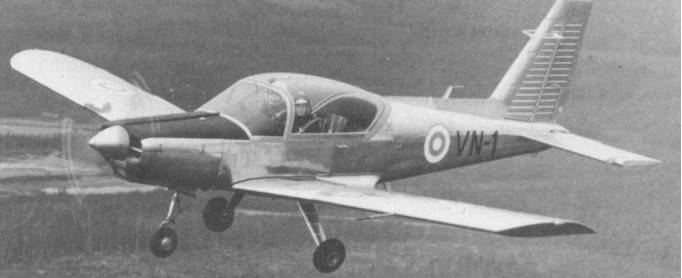
Own designed Leko-70 Vinka two-seat piston-engined trainer evolved by new design group created September 1970. The L.70 first flew on July 1, 1975.
Valmet L.70 Militrainer Article
30 Valmet Vinka were delivered to the Finish air force in the late 1970s, and entered service as the Vinka in October 1980. Production of the L.70 piston-engined side-by-side primary/basic trainer for the Finnish Air Force ended in 1982.
L-70 Miltrainer
Engine: 1 x Lycoming AEIO-360, 150 kW
Span: 9.8 m
Length: 7.5 m
Wing area: 14.5 sq.m
Empty wt: 765 kg
MTOW: 1250 kg
Warload: 300 kg
Max speed: 235 kph
Initial ROC: 340 m / min
Ceiling: 4800 m
T/O run: 230 m
Ldg run: 175 m
Fuel internal: 170 lt
Range: 970 km
Valmet Vima Gallery

Valmet Vima

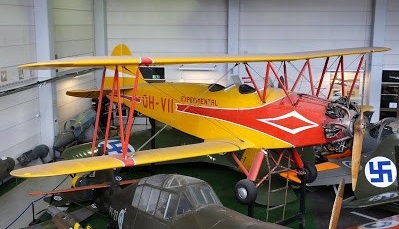
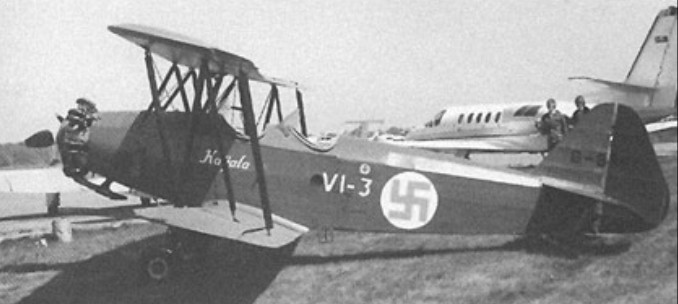
Two-seat trainer designed by engineer Arvo Ylinen. The Finnish Air Force had 22 aircrafts in use in 1937 – 1963, in addition the civilian aircraft OH-ILM was added as VI-40 in 1953.
Valmet
Valmet Oy Kuoreveden Tehdas
Valtion Metallitehtaat Lentokonetehdas
Valmet Oy Tampere
Valmet Aviation Ind
Finavitec OY
Finland
Valmet Oy was shortened title from 1958 of state-owned group (Valtion Metallitehtaat Lentokonetehdas) consisting of several metalworking factories. Kuoreveden Tehdas (Kuorevesi Works) was formerly part of factory group Valmet Oy Tampere, from which it separated in 1974, and became the largest aircraft factory in Finland. Foreign aircraft produced under license included Potez (Air Fouga) Magister jet trainers and 12 Saab Draken fighters. Own designed Leko-70 Vinka two-seat piston-engined trainer evolved by new design group created September 1970, followed in 1985 by the two/four-seat L-80 TP turboprop version. Also flew prototypes of the PIK-23 Towmaster. Valmet also assembled 46 of the 50 BAe Hawk jet trainers for Finnish Air Force. Other activities included overhaul and repair of military and civil aircraft and piston aero engines. The other aviation member of group was Valmet Oy Linnavuoren Tehdas, at Siuro, concerned mainly with overhaul and repair of jet aero engines.
Valmet Aviation Ind followed on from Valmet OY before the latest change to Finavitec OY. Manufactured the L-90TP RediGO turboprop trainer before being sold to Aermacchi of Italy in 1996. Began assembly of 57 F-18C Hornet fighters for the Finnish Air Force from kits, and manufactured parts, plus their engines.
Valley Engineering Back Yard Flyer
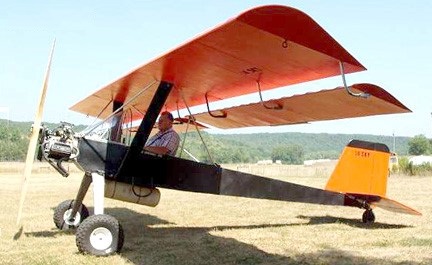
A Back Yard Flyer UL prototype was built by Valley Engineering in 2005 as a STOL ultralight. Featuring a constant-chord wing with trailing full-length “flaperons.” Demonstrated take-off in about three seconds over 70 feet. With simple disassembly for trailering it was priced around.$25,000.
Planned production was for a two place, open cockpit low wing monoplane, side-by-side SP version for the FAA Part 103 Sport Pliot market, includes ballistic parachute system.
Engine: Valley-VW
Cruise speed: 90 mph
Stall: 30 mph
Seats: 1
Valley Engineering
Gene & Larry Smith
Rolla MO.
USA
Built the Back Yard Flyer UL in 2005.
Valentin Taifun 11S
Taifun 12E as two-seat lightplane was developed into Taifun 11S four-seater of 1988.
Valentin Taifun 12E
Valentin Flugzeugbau Gmbh developed Taifun 12E as two-seat lightplane (first flown 1985), it has a two bladed non retracting Muhlbauer variable pitch feathering propeller.
Further developed into Taifun 11S four-seater of 1988.
Valentin Taifun
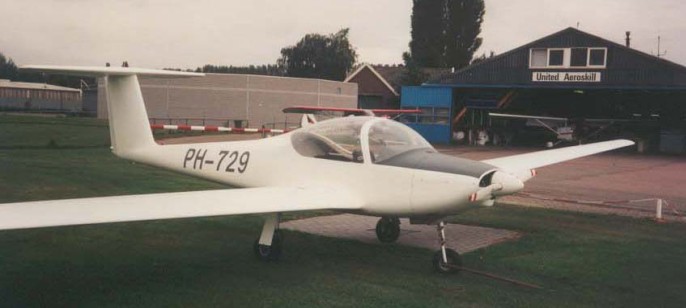
The Taifun two-seater motor glider was designed by Thomas Fischer and Dipl-lng Jorg B. Stieber for Valentin GmbH Gerateund Maschinenbau, makers of high-quality aircraft switches.
The Taifun is a cantilever low wing monoplane with a T-tail; the one-spar wings and ailerons are of glassfibre/foam sandwich construction, with all glassfibre flaps. The wings can be folded flat along the fuselage for easier hangar stowage, and Schempp-Hirth air brakes are fitted in their upper surfaces. The stressed skin fuselage is also a glassfibre/foam sandwich structure as are the fixed incidence tailplane and elevator. All versions have disc brakes on the main wheels, and the nosewheel of the 15E and 17E is steerable; the undercarriage of both these variants is fully enclosed when retracted. The pilots are seated side-by-side under the rear sliding canopy, with dual controls as standard. Engine is an 80hp Limbach L2000 EB ‘flat four’ driving a Hoffman HO-V62 three-position two bladed
propeller.
Construction of the prototype had begun in July 1979. The prototype, a Taifun 17E registered D-KONO, made its first flight late in February 1981, as the Valentin Taifun, when more than 25 had been ordered.
Four versions of the Taifun were to be produced: the Taifun 15S is the basic model with 15m span wings and a fixed tailwheel undercarriage, the Taifun 17S has the same undercarriage as the 15S and 17m span wings, the Taifun 15E has 15m span wings and a retractable nosewheel undercarriage, and the Taifun 17E has the same undercarriage as the 15E but has 17m span wings.
Taifun 15E
Span: 49 ft 2.5 in
Length: 25 ft 6.5 in
Height: 7 ft 1 in
Wing area: 176.0 sqft
Aspect ratio: 13.8
Empty weight: 1,058 lb
Max take-off weight: 1,598 lb
Max speed: 165 mph (in smooth air)
Max cruising speed: 132 mph
Min sinking speed: 3.25 ft/sec at 54 mph
Best glide ratio: 28:1 at 75 mph
Max rate of climb: 531 ft/min at sea level
Range with max fuel: 652 miles
Taifun 15S
Span: 49 ft 2.5 in
Length: 25 ft 6.5 in
Height: 7ft 1 in
Wing area: 176.0 sqft
Aspect ratio: 13.8
Taifun 17E
Span: 55 ft 9.25 in
Length: 25 ft 6.5 in
Height: 7ft 1 in
Wing area: 189.4 sq ft
Aspect ratio: 16.4
Taifun 17S
Span: 55 ft 9.25 in
Length: 25 ft 6.5 in
Height: 7ft 1 in
Wing area: 189.4 sq ft
Aspect ratio: 16.4
TWI Taifun 17E II
Engine: 67 kW/ 90 bhp Limbach L 2400 EB1.b
Wing span: 17 m / 55.7 ft
Wing area: 17.6 sq.m / 189.4 sq.ft
Aspect ratio: 16.4
Airfoil: Wortmann FX-67-K-170/7
Empty Weight: 610 kg / 1345 lb
Payload: 240 kg / 529 lb
Gross Weight: 850 kg / 1874 lb
Wing Load: 48.3 kg/sq.m / 9.9 lb/sq.ft
L/DMax: 30 115 kph / 62 kt / 71 mph
MinSink: 0.95 m/s / 3.12 fps / 1.85 kt
Seats: 2

