Valtion Myrsky

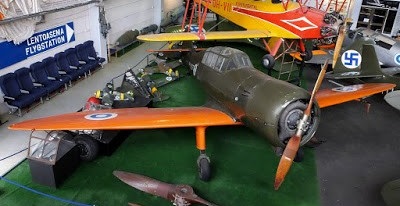
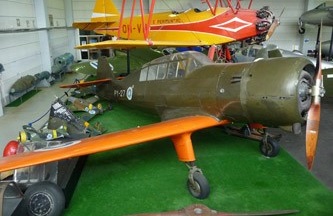
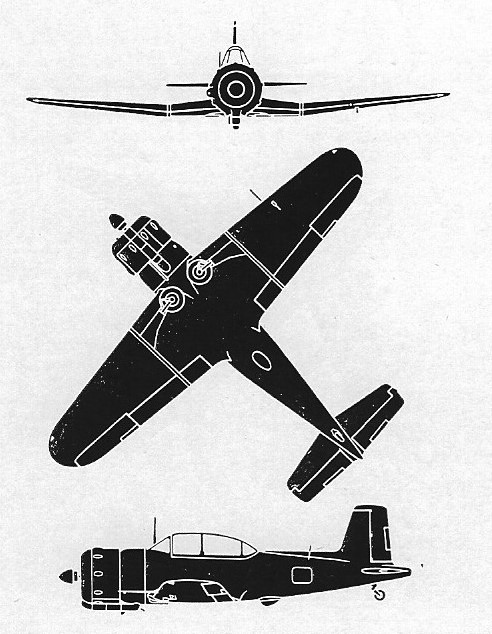
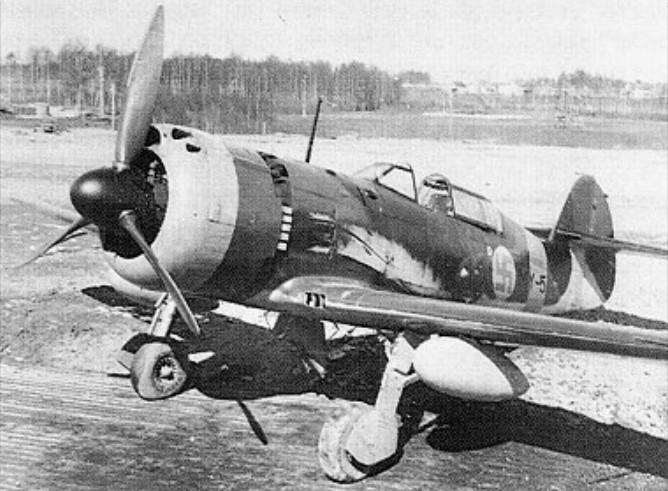
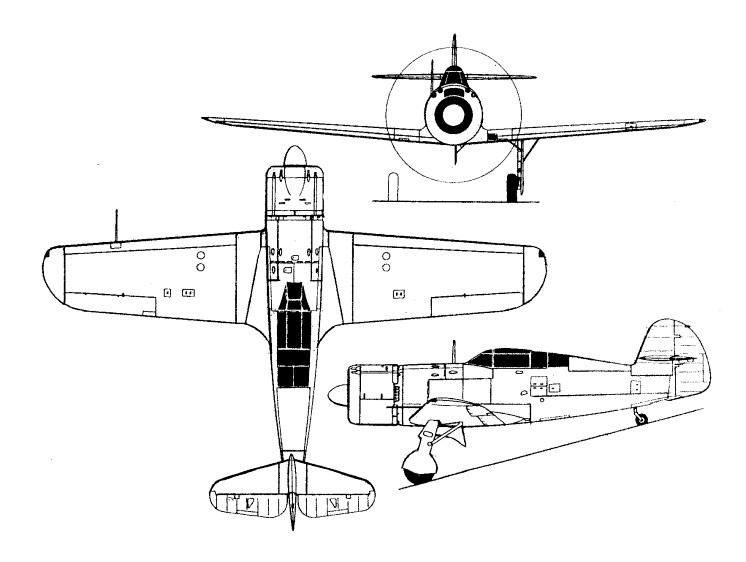
On 8 June 1939, the VL (Valtion Lentokonetehdas) received a contract from the Ministry of Defence to design a new single-seat fighter. Chief designer was Dipl Ing A Ylinen, who was assisted by T Verkkola and M Vainio, and, within nine months of receiving the definitive prototype contract on 20 December 1940, the prototype of the Myrsky (Storm) was in final assembly. A conventional low-wing cantilever monoplane, the Myrsky had a plywood-skinned two-spar wooden wing and a welded steel-tube fuselage covered by dural panels forward and fabric aft. Power was provided by a Pratt & Whitney R-1830-SC3-G Twin Wasp 14-cylinder radial rated at 1115hp for take-off. The prototype was flown on 23 December 1941, but immediately encountered the first of what were to be many teething troubles.
On 30 May 1942, the VL received a contract for three development aircraft which were to embody numerous detail structural and other changes, these including an increase in wing area of 1.3sq.m and a change in armament from two 12.7mm and four 7.7mm guns to three (in first and second) or four (in third aircraft) of the larger-calibre weapons. The first of these was completed on 30 April 1943, but crashed a week later, and the second suffered a wheels-up landing three months later, and broke up in the air shortly after resuming flight test. The third was evaluated in service, and, on 17 March 1944, lost both wings in a dive.
In the meantime, VL had initiated production of the first series model which was referred to as the Myrsky II Series. All the progressive changes that had been introduced in the pre-series aircraft were incorporated, armament was standardised on four 12.7mm LKK/42 guns, and by the end of July 1944 the VL had completed 14 of the II Series aircraft, a further 16 having been delivered by the truce of 4 September. Production continued after the truce and the last five of the 47 built were delivered straight to the Air Force Depot on 30 December 1944 without flight testing. The Myrsky II series was assigned to a tactical reconnaissance squadron (TLeLv 12) which received its first aircraft on 23 July 1944, 20 being delivered to the squadron before the Armistice, and a second squadron (TLeLv 16) initiating conversion to the Myrsky meanwhile. The Myrsky was flown operationally over Lapland against the Wehrmacht under the terms of the Finnish-Soviet agreement, but Ilmavoimat flew this fighter only to a limited extent, and the service’s doubts as to its durability and sturdiness, despite continuous reinforcement of various components, finally came to a head on 9 May 1947 when a Myrsky broke up in a dive, all aircraft of this type then being grounded.

Max take-off weight: 3213 kg / 7083 lb
Empty weight: 2337 kg / 5152 lb
Wingspan: 11.00 m / 36 ft 1 in
Length: 8.35 m / 27 ft 5 in
Height: 3.00 m / 10 ft 10 in
Wing area: 18.00 sq.m / 193.75 sq ft
Max. speed: 535 km/h / 332 mph
Range: 500 km / 311 miles
Valtion Sääski

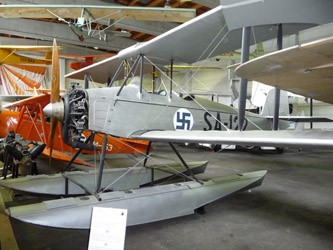
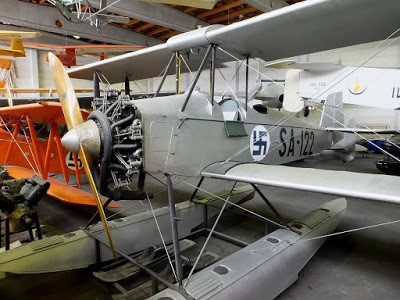
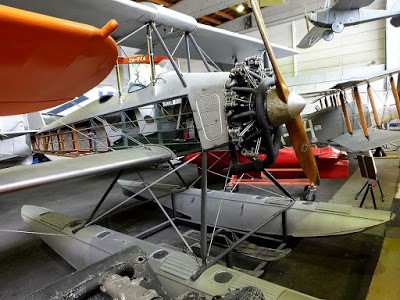
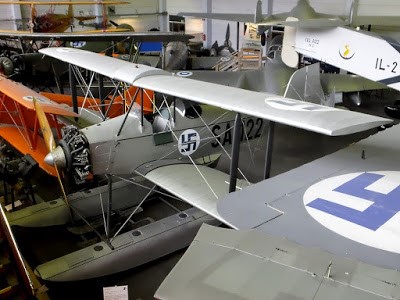
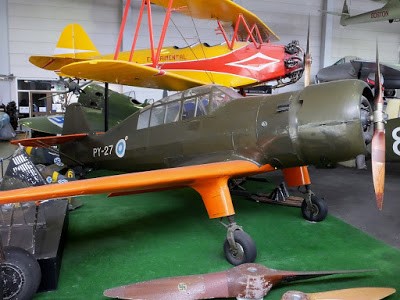
V.L. Sääski II – Registration number: SÄ-122, Serial number: 11

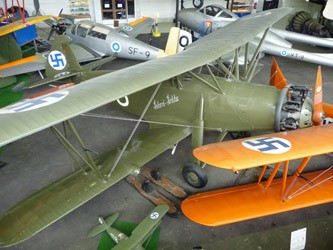
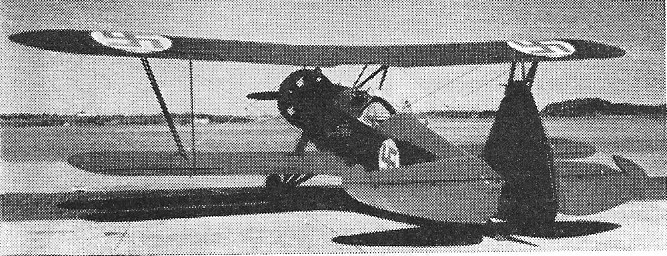
First VL product was the Saa’ski two-seat trainer. A trainer designed by engineer K.W. Berger and A. Nieminen. The first aircraft designed in Finland for mass production. The Finnish Air Force used 34 Sääski aircraft in 1928 – 1941. In addition, 5 aircraft were in civilian and official use.

SA-122

Valtion Lentokonetehdas / VL

Finland
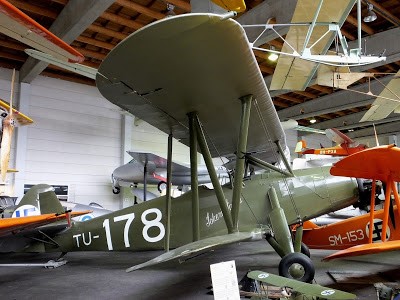
Finnish State Aircraft Factory, created February 1928 from former IVL (Ilmailuvoimien Lentokonetehdas = Aviation Force Aircraft Factory) which, from its formation near Helsinki in 1921, had built Hansa-Brandenburg W.33 seaplanes and Caudron C 60 trainers under license for Finnish Air Force, plus the Finnish-designed Kotka maritime reconnaissance/bomber biplane. First VL product was the Saa’ski two-seat trainer, followed by license production of de Havilland Moths and Blackburn Ripons. After producing the Vima light trainer and Tuisku advanced training/ reconnaissance biplanes, the VL was reorganized in 1936 and moved to Tampere, where it produced Pyry monoplane trainers, Fokker C.X. biplanes, Fokker D.XXI fighters and Bristol Blenheim bombers under license. Next indigenous product was single-seat Myrsky fighter of 1942-1945. Became part of Valtion after Second World War.

  1. The names of aircrafts of the State Aircraft Factory (Valtion Lentokonetehdas) since 1933 are different kind of winds. Therefore “Humu” means “Whirl”.

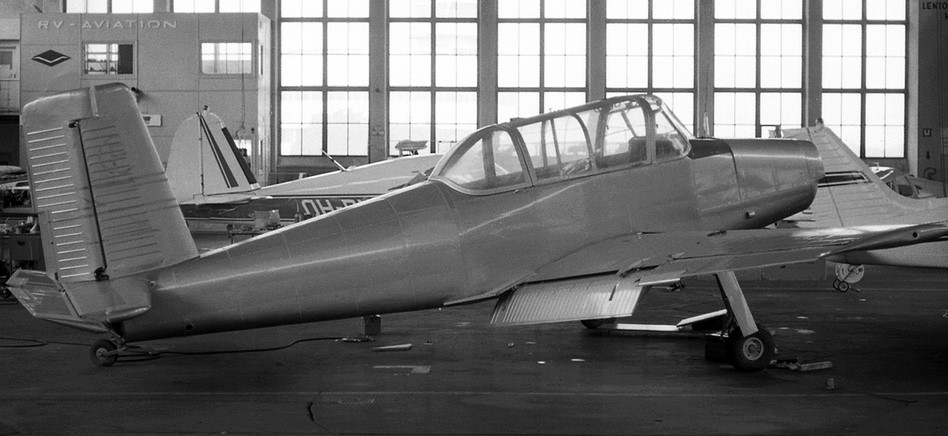
Valmet TL-III Tuuli

The TL-III Tuuli was a primary trainer for the Finnish Air Force.

The wing is a light alloy stressed-skin structure. With a main spar at 25% chord. The slotted ailerons are light-alloyed covered. Aerodynamically and mass balanced, and fitted with balance tabs adjustable on ground. The landing flaps open 40 degrees, and the ailerons are coupled to the landing flaps so when the flaps fully open the ailerons are deflected 15 degrees.

The fuselage is a light-metal stressed-skin construction. Two main frames, one at the instrument panel and one behind the cargo compartment, divide the fuselage into three separately manufactured parts, which are riveted together. The extension of the main spar passes under the front seats in the fuselage, to which the fastening points of the main spar of the wings are attached. The fastening point of the auxiliary spar connects with a reinforced fuselage rib. The rudder and the elevators are stressed-skin structures with light-alloy covering.

The fin and stabiliser are attached to the reinforced ribs on the rear fuselage. Landing gear is rtractable mains and fixed tailwheel. The front cockpit has side-by-side pilot seats with full dual controls.

It was available in three versions; an aerobatic two-seater, a three-seat utility aircraft, and a for-seat liaison aircraft. It is capable of fitting a standard size stretcher.

Engine: Continental O-470-A, 225 hp
Span: 36 ft 1 in
Length: 26 ft 3 in
Height: 8 ft 6 in
Empty weight: 2350 lb
Loaded weight: 3166 lb
Max speed SL: 136 mph
Cruise: 112 mph

Valmet Vihuri

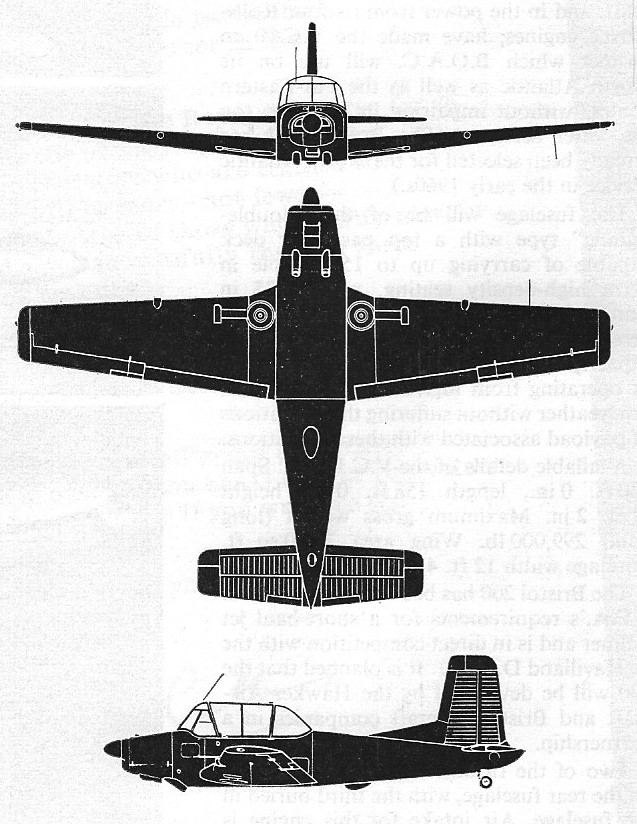
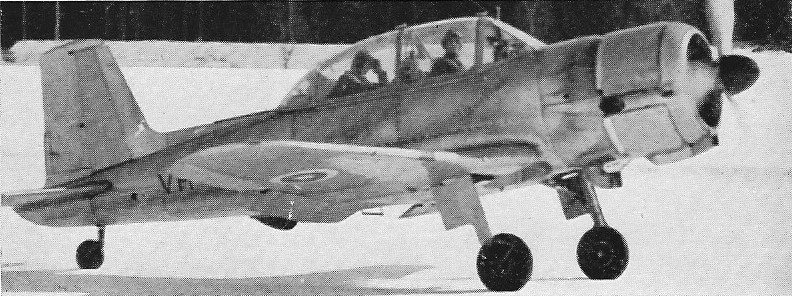
The Vihuri (Squall) was built for the Finish Air Force by Valmet OY at Tampere. The prototype flew for the first time on 6 February 1951, and the first production machine of an initial batch of thirty was flown on 3 August 1953.

Engine: 820 hp Bristol Mercury 8
Wingspan: 33 ft 1 in
Wing area: 202.9 sq.ft
Length: 28 ft 9 in
Height: 12 ft 8 in
Max weight: 6345 lb
Max speed: 268 mph at 12.140 ft
Econ cruise: 203 mph at 3280 ft
ROC: 2263 fpm
Service ceiling: 29,100 ft
Seats: 2

Valmet PIK-23 Towmaster / PIK Pik-23 Suhinu

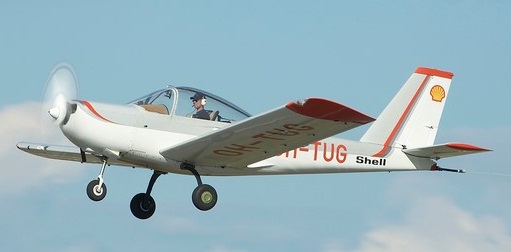
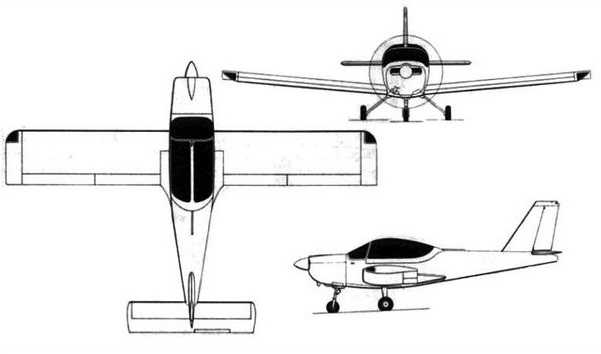
The Valmet PIK-23 Towmaster is a Finnish two-seat glider towing/primary trainer aircraft built entirely out of composite materials in the early 1980s.

The Finnish technology students aviation club suggested in the 1970s, that a new aircraft should be developed for glider towing. The work focused on the improvement of a previous design, the PIK-19 Suhinu (Suhinu is a contraction of Super Hino = Super Tow-plane). Later on, the Helsinki University of Technology and Valmet Oy joined the project and the design process started from scratch. The goal was to develop a target/glider tower, which also could be used for basic training. It was given the name “PIK-23 Towmaster”.

Only two aircraft were manufactured, one at Valmet and one at the Helsinki University of Technology. The first aircraft, OH-TOW, made its maiden flight on March 22, 1982, flown by Mikko Järvi. The second aircraft, OH-TUG, flew the following year. OH-TUG was written of in 1991.

Valmet marketed the aircraft intensively, but no orders followed. It was also investigated if the aircraft could be sold in parts, for self-assembly, in order to lower the price. In its intended role as a glider tower, the PIK-23 has been quite successful.

PIK-23
Engine: 1 × Avco Lycoming O-360-A4M, 130 kW (180 hp)
Propeller: 2-bladed Hoffmann fixed pitch
Wingspan: 10.00 m (32 ft 10 in)
Wing area: 14.00 m2 (150.7 sq ft)
Aspect ratio: 7.14:1
Airfoil: NACA 632415 (modified)
Length: 7.19 m (23 ft 7 in)
Height: 2.90 m (9 ft 6 in)
Empty weight: 590 kg (1,301 lb)
Max takeoff weight: 870 kg (1,918 lb)
Fuel capacity: 200 L (44 imp gal; 53 US gal)
Maximum speed: 250 km/h (160 mph, 130 kn) at sea level
Cruise speed: 220 km/h (140 mph, 120 kn) at 3,660 m (12,010 ft) (65% power)
Stall speed: 78 km/h (48 mph, 42 kn) (flaps down)
Never exceed speed: 281 km/h (175 mph, 152 kn)
Range: 1,250 km (780 mi, 670 nmi) at 3,660 m (12,010 ft) (65% power)
Endurance: 6 hr 30 min (55% power)
Rate of climb: 5.80 m/s (1,142 ft/min)
Takeoff run to 15 m (50 ft): 320 m (1,050 ft)
Crew: 2