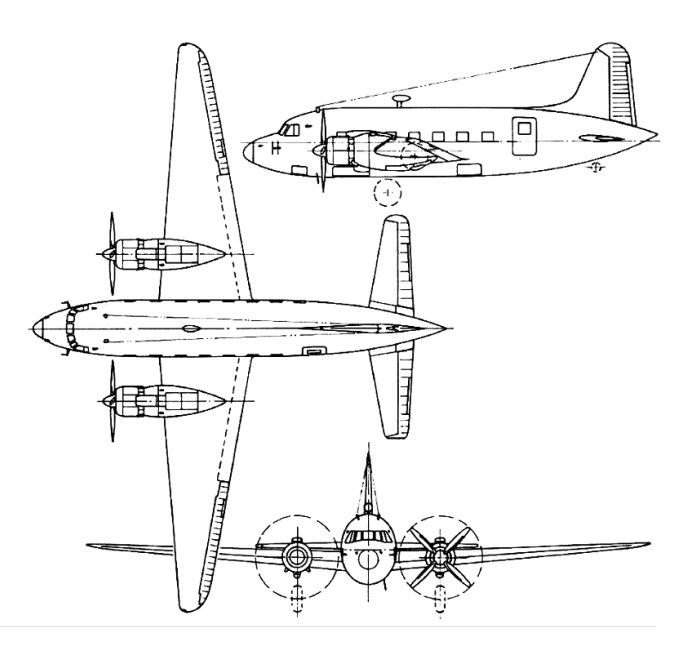
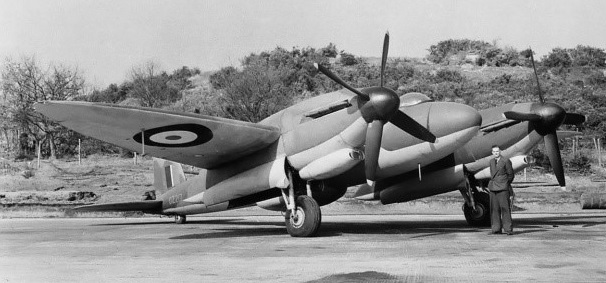
Vickers 660 Valiant

To meet the need for long range high altitude heavy bomber aircraft, capable of carrying nuclear weapons, the Avro Vulcan, along with the Handley Page Victor and Vickers Valiant, was developed in accordance with an Air Ministry specification that originated in 1947.

Vickers Valiant Article

The Vickers Valiant was designed to Air Ministry specification B.9/48. It was a cantilever shoulder-wing monoplane of all-metal stressed-skin construction. The wing had compound sweepback on the leading edge, somewhat similar to that of the Handley Page Victor, air-brakes, double-slotted flaps and powered ailerons. The fuselage was a circular-section semi-monocoque structure, incorporating a pressurised cell to contain the crew of five, and a large bomb bay which later proved capable of accommodating a Blue Steel stand-off weapon. The tail unit was conventional, but the tailplane was mounted almost half-way up the fin to keep it clear of the efflux from the four turbojet engines, buried in the inner wing adjacent to the fuselage. Landing gear was of tricycle type electrically retracting tan¬dem main gears folding outwards. The Valiant was largely conventional in construction, with a giant radar in its underside, an inflight refuelling probe (added after delivery) above and a ventral blister for a visual bombing station. The main weapon bay could house all the UK’s nuclear bombs (or the Blue BoarTV guided bombs) or up to 21 HE bombs of 454 kg (1,000 lb) each. One unusual feature was the extensive use of electrical power for the actuation of practically all movable units, even powered controls. The only exception was a minor hydraulic system for brakes and powered steering, but even this had its pumps driven by electric motors.

Two prototypes were ordered initially, one to be powered by four Rolls-Royce RA.3 Avon 204 turbojets and the other by four Armstrong Siddeley Sapphires. The first prototype made its maiden flight on 18 May 1951, but was lost in an accident on 12 January 1952. The second prototype flew first on 11 April 1952, but was powered by RA.7 turbojets instead of the Sapphires as planned originally.

Vickers Valiant 2nd prototype

In spite of the fact that two types of so-called V bomber were already on order it was put into production as well, allegedly as an insurance against ‘failure’ of the others.
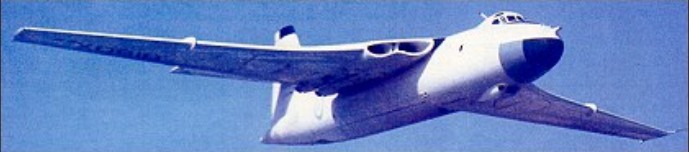
Named Valiant, B.1 began to enter service in January 1955, the first of the V-bombers to serve with the RAF. They were followed by B(PR).1 long-range strategic reconnaissance; B(PR)K.1 multi-purpose bomber, photo-reconnaissance, tanker; and BK.1 bomber/tanker aircraft. Production totalled 111 examples, including one B.2 pathfinder prototype. Used extensively in service, Valiants dropped the first British hydrogen and atomic bombs and during operations in the Suez campaign operated with high-explosive bombs.
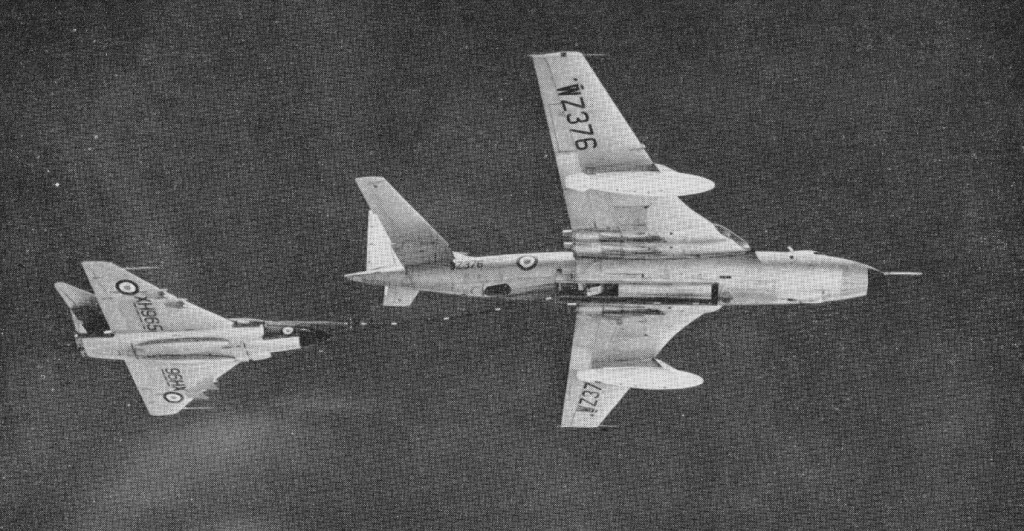
Javelin FAW.8 refuelling from a Vickers Valiant

Vickers built 108 including prototypes, and from January 1955 these served with 10 RAF squadrons. At first painted all in anti flash white, with very pale roundels and serials, they set a high standard in navigation and bombing, though most crews wished to forget their one taste of actual warfare when in late 1956 four squadrons bombed Egyptian targets during the ill starred Suez campaign. Valiants carried out all of the UK’s live air tests of nuclear weapons. There were reconnaissance, tanker and multi role versions, and from 1963 Valiants were given regular grey and green camouflage and assigned to low level missions using conventional bombs in support of SACEUR (Supreme Allied Commander, Europe) as a NATO force, though still based in the UK. By this time they were the RAF’s only inflight refuelling tanker force.

In the Autumn of 1957 these four Valiants, with two Vulcans, flew to the US to compete with USAF teams in anannual bombinng compteition. One Valiant came 11th of the 100 aircraft competing.

Intended for fast high-altitude strategic bombing, the Valiant – in company with other V-bombers – was switched to low-level operations. There seems little doubt that the stresses imposed by such a role accelerated the wingspan metal fatigue first reported in late 1964, and which led to the scrapping of all Valiants in January 1965.

The RAF did not buy the Valiant Mk 2, first flown in 1953, which was specially designed for low level operations. With just over 100 built at Brooklands aerodrome, production ended in the autumn of 1957.

Gallery

Vickers Valiant B.Mk.1
Engines: 4 x Rolls-Royce RA.28 Avon 204/205, 10,050 lb / 44.7kN
Wingspan: 34.85 m / 114 ft 4 in
Length: 32.99 m / 108 ft 3 in
Height: 9.8 m / 32 ft 2 in
Wing area: 219.43 sq.m / 2361.92 sq ft
Max take-off weight: 63503 kg / 140001 lb
Empty weight: 34419 kg / 75881 lb
Max fuel w/underwing tanks: 9972 gal
Max speed: 492 kts / 912 km/h / 567 mph at 30,000 ft
Max cruise: 553 mph at 30,000 ft
Service Ceiling: 16460 m / 54000 ft
Range w/max.fuel: 7242 km / 4500 miles
Bombload: 9525kg / 21,000 lb or 2 x 1615 flight refuelling tanks
Crew: 5

Valiant B(K)Mk.1
Type: five seat bomber and inflight refuelling tanker
Engines: 4 x 4763 kg (10,500 lb) thrust Rolls Royce Avon 201 turbojets
Max speed 912 km/h (567 mph) at 9145 m (30,000 ft)
Service ceiling: 16460 m (54,000 ft)
Range with reduced bombload 7242 km (4,500 miles)
Wing span: 34.85 m (114 ft 4 in)
Length (normal long ECM tailcone): 33.00m(108ft 3in)
Height: 9.81 m (32 ft 2 in)
Wing area: 219.44 sq.m (2,362.0 sq ft)
Bombload: 9526 kg (21,000 lb)
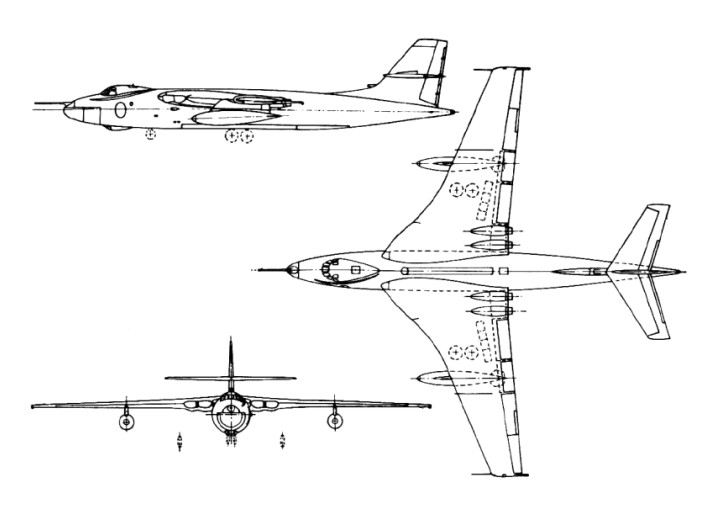
Vickers Valiant

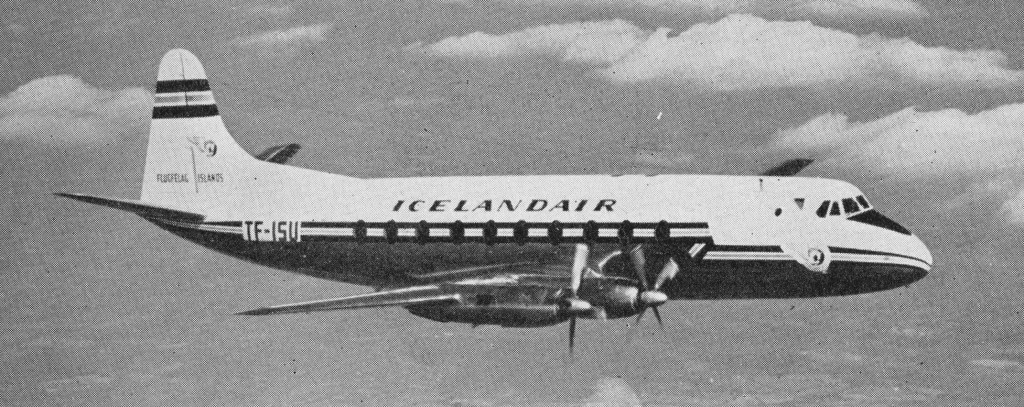
Vickers Viscount Gallery

Back to Vickers Viscount

Vickers Viscount 802
Viscount 800
Viscount 800
South African Airways
Vickers Viscount 807 ZK-BRF
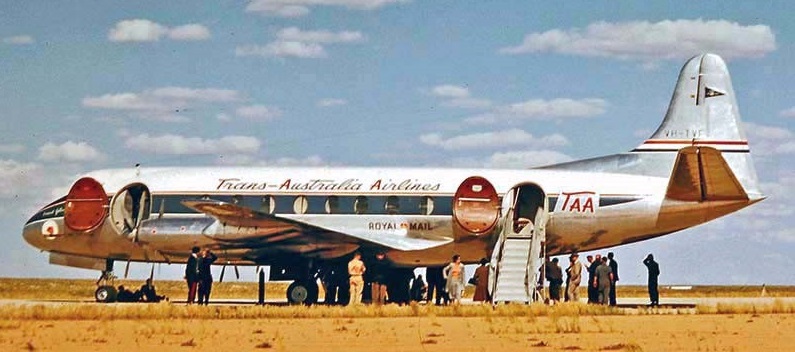
TAA Viscount VH-TVF on a Forrest, Australia, diversion in 1955. On this occasion several tyres blew out during landing, passengers patiently wait while the tyres are replaced.
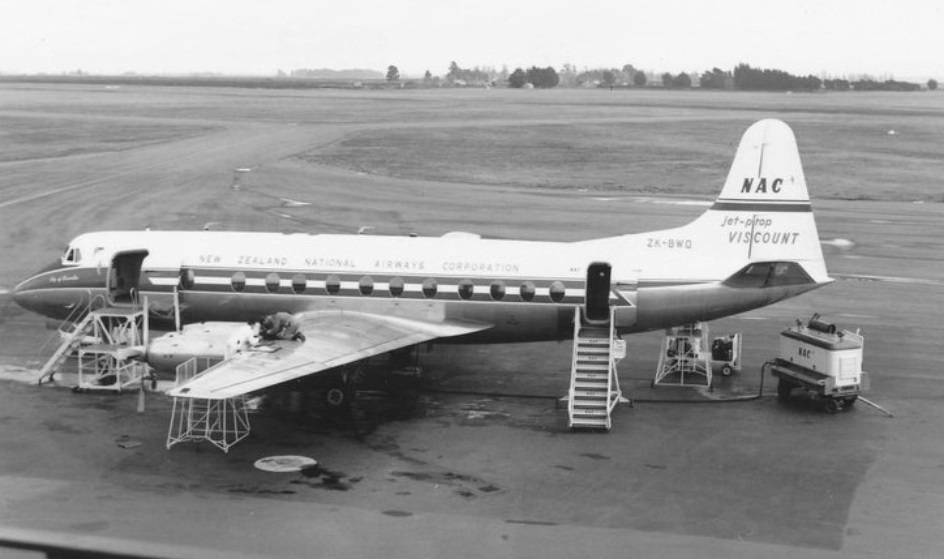
Viscount 807 ZK-BWO
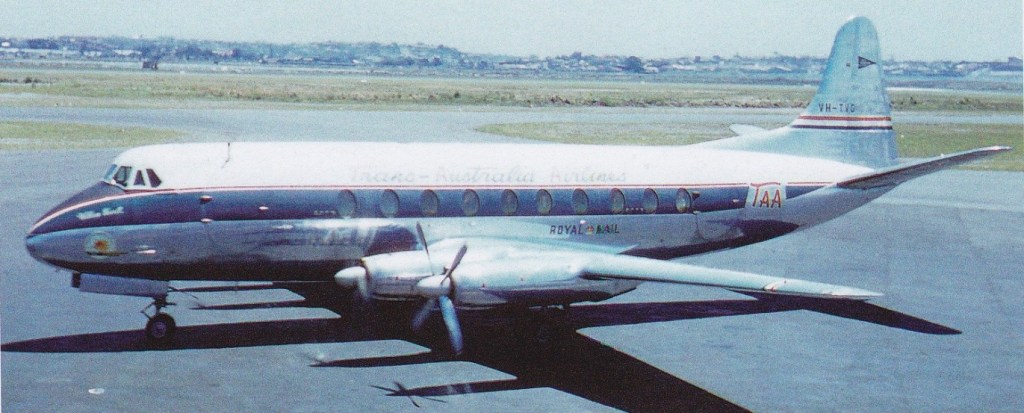
Viscount V.720 VH-TVG c/n 84
1948
1948
1949

Vickers Viscount

Viscount 806

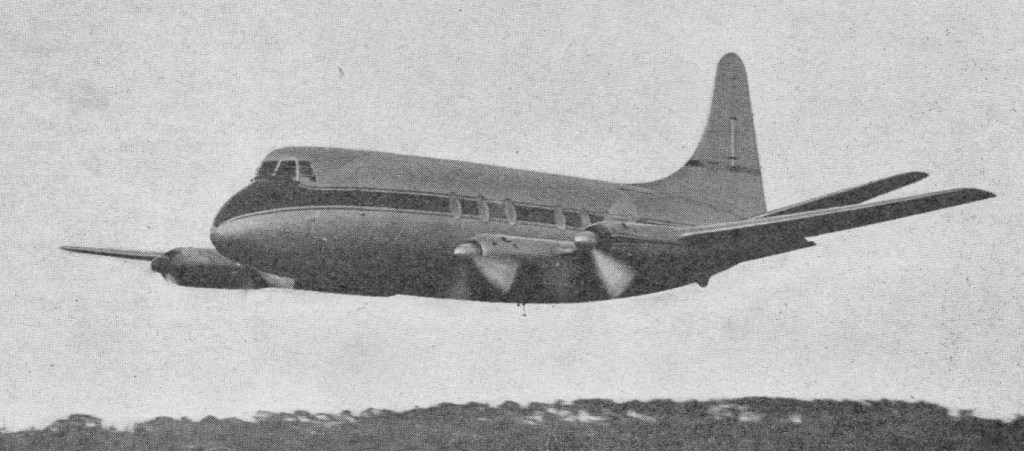
The origin of the Viscount can be traced back to the war-time Brabazon Committee, which was charged with the task of steering Britain’s aircraft industry in the right direction in the immediate post-war years. One of its recommendations was the development of a turboprop-powered short/medium-range airliner (identified originally as the Brabazon IIB), and in April 1945 Vickers were instructed to proceed with its design and development, then identified by the company as the VC2 project.

Vickers Viscount Article

Discussions between the committee, liased with B.E.A., and Vickers designers resulted in the developing of the Type 609. Construction of two prototypes began in December 1946, modified to a 32-seat capacity at the request of British European Airways, renumbered Type 630 and named Viceroy. The name was changed to Viscount in 1947. This was the first of the company’s designs to be brought to fruition under the leadership of George (later Sir George) Edwards, following the death of Rex Pierson.
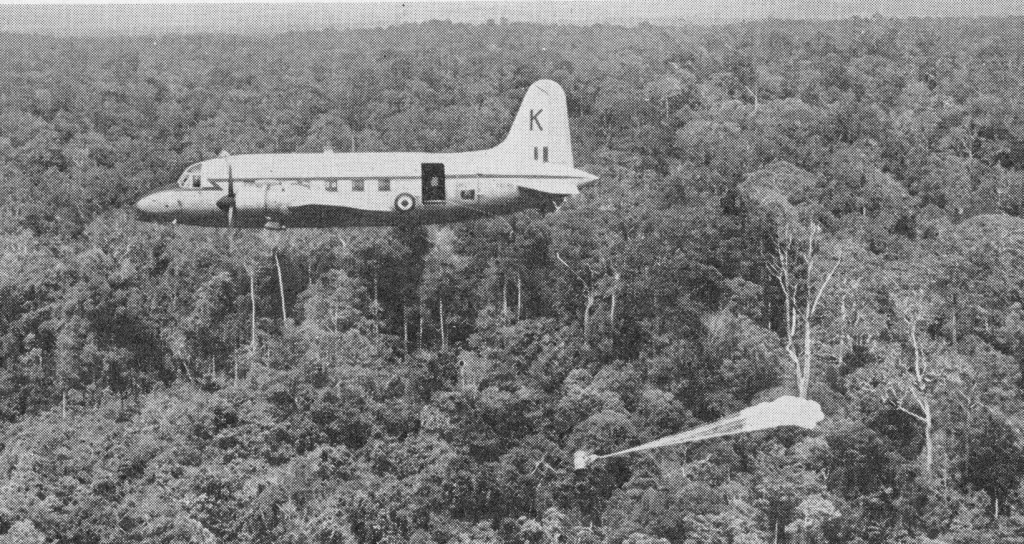
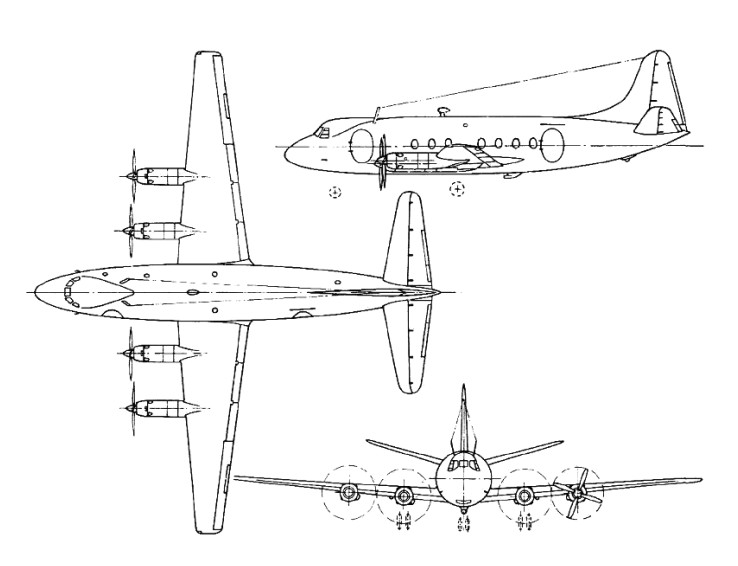
As finalised, a circular-section pressurised fuselage was chosen with low-set monoplane wings, a Vickers-style tail unit, retractable tricycle-type landing gear and four of Rolls-Royce’s new Dart turboprops.
Despite the efforts of Edwards, his design team and Vickers’ engineers, interest in the project waned when BEA had doubts about the aircraft’s economics in the autumn of 1947.

Prototype Model 630 Viscount (G-AHRF) powered by Rolls-Royce Darts engines was flown first on 16 July 1948. The second prototype (G-AHRG; VX217), completed with Rolls-Royce Tay turbojets was used as an engine test-bed. The design was considered as to small and slow, went back to the drawing board and re-emerged as the larger Type 700 with a 53-seat capacity. The new prototype (G-AMAV) flew for the first time on August 28, 1950. By this time, BEA had already bolstered Vickers’ enthusiasm by ordering 20 (later 26) Viscount 701s on 3 August.

Flying the Vickers Viscount

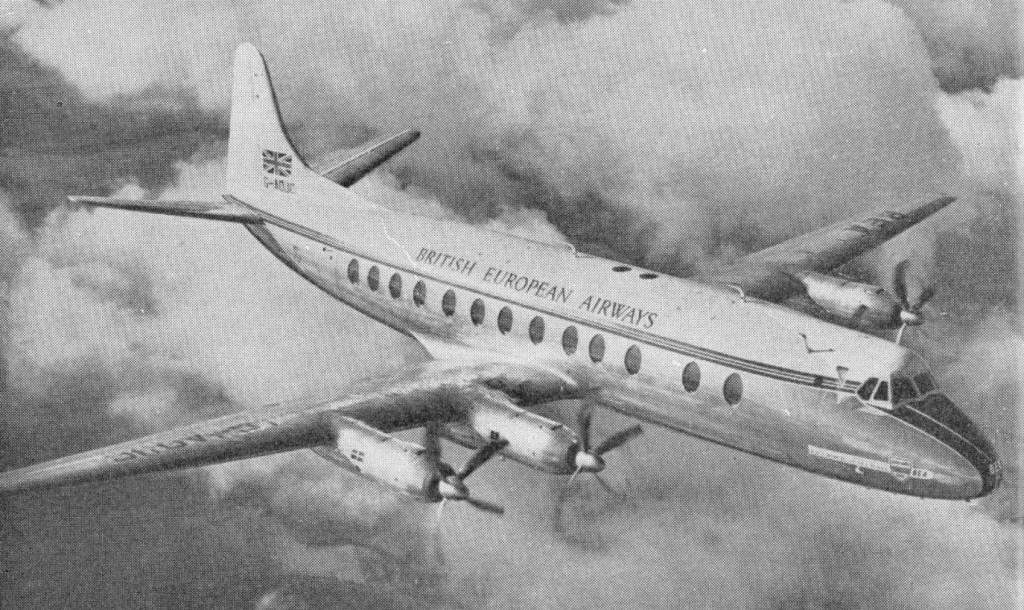
The Viscount prototype was loaded to British European Airways and operated the world’s first turboprop service on 29 July 1950. An order for 30 Viscounts was signed by BEA in August 1950 with BEA operating the first commercial flights on 18 April 1953.

A C.A.A. team arrived on May 16th 1954 to evaluate the Viscount. Their visit, the first step towards American certification of the Viscount, resulted from negotiations between Vickers-Armstrongs and TransCaribbean Airways, an American independent airline.

The Italian journal Alata reported in May 1954: “The Viscounts destined for the R.A.F., probably three in number – two to replace the present Royal Vikings – will be 700Ds, and will be powered by the new Dart RDa.6.”

The Viscount 700 had a fuselage 80 inches longer, albeit bringing a 7,500 lb weight increase. The proto-type had a fuel load of 1,620 gallons whereas pro¬duction Type 701s would carry 1,920 gallons. A total of 287 of the Viscount 700 Srs. were built.

The 800 series had more powerful engines and a longer fuselage seating up to 75 pas¬sengers and flew on 27 July 1956, sixty-seven being produced, followed by 84 Viscount 810 Srs. aircraft.

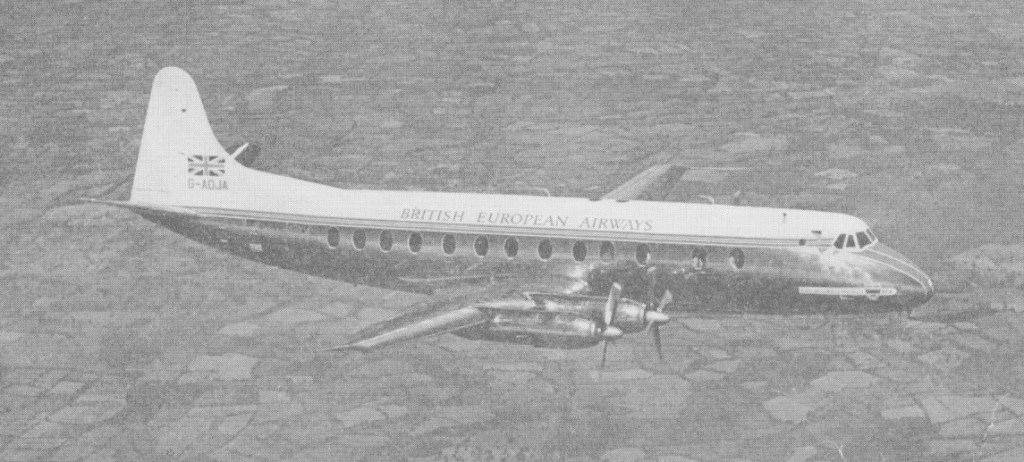
The prototype Viscount 802, G-AOJA, was the first production aircraft and destined for service with BEA. BEA had 24 Viscount on order.
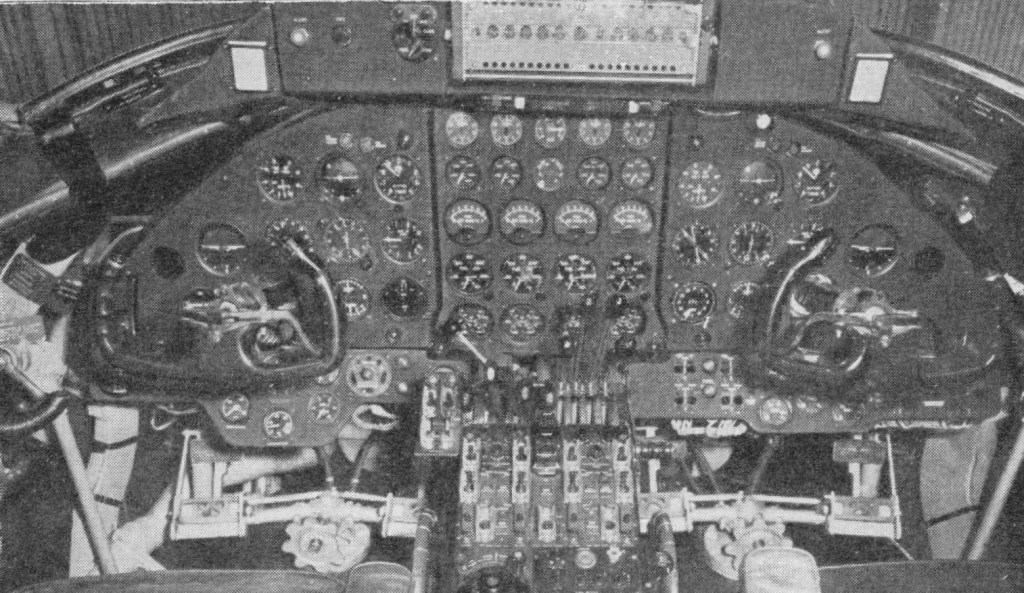
The BEA Viscount 802 featured an altered instrument panel to fit a Smiths Flight System direction indicator and beam compass and Decca Flight Log.

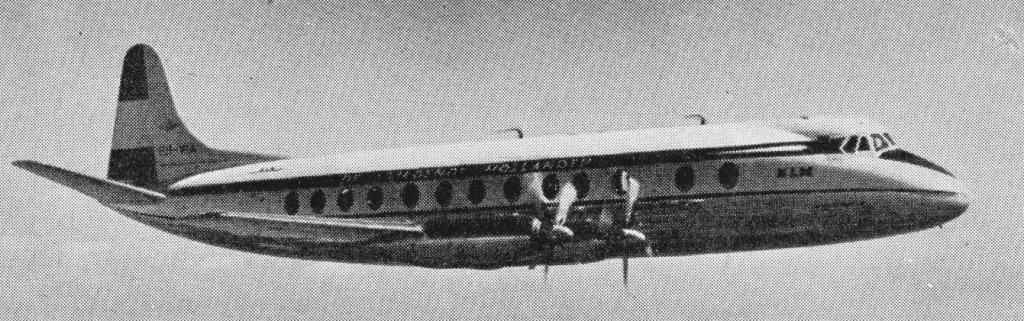
KLM began receiving the first of nine Viscount 803s at the end of 1957. By the middle of 1958 40 airlines had ordered the Viscount 400 had been sold so far at over £150 million.

Viscount 803

One development, flown but not continued, was a RR Tay powered version.
Between 1953 and 1959 438 were sold and orders from Capital Airlines of Washington totalled 60 aircraft.

Gallery

700
Engines: 4 x 1,530 h.p. Rolls Royce Dart 506 turboprop
Length 81.2 ft. (24.75 m)
Wing span 94 ft. (28.65 m)
Weight, loaded 56,000 lb. (2,540 kg)
Seats: 3 to 4 crew; 40 to 48 passengers
Max cruise speed: 300 mph (480 kph)
Ceiling 28,500 ft. (8,700 km) fully loaded
Range: 750 miles (1,200 km) 13,000 lb payload

Viscount 700D
Engines: 4 x RR Dart 510
Span 93 ft 8.5 in
Length 81 ft 2 in
MAUW 60,000 lb
Cruise speed 320 mph

Vickers V 800 Viscount
Engines: 4 x Rolls Royce Dart 510, 1989 shp
Length : 85 ft 7 in / 26.11 m
Height : 26.739 ft / 8.15 m
Wingspan : 93 ft 8.5 in / 28.65 m
Max. speed : 297 kts / 550 km/h
Cruise speed: 315 mph
Service ceiling : 25098 ft / 7650 m
Crew : 3+60
MAUW: 62,000 lb

807
Engines: 4 x Rolls-Royce Dart

810 Viscount
Crew: 2
Passengers: 75
Engines: 4 x Rolls-Royce Dart RDa. 7/1 Mk 525 turbo-prop, 1566kW
Max take-off weight: 32885 kg / 72499 lb
Empty weight: 18854 kg / 41566 lb
Wingspan: 28.56 m / 94 ft 8 in
Length: 26.11 m / 86 ft 8 in
Height: 8.15 m / 27 ft 9 in
Cruise speed: 563 km/h / 350 mph
Ceiling: 7620 m / 25000 ft
Range w/max.payload: 2776 km / 1725 miles

Vickers Viscount

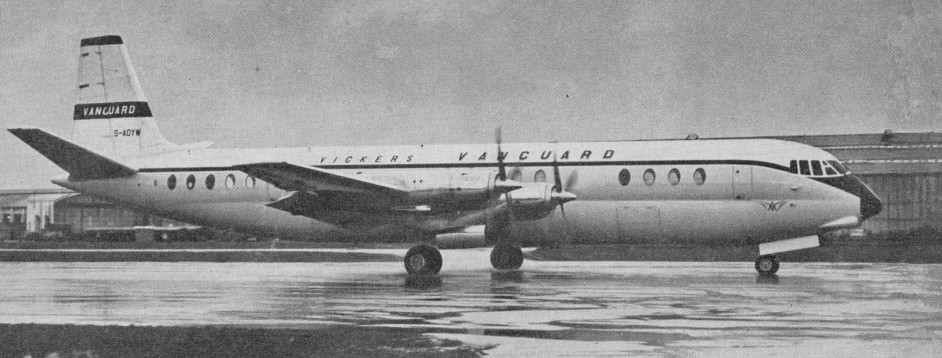
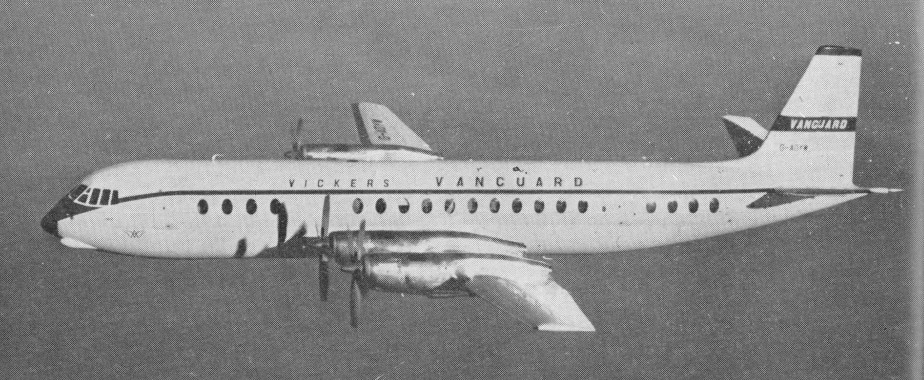
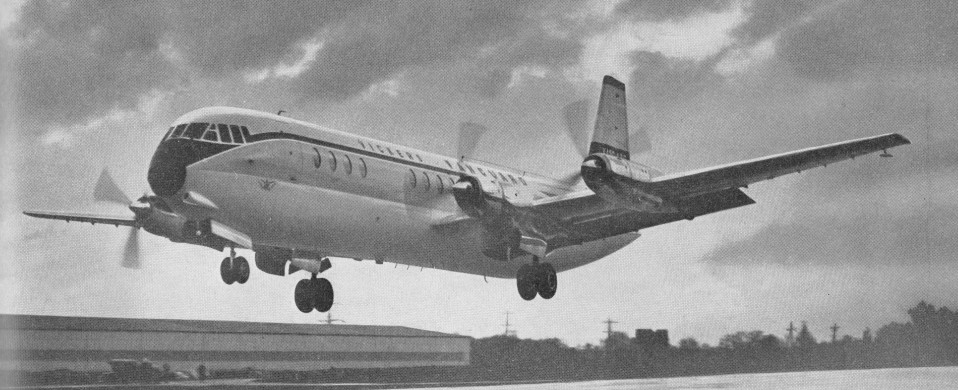
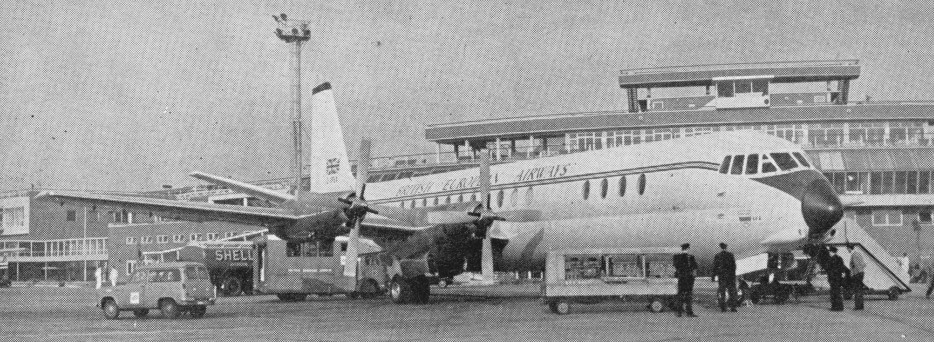
Vickers 952 / 953 Vanguard / Merchantman

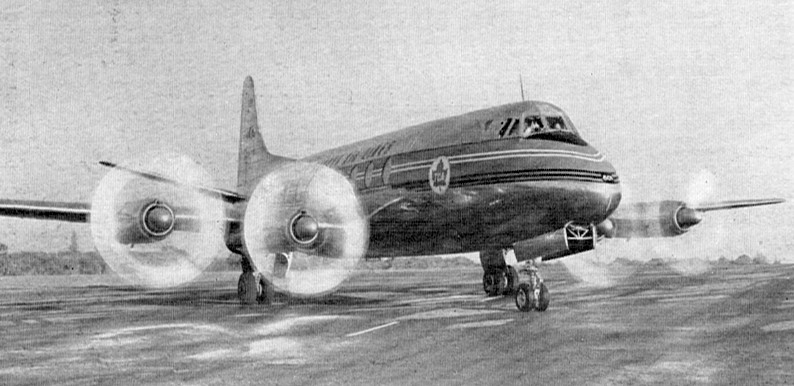
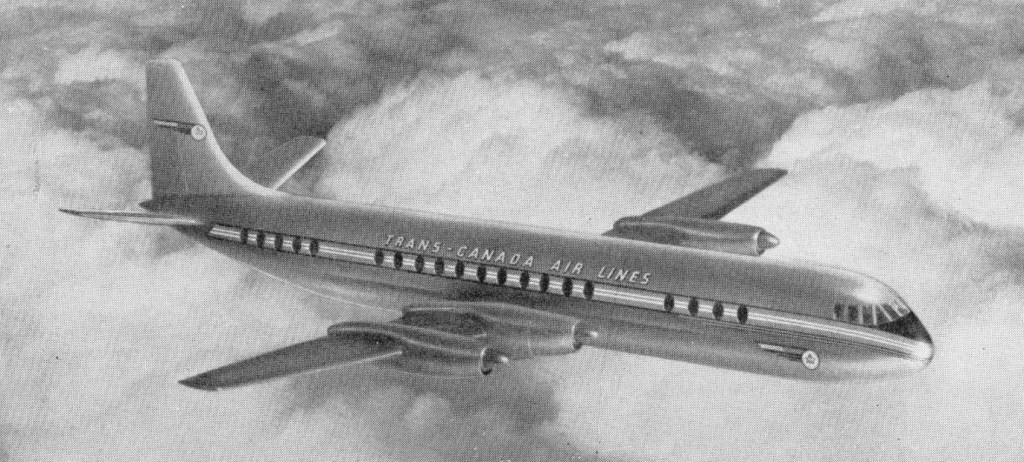
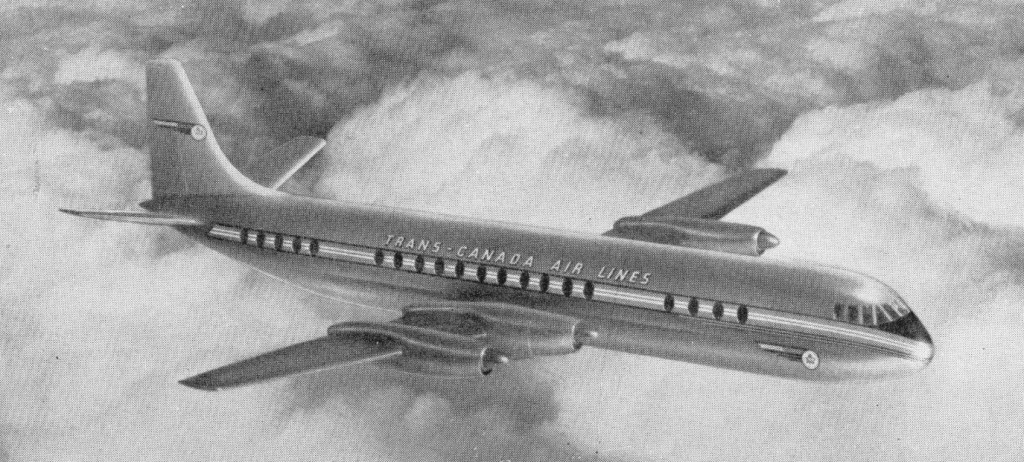
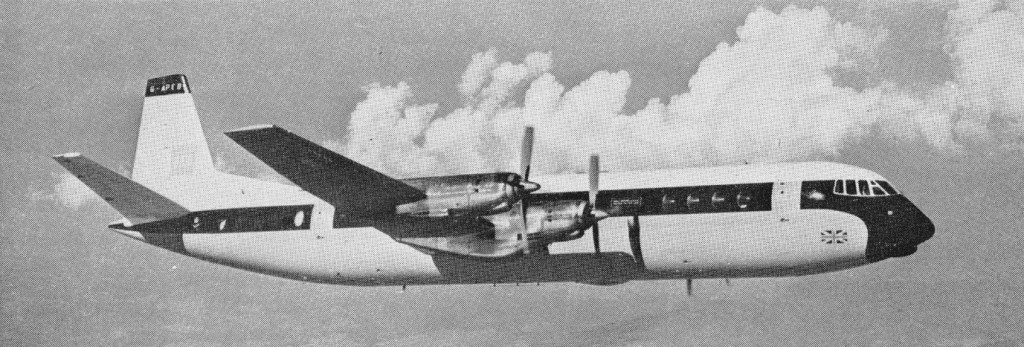
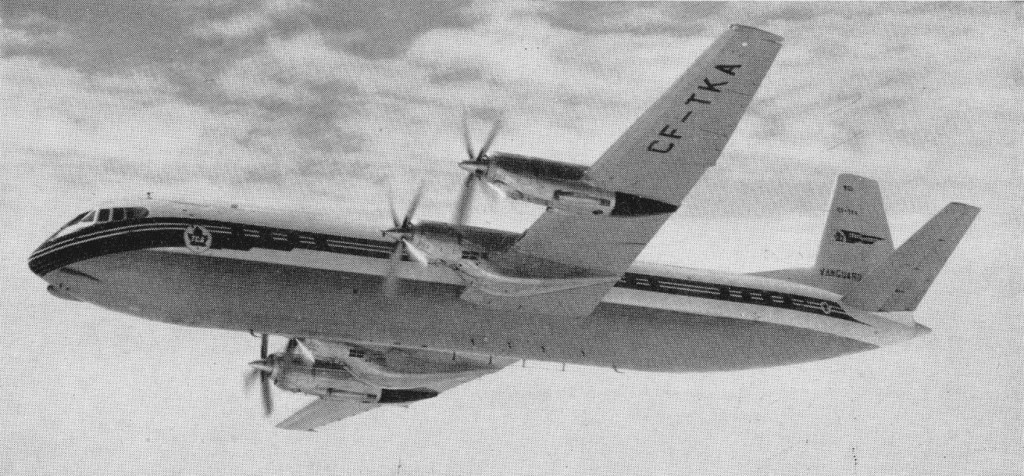
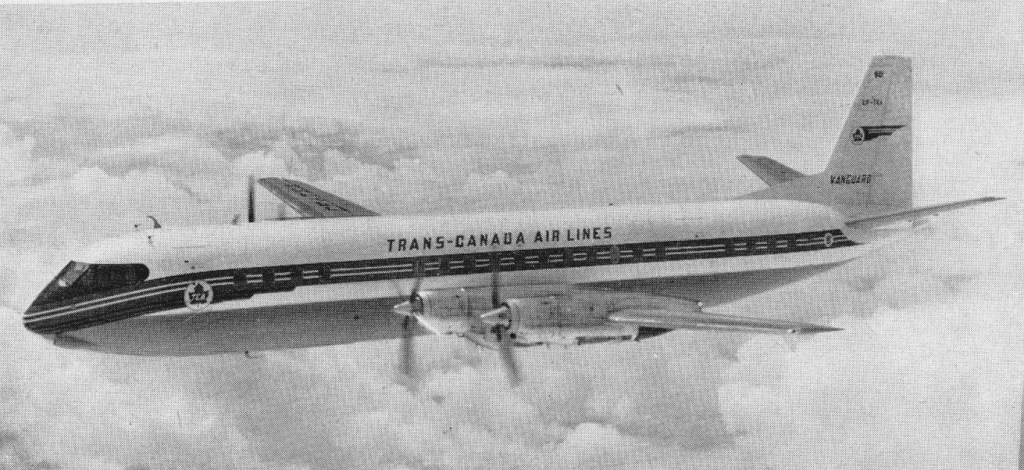
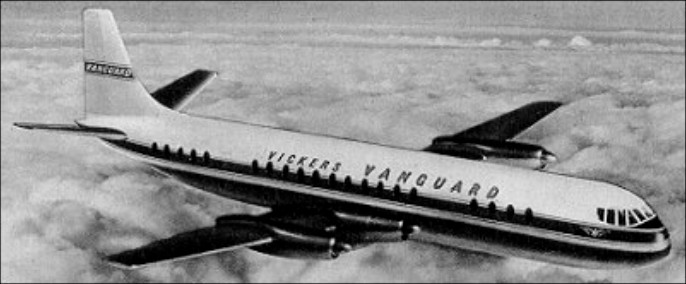
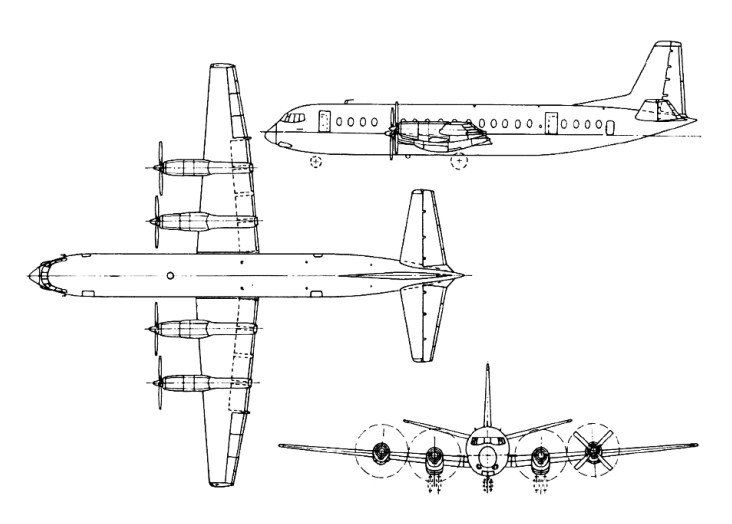
In early 1953, not long after the Viscount entered service with British European Airways (BEA), discussions began to initiate the design of a successor. Both BEA and Trans-Canada Airlines were interested in a generally similar aircraft; compromise in design to satisfy the views of these two operators resulted in the low-wing configuration and ‘double-bubble’ fuselage to provide a large underfloor cargo hold beneath the main cabin.
The power plant considered originally for inclusion in the design was the Rolls-Royce Dart. But Rolls-Royce intimated that development of a new engine, the RB.109, was then well under way and it (later known as the Tyne) was chosen to power this new transport. Construction was entirely conventional except for the wing, which introduced integrally machined skins of light alloy to provide spanwise stiffening at low cost, and three shear webs instead of the single spar in the Viscount wing. When tied together by closely spaced ribs it produced a rigid box structure and outboard of the centre-section it was sealed to form integral fuel tanks.

First flight of the prototype Vanguard, as the new aircraft had been named, was made on 20 January 1959. But because of the normal development programme of a new civil airliner – coupled with delays caused by problems with the new power plant – it was not until 1 February 1961 and 1 March 1961 that these aircraft began regular service with Trans-Canada Airlines and BEA respectively. The Vanguard made its first public appearance flying London-Hamburg-London (940 sm) in 2 hr 33 min. The flight was made by the second prototype G-APEA. By then this and other second-generation turboprop-powered airliners had been deposed by the development and introduction into service of economical turbojet-powered airliners such as the Boeing Model 707. Consequently production ended after the original orders had been completed: 20 for BEA and 23 for Trans-Canada Airlines.

Trans-Canada Airlines increased its order for Vickers Vanguards to 23 during 1960.

On 10 October 1969 the first of nine freighter conversions of the Vanguard by Aviation Traders (Engineering) Ltd, called Merchantman, was flown for BEA.

Gallery

Type 952 Vanguard
Engines: 4 x Rolls-Royce Tyne RTy.11 Mk 512 turbo-prop, 4135kW / 5545 shp
Props: 4 blade, 14.5ft dia
MTOW: 146,500 lb (66451 kg)
Empty weight: 37421 kg / 82500 lb
Wingspan: 36.14 m / 118 ft 7 in
Length: 37.45 m / 122 ft 10 in
Height: 10.64 m / 35 ft 11 in
Wing area: 141.86 sq.m / 1526.97 sq ft
Cruise speed: 684 km/h / 425 mph at 20,000ft
Ceiling: 9145 m / 30000 ft
Range w/max.payload: 2945 km / 1830 miles with max payload (37000lb/16,783kg) at 420 mph
Typical range: 1830 miles (2945 km)
Crew: 2-3
Passengers: 97-139

Type 953C Merchantman

Vickers Vanguard

Vickers Valetta

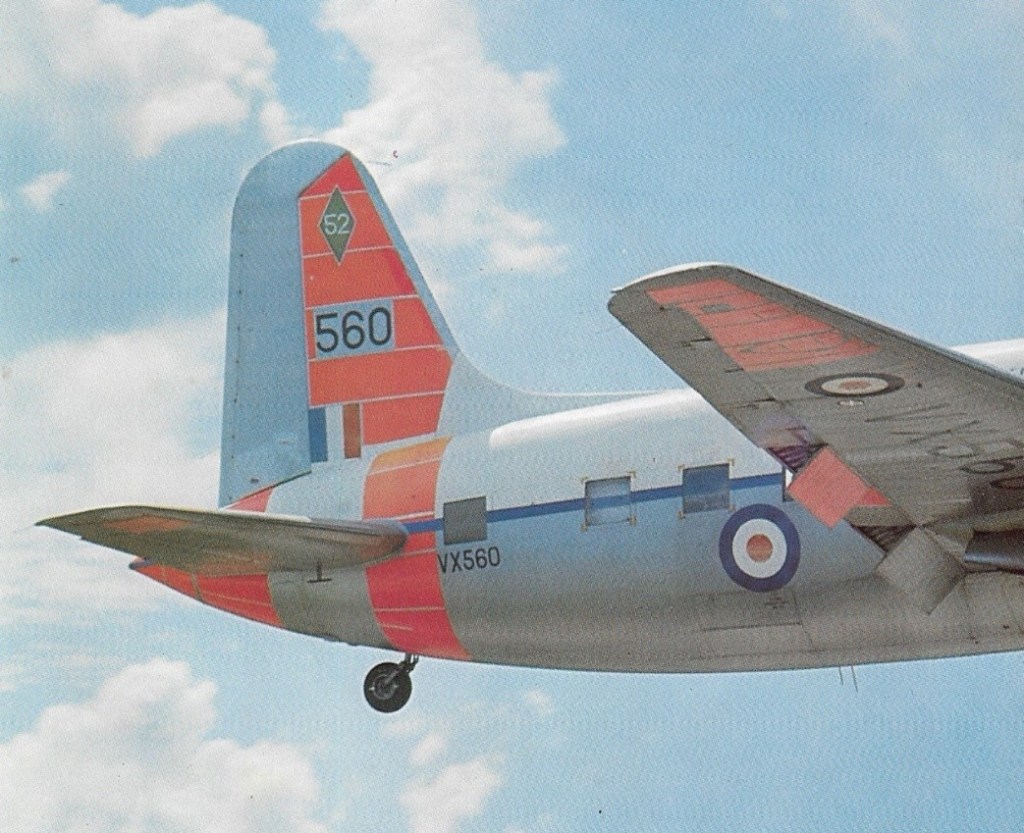
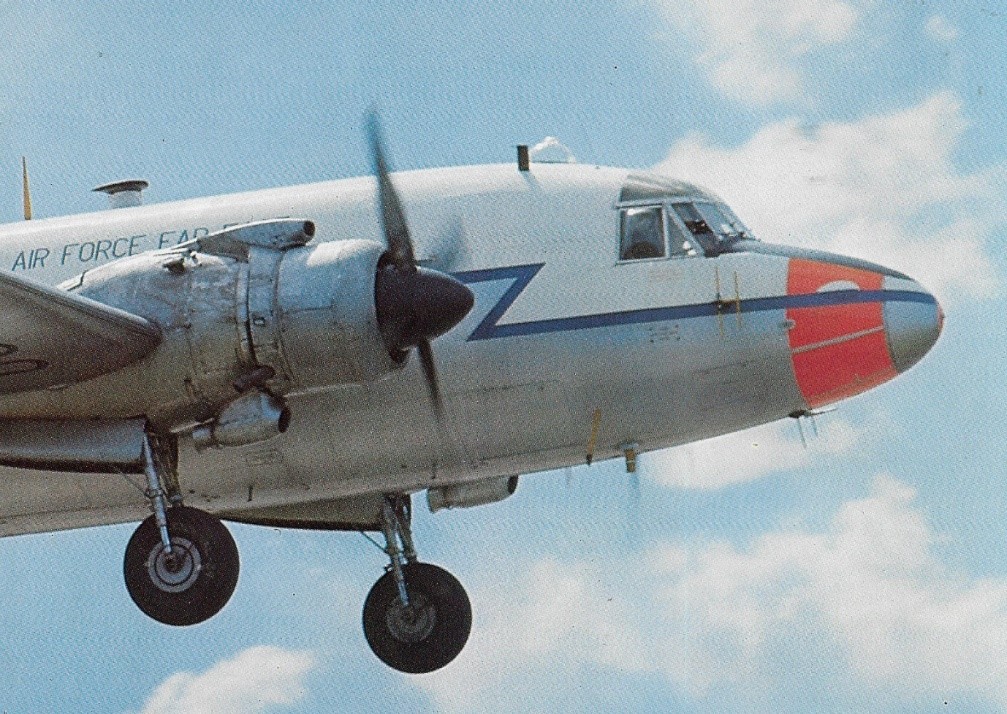
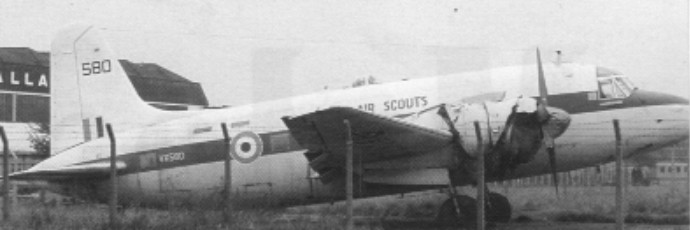
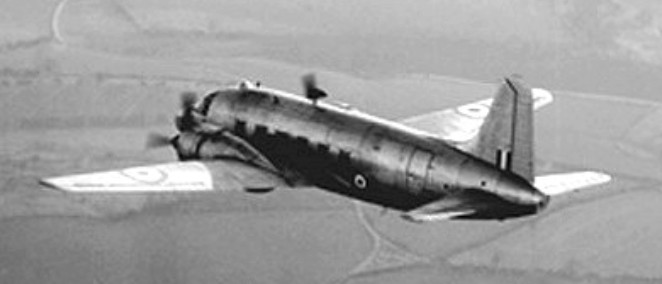
Valetta C.2

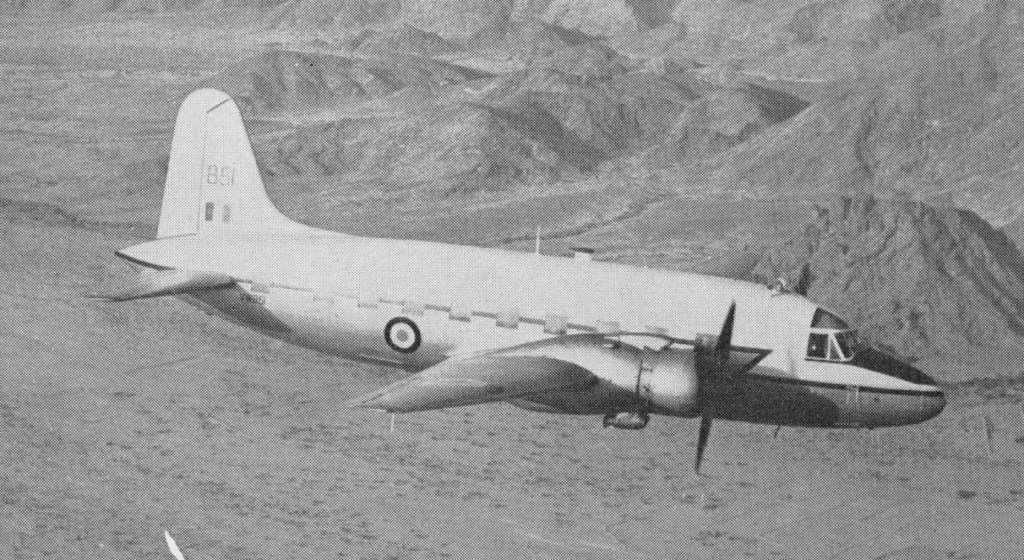
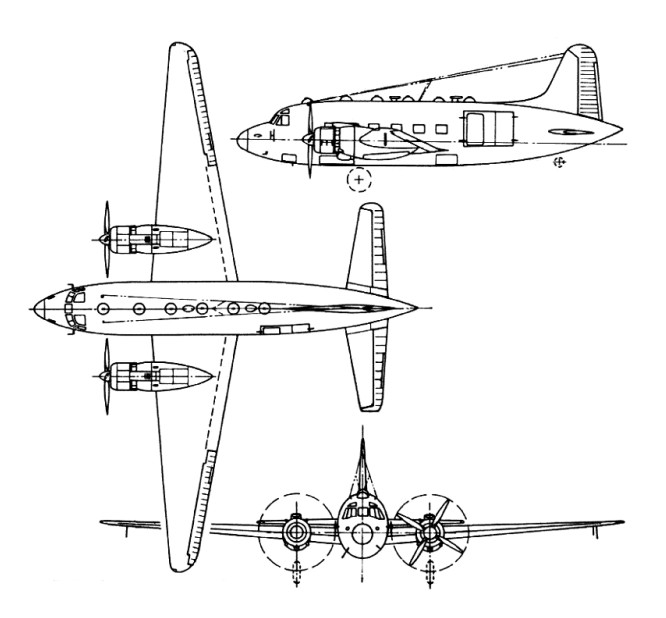
The Valetta was a military transport aircraft, the prototype of which flew for the first time on 30 June 1947. The C.I was the standard RAF version for use by Airborne Forces; could be used in various roles, such as troop-carrying, freighting, paratroop-carrying, supply-dropping and as an ambulance. The C.2 was a special VIP version for 9 to 15 passengers. The T.3 was designed specifically for use as a navigational flying classroom. A number of T.3s were later converted into T.4s with radar fitted in an extended nose. Production totalled 260 aircraft. Power was provided by two 1,472kW Bristol Hercules 230 radial engines.

Gallery

Vickers Valetta

Vickers 648 Varsity / 668 Varsity

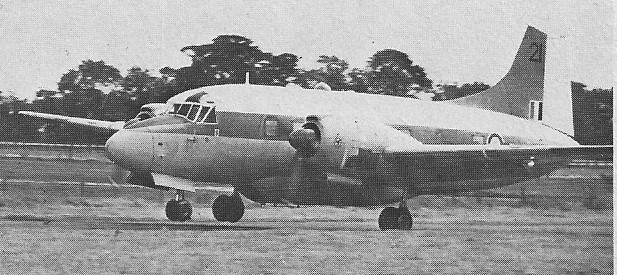
The Varsity general-purpose aircrew trainer retained the general characteristics of the Valetta C.I, but had a tricycle landing gear and a slightly longer fuselage. For bomb-aiming training, a bomb bay and bomb-aiming station were provided in the form of a pannier fitting against the fuselage underbelly.

Vickers Varsity Article

The prototype type 648 first flew in July 1949 and type 668 Varsity T.ls went into service with the RAF in 1951. A total of 163 were built.

Varsity T.1

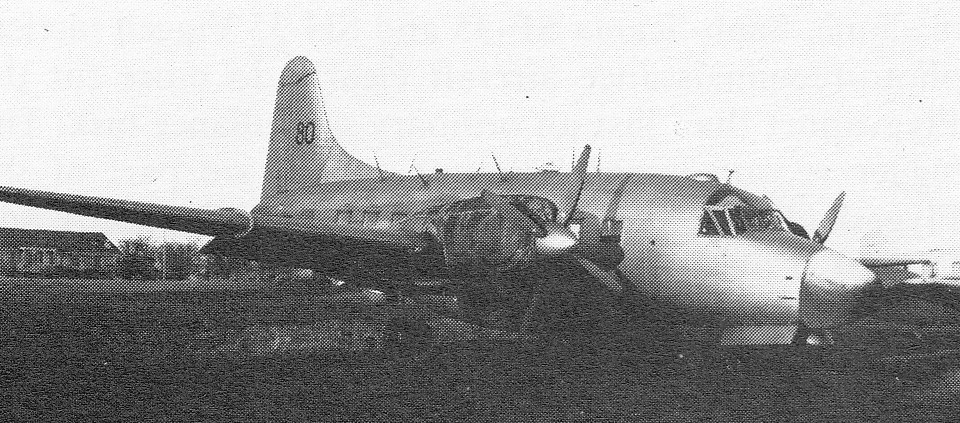
When the Swedish Air Force purchased a Vicker Varsity in the 1950s it was said it would be employed on high-altitude radio trials. It flew COMINT missions until 1973, festooned with antennas. It is now in a Swedish Air Force museum near Linköping.

Swedish COMINT Varsity

A Vickers Varsity was experimentally fitted by Napier with two Eland turboprops.

Vickers 648 Varsity
Engine : 2 x Bristol Hercules 264, 1923 hp
Length : 67.487 ft / 20.57 m
Height : 23.917 ft / 7.29 m
Wingspan : 95.571 ft / 29.13 m
Wing area : 974.142 sq.ft / 90.5 sq.m
Max take off weight : 37507.1 lb / 17010.0 kg
Weight empty : 27044.3 lb / 12265.0 kg
Max. speed : 250 kts / 463 km/h
Cruising speed : 208 kts / 385 km/h
Service ceiling : 28707 ft / 8750 m
Wing load : 38.54 lb/sq.ft / 188.0 kg/sq.m
Maximum range : 2300 nm / 4260 km
Range : 2300 nm / 4260 km
Crew : 2

Vickers Varsity

Vickers 610 Viking

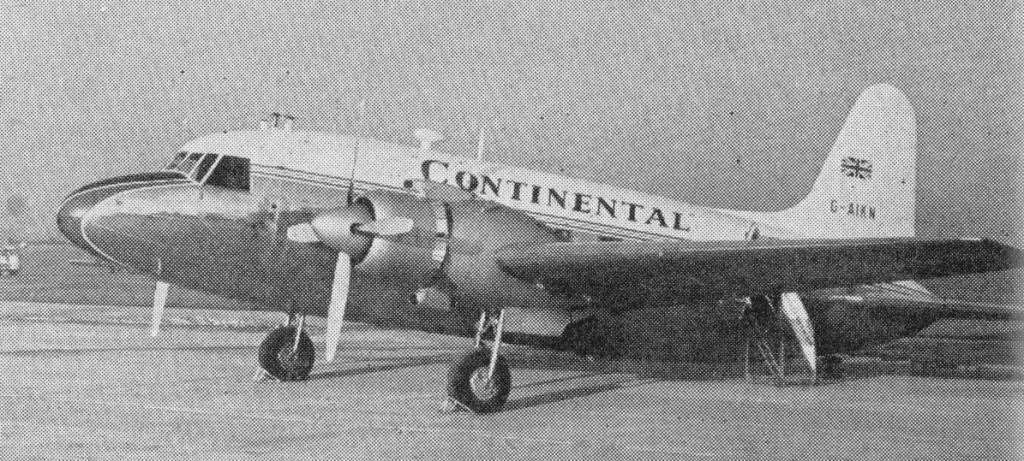
The Viking was a twin-engined 24-27-seat transport and was the first completely new post-World War II airliner to fly in the world. For speed and cheapness parts of the Wellington bomber were used, particularly in the wings. The fuselage, of stressed skin construction, was new.

Vickers 610 Viking Article

British European Airways operated a fleet of 49 on its European network and total production was 163. BEA aircraft were modified to allow them to carry up to 34 or 38 tourist-class passengers when required. Four also flew with the Queen’s Flight.

On 1 September 1946 the first Viking joined the British European Airways (BEA) fleet. BEA were to eventually operate 75 Vikings, fitted for 21 passengers.

In December 1946, the Vikings were grounded due to the icing up of control surfaces. After extensive modifications to the elevators and de-icing system, the Vikings were back in the air the following April.

On 30 October 1954 two farewell flights marked the retirement of BEA Vikings and the last commercial service from RAF Northolt.

Gallery

Engines 2 x 1,690 hp Bristol Hercules
Length 65.1 ft (19.8 m)
Wing span 89.25 ft (27.2 m)
Weight empty 22,910 lb (10, 400 kg.)
Seats: 2 crew and 21 passengers
Cruise speed 210 mph (340 kph)
Ceiling 22,000 ft (6,700 km) fully loaded
Range 1,875 miles (3,000 km)

Viking IB
Engines: 2 x Bristol Hercules 634, 1260kW
Max take-off weight: 15354 kg / 33850 lb
Empty weight: 10546 kg / 23250 lb
Wingspan: 27.2 m / 89 ft 3 in
Length: 19.86 m / 65 ft 2 in
Height: 5.94 m / 20 ft 6 in
Wing area: 81.94 sq.m / 881.99 sq ft
Cruise speed: 338 km/h / 210 mph
Ceiling: 7240 m / 23750 ft
Range w/max.payload: 837 km / 520 miles
Crew: 3-4
Passengers: 21-38

Vickers 610 Viking IB

Vickers 432

The final attempt by Vickers to develop a fighter for the RAF began in 1939 with a design for a twin-engined heavy fighter featuring an armament of a 40mm Vickers cannon in a dorsal turret. As the Type 414, this corresponded with the requirements of Specification F.22/39 for a 400 mph (644 km/h) two-seat fighter. The aircraft was to carry four 20-mm cannons, with the possibility of later mounting two 40-mm cannons.

Under a design team led by Rex Pierson, Vickers-Armstrongs Ltd. (Vickers) had been working on a fighter with a single flexibly-mounted 40-mm cannon installed in the aircraft’s nose. The twin-engine aircraft was powered by Rolls-Royce Griffon engines and met the requirements of F.6/39, aside from its armament. Vickers met with the Air Ministry in April 1939 to discuss the aircraft’s potential. The Air Ministry was sufficiently impressed and issued Specification F.22/39 that covered the Vickers fighter, which carried the internal designation Type 414. Specification F.6/39 was subsequently cancelled in November 1939.

Turret development began in a Wellington test-bed but, in the course of 1940, the requirement was changed via Specification F.16/40, to emphasise high-altitude performance, as there were growing fears that the Luftwaffe would be able to launch operations over Britain at altitudes beyond the capabilities of existing RAF fighters. A more conventional armament of 20mm cannon was adopted in the revised Vickers 420 design to the new specification, but further changes were called for in Specification F.7/41, including a pressure cabin.

Two Type 414 prototypes were ordered on 30 August 1939, and they were assigned serial numbers R2436 and R2437. After inspection of the Type 414 mockup in early February, the Air Ministry inquired about the possibility of installing several 20-mm cannons in place of the single 40-mm cannon. Vickers responded with aircraft proposals incorporating eight 20-mm cannons or two 40-mm cannons.

Vickers designated the fighter with 20-mm cannons as the Type 420. Two cannons were positioned in the aircraft’s nose, and three were on each side of the cockpit. Vickers and the Air Ministry discussed the Type 420 in June 1940, and Specification F.16/40 was issued for the aircraft’s development. The Type 420 was given a high priority, and an order for two prototypes was expected. The order for two Type 414 prototypes was still in place. However, the Type 420 took precedence, and work on the Type 414 slowed substantially.

In early January 1941, the Air Ministry requested a design change to reduce the number of 20-mm cannons to six. At the same time, Vickers had designed a high-altitude fighter that used many components from the Type 420. The high-altitude aircraft was armed with four 20-mm cannons and powered by two Rolls-Royce Merlin engines. The Air Ministry was interested in Vickers’ proposal, as they felt there was an urgent need for a heavily armed, high-altitude fighter aircraft to intercept high-altitude German bombers that were expected in the skies over Britain. However, high-altitude German bombing raids were never undertaken en masse and did not present a significant threat to Britain during World War II.

In March 1941, work on the Type 414 was stopped completely, and discussions with Rolls Royce commenced regarding the acquisition of Merlin engines. In May 1941, Vickers detailed the specifics of the high-altitude aircraft, which it had designated as Type 432. The Vickers response to this final requirement was Type 432, completely re-stressed and with an armament of six 20mm cannon in a ventral blister. The original contract for the Type 414/420s was cancelled in 1941 and a new one substituted for two Type 432s. Design work on the Type 432 continued, resulting in the switch to a single-seat cockpit placed in the nose of the aircraft and six 20-mm cannons installed in a ventral fairing. Each cannon had 120 rounds of ammunition. The Air Ministry ordered two Type 432 prototypes on 9 September 1941, and the aircraft would be built to the new Specification F.7/41. The two Type 432 prototypes were issued serial numbers DZ217 and DZ223.

As finally built, the Type 432 was the first Vickers aircraft of wholly stressed-skin construction of stressed-skin aluminum panels that were flush-riveted to the closely-spaced circular structures that made up the airframe, and it made use of a so-called “lobster-claw” design for the wing torsion box, in which heavy-gauge skin had a thickened section to house the span wise spar booms, giving a profile shaped like a lobster claw so that conventional wing spars and ribs were omitted. Fabric covered the aft section of the wings and the aircraft’s control surfaces. The fuselage was a streamlined tube and the coolant radiators for the engines were buried within the wing. The pilot was accommodated in a relatively small, self-contained pressure cabin, his head being enclosed by a small, double-glazed dome, or “bubble”, which hinged to one side for access and egress.

The Type 432 mockup was inspected in late December 1941, and the first prototype, DZ217, was built throughout 1942. The aircraft was built at Foxwarren, a special Vickers dispersal site for experimental work near Brooklands in Surrey, England. The site did not have an airfield, so the Type 432 was disassembled and transported to Royal Aircraft Establishment Farnborough for its first flight.

The Vickers Type 432 prototype DZ217 appears shortly after its completion at Foxwarren.

Powered by two Rolls-Royce Merlin 61 12-cylinder Vee-type engines rated at 1520hp (1,178 kW) at 23,500 ft (7,163 m), the first prototype Type 432 was flown on 24 December 1942, piloted by Tommy Lucke, initial trials revealing serious handling difficulties on the ground, the aircraft snaking while taxying and necessitating 3 in (76 mm) aft movement of the mainwheels to correct the bad tracking. The impossibility of making a three-point landing was only rectified by replacement of the Irving-type ailerons with surfaces of Westland type and alteration of tail settings. The competitive Westland Welkin was ordered into production and the second prototype of the Vickers fighter, the Type 446, was cancelled on 1 May 1943 before completion. This decision was not made official until 1 May 1943.

The first prototype was retained by Vickers for test purposes until the end of 1944. The estimated maximum speed of 700km/h at 8535m was never attained as the Merlin 61 engines did not run satisfactorily above 7010m.

The sole Type 432 aircraft continued to fly occasionally until November 1944. Some efforts were made throughout the aircraft’s existence to improve its handling and flight qualities, as the Type 432 was noted as having heavy controls. Only 28 flights were made, and the aircraft was never submitted for official trials or tested to its maximum performance. Additionally, the 20-mm armament and the pressurized cabin were never installed. Although the Type 432 exceeded 400 mph (644 km/h) in a slight dive, the highest speed obtained in level flight was 380 mph (612 km/h), recorded on 14 May 1943. One of the factors that limited flight testing was that the Merlin engines installed in the Type 432 did not run well above 23,000 ft (7,010 m). Since the Type 432 had no future as a production aircraft, the performance issues of its Merlins were never fully investigated.

The entire Type 432 program was cancelled at the end of 1943.

Aircraft observers were a regular fixture during World War II, keeping an eye out for any enemy action in the skies over Britain. The rarely-seen and oddly-shaped Type 432 was only listed as “AP1480” in the recognition handbooks. This non-descript designation led the spotters to dub the Type 432 as the “Tin Mossie” on account of the aircraft’s resemblance to the wooden de Haviland Mosquito.

Engines: Rolls-Royce Merlin 61, 1520hp
Wingspan: 17.34 m / 56 ft 10 in
Length: 12.38 m / 40 ft 7 in
Height: 4.19 m / 13 ft 9 in
Wing area: 40.97 sq.m / 441.00 sq ft
Fuel capacity: 506 USG / 421 Imp gal / 1,914 lt
Max take-off weight: 9148 kg / 20168 lb
Empty weight: 7427 kg / 16374 lb
Top speed est: 320 mph (515 km/h) at sea level
Top speed est: 435 mph (700 km/h) at 28,000 ft (8,534 m)
Top speed est: 400 mph (644 km/h) at 40,000 ft (12,192 m)
Cruise speed est: 400 mph (644 km/h) at 29,500 mph (8,992 m)
Service ceiling: 43,500 ft (13,259 m)
Initial climb rate: 2,750 fpm (14.0 m/s
Range: 2400 km / 1491 miles

Vickers 432