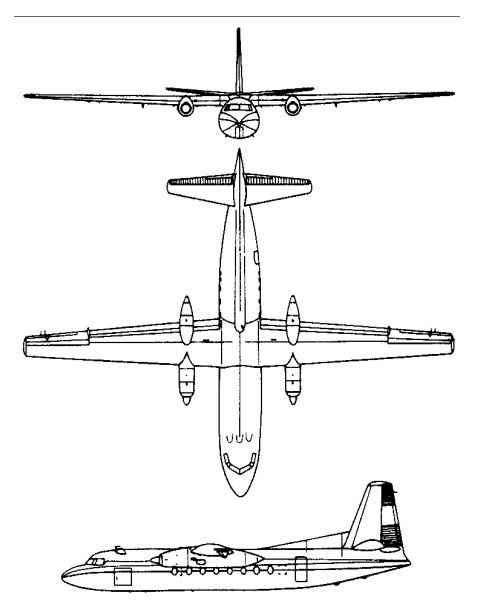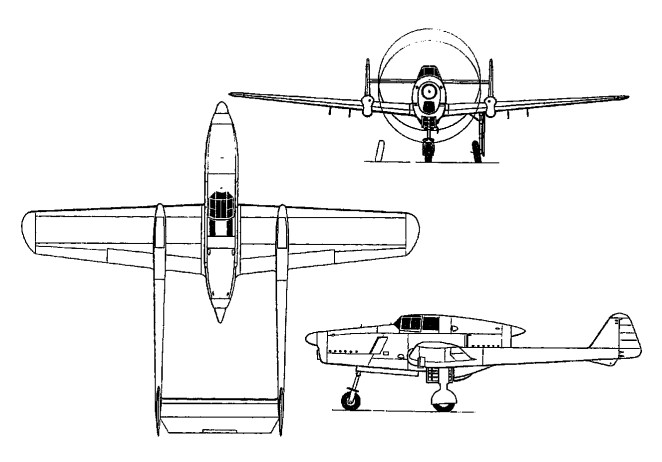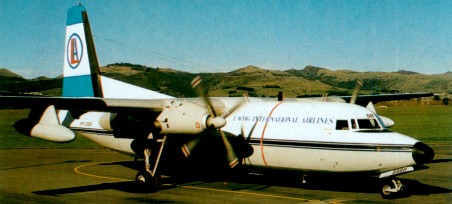
The company’s design study of 1950 was for a 32-seat transport to be powered by two Rolls-Royce Dart turboprop engines. Known as the P.275 project, it was enlarged slightly and modified to incorporate a circular-section pressurised fuselage by 1952, when Dutch government backing was sought for its construction and development.
Fokker F-27 Friendship Article
The type was then designated Fokker F27, and the first of two prototypes made its maiden flight on 24 November 1955 from Schiphol, powered by two Dart 507 turboprops. At the controls was Fokker’s chief test pilot, Mr H.V.B. Burgerhout, for the 34 minute flight. The first prototype did not have a pressurised cabin. For its first trials the prototype F.27 was powered by Rolls Royce Dart Mk. 507 engines, and in March 1956 these were replaced by Dart Mk. 511 engines.
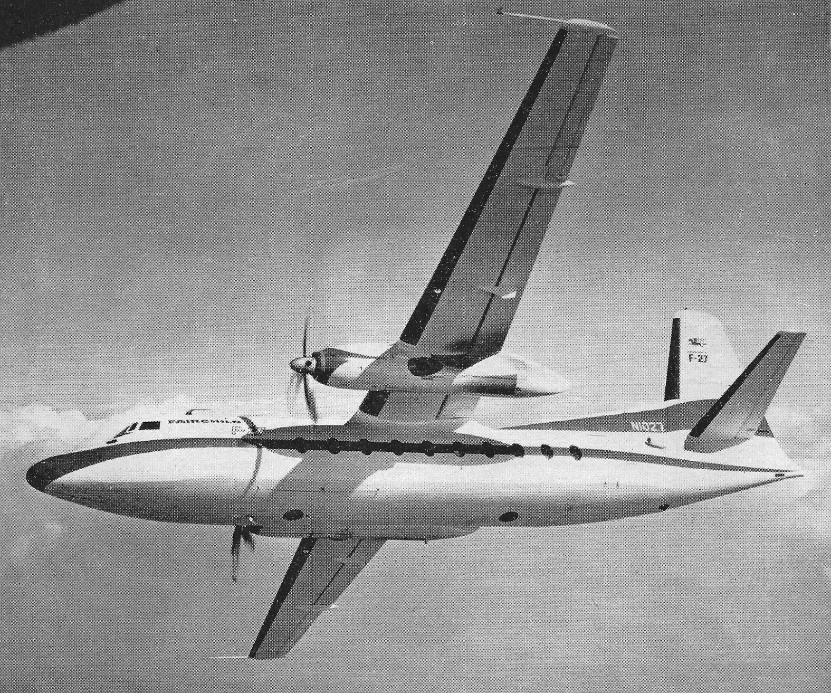
Two of the prototypes never flew at all, as they were used to investigate fatigue, wing loading and pressurisation problems (submerged in a water tank). Fokker installed a pneumatic system for the retractable undercarriage, because air is cheap, fast and non combustible. A high-wing monoplane, the F27 has a pressurised fuselage, retractable tricycle landing gear and accommodation for 28 passengers. The second prototype, with Dart Mk 511 engines and its fuselage lengthened by 0.91m to seat 32 passengers, was flown on 31 January 1957.
Between the initial flights of these two prototypes, On April 26th 1956 it was announced that Fokker had concluded an agreement with the Fairchild Engine and Airplane Corporation for the manufacture and marketing of the F27 in North America, where it was known as the Fairchild F-27.
By April 1956 orders had come in for 30 aircraft.
On March 23rd, 1958, the first production F.27 EI AKA for Aer Lingus, made its ¬maiden flight, to be followed on 12 April by the first American built F.27, for Pied¬mont Airlines.
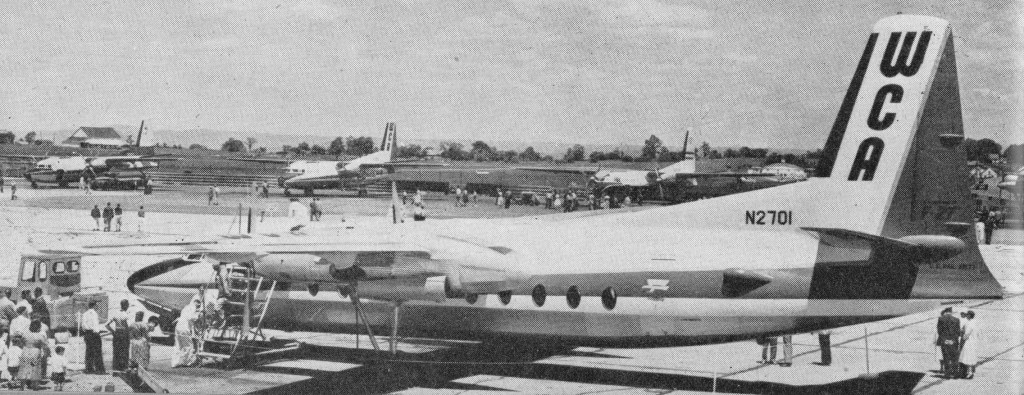
Fokker’s first F27 Friendship entered service with Aer Lingus in December 1958, but Fairchild had been a little quicker off the mark, its F-27 entering service with West Coast Airlines three months earlier.
The American company had modified the interior layout to seat 40, increased the fuel capacity and made provision for weather radar in a lengthened nose; Fokker adopted similar improvements at a later date.
The initial Dutch production version was designated F27 Mk 100 (Fairchild F-27), and was powered by two 1279kW Rolls-Royce Dart RDa.6 Mk 514-7 turboprops.
A total of eighty-five Series 100 were built.
It was followed by the similar F27 Mk 200 (Fairchild F-27A) with 1529kW Dart RDa.7 Mk 532-7 engines. Both airliners had standard accommodation for 40 passengers, but a high-density arrangement made it possible to seat 52. An executive version of the Mk 200 was available with the interior design to customer requirements.
Subsequent versions include the F27 Mk 300 Combiplane (Fairchild F-27B), a passenger/cargo aircraft with Mk 100 powerplant, a reinforced cabin floor, cargo tie-down rings and a large cargo door forward of the wing on the port side. A similar Combiplane version of the Mk 200 had the designation F27 Mk 400, but no equivalent version was produced by Fairchild in America.
Friendship Bulletin February 1961
In 1964 the Sudanese air force ordered four F-27s for paratrooper and medical evacuation missions, incorporating upward-hinging cargo door forward and two sliding doors near the rear. They can carry 45 in canvas seats, 24 litters, or 13,000 lb of cargo. Nine F-27M Troopships were in service with the Netherlands air force.
In 1964 Fairchild was to start a production line again to produce 15 F-27s ordered by Ozark Airlines. Priced at $995,000 each, engines were to be Rolls Royce Dart 7s and the MTOW 42,000 lb.
The Mk.400M flew in April 1965. It can carry 6,000kg of cargo, 46 paratroops, or 24 stretchers and nine attendants. A number of civilian-standard F.27 Friendships, some with VIP inte¬riors, were sold to military operators. Formerly known as the Troopship, the Mk.400 military version was ordered for the Royal Thai Air Force. These aircraft, deliv¬ered in 1986 and early 1987, were multirole aircraft equipped for transport, target towing, and SAR duties.
Fokker next developed a lengthened fuselage (by 1.50m) variant of the Mk 200. Designated F27 Mk 500, this failed to appeal initially to airline operators, but 15 were acquired by the French government for service with the nation’s Postale de Nuit. Friendship Mk 500s in service with airlines have standard accommodation for 52 passengers, with high-density seating for 60. Fairchild in America produced its own stretched variant, the FH-227.
The FH-227 differed from the standard F27 by having a fuselage ‘stretch’ of 1.83m to provide accommodation for a maximum of 52 passengers, with increased baggage and cargo space, and by the installation of 1678kW Rolls-Royce Dart RDa.7 Mk 532-7 turboprop engines. The first of two FH-227 prototypes made its initial flight on 27 January 1966. Production of FH-227s and their variants had reached 79 when production ended. When the Fairchild Hiller FH.227 production line closed down more than 200 aircraft had been sold.
Fairchild Stratos Corp. demon¬strated its F 27G variant in 1963, incorporating the refinements developed by Fairchild in the F 27F, and also has a large cargo door in the front fuselage, as used in the F 27B. It is intended for both military and civil use.
The last production version was the F27 Mk 600, combining the Mk 200 fuselage without the reinforced cabin floor but with the cargo door of the Mk 300/400 Combiplanes. The F27 Mk 600 introduced an optional roller-track quick-change interior so that the type could be used for passenger/cargo services. Other versions included the F27 Mk 400M and F27 Mk 500M military aircraft, an F27 Mk 400M aerial-survey version and an F27 Maritime suitable for coastal patrol, fishery protection, and search and rescue. Late production aircraft had an updated flight deck and cabin interior. Manufacture was shared by Dassault-Breguet (France), MBB (Germany) and SABCA (Belgium). When production was terminated in 1986 in favour of the Fokker 50, the company had sold 581 F27s alongside 205 Fairchild-built F-27/FH-227 variants. In mid-1991 Fokker stated that around 450 F27s were still in service and that the highest-time aircraft had made some 80,000 flights.
About 30 FH-227s of different marks remained in airline service in 1991.
The Fokker F.27 Maritime prototype (PH FCX), a conversion from an ex airline F.27, was flown for the first time on 25 March 1976. This medium range maritime patrol aircraft was equipped for this role by the installation of adv¬anced avionics, including search radar and long range inertial navigation. Operated by a crew of up to six, the F.27 Maritime can carry fuel for an endurance of 10 to 12 hours or range of 3,107 miles (5000 km).
A total of 17 of the Dart engined F.27 Maritimes was sold to seven customers. The four delivered to the Royal Thai Navy have a weapons capability, but are not equipped to full Enforcer standard.
F-27
Engines: 2 x Rolls-Royce Dart 7 535-7R, 1835 shp.
Props: Dowty-Rotol 4-blade, 106-in.
Seats: 56.
Length: 82.3 ft.
Height: 28.7 ft.
Wingspan: 95.2 ft.
Wing area: 754 sq.ft.
Wing aspect ratio: 12.1.
Maximum ramp weight: 45,200 lbs.
Maximum takeoff weight: 45,000 lbs.
Standard empty weight: 27,400 lbs.
Maximum useful load: 17,800 lbs.
Zero-fuel weight: 39,500 lbs.
Maximum landing weight: 43,500 lbs.
Wing loading: 59.7 lbs/sq.ft.
Power loading: 12.3 lbs/hp.
Maximum usable fuel: 9090 lbs.
Best rate of climb: 1250 fpm.
Certificated ceiling: 20,000 ft.
Max pressurisation differential: 4.2 psi.
8000 ft cabin alt @: 20,000 ft.
Maximum single-engine rate of climb: 413 fpm @ 150 kts.
Single-engine climb gradient: 165 ft/nm.
Single-engine ceiling: 9500 ft.
Maximum speed: 259 kts.
Normal cruise @ 20,000ft: 259 kts.
Fuel flow @ normal cruise: 1542 pph.
Endurance at normal cruise: 5.4 hrs:
Stalling speed clean: 98 kts.
Stalling speed gear/flaps down: 78 kts.
Turbulent-air penetration speed: 183 kts.
Fokker F27 Mk 200
Engines: 2 x Rolls-Royce Dart Mk 536-7R turboprops, 1730kW
Max take-off weight: 20410 kg / 44997 lb
Loaded weight: 12148 kg / 26782 lb
Wingspan: 29.0 m / 95 ft 2 in
Length: 23.56 m / 77 ft 4 in
Height: 8.5 m / 27 ft 11 in
Wing area: 70.0 sq.m / 753.47 sq ft
Cruise speed: 480 km/h / 298 mph
Ceiling: 8990 m / 29500 ft
Range: 1926 km / 1197 miles
F-27-400M
Engine: 2 x R-R Dart turboprop.
Installed pwr: 3590 kW.
Span: 29 m.
Length: 23.6 m.
Wing area: 70 sq.m.
Empty wt: 11,436 kg.
MTOW: 21,545 kg.
Payload: 6485 kg.
Cruise speed: 430 kph.
Initial ROC: 380 m / min.
Ceiling: 7620 m.
T/O run: 1020 m.
Ldg run: 530 m.
Fuel internal: 5900 kg (+1535 kg).
Range/payload: 1300 km with 4765 kg.
Capacity: 48 pax.
F27-500
Engines: 2 x RR Dart -7, 2050 shp.
Seats: max 52.
Wing span: 95 ft 2 in (29 m).
Length: 82 ft 0.5 in (25.01 m).
Height: 27 ft 11 in (8.5 m).
Max TO wt: 43,500 lb (19,730 kg).
Max level speed: 292 mph ( 470 kph).
F27 Mk 600
Seats: 44 plus crew
Gross weight: 45,000 lbs
Empty weight: 22,786 lbs
Fuel capacity: 1,357–2,463 gal
Engines: two 2,140 shp Rolls-Royce Dart turboprops
Cruise speed: 298 mph
Initial climb rate: 1,480 fpm
Service ceiling: 29,500 ft
Takeoff distance: 2,310 ft
Landing distance: 3,290 ft.
F-27 MPA Maritime
Engines: 2 x R-R Dart 532-7 turboprop, 2210 shp.