Back to Fouga C.25S
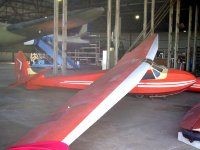
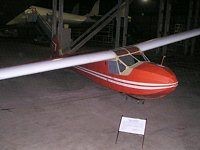
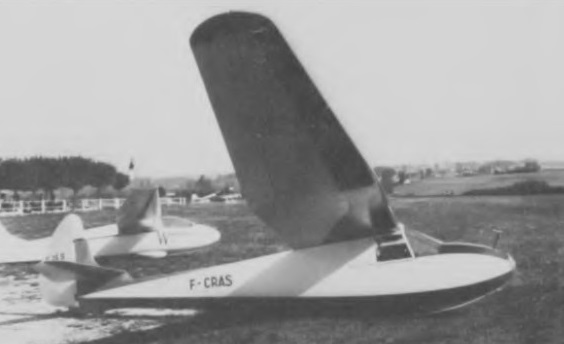
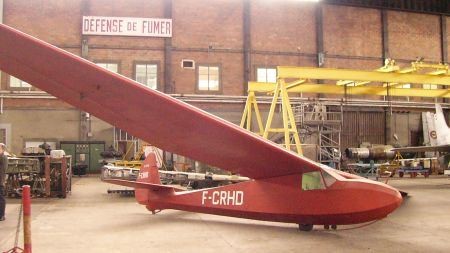
The Castel C.25S, sometimes known as the Aire, is a French training glider, the design, by Robert Castello, began soon after the Franco-German Armistice of June 1940. The C.25S was intended to increase the number of machines available for recreational gliding in the southern, unoccupied region of France.
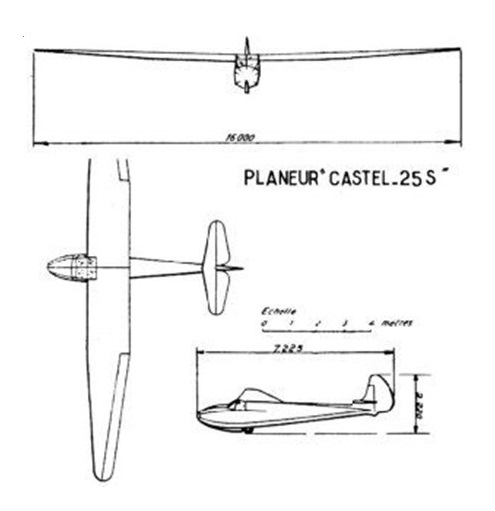
The C.25S is an all wood aircraft with a monocoque fuselage skinned with plywood and fabric covered, wooden framed wings. The cantilever, high mounted, constant dihedral wings have a constant chord inner section, occupying about 40% of the span, and outer, straight tapered panels with rounded wing tips and ailerons filling their trailing edges. Airbrakes are mounted at mid-chord on the inner-outer panel junction, opening above the wings.
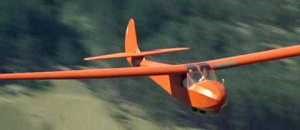
The fuselage has parallel, flat sides and is polygonal in cross-section, tapering to the tail. The crew are seated beneath the leading edge of the wing in side-by-side seating equipped with dual control, enclosed by a canopy which is hinged at the leading edge of the wing. The C.23S has a narrow fin with a shallow forward extension that mounts the tapered tailplane clear of the fuselage. Its rudder is horn balanced, has a curved trailing edge and extends down to the keel, requiring a cut-out between the separate elevators for its movement. The C.25S has a fixed monowheel undercarriage, assisted by a forward mounted main skid and small tailskid.
The first two prototypes of the C.25S both flew in 1942. 100 C.25S were ordered by the French Air Ministry to assist the post-war revival of aviation in France. These were built in Fouga’s factory at Aire-sur-Adour between 1945 and 1948 and delivered to French gliding clubs.
Significantly more may have been built; some sources say that another 30 were built during the war and others asserts a total of 200 were built. The C.25Ss with the Caudron C.800s provided the backbone of the French glider basic training fleet until the arrival of the Wassmer WA 30 Bijave in the early 1960s.
The C.25S proved to be a successful long distance flyer, setting several records in the early 1950s.
A pair of C.25S had a role in one of the most commercially successful French films, the 1966 comedy La Grande Vadrouille.
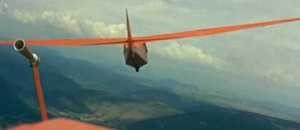
About a dozen examples of the C 25S were still on the French civil register in 1979. Five remained on the French civil aircraft register in 2010.
Specifications
Length: 7.23 m (23 ft 9 in)
Wingspan: 16.0 m (52 ft 6 in)
Height: 2.22 m (7 ft 3 in)
Wing area: 20.0 sq.m (215 sq ft)
Aspect ratio: 12.8
Profile at the root: Gö 535
Profile at the end: NACA 23010
Dihedral: 1 ° 30
Empty weight: 261 kg (575 lb)
Gross weight: 441 kg (972 lb)
Never exceed speed: 140 km/h (87 mph; 76 kn)
Rough air speed max: 90 km/h (55.9 mph; 48.6 kn)
Aerotow speed: 100 km/h (62.1 mph; 54.0 kn)
Maximum glide ratio: about 25 at 67–69 km/h (41.6–42.9 mph; 36.2–37.3 kn)
Rate of sink: 0.73 m/s (144 ft/min) minimum, at 62 km/h (38.5 mph; 33.5 kn)
Rate of sink: 2 m / s at 65 – 100 km / h
Wing loading: 22.0 kg/sq.m (4.5 lb/sq ft)
Crew: Two
Fouga et Cie
Air Fouga
Potez Air Fouga
Fouga’s aircraft department formed 1936, subsequently building designs of M. Pierre Mauboussin who, with M. Castello, developed Castel-Mauboussin gliders and sailplanes. Operated postwar as Etablissements Fouga et Cie, becoming Air Fouga September 1956 when company was taken over, in equal shares, by Breguet, Dassault, Morane-Saulnier, Sud Est and Ouest Aviation.
Acquired by Henry Potez May 1958, renamed Potez Air Fouga. Early activities included production of Mauboussin 123 trainer, Castel C.25S, C.30S, and C.300S gliders. Castel- Mauboussin CM.10 transport glider built for French military forces, also CM.100 powered version with two Renault engines. In the latter CM-101R Renault engines augmented by two Turbomeca Pimene turbojets. Experience with CM.8-R.9 Cyclipe and with the Gemeaux led to development of the CM.170R Magister jet trainer, first flown 23 July 1952 and subsequently built in quantity for French Air Force and overseas customers.
The company operated as Potez Air Fouga until September 23,1961, when it was completely absorbed into Etablissements Henry Potez SARL. Continued development of CM.170 Magister and CM.175 Zephyr naval version, which were first flown as production aircraft on May 30,1959.
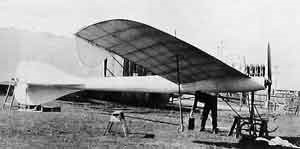
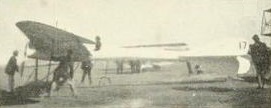
This large monoplane, Louis Fortney’s third, was powered with a 4-cylinder Knox engine of 60 hp weighing 400 lbs. Viewed from a distance the machine had a very fine appearance, but under closer inspection revealed a number of weak points in construction. After two short jumps Fortney met with the usual fate of the novices –yet deserves credit for staying in the game– as this was also his third machine to be destroyed.

The Wicko was originally designed to use a Ford V8 car engine, and the first prototype two-seat Wicko FW1, with a modified Ford V8 engine known as the Wicko F, was completed in September 1936. This was later re-engined with a 90hp Cirrus Minor I as the FW2. A 150hp Cirrus Major installation, specifically for the 1937 King’s Cup race, resulted in the FW3, and this engine became the standard powerplant for all GMI production models.
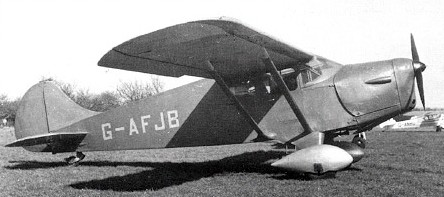
Nine Wickos were built 1938-1939 at Southampton designated G.M.1 with the more powerful Gipsy Major engine, that being the total production.
Established in 1934 by G. N. Wickner, V. Foster and J. F. Lusty, initially at the latter’s furniture factory at Bromleyby-Bow, London. Mr. Wickner’s earlier designs, built in Australia, included Wicko Sports Monoplane and Wicko Lion, both high-wing monoplanes on which the prototype Wicko F.W.1 was based. Of wooden construction, the F.W.1 was powered by a Ford V-8 engine, and became F.W.2 with Cirrus Minor and F.W.3 with Cirrus Major. Nine production aircraft built 1938-1939 at Southampton were designated G.M.1 with Gipsy Major engine.
The company ceased production at the outbreak of war.
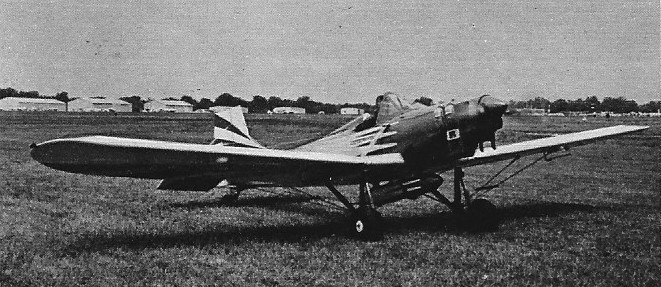
Sidney Foster, an automotive engineer, built his original design single-seater over a 22-year period. Named ‘Blood, Sweat and Tears’, N48F has an all-wood Clark Y aerofoil wing, and steel-tube fuselage and tail. The own design landing gear uses BT-13 tail wheel shock struts.
Fuel is carried in an external tank, 10 USG / 37.9 lt, and an 8 USG / 30.3 lt fuselage tank.
Engine: Lycoming. 125 hp
Wingspan: 30 ft / 9.1 m
Length: 21 ft / 6.4 m
Empty weight: 904 lb / 410 kg
MAUW: 1265 lb / 573.8 kg
Cruise: 120 mph / 193 kph
Landing speed: 45 mph / 72.4 kph
ROC: 1500 fpm / 7.62 m/sec
Endurance: 2 hr
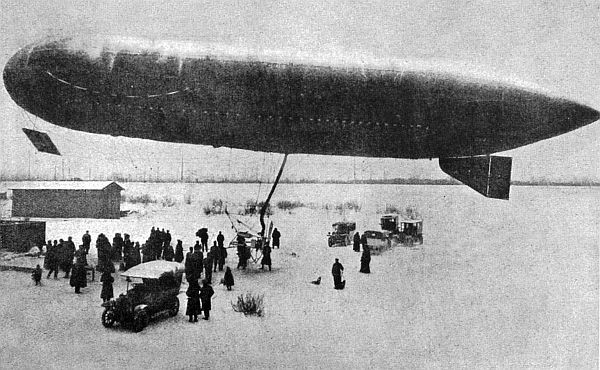
In 1910, Villehad Henrik Forssman (1884–1944) had graduated from the Riga Polytechnic Institute as a mechanical engineer and then moved to Germany that same year. Thereabouts, the Swede had been contracted by the Russian army to deliver a dirigible and was there to be used for intelligence services, which was constructed at “August Riedinger Ballonfabrik” in Augsburg. It is not known whether or not the Russian military ever took delivery of the airship. The dirigible was only 35 meters long with a maximum diameter of 6 meters, and held 800 cubic meters of hydrogen gas. It could be dismantled very quickly and just as fast, later be ready to fly. Because of lift-force limitations a gondola was not available, only a single bench seat with the engine, where the pilot and a mechanic had a place to sit. The 28 hp motor, which was also built by Forssman, weighed only 38 kg, and the cooling 4 1/2 kg. Reportedly the entire craft weighed 450 kg and capable of attaining a maximum speed of 43 km/h.
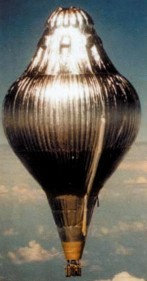
Steve Fossett floating at 25,000ft at an average speed of 38km/hr was on his sixth attempt to fly solo round the world by balloon. The flight started from Perth, Australia, in his craft, Solo Spirit.
USA
Forney Manufacturing Company acquired production rights for Engineering and Research Corporation’s Ercoupe 415 two-seat light aircraft in April 1955. First production F-1 Aircoupe flew on September 1956. Offered later as Fornaire Execta, Explorer, and Expediter. Rights sold in 1960 to the city of Carlsbad, New Mexico.

