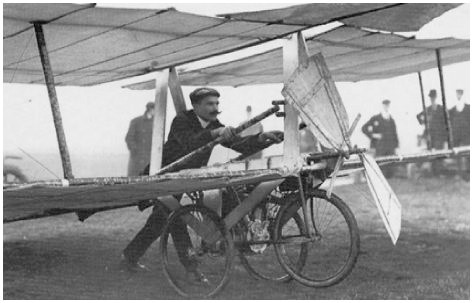
Standing on three bicycle wheels and with wings twenty feet across, Mr. Guillon’s “airship” had a 20 hp engine drive the propeller, which was five feet long and made of aluminium. The total weight of the machine was 300 lb., and with Mr. Guillon on board, reclining in a sloping position of 45 degrees at the back, the weight was 420 lb. When tested at Epsom Downs, Surrey, UK, on 11 April 1907, the aeroplane started away at a good twenty miles an hour, but Mr. Guillon could not get the engine to work satisfactorily, and the machine failed to rise from the ground. Furthermore, the rudder did not seem to act properly, darting this way and that. The aeroplane kept the crowd of some fifty persons constantly running to keep out of danger. Six unsuccessful trials were made, then the axle was found to be bent, and the experiment came to an end.
M. J. Guillemin designed a high-wing single-engine light postal or ambulance monoplane, the J.G.40, shown on the Bleriot Aeronautique stand at the 1930 Paris Air Show. The latter company acquired the license to build aircraft.
France M. J. Guillemin designed a high-wing single-engine light postal or ambulance monoplane, the J.G.40, shown on the Bleriot Aeronautique stand at the 1930 Paris Air Show. The latter company acquired the license to build aircraft. A two-seat light aircraft, the J.G.10, competed in the French Air Ministry Light Aeroplane Competition of 1931, but retired with engine trouble.
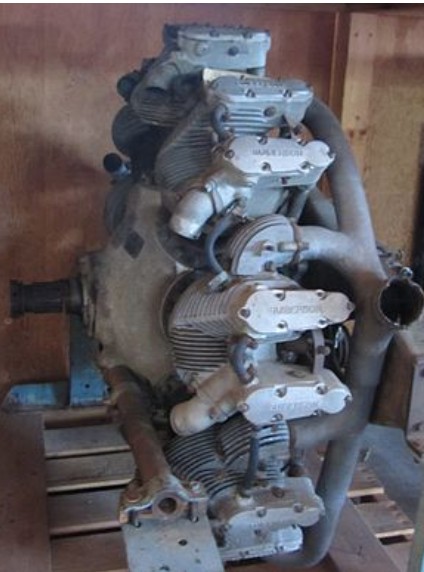
The Guiberson A-1020 (ATC 220) is a four-stroke diesel radial engine developed by for use in aircraft and tanks. Development started in the 1930s with the A-918 designed by C C Spangenberger and A-980 designed by Fred A. Thaheld, which was first flown in 1931. It is a single-row direct drive nine cylinder-four cycle engine. Four A-918 were built.
Production A-1020’s and T-1020’s were designed and sold by Guiberson and produced by Buda Engine Co.
A T-1020 version was coincidentally produced for use in tanks. To demonstrate its capability to military and civil aviation officials in 1940, a 1500-mile flight from Dallas to Washington DC took 10h:35m flying time at an average 142mph. Cruising at 3000′ altitude at 1800rpm on Caterpillar tractor fuel (6 cents a gallon) consumed at the rate of 11.5 gph, cost was only $6.90. Three gallons of lubricating oil added $4.20—a total of $11.10 for fuel and oil for the flight. Its fuel cost of less than 12 cents a mile was an unheard-of figure for flight operations at the time.
Variants:
Guiberson A-980 210hp – the initial development model for use on aircraft.
Guiberson A-1020 340hp – production engines for aircraft use.
Guiberson T-1020 250hp for use in light tanks such as the M5 Stuart
Applications: Waco 10 – A-980 Stinson Reliant – A-1020 M5 Stuart light tank – T-1020
Specifications:
A-918 1934 250hp
A-980 1932 ATC 79 185hp
A-1020 Type: 9-cyl air-cooled radial diesel piston engine Bore: 5.125 in (130.18 mm) Stroke: 5.5 in (139.70 mm) Displacement: 1,021 cu in (16.73 l) Dry weight: 650 lb (294.84 kg) Designer: F. A. Thaheld Power output: 340 hp (253.54 kW) Compression ratio: 15:1 Specific fuel consumption: .42 lb/hp/hr (0.14 kg/kW/hr) Oil consumption: 0.33 US gall/hr (1.25 l/hr Power-to-weight ratio: 0.52 hp/lb (0.85 kW/kg)
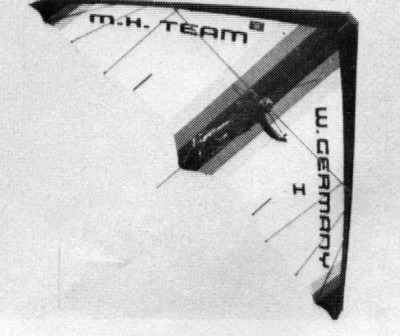
Wings 156 Wing area: 15.6 m² Wing span: 9.7 m Aspect ratio: 6 Hang glider weight: 18 kg Minimum pilot weight: 60 kg Maximum pilot weight: 85 kg Maximum speed: 64 km/h Max glide ratio (L/H): 11 Packed length short: 3.65 m Number of battens: 8 Nose angle: 112°
Wings 172 Wing area: 17.2 m² Wing span: 9.7 m Aspect ratio: 5.5 Hang glider weight: 18 kg Minimum pilot weight: 70 kg Maximum pilot weight: 85 kg Maximum speed: 64 km/h Max glide ratio (L/H): 11 Packed length short: 3.65 m Number of battens: 8 Nose angle: 112°