Founded by Gulfstream American chairman Allen Paulson after purchase of former Rockwell Commander aircraft series. Program ended 1985.
Author: Terry
Guizhou JL-9 / FTC-2000 Mountain Eagle
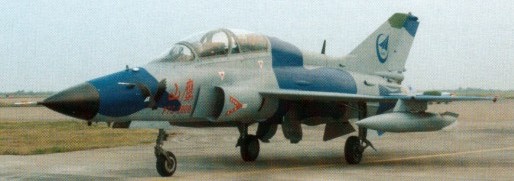
In 2001, Guizhou began development of a new trainer aircraft to replace the JJ-7 (MiG-21) trainers and better prepare pilots for flying the J-11 (Su-27) and J-10. To reduce costs and development time, Guizhou based their design off of the JJ-7. It uses the same fuselage and wings of the late-model JJ-7s, while radically redesigning the forward fuselage. The intakes were moved to the sides of the fuselage, allowing for a solid nose holding a radar. To improve the view for the instructor, the tandem cockpits were stepped. While intended as a trainer, it retains secondary attack capabilities. It comes standard with an ECM suite and a radar warning receiver, as well as an inflight refueling probe. Armament consists of an internal 23mm cannon and five hardpoints for unguided air-to-ground munitions and short-range AAMs.
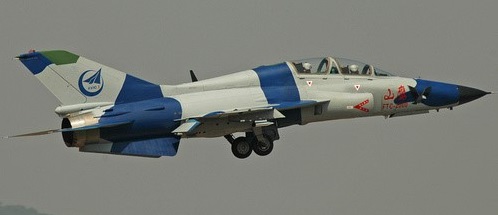
Also known as the FTC-2000 Mountain Eagle, on December 13, 2003, the JL-9 derivative of the JJ-7 first flew, from An Shun/Huang Guo Shu (AVA) airport. Involving little change from the JJ-7, the JL-9 took 28 months from design to first flight.
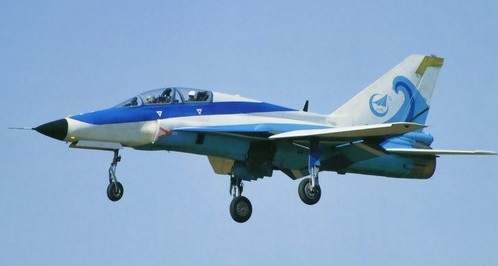
The PLAAF began service trials of the JL-9 in 2006, while Guizhou continued to upgrade the onboard systems. In 2009, the JL-9 passed trials, and began production.
Meanwhile a navalized variant for the PLANAF has arose, incorporating several major modifications. The nose intakes were modified to prevent engine stalls at high angles of attack, the vertical stabilizer and leading-edge root extensions were enlarged, and the ventral fins were deleted to make space for the landing hook.
Guizhou Mifeng-2 (Honeybee-2)
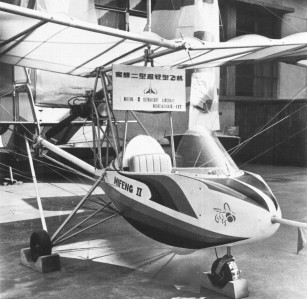
A Chinese designed and built ultralight, first appearing in 1982. The craft features three axis controls.
Guizhou Aviation Industry Group
Developed the tandem two-seat supersonic leadin/ fighter conversion trainer versions of the Chengdu J-7, as the JJ-7 or FT-7 for export. First JJ-7 flew in July 1985, and latest lengthened F-7P variant entered service with Pakistan in 1996.
Gumieniuk
Gumieniuk, a carpenter from Łastowice built an aircraft in 1912 but there is no information about flights.
Guldentops Trainer
Training Aircraft, Belgium, 1937
Engine: Cirrus Hermes, 118 hp
Crew: 2
Guldentops
Belgium
Operators of the Belgian National Aviation Schools founded in 1936 at Brussels, Kiewit and Gosselies. M. Guldentops designed and built several light aircraft, and after he took over the Societe Bulte a training biplane known as the Bulte-Guldentops appeared in 1938, powered by a Cirrus Hermes engine.
Guizhou WS-13 / WoShan WS-13 Taishan
The WS-13 Taishan (WoShan-13) is a turbofan engine designed and manufactured by Guizhou Aircraft Industry Corporation to power the Pakistan-China jointly developed JF-17 Thunder light-weight multi-role fighter, and in the near future the Shenyang J-31 fifth generation stealth fighter currently under development.
China began development of the Taishan in 2000 to replace the Klimov RD-93 turbofan, which had been selected in the 1990s to power the JF-17 light-weight fighter. It is designed to have a life span of 2,200 hours and an improved version, providing around 100 kN (22,450 lb) of thrust with afterburner, was under development.
First run in 2006, the WS-13 Taishan was certified in 2007 and serial production began in 2009. The 18 March 2010 edition of the HKB report stated that a FC-1 equipped with the WS-13 completed its first successful runway taxi test.
Officials at the Farnborough International Airshow in August 2010 stated that a JF-17 development aircraft is flying with a Chinese engine, which is most likely to be the WS-13.
In November 2012, Aviation Week reported that a JF-17 Thunder is flying in China with the Guizhou WS-13 engine.
Variants:
WS-13 – 86 kilonewtons (19,000 lbf) thrust with afterburner.
WS-13A (upgraded) – 100 kilonewtons (22,000 lbf) thrust with afterburner.
Specifications:
WS-13
Type: Afterburning turbofan
Length: 4.14 metres (13.6 ft)
Diameter: 1.02 metres (3 ft 4 in)
Dry weight: 1,135 kilograms (2,502 lb)
Compressor: Two-spool 8-stage axial
Combustors: annular
Maximum thrust: 51.2 kilonewtons (11,500 lbf) dry; 86.37 kilonewtons (19,420 lbf) with afterburner
Bypass ratio: 0.57:1
Turbine inlet temperature: 1650 K (1,377 °C (2,511 °F))
Thrust-to-weight ratio: 7.8
Guimbal Cabri G2 Gallery


Guimbal Cabri G2
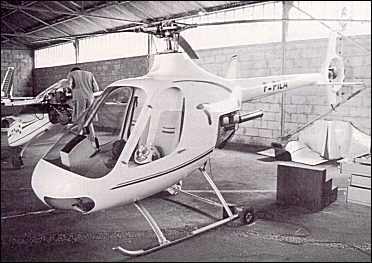
The Guimbal Cabri G2 is a two-seat single-reciprocating-engine-powered light helicopter. The two-seat Cabri G2 light helicopter was designed by Bruno Guimbal, a Eurocopter engineer, and the prototype (F-PILA) made its first flight at Marseille-Marignane in April 1992.
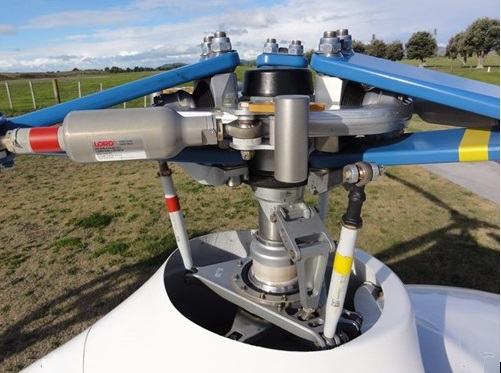
Powered by a 150hp Lycoming, the main structure is carbon composite construction, and it uses a three bladed soft-inplane main rotor with carbon composite blades. The tail rotor is a fenestron design using seven injection moulded blades. Energy attenuating carbon composite seats of Guimbal’s own design are installed. The helicopter has conventional unassisted flight controls and largely conventional analogue instrumentation but uses its own design of electronic monitor for all engine functions.
An STC embodied on the engine is held by Guimbal and comprises a Plasma electronic ignition with variable timing to replace the RH retard-capable magneto, and also a compact oil filter housing.

Development continued at Aix-en-Provence with restricted DGAC certification being issued on 18 April 1994.The helicopter is the first light helicopter to be type certificated (Type Certificate R.145) by EASA against CS27.
Type Acceptance Certificate No. 11/21B/20 was granted on 22 June 2011 by New Zealand CAA.

