Haufe Hobby HA-S-3

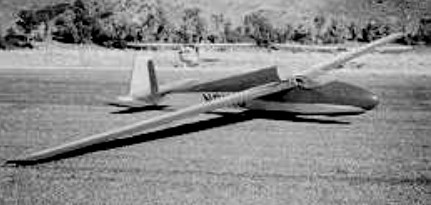
The Ha-S-3, designed by Bruno Haufe, which first flew in 1971, is a development of the HA-S-2 Hobby, which had wings of shorter span (12.86 m. / 42.2 ft) and cockpit 2 in/ 5 cm narrower. It has a fixed main gear, with approach control by spoilers.

Wing span: 13.1m / 43ft
Wing area: 10.41sq.m / 112sq.ft
Empty Weight: 187kg / 412lb
Payload: 85kg / 188lb
Gross Weight: 272kg / 600lb
Wing Load: 26.13kg/sq.m / 5.36lb/sq.ft
L/DMax: 28 85 kph / 46 kt / 53 mph
MinSink: 0.89 m/s / 2.92 fps / 1.73 kt
Airfoil: Clark Y
Aspect ratio: 15.9
Seats: 1
No. Built: 1

Haufe Dale Hawk 2

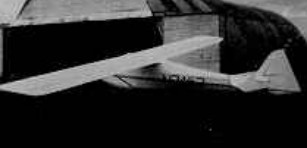
Designed by Leland Hanselman and Walter Haufe, the wood and fabric Hawk first flew in 1939, making a 9:50 hr. flight in 1940. After storage during World War II it was rebuilt and continued to fly until donated in 1969 to the Experimental Aircraft Association Museum. No spoilers.

Wing span: 12.19m / 40ft
Wing area: 13sq.m / 140sq.ft
Empty Weight: 136kg / 300lb
Payload: 86kg / 190lb
Gross Weight: 222kg / 490lb
Wing Load: 17.08kg/sq.m / 3.5lb/sq.ft
MinSink: 0.91 m/s / 3.0 fps / 1.78kt
Airfoil: USA 35A
Aspect ratio: 12.5
Seats: 1
Built: 1

Haufe Buzzer 2

A development of an earlier Nelson powered motor glider, the Buzzer 2’s propeller is driven through a 2:1 reduction chain, running enclosed in oil, which brings propeller rpm down to 3,000. Designed by Walter Haufe for self launching, it features a single centerline fixed wheel and small wing outrigger wheels for taxiing, with a steel tube fuselage and tail, single-spar, single-strut wood wing, and fabric cover.

Engine: Curtiss snowmobile 2-cycle
Wing span: 10.36m / 34ft
Wing area: 11.52sq.m / 124sq.ft
Empty Weight: 177kg / 390lb
Payload: 95kg / 210lb
Gross Weight: 272kg / 600lb
Wing Load: 23.61kg/sq.m / 4.8lb/sq.ft
Water Ballast: 0
Aspect ratio: 8
Seats: 1
Airfoil: NACA 2412 modified
No. Built: 1

Haufe Hawk

Designed and built by Walter Haufe, of Neenah, Wisconsin, this single-seater high wing motor glider is powered by a 40hp Nelson H-59 four-cylinder horizontally-opposed engine mounted in the nose. The engine, when stopped for soaring flight, swings back through 80° inside its cowling so that the two-blade fixed-pitch propeller, also designed and built by Mr Haufe, is stopped in the vertical position and lies flat along the top of the cowling to minimise drag. The cooling air intakes for the cylinders are open when the engine is running but are closed when the engine is stopped. The cantilever wooden wing is of semi-elliptical planform with upturned tips, the fuselage is a fabric covered steel tube structure and the tail unit is wooden with fabric covering. Landing gear consists of a fixed monowheel and a tailskid, plus an unusual skid with small balancer wheel just behind the engine cowling to prevent the prop from touching the ground. The pilot sits under a removable cockpit canopy set into the wing leading edge. The Hawk prototype, N1051Z, made its first flight in 1962.

Span: 40 ft 6 in
Length: 22 ft 6 in
Empty weight: 462 lb
Max speed: 40 mph
Min sinking speed: 3.0 ft/sec
Rate of climb: 500 ft/min

Hatfield Man-Powered Aircraft Club MPA / Puffin

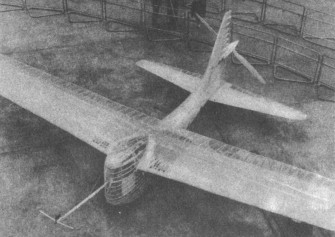
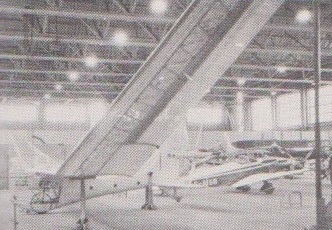
Built specially to compete for the Kremer prize of £5,000 for man-powered flight. A single seat, fixed wing monoplane with the propellor driven by pedalling. Employees of the de Havilland Aircraft Company’s Puffin flew in November 1961 from Hatfield aerodrome. Puffin was with transparent Melinex covering and extreme dihedral on its 25.6 m (84 ft) wings. Its pilot, Jim Phillips, by the end of the year had flown the craft up to 686 m (750 ft) and made turns through 8o degrees. On 4 May 1962 Hatfield Man Powered Aircraft Club chairman John Wimpenny flew the Puffin 908 m (993 yards). He was awarded a £50 prize for his record 805 m (880 yard) flight.

Construction was metal tube with balsa for the non-load carrying areas with Mellinex covering. A single main wheel undercarriage with a jockey wheel at the tail were fitted.

It crashed after ninety flights at Hatfield in April 1964 and was rebuilt as the Puffin II.

The Puffin II was an entirely new design wing of greater span and having a different Airfoil section. It flew for about another ninety flights at Hatfield until it collided with some ground equipment there in 1969 and was wrecked.

Liverpool University MPAG bought the remains and they were used in their ‘Liverpuffin’.

Puffin I
Wingspan: 84.00 ft
Wing area: 380 sq.ft
Aspect ratio: 21:1
Empty weight: 140 lb

Puffin II
Wingspan: 93.00 ft
Wing area: 390 sq.ft
Aspect ratio: 22:1
Empty weight: 140 lb