The Helvellyn was a one-off light aircraft, designed by Norman Sykes. Registered G-AFKT, the open cockpit, tandem, two seater, low wing monoplane was built and flown in 1939.
Author: Terry
Hillson Pennine
The Pennine was a one-off light aircraft, designed by Norman Sykes. A two seat, side by side, high wing monoplane, registered G-AFBX but not flown before the outbreak of war.
Hills & Sons / Hillson
UK
F.Hills & Sons Ltd was formed by Francis Hills in 1849 as a one-man joinery company in Yarm on Tees. Cooper and Walter Hills (grandsons of Francis) took over in 1907, and during the First World War, the company made ammunition boxes and joinery for the Forces. In 1921, Hills became a limited company, and in 1923, moved to larger premises in Stocton. The company began making aeroplanes after Managing Director W.R.Chown, who was interested in aircraft development, visited Prague, Czechoslovakia to obtain a license to produce the Praga E.114 Air Baby two-seat lightplane. Thirty were manufactured from 1936, known as Hillson Pragas. Following this, he purchased the old Ford Motor Company premisis in Trafford Park, Manchester, for joinery and aircraft production.
The first aircraft built by Hills was a Pou du Ciel, an HM.14 Flying Flea. The aircraft was registered G-ADOU in October 1935, and test flown at Barton Aerodrome.
The first licence-built Praga E.114 was sold to Australia, and the second registered G-AEEU became the company’s demonstrator in April 1936. Total production by Hills amounted to twenty-eight aircraft, plus seven uncompleted.
There followed two-one-off Hillson light aircraft, both designed by Norman ykes: the Pennine, a two seat, side by side, high wing monoplane, registered G-AFBX but not flown before the outbreak of war; the Helvellyn G-AFKT, an open cockpit, tandem, two seater, low wing monoplane was built and flown in 1939.
During 1938-39, Hills built Anson wings and laminated spars for Airspeed Oxfords. During the war, the company produced no less than 480.000 JABLO propeller blades and 10 million square feet of aeronautical plywood for Mosquito and other aircraft.
In addition the company produced more than 800 Percival Proctors and the slip-wing Hawker Hurricane I, after first buillding and testing a research aircraft called the Hillson Bi-mono. An expendable slip-wing was mounted above the fuselage in order to obtain more lift for operating out of small fields and to enable the aircraft to take off at greater than normal gross weight. Once airborne, the wing could be released by the pilot.
Hillside Sunseeker
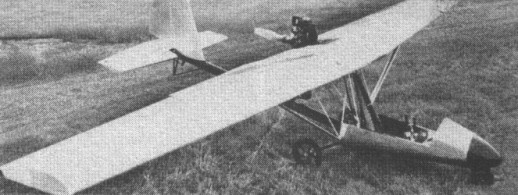
High monowing, strut-braced, Kevlar/foam construction. Full three-axis control system. Powered by a WAE two-cylinder horizontally opposed British microlight engine. The landing gear was Chrome-moly steel, trike type.
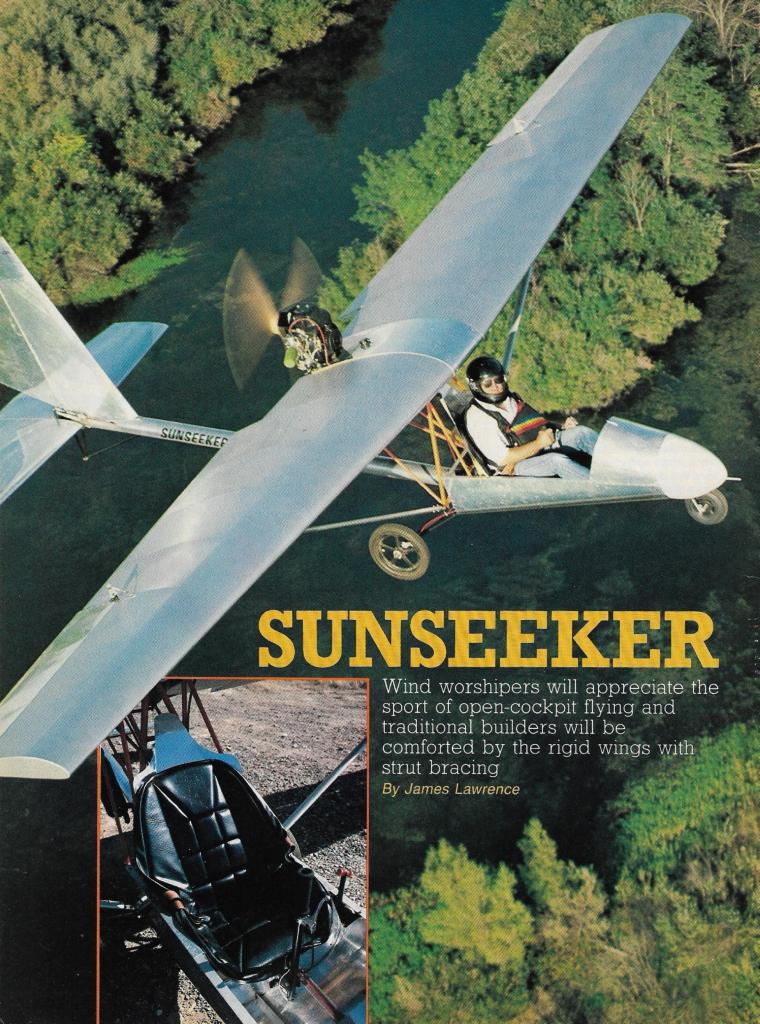
After spending something like $200k developing the aircraft and all the tooling, the original designers found they couldn’t obtain product liability insurance and they decided to sell the project to someone who was going to manufacture it in Mexico. That never came to.
Only 10 came out of the factory.
Engine: WAE 2 cyl, 30 hp
Wingspan 31 ft
Wing area 112 sq.ft
Length 18 ft
Empty weight 245 lb
Payload 245 lb
Gross 600 lb
Wing loading 4 lbs/sq.ft
L/D 22:1
Cruise speed 60 mph
Stall speed 19 mph
Vmax 63 mph
Climb rate 1000 fpm
Takeoff run 150-200 ft
Landing roll 150-200 ft
Fuel capacity 5 USG
Hillside Aviation
1983: 2600 Gold St., Redding, CA 96001, USA.
UL builder
Hillman 360
Hillman Helicopter designed Model 360 as three-seat utility helicopter of very modern design which first flew 1981.
Hillman Hornet
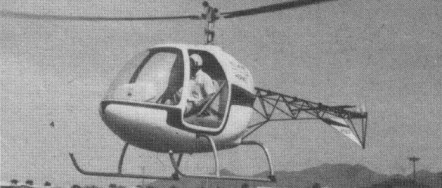
The Hillman Hornet, first flown in 1978, was top rotorcraft award winner at Oshkosh ‘78 and received the Best Helicopter Design honors at the Popular Rotor-craft Convention in Rockford, Illinois. Developed in 1979, in 1980 a Turbo Hornet was in production. Standard features include a comfortable cockpit for two, excellent visibility, room for a variety of avionics and dual controls. Flight performance has been favorably compared with that of the Hughes 300. The Hornet is available in kit form for owner assembly for $29,950 under one of several factory-supervised programs. Assembly assistance is available at the factory in addition to flight training. Optional features now under development are floats, cargo hook, fibreglass tailboom shroud, doors and turbo-charging.
Gross Wt. 1400 lb.
Empty Wt. 800 lb
Fuel capacity 22 USG
Rotor span 25 ft 5 in
Length 21 ft 2 in
Engine 150-hp Lycoming
Top speed 100 mph.
Cruise 90 mph.
Climb rate 1000 fpm.
Ceiling 12,000 ft
Range 200 miles
Hillman WankelBee
Douglas Hillman developed WankelBee helicopter with rotary combustion engine (first flown 1975).
Hillman
After Douglas Hillman developed WankelBee helicopter with rotary combustion engine (first flown 1975) and two-seat Hornet (first flown 1978).
1980: Hillman Helicopters Inc., Box 1411, Scottsdale, AZ 85252, USA.
Hillman Helicopter designed Model 360 as three-seat utility helicopter of very modern design which first flew 1981.
Hiller Engines
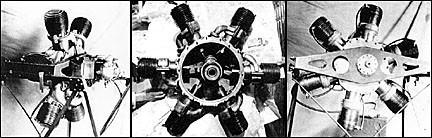
Stanley V Hiller of Alameda CA., USA, built a number of engines during 1910 to 1913.
1910 = unknown type.
1911 = 30hp 6RA rotary, two-cycle.
1912 = 60hp 6RA rotary; built by C E Kelsey, San Francisco.
1913 = 90hp unknown type.

