It took George Grover some fifteen years of continual agitation before he finally persuaded the War Office to carry out trials with free and tethered observation balloons, but in 1878 such a series of tests was carried out at Woolwich Arsenal, introducing aeronautics for the first time to the British Army. These experiments resulted in the first ever Air Estimate, when the War Office voted £150 to build a balloon designed by Captain J.L.B. Templer of the 2nd Middlesex Militia. In fact, the Pioneer, as this craft was titled, cost only £71, and made its first, successful, ascent on August 23rd, 1878. Templer was promptly, though unofficially, designated as instructor to the Corps of Royal Engineers in the art of ballooning, which duty he carried out with Pioneer and another balloon of his own, the Crusader.
Author: Terry
H.M. Balloon Factory Pioneer
It took George Grover some fifteen years of continual agitation before he finally persuaded the War Office to carry out trials with free and tethered observation balloons, but in 1878 such a series of tests was carried out at Woolwich Arsenal, introducing aeronautics for the first time to the British Army. These experiments resulted in the first ever Air Estimate, when the War Office voted £150 to build a balloon designed by Captain J.L.B. Templer of the 2nd Middlesex Militia. In fact, the Pioneer, as this craft was aptly titled, cost only £71, and made its first, successful, ascent on August 23rd, 1878. Templer was promptly, though unofficially, designated as instructor to the Corps of Royal Engineers in the art of ballooning, which duty he carried out with Pioneer and another balloon of his own, the Crusader.
H.M. Balloon Factory
It was in the early 1860s that a Royal Engineer officer, Lieutenant George Edward Grover, first began to investigate the use of balloons for military purposes. It took Grover some fifteen years before he persuaded the War Office to carry out trials with free and tethered observation balloons, but in 1878 such a series of tests was carried out at Woolwich Arsenal, introducing aeronautics for the first time to the British Army. These experiments resulted in the first ever Air Estimate, when the War Office voted £150 to build a balloon designed by Captain J.L.B. Templer of the 2nd Middlesex Militia; the Pioneer.
Templer was, though unofficially, designated as instructor to the Corps of Royal Engineers in the art of ballooning, which duty he carried out with Pioneer and another balloon of his own. At Woolwich, a Balloon Equipment Store was set up under Captain R. P. Lee, R.E., beginning the RAF.
From these foundations there was formed, in 1890, a Balloon Section of the R.Es., now trans¬ferred to new quarters at Aldershot; the Air Estimate had risen from the initial £150 to a figure of £4,300; and Major Templer was now ‘Officer in Charge of Balloons’. In 1894, when the establishment’s title was once again changed, he became the Balloon Factory’s first superintendent. The Superintendent of the Balloon Factory at Aldershot, Lt. Col. J. L. B. Templer, went to Paris to find out all about Santos Dumont’s airships. On his return, he extracted £6,000 from the Treasury to conduct, similar experiments in Britain. This covered the cost of the envelopes for two airships, but no engines, so work came to a temporary halt in 1904.
The outbreak of the Boer War in 1899 meant considerably increased production at the Factory.
The Man lifting Kite Section had been formed in 1894 under Capt. B. F. S. Baden Powell, but it did not come into prominence until 1906, when “Colonel” S. F. Cody was appointed Chief Instructor in Kiting. Until his death in an aircraft accident seven years later, this colourful figure with the goatee beard, and long hair sprouting from under an enormous Stetson hat, remained a dominant figure in British aviation, combining rare skill and courage with a flair for showmanship that was displayed not only in his personal appearance but in stunts such as crossing the’ Channel in a small boat towed by several of his kites. Although unrelated, he traded on the publicity value 6f his famous namesake and fellow American, Col. “Buffalo Bill” Cody, and was to be seen astride a richly saddled white horse almost as often as on the pilot’s seat of an aircraft.
In 1905 the Balloon Factory, together with the Balloon Section, R.E., was moved to South Farnborough
In April 1911 the Factory changed its title again it was now the Army Aircraft Factory, a shift of emphasis reflected in the year’s Air Estimate of £85,000 for dirigibles and aeroplanes and the R.E. Balloon Section closed down.
On April 11, 1912, the Army Aircraft Factory became the Royal Aircraft Factory.
HL Albatron SX

The tube and fabric two seat Albatros SX could be had with Rotax 582, Rotax 912 or Hirth F 30 engines.
Albatron SX
Engine: Rotax 582 , 64 hp
Wing span: 9.20 m
Wing area: 11 sq.m
MAUW: 450 kg
Empty weight: 255 kg
Fuel capacity: 55 lt
Max speed: 145 kph
Cruise speed: 140 kph
Minimum speed: 65 kph
Climb rate: 4 m/s
Fuel consumption: 12 lt/hr
Certification: VZ
Seats: 2
Price (1998): 54 650 DM vati
HL Flugzeugtechnik
1998:
Am Mühlenberg 29
D-49770 Herzlohe
Germany
UL builder
HKS 700
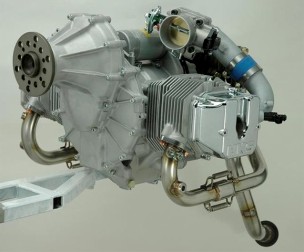
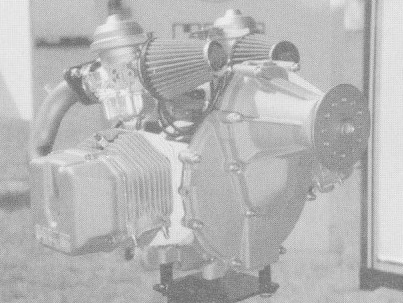
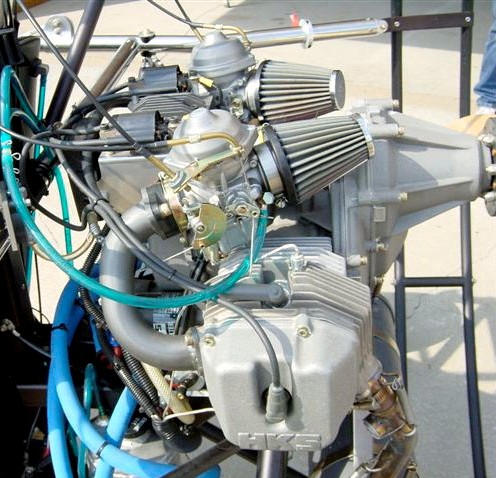
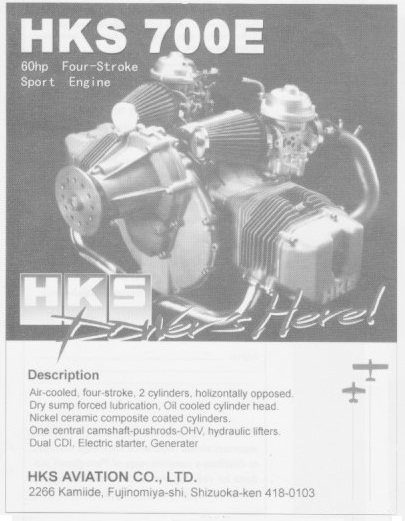
The HKS 700E is a twin-cylinder, horizontally opposed, four stroke, carburetted aircraft engine, designed for use on ultralight aircraft, powered parachutes and ultralight trikes. The engine is manufactured by HKS, a Japanese company noted for its automotive racing engines.
The HKS 700E has dual capacitor discharge ignition, dual carburetors and electric start. The engine is mainly air-cooled, but with oil-cooled cylinder heads. The OHV pushrod engine has four valves per cylinder, and nickel-ceramic coated cylinder bores. Lubrication is dry sump, with a trochoid pump.
The reduction drive is a choice of two integral gearboxes: the A-type gearbox has a 2.58:1 ratio and can accommodate propellers of up to 4,000 kg/sq.cm inertial load; the B-type gearbox has a 3.47:1 ratio and can accommodate propellers of up to 6,000 kg/sq.cm.
The 700E burns 9 L (2.4 US gal) per hour in cruise flight at 4,750 rpm. The recommended time between overhauls is 800 hours, although this is expected to be increased as experience is gained.
Producing 60 hp (45 kW) at 6,200 rpm for three minutes for take-off and 56 hp (42 kW) at 5,800 rpm continuously, the 700E was designed as a fuel efficient four stroke alternative to the high fuel consumption two stroke engines, such as the Rotax 582.
The company’s owner’s manual disclaimer states:
WARNING! This is a non-certified aircraft engine, the possibility of engine failure exists at all times. Do not operate this engine over densely populated areas. Do not operate this engine over terrain where a safe, power off landing cannot be performed. The operating and maintenance instructions supplied with this engine must be followed at all times. Flying any aircraft involves the risk of injury or death, building and maintaining your own aircraft requires great personal responsibility.
Variants:
700E
Initial version, normally aspirated and producing 60 hp (45 kW) at 6200 rpm for three minutes for take-off and 56 hp (42 kW) at 5800 rpm continuously.
700T
Turbocharged version with a 62.5 mm (2.5 in) stroke and a compression ratio of 8.8:1, that produces 80 hp (60 kW) at 5300 rpm for three minutes for take-off and 77 hp (57 kW) at 4900 rpm continuously. The engine’s dry weight is 57.5 kg (127 lb) equipped with electrical system, electric starter, fuel injectors, gearbox, exhaust system and turbocharger. The initial time between overhauls is recommended as 500 hours, but this is expected to rise with operational experience.
Applications:
Aeroalcool Quasar
Aeros del Sur Manta
Aéro Services Guépard Guépe
Air Creation Skypper
Air Creation Trek
Airsport Sonet
Antares MA-33
Aviation Products Star Trike
BAaer Guri
BB Microlight BB-two seater
Bede BD-6
Bede BD-17 Nugget
ASAP Chinook Plus 2
Capella T-Raptor
CGS Hawk
Club ULM Rotor Ptenets-2
Cyclone AX2000
DTA Combo
Earthstar Thunder Gull
Excalibur Aircraft Excalibur
Fletcher Hercules
Flightstar II
Flying K Sky Raider
Flying Machines FM301
Harmening High Flyer
Green Sky Adventures Micro Mong
Hy-Tek Hurricane Hauler
Murphy JDM-8
Murphy Maverick
North Wing Sport X2
Phoenix Air Phoenix
Quad City Challenger
RagWing RW22 Tiger Moth
Rainbow Aerotrike
SlipStream Ultra Sport
Solo Wings Aquilla
Sport Flight Talon
Stellar Astra
Summit Steel Breeze
TechProAviation Merlin 100
Titan Tornado
Specifications:
700E
Type: Two cylinder, four-stroke aircraft engine
Bore: 85 mm (3.3 in)
Stroke: 60 mm (2.4 in)
Displacement: 680 cc (41.49 cu in)
Dry weight: 55 kg (121 lb) equipped with electrical system, electric starter, carburetors, gearbox, exhaust system, oil tank and cooler
Valvetrain: two intake and two exhaust valves per cylinder
Fuel type: unleaded auto fuel
Oil system: dry sump with a trochoid pump
Cooling system: free air cylinders, with oil-cooled cylinder heads
Reduction gear: A-type gearbox with 2.58:1 ratio, limit of 4,000kg/sq.cm inertial load. The B-type gearbox with 3.47:1 ratio, limit of 6,000kg/sq.cm inertial load
Power output: 60 hp (45 kW) at 6200 rpm for three minutes for take-off and 56 hp (42 kW) at 5800 rpm continuous
Compression ratio: 11.3:1
Max torque: 7 kgm at 5800 rpm
Price 1998: $6200
700T
80 HP
Turbo Charged
Intercooled
Elec Fuel Injection
Sea Level Performance at 15,000 ft
Turbo Charged, Electronic Fuel Injection
2 Cylinders 4-Stroke Engine With Horizontally Opposed Cylinders 4 Valves per Cylinder Turbocharger with Intercooler
Bore X Stroke: 85mm x 62.5 mm
Compression Ratio: 8.8 : 1
Power Output: 77hp (57.4kw) at 4900rpm (continuous)
80hp (59.7kw) at 5300rpm (3min./Take off)
Maximum Torque: 79.6 ft lb at 4600 – 5200 rpm
Maximum RPM: 5300
TBO: 500 hours
Reduction Gear: Designation C-type 2.62:1
Engine Weight (Dry, with Electric Starter, Fuel line with Injector, Exhaust Manifold, Intake Manifold, turbocharger, and Gearbox): 126.8 lbs 57.5 kg (57.5 kg)
HKS
HKS Co., Ltd. (株式会社エッチ・ケー・エス Kabushiki-gaisha Ecchi Kē Esu) was formed in 1973 by Hiroyuki Hasegawa, a former engineer for Yamaha Motor Company, and his partner Goichi Kitagawa, while the start up capital was supplied by Sigma Automotive (hence the name HKS). The company began operations by tuning gasoline-powered engines in a dairy-farming shed at the foot of Mount Fuji in Japan. Their goal was to design and build high performance engines and components that major OE (original equipment) manufacturers could not or would not produce. In July 1974, Hasegawa engineered and built the first commercialized turbocharger kit for passenger automobiles; since then developing turbocharger upgrades and bolt-on turbocharger kits that subsequently became the core business of HKS. Hasegawa also created the first commercially available electronic turbo timer and boost controller.
HKS is a publicly traded company with an international sales and distribution network spanning Asia, Europe, Australia and the Americas to support its customer base. The main manufacturing and R&D facility is at the foot of Mount Fuji. Subsidiary companies have been established in California (HKS USA), Cambridgeshire, England (HKS Europe), and Bangkok, Thailand (HKS Thailand). HKS USA, established in 1982, shut down operations in 2011 electing instead to use wholesale distributors to handle their supply chain in the USA. Motovicity Distribution was selected as the North American warehouse for HKS where a full inventory of products is maintained for HKS’ North American customers.
The company also produces the HKS 700E aircraft engine, under its subsidiary, HKS Aviation. And also produced a 600cc Speedway cycle engine.
1998:
226 Kamijde Fujinomiya-shi
418-0103 Shizuoka-ken
Japan
HK Aircraft Wega 100
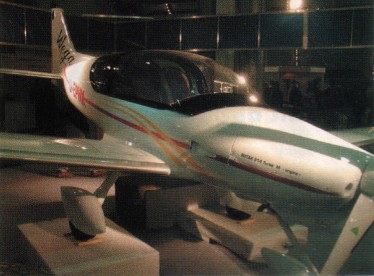
The HK Aircraft Wega 100 was being certified to the European JAR/VLA standards in 2001.
HK Aircraft Technology AG IOG
Germany
Offered the Wega two-seat and composites constructed very light aircraft, promoted by the European Union and the Bavarian Ministry of Economics, Transport and Technology.
Hiscox Dunstable Devil / Hyper-Hols
The Dunstable Devil, also known as the Hyper-Hols, was a modified Hors-der-Teufel built by D.G.Hiscox and first flown on 19 August 1934.
It featured a streamlined fuselage nacelle, strutted rear fuselage, and twin fins and rudders.
Only one glider was so modified. C of A BGA.238 was issued in November 1935.

