In 1972 at the request of a group of students from the institute and under the direction of the head of the aeronautical construction laboratory A. Barannikov, within the structure of OSKB JAI, the Aviation Construction Club (KAK) was created.
The SKB students wanted to fly, but according to the institute’s rules this was impossible. There was no model whose piloting was simple enough to allow them to use it. For that reason it was decided to test the construction of such an airplane. By that time the simple Oshkinis BRO-11 glider had spread and was flying successfully throughout the USSR, so the students decided to copy it.
The BRO-11 Pioner was designed by BI Oshkinis in 1954 and built at the Kaunas Glider Station. The technical documentation for its series production and static tests were developed at the Moscow Aviation Institute. It was a cheap glider, capable of being built in any workshop from the plans published in the technical literature and the press.
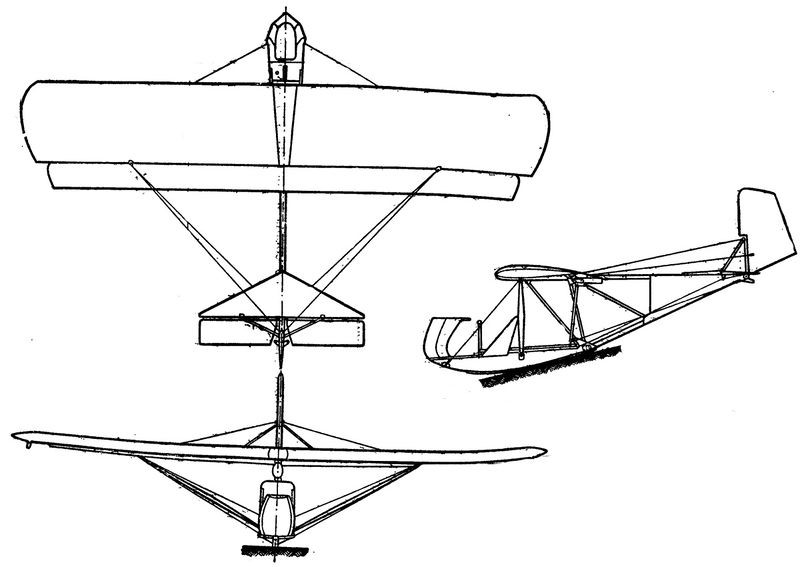
The JAI-28 glider was designed as a high-wing monoplane braced by two uprights. It used hanging ailerons, occupying practically the entire wingspan and with a kinematic link with the elevator.
The construction was basically of wood, with some use of metal joints and components. All the elements, with the exception of the ash tail skate, were made with aviation pine wood. The covering was three-layer plywood.
The metal details were made with brand 25 steel sheet and brand 20A steel tubes. D16 duralumin was used for the washers, trim strips, rudders, ailerons and other components.
As in the BRO-11 the fuselage does not exist, Instead a piece is implemented to which the wing, ailerons, tail unit, floor, foredeck, seat, pedals, lever and the landing skid.
The wing is made up of two sections and is attached to the central bar at three points. The ailerons are hung under the wing and are fixed by two points, occupying almost the entire span.
The tail was of the conventional type and featured a simplified construction. The horizontal plane consisted of the stabilizer and two halves of the elevator. The vertical plane featured an empennage and rudder. The keel was braced to the outrigger by two struts.
The stabilizer had a triangular shape in the plane and in its structure it had a spar, seven ribs and a front rib.
The first BRO-DPK glider, later named JAI-28 (Russian: ХАИ-28 (БРО-ДПК)), was designed and built by a group of students, among which were V. Silyukov, S. Alexandrov, N. Lavrov and V. Byzov. The screening was finished in 1973.
The first JAI-28 glider was built in 1974 and on June 17, 1975 it made its first flight with A. Barannikov at the controls.
The students soon learned to fly on it from small hills. The launch of the glider was carried out by means of a rubber band of about 30 meters. At one end there was a ring to fix the glider. The other end was divided into two points of about 5 meters. This end was tensioned for the glider to take off. Take-off could also be done by dragging, using a rope.
Thanks to its low weight, the glider could also be used for ground control training.
In total, three copies of the JAI-28 were built, in which 75 pilots received their initial training.
The JAI-28 would be used as the basis for developing the JAI-29 “Korshun” motor glider.
JAI-28
Wingspan: 8. 8 m
Wing area: 12.2 m²
Aspect ratio: 6.8
Empty weight: 58 kg
Normal flight weight: 118 kg
Payload: 70 kg
Maximum payload: 85 kg (with installation of tail weights)
Glide ratio: 12.5
Minimum descent: 1.1 m / s
Landing speed: 30 km / h
Stabilizer surface: 0.78 m²
Elevator area: 0.65 m²
Empennage surface: 0.5 m²
Rudder surface area: 071 m²
Accommodation: 1